Sweet Love Quotes
100 Short Love Messages for Quick Handwritten Notes
100 short love messages for handwritten notes, sorted by time of day, plus where to leave each one and a three-step way to write your own.
Updated
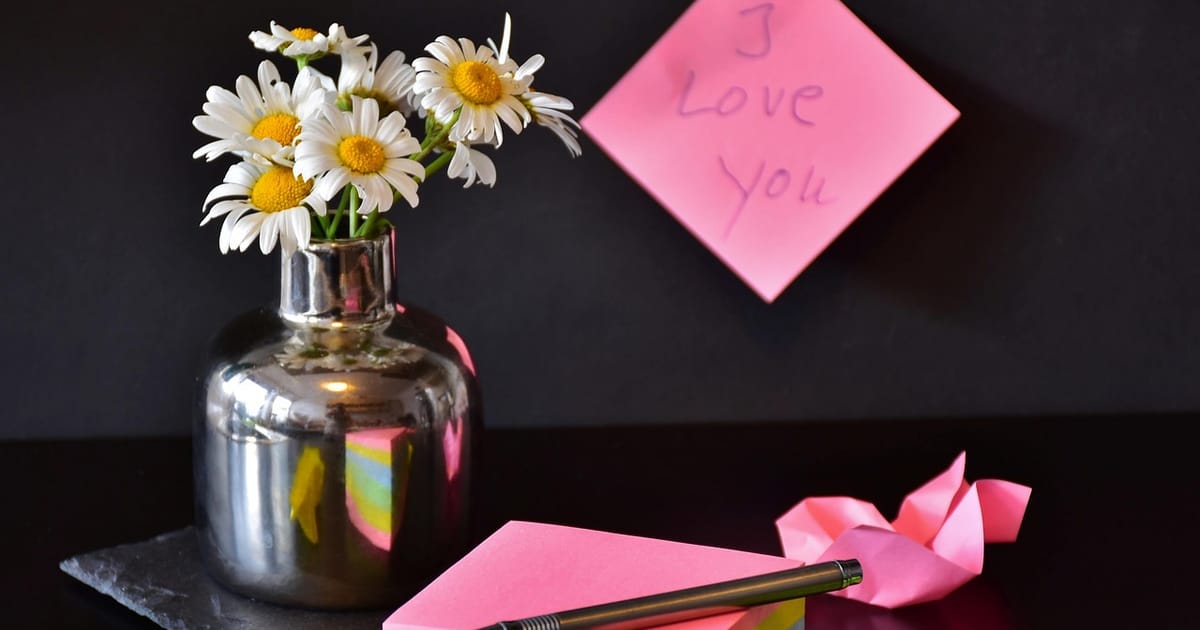
The most anthologized kitchen-table note in English is twenty-eight words long. William Carlos Williams published "This Is Just to Say" in 1934, and it reads like something stuck to a refrigerator door: an apology for eating the plums that were being saved for breakfast. Nobody would call it a love letter, yet it does everything a good short note should do. It is specific, it is honest about something small, and it assumes a reader who knows the writer well enough to smile.
That is the standard for this page. The 100 messages below were written by our editors to be copied, adapted or used as a starting point. They are not quotations, so you don't need to credit anyone; sign them with your own name. Where we quote real people, it is in the short boxed passages, each with its source. If you want something longer than a sticky note, our guide on how to write a love letter covers the full-page version.
Where to Leave Each Kind of Note
A short note is mostly about timing and placement. The same eight words read differently on a pillow and on a car windshield, so it helps to decide where the note will be found before you decide what it says.
| Where it is found | When it is read | Best length | Tone that works | Start with |
|---|---|---|---|---|
| Beside the coffee maker or kettle | First minutes of the day | One line | Warm, encouraging | Morning notes 1–20 |
| Lunch bag, laptop bag, coat pocket | Midday, often among colleagues | Under 10 words | Private but not too intimate | Midday notes 21–40 |
| Steering wheel or bike seat | Before a commute | 3–6 words | Upbeat, nothing that needs a reply | Notes 12, 17, 20, 26 |
| Pillow or nightstand | Late evening | One or two lines | Quiet, reassuring | Evening notes 41–60 |
| Bathroom mirror (dry-erase marker) | Any time, often twice | Very short | Playful | Humor notes 61–80 |
| Inside a book they are reading, or a suitcase | Days or weeks later | Two or three lines | Reflective | Companionship notes 81–100 |
A practical rule: the less private the place, the less private the wording. A lunch bag may be opened in front of coworkers, so save the bedroom jokes for the nightstand.
Morning Light and Daily Beginnings
Morning notes have one job, which is to make the day start on a good footing. They work best when they are short enough to read with one hand while the other holds a mug, and when they point forward, toward the meeting, the exam or the evening. A note that asks a question ("Did you sleep?") is less useful here than one that simply gives something.
- Waking up next to you is the only motivation I need today.
- Drink this coffee, conquer your meetings, and come back to me.
- The best part of my morning is always you.
- I left early, but my mind is still at home with you.
- You make the early hours entirely bearable.
- Have a beautiful day. I'll be counting the hours.
- Every morning with you feels like a quiet victory.
- I hope your day is as bright as your laugh.
- Good morning to my absolute favorite person.
- I'm already looking forward to tonight.
- You were sleeping so peacefully I didn't want to wake you.
- Take a deep breath today. I'm in your corner.
- My first thought today was how lucky I am.
- I made the coffee just how you like it.
- Whatever happens today, we'll handle it together later.
- You are my favorite reason to lose sleep.
- Go show the world what I already know about you.
- I love you more today than I did yesterday.
- Don't forget how capable you are.
- See you at six. I love you.
If none of these sounds like you, look for the plainest one and add a single detail only the two of you would recognize: the name of the meeting, the dog, the song that was on in the car. Note 20 is the template for this. "See you at six" is a promise, and promises tend to stay with a reader longer than adjectives.
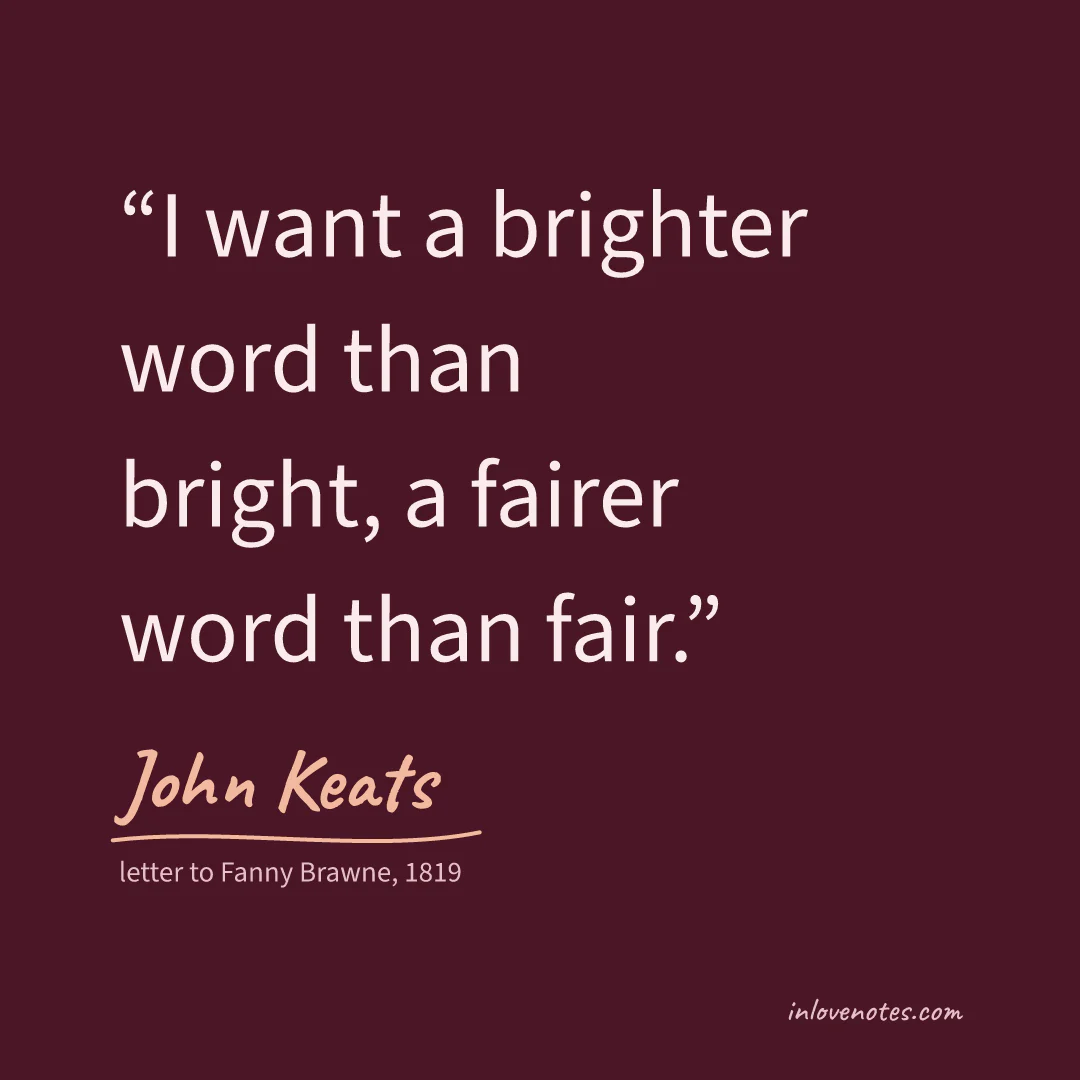
I want a brighter word than bright, a fairer word than fair.
John Keats, letter to Fanny Brawne, Shanklin, postmarked 3 July 1819
This comes from the first of Keats's surviving letters to Fanny Brawne, written on the Isle of Wight in the summer of 1819. In the same letter he wishes they were butterflies who "liv'd but three summer days". Keats was a poet at the height of his powers, and still he complains that ordinary words fall short. It is a useful thing to remember at 7 a.m. with a pen and a receipt: nobody finds the perfect word, and the reach for it is part of what the reader feels.
Midday Anchors in the Chaos
Midday notes are read in the middle of something else, often on a phone between tasks or in a bag at a shared table. Keep them light enough that they can be read in public and short enough that they don't demand an answer. The aim is a small interruption, not a conversation. If the person you are writing to is having a hard week, name the hard thing directly (note 26) rather than pretending it is a normal Tuesday.
- Just stopping by your thoughts to say I love you.
- Halfway through the day, still thinking about you.
- I hope your afternoon is flying by.
- Thinking of your smile while I stare at this spreadsheet.
- Only four more hours until I get to see you.
- You're doing great today. Keep going.
- I just remembered your joke from yesterday and laughed out loud.
- Take a screen break and remember that I adore you.
- I'm so proud of how hard you work.
- Wish we were having lunch together right now.
- You are my favorite distraction.
- Just a quick reminder that you are deeply loved.
- I can't wait to hear about your day.
- Hang in there. The weekend is almost here.
- You are the brightest spot in my day.
- Sending you a little extra energy for the afternoon slump.
- I love the life we're building together.
- You make every ordinary day feel special.
- I'm so lucky to be doing life with you.
- Almost time to go home to my favorite place: you.
Messages 21, 27 and 33 work well as texts too. The rest are better on paper, folded into a lunch box or slipped into a laptop sleeve where they will be found by surprise.
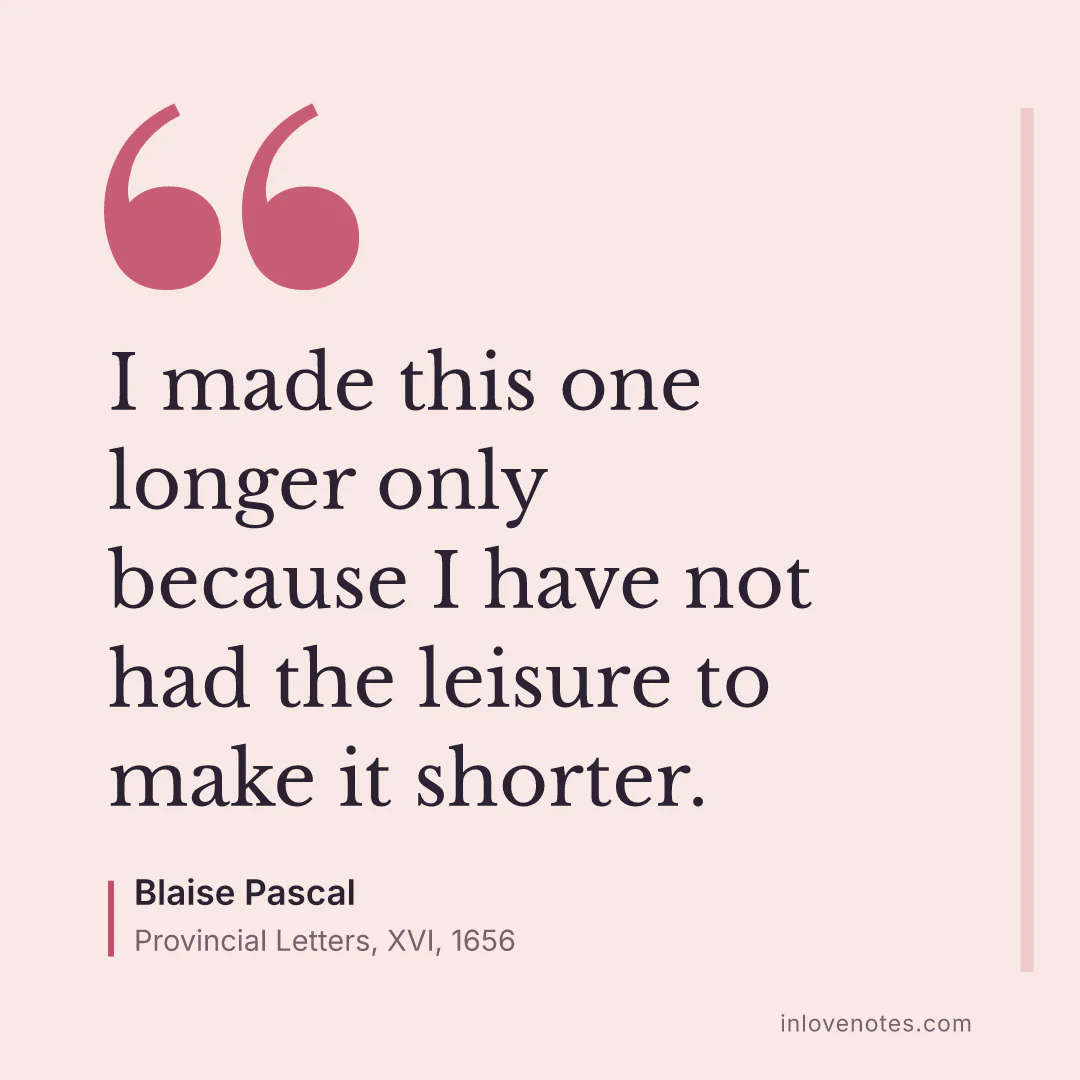
Je n'ai fait celle-ci plus longue que parce que je n'ai pas eu le loisir de la faire plus courte." ("I made this one longer only because I have not had the leisure to make it shorter.")
Blaise Pascal, Provincial Letters, Letter XVI, 4 December 1656
Pascal wrote this as an apology at the end of one of his Provincial Letters, a series of anonymous open letters he published during a theological dispute with the Jesuits. It is often loosely quoted in English as "I would have written a shorter letter, but I did not have the time." The line is also credited to Mark Twain, T. S. Eliot and even Cicero, but Pascal's letter is the earliest documented source. The point holds for love notes: short takes more care, not less. A six-word note that sounds exactly like you is harder to write than a rambling paragraph, and the reader can tell.
Quiet Evening Reassurances
Evening notes close the day. They are read slowly, often in bed, so they can carry a bit more feeling than a morning note. They are especially useful after a rough day or a small argument, when saying the words out loud feels harder than writing them down. Note 43 is the one to reach for after a tense evening. It doesn't ask who was right; it only says you are still a team.
- Thank you for being my safe place today.
- I love ending my day right next to you.
- Whatever went wrong today, we're okay tonight.
- You are the best part of coming home.
- Rest well. I'll be right here.
- I love the quiet moments we share after the world goes dark.
- Thank you for everything you did for us today.
- You make this house feel like a home.
- I could talk to you for hours, but I know you need sleep.
- Every night with you is a good night.
- I'm so glad we found each other.
- You are my favorite way to end the day.
- Sleep well, my love. Tomorrow is a new start.
- I love watching you relax after a long day.
- We make a really great team.
- I'm entirely yours, even in my sleep.
- Thank you for listening to me vent tonight.
- I love the life we've built within these walls.
- You are the last thing on my mind before I sleep.
- Goodnight. I'll love you again tomorrow.
When one of you travels, these same lines work in a suitcase or a toiletry bag, to be found on the first night away. For a set of notes meant to be opened over weeks, see our page on open when letters.
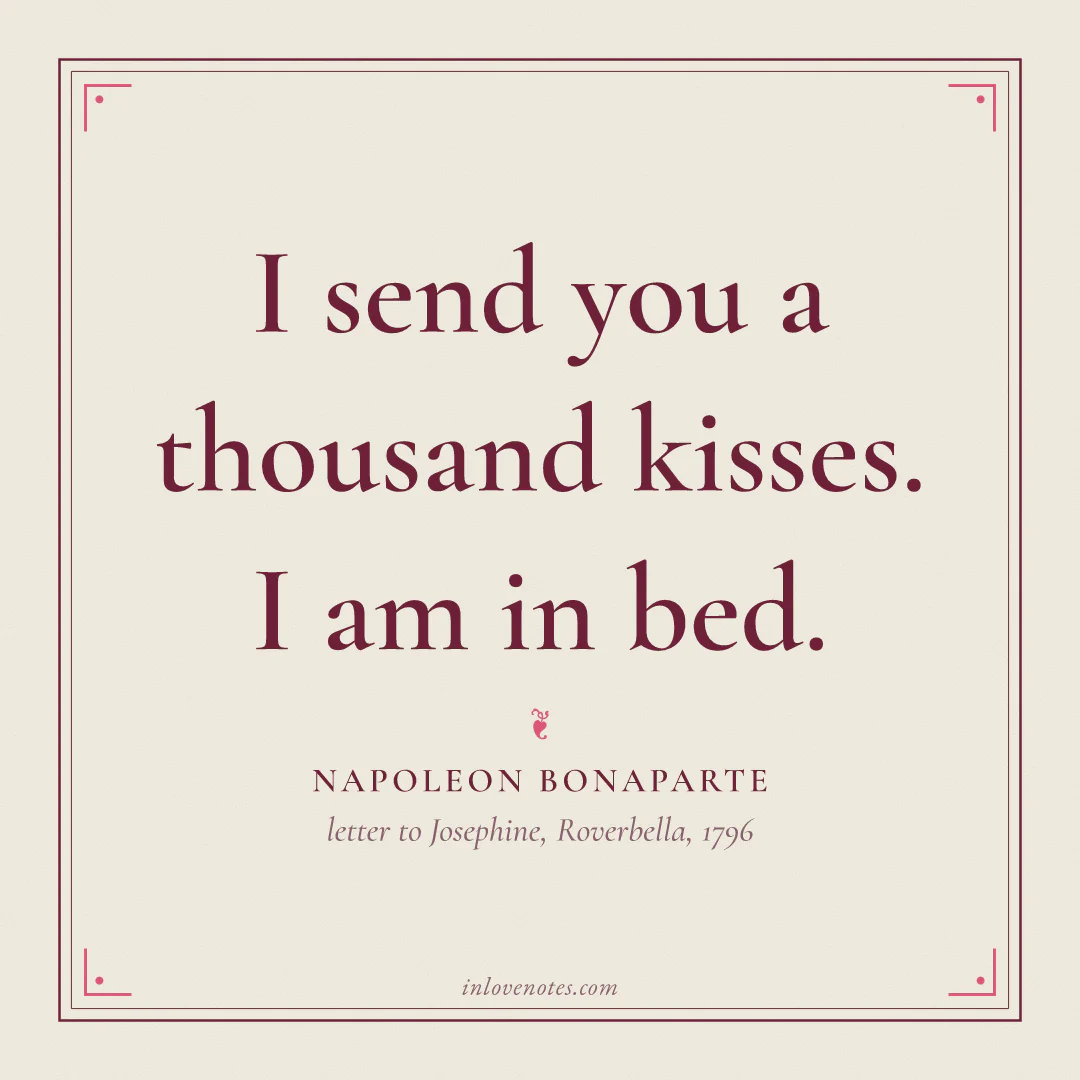
I send you a thousand kisses. I am in bed.
Napoleon Bonaparte, letter to Josephine, Roverbella, 6 July 1796 (trans. Henry Foljambe Hall, 1901)
Napoleon's letters to Josephine are usually remembered for their fever, but this one is almost a sticky note. It was written from Roverbella, near Mantua, during his Italian campaign. It begins "I have beaten the enemy," says he is "tired to death" and thinks he is going to be ill, asks her to come to Verona, and ends with the line above. It is signed simply "Bonaparte." The whole letter is barely fifty words. It is a reminder that the most memorable short notes often say plainly what state the writer is in. Tired, missing you, going to sleep: that is enough.
Humor and the Friction of Proximity
Living with someone means shoes in the hallway, a stolen blanket and an alarm that goes off twice. Funny notes acknowledge those small irritations and choose the person anyway. They land best when the relationship is in a good place. After a real fight, a joke can read as dodging the issue, so use the evening notes above first and save these for an ordinary week.
- I love you more than I love being right, which is saying a lot.
- You are my favorite person to do absolutely nothing with.
- I love you even when you steal the covers.
- You are the only person I'd share my snacks with.
- I love you, but please put your shoes away.
- You are my favorite emergency contact.
- I love you enough to deal with the spider for you.
- We go together like coffee and anxiety.
- I love you even though you take forever to get ready.
- You are the cheese to my macaroni.
- I love you more than I hate your alarm clock.
- You are my favorite person to annoy.
- I plan on bugging you every single day for the rest of your life.
- I love you, even when you're hangry.
- You are the only person I tolerate before coffee.
- I love you more than I love sleeping in.
- We're a mess, but we're a great mess together.
- I love you even when you sing off-key.
- You are my favorite weirdo.
- I love you. Now please take out the trash.
Williams's plum poem belongs here too. Its closing lines, "Forgive me / they were delicious," are a confession and a boast in the same breath, which is exactly the tone of notes 65 and 80. If you have actually eaten the last of something, a note in that spirit is a perfectly good love note. Copy the idea rather than the poem, which is still under copyright. For quotations that do the same job, see our collection of funny love quotes and who really said them.
The Long Arc of Companionship
After years together, notes change. They rely less on big declarations and more on recognition: of time shared, of trouble survived, of habits that have become a private language. These suit anniversaries, birthdays, the night before a hard medical appointment, or no occasion at all. They are also the ones most likely to be kept, so it is worth writing them on something sturdier than a receipt.
- Every year with you is better than the last.
- I would choose you all over again.
- Thank you for growing older with me.
- We have built a beautiful life.
- I love the history we share.
- You are still my favorite adventure.
- Thank you for staying by my side through it all.
- I love who you were, who you are, and who you will be.
- We have weathered every storm together.
- You are my constant in a changing world.
- I'm so proud of the couple we have become.
- Thank you for never giving up on us.
- I love the quiet understanding between us.
- You are my lifelong companion.
- I cherish every memory we have made.
- We are exactly where we are supposed to be.
- Thank you for being my anchor.
- I love the way we navigate life together.
- You are my greatest achievement.
- I will love you until the very end.
For an anniversary, pair one of these with a single dated memory ("Thank you for growing older with me. [The city, the weather, the year you first went there.]") and it becomes a note nobody else could have written. If the note turns into a page, our guide to how to start and end a love letter has openings and sign-offs that suit a longer form.
Writing Your Own in Under a Minute
Borrowed lines are fine, but the notes people keep are usually the ones that could only have come from one person. A simple three-part pattern gets you there quickly:
- One concrete detail. Something from the last day or two: the burnt toast, the interview, the song in the car.
- One feeling, in plain words. "Proud," "lucky," "missed you," "still laughing." Skip intensifiers like "so so so."
- One small promise or pointer forward. "Dinner's on me." "See you at six." "Tell me everything tonight."
Put together: "Saw you practicing your talk at midnight. Proud of you. Tacos after?" That is twelve words and it could not be sent to anyone else. Some practical points:
- Use whatever paper is at hand. A torn envelope signals spontaneity; a small card signals that you planned it. Both work.
- Write the date in a corner if you think it might be kept. Future you will be glad.
- Don't leave three in a day. One note found by surprise does more than a trail of them.
- If your handwriting is hard to read, print in capitals. Legible beats pretty.
What People Usually Get Wrong
Is a short love note enough, or does it look lazy?
A short note looks lazy only when it is generic. "Love you" on a sticky note is fine as a habit, but it fades into the background if it is the same every day. Adding one specific detail, as in the pattern above, is usually all it takes to make a short note feel considered.
Does handwriting matter for a love note?
Neatness matters much less than the fact that it is handwritten at all. Part of the appeal of a paper note is that it can be kept, reread and found again in a coat pocket months later, which rarely happens with a text. If your writing is hard to read, print clearly rather than switching to a phone.
How often should you leave love notes?
There is no rule. Some couples swap a note every morning; others save them for travel, exams or hard weeks. What matters is that the note still feels like a surprise. If notes have become routine, change the place, the time or the length rather than stopping altogether.
Pick one line from this page tonight, change one word so it sounds like you, and leave it where it will be found before you are awake.