Romantic Love Quotes
Deep Love Quotes for Him: 12 Lines From Poems, Plays and Novels, With Sources
12 deep love quotes for him from Juliet, Jane Eyre, Wuthering Heights and Bradstreet, each checked against the original, with the scene and who heard it.
Updated

Heathcliff never hears the famous part. In chapter IX of Wuthering Heights, Catherine Earnshaw explains her feelings to Nelly Dean, the housekeeper, while Heathcliff sits unseen behind the settle. He listens until she says it would degrade her to marry him, then gets up and slips out. So he misses the next sentences: "he's more myself than I am" and "Whatever our souls are made of, his and mine are the same." Two of the most quoted lines a woman ever spoke about a man were said to the wrong person, and he had already left the room.
That happens a lot in literature. Many of the deepest love lines about a man are said about him rather than to him: to a friend, a servant, a rival or a blank page. This page sorts twelve of them by who was listening, because that changes how a line reads in a note to him. Each one has been checked against the original text (Project Gutenberg, Wikisource or the University of Toronto's Representative Poetry Online) and comes with the speaker, the scene and the date. After the quotes there is a table for matching a line to a moment, a short guide to copying one into a card, and a list of popular "deep" lines we checked and left out.
Said Straight to Him
These four are direct declarations. Each speaker is looking at the man she means, or writing to him, so they work as they are, with no reframing.
My bounty is as boundless as the sea, / My love as deep; the more I give to thee, / The more I have, for both are infinite.
Juliet, in William Shakespeare's Romeo and Juliet, Act 2, Scene 2 (first printed 1597)
This comes from the balcony scene, after Romeo has climbed into the Capulet orchard and Juliet has found out he was listening to her. He asks for "Th'exchange of thy love's faithful vow for mine", and she answers that she gave it before he asked and would like to give it again. The line is a small sum that doesn't come out: love is the one thing that grows as you give it away. It has the word "deep" in it, which makes it the most literal answer to the search for a deep love quote for him. Juliet is about thirteen and has known Romeo for a few hours, so the line suits new, overwhelming love better than a silver anniversary.
I would not wish / Any companion in the world but you.
Miranda, in William Shakespeare's The Tempest, Act 3, Scene 1 (written c. 1611; printed in the First Folio, 1623)
Ferdinand has been set to carrying logs by Miranda's father, and she offers to carry them for him. In the same speech she admits she has seen almost no other men, "More that I may call men than you, good friend, / And my dear father", which is half the charm: she has no one to compare him with and doesn't need anyone. Cut to the two lines above, it is one of the plainest declarations in Shakespeare, with no metaphor at all. It fits a note slipped into a lunch bag or a card for no reason as well as a wedding speech.
I have talked, face to face, with what I reverence, with what I delight in,—with an original, a vigorous, an expanded mind. I have known you, Mr. Rochester.
Charlotte Brontë, Jane Eyre, chapter XXIII (1847)
Jane says this in the orchard at Thornfield on midsummer evening, when she believes Rochester is about to marry Blanche Ingram and send her away to Ireland. It comes just before her famous speech ("Do you think, because I am poor, obscure, plain, and little, I am soulless and heartless?"), and Rochester proposes a few minutes later. What makes it deep rather than sweet is what she praises: not his looks or his money, but his mind and the conversations they had. Use it for a man whose way of thinking you love; take out "Mr. Rochester" and the line is ready for a card.
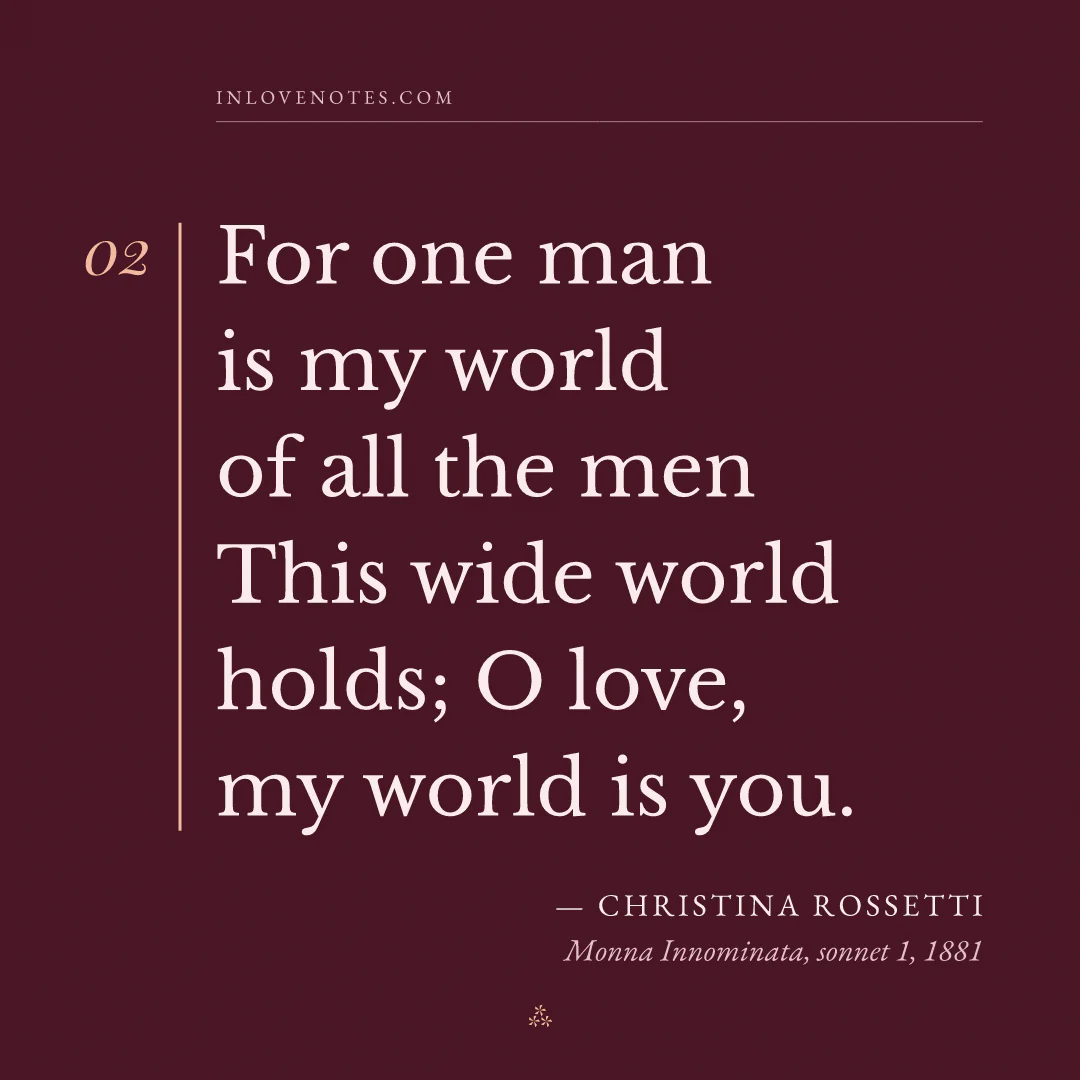
For one man is my world of all the men / This wide world holds; O love, my world is you.
Christina Rossetti, Monna Innominata, sonnet 1, in A Pageant and Other Poems (1881)
Monna Innominata means "unnamed lady". It is a sequence of fourteen sonnets that Rossetti wrote as the replies that the women in Dante's and Petrarch's poems never got to write. This first sonnet opens "Come back to me, who wait and watch for you", and the speaker is counting the days between visits. The couplet above is the turn: there are plenty of men in the world, but only one counts. It suits long distance, a partner who travels for work, or anyone waiting at an arrivals gate. The rest of the sequence gets sadder, so if you quote it, quote this sonnet.
Said About Him, to Someone Else
These two lines were never meant for the man's ears. That is why they feel so honest: nobody is performing. If you send one, you are telling him what you would say about him when he isn't in the room.
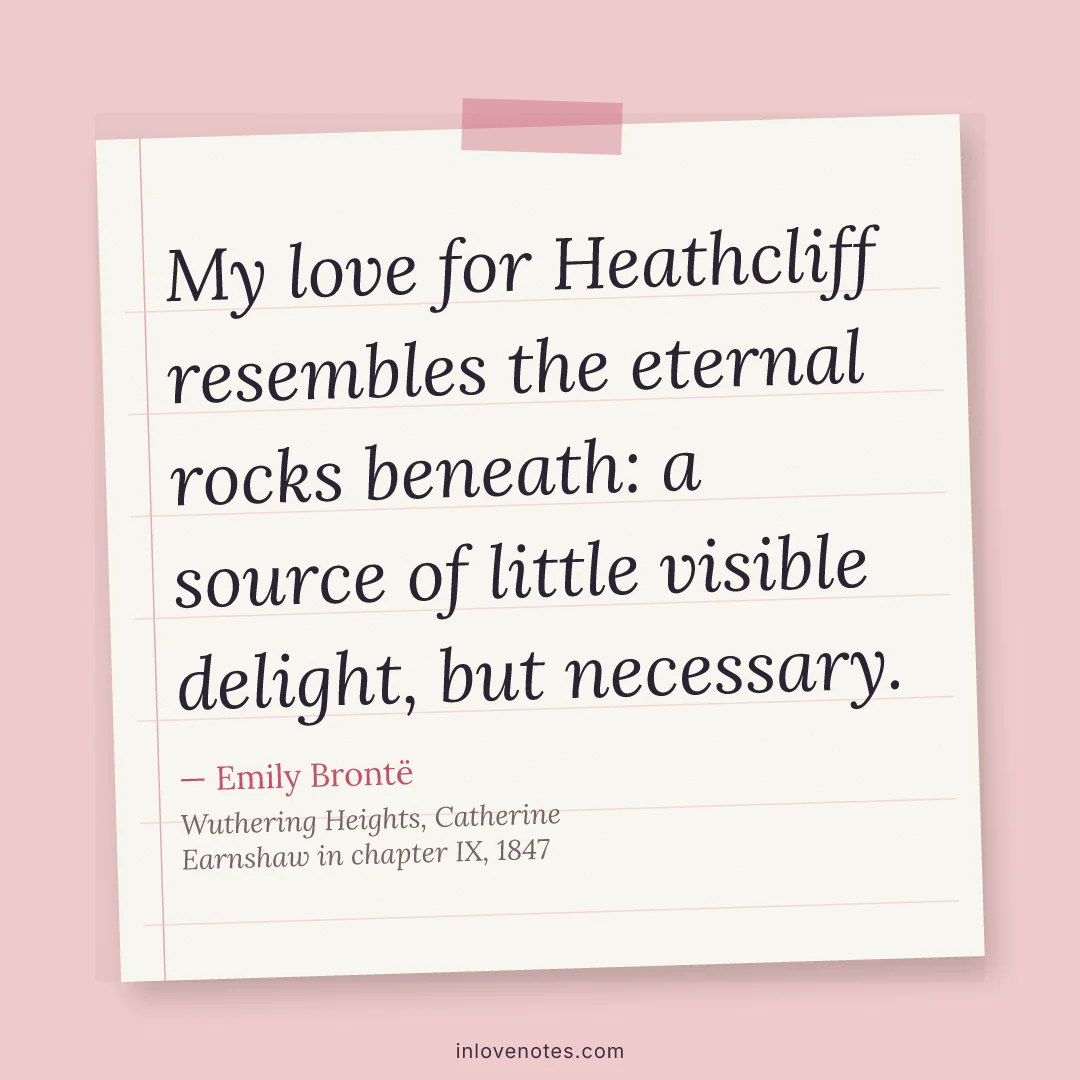
My love for Heathcliff resembles the eternal rocks beneath: a source of little visible delight, but necessary.
Catherine Earnshaw, in Emily Brontë's Wuthering Heights, chapter IX (1847)
This is a few lines after the passage Heathcliff missed. Catherine compares her two loves: her love for Edgar Linton is "like the foliage in the woods", and time will change it "as winter changes the trees"; her love for Heathcliff is the rock underneath. Then she says "Nelly, I am Heathcliff!" It is a strange compliment, because it admits the love is not always pleasant, and that is why it works for a long relationship. "Little visible delight, but necessary" is what long love often feels like on an ordinary Tuesday. Be aware that the novel is far from a model romance; the line stands up better on its own than the relationship does.
All the privilege I claim for my own sex (it is not a very enviable one; you need not covet it), is that of loving longest, when existence or when hope is gone.
Anne Elliot, in Jane Austen's Persuasion, chapter XXIII (1817)
Anne is arguing with Captain Harville in a hotel room in Bath about whether men or women love more faithfully. Captain Wentworth, the man she refused eight years earlier and still loves, is sitting at a desk nearby, apparently writing a letter. He hears every word. Anne never says his name, but the line is about him, and it is the closest she comes to a confession. Austen died in July 1817 and Persuasion came out after her death, so this is one of the last things she wrote about love. It fits a reunion, a second chance, or a card for someone who waited.
For a Husband: Lines About the Long Haul
Search for deep love quotes for him and most results are about falling in love. These four are about staying in it, which makes them better for anniversaries, vow renewals and the card that goes with a 25th-anniversary dinner.
Set me as a seal upon thine heart, as a seal upon thine arm: for love is strong as death ... Many waters cannot quench love, neither can the floods drown it.
Song of Solomon 8:6–7 (King James Version, 1611)
These lines belong to the woman in the Song of Songs and come near the end of the book. A seal was a signet that a person wore on a cord or a ring and used as a signature, so "set me as a seal upon thine heart" means "wear me as your identity". The full verse also says "jealousy is cruel as the grave", which is usually cut, as here, when the passage is read at weddings. The KJV wording is in the public domain in the United States, so you can print it freely. For more scripture on marriage, read in context, see our Bible verses about love and marriage.
If ever two were one, then surely we. / If ever man were lov'd by wife, then thee.
Anne Bradstreet, "To My Dear and Loving Husband", Several Poems, 2nd edition, Boston (1678)
Bradstreet married Simon Bradstreet in England in 1628 and sailed with him to Massachusetts two years later. She wrote this twelve-line poem to him, and it was printed only after her death in 1672. It is one of the earliest love poems written by a woman in English-speaking America, and the first couplet is still the easiest thing in this list to write in a card: twenty words, all of them plain. The poem ends "Then while we live, in love let's so persever / That when we live no more, we may live ever", which suits a long marriage better than a new one. The 1678 spellings ("lov'd", "persever") are worth keeping.
Love's not Time's fool, though rosy lips and cheeks / Within his bending sickle's compass come; / Love alters not with his brief hours and weeks, / But bears it out even to the edge of doom.
William Shakespeare, Sonnet 116 (1609)
Sonnet 116 ("Let me not to the marriage of true minds / Admit impediments") is a wedding-reading staple, and it belongs here for two reasons. It is about love that survives age, the "rosy lips and cheeks" that Time cuts down with his sickle. It also sits among the first 126 sonnets of the 1609 edition, the group usually read as addressed to a young man, so it was very likely written for a "him". People often quote the opening; the third quatrain above is the part that speaks to a husband of thirty years.
What greater thing is there for two human souls than to feel that they are joined for life—to strengthen each other in all labour, to rest on each other in all sorrow, to minister to each other in all pain, to be one with each other in silent unspeakable memories at the moment of the last parting?
George Eliot, Adam Bede, chapter LIV (1859)
Here the narrator, not a character, is speaking, in the chapter where Adam Bede and Dinah Morris finally agree to marry after a long and painful story. George Eliot was the pen name of Mary Ann Evans, who was living with George Henry Lewes, a married man she could not marry, when she wrote it. The sentence is long, but every clause names something ordinary, like work, sorrow and pain, and that is what makes it deep. It reads well aloud at an anniversary dinner or a vow renewal, and the last clause makes it suitable for a sympathy note to a widow or widower too.
Written While Falling: Two Poems in the First Person
These are the inside view: women writing about how being in love feels to them while it is happening, rather than a declaration to him.
I love thee to the depth and breadth and height / My soul can reach, when feeling out of sight / For the ends of Being and ideal Grace.
Elizabeth Barrett Browning, Sonnets from the Portuguese, XLIII (1850)
Elizabeth Barrett wrote the sonnets during her courtship with Robert Browning. They married secretly in 1846, and she published the sequence in 1850 under a title that made it look like a translation, to hide how personal it was. Sonnet 43 is the one that begins "How do I love thee? Let me count the ways." The second line, quoted above, is the deep one: it measures love the way you would measure a room. The sonnet ends "I shall but love thee better after death", so it also works in a memorial card for a husband. Our deep love messages for him page has lines from her real letters to Robert.
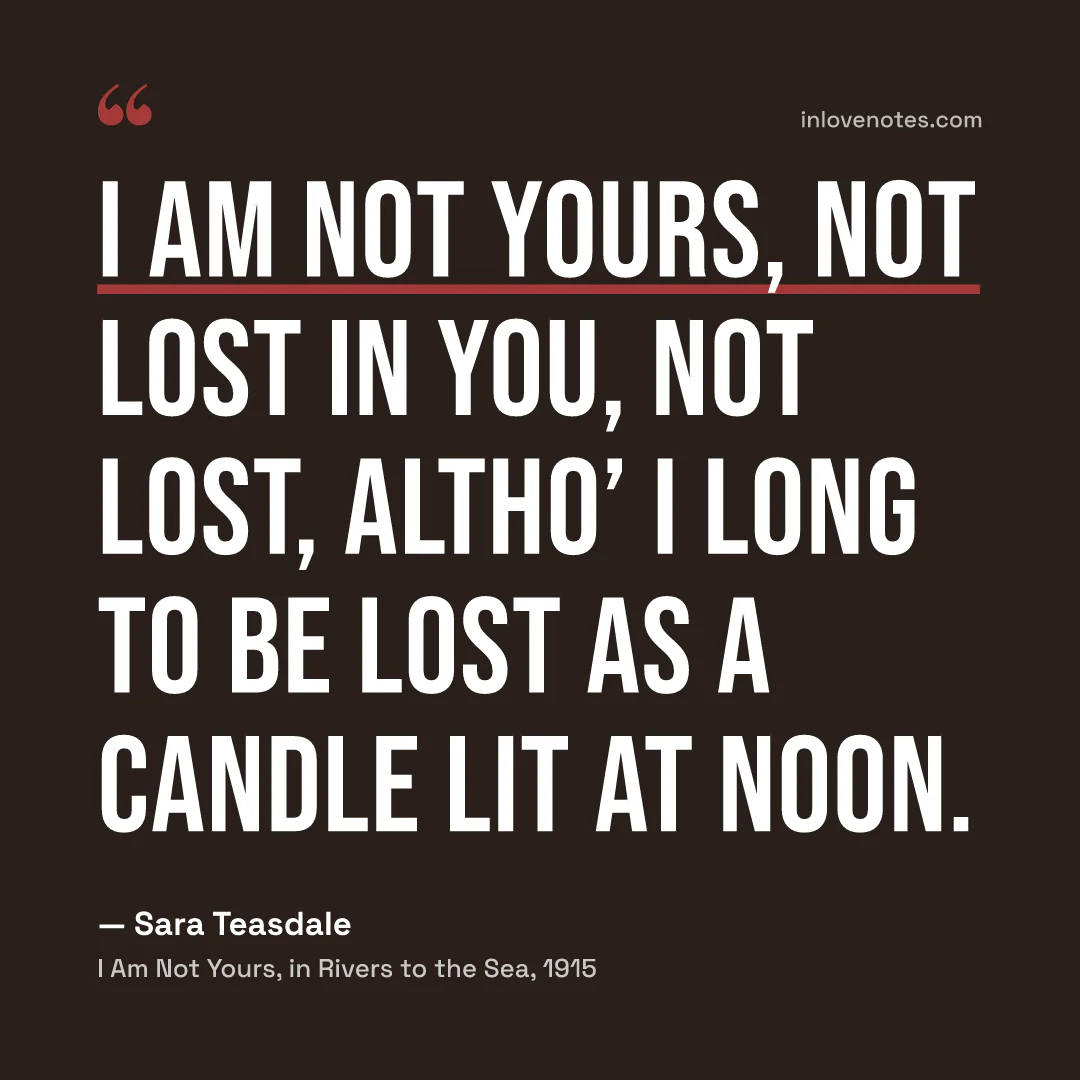
I am not yours, not lost in you, / Not lost, altho' I long to be / Lost as a candle lit at noon, / Lost as a snow-flake in the sea.
Sara Teasdale, "I Am Not Yours", Rivers to the Sea (1915)
This is the only line in the list that starts with a refusal, and it is a trick: the speaker isn't saying she doesn't love him, she is saying she wants to love him more completely than she can. The images are about disappearing, a candle you can't see in daylight and a snowflake in the ocean. The poem ends asking him to "plunge me deep in love". In 1918 Teasdale won the Columbia University poetry prize, the forerunner of the Pulitzer Prize for Poetry. Send these four lines to someone you love more than you are comfortable saying.
Which Line for Which Moment
| Line (opening words) | Speaker, and who hears it | Best for |
|---|---|---|
| "My bounty is as boundless as the sea..." | Juliet, to Romeo | New love; a first "I love you" |
| "I would not wish any companion in the world but you." | Miranda, to Ferdinand | An everyday note; a short card |
| "I have talked, face to face, with what I reverence..." | Jane Eyre, to Rochester | A man you love for his mind |
| "For one man is my world of all the men..." | Rossetti's speaker, to her absent love | Long distance; waiting for him |
| "...the eternal rocks beneath..." | Catherine, to Nelly (not to Heathcliff) | A long, unglamorous, solid love |
| "...loving longest, when existence or when hope is gone." | Anne Elliot, to Harville (overheard by Wentworth) | Reunions; second chances |
| "Set me as a seal upon thine heart..." | The woman in the Song of Songs, to her beloved | Wedding readings; church cards |
| "If ever two were one, then surely we." | Bradstreet, to her husband | Anniversary card for a husband |
| "Love's not Time's fool..." | Shakespeare's speaker, most likely to a young man | Milestone anniversaries; vows |
| "What greater thing is there for two human souls..." | Eliot's narrator, about Adam and Dinah | Vow renewals; sympathy notes |
| "I love thee to the depth and breadth and height..." | Barrett Browning, to Robert Browning | Love letters; memorial cards |
| "I am not yours, not lost in you..." | Teasdale's speaker, to her love | A private, intense note |
Turning a Line About Him Into a Note to Him
The lines that were said about a man, like Catherine's and Anne's, need a frame before they go in a card, because "Heathcliff" or "my own sex" can confuse the reader. Here is what works:
- Don't edit the quote; frame it. Write the line exactly as published, then add one sentence of your own that points it at him: "Emily Brontë wrote this about Heathcliff. I'd say it about you."
- Cut with an ellipsis, not a rewrite. Shortening the Song of Songs passage with "..." is honest. Changing "thee" to "you" turns it into your sentence, so then don't put the author's name under it.
- Keep the line breaks in poetry. In a card, put each line of verse on its own line; in a text, use a slash, as above.
- Name the source under the line. "Charlotte Brontë, Jane Eyre" is enough. It shows you went looking for the words, and it stops anyone thinking you wrote Shakespeare.
- Add something only you could write. One specific memory or habit of his, two sentences at most, after the quote. If you need help with that part, our love letters for him guide has sample letters by occasion.
Three examples, written by our editors to show the pattern:
- Under Bradstreet: "Twenty-two years and I still haven't found the couple who could compare. Happy anniversary."
- Under Miranda: "Five hundred miles of driving with you and I'd still pick you for the next five hundred."
- Under Rossetti, for a partner working away: "Eleven days down, four to go. Come back to me."
Popular "Deep" Lines We Checked and Left Out
These turn up on most lists of deep love quotes for him, usually with the wrong name under them. For a longer list, see our guide to misattributed love quotes.
| The line as shared | Usual credit | What the sources show |
|---|---|---|
| "My heart is, and always will be, yours." | Jane Austen, Sense and Sensibility | Not in the novel. Emma Thompson wrote it for Edward Ferrars in the 1995 film. |
| "I would rather share one lifetime with you than face all the ages of this world alone." | J.R.R. Tolkien, The Fellowship of the Ring | Shared as Arwen's line to Aragorn in Peter Jackson's 2001 film. No published transcript confirms the wording, so it is not in the twelve. |
| "To be loved for what one is, is the greatest exception." | Victor Hugo, Les Misérables | Not in the Hapgood translation. Hugo's real line: "The supreme happiness of life consists in the conviction that one is loved; loved for one's own sake—let us say rather, loved in spite of one's self" (Volume I, Book Fifth, chapter IV). |
| "We are asleep until we fall in love." | Leo Tolstoy, War and Peace | Not in Aylmer Maude's translation; no primary source located. |
| "I am yours, don't give myself back to me." | Rumi | No primary source located, and Wikiquote's Rumi page doesn't list it. Treat it as anonymous. |
Questions People Ask
What is the deepest love quote for him?
There is no ranking, but if you take "deep" literally, Juliet's "My love as deep; the more I give to thee, / The more I have, for both are infinite" is the classic answer. For a long marriage, George Eliot's "What greater thing is there for two human souls than to feel that they are joined for life" goes deeper than any line about falling in love.
Did Jane Austen write "My heart is, and always will be, yours"?
No. The line is not in Sense and Sensibility (1811). Emma Thompson wrote it for the 1995 film, which she also starred in. Austen's real line about lasting love is Anne Elliot's in Persuasion: "loving longest, when existence or when hope is gone."
How do I put a love quote in a card for my husband or boyfriend?
Copy the line exactly, name the author underneath, and add one or two sentences of your own that tie it to him. Short lines (Miranda, Bradstreet) fit a small card. Longer ones (Eliot, Barrett Browning) belong in a letter or a speech.
Austen gave Wentworth the reply. While Anne was still talking to Harville, he wrote her a letter at the desk and left it for her: "You pierce my soul. I am half agony, half hope." Austen prints the whole letter in chapter XXIII, and Wentworth wrote it because of a line that wasn't meant for him.