a note on
12 Italian Love Quotes with English Translation That Will Ground Your Letters
Translating romance requires moving beyond obvious clichés to capture the messy, grounding reality of historical and modern Italian literature.
penned by Erdi Dogan

The Language Demands Physicality Before Emotion
Italian writers rarely treat affection as a purely abstract concept hovering above the human experience. They drag it into the dirt. Physical survival and romantic attachment have historically shared the same vocabulary across the Mediterranean, making expressions of heavy emotional devotion feel tangible rather than theoretical. You do not simply feel something; you endure it physically."L'amore è come la fortuna: non gli piace che gli si corra dietro." — Carlo Dossi, Note Azzurre, 1912
Dossi recorded this cynical observation in his sprawling, posthumously published notebooks, treating passion with the same suspicion usually reserved for gambling at a provincial casino.
"Bocca baciata non perde ventura, anzi rinnuova come fa la luna." — Giovanni Boccaccio, Decameron, 1353
Written as the Black Death ravaged Florence and decimated its population, Boccaccio used this line to argue that physical affection is a renewable resource rather than a depreciating asset.
"L'amore è un'erba spontanea, non una pianta da giardino." — Ippolito Nievo, Le confessioni d'un italiano, 1867
Nievo drafted this sweeping historical narrative during the chaotic unification of Italy, using the metaphor of wild grass to explain why orchestrated alliances constantly failed under pressure.
"Baciare qualcuno per la prima volta è sempre una specie di miracolo." — Alda Merini, Aforismi e magie, 1999
Merini spent years navigating the brutal realities of the mid-century psychiatric system, which gave her later reflections on physical reactions to sudden affection a desperate, grounded reverence.
This insistence on bodily reality prevents the literature from floating away into pure sentiment. When authors describe a racing pulse or a sleepless night, they treat these symptoms with clinical precision. The mechanics of human interaction require a vocabulary that acknowledges sweat, exhaustion, and the sheer physical toll of maintaining a connection over decades.Adjacent: how comedians balance romantic sincerity
Translations Often Betray the Melancholy Beneath the Romance
The assumption that Latin-based languages are inherently cheerful ignores centuries of plague, war, and political fragmentation. English translations frequently smooth out the sharp edges of these texts, attempting to force melancholy observations into upbeat greeting card formats. When you read the original phrasing, the underlying grief becomes impossible to ignore. Affection is rarely portrayed as a cure for human suffering; it is usually framed as a beautiful complication."Eppure, nonostante tutto, ti aspettavo." — Dino Buzzati, Un amore, 1963
Buzzati's late-career novel stripped away his usual magical realism to document the exhausting, pathetic reality of waiting in Milan for someone who might never arrive.
"L'amore è la più a buon mercato delle religioni." — Cesare Pavese, Il mestiere di vivere, 1952
Pavese kept this private diary throughout the fascist era and the devastating post-war period, viewing romantic devotion as the only belief system accessible to a ruined populace.
"Due cose belle ha il mondo: amore e morte." — Giacomo Leopardi, Amore e Morte, 1832
Writing from a stifling provincial estate while battling chronic illness, Leopardi viewed deep affection and absolute non-existence as the only two viable escapes from daily suffering.
"Nessun maggior dolore che ricordarsi del tempo felice nella miseria." — Dante Alighieri, Inferno, 1320
Francesca da Rimini speaks this line from the second circle of hell, confirming that the memory of a shared kiss becomes an active instrument of torture when the relationship ultimately collapses.
Understanding this darkness is crucial for grasping the methods for maintaining intimacy across borders. The writers who produced these lines understood that joy is fragile. They did not expect romance to solve their political crises or cure their ailments, but they recognized it as the only acceptable distraction from the inevitable decline of empire.Adjacent: the kind of levity required for marriage speeches
Modern Dialects Strip Away the Operatic Excess
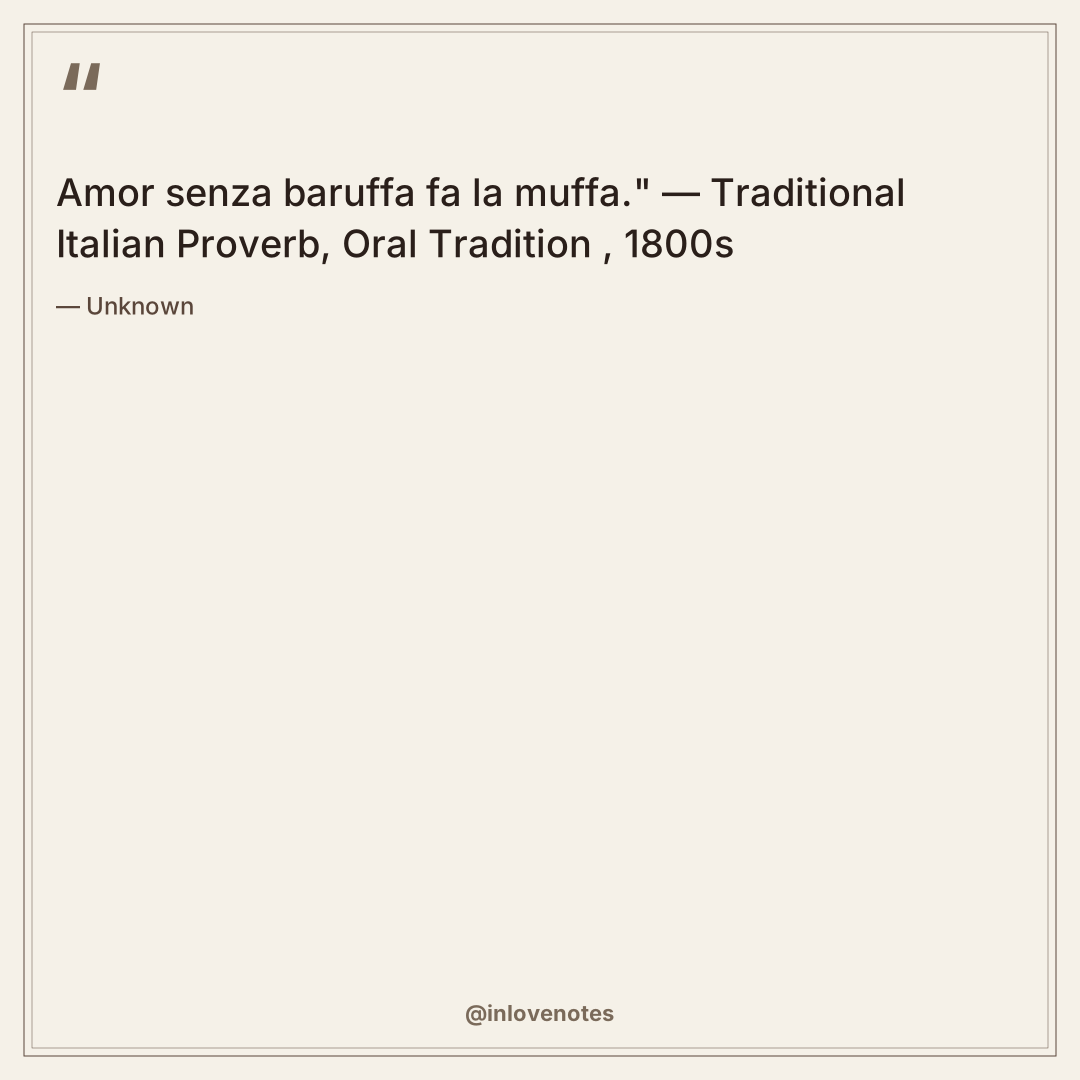
Contemporary writers abandoned the soaring sonnets of the Renaissance for something much sharper. They recognized that modern devotion requires survival skills, not grand theatrical gestures. As the country industrialized and people migrated from agricultural villages to concrete apartment blocks in Turin and Rome, the language of love adapted to the noise of the machinery."Amor senza baruffa fa la muffa." — Traditional Italian Proverb, Oral Tradition, 1800s
Rural communities across the northern agricultural regions passed down this rhyming warning that relationships without regular, vocal conflict inevitably stagnate and rot from the inside out.
"Chi vive amante sai che delira." — Pietro Metastasio, L'Olimpiade, 1733
As the imperial poet for the Habsburg court, Metastasio crafted librettos that warned aristocratic audiences about the complete psychological collapse inherent in pursuing unregulated desire.
"L'amore è l'ala che Dio ha dato all'anima per salire sino a lui." — Michelangelo Buonarroti, Rime, 1530
The sculptor approached poetry with the exact same muscular intensity he brought to Carrara marble, framing romantic obsession as a grueling, physical ascent rather than a gentle emotion.
"Amai trite parole che non uno osava." — Umberto Saba, Canzoniere, 1921
Operating a small antiquarian bookshop in Trieste, Saba actively rejected modernist abstraction to rescue ordinary, worn-out romantic vocabulary from obscurity.
The transition from grand poetry to blunt prose mirrors the broader cultural shift toward brutal honesty. When you remove the decorative flourishes, what remains is a stark assessment of what two people owe each other. The modern Italian approach to affection demands a ruthless accounting of personal flaws. You do not love someone because they are perfect; you tolerate their specific brand of madness because the alternative is spending the rest of your life talking to an empty room.