Love Quotes for Cards: 8 Old Lines That Fit, Checked at the Source
8 love quotes for cards from Burns, Sidney, Shelley and Eliot, checked against the printed texts, with word counts, the card each suits and how to sign it.
The best love quotes for cards are short, old enough to be free to copy, and quoted exactly, with the writer's name underneath. The ones that work run from 7 to 23 words. This page gives eight such lines, each checked against a printed text: Shelley, Burns (twice), Sidney, Marlowe, Browning, George Eliot and a verse from Ecclesiastes. For each one there is the card it suits best, how many words it takes up, and what the rest of the poem says, so nothing in it catches you out. After them you'll find a short guide to where the quote goes on the card and how to sign it, and a table of four card favourites printed under the wrong name. For more lines, the love quotes collection sorts them by recipient.
Eight lines, measured for the space on a card
The word counts below are ours, taken from the texts listed under Sources. A gift tag holds about one line. The inside of a folded card holds a quote of up to roughly 25 words and still leaves room for your own message.
| Line begins | Writer, work, year | Words | Best card |
|---|---|---|---|
| "Nothing in the world is single" | Percy Bysshe Shelley, "Love's Philosophy", 1819 | 23 | Valentine's Day, a first card |
| "Till a' the seas gang dry" | Robert Burns, "A Red, Red Rose", 1794 | 14 | Valentine's Day, anniversary |
| "My true love hath my heart" | Sir Philip Sidney, Arcadia, 1593 | 17 | Anniversary, engagement |
| "Grow old along with me" | Robert Browning, "Rabbi Ben Ezra", 1864 | 11 | Birthday, long marriage |
| "Tho' it were ten thousand mile" | Robert Burns, "A Red, Red Rose", 1794 | 13 | Long distance, before a trip |
| "Come live with me and be my Love" | Christopher Marlowe, 1599 printing | 8 | Moving in, a proposal |
| "Two human souls … joined for life" | George Eliot, Adam Bede, 1859 | 18 (58 in full) | Wedding card for a couple |
| "A threefold cord" | Ecclesiastes 4:12, King James Version, 1611 | 7 (18 in full) | Wedding card, religious couple |
For a Valentine's card: Shelley's question and Burns's promise
A Valentine's card can ask for something. That is why Shelley's poem works so well there: all of it leads up to a question.
Nothing in the world is single; / All things by a law divine / In one spirit meet and mingle. / Why not I with thine?
Percy Bysshe Shelley, "Love's Philosophy" (first printed in Leigh Hunt's The Indicator, 22 December 1819)
Shelley lists rivers running into the ocean and winds mixing in the sky, then turns the whole of nature into an argument for one kiss. The second stanza ends "What is all this sweet work worth / If thou kiss not me?" That is the lighter, cheekier choice if you are writing to someone you are already with. Check which version of the poem you are copying from. Thomas Hutchinson's edition of Shelley's poems records that the 1819 printing reads "In one another's being mingle" in the seventh line. "In one spirit meet and mingle" is the wording Shelley wrote in a copy of the poem he gave to Sophia Stacey in December 1820. Both are Shelley's. Just don't mix the two versions in one card.
And I will luve thee still, my dear, / Till a' the seas gang dry.
Robert Burns, "A Red, Red Rose" (published 1794)
Burns gave the words to the Edinburgh music publisher Pietro Urbani, who printed them in 1794 in a book of Scots songs without Burns's name. Burns was not pleased with how Urbani handled it. "Gang dry" is Scots for "go dry", and "a'" means "all". Keep the Scots spelling if you can. The odd spellings are part of what makes it sound like a promise, not a slogan. If the person reading the card might stumble over them, "Till all the seas go dry" is a fair modern spelling, but then don't put Burns's name under it as if it were his exact text. Write "after Robert Burns" instead.
Anniversary and birthday cards: Sidney's bargain and Browning's best years
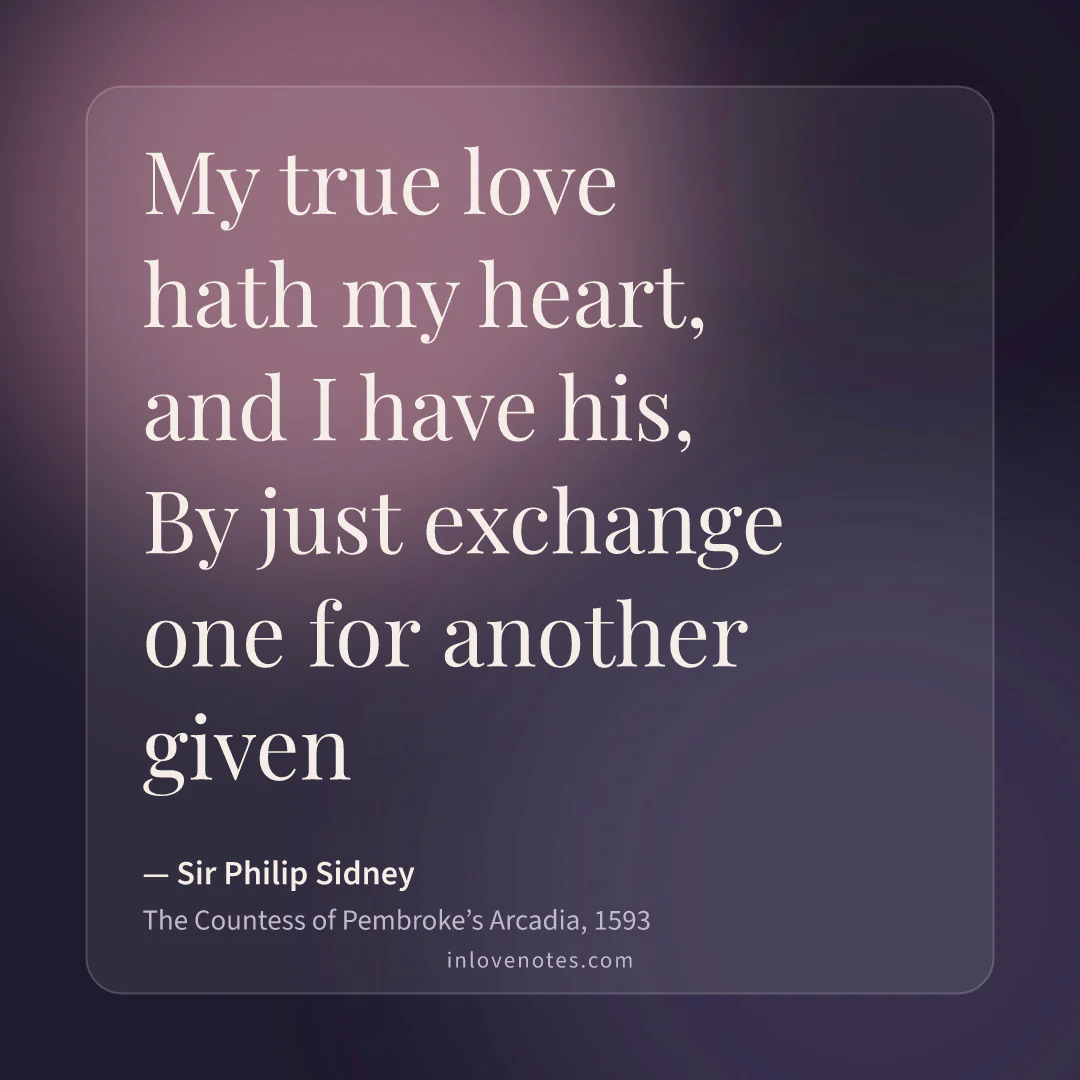
My true love hath my heart, and I have his, / By just exchange one for another given
Sir Philip Sidney, The Countess of Pembroke's Arcadia (1593 edition)
In the Arcadia this is sung by a shepherdess about the shepherd she is promised to, so the original "his" is a woman speaking. If a man is writing it to a woman, "and I have hers" is a common change. But it is then your adaptation, and the honest attribution is "after Sir Philip Sidney". The poem's second stanza has the line that suits an anniversary best: "His heart in me keeps him and me in one." Sidney died in 1586, and the Arcadia was printed after his death, first in an unfinished form in 1590, then in a fuller one in 1593. Arthur Quiller-Couch printed the poem as "The Bargain" in his Oxford Book of English Verse, which is why some cards use that title.
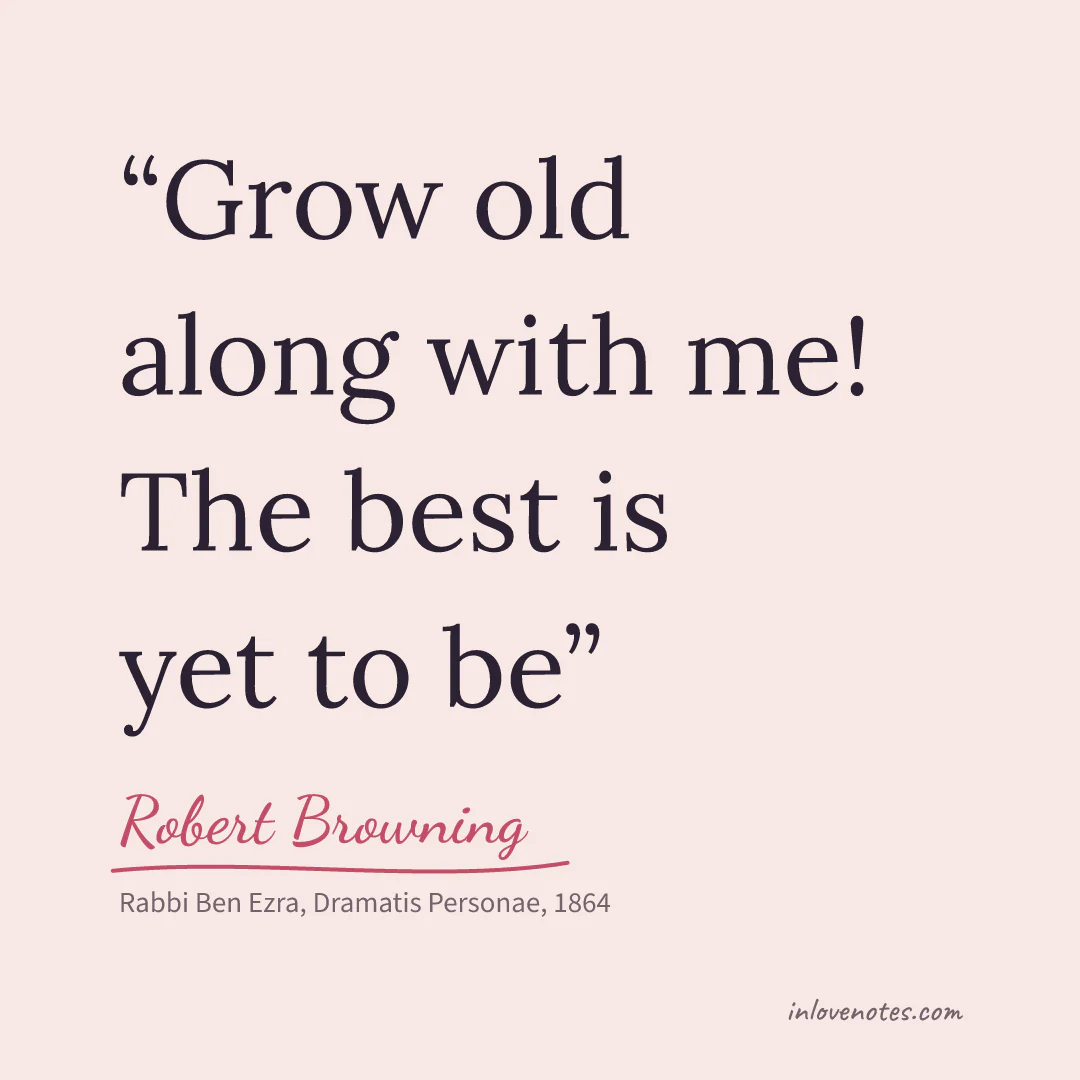
Grow old along with me! / The best is yet to be
Robert Browning, "Rabbi Ben Ezra", in Dramatis Personae (1864)
This is the most popular line on birthday cards for a partner, and it is worth knowing what it really is. Browning gives the words to Abraham ibn Ezra, a twelfth-century Jewish scholar, and the poem is about age and faith, not about a couple. The next lines are "The last of life, for which the first was made: / Our times are in His hand". So it is not a love poem in the usual sense. It still suits a card well: it says the later years are what the earlier ones were for. That is a generous thing to tell someone on a fortieth or sixtieth birthday. If your partner isn't religious, stop after "yet to be". The two lines stand on their own.
When one of you is away
And I will come again, my Luve, / Tho' it were ten thousand mile.
Robert Burns, "A Red, Red Rose" (1794)
These are the last two lines of the same song as the Valentine's line above, and readers often forget that the poem is a goodbye. The speaker says "fare thee weel" twice before he promises to come back. That makes this the right line for a card tucked into a suitcase, sent overseas, or left behind before a deployment or a long work trip. It suits a card that goes with someone better than one that waits for them. For more lines about distance, see our long-distance relationship love quotes.
Moving in, a proposal, or the first card you give
Come live with me and be my Love
Christopher Marlowe, "The Passionate Shepherd to His Love" (first printed 1599)
Eight words and an invitation, which is why it works on a card that comes with a key, or one that asks a question. The poem's title is useful too if you are slipping it into a card. A shepherd promises his love "beds of roses / And a thousand fragrant posies" if she will come. It was first printed in 1599, six years after Marlowe's death, in four stanzas, in The Passionate Pilgrim. That collection was sold under Shakespeare's name. The full six-stanza poem with Marlowe's name came out in England's Helicon in 1600. So a card that credits Shakespeare is repeating a 1599 publisher's mistake. Sir Walter Ralegh wrote a sceptical reply, "The Nymph's Reply to the Shepherd," printed in the same 1600 book. Don't quote Ralegh, unless the card is a joke between two people who will both get it.
A wedding card for the couple
A wedding card is written to two people, by someone outside the marriage, so a line where the lover talks to the beloved ("my dear", "my Love") sounds wrong in it. These two speak about a couple, not to one person.
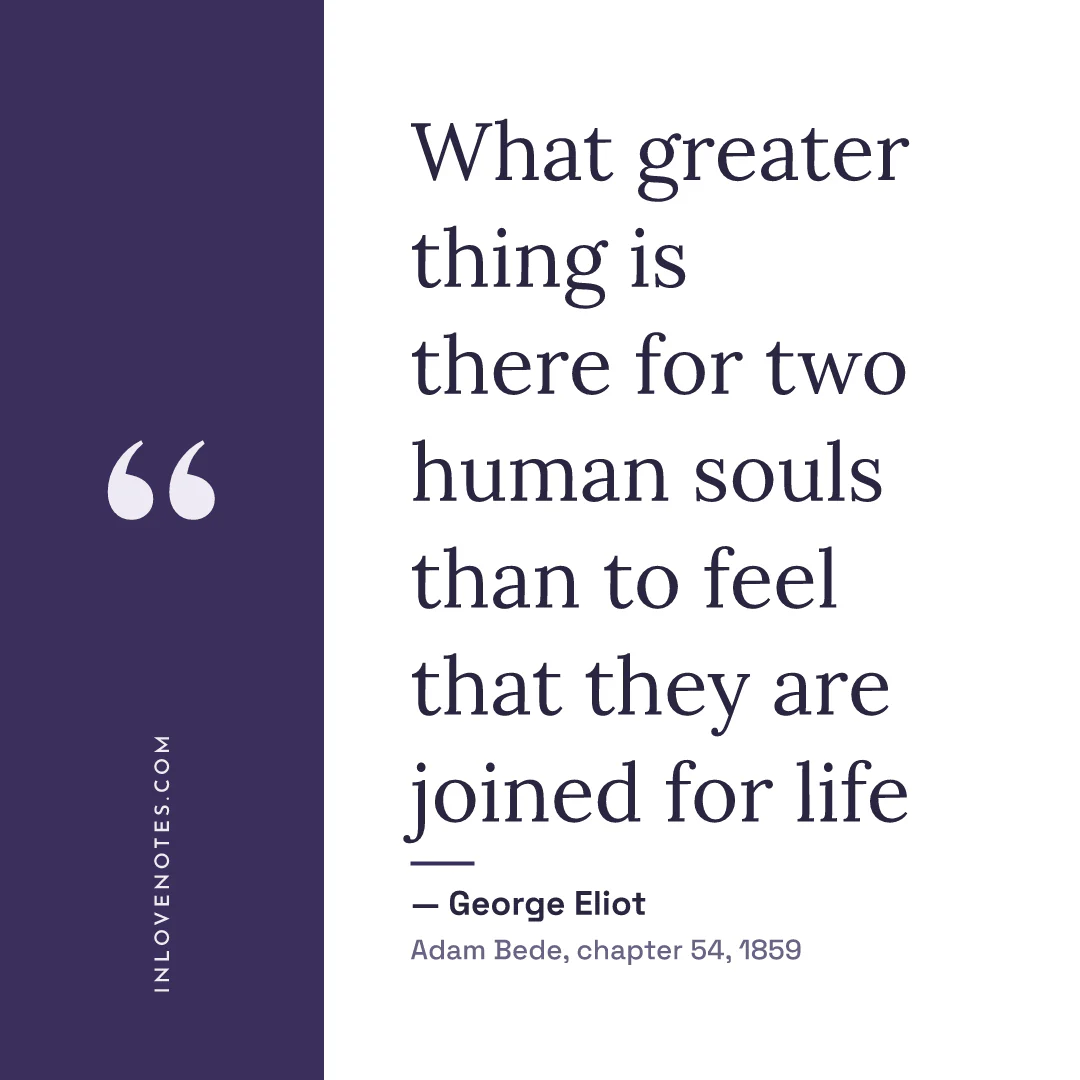
What greater thing is there for two human souls than to feel that they are joined for life
George Eliot, Adam Bede, chapter 54, "The Meeting on the Hill" (1859)
Eliot's sentence doesn't stop there. It goes on: "to strengthen each other in all labour, to rest on each other in all sorrow, to minister to each other in all pain, to be one with each other in silent unspeakable memories at the moment of the last parting?" The full 58 words are a question that ends at a deathbed. That is moving in a reading, but heavy at the top of a wedding card. Most card makers stop at "joined for life" and turn the question into a statement. If you do the same, end with an ellipsis rather than a full stop, so you are not putting words in Eliot's mouth. In the novel the sentence comes right after Adam Bede and Dinah Morris agree to marry.
And if one prevail against him, two shall withstand him; and a threefold cord is not quickly broken.
Ecclesiastes 4:12, King James Version (1611)
In context, the passage is about companions in general, not marriage. Verse 10 says "if they fall, the one will lift up his fellow", and verse 11 says "if two lie together, then they have heat". Many couples and churches read the third strand as God, and it is a favourite in Christian wedding cards for that reason. "A threefold cord is not quickly broken" is seven words, small enough for a card with a printed message already inside. Write the reference ("Ecclesiastes 4:12") rather than a name underneath it. For a fuller reading at the ceremony itself, see 1 Corinthians 13 as a wedding reading.
Where the quote goes, and how to sign it
Most people get the words right and the layout wrong. A few habits make a borrowed line look chosen rather than copied:
- Quote first, then your words. Put the quotation at the top of the inside right-hand page, then leave a line, then write your own message. Your message should explain why this line, for this person, now. The quote opens the card. You do the talking after it.
- Attribute with a dash and a name. "— Robert Burns" is enough on a card. Add the work only if it means something to the reader ("— Jane Austen, Persuasion" for someone who loves the book). Bible verses take the reference, not the translation, unless you are mixing translations.
- Keep the line breaks. If you write a poem on one line, use a slash where the line ended, as we do on this page. If you have room, set it out in lines as it was written.
- Keep the old spellings, or say you changed them. "Luve", "hath" and "Tho'" are the writer's own. Writing "after" before the name is the honest way to show you have adapted a line.
- Read the poem before you send it. Two of the eight lines above come from poems that end in parting (Burns) or at a deathbed (Eliot). You will want to know that before the card is opened.
Here are three examples of the quote-plus-message pattern. We wrote them as models, and they are not from real cards. Fill in your own details:
- "Grow old along with me! / The best is yet to be." — Robert Browning. Forty looks good on you, [name]. Here's to the half Browning says is better.
- "Come live with me and be my Love." — Christopher Marlowe. The key in this envelope is to the flat. The rest of the poem is about roses. I'll do my best.
- "A threefold cord is not quickly broken." — Ecclesiastes 4:12. [Names], we're so happy for you both. With love on your wedding day, [your names].
If you'd rather write the whole card yourself, our guide to how to write a love letter shrinks well to card length.
Four card favourites printed under the wrong name
These lines turn up on cards, mugs and wall prints every year. Each is fine to use. Just don't put the famous name underneath.
| The line, as printed | Usually credited to | What the record shows |
|---|---|---|
| "If you live to be a hundred, I want to live to be a hundred minus one day…" | A. A. Milne, Winnie-the-Pooh | Quote Investigator found no evidence Milne wrote it. The idea goes back to a 1917 verse by Tom Phillips ("May you all live forever / May I live forever less a day"), and the earliest Pooh credit it found is a 1999 newspaper column. In The House at Pooh Corner (1928), Christopher Robin asks Pooh not to forget him "when I'm a hundred", and Pooh asks how old he will be then: "Ninety-nine." |
| "To love another person is to see the face of God" | Victor Hugo, Les Misérables | It isn't in the novel. We searched the full English translation by Isabel Hapgood, and the line comes from the epilogue of the 1985 English-language stage musical (English lyrics by Herbert Kretzmer). Credit it to the musical, not to Hugo. |
| "Come live with me and be my love" | William Shakespeare | Marlowe's. It was first printed in 1599 in The Passionate Pilgrim, a collection sold under Shakespeare's name, and printed with Marlowe's name in England's Helicon (1600). |
| "I love you not only for what you are, but for what I am when I am with you" | Roy Croft | The poem goes back to a 1918 poem by Mary Carolyn Davies. The full story is on our misattributed love quotes page. |
Questions people ask about quotes in cards
What should I write in a card for my partner?
One line from someone else, then two or three sentences of your own about something only the two of you know. The quote sets the tone, and your sentences are what they will keep the card for. If you only have room for one, write your own.
Do I have to credit a quote in a handwritten card?
Nobody will check, but credit it anyway. A name under the line tells the reader you chose it on purpose, and it stops them thinking you are claiming the words as yours. A dash and the writer's surname is enough.
Can I use song lyrics in a card?
In a single handwritten card for one person, people quote lyrics all the time. Printing lyrics on cards to sell, or on wedding stationery that a business produces, is different, because most modern songs are still under copyright. The eight lines on this page are all centuries old, so you can use them anywhere.
How long should a quote in a card be?
Short enough that your own words still get more space. In practice that means one or two lines of poetry, or about 10 to 25 words. A 58-word sentence like Eliot's full one belongs in a reading or a letter, not a card.
Sources
- Sidney, "My true love hath my heart" (as "The Bargain"), Marlowe, "The Passionate Shepherd to His Love", and Burns, "A Red, Red Rose": Arthur Quiller-Couch (ed.), The Oxford Book of English Verse (1900), full text on Project Gutenberg #1304, read 1 November 2026. Word counts are ours.
- Shelley, "Love's Philosophy", with the editor's note on the 1819 Indicator printing and the Stacey manuscript: Thomas Hutchinson (ed.), The Complete Poetical Works of Percy Bysshe Shelley, Project Gutenberg #4800.
- George Eliot, Adam Bede (1859), chapter 54: Project Gutenberg #507.
- Browning, "Rabbi Ben Ezra": text at the Poetry Foundation. Publication in Dramatis Personae (1864) and the ibn Ezra background: Wikipedia, "Rabbi ben Ezra".
- Sidney's Arcadia (1590 and 1593 editions) and the shepherdess who sings the poem: Interesting Literature.
- Marlowe's poem in The Passionate Pilgrim (1599) and England's Helicon (1600): Wikipedia, "The Passionate Shepherd to His Love".
- Burns and Urbani's 1794 printing: Wikipedia, "A Red, Red Rose".
- Ecclesiastes 4:9–12, King James Version: BibleGateway.
- The "hundred minus one day" line: Garson O'Toole, "May You All Live Forever. May I Live Forever Less A Day", Quote Investigator, 27 January 2020.
- Les Misérables, Isabel F. Hapgood translation (1887): Project Gutenberg #135, full text searched 1 November 2026. Musical epilogue and lyricist: Wikipedia, "Les Misérables (musical)".