Civil War Love Letters: Which Ones Are Real, From Sullivan Ballou's Farewell to General Pickett's
Civil War love letters checked: Sullivan Ballou's full text and the doubts over it, plus Child, Chamberlain, Boatright and Pickett's likely fakes.
The most famous of all Civil War love letters survives only in other people's handwriting. No copy of Sullivan Ballou's farewell to his wife Sarah in his own hand has ever been found, and scholars who have read his confirmed letters doubt he wrote it. Another celebrated set, General George Pickett's letters to his "little one", was probably composed by his widow decades later. Meanwhile, plainer letters by a New Hampshire surgeon and by Joshua Chamberlain can be traced to real papers. This page gives you the full Ballou text, how the wording changes between printings, the evidence on each side, and a table rating six letters by how firmly they are sourced. For other letters we have checked, start with Love Letters of Great Men or the love quotes collection.
Which Civil War love letters can you trust?
Trust depends on one question: can the text be traced to a manuscript in the writer's own hand, or to an archive that holds his papers? By that test, three of the six letters below stand on firm ground, and the two most romantic do not. The ratings are our own reading of the sources listed at the end of this page.
| Letter | Date | What the text rests on | Our rating |
|---|---|---|---|
| Sullivan Ballou to Sarah, "My Very Dear Wife" | July 14, 1861 | Copies in other hands; first printed 1868; no autograph found. | Disputed. The words are old, the author is in question. |
| Ballou's other letter of the same day | July 14, 1861 | Ballou Papers, Rhode Island Historical Society, in his handwriting. | Confirmed. |
| William Child to Carrie, after Antietam | September 22, 1862 | Printed by Antietam National Battlefield (National Park Service). | Well sourced. We read the park's text, not the manuscript. |
| Joshua Chamberlain to Fanny, from Burkeville | April 19, 1865 | Chamberlain letterbook, Pejepscot Historical Society, transcribed by Bowdoin College with page images. | Confirmed. |
| George Boatright to Mattie Burroughs | Undated excerpt, before July 1864 | Quoted by a history-tourism site crediting Monocacy National Battlefield. | Unconfirmed by us. The park's own copy was not found online. |
| George Pickett to LaSalle Corbell | Dated June 18, 1863 in the book | The Heart of a Soldier (1913), published by his widow. | Probably fabricated. |
The full text of the Sullivan Ballou letter
This is the text as the National Park Service prints it for Manassas National Battlefield Park. Ballou was a 32-year-old Providence lawyer and former Speaker of the Rhode Island House, serving as major of the 2nd Rhode Island Infantry, a Union regiment, in camp outside Washington a week before First Bull Run.
Headquarters, Camp Clark
Washington, D.C., July 14, 1861My Very Dear Wife:
Indications are very strong that we shall move in a few days, perhaps to-morrow. Lest I should not be able to write you again, I feel impelled to write a few lines, that may fall under your eye when I shall be no more.
Our movement may be one of a few days duration and full of pleasure and it may be one of severe conflict and death to me. Not my will, but thine, O God be done. If it is necessary that I should fall on the battle-field for any country, I am ready. I have no misgivings about, or lack of confidence in, the cause in which I am engaged, and my courage does not halt or falter. I know how strongly American civilization now leans upon the triumph of government, and how great a debt we owe to those who went before us through the blood and suffering of the Revolution, and I am willing, perfectly willing to lay down all my joys in this life to help maintain this government, and to pay that debt.
But, my dear wife, when I know, that with my own joys, I lay down nearly all of yours, and replace them in this life with care and sorrows, when, after having eaten for long years the bitter fruit of orphanage myself, I must offer it, as their only sustenance, to my dear little children, is it weak or dishonorable, while the banner of my purpose floats calmly and proudly in the breeze, that my unbounded love for you, my darling wife and children, should struggle in fierce, though useless, contest with my love of country.
I cannot describe to you my feelings on this calm summer night, when two thousand men are sleeping around me, many of them enjoying the last, perhaps, before that of death, and I, suspicious that Death is creeping behind me with his fatal dart, am communing with God, my country and thee.
I have sought most closely and diligently, and often in my breast, for a wrong motive in this hazarding the happiness of those I loved, and I could not find one. A pure love of my country, and of the principles I have often advocated before the people, and "the name of honor, that I love more than I fear death," have called upon me, and I have obeyed.
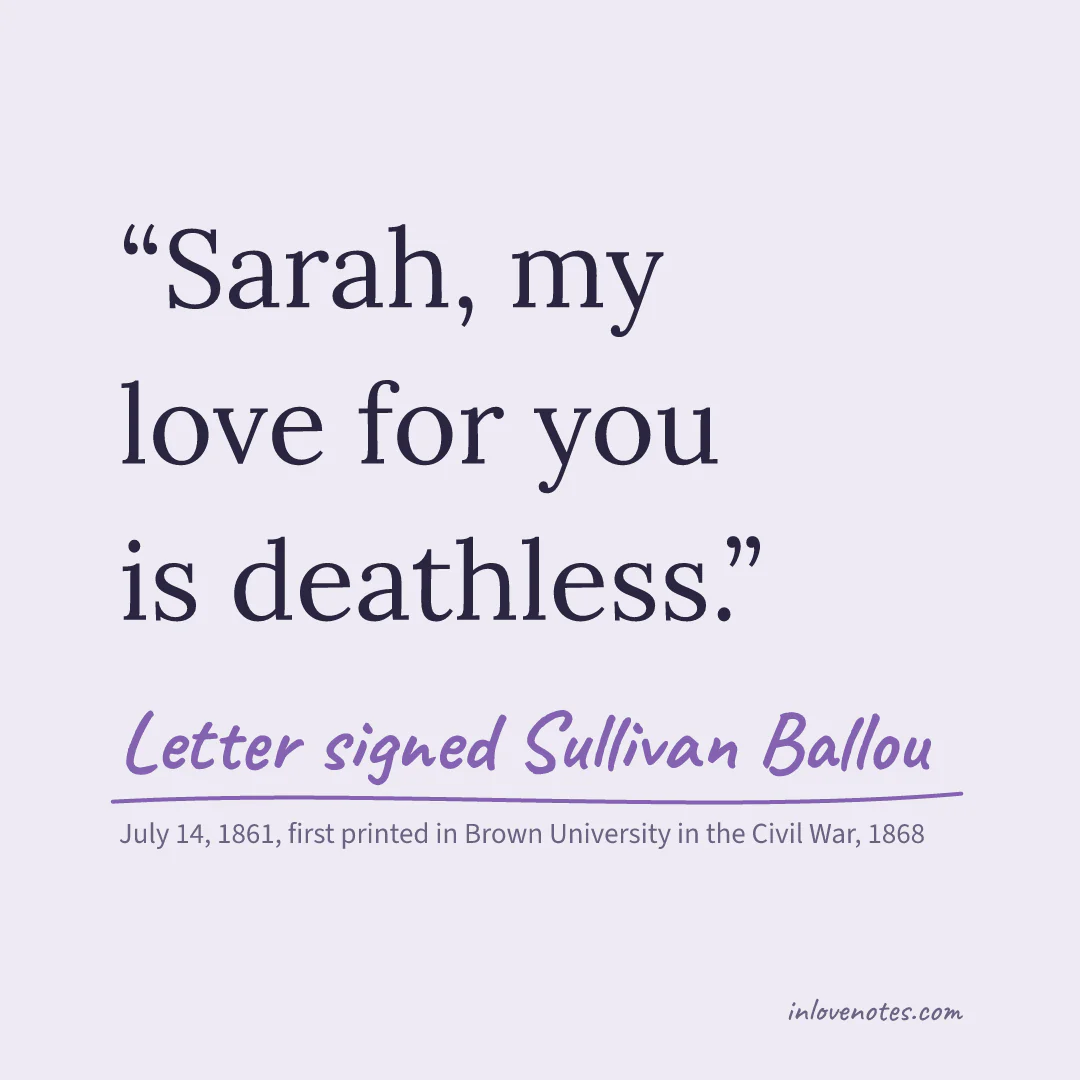
Sarah, my love for you is deathless. It seems to bind me with mighty cables, that nothing but Omnipotence can break; and yet, my love of country comes over me like a strong wind, and bears me irresistibly on with all those chains, to the battlefield. The memories of all the blissful moments I have spent with you come crowding over me, and I feel most deeply grateful to God and you, that I have enjoyed them so long. And how hard it is for me to give them up, and burn to ashes the hopes of future years, when, God willing, we might still have lived and loved together, and seen our boys grow up to honorable manhood around us.
I know I have but few claims upon Divine Providence, but something whispers to me, perhaps it is the wafted prayer of my little Edgar, that I shall return to my loved ones unharmed. If I do not, my dear Sarah, never forget how much I love you, nor that, when my last breath escapes me on the battle-field, it will whisper your name.
Forgive my many faults, and the many pains I have caused you. How thoughtless, how foolish I have oftentimes been! How gladly would I wash out with my tears, every little spot upon your happiness, and struggle with all the misfortune of this world, to shield you and my children from harm. But I cannot, I must watch you from the spirit land and hover near you, while you buffet the storms with your precious little freight, and wait with sad patience till we meet to part no more.
But, O Sarah, if the dead can come back to this earth, and flit unseen around those they loved, I shall always be near you in the garish day, and the darkest night amidst your happiest scenes and gloomiest hours always, always, and, if the soft breeze fans your cheek, it shall be my breath; or the cool air cools your throbbing temples, it shall be my spirit passing by.
Sarah, do not mourn me dear; think I am gone, and wait for me, for we shall meet again.
As for my little boys, they will grow as I have done, and never know a father's love and care. Little Willie is too young to remember me long, and my blue-eyed Edgar will keep my frolics with him among the dimmest memories of his childhood. Sarah, I have unlimited confidence in your maternal care, and your development of their characters. Tell my two mothers, I call God's blessing upon them. O Sarah, I wait for you there! Come to me, and lead thither my children.
— Letter signed Sullivan, to Sarah Ballou, July 14, 1861 (National Park Service text)
Most viewers of Ken Burns's The Civil War never heard all of this. The film, first broadcast on September 23, 1990, used excerpts making up only about half the letter, read by Paul Roebling over Jay Ungar's "Ashokan Farewell". The passages about debt, government and the Revolution are what a love-letter reader tends to skip, yet they are why the letter is so often presented as an explanation of why Northern men went to war.
Why the wording changes from one printing to the next
The wording changes because there is no autograph to settle it, only copies and printings. Set the Park Service text beside the passages quoted in Fred Zilian's 2021 essay for History News Network, and these differences appear. The comparison is ours; we are not claiming either version is the original.
| National Park Service text | Zilian's 2021 essay | Why it matters |
|---|---|---|
| "My Very Dear Wife" | "My dear Sarah" | The opening itself is unsettled. |
| "for any country" | "for my country" | One word changes the sense, and "my" reads more naturally. |
| "leans upon" | "leans on" | A small sign of separate transcription. |
| "can break" | "could break" | A shift of tense in the most quoted sentence. |
| "if the soft breeze fans your cheek" | "if there be a soft breeze upon your cheek" | The image is the same; the phrasing is not. |
| "the cool air cools your throbbing temples" | "the cool air fans your throbbing temple" | The second avoids the repeated "cool". |
| "do not mourn me dear" | "do not mourn me dead" | A tender address, or a statement about death. Check this one before you engrave it. |
If you are quoting the letter in a card, a reading or an essay, name the text you used. "As printed by the National Park Service" is honest and takes five words. For a school assignment, ask which version your teacher wants, because the two above would not match line for line. We keep a longer list of love lines that drift this way on our page of misattributed love quotes.
Did Sullivan Ballou really write it?
Nobody can prove it either way, because the original has not been found. Robert Grandchamp's 2017 HistoryNet article is the fullest public account of the evidence, and it sets out a real disagreement among people who have read the documents.
The trail of the text
- July 14, 1861: the date on the letter. The Rhode Island Historical Society holds two letters to Sarah with this date, one in Ballou's handwriting and the famous one in someone else's.
- July 21, 1861: First Bull Run. A cannonball killed his horse and tore away part of his right leg. He died in Confederate hands on July 28 or 29, so the line that he was "killed a week later" is a simplification.
- August 1861: according to his friend Horatio Rogers, the letter was found in a trunk left at Camp Clark, and the trunk was returned to Sarah. On that account the letter was never mailed. The story that Governor Sprague carried the trunk home is not in Rogers.
- 1868: first printing, in Rogers's chapter of Brown University in the Civil War. Earlier sketches of Ballou (1861, 1867) do not mention it, and neither does the 2nd Rhode Island's official history of 1875.
- 1888: reprinted in Adin Ballou's family history.
- 1986 to 1990: Don Fehrenbacher finds the copy at what is now the Abraham Lincoln Presidential Library and sends excerpts to Ric Burns. The film makes the letter famous.
The case against
Stephen Cushman of the University of Virginia and Shirley Samuels of Cornell both read the confirmed letters and came away convinced they were by a different mind. Their points can be checked side by side:
| Feature | Famous letter | Confirmed Ballou letters |
|---|---|---|
| Mood about the campaign | Expects death. | "I do not apprehend fighting on a large scale." |
| Subject matter | Country, God, the Revolution. | Weather, food, mail, a promotion, pay. |
| Typical detail | "mighty cables", "the banner of my purpose". | "my Rubber boots"; "If you can sell the cow for money—do so". |
| Calling Sarah | "thee". | Never "thee", Samuels says. |
| Literary borrowing | Reworks Brutus in Julius Caesar, 1.2. | None noted, and rougher grammar. |
| Later reference | — | His July 19 letter does not refer back to any farewell. |
Grandchamp goes further and asks whether Rogers himself, a gifted writer and Ballou's friend, composed the letter as a tribute. He offers that as a possibility, and no document proves it.
The case for
Robin Young, in her 2006 biography For Love and Liberty, dismisses the doubters and argues Ballou was a trained teacher of oratory, fully able to write in this high style. Sarah evidently knew the words: the closing line is cut into the Ballou memorial at Swan Point Cemetery in Providence, and one Historical Society copy, part of the papers she saved, may be the version she knew. A man can also write differently when he thinks he may be dying; Zilian, a retired Army officer, makes that point from his own experience of leaving a family for a posting in Korea.
Our view: treat it as a great American text of uncertain authorship. "Ballou's letter" is fine as a name, the way people say "Homer". Don't state as fact that he sat in his tent and wrote it, and don't call it a forgery either, since nobody has shown that. The popular idea that the original was buried with Sarah in 1917, which Burns has said he believes, has no evidence behind it.
The Ballou you can verify was just as devoted
The letters in his confirmed hand are less quotable, and they are full of love. This is from the other July 14 letter, about his two sons.
"And you can scarcely imagine how my blood dances, my nerves thrill and my brain almost whirls…and I see my little boys going through their childish pranks, and hear their singing voices, and even stretch my arms to catch them, and awake to touch the white walls of my tent."
— Sullivan Ballou to Sarah Ballou, July 14, 1861, Ballou Papers, Rhode Island Historical Society (as quoted by Grandchamp, 2017)
Reaching for children who aren't there and waking up against a canvas wall is a better image than anything about mighty cables, because you can see it. Whoever wrote the famous letter, this one is certainly the father's. It is also the one to read if you want to know what the real man sounded like when he missed home.
William Child: a surgeon's dream after Antietam
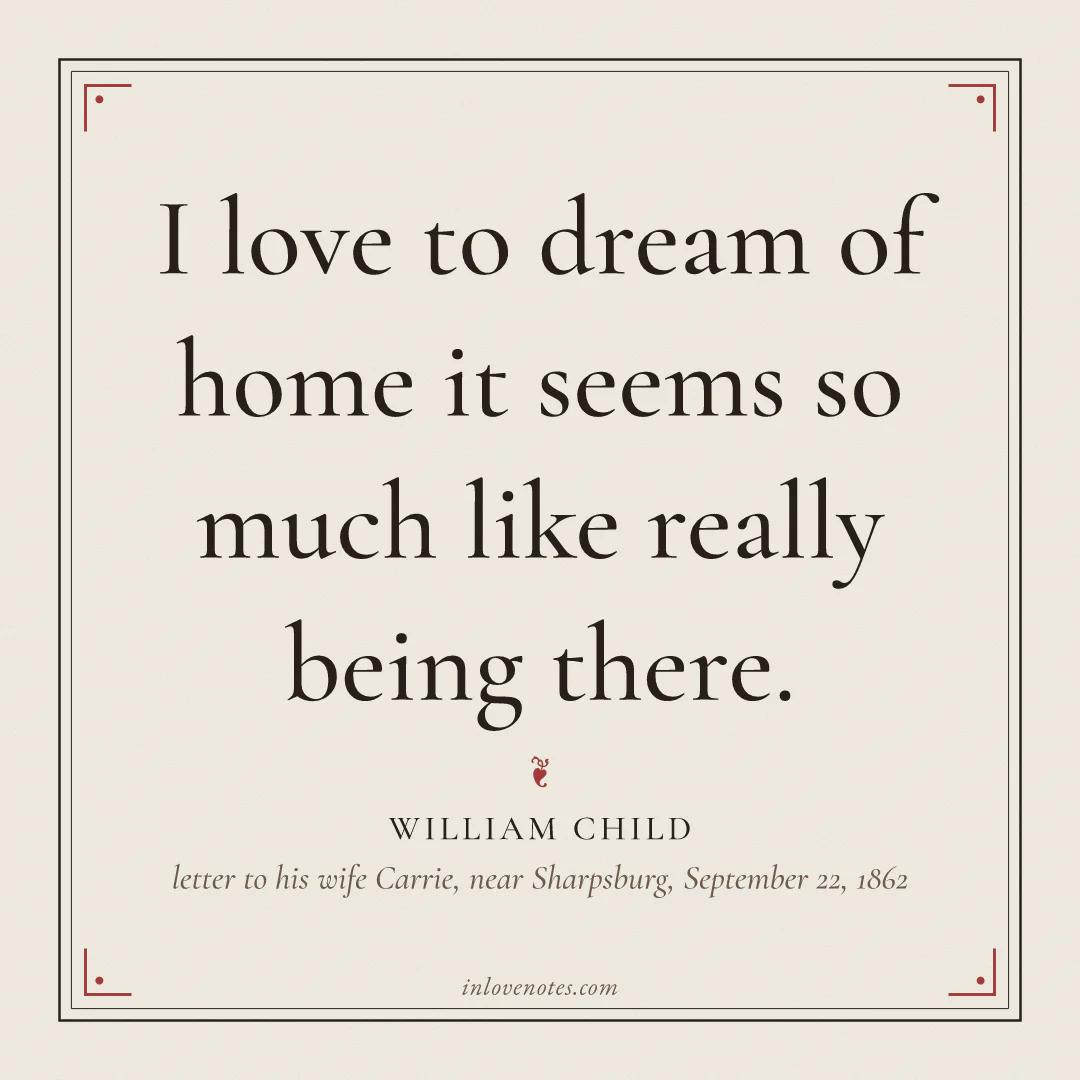
William Child, surgeon of the 5th New Hampshire, wrote more than 150 letters to his wife Carrie between 1862 and 1865. On September 22, 1862, five days after the battle, he began by reporting that he had dressed the wounds of 64 men in one day. Then the letter turns.
"Carrie I dreamed of home night before last. I love to dream of home it seems so much like really being there. I dreamed that I was passing Hibbards house and saw you and Lud. in the window. After then I saw you in some place I cannot really know where -you kissed me - and told me you loved me - though you did not the first time you saw me. Was not that quite a soldier dream?"
— William Child to Carrie Child, Battlefield Hospital near Sharpsburg, September 22, 1862 (National Park Service, Antietam National Battlefield)
"Though you did not the first time you saw me" is the line a forger would never think of. It is a private joke between a married couple, sent from a field hospital. He tied his horse to a peach tree that night, he adds, and in the same letter asks about his business affairs back in Bath. Child served to the end of the war and went home to Carrie and their children.
Joshua Chamberlain: a good-morning kiss after Appomattox
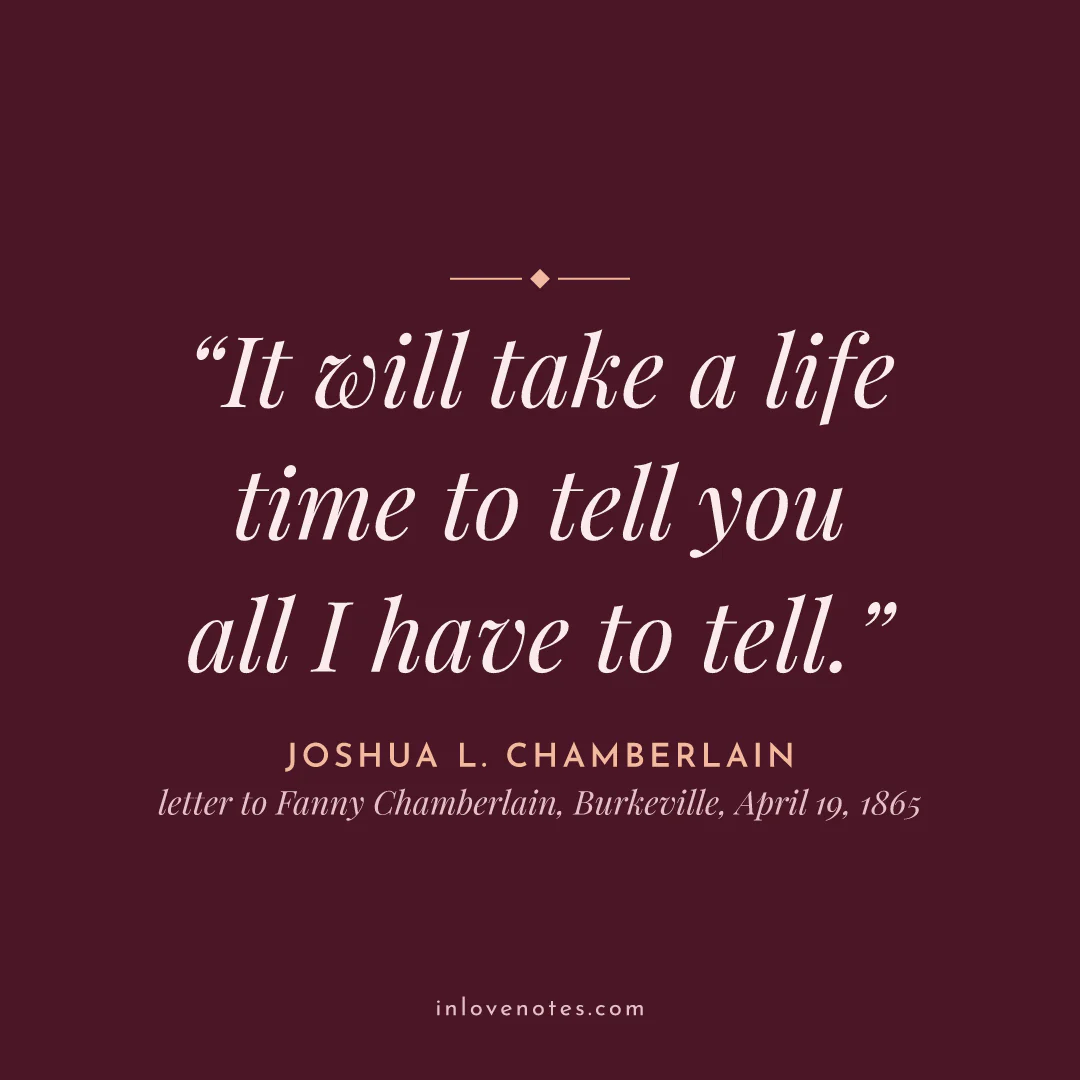
Five days after Lincoln's assassination, the general who received the Confederate surrender of arms at Appomattox sat down to write to Fanny. He opened with a sentence he had started three weeks earlier and never finished, then explained why.
"My darling wife, a good morning kiss for you, with big brown eyes + peach-bloom cheeks, and vol- no vel vet lips! That, I had written just three weeks ago, seeming like three months or years if you please…"
— Joshua L. Chamberlain to Fanny Chamberlain, Burkeville, Virginia, April 19, 1865 (Pejepscot Historical Society letterbook; Bowdoin College transcription)
That night, he says, he had fought a battle and taken two wounds. The "vol- no vel vet" is the correction left on the page: a man fumbling a compliment, on paper, in the middle of a war. The letter then runs through the surrender and his funeral service for the president before coming home again.
"It will take a life time to tell you all I have to tell. … Thank you darling. What is our baby's name? With a good night kiss + a long one."
— Joshua L. Chamberlain to Fanny Chamberlain, April 19, 1865 (Bowdoin College transcription)
He did not yet know his own daughter's name. Bowdoin's footnote says Fanny named the child Gertrude Loraine after he left in February, and that she lived for less than a year. Few sentences show the distance of that war more plainly. If you read Napoleon's letters to Josephine beside this one, you get the same mix of campaign news and wanting, without the grandeur.
George Boatright: a proposal with an apology in it
Private George W. Boatright of the 12th Battalion, Georgia Light Artillery, was writing to Martha Jane "Mattie" Burroughs, who was fifteen. We give this excerpt as Heart of the Civil War prints it, crediting Monocacy National Battlefield. We could not find the park's own copy online, so treat the wording as secondhand.
"I assure you there is nothing that affords me more pleasure than receiving and answering letters from my dear Mattie. (Excuse endearing words) though they are pure and uttered from the heart . . . Just imagine how happy it would make 'George' to meet with my 'dear Mattie.' I must say that you feel nearer to me than anyone I have ever met with, and to seal what I am now saying, will you consent to be my Mattie?"
— George W. Boatright to Mattie Burroughs, undated excerpt, as quoted by Heart of the Civil War (2020)
"Excuse endearing words" may be the most courteous parenthesis of the war. Her replies are lost, so we don't know her answer. He was mortally wounded at Monocacy on July 9, 1864, and died on July 12. The same source says Mattie did not marry until her fifties and lived to 85.
George Pickett: the love letters his widow probably wrote
The most romantic Confederate letters are the least trustworthy. In 1913 LaSalle Corbell Pickett published The Heart of a Soldier, presented as the general's intimate letters to her. This one is dated "In Camp, June 18, 1863".
"Each day, my darling, takes me farther and farther away from you, from all I love and hold dear. … Have faith, my little one; keep up a 'skookum tum-tum.' Your soldier feels that he will return to claim his bride—his beautiful, glorious bride."
— Letter printed under George E. Pickett's name, The Heart of a Soldier (Seth Moyle, 1913), pp. 79–80; authorship doubted
Encyclopedia Virginia says the historian Gary Gallagher "has convincingly argued" that she "apparently fabricated an entire wartime correspondence". Gallagher's comparison was with eleven handwritten letters. In a 2001 stylometric study, David Holmes measured function words and placed six of seven samples from the book in a separate group from those letters, supporting Gallagher. The seventh sample, from supposedly early-war letters, grouped with Pickett's, so some real material may be in there. The letters were still used in The Killer Angels and quoted in Burns's film, and you will find them online today presented as simply his. When you see "my little one" or "skookum tum-tum", credit the book, not the general.
How to check a Civil War letter you find online
Four questions will sort most letters in a few minutes:
- Who holds it? Look for a named archive and collection, as with "Joshua L. Chamberlain Collection". A site that says only "a soldier wrote" has told you nothing.
- When was it first printed? The longer the gap after the war, and the closer the publisher to the family, the more care you need. Ballou's gap is seven years; Pickett's is fifty.
- Does it talk about anything dull? Pay, boots, cows and neighbors' houses are good signs. All eloquence and no errands is a warning, though not proof.
- Does it match his other letters? Both the Ballou and Pickett doubts began with exactly this comparison.
What these letters teach about writing your own
If you are writing to someone deployed or far away, copy Child and Chamberlain rather than the famous farewell. Lofty language is hard to sustain and easy to doubt. Their power comes from things only that couple could know: Hibbard's house, "you did not the first time you saw me", the baby's name. Our guides to long-distance love letters and how to write a love letter go through the method. Here is a short model our editors wrote for this page, not a historical letter, with a closing borrowed from Chamberlain:
Dreamed of the kitchen last night, and you laughing at how I burn the toast. Tell me what the dog has wrecked this week. There is too much to say for one letter, so here is a good-night kiss, and a long one.
Questions readers ask
What did Sullivan Ballou write in his letter to his wife?
He wrote that he expected to move into battle within days, that he was ready to die to preserve the government, and that his love for Sarah and their sons was struggling against his love of country. He promised to stay near her in spirit if he died and asked her to wait for him. The full text is on this page.
Was the Sullivan Ballou letter ever sent?
Apparently not by mail. Horatio Rogers wrote in 1868 that it was found in Ballou's trunk at Camp Clark and that the trunk went back to Sarah in August 1861. No version in Ballou's own handwriting has been found, and scholars disagree on whether he wrote it.
Who read the Sullivan Ballou letter in the Ken Burns documentary?
Paul Roebling read the excerpts in The Civil War (1990), over Jay Ungar's "Ashokan Farewell". The narrator, David McCullough, then said that Ballou was killed a week later at the First Battle of Bull Run.
Are George Pickett's love letters real?
Probably not, at least most of them. The letters in The Heart of a Soldier (1913) were published by his widow, and both Gary Gallagher's comparison and a 2001 stylometric study point to her as their main author. Eleven handwritten letters by Pickett do survive and read differently.
Sources
- National Park Service, "My Very Dear Wife": The Last Letter of Major Sullivan Ballou (letter text).
- Robert Grandchamp, with Stephen Cushman and Shirley Samuels, "'O Sarah!' Did Sullivan Ballou's Famed Letter Come From Another's Pen?", HistoryNet, 2017 (provenance, confirmed letters, Young's position).
- Fred Zilian, "Lessons on Love from Sullivan Ballou's Civil War Letters", History News Network, 2021.
- Antietam National Battlefield, Letters and Diaries of Soldiers and Civilians (William Child).
- Bowdoin College, Chamberlain to "My Darling Wife", April 19, 1865.
- Charissa Hipp, "Civil War Love Letters: Tales of Love and Loss", Heart of the Civil War, 2020 (Boatright excerpt, more on Child).
- LaSalle Corbell Pickett, The Heart of a Soldier, 1913, Internet Archive scan.
- Encyclopedia Virginia: LaSalle Corbell Pickett; David I. Holmes, "A Widow and Her Soldier", ACH/ALLC 2001.