Love Letters of Great Men: The Sex and the City Book, the Real Anthologies and 8 Letters Worth Reading
The Sex and the City book was a prop. Here are the 3 real anthologies compared, plus 8 great men's love letters, each dated, sourced and explained.
The book Carrie Bradshaw reads in bed in the 2008 Sex and the City film, Love Letters of Great Men, did not exist when the film opened. It was a prop. On 10 June 2008 the Associated Press ran a "consumer alert" saying so, and pointing readers to the closest real book: Love Letters of Great Men and Women, edited by C. H. Charles and first published in London in 1924. Within months two new books took the film's title, one by John C. Kirkland and one edited by Ursula Doyle for Macmillan. The letters inside all of them are real.
This page sorts out which book is which, compares the three in a table, and then gives you eight love letters by great men, each dated, quoted from a printed source and explained: who wrote it, to whom, what was happening, and when a line from it is worth borrowing. Most of the excerpts come from the 1924 anthology, which is free to read online, so you can check every word.
Was the book in Sex and the City real?
Not at first. In an early scene of the film, Carrie (Sarah Jessica Parker) reads from Love Letters of Great Men while Mr. Big (Chris Noth) listens, and later in the film Big borrows passages from it for the emails he sends her. The AP report, carried by CBS News, called it "the imaginary collection", while noting that the scene cites real letters by Beethoven and Napoleon, among others. The press manager of AbeBooks told the AP he had received hundreds of queries about the book, and so many readers were sent to a 2007 Kessinger reprint of the 1924 Charles anthology that it ranked No. 134 on Amazon that afternoon.
There is one loose end worth knowing about. Wikipedia's article on the book gives the Kirkland edition a publication date of 12 May 2008, the date of the film's premiere. That date sits badly with the AP report four weeks later, which found no such book. We could not settle it from a primary record, so treat the May date with caution: what is certain is that the Kirkland volume was on sale by September 2008, when Wikipedia (citing a 2009 FindLaw column) says it topped Amazon's letters and correspondence list.
Three books called (almost) Love Letters of Great Men, compared
If you are buying a copy, or trying to find a letter you remember from the film, this is the difference between them.
| Book | Editor and first edition | Who is inside (examples) | Good for |
|---|---|---|---|
| Love Letters of Great Men and Women: From the Eighteenth Century to the Present Day | C. H. Charles, Stanley Paul & Co, London, 1924; reprinted by Kessinger in 2007 | Nelson, Mozart, Beethoven, Napoleon, Byron, Keats, Victor Hugo, Pushkin, Flaubert, Balzac, Desmoulins, the Brownings, Carlyle, Bismarck; women writers' replies too | Reading free: a scan is on the Internet Archive. Short notes introduce each writer. |
| Love Letters of Great Men, Vol. 1 | John C. Kirkland, 2008 (138 pages, per Wikipedia) | Ovid, Walter Raleigh, Goethe, Hawthorne, Poe, Mark Twain, Pierre Curie, Jack London, Henry VIII, Napoleon, Van Gogh, Mozart, Beethoven | The closest match to the film: it was made to look like the prop, with notes on what happened to each couple. |
| Love Letters of Great Men | Ursula Doyle, Macmillan, London, 2008; audiobook read by Anton Lesser, 15 August 2008 | Henry VIII, Pliny the Younger, Congreve, Nelson, Mozart, Flaubert, Darwin, Browning, Mark Twain, Oscar Wilde | A short modern selection, also on audio. Its companion, Love Letters of Great Women, followed from St. Martin's Press in November 2008. |
The lists above are examples taken from each book's own contents page (1924), its publisher's page (Doyle) or its Wikipedia entry (Kirkland), not full tables of contents. Under each letter below, we note which of the three books includes its writer.
Kings and composers: Henry VIII and Mozart
1. Henry VIII to Anne Boleyn (1528): the astronomy letter
"...reminding us of a point in astronomy which is this: the longer the days are, the more distant is the sun, and nevertheless the hotter; so is it with our love, for by absence we are kept a distance from one another, and yet it retains its fervour, at least on my side; I hope the like on yours." — Henry VIII, letter to Anne Boleyn (1528), trans. in The Love Letters of Henry VIII to Anne Boleyn (1906)
Henry wrote seventeen love letters to Anne Boleyn, eight in English and nine in French, and all but two of the texts in the 1906 edition come from the collection in the Vatican Library. The notes to the 1906 edition date the series to 1528 and early 1529, when Anne had left court and Henry was trying to coax her back. In this one he sends her "my picture set in a bracelet", wishing himself in its place. The astronomy is half right, as it happens: the Earth is farthest from the sun in early July, though that is not why summer is hot. The feeling travels well either way. Read it when one of you is away for the summer: the sun line works on a postcard. In: Kirkland, Doyle.
2. Mozart to his wife Constanze (Dresden, April 1789)
"If I were to tell you everything, what I do with your dear portrait, you would laugh a good deal... Now, really I believe I have written down something quite too stupid (for the world at least); but for us, who love each other so very dearly, it is not stupid at all." — Wolfgang Amadeus Mozart, letter to Constanze Mozart, Dresden (April 1789), in Love Letters of Great Men and Women (1924)
Mozart was six days into a journey away from Vienna when he wrote this, and he says so: "To-day is the sixth day that I am away from you, and bei Gott, it seems to me a year ago." What he does with the portrait is greet it with a string of pet names that the 1924 editor gave up translating properly ("Snub-nose", "Good-for-nothing") and then lower it slowly back into its case saying "Nu, nu, nu". Seven years earlier, in 1782, the same man had written Constanze a stiff, offended letter because she had let a young man measure her calves in company; the 1924 anthology prints both. Read together they show a marriage going from jealousy to private silliness.

Read it when you are about to write something silly and worry it sounds foolish. Mozart already gave you permission. In: all three books.
Written with death close: Desmoulins and Nelson
3. Camille Desmoulins to Lucile, from prison (spring 1794)
"I was born, in order to make you happy, in order to create for us both, with your mother and my father and some intimate friends, a Tahiti." — Camille Desmoulins, letter to Lucile Desmoulins from prison (1794), in Love Letters of Great Men and Women (1924)
Desmoulins was a journalist of the French Revolution who had helped rouse the Paris crowd in 1789 and then, by asking for clemency, made an enemy of Robespierre. He wrote this from his cell while on trial with Danton. He was guillotined on 5 April 1794; Lucile, who had tried to save him, was executed on 13 April, aged twenty-three. The letter is long and partly a political defence, but this one sentence, the wish for a private island of happiness with both families on it, is what people remember. Read it when you want to tell someone that your ambitions were always, underneath, about them. In: Charles 1924.
4. Nelson to Emma Hamilton, two days before Trafalgar (19 October 1805)
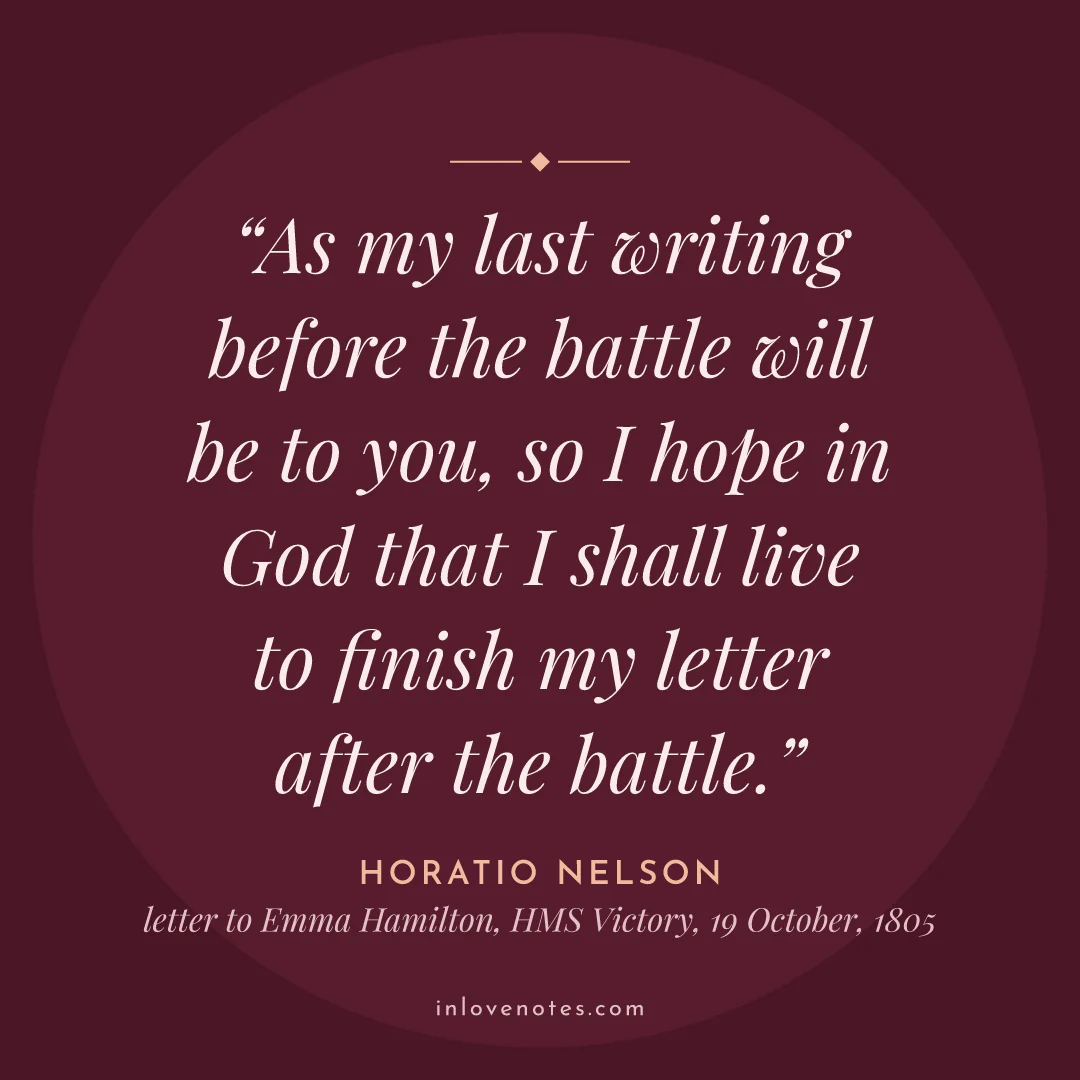
"The signal has been made that the enemy's combined fleet is coming out of port. We have very little wind, so that I have no hopes of seeing them before to-morrow... as my last writing before the battle will be to you, so I hope in God that I shall live to finish my letter after the battle." — Horatio Nelson, letter to Emma Hamilton, HMS Victory (19 October 1805), British Library Egerton MS 1614, text as printed in Love Letters of Great Men and Women (1924)
He did not finish it. Nelson was killed at Trafalgar on 21 October, and the letter was found open on the desk in his cabin on HMS Victory. It is now in the British Library, the last of fifty-eight letters to Emma bound together as Egerton MS 1614. When it was brought to her, Emma wrote on it: "O miserable, wretched Emma! O glorious and happy Nelson!" The 1924 anthology uses Nelson's portrait as its frontispiece.
Read it when you are writing before something uncertain: surgery, deployment, a long flight. Nelson's habit of heading the letter with the time and his ship's position ("noon; Cadiz, S.S.E. 16 leagues") is worth copying too. In: Charles 1924, Doyle.
The Romantics: Byron, Hugo and Pushkin
5. Byron to Teresa Guiccioli, written inside her book (Bologna, August 1819)
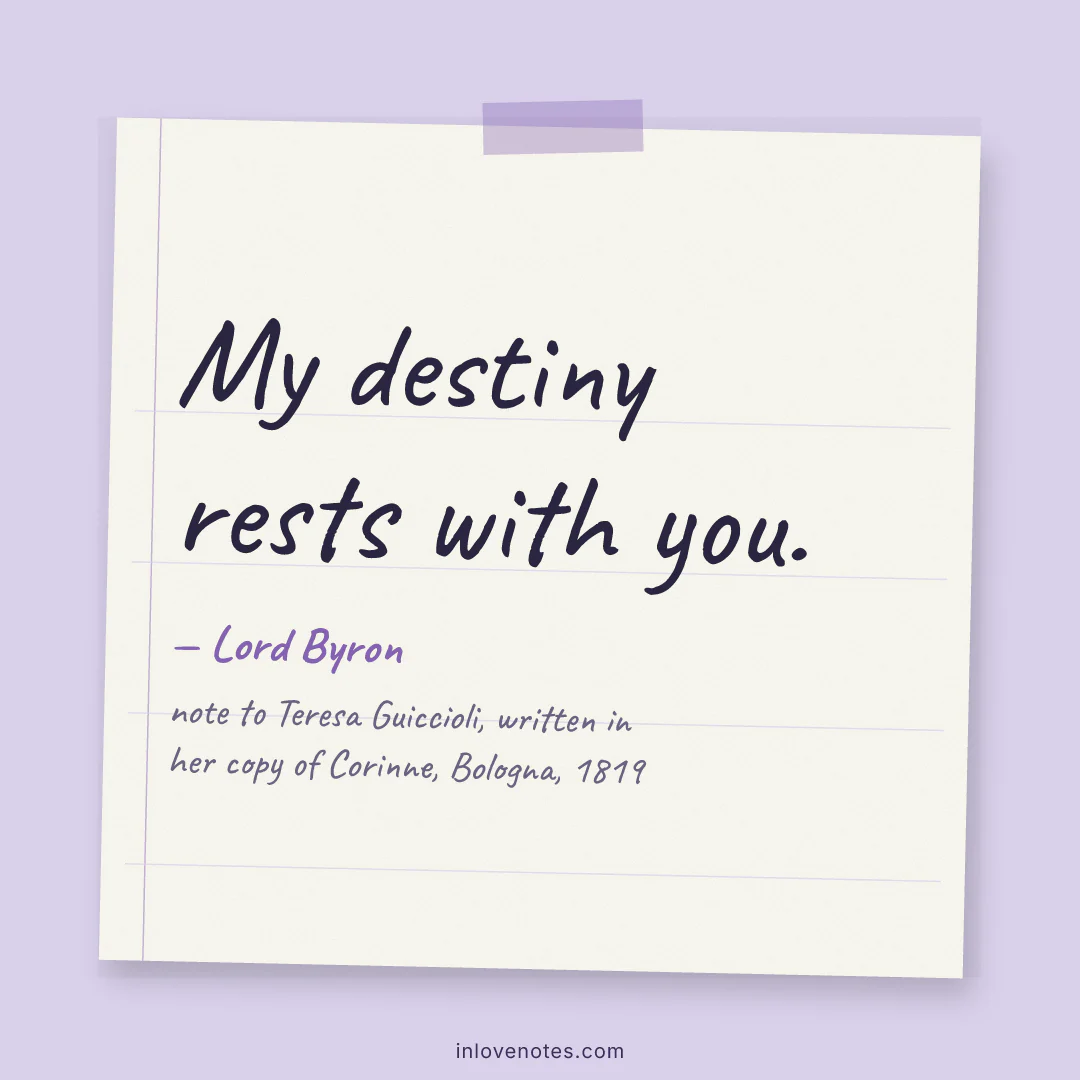
"In that word, beautiful in all languages, but most in yours, amor mio, is comprised my existence here and hereafter... my destiny rests with you." — Lord Byron, note to Teresa Guiccioli in her copy of Corinne, Bologna (August 1819), in Love Letters of Great Men and Women (1924)
Byron did not post this; he wrote it in the back of Teresa's copy of Madame de Staël's novel Corinne while sitting in her garden in Bologna, and he wrote it in English on purpose: "You will not understand these English words, and others will not understand them." Teresa was a countess, still in her teens and married to a much older man, and Byron says plainly that he wishes he had met her before her marriage. Editions date the note 23 or 25 August 1819. Read it when you are writing inside a book you are giving or returning: his idea of a note only the two of you can read is the whole charm. In: Kirkland, Charles 1924.
6. Victor Hugo to Adèle Foucher (March 1822)
"All my soul is yours. If all my existence had not been yours, the inmost harmony of my being would have been broken, and I would have died, yes, died irrevocably." — Victor Hugo, letter to Adèle Foucher (March 1822), in Love Letters of Great Men and Women (1924)
Hugo was twenty, still hunting for a steady post to marry on, and a letter from his father had nearly ended the engagement. The letter was written on a Friday night after the families finally allowed the engagement, and it admits that in the worst week Hugo had planned to run away with Adèle, promising he would have slept "on a chair or on the ground by the side of your bed, as the guardian of your repose". They married later in 1822. It is overwrought, and that is the point: the 1924 editor quotes the older Hugo looking back on these letters as the work of a "time of dreams". Read it when you want permission to be over the top, once. In: Charles 1924.
7. Pushkin to his wife Natalia (Boldino, 30 October 1833)
"You are pleased that men run after you; much cause for pleasure! ... When the trough is there, the pigs come of their own accord." — Alexander Pushkin, letter to Natalia Pushkina, Boldino (30 October 1833), in Love Letters of Great Men and Women (1924)
Not every great man's love letter is tender. Pushkin, away at his estate, scolds his young and much-admired wife for enjoying the attention of other men, and finishes with a fable about a host who served herring and no drink. Four years later he died of a wound from a duel with a man he believed was pursuing her. The 1924 editor includes it to show his "keen wit and outspoken criticism", and it reads now as a warning: jealousy and humour sit very close together in a marriage. Read it as a lesson rather than a model. In: Charles 1924.
A great man who admitted he loved badly: Flaubert
8. Gustave Flaubert to Louise Colet (from Croisset, undated)
"I love you as well as I can, badly, not enough, I know it, I know it." — Gustave Flaubert, letter to Louise Colet from Croisset (undated), in Love Letters of Great Men and Women (1924)
Flaubert's letters to the poet Louise Colet are among the most honest in the 1924 anthology, and among the least romantic. He wrote them from his family house at Croisset, near Rouen, complaining about his health and about a novel that "has difficulty in getting under weigh", and telling her she should not have loved a man "aged... in all the excesses of solitude". The anthology prints the letter without a year, so we don't give one. What makes the line last is that it is an apology without excuses. He ends the same letter more lightly: "Work, think of me, not too sombrely." Read it when you need to admit you have not been the partner you meant to be. In: Charles 1924, Doyle.
Which letter to read for which moment
| Your moment | Letter | The line to borrow | Why it works |
|---|---|---|---|
| A summer apart | Henry VIII, 1528 | "the longer the days are, the more distant is the sun, and nevertheless the hotter" | An image, not a complaint |
| A silly note you're shy about | Mozart, 1789 | "for us... it is not stupid at all" | Makes private jokes the point |
| Explaining what drives you | Desmoulins, 1794 | "to create for us both... a Tahiti" | Turns ambition into a shared place |
| Before surgery, a flight, a deployment | Nelson, 1805 | "my last writing before the battle will be to you" | Calm, practical, still loving |
| A note inside a book | Byron, 1819 | "my destiny rests with you" | Short enough for a flyleaf |
| An engagement or a yes | Hugo, 1822 | "All my soul is yours" | Four words, no qualifiers |
| Jealousy (as a warning) | Pushkin, 1833 | (don't borrow; read) | Shows how a joke can sting |
| An honest apology | Flaubert, undated | "I love you as well as I can, badly, not enough" | Admits fault without excuses |
Beethoven, Keats, Feynman: the great men we cover on their own pages
Some letters from these books are too long, or too disputed, to squeeze in here. Beethoven's three-part letter to the unnamed woman he called his "Immortal Beloved", which the film's scene cites, has its own page with the full text, the German original and the search for her identity: Beethoven's Immortal Beloved letter. John Keats appears in both the 1924 and the Kirkland books; we read his letters to Fanny Brawne in order in Keats's letters to Fanny Brawne. For a modern great man, there is Richard Feynman's unsent 1946 letter to his late wife, with the myths around it checked, in Feynman's letter to Arline. And if what you want is lines by husbands about their wives, Darwin, Stevenson and Twain among them, see love quotes husbands wrote for their wives.
Five habits to steal for your own letter
Read side by side, these eight men share almost nothing except a few habits that still work on paper.
- Say where and when you are. Nelson gives the hour and his position at sea; Hugo says it is Friday night and he has stayed in to write. A first line about your own place puts the reader in the room with you.
- Send an object with the words. Henry sends his portrait in a bracelet; Mozart talks to Constanze's portrait. A pressed flower, a ticket stub or a photo gives the letter something to hold.
- Keep one private word. Mozart's untranslatable pet names and Byron's English that Teresa couldn't read both make a letter belong to two people only.
- Admit something. Flaubert's "badly, not enough" and Hugo's "do not despise me for having been so weak" are what make their praise believable.
- Don't wait for the perfect version. Nelson's most famous letter is unfinished. Write before the moment passes.
If you want a step-by-step method, from the opening line to the sign-off, our guide on how to write a love letter walks through it, and misattributed love quotes lists famous lines that great men never actually wrote.
Questions people ask about Love Letters of Great Men
What is Love Letters of Great Men, Vol. 1?
It is an anthology compiled by John C. Kirkland and published in 2008 after the Sex and the City film, designed to match the fictional book Carrie reads. It collects letters by figures such as Henry VIII, Napoleon, Mozart, Beethoven, Byron, Keats and Mark Twain, with notes on what happened to each couple.
Is the book from Sex and the City real?
The book in the film was a prop; the AP reported on 10 June 2008 that no book by that title existed. Two real books then took the title in 2008 (Kirkland's and Ursula Doyle's for Macmillan), and the older 1924 anthology Love Letters of Great Men and Women by C. H. Charles was already in print in a reprint.
What is considered the greatest love letter ever written?
There is no agreed answer, but Beethoven's "Immortal Beloved" letter of July 1812 is the one most often named, and Beethoven is one of the writers the film's scene cites. Nelson's unfinished letter to Emma Hamilton before Trafalgar and Henry VIII's letters to Anne Boleyn are other common choices. All three are in at least one of the books compared above.
Can I read Love Letters of Great Men for free?
The 2008 books are in copyright. The 1924 Charles anthology, Love Letters of Great Men and Women, is free to read on the Internet Archive, and Henry VIII's letters to Anne Boleyn are free on Project Gutenberg. Both are linked in the sources below.
Sources
- C. H. Charles (ed.), Love Letters of Great Men and Women: From the Eighteenth Century to the Present Day, Stanley Paul & Co, London, 1924, scan on the Internet Archive (Digital Library of India copy). Source of the Mozart, Desmoulins, Nelson, Byron, Hugo, Pushkin and Flaubert excerpts, in that book's English translations.
- The Love Letters of Henry VIII to Anne Boleyn, with notes (notes by J. O. Halliwell-Phillipps), John W. Luce, Boston, 1906, Project Gutenberg #32155.
- Associated Press, "'Sex And The City' Book Doesn't Exist", 10 June 2008, via CBS News.
- "Love Letters of Great Men", Wikipedia (Kirkland edition, publication details and contents).
- Pan Macmillan, Love Letters of Great Men, ed. Ursula Doyle (audiobook, 15 August 2008; list of letter writers).
- British Library, Egerton MS 1614, Nelson's letters to Emma Hamilton, 1798–1805.
- "Camille Desmoulins", Wikipedia (execution dates of Camille and Lucile).