Beethoven's Immortal Beloved Letter: The Full Text, the German Original and the Search for Her
Beethoven's Immortal Beloved letter of July 1812 in full English, with his German, how it was dated, and the women named as the addressee, all sourced.
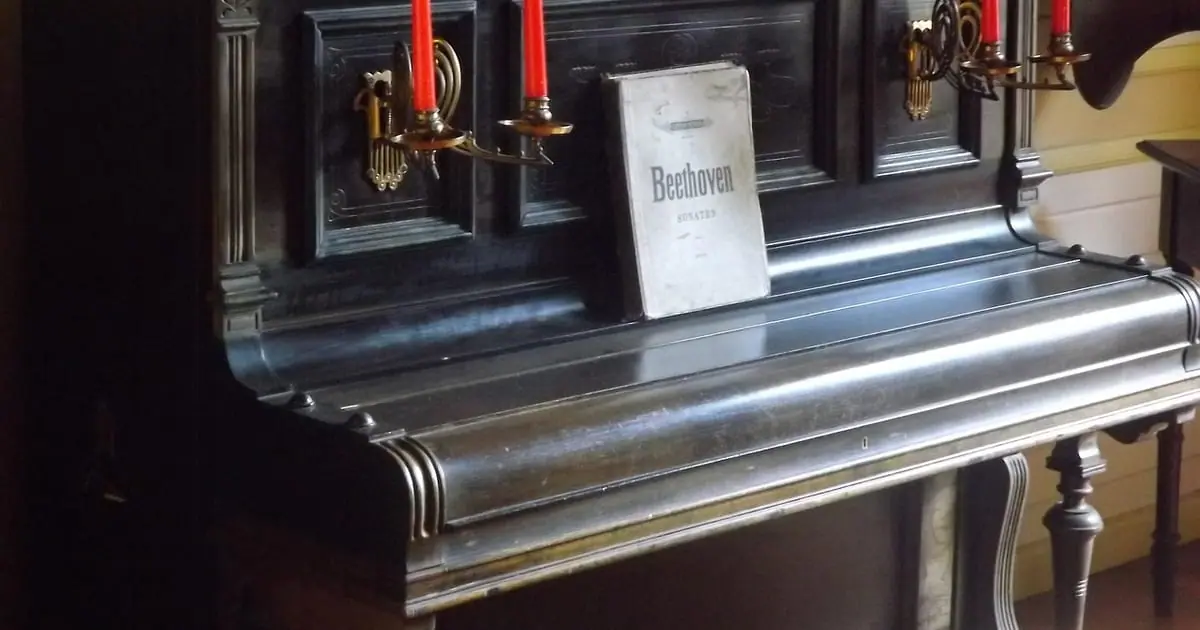
Beethoven died in Vienna on 26 March 1827, in his rooms in the Schwarzspanierhaus. In the days after, his friends searched the flat for some bonds he had left. According to Anton Schindler, his former secretary, Stephan von Breuning found a letter "together with other important documents, in a secret little drawer of a cash box" (Schindler's words as translated in Kalischer's 1909 edition of the letters). It was ten small pages, written in pencil and signed only "L." Nobody knew who it was for. It has become the most argued-over love letter in music history: Beethoven's letter to his "Immortal Beloved".
Below is the full text of the Immortal Beloved letter in a close English translation of our own, made from the German transcription of the manuscript, with Beethoven's own words beside the famous lines. After the text you'll find how scholars worked out that it was written on 6 and 7 July 1812, the women who have been put forward as the addressee, three places where the old English translations go wrong, and some notes for anyone who wants to borrow a line from it.
The letter at a glance
- Written: in three sittings, on the morning of Monday 6 July, the evening of 6 July and the morning of 7 July. Beethoven gave the day and month but no year.
- Where: the spa town of Teplitz (now Teplice, in the Czech Republic). The letter doesn't name the place; that was worked out later.
- To whom: no name, only "my angel", "my all" and, once, "meine Unsterbliche Geliebte", my Immortal Beloved. He meant to send it by the post coach to "K.", which scholars read as Karlsbad.
- Form: pencil on ten small pages, with a few words crossed out.
- Where it is now: the Staatsbibliothek zu Berlin (Berlin State Library), shelfmark Mus. ep. autogr. Beethoven 127. After Schindler died it passed to his sister, then to the Karlsbad porcelain maker August Nowotny, who gave his collection to the library in 1880.
- First printed: in 1840, in Schindler's Biographie von Ludwig van Beethoven (pp. 63–66).
The full letter in English
The translation follows the German closely, keeping Beethoven's dashes and his doubled exclamation marks, since these carry much of the feeling. Square brackets mark our additions. The German is from the transcription of the Berlin manuscript published with Sieghard Brandenburg's facsimile edition (Beethoven-Haus Bonn, 2001) and reproduced in the German Wikipedia article on the Unsterbliche Geliebte.
First sitting: Monday morning, 6 July
6 July, in the morning. —
My angel, my all, my very self. — Only a few words today, and in pencil (with yours). Not until tomorrow will my lodging be settled for certain. What a worthless waste of time over such things. — Why this deep grief, when necessity speaks? — Can our love last except through sacrifices, through not demanding everything? Can you change the fact that you are not wholly mine, and I am not wholly yours? — Oh God, look at beautiful Nature and calm your heart about what must be. — Love demands everything, and quite rightly; so it is for me with you, and for you with me. Only you forget so easily that I must live for myself and for you. If we were wholly united, you would feel this pain as little as I do.
My journey was dreadful. I did not arrive here until 4 o'clock yesterday morning. Since there were not enough horses, the post took another route, but what a dreadful road. At the last stage but one they warned me against travelling at night and made me afraid of a forest, but that only spurred me on, and I was wrong. The coach was bound to break down on that terrible road, bottomless, a mere country track. Without two such postilions as I had, I would have been left stuck on the way. Esterházy, on the other, usual road here, had the same fate with eight horses that I had with four. — Still, I took some pleasure in it again, as I always do when I get through something safely.
Now quickly from the outer to the inner. We shall probably see each other soon. Today, too, I cannot share with you the thoughts I have had about my life during these few days. If our hearts were always close together, I would have none of them. My heart is full of so much to tell you. — Ah — there are moments when I find that language is nothing at all. — Cheer up — stay my faithful, only treasure, my all, as I am yours. The gods must send the rest, what must and shall be for us. —
Your faithful Ludwig. —
Second sitting: Monday evening, 6 July
You are suffering, you my dearest creature. — I have only just found out that letters have to be posted very early in the morning. Mondays and Thursdays are the only days when the post goes from here to K. — You are suffering. — Ah, wherever I am, you are with me. I talk with myself and with you. Make it possible for me to live with you. What a life!!!! as it is!!!! without you. — Pursued here and there by people's kindness, which I mean to deserve as little as I do deserve it. — Humility of man towards man — it pains me — and when I see myself in the context of the universe, what am I, and what is he whom they call the greatest — and yet herein again lies the divine in man. — I weep when I think that you will probably not get the first news from me until Saturday. — However much you love me, I love you more still. — But never hide yourself from me. — Good night. — Since I am taking the baths, I must go to sleep. [Crossed out: "oh go with me, go with me".] Oh God, so near! so far! Is our love not a true heavenly edifice, but also as firm as the vault of heaven? —
Third sitting: Tuesday morning, 7 July
Good morning, on 7 July. — Even in bed my thoughts press towards you, my Immortal Beloved, joyful now and then, then sad again, waiting on Fate to see whether it will hear us. — I can live only wholly with you or not at all. Yes, I have resolved to wander about far away until I can fly into your arms, call myself entirely at home with you, and send my soul, wrapped in you, into the realm of spirits. — Yes, sadly, it must be so. — You will compose yourself, all the more since you know how faithful I am to you. No other can ever possess my heart, never — never. — Oh God, why must one be parted from what one loves so much? And yet my life in V[ienna], as it is now, is a miserable life. — Your love makes me the happiest and the unhappiest of men at once. — At my age now I would need some sameness, an evenness of life. Can that exist in our situation?
Angel, I have just heard that the post goes every day, and so I must close, so that you get the l[etter] at once. — Be calm. Only by calmly considering our existence can we reach our goal of living together. — Be calm — love me — today — yesterday — what tearful longing for you — you — you — my life — my all — farewell. — Oh, go on loving me. Never misjudge the most faithful heart of your beloved L.
ever yours
ever mine
ever us
Six lines, in German and in context
These are the lines people quote, with what Beethoven wrote and what was going on around them.
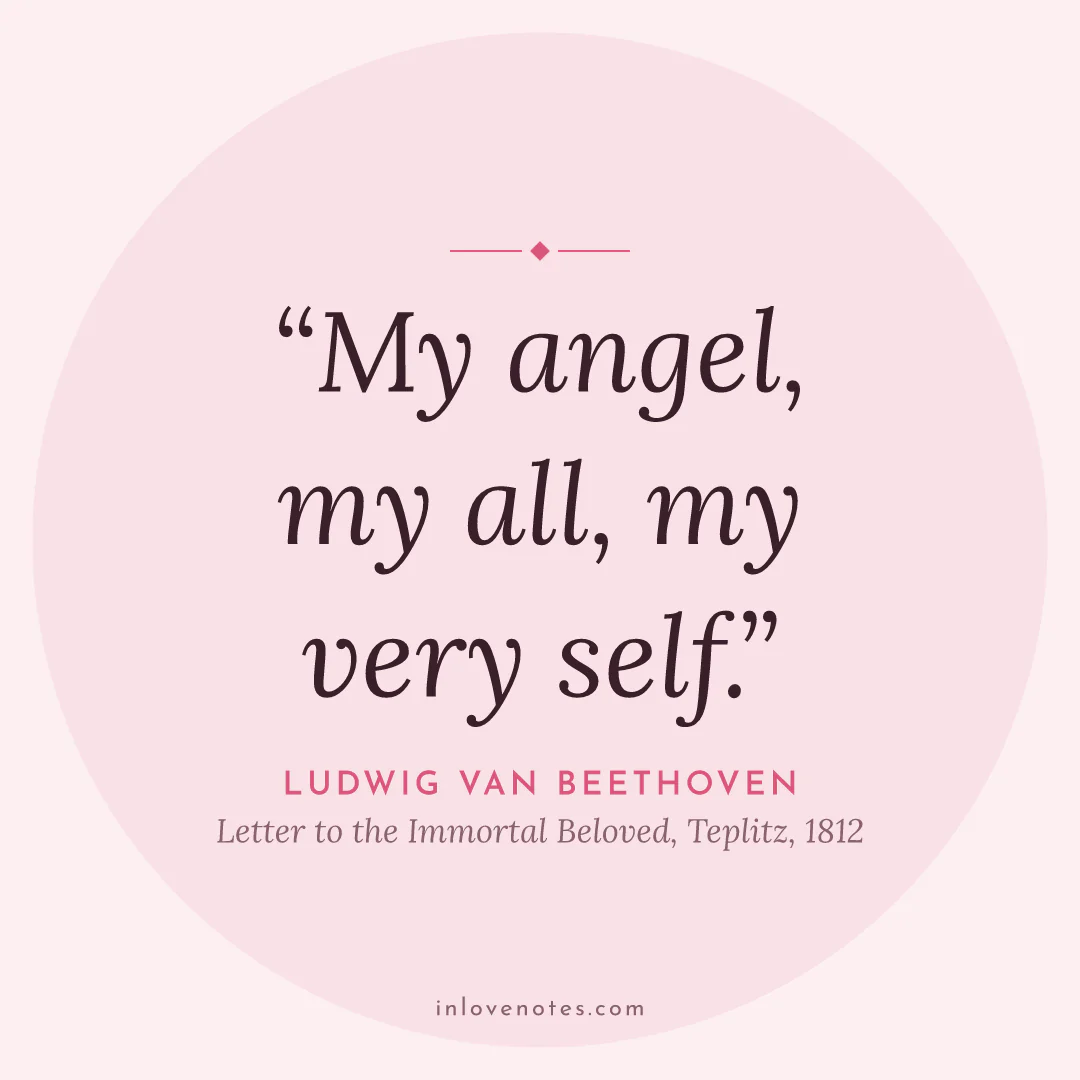
Mein Engel, mein alles, mein Ich. / My angel, my all, my very self.
Ludwig van Beethoven, letter to the Immortal Beloved, Teplitz, 6 July 1812
This is the opening, written before the post schedule and the broken coach intrude. "Mein Ich" is literally "my I". Lady Wallace's 1866 English edition made it "my second self", and Kalischer's 1909 edition made it "my very self". Either way the idea is the same: you are not beside me, you are part of who I am. Beethoven had used "Engel" and "mein Alles" before, in letters to Josephine Brunsvik between 1804 and 1809 that were only published in 1957.
Kann unsre Liebe anders bestehn als durch Aufopferungen, durch nicht alles verlangen. / Can our love last except through sacrifices, through not demanding everything?
Ludwig van Beethoven, letter to the Immortal Beloved, 6 July 1812
Readers who know only the last lines are often surprised by this. From the first paragraph, the letter is about a love that can't be completed. Beethoven tells her she is "not wholly mine" and asks her to calm herself "about what must be". Whatever the obstacle was, a marriage, money or rank, both of them already knew about it.
Es gibt Momente, wo ich finde daß die sprache noch gar nichts ist. / There are moments when I find that language is nothing at all.
Ludwig van Beethoven, letter to the Immortal Beloved, 6 July 1812
It's a striking thing for a composer to say in the middle of a ten-page letter, and it comes just after he admits he can't yet tell her what he has been thinking about his life. He doesn't explain it. The sentence opens with "Ach" and a dash, and he moves straight on to "cheer up".
Ach gott – so nah! so weit! / Oh God, so near! so far!
Ludwig van Beethoven, letter to the Immortal Beloved, evening of 6 July 1812
He wrote this at bedtime, just after a crossed-out "oh go with me, go with me". The pair "so near, so far" fits the facts as scholars reconstruct them. He had probably seen her in Prague a few days earlier, and she was now a day or two away by post coach. That is close enough to reach, yet he could not go to her.
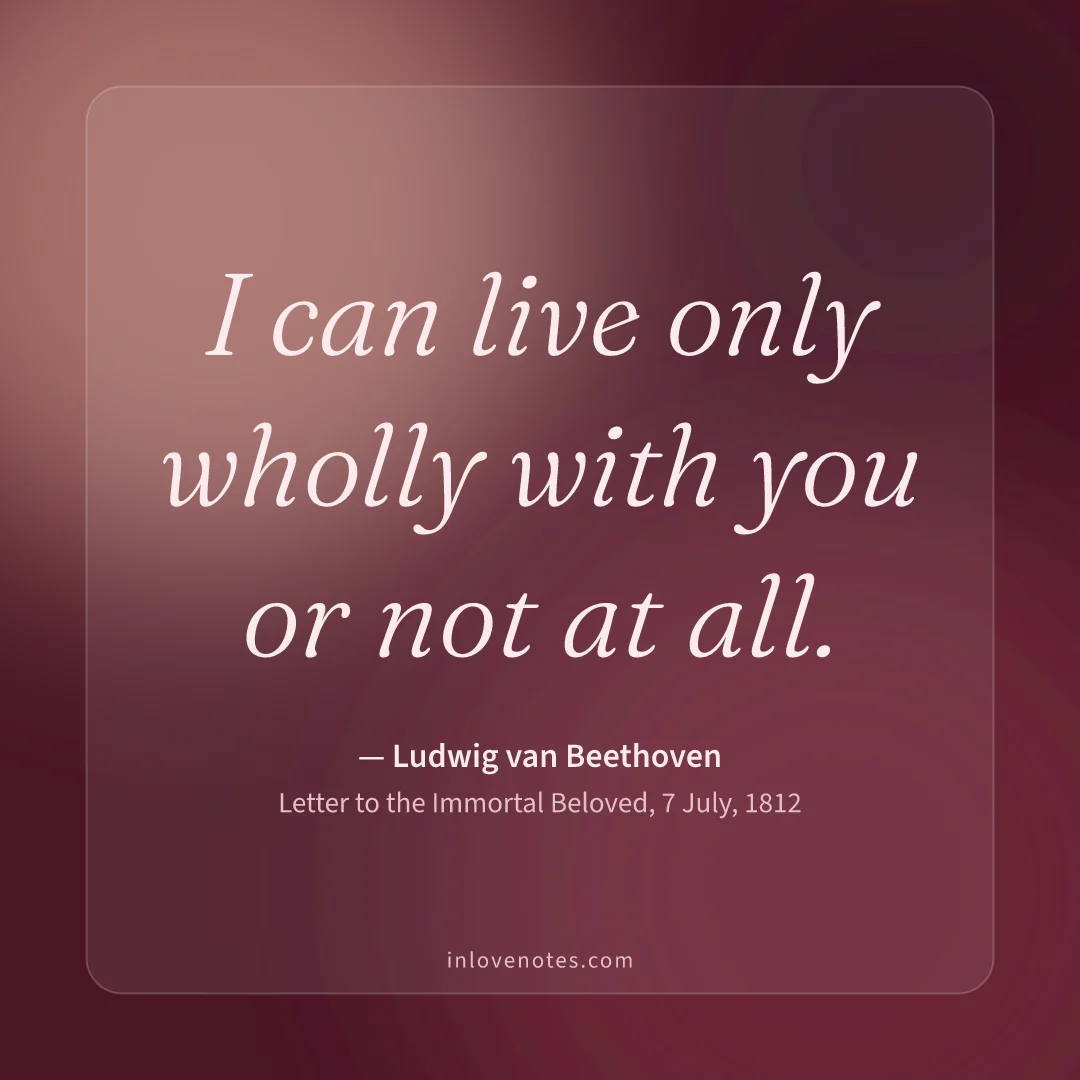
Leben kann ich entweder nur ganz mit dir oder gar nicht. / I can live only wholly with you or not at all.
Ludwig van Beethoven, letter to the Immortal Beloved, 7 July 1812
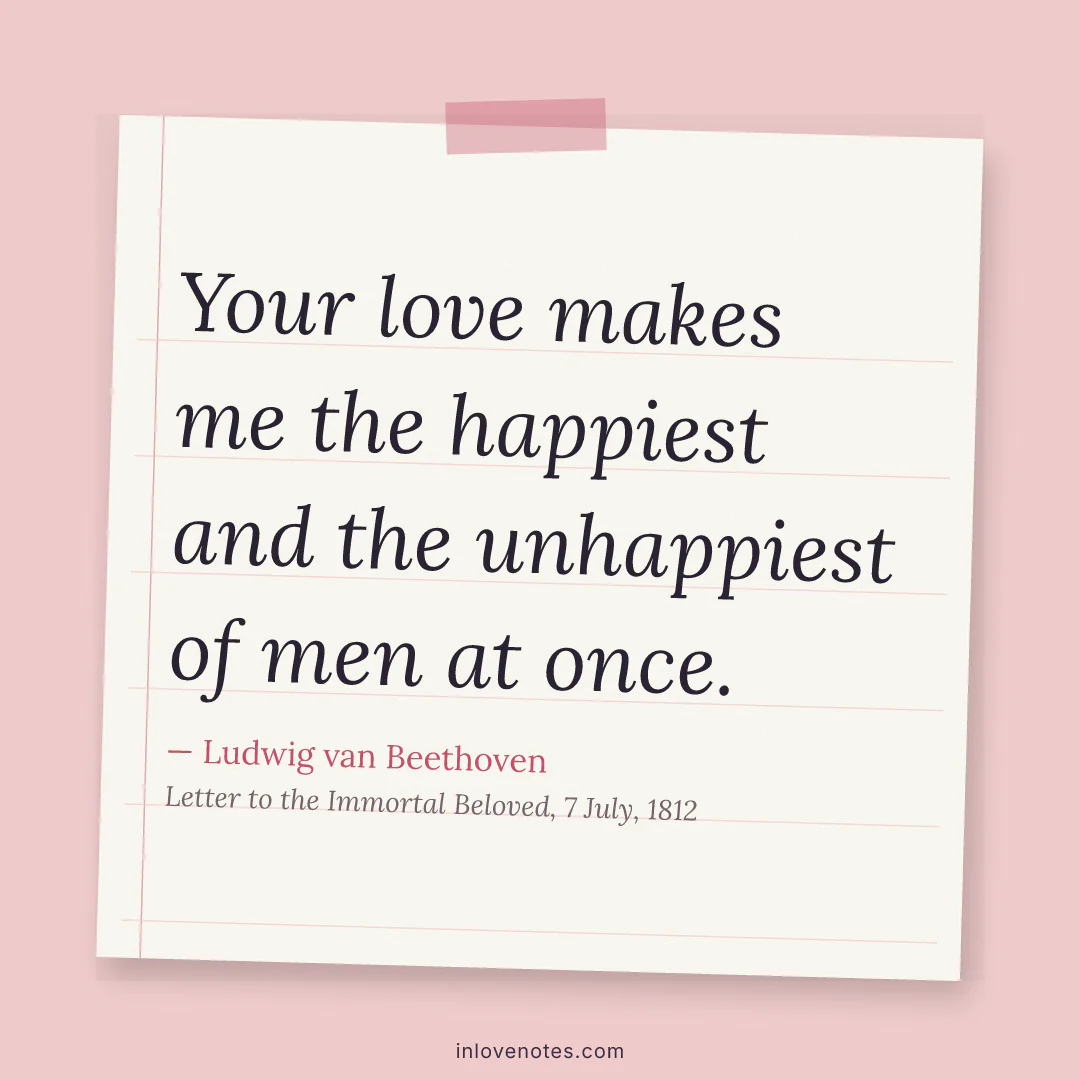
This is the most quoted line after the sign-off, and it is often read as a vow. In context it reads more like a decision to stay away: the next sentence says he will "wander about far away" until he can come to her, and then, "sadly, it must be so". The same morning he adds: "Your love makes me the happiest and the unhappiest of men at once" ("Deine Liebe macht mich zum glücklichsten und zum unglücklichsten zugleich").
ewig dein, ewig mein, ewig uns / ever yours, ever mine, ever us
Ludwig van Beethoven, letter to the Immortal Beloved, 7 July 1812
The three-line sign-off is the part people engrave on rings and write in wedding cards. Beethoven spelled the last word "unß". The best-known English version, "Ever thine. Ever mine. Ever each other's.", comes from Wallace's 1866 translation, and Kalischer's 1909 edition kept it. "Each other's" is a fair reading, but the German is shorter and stranger: just "ever us".
How the date was worked out
The letter has no year and no place. For seventy years it was printed with the wrong ones. The table shows how the date was established.
| Year | Who | What they said |
|---|---|---|
| 1840 | Anton Schindler | First prints the letter and says it was written to Countess Giulietta (Julie) Guicciardi, the dedicatee of the "Moonlight" Sonata. |
| 1840 and 1847 | Therese Brunsvik, Giulietta's cousin | In her diary (12 Nov 1840): "Three letters of Beethoven's, supposedly to Giulietta. Could they be fabrications?" On 15 Jan 1847 she adds that they must have been to her sister Josephine, "whom he loved passionately". |
| 1866 | Ludwig Nohl, in Lady Wallace's translation | Heads it "To Countess Giulietta Guicciardi. Morning, July 6, 1800". The footnote argues that "the 6th of July falls on a Monday in 1800". It doesn't: 6 July 1800 was a Sunday. (Gutenberg) |
| 1909 | A. C. Kalischer, translated by J. S. Shedlock | Still heads it "To Countess Giulietta Guicciardi" but dates it "July [1801?]". Kalischer counted "more than 70" differences between Nohl's supposedly exact text and the original. |
| 1911 | Max Unger | The post days to "K.", the bad roads and Prince Esterházy's broken coach point to Teplitz, with the letter going via Karlsbad. Goethe, at Karlsbad that week, noted almost nothing but rain in his diary. The year is 1812. |
| 1950s | Joseph Schmidt-Görg | A watermark study shows that Beethoven used this kind of paper for other letters in the summer of 1812, and at no other time. |
The weekday was the first clue, because Beethoven wrote "Monday, 6 July". 6 July fell on a Monday in 1795, 1801, 1807, 1812 and 1818. The Giulietta theory needed 1800 or 1801, and Thayer's candidate Therese Brunsvik needed 1807. Once the letter was placed in 1812, both theories fell. Giulietta had been married and living in Naples since 1803.
Who was she? The main candidates
Since Harry Goldschmidt's 1977 survey Um die Unsterbliche Geliebte, the debate has narrowed to two married women. Both were in Beethoven's circle and both had several children. The table also lists the earlier candidates and why they were dropped.
| Candidate | The case for her | The case against |
|---|---|---|
| Antonie Brentano (1780–1869), a Viennese-born wife of a Frankfurt merchant | Records place her where the letter needs her. She left Vienna on 1 July 1812, the Prager Oberpostamts-Zeitung lists her arriving in Prague on 3 July, and she then went on to Karlsbad. Argued by Maynard Solomon (1972) and backed by Klaus Martin Kopitz (2001) and others. | Solomon's case has been contested by Goldschmidt, Tellenbach, Steblin, Swafford and others. Edward Walden (2011) argues that Solomon "established requirements that he knew only his candidate could meet." |
| Josephine Brunsvik (1779–1821), widowed Countess Deym, remarried to Baron Stackelberg | Beethoven's surviving love letters to her (1804–09) use the same words: "Engel", "mein Alles". Her husband had left her by the end of June 1812, and her diary mentions a plan to go to Prague. Her daughter Minona was born on 8 April 1813, nine months after the Prague meeting. Supported by Kaznelson (1954), the Massins, Tellenbach (1983) and Steblin. | No document places her in Prague or Karlsbad in July 1812. She is not on the Vienna police list of departures for 28 June–4 July, the Prague newspaper's visitor lists or the spa registers. |
| Giulietta (Julie) Guicciardi | Schindler's choice in 1840. | She had lived in Naples since 1803, so the 1812 date rules her out. |
| Therese Brunsvik | Thayer's candidate, helped along by Mariam Tenger's 1890 "diary". | The diary was exposed as fiction, and the theory depended on dating the letter to 1807. |
| Amalie Sebald, Dorothea von Ertmann and others | A flirtation in the Bohemian spas in 1811 (Sebald); spa-list research by George Marek in 1969 (Ertmann). | Ertmann was already in Karlsbad on 25 June 1812, before the Prague meeting. Sebald is no longer seriously discussed. |
Then there is the 1994 film Immortal Beloved, written and directed by Bernard Rose, which makes her Johanna van Beethoven, his sister-in-law. That is a screenwriter's choice, not a scholarly one. Beethoven's later court battles with Johanna over her son Karl are well documented, and nothing ties her to July 1812. The musicologist Lewis Lockwood reviewed the film in The Musical Quarterly (1997) under the title "Film Biography as Travesty".
Was the letter ever sent? Nobody knows. Either Beethoven never posted it, or it was sent and later returned to him. It was among his papers when he died.
Three places the English versions disagree
Most English texts of the letter online come from the 1866 or the 1909 translation. Both are useful, and both make choices worth knowing about before you copy a line.
- "Mein Ich": Wallace has "my second self!" and Kalischer "my very self". The German is just "my I". "My second self" adds a meaning that isn't in the original, so "my very self" is the safer choice.
- "meine Unsterbliche Geliebte": Kalischer's 1909 text reads "my Beloved One" and drops "Immortal" altogether, the very word that gave the letter its name. Wallace keeps "my immortal beloved".
- "heute – gestern": Beethoven wrote "today — yesterday". Wallace turns it round to "Yesterday, to-day" and smooths the dashes into a sentence. Beethoven's dashes are part of the letter: he was writing fast, in pencil, against the post.
Borrowing his words for your own letter
The letter's lines are short and have been out of copyright for a long time, which is why they turn up in so many cards. A few points help them land well:
- For a wedding card or an engraving: "ever yours, ever mine, ever us" (or the German "ewig dein, ewig mein, ewig uns") is the safest choice. It is complete on its own and not sad out of context.
- For a partner far away: "so near! so far!" and "wherever I am, you are with me" both come from the evening sitting and fit the situation they were written in. Our long distance love letters guide has more on writing across a distance.
- Use with care: "I can live only wholly with you or not at all" can read as an ultimatum in a modern note. "Can our love last except through sacrifices" is about giving someone up. Neither belongs in a birthday card.
- Credit it properly: "Ludwig van Beethoven, letter to the Immortal Beloved, 6–7 July 1812" is accurate. "Beethoven to Giulietta Guicciardi" or "1800/1801" is the old, disproved version, and many quote sites still print it.
- Borrow the form, not just the words: what makes the letter moving is that it is written in real time, with the coach, the post days and the bedtime all in it. A letter written over a day, with the time noted at each sitting, works for anyone. Our guide on how to write a love letter walks through it.
If you like letters read in their setting, Keats's notes to Fanny Brawne, seven years later, are the English counterpart. We've dated sixteen of them in John Keats's letters to Fanny Brawne. For lines that are pinned on the wrong writer, see our misattributed love quotes page.
Questions about the Immortal Beloved letter
Who was Beethoven's Immortal Beloved?
No one knows for certain. Most scholars today pick either Antonie Brentano, who is documented in Prague and Karlsbad at the right time, or Josephine Brunsvik, to whom Beethoven had written love letters in the same words a few years earlier. Giulietta Guicciardi, the name in older books, is ruled out by the 1812 date.
When and where was the letter written?
In Teplitz (Teplice), in three sittings on 6 and 7 July 1812. The year was settled by the post route, the weather and, in the 1950s, a watermark study of the paper.
What does "ewig dein, ewig mein, ewig uns" mean?
"Ever yours, ever mine, ever us." The familiar English version "Ever thine. Ever mine. Ever each other's." is the 1866 translation by Lady Wallace.
Was the letter ever sent?
Nobody knows. It was found among Beethoven's papers after his death in March 1827. Either he never posted it, or it was returned to him.