12 French Love Quotes, Translated Word for Word and Traced to the Book
Twelve French love quotes in the original, each with a literal English translation, the book or play it comes from, and the moment it suits best.

Since the early 1900s, French jewellers have sold a small gold medallion engraved with a plus sign, a minus sign and the words qu'hier and que demain: "more than yesterday, less than tomorrow." The Lyon firm Augis made it famous, and many people who wear one think the line is by Edmond Rostand, the author of Cyrano de Bergerac. It isn't. It was written by his wife, the poet Rosemonde Gérard, and it comes from a much longer poem about growing old together. Plenty of French love quotes are like that: everyone knows the line, but few know who wrote it or what surrounds it. The twelve below appear in their original French, with a literal English translation, the book, play or poem they come from, and what they meant there. They run in date order, from a sixteenth-century essay to a 1943 children's book, so you can also read them as a short history of how France has written about love.
The moralists: 1580 to 1678
Before the novelists came the essayists and the writers of maxims. They were clever, dry and often unflattering about lovers. Their lines are short, which makes them good on a card. Some of them sting, though, so read the context before you copy one out.
1. Montaigne, on why he loved his friend
Si on me presse de dire pourquoi je l'aimais, je sens que cela ne se peut exprimer qu'en répondant : Parce que c'était lui, parce que c'était moi.
Michel de Montaigne, Essais, Book I, chapter 28, "De l'amitié" (1595 edition)
Translation: "If I am pressed to say why I loved him, I feel it can only be expressed by answering: because it was he, because it was I."
This is the most quoted answer in French to "why do you love me?", but Montaigne was writing about a friend: the young magistrate Étienne de La Boétie, who died in 1563. The famous answer is a handwritten addition. Montaigne wrote it in the margin of his own printed copy of the Essais, now called the Bordeaux copy, and it was first printed in the edition published in 1595, after his death. It still works perfectly for a partner. Just know you are borrowing a line about friendship, which some couples will like even more.
2. Pascal, on the heart's reasons
Le cœur a ses raisons que la raison ne connaît point.
Blaise Pascal, Pensées (published 1670), fragment 277 in the Brunschvicg numbering
Translation: "The heart has its reasons, which reason does not know." (W. F. Trotter's English translation reads the same.)
Pascal died in 1662 and left these notes unfinished. His family published them in 1670. In the fragment, the next sentence turns to God: "I say that the heart naturally loves the Universal Being." The fragment after it begins "It is the heart which experiences God, and not the reason." So the line is about faith first. Love borrowed it later. As a love quote it suits a relationship nobody around you expected, or one you can't explain and don't want to.
3–5. La Rochefoucauld, three maxims
Il n'y a que d'une sorte d'amour, mais il y en a mille différentes copies.
François de La Rochefoucauld, Maximes, no. 74 (1678 edition)
Translation: "There is only one kind of love, but there are a thousand different copies of it."
Il y a des gens qui n'auraient jamais été amoureux s'ils n'avaient jamais entendu parler de l'amour.
François de La Rochefoucauld, Maximes, no. 136 (1678 edition)
Translation: "There are people who would never have fallen in love if they had never heard love talked about."
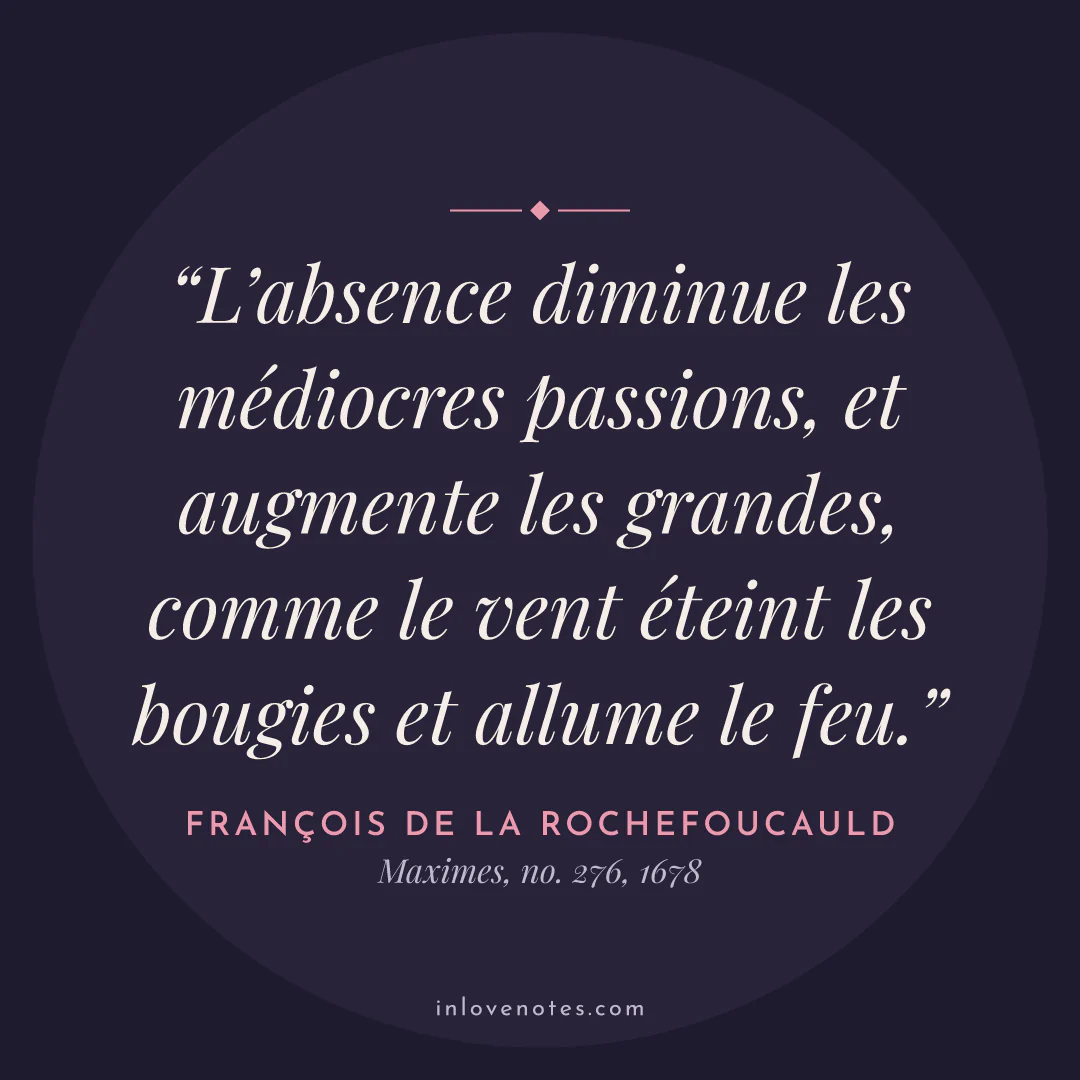
L'absence diminue les médiocres passions, et augmente les grandes, comme le vent éteint les bougies et allume le feu.
François de La Rochefoucauld, Maximes, no. 276 (1678 edition)
Translation: "Absence lessens ordinary passions and increases great ones, as the wind blows out candles and fans a fire."
La Rochefoucauld published his maxims in 1665 and kept revising them until the fifth edition of 1678, whose numbering is the one cited today. Look closely at the first line: the original says que d'une sorte. Most websites quietly modernise it to qu'une sorte. The second maxim is a joke at the expense of romantic novels, and it is a good one to share with someone who reads too many of them. The third is the classic French line for a long-distance relationship. It flatters the couple writing to each other, because it implies their love is the fire, not the candle.
The Romantic century: 1834 to 1874
In the nineteenth century French love writing got warmer and much less guarded. These three lines come from a play, a novel and a song-like poem, and all three are about choosing love despite the cost.
6. Musset, on being hurt and loving anyway
On est souvent trompé en amour, souvent blessé et souvent malheureux ; mais on aime, et quand on est sur le bord de sa tombe, on se retourne pour regarder en arrière, et on se dit : J'ai souffert souvent, je me suis trompé quelquefois, mais j'ai aimé.
Alfred de Musset, On ne badine pas avec l'amour, Act II, scene 5 (1834)
Translation: "We are often deceived in love, often hurt and often unhappy; but we love, and when we stand at the edge of the grave we turn round to look back and say to ourselves: I have often suffered, I have sometimes been wrong, but I have loved."
Perdican says this to his cousin Camille at the end of their quarrel in the second act. Camille has been taught in her convent that men are not to be trusted. Musset wrote the play in 1834, the year his affair with the novelist George Sand fell apart. Arvède Barine's 1893 biography of Musset quotes the speech in full in its chapter on his plays. It is too long for a card. Read aloud, though, it makes a strong wedding or anniversary reading, especially for a couple who have already been through something hard.
7. Victor Hugo, on what is enough
Aimer ou avoir aimé, cela suffit. Ne demandez rien ensuite.
Victor Hugo, Les Misérables, Part 5 ("Jean Valjean"), Book 6, chapter 2 (1862)
Translation: "To love or to have loved, that is enough. Ask for nothing more."
The sentence comes right after the wedding of Marius and Cosette, in a passage where the narrator steps out of the story to praise married love. The rest of the paragraph matters: "Love is the only ecstasy. … To love is a fulfilment." Because of "or to have loved", the line also fits a memorial or a sympathy card. It doesn't promise that love lasts. It says that having loved was already enough.
8. Verlaine, the poem that is a gift
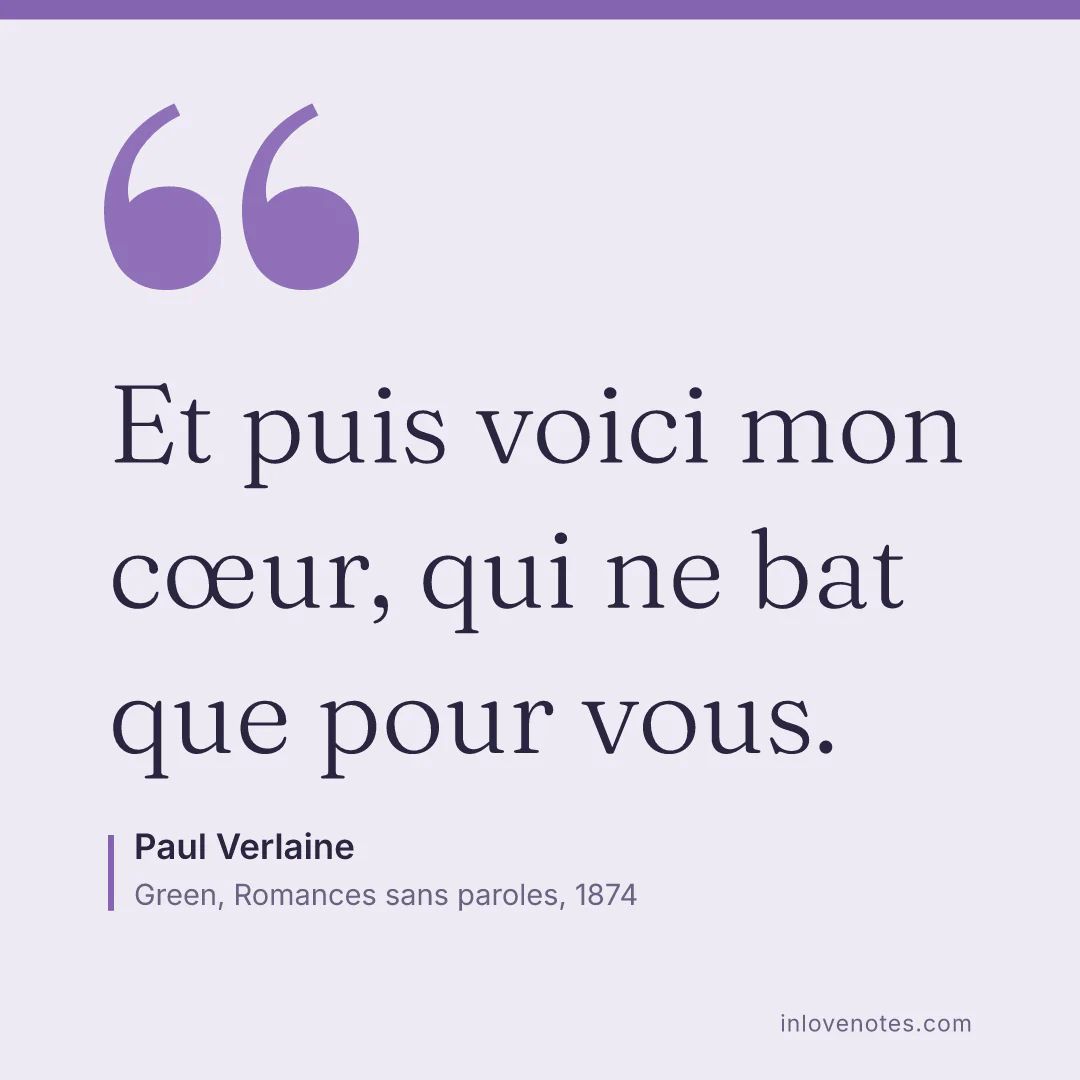
Voici des fruits, des fleurs, des feuilles et des branches, / Et puis voici mon cœur, qui ne bat que pour vous.
Paul Verlaine, "Green", Romances sans paroles (1874)
Translation: "Here are fruits, flowers, leaves and branches, / And then here is my heart, which beats only for you."
"Green" sits in the "Aquarelles" section of a collection that came out in 1874 while Verlaine was in prison in Belgium. He had shot and wounded Arthur Rimbaud in Brussels the year before. The poem itself is gentle, a lover arriving with an armful of gifts and asking to rest. Debussy and Fauré both set it to music, so there are recordings you can play. The line is easy to use: write it on the tag of a bouquet. Note the formal vous. It is courtly here, not cold.
Belle Époque: two lines from the Rostand household
The next two lines were written by a married couple. Rosemonde Gérard and Edmond Rostand married in 1890. Her line gets credited to him so often that it's worth printing both side by side.
9. Rosemonde Gérard, more than yesterday
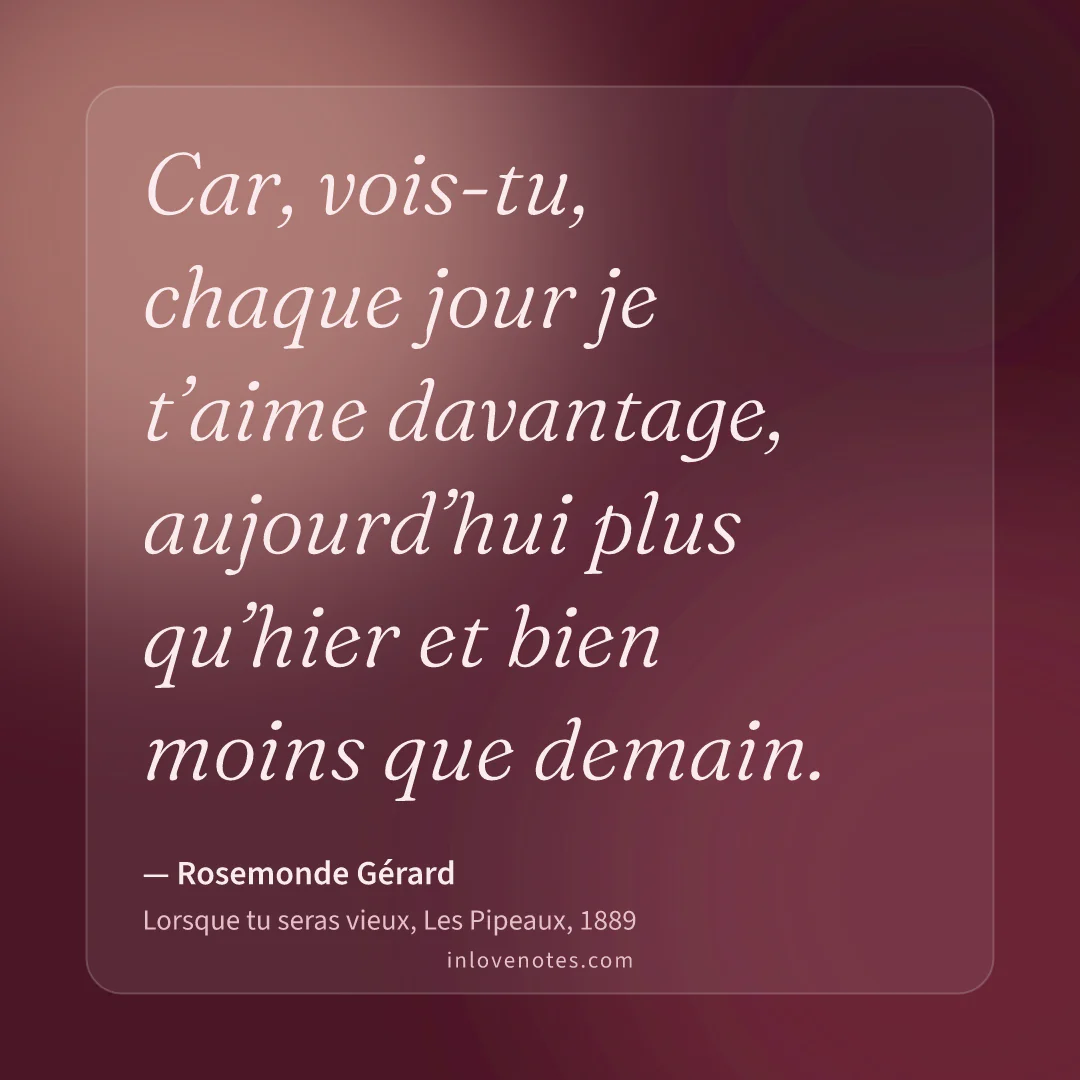
Car, vois-tu, chaque jour je t'aime davantage, / Aujourd'hui plus qu'hier et bien moins que demain.
Rosemonde Gérard, "Lorsque tu seras vieux", Les Pipeaux (Paris: Lemerre, 1889)
Translation: "For, you see, each day I love you more, / Today more than yesterday and far less than tomorrow."
The poem is often reprinted as "L'Éternelle chanson" ("The Eternal Song"). It begins "Lorsque tu seras vieux et que je serai vieille" ("When you are old and I am old") and pictures the couple on the same mossy bench years later, wrinkles and all. That is why it suits a long marriage better than a new crush. The couplet appears twice in the poem, and the second time it opens with "Car, vois-tu", the version quoted here. The jeweller's medallion shortens it to the last half-line. You can do the same: plus qu'hier, moins que demain fits on the inside of a ring.
10. Rostand, what a kiss is
Un baiser, mais à tout prendre, qu'est-ce ? / Un serment fait d'un peu plus près, une promesse / Plus précise, un aveu qui veut se confirmer, / Un point rose qu'on met sur l'i du verbe aimer.
Edmond Rostand, Cyrano de Bergerac, Act III, scene 10 (1897)
Translation: "A kiss, when all is said, what is it? / An oath taken a little closer, a promise / More precise, a confession that wants to be confirmed, / A rosy dot placed on the i of the verb aimer."
This is the balcony scene. Cyrano stands in the dark under Roxane's window and speaks for the handsome Christian, who can't find the words. Roxane keeps telling him to be quiet, and he keeps going. The "rosy dot on the i" only works in French, because aimer ("to love") has an i. In translation, keep the French verb in italics, as above, and the image survives.
The twentieth century: Saint-Exupéry
Both of the last two lines are by the aviator and writer Antoine de Saint-Exupéry, who disappeared on a reconnaissance flight in 1944. His books are still under copyright in France, so we quote only these short passages.
11. Looking in the same direction
Aimer ce n'est point nous regarder l'un l'autre mais regarder ensemble dans la même direction.
Antoine de Saint-Exupéry, Terre des hommes (1939), final chapter, "Les Hommes"
Translation: "Love does not consist in gazing at each other, but in looking together in the same direction." (The 1939 English edition, Wind, Sand and Stars, is not a word-for-word translation, so its wording varies.)
This is the favourite French line for wedding programmes. In the book, though, the next sentence is about comradeship: "There are no comrades unless they are joined on the same rope, climbing toward the same summit." Saint-Exupéry was describing pilots and friends bound by a shared task. That's why it works so well for a couple who build something together, such as a house, a business or a family. It works less well for a first date.
12. The fox's secret
On ne voit bien qu'avec le cœur. L'essentiel est invisible pour les yeux.
Antoine de Saint-Exupéry, Le Petit Prince, chapter XXI (1943)
Translation: "One sees clearly only with the heart. What is essential is invisible to the eye."
The fox gives this "secret" to the little prince as they part, just after teaching him what it means to tame someone, to make them unique in the world. The book first came out in New York in 1943, in French and English editions at the same time. It is the best-known French sentence about love that never uses the word, and that's why it suits a card for someone who is shy about saying it directly.
Which line for which moment
The same twelve lines, sorted by the occasion they suit best. "Short" means it fits on a small card or an engraving.
| Moment | Line | Length |
|---|---|---|
| Anniversary of a long marriage | Gérard, "plus qu'hier, moins que demain" | Short |
| Wedding programme or toast | Saint-Exupéry, "regarder ensemble dans la même direction" | Medium |
| Reading at a wedding or vow renewal | Musset, "mais j'ai aimé" | Long |
| Long-distance relationship | La Rochefoucauld, maxim 276 (absence and the fire) | Medium |
| Flowers or a gift tag | Verlaine, "voici mon cœur" | Short |
| "Why do you love me?" | Montaigne, "parce que c'était lui, parce que c'était moi" | Short |
| A love nobody expected | Pascal, "le cœur a ses raisons" | Short |
| A shy or understated person | Saint-Exupéry, "l'essentiel est invisible pour les yeux" | Short |
| Sympathy or memorial card | Hugo, "aimer ou avoir aimé, cela suffit" | Short |
| A playful note before a date | Rostand, "un point rose sur l'i du verbe aimer" | Medium |
| A couple sure no love was ever like theirs (with a wink) | La Rochefoucauld, maxim 74 (one love, a thousand copies) | Short |
| Teasing a romance reader | La Rochefoucauld, maxim 136 | Medium |
Putting French on a card without a slip
A quotation in a language your partner doesn't speak can feel lovely or a little showy. What usually tips it one way or the other is whether you get the small things right and add something of your own.
- Keep the accents and the œ. Cœur (heart) is spelled with the joined œ, and même, été and à all need their accents. A missing accent is the first thing a French speaker will notice.
- Know your tu and vous. Couples use tu (je t'aime). The vous in Verlaine is poetic and courtly. Don't mix the two in a message you write yourself.
- "Je t'aime bien" is weaker than "je t'aime". Adding bien ("well") turns "I love you" into "I like you". Je t'adore looks stronger but is often said to friends too.
- Get the endings right. Mon chéri is for a man, ma chérie for a woman. Mon amour works for anyone.
- Give the translation. Write it underneath in smaller letters, or say it when they open the card. Don't make them look it up.
- Add one sentence of your own. The quotation sets the mood. Your sentence is what they will remember. Our guide to writing a love letter has more on that part.
Three examples of how that looks. These are written by our editors, not quotations:
- "Plus qu'hier, moins que demain." Twenty-two years, and Gérard still has it right: today more than yesterday. Happy anniversary.
- "Voici des fruits, des fleurs, des feuilles et des branches, et puis voici mon cœur." Here are the flowers. You already have the rest.
- "L'absence diminue les médiocres passions, et augmente les grandes." Absence blows out candles and fans fires. Eleven days until I see you, and I think we're the fire.
Lines that need an asterisk
Three popular "French love quotes" need care before you print them:
- "Il n'y a qu'un bonheur dans la vie, c'est d'aimer et d'être aimé" ("There is only one happiness in life, to love and be loved") is everywhere under George Sand's name, often with a date of 1862. We could not find it in a book or a dated letter of hers, so on this page it can only be "commonly attributed to George Sand (no primary source located)". If you have the letter, our misattribution page explains how to send us a correction.
- "Plus qu'hier, moins que demain" is Rosemonde Gérard's, not Edmond Rostand's (see no. 9).
- "Parce que c'était lui, parce que c'était moi" and "Le cœur a ses raisons" are genuine, but neither was written about romance. One is about a friend, the other about faith. Using them for love is fine. Just don't claim the author meant it that way.
If you like this kind of line, our Italian quotes for love and marriage do the same thing for Italian, with translations and sources.
FAQ
What is the most romantic thing to say in French?
The simplest is still the best: "Je t'aime" ("I love you"). Don't add "bien", which makes it "I like you". For something longer, Rosemonde Gérard's "aujourd'hui plus qu'hier et bien moins que demain" ("today more than yesterday and far less than tomorrow") is the line French couples engrave on jewellery.
What is a beautiful French saying about love?
The most quoted are Pascal's "Le cœur a ses raisons que la raison ne connaît point" ("The heart has its reasons, which reason does not know", Pensées, 1670) and Saint-Exupéry's "On ne voit bien qu'avec le cœur" ("One sees clearly only with the heart", Le Petit Prince, 1943). Both are sourced above.
Is "Le cœur a ses raisons" about romantic love?
Not originally. In Pascal's Pensées the line leads into an argument about faith: the following fragment begins "It is the heart which experiences God, and not the reason." Readers have used it for love for centuries, and that's fine, as long as you don't say Pascal meant it that way.