Open When Letters: Label Ideas, Sample Letters and How to Make a Set
How many open when letters to write, label ideas for a boyfriend, girlfriend, best friend or long distance, three sample letters, and what to put inside.
On 14 July 1861, a week before the First Battle of Bull Run, Major Sullivan Ballou of the 2nd Rhode Island sat down in camp near Washington and wrote to his wife Sarah "a few lines, that may fall under your eye when I shall be no more." It was, in effect, a letter with an instruction on the envelope: read this if I do not come back. Ballou was mortally wounded at Bull Run, and the letter is said to have been found in his trunk afterwards. The modern "open when" letter is a much happier descendant of that idea: a bundle of sealed envelopes, each labelled with the moment it is meant for, so your words arrive exactly when they are needed. Below are the questions people ask most about making a set, answered in order, with label ideas, sample letters you can adapt, and a few lines from real letter writers on why the format works.
What is an "open when" letter, exactly?
It is a short letter sealed in an envelope that carries a condition instead of an address: "Open when you can't sleep," "Open when you miss me," "Open when you get the job." The person keeps the set and opens each one only when its moment comes. Some envelopes may never be opened, which is part of the charm. The gift says I thought ahead about your bad nights and your good news.
We could not find a documented inventor of the format. It circulates as a handmade gift on craft blogs and social media, and is especially popular with couples about to spend time apart, friends leaving for college, and parents sending a child to camp. What is documented is much older: people have always written letters meant to be read later, under a condition. Ballou's is the best-known example in American history.
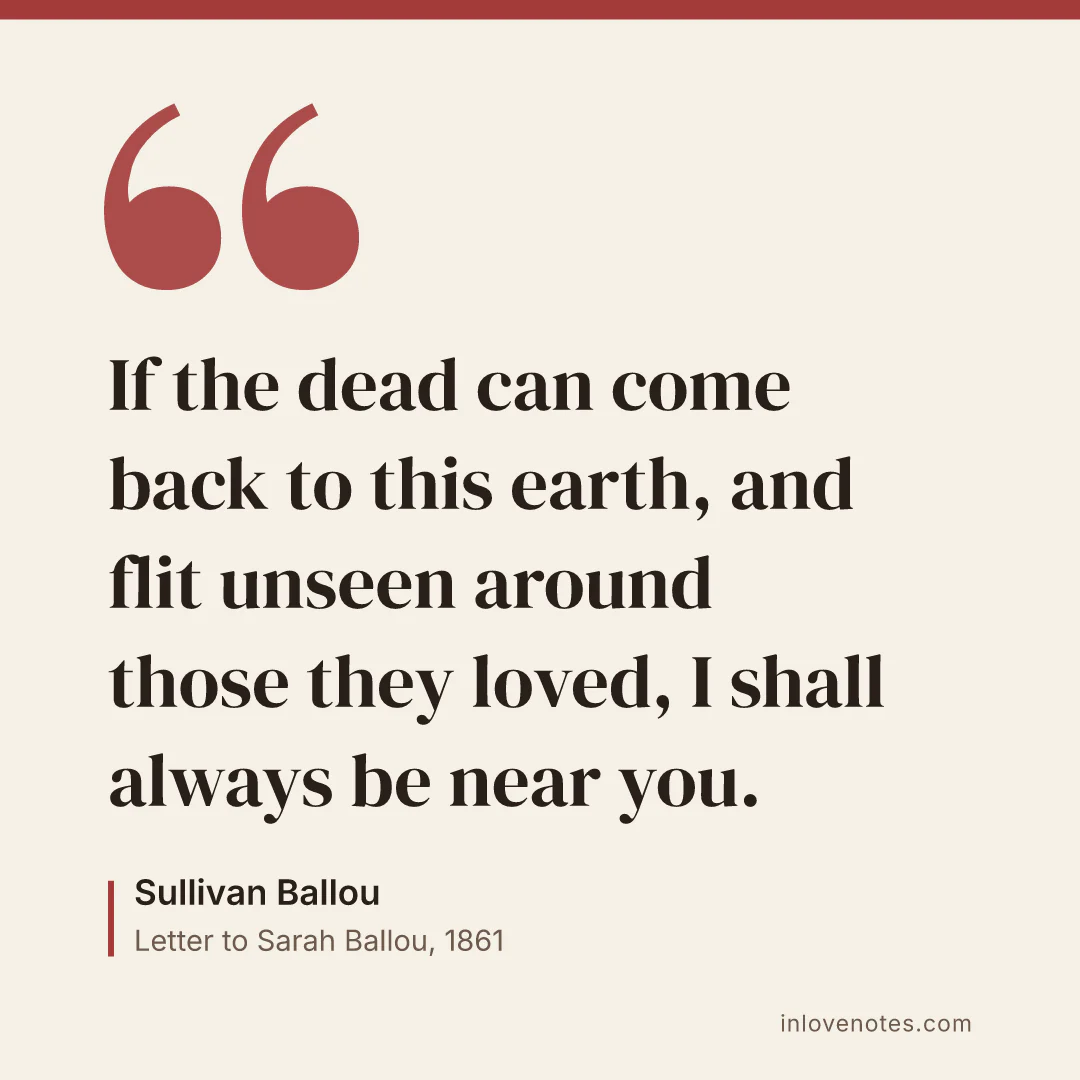
But, O Sarah, if the dead can come back to this earth, and flit unseen around those they loved, I shall always be near you in the garish day, and the darkest night amidst your happiest scenes and gloomiest hours always, always.
Sullivan Ballou, letter to Sarah Ballou, Camp Clark, Washington, D.C., 14 July 1861
The full text is published by the National Park Service. The letter reached a wide audience in 1990, when an abridged version was read in Ken Burns' documentary The Civil War. Ballou did what a good "open when" letter does: he imagined the exact situation his reader would be in ("your happiest scenes and gloomiest hours") and wrote to that moment, not to the world in general. Your envelopes will be about much lighter things, but that is the skill to borrow. Picture the person holding the envelope, then write to them in that moment.
How many letters should be in a set?
Fewer than you think. A set of eight thoughtful letters beats thirty rushed ones, and the person will open the first few within days. Match the size to how long the gift has to last:
| Set size | Good for | How to pace it | Writing time, roughly |
|---|---|---|---|
| 3–5 | A short trip, a hospital stay, exam week | All "moment" labels (bad day, can't sleep, before the exam) | One evening |
| 8–12 | A birthday or anniversary gift; the first months of long distance | Mix of feelings (sad, happy, bored) and milestones | Two or three evenings |
| 12, one per month | A year apart (deployment, study abroad) | Label by month ("Open in March") plus two or three emergency envelopes | A week or more |
| 20 or more | Big send-offs, or a set written by several friends together | Split the labels between writers so nobody repeats | Shared over a few weeks |
If you are short on time, write the envelopes for the hard moments first. Those are the ones people remember.
What should the labels say?
Good labels are specific enough that the person knows when they have arrived at that moment. "Open when you're sad" is fine; "Open when the day went wrong before lunch" is better, because it makes them smile before they have even opened it. Choose a handful from each group below rather than all from one.
Ordinary days
- Open when you need a laugh
- Open when you're bored
- Open when it's raining and you have nowhere to be
- Open when you're making coffee on a Sunday
- Open when you hear our song
- Open when you want to know how much I love you
Hard nights
- Open when you can't sleep
- Open when you've had a bad day
- Open when you're sick in bed
- Open when you feel like you're not good enough
- Open when we've had a fight
- Open when you're stressed about money, work, or exams
Missing each other
- Open when you miss me
- Open when you need a hug and I'm not there
- Open when you're counting the days
- Open when you're at the airport
- Open the night before we see each other again
Milestones
- Open on your birthday
- Open on our anniversary
- Open when you get good news
- Open on your first day at the new job
- Open when you move into the new place
- Open on New Year's Eve
Playful ones
- Open when you need proof I'm thinking about you (fill it with a list of every time you did)
- Open when you want to argue with me (one side of a debate you both enjoy)
- Open when you're hungry (a recipe, or a takeaway voucher)
- Open when you've opened all the others
What do you actually write inside one?
Most "open when" letters are short, between a few lines and one side of a card. A reliable shape has four parts:
- Name the moment. Show that you know where they are: "So it's 2 a.m. and you're still awake."
- Say the one true thing. One reassurance, one compliment, or one reason, in plain words. Don't try to fit everything in.
- Give them something to do. A small action turns a letter into company: make tea, look at the photo inside, call me, write three good things down.
- Close with the next thing. A plan, a date, a promise. "Twelve more sleeps" lands better than "goodbye."
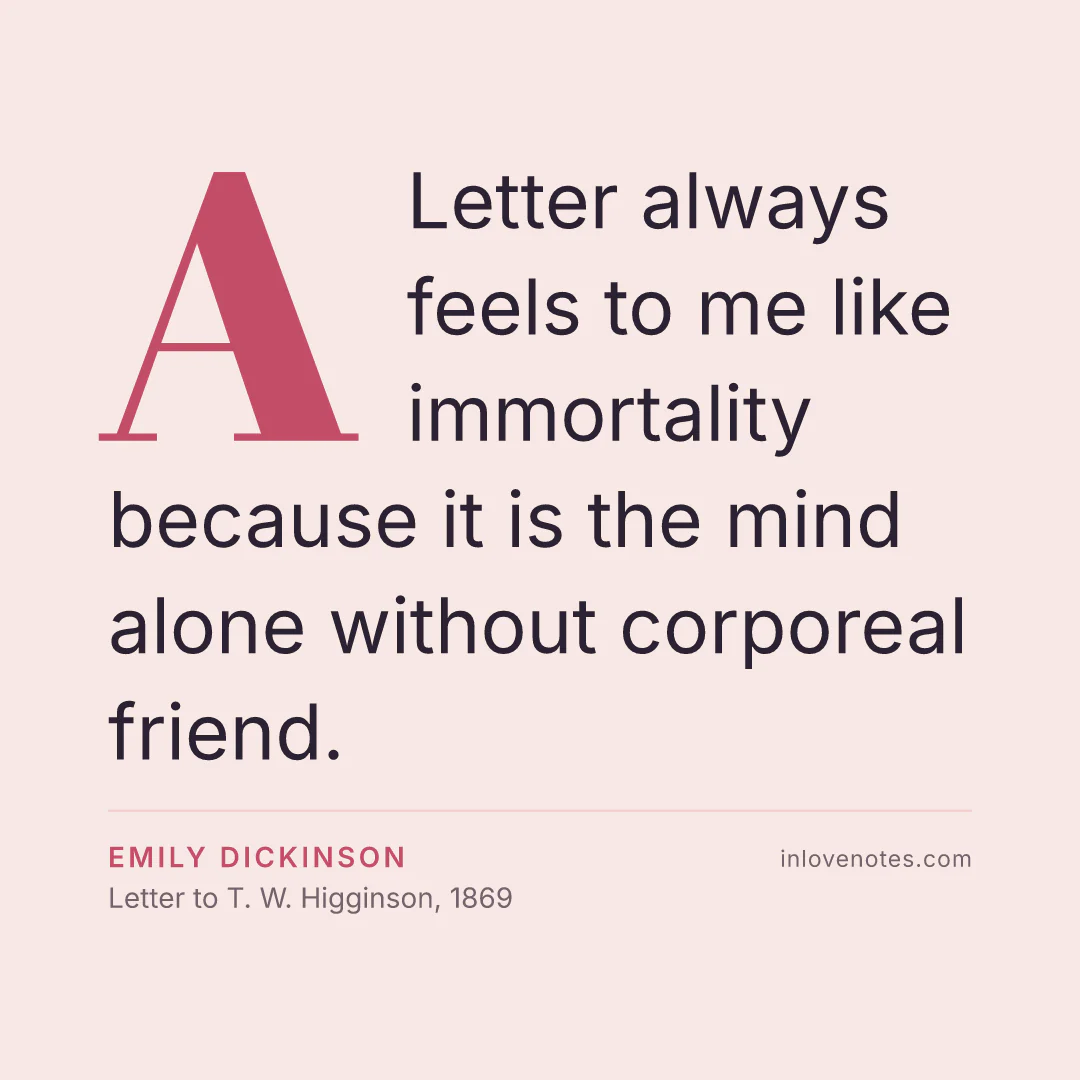
Emily Dickinson put the reason this works into one sentence in a letter to her mentor, the writer Thomas Wentworth Higginson:
A Letter always feels to me like immortality because it is the mind alone without corporeal friend.
Emily Dickinson, letter to Thomas Wentworth Higginson, June 1869 (Letter 330)
At that point the two had corresponded for seven years without meeting. Higginson had written of wanting to see her, and Dickinson, who rarely left home, answered that she would be glad if he could come "so far as Amherst." Her opening line explains why the correspondence had worked so well without a meeting: a letter carries the mind with nothing else in the way. An "open when" letter gets the same advantage. You can say the encouraging thing without being interrupted, without your voice catching, and at the exact moment it is needed. The Emily Dickinson Museum notes that she used almost the same sentence again in late 1882, in a letter to James D. Clark, so it was a conviction and not a passing phrase.
Here are three short samples written by our editors to show the shape. Swap the bracketed parts for your own details, because the details are what make it yours.
Open when you can't sleep
Hey, night owl. If you're reading this, it's late and your brain won't switch off. Here is your only job for the next ten minutes: put the phone face down, drink some water, and read this slowly. You did enough today. Whatever is circling in your head will still be there at breakfast, and it will be smaller in daylight. I'm asleep somewhere thinking nothing, and in [number] days I'll be close enough to tell you this in person. Breathe out. Now go to sleep. [Your name]
Open when you miss me
I miss you too, probably at this exact minute. Here is what to do: put on [our song], look at the photo in this envelope, and send me one word, any word, so I know you opened this one. Missing someone this much only happens when there is a lot to miss, so take it as good news. [Date of the next visit] is coming. Love, [name]
Open when you get good news
YES. I don't even know what happened yet and I'm already proud of you. Call me before you tell anyone else, because I want to hear it in your voice. Then go and celebrate properly; you earned this. I always knew you would. [Name]
For longer letters, especially an anniversary envelope, our guide to writing a love letter walks through the full process, and this comparison of openings and sign-offs helps with the first and last lines.
Do the labels change for a boyfriend, a girlfriend, a best friend or long distance?
The format is the same; the emphasis shifts. This is how the most-searched versions differ:
| For | Labels that work best | Tone | Extra worth adding |
|---|---|---|---|
| A boyfriend or husband | Before a big game or interview, when you're stressed about work, when you think you messed up | Direct and specific; name what you admire | A voucher for something you'll do together |
| A girlfriend or wife | When you doubt yourself, on a lazy Sunday, when you need to feel beautiful | Warm and detailed; quote things she has said | A pressed flower, a photo, a playlist |
| A best friend | When you get dumped, when you need someone on your side, when you're homesick | Funny first, sincere second | An inside joke, a list of your best days together |
| Long distance | When you miss me, at the airport, the night before we see each other, when the time difference is unbearable | Forward-looking; always mention the next visit | Something that smells or feels like you |
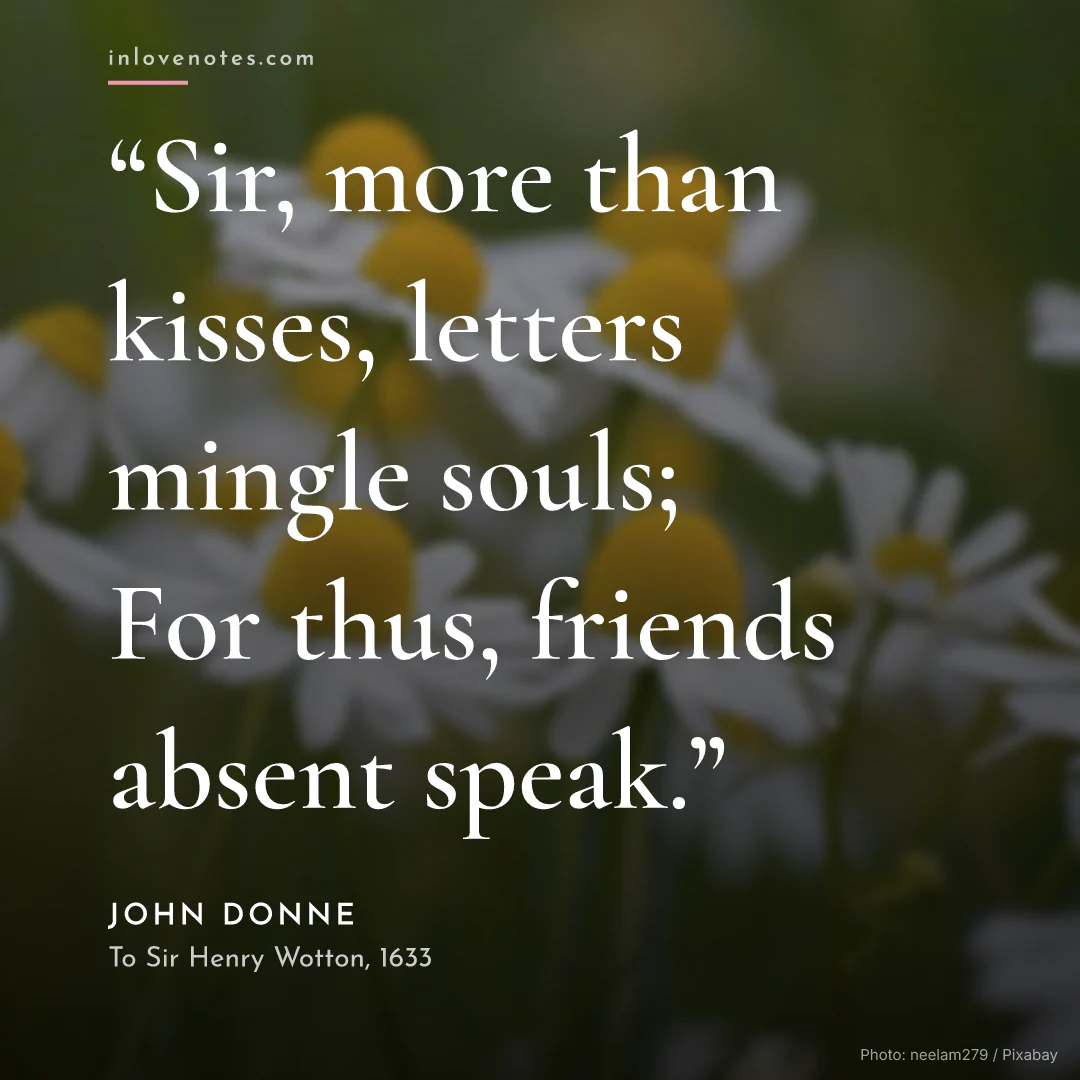
For long distance especially, letters do something calls and texts don't: they stay in the room. John Donne made that point in a verse letter to his friend Henry Wotton, written in the late 1590s:
Sir, more than kisses, letters mingle souls; / For thus, friends absent speak.
John Donne, "To Sir Henry Wotton", first printed in Poems, 1633
Donne was writing to a friend, not a lover, but the second line is the whole case for an "open when" set: it is how people who are apart keep talking. The first line is a deliberate overstatement, and that makes it a good line to copy onto the outside of a long-distance bundle or the "open when you miss me" envelope.
If you want a full letter rather than a short note for him, see our sample love letters for him, by occasion. For her, the long messages taken from real love letters give you lines to borrow for the anniversary envelope.
What can go in the envelope besides the letter?
A small object makes the moment physical. Keep it flat and light enough to post if you are mailing the set.
- Can't sleep: a chamomile tea bag, a short audio message (QR code to a private link), a lavender sachet.
- Bad day: a chocolate square, a list of "ten things you did right this month," a coupon for a phone call at any hour.
- Miss me: a photo of the two of you, a few drops of your perfume or cologne on the paper, a ticket stub you both kept.
- Bored: a crossword you made, a quiz about yourself, a list of films to watch "together" on a call.
- Celebration: confetti (warn them), a party popper, a gift card for a dinner out.
- Sick: a sachet of soup or a takeaway voucher, a list of comfort shows, a "get well" drawing.
Is it better to write them yourself or buy a pre-written set?
Pre-written and printed "open when" sets exist, and they are fine as envelopes and prompts. But the reason the gift works is that the words inside are clearly yours. A good compromise: buy or print the envelopes and labels, then handwrite every letter. If you are stuck, take a prompt from the lists above and write three honest sentences. Short and personal beats long and generic.
How do you put the set together and hand it over?
- Choose the labels first, then write the letters, then decide what goes inside. Doing it in that order stops you writing the same letter five times.
- Use one colour of envelope per group (blue for hard nights, yellow for celebrations) so they can find the right one quickly at 2 a.m.
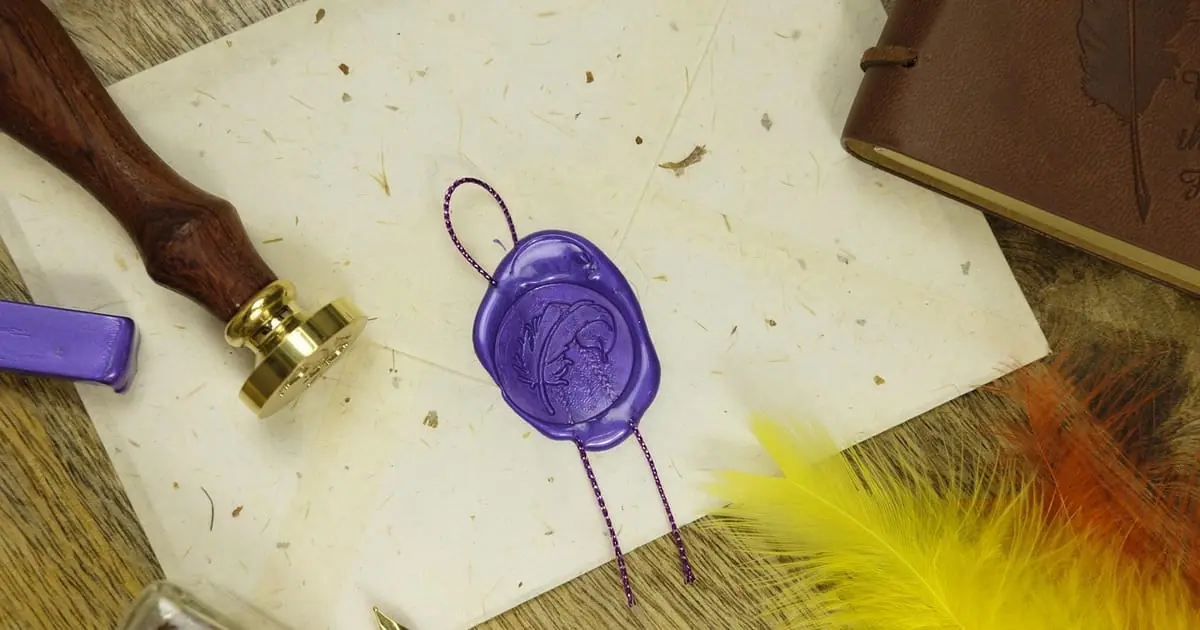
- Seal each one properly. Wax, washi tape or a sticker all work. The seal is the promise not to peek.
- Add a cover card with the one rule: "Only open each envelope when it's true."
- Store them together in a box, a ribbon-tied bundle or a shoebox you have decorated, so the set feels like one gift.
- Hand them over in person if you can, ideally just before the time apart starts. If you are posting them, number the outside so you can tell whether anything went missing.
What makes an "open when" letter fall flat?
- Every letter says the same thing. If "Open when you're sad" and "Open when you miss me" could swap envelopes, rewrite one.
- The label promises more than the letter gives. "Open when you need a laugh" needs an actual joke inside.
- Heavy news in a light envelope. Keep confessions and serious conversations for in person.
- Dated details that will expire. "See you next Friday" is wrong by the time they open it in a month. Write "see you soon" or name the actual date.
- Making them feel guilty for opening one. "Don't open this unless you really have to" takes the comfort away. They should feel welcome to open it.
And the last envelope?
Most sets end with "Open when you've opened all the others." It is the easiest one to write, because by then you know what the whole set was for. Thank them for reading, tell them what you hope they will remember from all the envelopes, and finish with the plan for what comes next. Ballou wrote for an ending he feared. You get to write for one you are looking forward to.