How to Start and End a Love Letter: Openings and Sign-Offs Compared
Eight ways to open a love letter and ten sign-offs from formal to intimate, compared in tables, with real first and last lines from Browning, Napoleon and Feynman.
Robert Browning's first letter to Elizabeth Barrett, postmarked 10 January 1845, has no "Dear Miss Barrett" at the top. It begins in the middle of a feeling, and her name only arrives at the end of the first clause. Twenty months later the two poets married in secret. A love letter has two moments the reader feels most: the first line, which decides how the rest is read, and the last, which is often the only part reread. This guide puts the options for both side by side, with tables you can choose from and a few real openings and sign-offs from letters that survived, each traced to its source.
Why the first and last lines carry so much weight
The middle of a letter does the explaining. The edges set the tone. They also do different jobs, which is why one rule of thumb rarely fits both:
| Part | Its job | Usual length | Most common slip |
|---|---|---|---|
| Greeting | Tells them who is speaking, and how close you are | 1–4 words | Defaulting to "Dear [name]" when you never call them that |
| First sentence | Says why this letter exists | One sentence | Apologising for writing ("I'm not good with words, but…") |
| Last sentence | Leaves one thing behind: a promise, a plan, a plain "I love you" | One or two sentences | Trailing off ("Anyway, that's all for now") |
| Sign-off | Matches the warmth of everything above it | 1–4 words, then your name | Copying a formula that is colder or grander than the letter |
| P.S. (optional) | A second, smaller ending | One line | Using it for the most important thing you meant to say |
If you have not drafted the middle yet, start with our step-by-step guide to writing a love letter and come back here for the edges.
How to start a love letter: eight openings compared
There is no correct greeting, only one that sounds like you. Read the examples aloud. The one you could say to their face without wincing is usually the right one.
| Opening | Example | Suits | Watch out for |
|---|---|---|---|
| Their name, alone | "Sam," | Long relationships; letters with serious news | Can read as stern if the next line is not warm |
| The name only you use | "[Pet name]," | Couples who already have one | Do not invent a new nickname for the occasion |
| Classic "My dearest" | "My dearest [name]," | Anniversaries, wedding-morning letters | Formal if you never speak like this |
| Straight into the feeling | "I love the way you [habit], [name]." | Any letter, especially a first one | Make the detail specific or it sounds generic |
| Why now | "[Name], it is a year today since [event]." | Anniversaries, milestones | Keep the date fact short and move on |
| A question | "Do you know what I thought of first this morning?" | Playful letters, long distance | Answer it in the next sentence |
| Playful or formal-on-purpose | "To the keeper of the good blanket," | Couples with a running joke | Wrong for apologies or hard news |
| A borrowed line | A short quote, credited, then your own sentence | Shy writers; literary partners | The quote cannot do the whole job |
Two openings from real letters
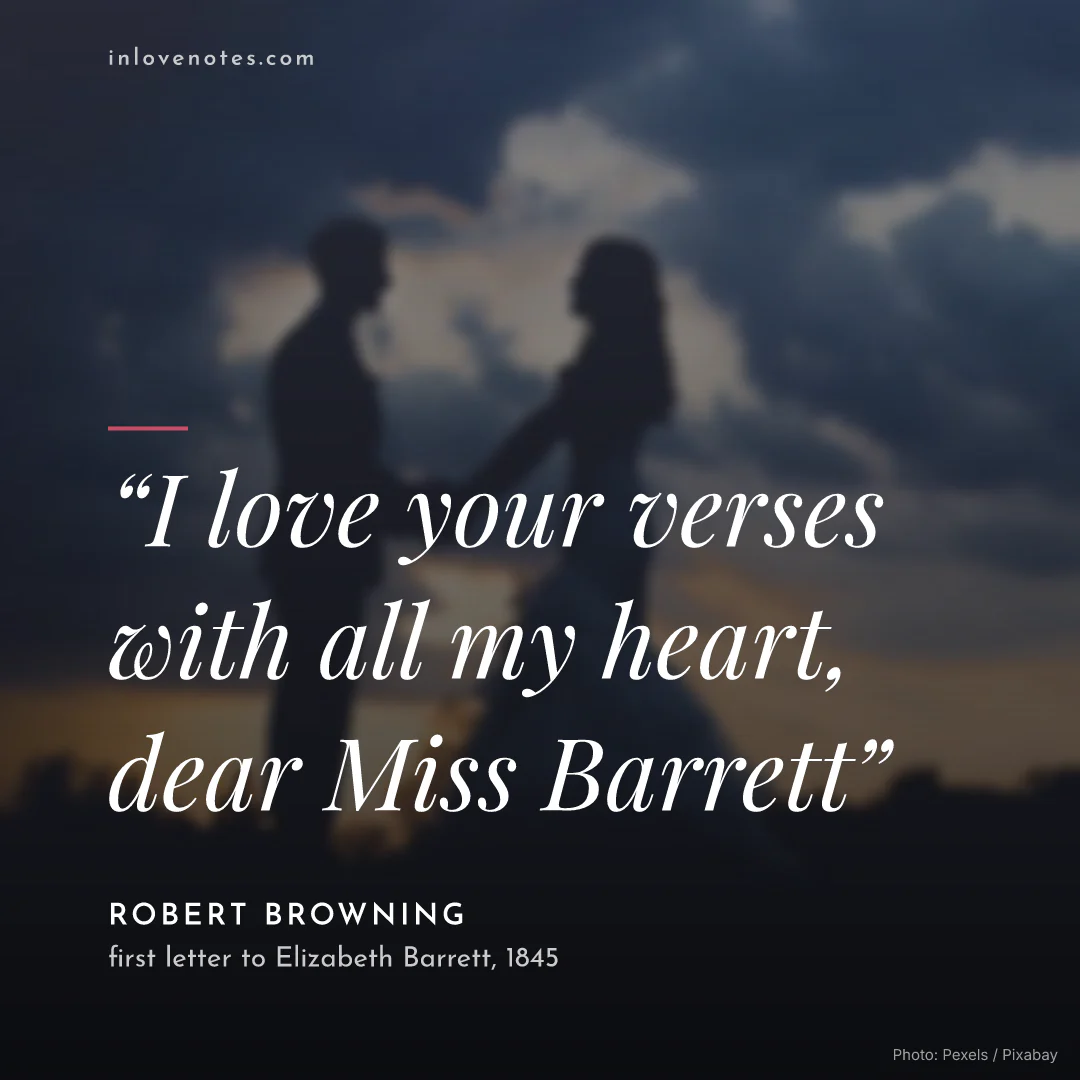
Browning's opening is the clearest example of starting straight into the feeling. He was 32 and largely unknown to her; she was older and already famous, and an invalid who rarely left her father's house on Wimpole Street.
I love your verses with all my heart, dear Miss Barrett,—and this is no off-hand complimentary letter that I shall write
Robert Browning, letter to Elizabeth Barrett, New Cross, postmarked 10 January 1845, in The Letters of Robert Browning and Elizabeth Barrett Barrett, 1845–1846 (1899)
The greeting is tucked inside the declaration, so the very first words are "I love". A few lines later he goes further: "I do, as I say, love these books with all my heart—and I love you too." Notice that he still signs off politely, "Yours ever faithfully, Robert Browning". A bold first line can sit happily above a modest last one.
The playful opening has a long history too. In October 1762, when John Adams was courting Abigail Smith, he addressed a short note to "Miss Adorable" and wrote it as a mock legal order.
Miss Adorable, By the same Token that the Bearer hereof satt up with you last night I hereby order you to give him, as many Kisses, and as many Hours of your Company after 9 O'Clock as he shall please to Demand and charge them to my Account
John Adams, letter to Abigail Smith, 4 October 1762, Adams Family Papers, Massachusetts Historical Society
Adams, a young lawyer, borrowed the language of his own trade and turned it into a joke between the two of them. That is the test for any playful greeting: it should come from your shared life, not from a list. The spelling ("satt") is his own.
How to end a love letter: sign-offs from formal to intimate
A sign-off should sit at the same temperature as the letter. If you have just written three warm paragraphs, "Regards" will feel like a door closing. If the letter was light, "Eternally yours" may feel too heavy. This table runs roughly from reserved to most intimate.
| Sign-off | Tone | Works best for | Less suited to |
|---|---|---|---|
| Yours, | Quiet, a little old-fashioned | Early letters; shy writers | An anniversary letter that needs more warmth |
| Yours ever, / Ever yours, | Steady | Long-term partners, letters of reassurance | A first date thank-you (too much, too soon) |
| Love, / With love, | Warm, everyday | Notes in a lunchbox, short letters | A big occasion, where it can feel routine |
| All my love, | Warm, generous | Birthdays, anniversaries, long distance | Very new relationships |
| Always, / Yours always, | Committed | After a hard season; before time apart | Casual or uncertain relationships |
| Missing you, | Tender, a little sad | Long-distance letters | Letters written under the same roof |
| Until [Friday / the airport / next time], | Hopeful, specific | Long distance with a date on the calendar | When you do not yet know the date |
| Forever yours, / Eternally yours, | Romantic, grand | Wedding-day letters, proposals, vow letters | Light notes |
| Your [pet name], | Private | Couples with a shared name or joke | Anything that might be read by others |
| A drawing, initials or a private symbol | Most intimate | Couples who write often | A first letter |
Before the sign-off comes the last sentence, and that matters more than the formula below it. A promise ("I will be at the station"), a plan ("Saturday, the bakery, early") or a plain "I love you" all give the sign-off something to stand on.
How some famous letters ended
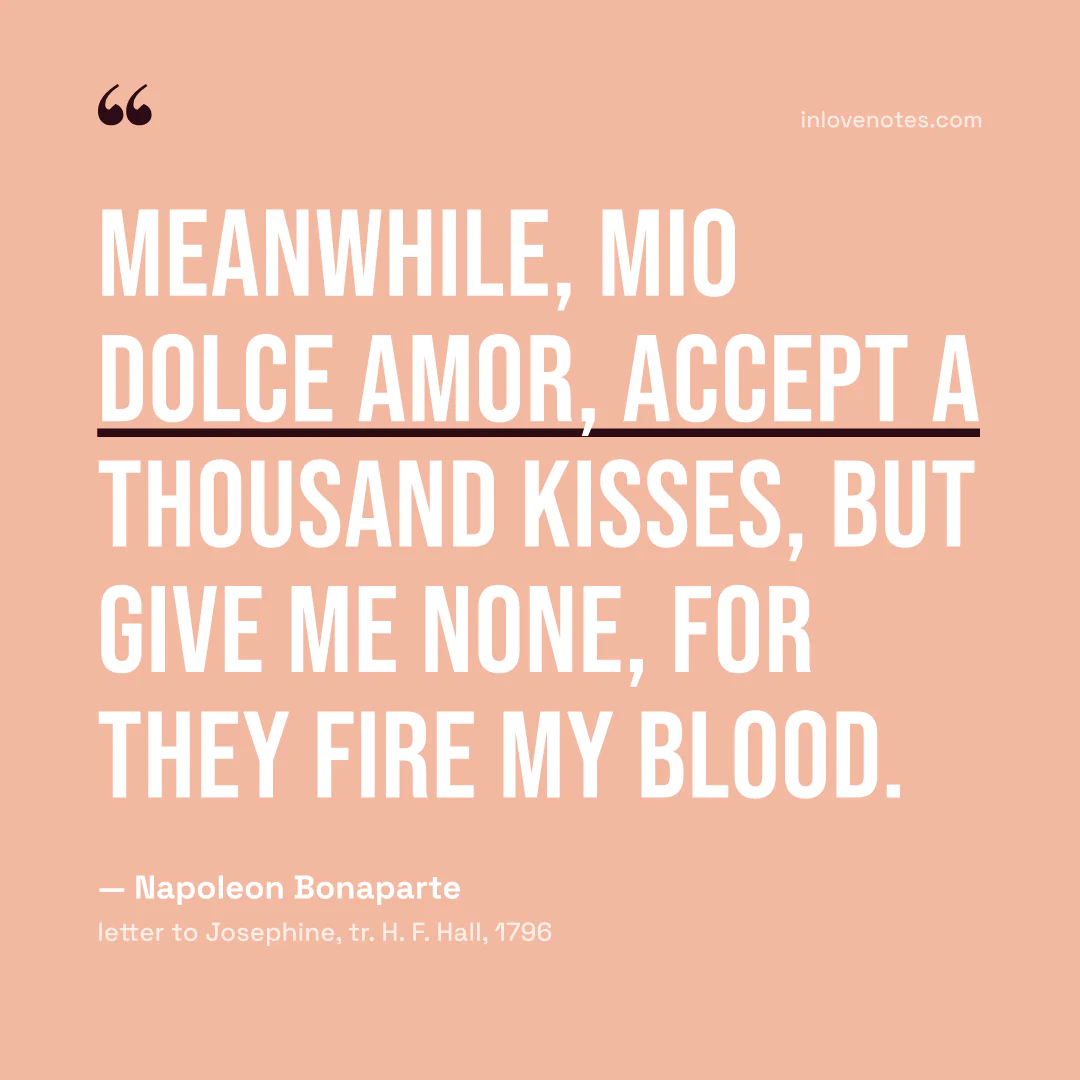
Napoleon Bonaparte's short note to Josephine de Beauharnais, written before their marriage in March 1796 and placed first in Henry Foljambe Hall's 1901 English edition of his letters, ends with a line that is half sign-off, half warning.
Meanwhile, mio dolce amor, accept a thousand kisses, but give me none, for they fire my blood.
Napoleon Bonaparte, undated letter to Josephine, before March 1796, in Napoleon's Letters to Josephine, 1796–1812, translated by Henry Foljambe Hall (1901)
He signs it simply "N. B." Hall notes that the original French has a slip of the pen in "a thousand kisses" (un millier de baise); this is a hurried note, not a polished one. The lesson for your own letter is that the closing line can carry the emotion so the signature does not have to. "A thousand kisses" went on to become one of his habitual endings in later letters.
Some couples sign with a name that belongs only to the letters. Abigail Adams often signed as "Portia", after the loyal wife of the Roman Brutus. Her letter of 29 August 1776, written while John was at the Continental Congress in Philadelphia, ends:
My Best wishes attend you ever yours, Portia
Abigail Adams, letter to John Adams, 29 August 1776, Adams Family Papers, Massachusetts Historical Society
A pen name lets a sign-off say something about the relationship. "Portia" told John that she saw herself as his partner in a public cause, not only his wife at home.
Others drop words entirely. In the letters published in Speaking for Themselves (1998), edited by their daughter Mary Soames, Winston and Clementine Churchill kept the nicknames "Pug" (later "Pig") and "Kat", and often added a small sketch of a pig or a cat beside their signatures, as Peter Bradshaw's review in the London Review of Books (1999) describes. Henry VIII went further still, with a coded signature. One of his letters to Anne Boleyn (most of the surviving ones are in the Vatican Library) ends "Your loyal and most assured Servant, H. no other A B seek R.", with her initials, drawn inside a heart, placed between his; the 1906 Boston edition of the letters explains it as "H. seeks no other. R." (R for Rex, king). For a modern letter, a doodle or a pair of initials is the same idea: a sign-off nobody else could use.
For one more closing in this spirit, Beethoven's three-line "ever yours, ever mine, ever ours" from his letter to the "Immortal Beloved" is discussed in our love letter guide.
The postscript: a second, quieter ending
A P.S. was originally for things remembered after signing. In a love letter it does something else: it lets you end twice, once formally and once softly. Used well, it is the line people quote.
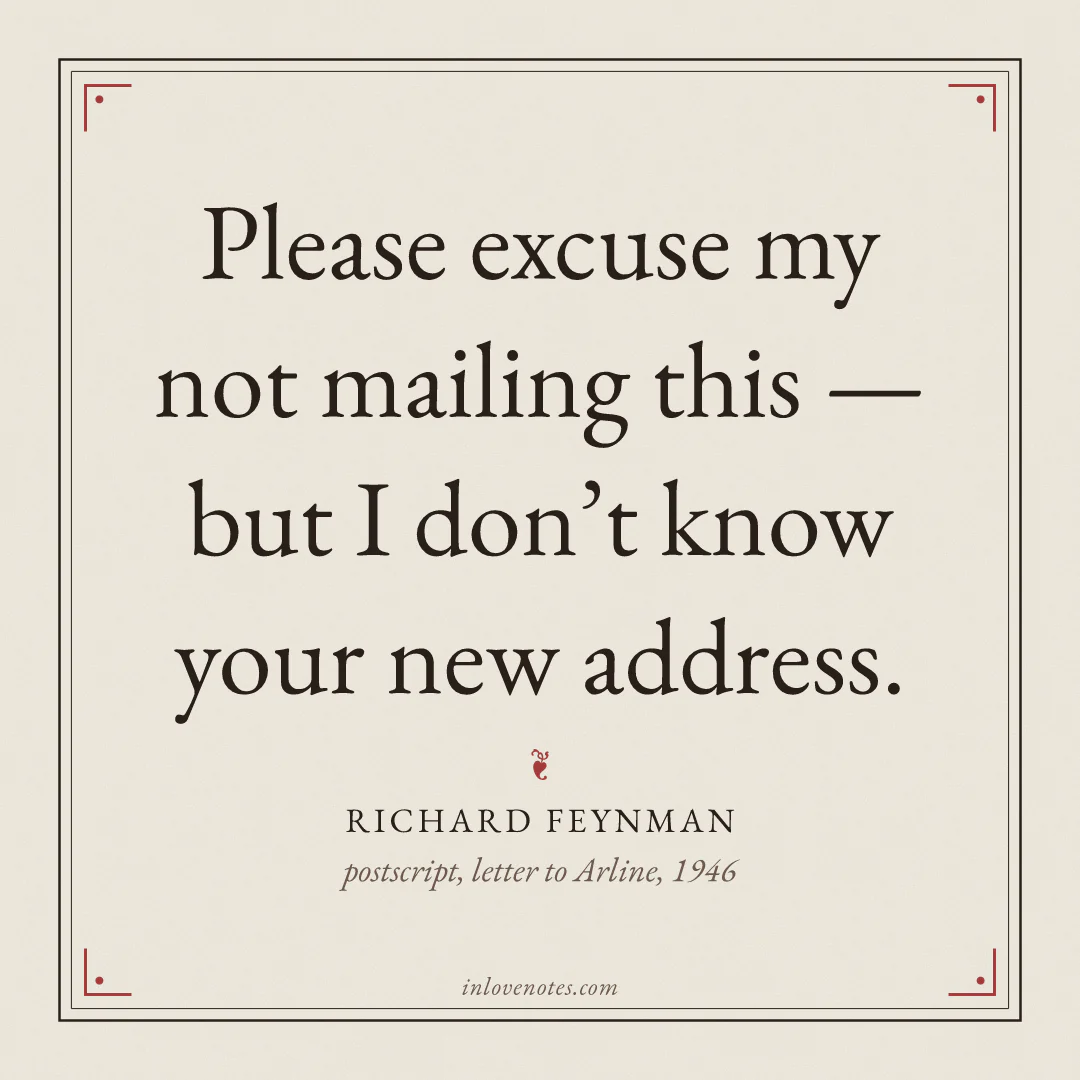
PS Please excuse my not mailing this—but I don't know your new address.
Richard Feynman, letter to Arline Feynman, 17 October 1946, published in Perfectly Reasonable Deviations From the Beaten Track (2005)
Arline had died of tuberculosis in June 1945. Feynman wrote to her sixteen months later and signed the letter "Rich"; it stayed sealed in his papers until after his death in 1988. The postscript is gentle, almost a joke, and it says more about grief than the paragraph above it. Most letters will never carry that weight, but the principle holds: keep the P.S. small, specific and in your own voice.
Postscripts that work in ordinary letters:
- A practical line: "P.S. Check the coat pocket."
- A small confession: "P.S. I still have the ticket from [place]."
- A plan: "P.S. Keep Sunday morning free."
- A private joke, if you have one.
Pairing a first line with a last line
The opening and the sign-off should feel as if they belong to the same letter. These pairings are starting points; replace the brackets with your own details.
| Situation | Open with | Close with |
|---|---|---|
| A first love letter | "[Name], there is something I have wanted to put in writing." | "Yours," and your first name |
| Anniversary | "My dearest [name], [number] years today." | "All my love, always," |
| Long distance | "[Pet name], it is [time] here and you are asleep." | "Until [date]," |
| After an argument | "[Name], I was wrong about [thing]." | "Yours, still and always," (no jokes in the P.S.) |
| A hard time for them | "[Name], you do not have to reply to this." | "I am right here," and your name |
| Wedding morning | "To my [husband / wife], in a few hours," | "Forever yours," |
| No reason at all | Straight into one thing you love about them | "Love," and a small drawing |
For whole letters built on these frames, see our sample love letters for him, by occasion, and the long love messages for her drawn from real correspondence.
Openings and endings that usually fall flat
- "I don't know how to start this." You have started; delete the line and begin with the sentence after it.
- "To whom it may concern"-style jokes in a serious letter. Humour at the top tells the reader not to take the rest seriously.
- A different name from the one you use. If you always call them "Jo", "Dearest Josephine" sounds like someone else wrote it.
- Ending on logistics. "Don't forget the dentist on Tuesday" belongs in a text, or at most in the P.S.
- Stacking sign-offs. "Love you always and forever, all my love, your one and only" says less than "Always,".
- A sign-off you cannot mean yet. "Forever yours" on a third date puts pressure on the reader. Choose the honest size.
Questions people ask about starting and ending love letters
Should I sign a love letter with my full name?
No, unless that is a joke between you. Use the name they call you. Browning signed "Robert Browning" to a near-stranger in 1845; by the time you are writing love letters, your first name or nickname is warmer.
Is "Love," too casual to end a love letter?
Not if the last sentence above it carries the feeling. "Love," after a strong closing line reads as natural. After a weak one, choose something fuller, such as "All my love," or "Always,".
How do you end a long-distance love letter?
Point to the next time you will be together. "Until [date]," or a last line about the plan ("Twelve days. I am counting.") works better than a sad goodbye, because it gives the reader something to hold on to between letters.
Can I use the same sign-off every time?
Yes. A repeated sign-off becomes a signature of the relationship, the way the Churchills' pig and cat sketches did. Change it only on occasions that call for something bigger.
When you have written both edges, read only the first line and the last line together, skipping everything in between. If they sound like the same person talking to the same person, the letter is ready to fold. If you need something shorter for a pillow or a lunchbox instead, our short handwritten love messages are a good place to start.