Love Letter in Spanish: How to Start It, How to Sign It, and Lines From Bécquer, Lope and Neruda
How to open and sign a love letter in Spanish (with the RAE rule), te quiero vs te amo, sourced lines from Spanish poets and a sample letter, translated.
A love letter in Spanish opens with a colon, not a comma: Mi amor: or Querida Ana:, with the letter itself starting on the next line with a capital. It usually ends with Te quiero, Con todo mi amor or Siempre tuyo (tuya if the writer is a woman). Those two details, plus choosing between te quiero and te amo, are most of what separates a letter that sounds Spanish from one that sounds machine-translated.
This page gives you the openings and sign-offs in two tables, each translated and marked for who it suits; what one of the best-known love poems in the language actually says about querer and amar (we counted); six lines from four Spanish-language poets, with our own translations; one "García Márquez" quote he never wrote; and a sample letter you can adapt, set out line by line with the English.
How do you start a love letter in Spanish?
Start with a greeting followed by a colon, then begin the letter on a new line with a capital letter. The Real Academia Española is blunt about the comma: its Diccionario panhispánico de dudas calls it "costumbre anglosajona, que debe evitarse en español" (an English-speaking habit, to be avoided in Spanish), and gives Querido amigo, as the example of what not to write.
| Opening | What it means | When it fits |
|---|---|---|
| Mi amor: | My love | The safe default for a partner, any age, any country. |
| Amor mío: | My love (word order of poems and songs) | A handwritten letter; slightly more lyrical than mi amor. |
| Querida Ana: / Querido Daniel: | Dear Ana / Dear Daniel | Warm but restrained; good early on. The ending agrees with the person you write to: querida for a woman, querido for a man. |
| Mi vida: | My life | A long relationship. Common in speech, so it reads as intimate rather than grand. |
| Cariño: | Darling, honey | Everyday affection; the same word for a man or a woman. |
| Mi cielo: / Corazón: | My sky, my heaven / Heart (sweetheart) | Tender pet names; neither changes with gender. |
| Mi media naranja: | My other half (literally, my half orange) | Playful; better in a note than in an anniversary letter. |
If you have been writing in English, our guide on how to start and end a love letter compares the English openings; most of its advice carries over, apart from the punctuation.
Te quiero or te amo: which one goes in the letter?
Both mean "I love you", and both belong in a love letter. Te amo is the heavier one: a Spanish teacher at Tell Me In Spanish describes amar as "a greater and deeper level of affection" for a partner or close family, and te quiero as the lighter version used with friends and new relationships. The Real Academia's dictionary defines querer, in its second sense, simply as "amar, tener cariño" (to love, to have affection for). How heavy te amo sounds also depends on the family and the country, so if your partner grew up with Spanish, the words they already use with you are the best guide.
One of the best-known love poems in the language takes a side. Pablo Neruda's "Poema 20", from Veinte poemas de amor y una canción desesperada (Santiago, Nascimento, 1924), uses the verb querer eight times for the woman he lost, and amar once, for her eyes:
"Yo la quise, y a veces ella también me quiso." — Pablo Neruda, "Poema 20", Veinte poemas de amor y una canción desesperada (1924)
"I loved her, and sometimes she loved me too." If te quiero felt too small for a love letter, Neruda is your evidence that it isn't. A practical rule: write te quiero if you already say it out loud to each other, and save te amo for the sentence you want to land hardest, usually near the end. Using both in one letter is normal.
How do you end a love letter in Spanish?
End with a short closing line, a comma, and your name. The closing that trips learners up is tuyo/tuya: it describes the writer ("I am yours"), so it agrees with the writer's gender, not the reader's. A woman writes Siempre tuya to anyone; a man writes Siempre tuyo.
| Closing | What it means | Notes |
|---|---|---|
| Te quiero, | I love you | Fits any stage of a relationship. |
| Te amo, | I love you (deepest) | For a serious partner; see the regional note above. |
| Con todo mi amor, | With all my love | Works for both a letter and a card. |
| Siempre tuyo, / Siempre tuya, | Always yours | Agrees with the writer. |
| Tuyo para siempre, / Tuya para siempre, | Yours forever | Wedding and anniversary weight. |
| Un beso, / Besos, | A kiss / Kisses | Light; also used with family and friends. |
| Te quiere, Ana | (Ana) loves you | Third person, the verb before the name. Very common in Spanish and almost never used in English. |
| Te echo de menos / Te extraño | I miss you | Both are correct (the Academia's entry for extrañar defines it as "echar de menos"); te echo de menos is the everyday form in Spain, te extraño in much of Latin America. |
A postscript is P. D. (posdata), not P.S., and it is a good place for a line of poetry. Gustavo Adolfo Bécquer's Rima XXIII is short enough to fit under a signature:
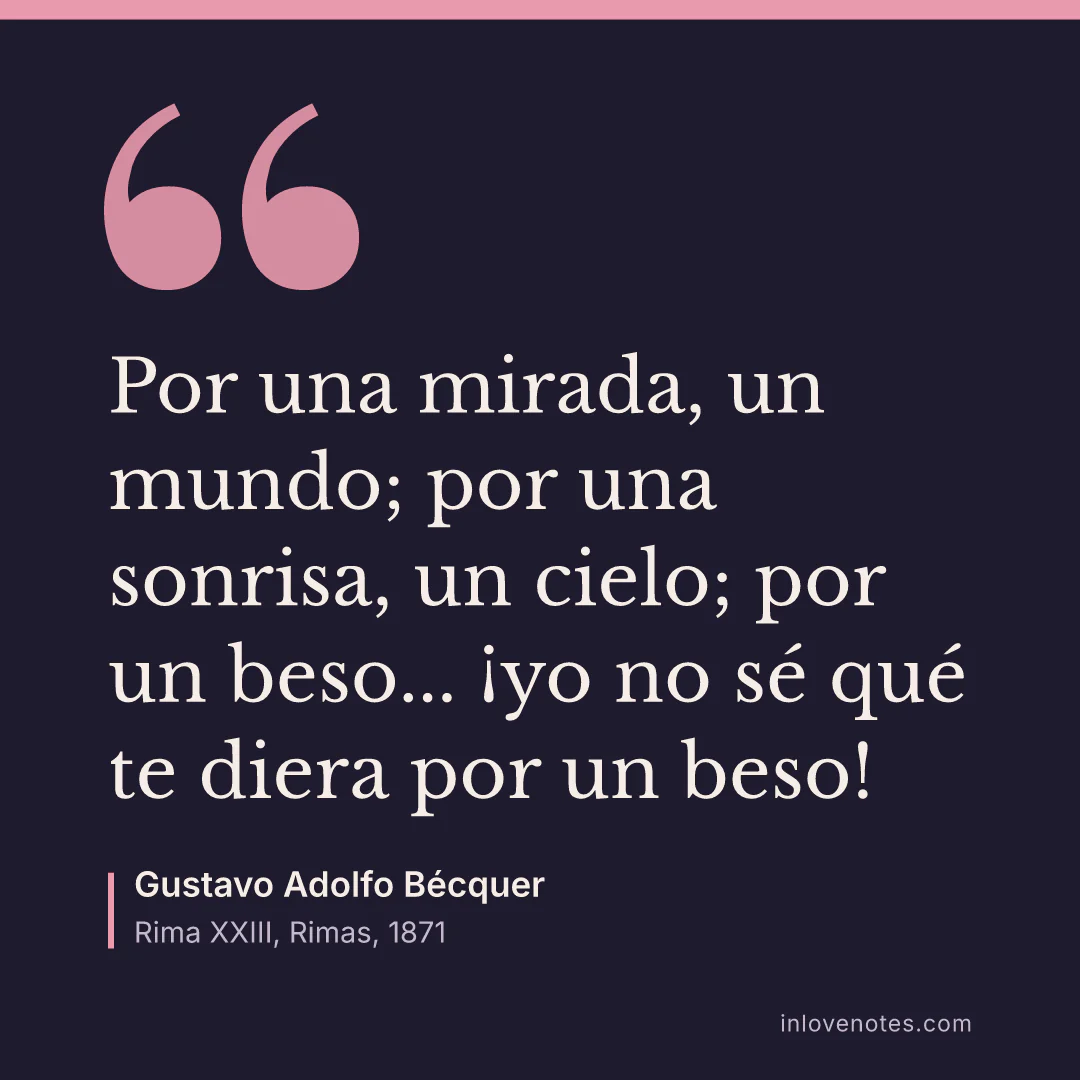
"Por una mirada, un mundo; / por una sonrisa, un cielo; / por un beso... ¡yo no sé / qué te diera por un beso!" — Gustavo Adolfo Bécquer, Rima XXIII, Rimas (1871)
"For a glance, a world; / for a smile, a heaven; / for a kiss... I don't know / what I would give you for a kiss!" These lines nearly didn't survive. Bécquer had given the manuscript of his poems to his patron, the minister Luis González Bravo, and it was lost when the minister's house in Madrid was sacked in the revolution of 1868. Bécquer rewrote the poems from memory in a notebook he headed "Poesías que recuerdo del libro perdido" (poems I remember from the lost book), and after his death in 1870 his friends collected his work; the Rimas appeared in the two-volume Obras of 1871 (the Rimas article sets out the history). The manuscript orders the poems differently; the numbers here follow the printed Obras.
Three lines from Spanish-language poets, with our translations
These are all from published poems, quoted from the editions listed in the sources (line-opening capitals lowered). The translations are ours and stay close to the Spanish, so you can see which word does what.
Lope de Vega: love defined in fourteen lines
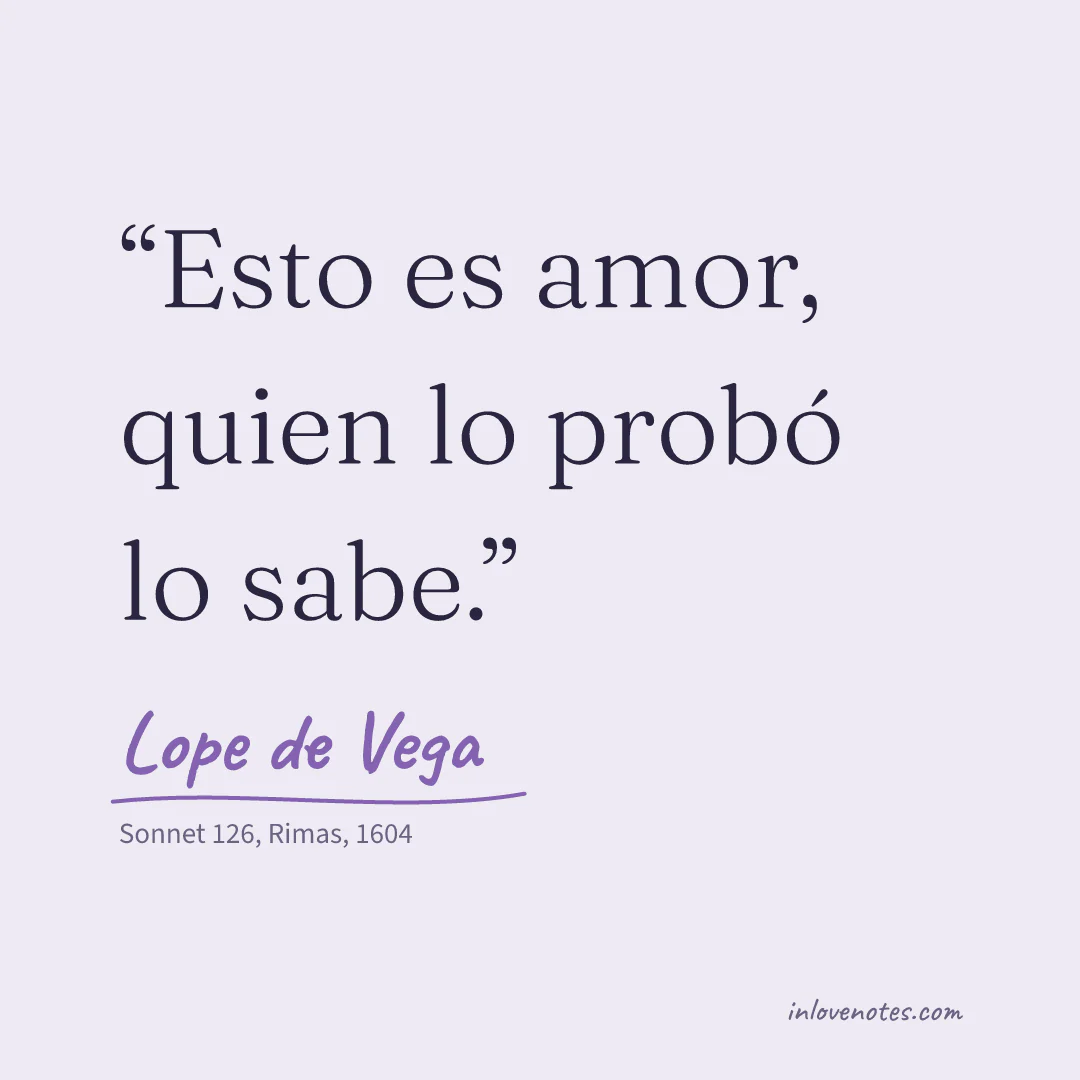
"creer que un cielo en un infierno cabe, / dar la vida y el alma a un desengaño; / esto es amor, quien lo probó lo sabe." — Lope de Vega, sonnet 126, Rimas (1604)
"To believe a heaven fits inside a hell, / to give your life and soul to a disappointment: / this is love; whoever has tasted it knows." The sonnet, which opens "Desmayarse, atreverse, estar furioso" (to faint, to dare, to rage), runs thirteen lines of contradictory verbs and adjectives without ever naming its subject, and only in the last line says what it has been describing (the full text is quoted in Spanish Wikipedia's article on literary commonplaces). It is number 126 of the Rimas, the collection Lope published in 1604. The last line, esto es amor, quien lo probó lo sabe, works on its own in a letter after a hard year.
Sor Juana Inés de la Cruz: the heart in her hands
"pues ya en líquido humor viste y tocaste / mi corazón deshecho entre tus manos." — Sor Juana Inés de la Cruz, sonnet "En que satisface un recelo con la retórica del llanto" (17th century; text from Wikisource)
"For now, in liquid form, you saw and touched / my heart, undone, between your hands." The Mexican nun-poet (died 1695) wrote the sonnet to someone she calls mi bien (my dear, literally my good): her words had not persuaded them, she wanted them to see her heart, and it came out as tears; the sonnet's old heading says it answers a suspicion "con la retórica del llanto" (with the rhetoric of tears). Its tenth line, no te atormenten más celos tiranos (let tyrant jealousy torment you no more), makes it the right poem for the letter after an argument, not for a birthday card. Text from Wikisource.
Pablo Neruda: the line people quote after a breakup
"Es tan corto el amor, y es tan largo el olvido." — Pablo Neruda, "Poema 20", Veinte poemas de amor y una canción desesperada (1924)
"Love is so short, and forgetting is so long." It comes near the end of the same poem quoted above, and it is about a love that is over, so think twice before putting it in a letter to someone you are still with. Neruda's poems are still in copyright, which is why we quote single lines here; for a love poem from him to give whole, his Cien sonetos de amor (1959), dedicated to his wife Matilde Urrutia, is the book to buy.
The "García Márquez" quote he never wrote
Search for Spanish love quotes and you'll find this one credited to Gabriel García Márquez, including in a 2022 list of love quotes in the magazine ¡Hola!:
"Te quiero no por quien eres, sino por quien soy cuando estoy contigo." — commonly attributed to Gabriel García Márquez (no primary source located); adapted from Mary Carolyn Davies, "To a Friend" (1918)
It is a Spanish rendering of the opening of an English poem, "I love you not only for what you are, but for what I am when I am with you." According to Wikipedia's account of its history, Mary Carolyn Davies published the poem as "To a Friend" in the Epworth Herald on 26 October 1918; a 1936 anthology, Best Loved Poems of the American People, credited it to a "Roy Croft", and its editor corrected that in the New York Times Book Review in 1943. The Spanish version also changes the meaning: "not only for what you are" became "not for who you are", which is less kind to the person reading it. If you want the thought, write it in your own words; if you want the line, credit Davies.
García Márquez has been given words before. In May 2000 a farewell poem, "La marioneta", ran under his name in the Peruvian daily La República; it was written by the Mexican ventriloquist Johnny Welch for his puppet Mofles (the Museum of Hoaxes tells the story). Our page on misattributed love quotes traces sixteen more lines like these.
A sample love letter in Spanish, line by line
The letter below is a template, not a script: keep the frame (greeting, three or four things that are true about the two of you, the sign-off), swap in your own specifics, and read it aloud once to check it sounds like you. It is written by a woman to a man; the notes after the table show what changes for other combinations.
| Spanish | English |
|---|---|
| Mi amor: | My love, |
| Hoy quería escribirte algo que no cabe en un mensaje. | Today I wanted to write you something that doesn't fit in a text. |
| Pienso en ti más de lo que te digo. | I think about you more than I tell you. |
| Contigo todo es más fácil, incluso los días difíciles. | Everything is easier with you, even the hard days. |
| Gracias por quererme como soy. | Thank you for loving me as I am. |
| Cuando no estás, te echo de menos en las cosas pequeñas: el café de la mañana, el camino a casa, el final del día. | When you're not here, I miss you in the small things: the morning coffee, the walk home, the end of the day. |
| No sé escribir como los poetas, pero sé lo que siento. | I can't write like the poets, but I know what I feel. |
| Te quiero hoy y te voy a querer mañana. | I love you today and I'm going to love you tomorrow. |
| Siempre tuya, [tu nombre] | Always yours, [your name] |
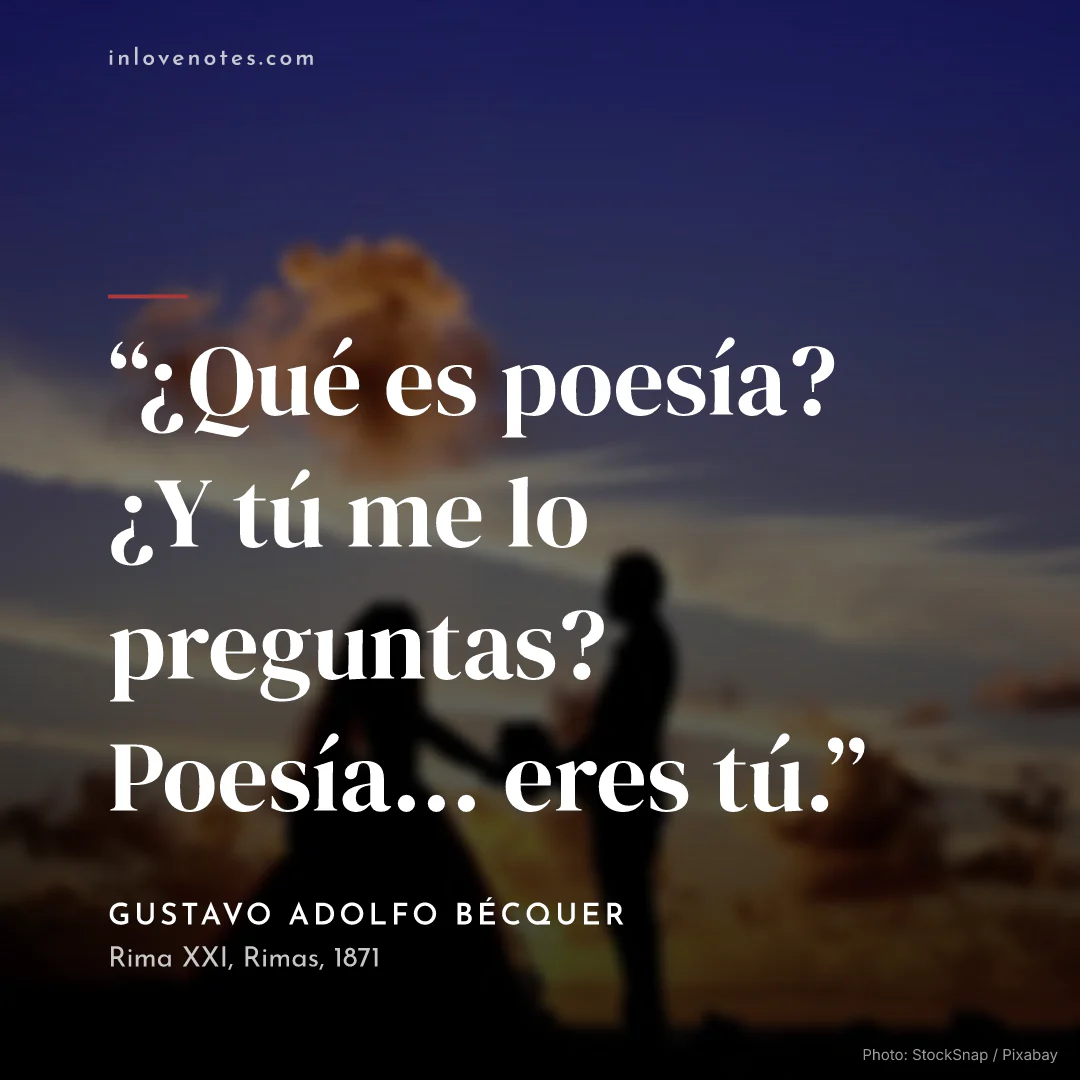
| P. D.: ¿Qué es poesía? ¿Y tú me lo preguntas? Poesía... eres tú. | P.S. What is poetry? You're asking me? Poetry... is you. |
What changes: a man signs Siempre tuyo. Nothing else in this letter changes with gender, because mi amor, contigo and quererme are the same for everyone; if you add an adjective about yourself, check its ending: feliz stays the same, but contento becomes contenta from a woman. For te echo de menos a Latin American reader may prefer te extraño. For a letter between two cities, our long-distance love letters guide has the stages of being apart; the Spanish frame above works for each of them.
The postscript is the end of Bécquer's Rima XXI, the poem in which a woman asks the speaker what poetry is while she fixes her blue eyes on his:
"¿Qué es poesía? dices mientras clavas / en mi pupila tu pupila azul; / ¿Qué es poesía? ¿Y tú me lo preguntas? / Poesía... eres tú." — Gustavo Adolfo Bécquer, Rima XXI, Rimas (1871)
"'What is poetry?' you say, as you fix / your blue eye on mine. / What is poetry? And you ask me that? / Poetry... is you." We quote the 1885 Obras on Wikisource, where the scan reads "proguntas", a misprint for preguntas; other editions punctuate the third line differently, the words stay the same. It is the line Spanish readers recognise at once, which is the point of putting it in a P. D.: it tells the reader you went looking for something from their language.
Five mistakes that make a Spanish love letter sound translated
- A comma after the greeting. Mi amor, is the English habit the Academia names; write Mi amor: and start the letter on the next line with a capital.
- Tuyo agreeing with the reader. A man writing to a woman signs tuyo, not tuya: the word describes him.
- Estoy excitado for "I'm excited". In a love letter it can read as sexual. For "I can't wait to see you", write tengo muchas ganas de verte.
- Usted instead of tú. Usted is the polite, distant "you". Everything in a love letter goes in tú (te quiero, contigo, tus manos).
- Translating idioms word for word. "You're the apple of my eye" does not survive the trip; Spanish has its own, such as eres mi media naranja or estoy loco/loca por ti (I'm crazy about you). If a phrase came out of a translation app, ask a Spanish speaker or swap it for a plain sentence: me haces muy feliz (you make me very happy) is never wrong.
The same habit of checking the original helps with other languages too: our French love quotes are translated word for word and traced to the book.
Questions readers ask
What's the most romantic thing to say in Spanish?
Te amo is the strongest "I love you". In writing, a line people recognise often moves them more: Bécquer's "Poesía... eres tú" (poetry is you) is the classic, and "Por un beso... ¡yo no sé qué te diera por un beso!" (for a kiss, I don't know what I would give you) is a close second.
How do you start a love letter in Spanish?
With a greeting and a colon: Mi amor:, Amor mío:, or Querida Ana: / Querido Daniel:. Start the letter on the next line with a capital letter. The Real Academia Española advises against the English-style comma.
How do you end a letter in Spanish to express love?
Use Te quiero, Te amo, Con todo mi amor, or Siempre tuyo (from a man) / Siempre tuya (from a woman), followed by your name. A very Spanish alternative is the third person: Te quiere, Ana.
How do I say "I love you" in a letter?
Te quiero fits any relationship and is what Neruda uses in "Poema 20"; te amo is deeper and best kept for a serious partner. Many letters use te quiero in the body and te amo once, near the end.
Sources
- Real Academia Española, Diccionario panhispánico de dudas, "dos puntos", section 2.9 (colon after letter greetings).
- Real Academia Española, Diccionario de la lengua española: querer, extrañar.
- Gustavo Adolfo Bécquer, Rimas XXI and XXIII, Obras (Madrid, Fernando Fe, 1885), on Wikisource; publication history from "Rimas (Bécquer)", Wikipedia.
- Lope de Vega, sonnet 126 ("Desmayarse, atreverse, estar furioso"), index of the Rimas on Wikisource; full text quoted in "Tópico literario", Wikipedia; publication date from "Lope de Vega", Wikipedia.
- Tell Me In Spanish, "Te quiero vs te amo".
- Sor Juana Inés de la Cruz, "En que satisface un recelo con la retórica del llanto" ("Esta tarde, mi bien, cuando te hablaba"), on Wikisource as "Esta tarde, mi bien" and "De amor y de discreción".
- Pablo Neruda, "Poema 20", Veinte poemas de amor y una canción desesperada (Nascimento, 1924), text as printed in Cultura Genial; verb count ours.
- "Roy Croft", Wikipedia (Mary Carolyn Davies, "To a Friend", Epworth Herald, 26 October 1918; the 1936 misattribution and the 1943 correction).
- Museum of Hoaxes, "Gabriel Garcia Marquez's Final Farewell" (May 2000).