Short Heartbreak Quotes: 13 Lines From Poems and Novels, Each Checked Against the Source
13 short heartbreak quotes from Shakespeare, Dickinson, Millay, Hemingway and more, each checked against the original text, with word counts for captions.

In 2011, researchers at Columbia and the University of Michigan put 40 people who had recently been through an unwanted break-up into a brain scanner, showed them a photo of their ex and asked them to think about being rejected. The areas that lit up overlapped with the ones that process physical pain. Poets had been saying the same thing for a few thousand years, usually in fewer words. The 13 short heartbreak quotes below are some of the best of those words, and every one is checked against the book or poem it comes from, with the year, so you can quote it without passing on a mistake.
They are grouped by where you are: the first night, the missing, the moment someone tells you that time heals, and the slow way out. After them come a table with the word count of each line (useful for a caption), a short answer to why heartbreak hurts in the body, a few rules for posting or sending a line, and one famous "Dr. Seuss" quote that isn't his.
The 13 lines at a glance
If you only need a line, this table is the quick version. The word count is for the exact words we quote; the longer passages under each heading give the context.
| Line | Who and where | Year | Words |
|---|---|---|---|
| "Give sorrow words. The grief that does not speak / Whispers the o'er-fraught heart, and bids it break." | Shakespeare, Macbeth 4.3 | c. 1606 | 17 |
| "Heart, we will forget him! / You and I, to-night!" | Emily Dickinson, Poems, Third Series | 1896 | 9 |
| "Tears, idle tears, I know not what they mean" | Alfred Tennyson, The Princess | 1847 | 9 |
| "Woman much missed, how you call to me, call to me" | Thomas Hardy, "The Voice" | 1914 | 11 |
| "You are part of my existence, part of myself." | Charles Dickens, Great Expectations ch. 44 | 1861 | 9 |
| "So we beat on, boats against the current, borne back ceaselessly into the past." | F. Scott Fitzgerald, The Great Gatsby | 1925 | 14 |
| "Time does not bring relief; you all have lied / Who told me time would ease me of my pain!" | Edna St. Vincent Millay, Renascence and Other Poems | 1917 | 19 |
| "And thus the heart will break, yet brokenly live on" | Lord Byron, Childe Harold's Pilgrimage III.32 | 1816 | 10 |
| "Time is a kind friend, he will make us old." | Sara Teasdale, "Let It Be Forgotten" | 1920 | 9 |
| "Take away idle hours, and Cupid's bow is broken." (our translation) | Ovid, Remedia Amoris line 139 | c. AD 1 | 9 |
| "The world breaks every one and afterward many are strong at the broken places." | Ernest Hemingway, A Farewell to Arms ch. 34 | 1929 | 14 |
| "Your pain is the breaking of the shell that encloses your understanding." | Kahlil Gibran, The Prophet | 1923 | 12 |
| "How else but through a broken heart / May Lord Christ enter in?" | Oscar Wilde, The Ballad of Reading Gaol | 1898 | 12 |
For the first night, when it has only just happened
The first lines worth having are the ones that give you permission to say it out loud. Neither of these pretends the pain is small.
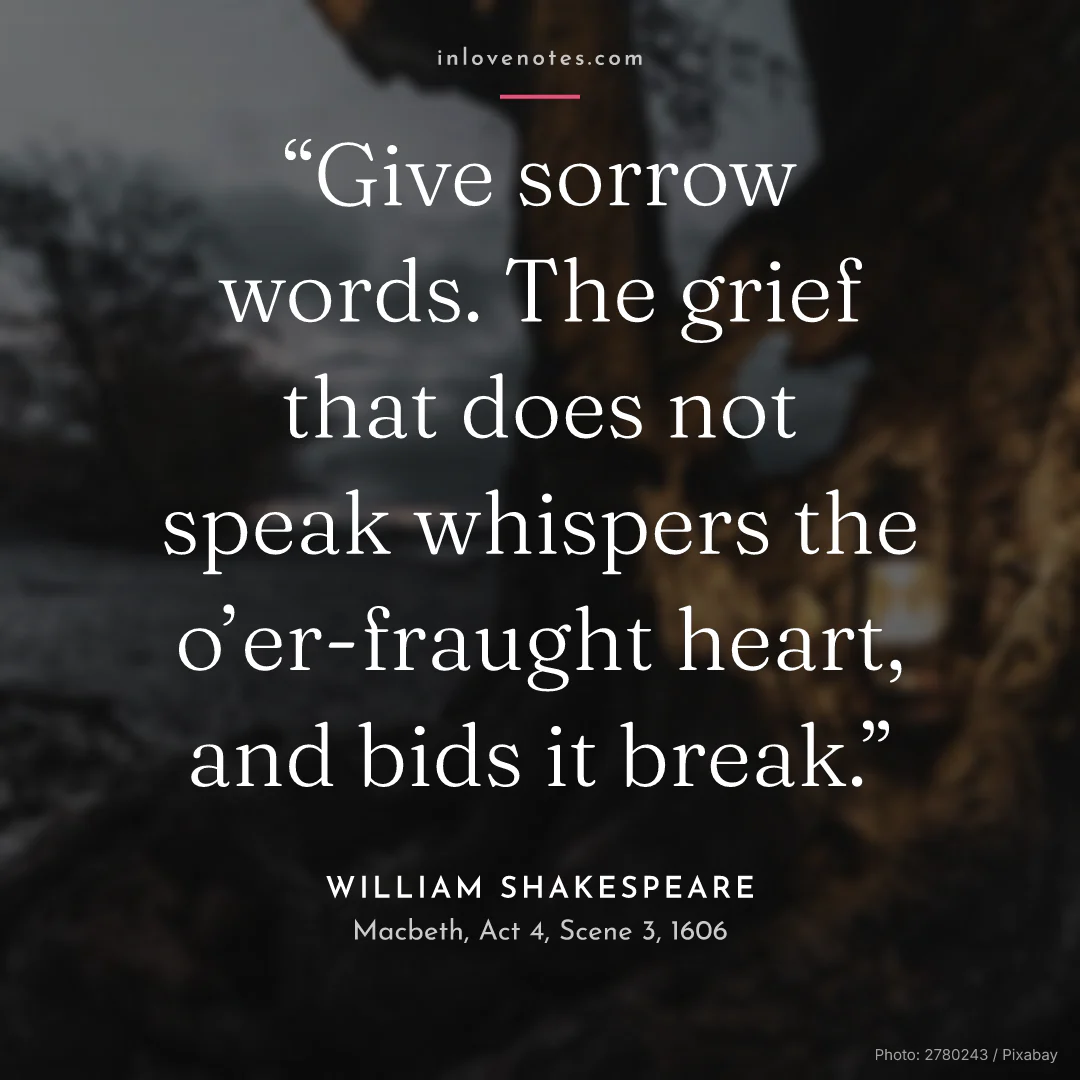
"Give sorrow words. The grief that does not speak / Whispers the o'er-fraught heart, and bids it break." — Malcolm, in William Shakespeare, Macbeth, Act 4, Scene 3 (c. 1606)
Malcolm says this to Macduff, who has just learned that his wife and children have been murdered and has pulled his hat down over his face rather than speak. It is not a love scene, but it is the oldest good advice on this page: a grief kept silent overloads ("o'er-fraught") the heart until it breaks. For heartbreak, it works as a caption for the post where you finally tell people, or as a note to a friend who has gone quiet. Quote it with the line break as a slash; the play prints it as verse.
"Heart, we will forget him! / You and I, to-night! / You may forget the warmth he gave, / I will forget the light." — Emily Dickinson, Poems, Third Series (1896)
Dickinson never titled it; editors use the first line. It was printed ten years after her death in the third posthumous volume of her poems. The joke inside the poem is that the speaker is trying to split the job of forgetting with her own heart, and the last stanza ("Haste! lest while you're lagging, / I may remember him!") admits it isn't working. For a short post, the first two lines are enough and they read as resolve; quote all four if you want the reader to hear the doubt as well.
When you miss them more than you expected
Missing someone after a break-up is less about the big moments than about the ordinary ones that keep coming back. These four lines are about exactly that.
"Tears, idle tears, I know not what they mean, / Tears from the depth of some divine despair / Rise in the heart, and gather to the eyes, / In looking on the happy Autumn-fields, / And thinking of the days that are no more." — Alfred Tennyson, "Tears, Idle Tears", in The Princess (1847)
The song sits inside Tennyson's long narrative poem The Princess, sung to the harp by one of the Princess's maids. Its point is that the tears come without a clear reason, set off by something as harmless as a field in autumn. That is a fair description of the third week of a break-up, and the first line alone (nine words) works as a caption.
"Woman much missed, how you call to me, call to me, / Saying that now you are not as you were / When you had changed from the one who was all to me, / But as at first, when our day was fair." — Thomas Hardy, "The Voice", Satires of Circumstance (1914)
Hardy dated the poem December 1912, weeks after the death of his first wife, Emma, and placed it in a group he called "Poems of 1912–13", under the Latin epigraph Veteris vestigia flammae, "traces of the old flame" (Dido's words in Virgil's Aeneid). What makes it a heartbreak poem rather than only a grief poem is the second and third lines: he hears her not as she had become ("when you had changed") but as she was at the start. Anyone who keeps remembering the first months of a relationship instead of the last will recognise it.
"Out of my thoughts! You are part of my existence, part of myself. You have been in every line I have ever read since I first came here, the rough common boy whose poor heart you wounded even then." — Pip to Estella, in Charles Dickens, Great Expectations, ch. 44 (1861)
Estella has just told Pip she will marry Bentley Drummle and that he will "get me out of your thoughts in a week". His answer is the speech above, which goes on for several more sentences. The short form people quote, "You are part of my existence, part of myself", is accurate as far as it goes; keep "Out of my thoughts!" in front if you want the reply to make sense on its own.
"So we beat on, boats against the current, borne back ceaselessly into the past." — F. Scott Fitzgerald, The Great Gatsby (1925)
The last sentence of the novel, written by Nick Carraway after Gatsby's death. Gatsby spent five years trying to get Daisy back and to repeat the past; the sentence says everyone is pulled the same way. It suits the late-night post about scrolling through old photos better than any line here. Quote it exactly: "borne", not "born".
When someone tells you that time heals
Everyone who has had their heart broken has been told that time heals. Three writers answered that, and they don't agree, which is why they are worth reading side by side.
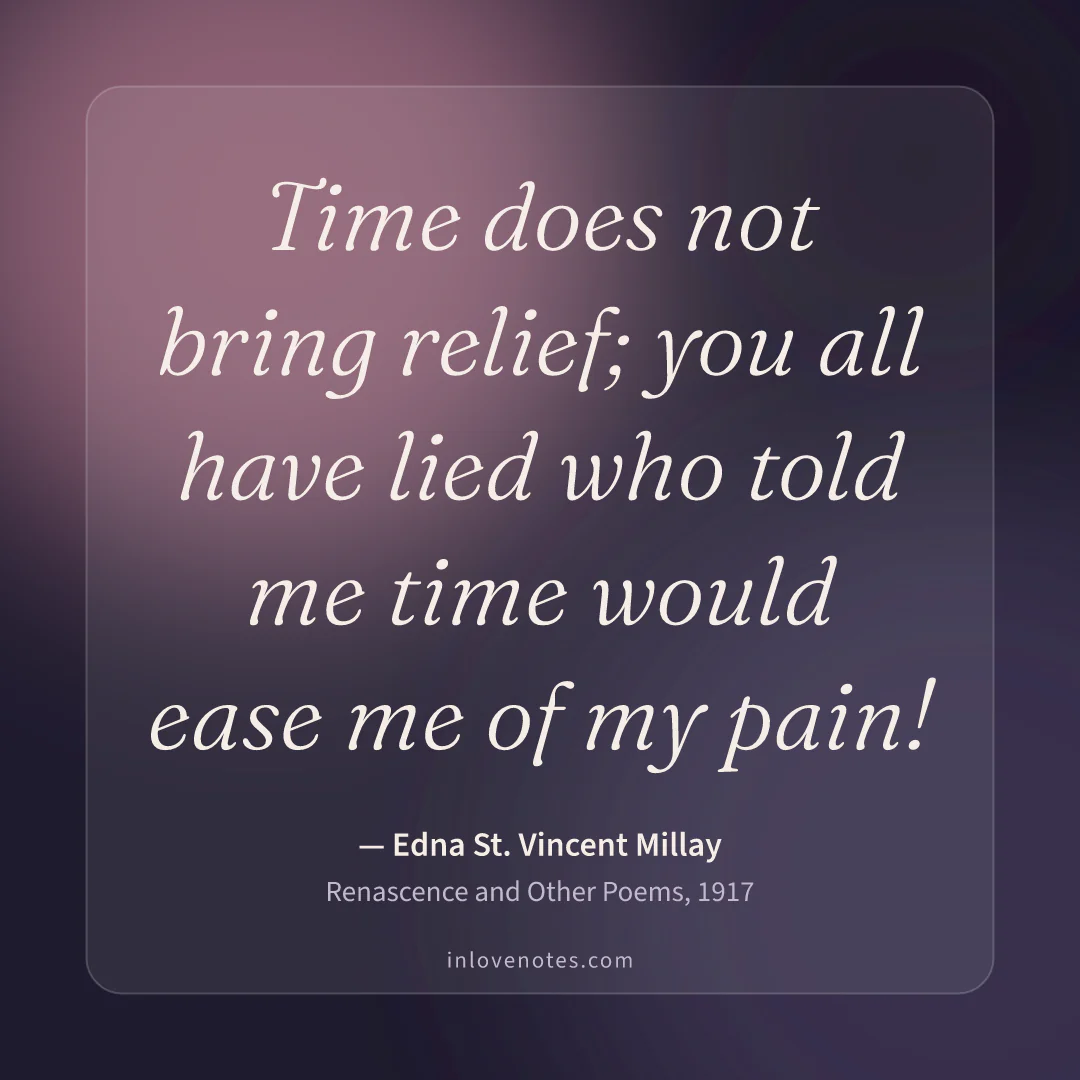
"Time does not bring relief; you all have lied / Who told me time would ease me of my pain! / I miss him in the weeping of the rain; / I want him at the shrinking of the tide" — Edna St. Vincent Millay, Sonnet II in Renascence and Other Poems (1917)
This is the second of the sonnets that close Millay's first book, published when she was twenty-five. It opens by calling everyone who promised relief a liar, then lists the places the missing goes on (rain, tide, the snow melting off the mountains). Use it when you are tired of being told it will get better; it says the opposite and admits it out loud, which can be more comforting than reassurance.
"Let it be forgotten, as a flower is forgotten, / Forgotten as a fire that once was singing gold, / Let it be forgotten for ever and ever, / Time is a kind friend, he will make us old." — Sara Teasdale, "Let It Be Forgotten", Flame and Shadow (1920)
Three years after Millay's sonnet, Teasdale gives the other answer: time is "a kind friend", though the kindness is only that it makes us old. The second stanza asks that anyone who wonders be told "it was forgotten / Long and long ago". It is a good line for the moment you decide to stop talking about it, and the pairing with Millay is worth keeping in mind if you are choosing a line for someone else: Millay for the week it still hurts, Teasdale for the month you want to close the door.
"And thus the heart will break, yet brokenly live on" — Lord Byron, Childe Harold's Pilgrimage, Canto III, stanza 32 (1816)
Byron wrote Canto III in 1816, the year he left England for good after his separation from his wife. The stanza compares the heart to a ruin that keeps standing after its battlements are gone, and this last line is the third answer to "time heals": it doesn't, exactly, but you go on anyway. "Brokenly" is the word people drop when they quote it from memory; keep it.
Ovid, two thousand years earlier, was more practical. His Remedia Amoris ("Remedies for Love") is a poem of advice for people who want to fall out of love, written as a follow-up to his Art of Love. Line 139 reads Otia si tollas, periere Cupidinis arcus: in our translation, "Take away idle hours, and Cupid's bow is broken" (periere literally means "have perished"). The next line adds that love's torches then lie scorned and without light. The advice that follows is to keep busy. It is the oldest written break-up advice we know of, and it still reads like something a friend would say.
Healing from heartbreak: lines for the way out
The last group is for later, when the question is no longer how to get through the night but what the whole thing did to you.
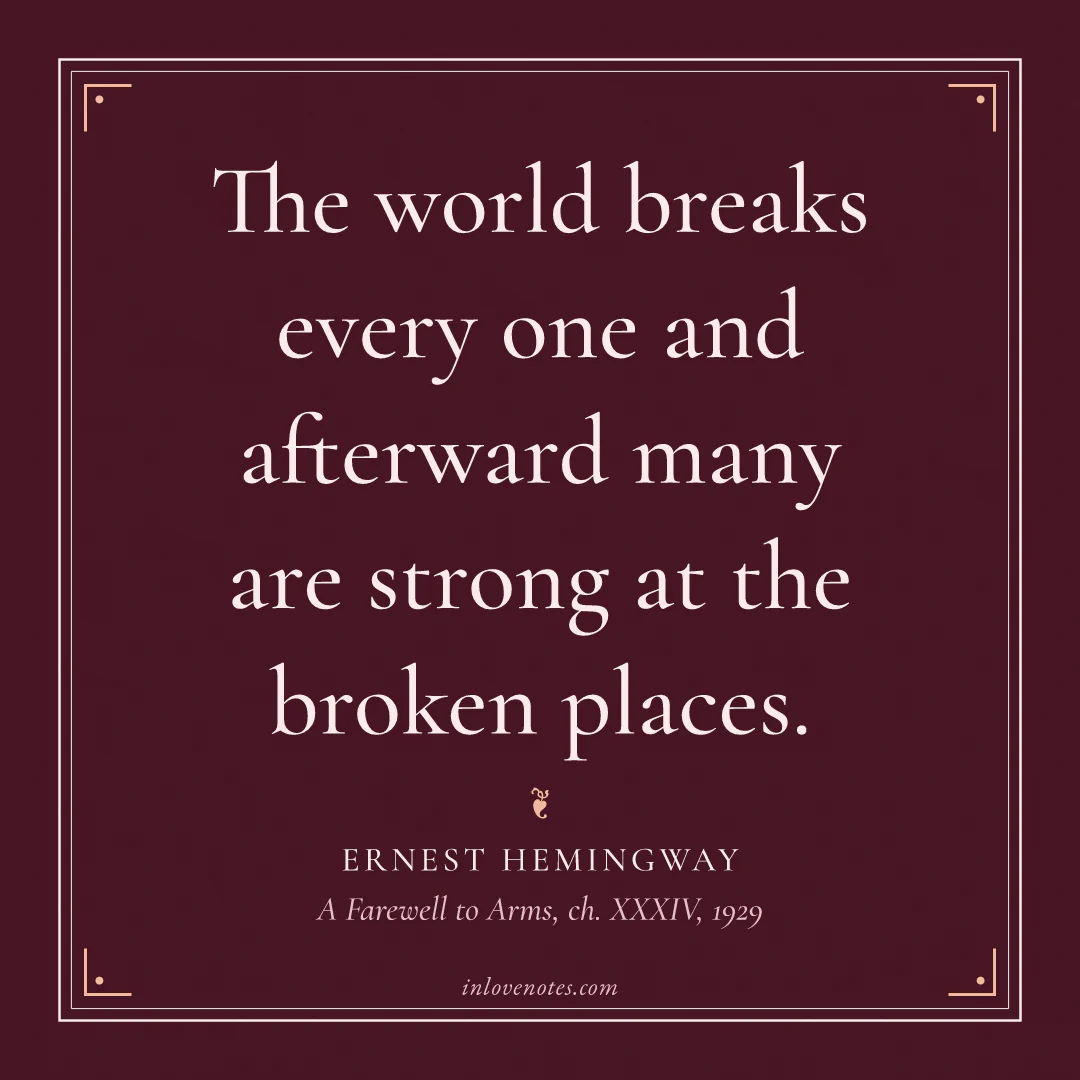
"The world breaks every one and afterward many are strong at the broken places. But those that will not break it kills." — Frederic Henry, in Ernest Hemingway, A Farewell to Arms, ch. 34 (1929)
Frederic Henry, the narrator, writes this while describing his life with Catherine Barkley, after he has deserted the army and found her again. The first sentence is one of the most quoted lines about recovering from pain, and it is usually printed alone. Read on and the passage turns darker: the world "kills the very good and the very gentle and the very brave impartially", and the novel ends with Catherine's death. The quote is honest as a line about surviving; just don't present it as Hemingway's optimism. In the 1929 text it is "every one", two words.
"Your pain is the breaking of the shell that encloses your understanding." — Kahlil Gibran, The Prophet, "On Pain" (1923)
In The Prophet, a woman asks Almustafa to speak of pain, and this is his first sentence. The next one explains the image: as the stone of a fruit must break for its heart to reach the sun, "so must you know pain". It is gentler than Hemingway and better for a card to a heartbroken friend, because it gives the pain a purpose without telling them to cheer up.
"How else may man make straight his plan / And cleanse his soul from Sin? / How else but through a broken heart / May Lord Christ enter in?" — Oscar Wilde, The Ballad of Reading Gaol (1898)
Wilde wrote the Ballad after his release from two years in prison, and it was first published under his cell number, C.3.3. The stanza is about repentance, not romance, but the idea that a broken heart is an opening rather than only a wound is why it is quoted after break-ups. If you use only the last two lines, keep the religious frame visible; it is part of the meaning.
Why does heartbreak hurt so much?
Part of the answer is that the brain treats an intense rejection a little like an injury. In the 2011 study above (Kross, Berman, Mischel, Smith and Wager, PNAS), the 40 participants had all been through an unwanted break-up in the previous six months; looking at the photo of their ex activated the secondary somatosensory cortex and dorsal posterior insula, regions that support the sensory side of physical pain. That is why "my chest hurts" is not only a figure of speech.
There is also a real medical condition nicknamed "broken heart syndrome": takotsubo cardiomyopathy, a temporary weakening of the heart muscle that can follow severe emotional or physical stress. A 2025 study in the Journal of the American Heart Association, led by Mohammad Reza Movahed at the University of Arizona, looked at 199,890 US hospital patients with it between 2016 and 2020: 83% were women, and men died of it at about twice the rate (11.2% against 5.5%). It is rare and it can mimic a heart attack, so chest pain after bad news is a reason to call emergency services, not to wait.
Before you post it, text it or write it in a card
- Captions: under 12 words reads best on a photo (the table gives the counts). Dickinson, Tennyson, Dickens, Byron and Teasdale all fit. Add the name: "— Emily Dickinson" costs two words and stops the line being reposted as anonymous.
- Cutting a line: if you shorten a quote in the middle, mark it with an ellipsis (...). Don't change words to make it fit; "everyone" for Hemingway's "every one" and "born" for Fitzgerald's "borne" are the two slips we see most.
- Sending one to your ex: a quote chosen to make someone feel guilty usually reads as exactly that. If you want to say something to them, a short note in your own words does it better; if you are not sure whether to send it, our piece on Richard Feynman's letter to his wife describes the old habit of writing the letter and keeping it.
- For a friend: pick from the last two groups (Gibran, Teasdale, Hemingway) rather than the first; a friend in the first week needs company more than a quote, and a line about getting through it lands better a little later.
- If the heartbreak is about him: our sad love quotes for him are grouped by what happened (missing him, a break-up, a loss), and the four sad quotes checked against the books include Wilde's real wording of "hearts are made to be broken".
The "Dr. Seuss" heartbreak quote that isn't his
"Don't cry because it's over, smile because it happened" is the most shared break-up quote on the internet and usually carries Dr. Seuss's name. Quote Investigator found no evidence that he ever wrote or said it. Theodor Geisel died in 1991; the earliest Seuss link QI found is a June 1998 high-school graduation speech that paraphrased Oh, the Places You'll Go! and then added the line, and by 2002 it was being printed as his. The closest early match QI located is German: two lines in the poem "Leuchtende Tage" ("Bright Days") by Ludwig Jacobowski, quoted in the August 1899 issue of Das Magazin für Litteratur. If you use it, the honest credit is "often attributed to Dr. Seuss; no source found". More lines like this are on our page of misattributed love quotes.
Questions readers ask
What is a good short quote for a broken heart?
For the first days, Dickinson's "Heart, we will forget him! / You and I, to-night!" (1896) or Shakespeare's "Give sorrow words" from Macbeth. For later, Hemingway's "The world breaks every one and afterward many are strong at the broken places" (1929). All three are checked against the original texts above.
Who said "Don't cry because it's over, smile because it happened"?
Not Dr. Seuss, as far as anyone has found. Quote Investigator traced the idea to the German poet Ludwig Jacobowski in 1899; the Seuss attribution appears from 1998 onward.
Why does heartbreak hurt physically?
Brain scans of people after an unwanted break-up (Kross et al., PNAS, 2011) show activity in regions that also handle physical pain. Severe emotional stress can also trigger takotsubo cardiomyopathy, "broken heart syndrome", which needs medical care.
Sources
- Shakespeare, Macbeth, Project Gutenberg #1533 (Act 4, Scene 3).
- Emily Dickinson, Poems, Three Series, Complete, Project Gutenberg #12242 (Third Series, 1896, poem XIII).
- Alfred Tennyson, The Princess, Project Gutenberg #791.
- Thomas Hardy, Satires of Circumstance, Lyrics and Reveries (1914), Project Gutenberg #2863 ("The Voice", dated December 1912; "Poems of 1912–13").
- Charles Dickens, Great Expectations, Project Gutenberg #1400 (ch. XLIV).
- F. Scott Fitzgerald, The Great Gatsby (1925), Project Gutenberg #64317.
- Edna St. Vincent Millay, Renascence and Other Poems (1917), Project Gutenberg #109.
- Lord Byron, Childe Harold's Pilgrimage, Project Gutenberg #5131 (Canto III, stanza XXXII).
- Sara Teasdale, Flame and Shadow (1920), Project Gutenberg #591.
- Ovid, Remedia Amoris, Latin text, The Latin Library (lines 139–140); translation ours.
- Ernest Hemingway, A Farewell to Arms (Scribner, 1929), Project Gutenberg #75201 (ch. XXXIV).
- Kahlil Gibran, The Prophet (1923), Project Gutenberg #58585 ("On Pain").
- Oscar Wilde, The Ballad of Reading Gaol, Project Gutenberg #301.
- Kross E, Berman MG, Mischel W, Smith EE, Wager TD, "Social rejection shares somatosensory representations with physical pain", PNAS 108(15), 2011, full text on PubMed Central.
- Movahed et al., takotsubo outcomes 2016–2020, Journal of the American Heart Association (14 May 2025), as reported by HealthDay.
- Quote Investigator, "Don't Cry Because It's Over; Smile Because It Happened" (2016).