Love Notes for Him: 60 Short Notes to Leave Where He'll Find Them
60 love notes for him, sorted by where he'll find them: lunchbox, wallet, mirror, suitcase, after a fight. Plus 3 famous notes from books and letters.
After a dinner party in Anna Karenina, Kitty is doodling with a piece of chalk on the green cloth of a card table. Levin takes the chalk and writes fourteen letters, the first letter of each word of a question he's been carrying for more than a year. She reads it. She takes the chalk and answers the same way. By the time her father calls her away to the theatre, a proposal has been made and accepted on a card table, and the rest of the room thinks they've been playing a parlour game. That's what a good love note is: a few words, left in a place where only one person will read them, about one thing that matters between you. This page has 60 short love notes for him that we wrote for it, sorted by where he'll find them and what kind of day he's having: lunchbox, wallet, car visor, bathroom mirror, before an interview, after an argument, while he's away. Between them are three famous notes, two from novels and one from a real secret engagement, and what each one teaches, a table of where notes survive (and where they turn to pulp), a plan for a jar of 365, and a three-line way to write your own.
A note is not a letter, and not a text
A love letter has room. It can tell a story, explain, apologise properly, go back over years. A text arrives in a stream with the bank alerts and the group chat, and it's gone by the afternoon. A note sits between the two. It's short like a text, but it's paper, it's in your handwriting, and it turns up somewhere he wasn't expecting it. The surprise does half the work. The other half is the one specific thing it says. "Love you!" on a sticky note is nice. "You make the coffee every morning and I notice" is the one he keeps.
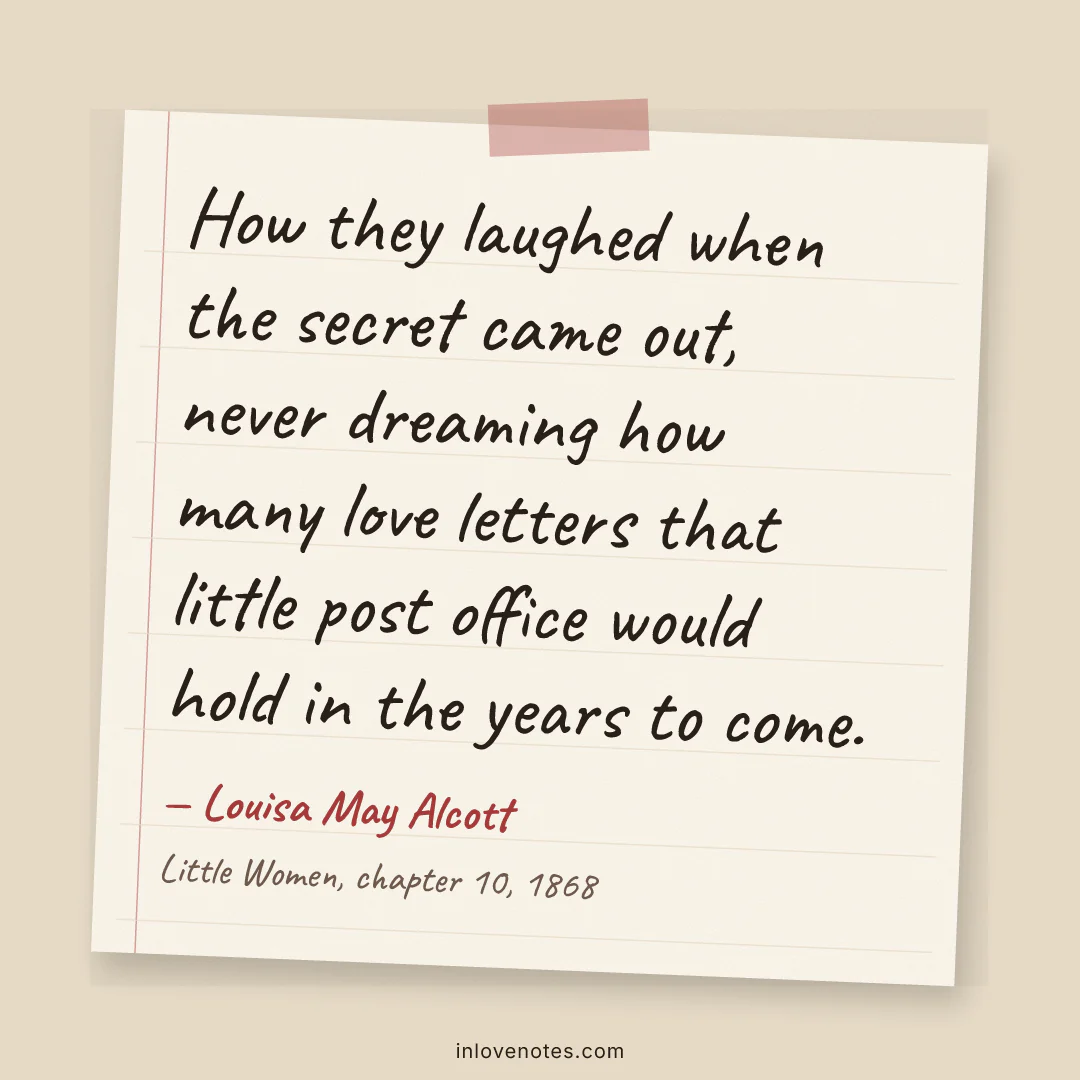
Notes have always worked like this. In chapter 10 of Little Women, Laurie joins the March sisters' club and, as a thank-you, sets up a post office in the hedge between the two gardens, an old birdhouse with the door stopped up and a padlock, one key for each house. Alcott then lists what went through it:
Tragedies and cravats, poetry and pickles, garden seeds and long letters, music and gingerbread, rubbers, invitations, scoldings, and puppies. [...] How they laughed when the secret came out, never dreaming how many love letters that little post office would hold in the years to come.
Louisa May Alcott, Little Women (1868), chapter 10, "The P. C. and P. O."
Pickles and poetry in the same box is the point. The hedge post office works because it's ordinary, part of the day, a place both houses check without thinking. That's what you're building when you start leaving notes for him: not one big gesture but a habit, a spot he learns to look in. Alcott's line about "the years to come" is the quiet promise every note carries. If you want something longer than a note, our guide to love letters for him has full sample letters for a first letter, an anniversary and a hard time.
Lunchbox and lunch-bag notes (read between bites)
Lunch is the middle of his day, often the only ten minutes nobody needs anything from him. Keep these to a line or two, write them on a napkin or a folded square of paper, and put them on top so he doesn't find a mayonnaise-soaked one at the bottom. Lunchbox notes can be silly. They're best when they sound like you talking across the kitchen. All of the notes on this page are examples we wrote for it; change the details so they're true for the two of you.
- Halfway through the day. Halfway to seeing you.
- I packed the good crisps. That's how you know it's love.
- Eat the whole thing, not just the sandwich. Someone at home wants you back in one piece.
- This apple was chosen from eleven candidates. You're worth the effort.
- Look up from your desk for ten seconds. That's me, thinking about you.
- Lunch is on me today. So is dinner. So are the dishes.
Wallet, pocket and car-visor notes
These are the notes that get carried. A small card behind his bank card can live in a wallet for years, so write it on something stiff and make it a line that will still be true next year. Coat-pocket notes are seasonal: slip one into the winter coat in autumn and he'll find it on the first cold day. A note tucked into the sun visor is for the drive, so keep it to a few words he can read at a red light.
- (wallet) In case of emergency: you are loved, and you know the way home.
- (wallet, behind a card) Before you pay for anything today: you're already the best thing I've got.
- (winter coat) You found this because it's cold enough for this coat. Come home and I'll warm your hands.
- (car visor) Drive slowly. I'd like you back exactly as you left.
- (jeans pocket) If this went through the wash, it still counts.
- (phone case) Every time you check this, remember someone's checking on you.
Sticky notes for the mirror, the fridge and the laptop
Sticky notes are the youngest tool on this page. The weak, reusable glue was invented at 3M by Spencer Silver, nobody knew what to do with it for years, and in 1974 his colleague Art Fry used it to keep his bookmark from falling out of his hymn book. Post-it Notes went on sale across the United States only in 1980. In forty-odd years they've become the default love note: cheap, bright, removable, and impossible to miss on a bathroom mirror. Write big, keep it under ten words, and put it at his eye level, not yours.
- (bathroom mirror) That man in the mirror? I'd pick him again.
- (coffee jar) You make the coffee every morning. I notice. Thank you.
- (laptop lid) Close this at six. Someone at home misses you.
- (fridge) Shopping list: milk, eggs, more evenings with you.
- (steering wheel) You did hard things this week. I'm proud of you.
- (one word per note, up the stairs) You / are / my / favourite / person / to / come / home / to.
The stair trail in note 18 counts as one note, and it's the one people remember. It works with any short sentence: one word on each step, or on each kitchen cupboard, so he reads it in the order he walks.
Before an interview, a game or a hard appointment
A note before a big day should do one job: steady him. Don't remind him what's at stake; he knows. Tell him what stays the same whatever happens, and if you can, tell him when you'll be thinking of him so he can picture it. Leave it with whatever he'll take: in the folder with his CV, in the kit bag, in the pocket of the jacket for the appointment.
- You've prepared for this. Walk in like the man I know.
- Whatever they decide today, my answer about you stays the same.
- Breathe out before you start. I'll be thinking of you at ten.
- Win or lose, there's dinner and me afterwards.
- I'll be in the waiting room or at the end of the phone. Either way, you're not doing this alone.
- By tonight you'll have done it. We're celebrating either way.
When his week has been rough
Some men find it easier to hear "I see how hard you're working" than "I love you", and easier still to read it than to hear it out loud. These notes don't try to fix anything. They notice, and they give him permission to stop for an evening. Put them where he lands when he gets home: on the pillow, on the remote, on the beer in the fridge.
- You don't have to be fine with me.
- I saw how hard this week was. I've taken Saturday morning off your list.
- You carry a lot without complaining. Put some of it down here.
- No fixing anything tonight. Just the sofa, a film, and me.
- You're allowed to be tired. You're still my favourite.
- Hard weeks end. We don't.
Funny and cheesy notes
A funny note says "I like you" as well as "I love you", and in a long relationship the first can be rarer. Cheesy is allowed if you both know it's cheesy; a groan is a kind of laugh. The best jokes are the private ones, so treat these as shapes to fill with your own: his snoring, his loyalty to one brand of cereal, the argument you keep having about the thermostat.
- I love you more than you love the last slice of pizza. And that's a lot.
- You're the only person I'd share my fries with. Don't push it.
- Roses are red, the bins go out Thursday. I love you every day, but especially Thursday.
- Official notice: you've been selected as my favourite human for another year. No action required.
- If you were a vegetable you'd be a cute-cumber. I'm sorry. I'm not sorry.
- You still snore. I still love you. Science can't explain it.
Notes that ask him out, the way Clara Wieck did
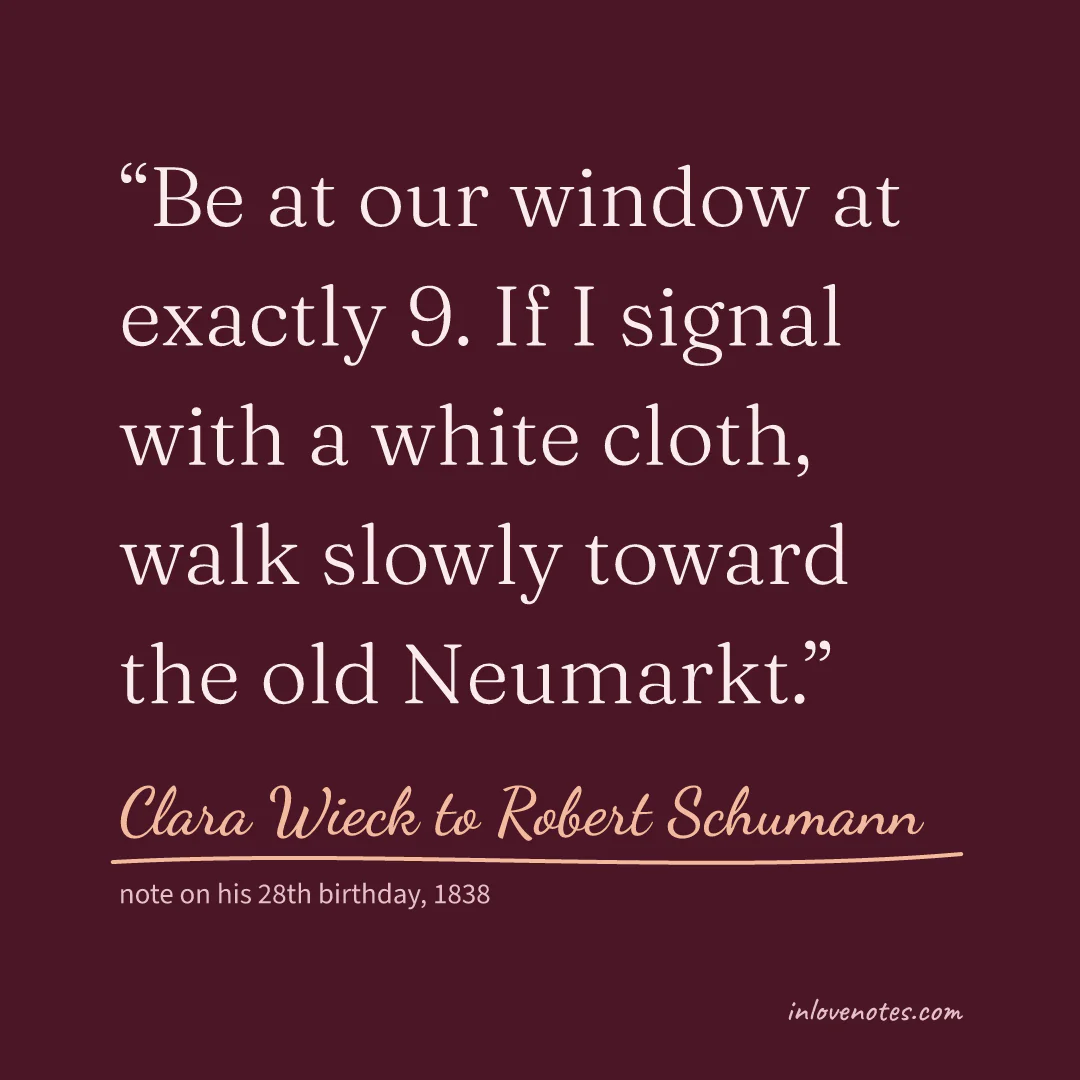
In the summer of 1838 the pianist Clara Wieck was 18 and secretly engaged to the composer Robert Schumann. Her father, Friedrich Wieck, was set against the match and watched her closely, so the couple met when they could and wrote in secret. On Robert's 28th birthday, 8 June 1838, she sent him this:
Be at our window at exactly 9. If I signal with a white cloth, walk slowly toward the old Neumarkt. I will follow soon after and go with you, since I have to fetch Mother at her mother's. If I don't signal, it means she hasn't gone.
Clara Wieck to Robert Schumann, 8 June 1838 (English translation as quoted by Interlude, "A Timeline of the Romance Between Robert and Clara Schumann")
There isn't a single loving word in it, and it's one of the most romantic notes on this page. It's a plan: a time, a signal, a route, and what to do if it doesn't work. The love is in the trouble she's gone to and in the "our" of "our window". It also leaves him something to do, which is the secret of a good date note: he isn't only told he's loved, he's told where to be. The two of them married in 1840, after taking her father to court for permission. Use this kind of note when the relationship has settled into routine and you want to give him the feeling of being sought again. Keep the details exact and the reason a surprise.
- Friday, 7:30. Wear the blue shirt. Don't ask where.
- If the porch light is on tonight, come out to the garden. Bring two glasses.
- Meet me where we had our first coffee. Saturday at ten. I'll be the one smiling.
- This note is a ticket. Valid for one walk, no phones, any evening this week.
- Keep Sunday clear. That's all you're getting.
- When you read this, text me one word: yes. The rest is planned.
While he's away
Travel notes are the ones packed in advance: in the suitcase, inside a shoe, in the washbag, in the laptop sleeve. Hide more than one and number them or write a day on the outside, so he finds a new one each night. If he's away for longer, a set of open when letters does the same thing at letter length, and for the bigger picture of being apart, our long distance love letters guide goes stage by stage.
- (in the suitcase) You found this when you unzipped the bag. The bed's too big without you.
- (marked "night two") Open on night two, when the hotel pillow is at its worst.
- Count the sleeps. I already have.
- Same moon, different window. Say goodnight to it. I'll hear.
- Bring yourself home. Souvenirs optional.
- Wherever you're sleeping tonight, you're still home to me.
After an argument
A note can't settle an argument, and it shouldn't try to win one. What it can do is put something kind between you while you're both still sore. Researchers at the Gottman Institute describe a "magic ratio" for couples: in happy, stable relationships, there are about five positive interactions for every negative one during conflict. A note left on his side of the bed is one of the five. Own your part plainly, don't add "but", and leave the rest of the conversation for later, face to face.
- I was wrong about the tone. I'm still sure about you.
- We can finish the argument later. I'd rather finish the day with you.
- I'm sorry for what I said at dinner. You deserved better from me.
- We disagreed. We're not in danger. Both things are true.
- I'm still a bit cross and I still love you. The second one is bigger.
- Can we start the evening again? I'll go first: hi. I missed you.
Notes that might make him cry
The notes people describe as making them cry are rarely the grandest ones. They're the ones that say something he half-hoped was true and never asked about: that he's enough, that the ordinary years count, that you'd choose him on the bad days too. Save these for a quiet moment rather than a busy morning, and put them somewhere he'll be alone when he reads them: inside a book he's reading, under his pillow, in the glovebox before a long drive.
- I didn't know what safe felt like until you.
- Thank you for the ordinary days. They're my favourite thing we've made.
- When I picture being old, you're in the next chair.
- You've never once made me feel like too much.
- I'd choose you on the hard days too. Especially on those.
- If you ever wonder whether you're enough: you were, from the first day.
If you'd like to pair one of these with a line by someone else, our collection of short love poems for him has nine poems traced to their first printing, several short enough for a card.
The initials note, borrowed from Anna Karenina
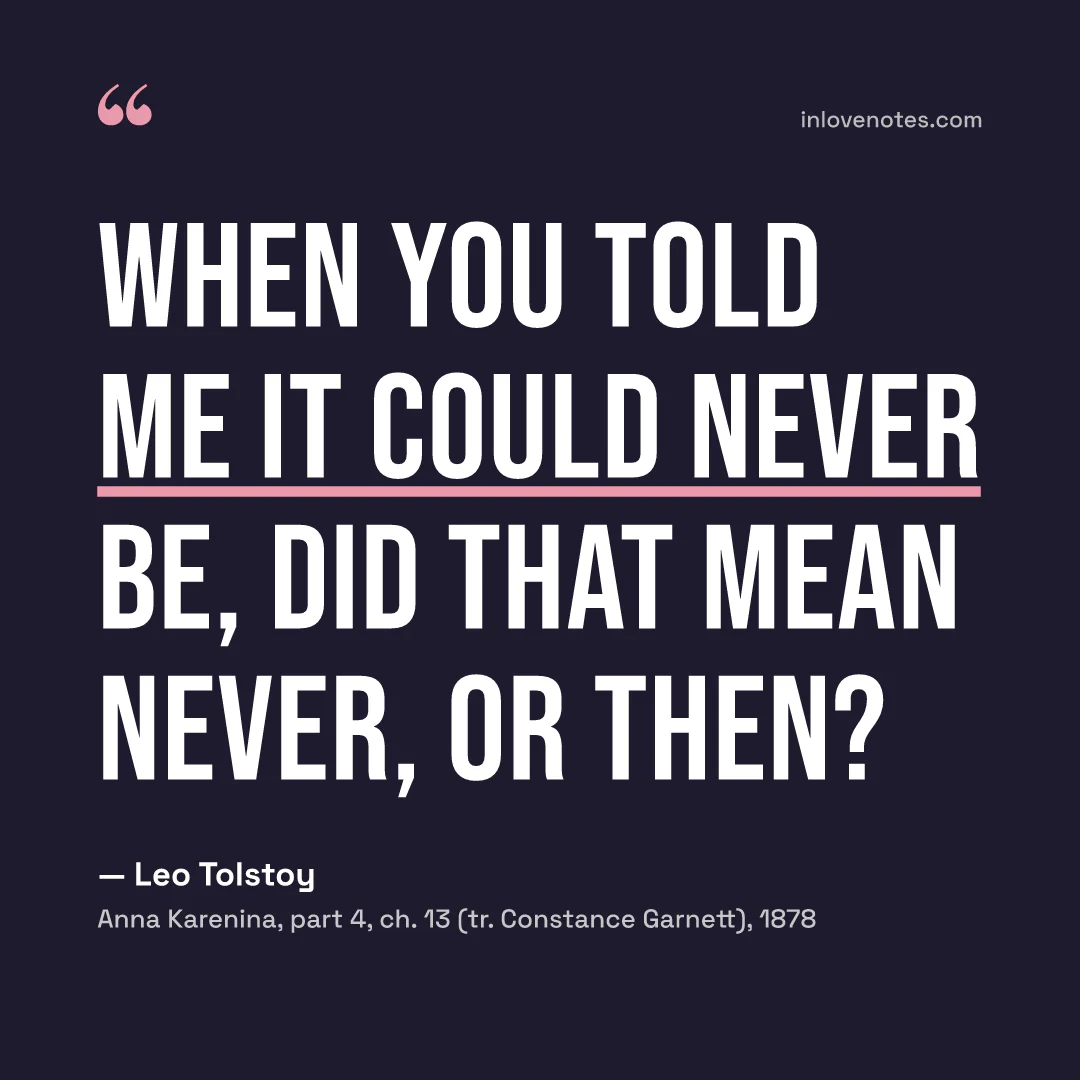
Back to Kitty and Levin. More than a year before this scene she turned down his proposal, and he has never known whether she meant "never" or only "not then". This is part 4, chapter 13 of Tolstoy's novel (published in book form in 1878), in Constance Garnett's English translation:
'Here,' he said; and he wrote the initial letters, w, y, t, m, i, c, n, b, d, t, m, n, o, t. These letters meant, 'When you told me it could never be, did that mean never, or then?'
Leo Tolstoy, Anna Karenina (1878), part 4, chapter 13, translated by Constance Garnett
She reads it. She writes back in initials: "Then I could not answer differently." She adds a request, "If you could forget and forgive what happened," and he snatches the chalk so fast he breaks it, writing out in initials that he has nothing to forget or forgive and has never stopped loving her. The scene ends with three letters from him and her answer, written out in full: "Yes." Tolstoy shows us almost none of the words; the drama is all in whether the other person can read you. That's why the scene works as a model. A note in initials is a private language, a small test only the person who knows you can pass.
You can use it as a game. Write the first letters of a sentence on a sticky note and leave it on the mirror: i. l. y. m. t. y. k. ("I love you more than you know") or y. a. m. f. p. ("you are my favourite person"). Put the answer on a second note somewhere he'll find later, or let him text you his guess. Keep it short; Levin's fourteen letters only worked because the question was already on Kitty's mind too.
Where notes survive, and how long they should be
Paper and place matter more than people expect. A note in a lunchbox meets condensation; a wallet card gets bent a hundred times; a sticky note on a bathroom mirror curls in the steam. This table is a quick guide to matching the note to the spot.
| Where he finds it | What holds up there | Best length | Notes from this page |
|---|---|---|---|
| Lunchbox or lunch bag | Folded paper or a napkin, on top of the food | One or two lines | 1–6 |
| Wallet | A small stiff card, cut to bank-card size | One line that will stay true | 7, 8 |
| Coat or jeans pocket | Thick paper, folded small | One line | 9, 11 |
| Car visor or steering wheel | A card under the visor strap, or a sticky note | Under ten words | 10, 17 |
| Bathroom mirror | Sticky note away from the shower, or a dry-erase marker | Under ten words | 13 |
| Suitcase or washbag | Envelope with a day written on it | Three or four lines | 43–48 |
| Under the pillow or in a book | A plain card | Two or three lines | 55–60 |
| A jar | Strips rolled or folded, a colour for each mood | One or two lines | Any |
A jar of 365, or one note a day: what Juliette Drouet's letters suggest
If one note is good, is one every day better? The great example is the French actress Juliette Drouet, who wrote to Victor Hugo from 1833, the year they became lovers, until shortly before her death in 1883. A research team led from the Université de Rouen Normandie is putting the whole correspondence online, and it runs to some 22,000 letters. Spread over fifty years, that works out at more than one a day. Nobody has 22,000 grand declarations in them, so a habit like that can only run on small things: the day, the weather between you, what you noticed. That's the lesson for a jar, too.
A 365 jar (or a 52-note jar, one a week, which is far more likely to get finished) works the same way. Mix the kinds of note so he never knows what he'll draw: some funny, some practical, some tender, a few date tickets like Clara's. A rough mix that keeps it lively:
- About a third about him: what he does, what you notice, what you're proud of.
- About a quarter memories: one specific moment per note, with the place or the date.
- A fifth or so funny, including your private jokes.
- A handful of "tickets": a walk, breakfast in bed, the film of his choice, no questions asked.
- The rest "open when" notes for bad days, with the instruction written on the outside.
Write them in batches of ten so they don't all sound alike, and date a few on the outside for birthdays and anniversaries. If you'd rather give one big list than a jar, our 100 reasons why I love you guide shows how to turn the same raw material into a list, a deck of cards or a little book.
Write your own in three lines
Every note on this page follows roughly the same pattern, and you can use it to write ones nobody else could have written:
- One specific thing. Something he did, a habit, a moment from this week. "You fixed the gate without being asked."
- What it meant to you. One short clause. "It made me feel looked after."
- A small turn at the end. A promise, a joke, a plan, or just his name. "Dinner's on me. Gate-fixer."
Then cut it. Most first drafts of a note are twice as long as they need to be, and the shortest true sentence usually wins. For a hundred more short lines and where to leave them, see our short love messages for handwritten notes.
Questions about love notes for him
What do you write in a love note to him?
Write one specific thing you noticed about him, what it meant to you, and a short ending such as a plan, a joke or his name. "You make the coffee every morning. I notice. Thank you." beats a general "I love you" because it shows you were paying attention.
Where can I hide love notes for my boyfriend?
Good spots are the places he reaches without thinking: his lunchbox, wallet, coat pocket, car visor, the bathroom mirror, his laptop lid, a suitcase before a trip, or inside the book he's reading. Pick a spot where he'll be alone for a moment when he finds it.
How long should a love note be?
Usually one to three lines. A wallet or mirror note works best under ten words; a note in a suitcase or under a pillow can run to three or four lines. If it needs more than that, it's a letter, and that's fine too.
How do you tell him you love him deeply in a note?
Name something about him you'd choose again, especially on hard days, and say it plainly. Lines like "I'd choose you on the hard days too. Especially on those." work because they go past the good moments to the ones that test a relationship.
Sources
- Leo Tolstoy, Anna Karenina (1878), part 4, chapter 13, translated by Constance Garnett (1901), Project Gutenberg #1399.
- Louisa May Alcott, Little Women (1868), chapter 10, "The P. C. and P. O.", Project Gutenberg #514.
- Clara Wieck to Robert Schumann, 8 June 1838, English translation as quoted in "A Timeline of the Romance Between Robert and Clara Schumann", Interlude (interlude.hk).
- Juliette Drouet, Lettres à Victor Hugo, digital edition directed by Florence Naugrette, Université de Rouen Normandie with Sorbonne Université (juliettedrouet.org), presentation of the edition (22,000 letters).
- "The Magic Relationship Ratio, According to Science", The Gottman Institute blog (gottman.com), on the 5-to-1 ratio during conflict.
- History of the Post-it Note (Spencer Silver's adhesive, Art Fry's 1974 bookmark idea, US launch in 1980): "Post-it Note", Wikipedia, citing 3M and Henry Petroski, The Evolution of Useful Things (1992).