Love Letters for Him: Sample Letters for a Boyfriend or Husband, by Occasion
Sample love letters for him for six situations, from a first letter to an anniversary or a hard week, with real lines from Abigail Adams and Zelda Sayre.
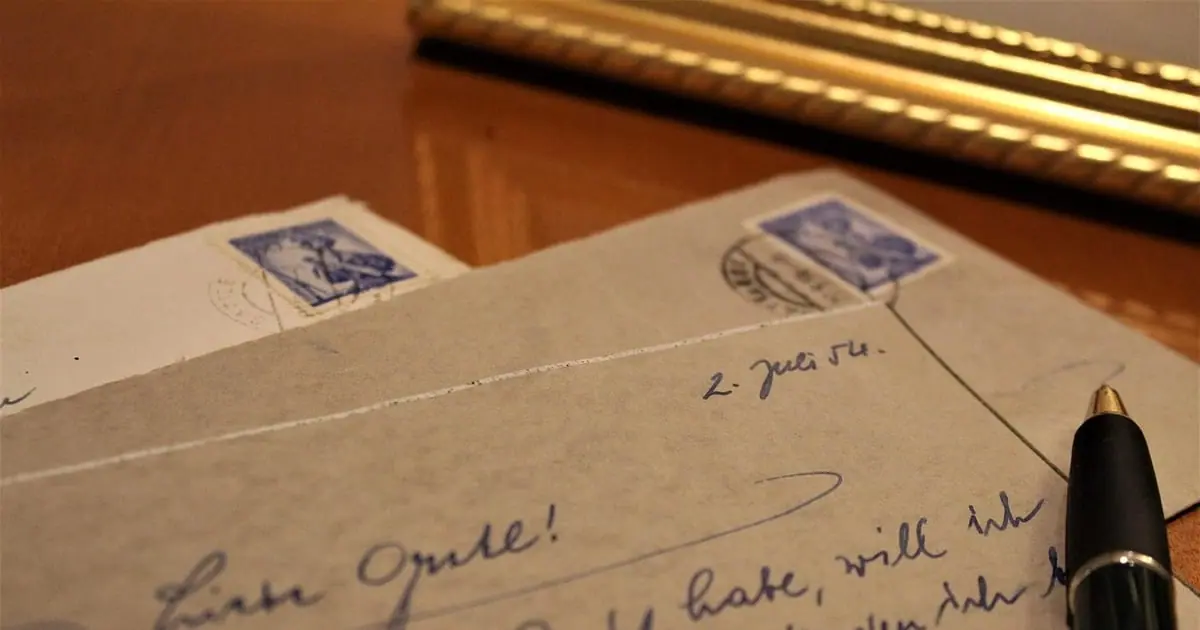
In December 1782 John Adams was in Paris, helping negotiate the peace that would end the American Revolution, and he had been away from home for most of three years. On 23 December his wife Abigail sat down in Massachusetts to write to him. She had no news, she admitted, and nothing new to say about her feelings. She wrote anyway, and the letter is now one of the best-known in the Adams papers. That is the whole case for writing a love letter to a man: it doesn't need news. It needs him to hear, in your words, that he still has the place he thinks he has.
This page is built around situations rather than quotes. For each one you'll find what the letter needs to do, a sample you can adapt (the bracketed parts are yours to fill in), and a line or two from real letters women wrote to the men they loved. If you want the step-by-step method first, start with our guide on how to write a love letter.
Before you write: what kind of letter is this?
Most letters to a boyfriend or husband fail for one of two reasons: they try to say everything, or they say nothing specific. Deciding the situation first fixes both. Use the table to set the length and the one job the letter has to do.
| Situation | Length | The one job | Leave out |
|---|---|---|---|
| Early days (first letter) | Half a page | Name what you noticed about him | Big promises about the future |
| Anniversary (husband) | One page | Show him you remember the year, not only the day | A list of everything that went wrong |
| Long distance | One page, sent regularly | Make the ordinary day visible to him | Counting how unfair the distance is |
| After an argument | A short paragraph | Own your part and reopen the door | Relitigating the fight |
| He's having a hard time | A few lines | Stay with him, don't fix him | Advice, silver linings |
| Just because | Two or three sentences | Surprise | Anything that needs a reply |
A first letter to a boyfriend
A first letter is easy to overdo. He doesn't need a declaration yet; he needs proof that you've been paying attention. One concrete detail he didn't know you'd noticed does more than any adjective.
Sample: [Name], I've been meaning to tell you something, and it felt too small to say out loud, so here it is on paper. When we [real moment: waited for the bus in the rain / cooked that terrible pasta], you [specific thing he did]. I keep coming back to it. I like who I am around you: [one honest word: lighter, braver, less in a hurry]. That's all. No big speech. I just didn't want it to go unsaid. [Your name]
For a playful opening, look at how Simone de Beauvoir greeted the American novelist Nelson Algren. Their correspondence ran from 1947 to 1964 and was published as Beloved Chicago Man in 1998. Her first letter, on 23 February 1947, begins "Dear Nelson Algren". By 8 May it is "My precious, beloved Chicago man", and in October 1950 she opens with "My dearest not too repellent you." A salutation that only he would understand is one of the cheapest, surest ways to make a letter feel private.
An anniversary letter to your husband
The anniversary letter is the one most people dread, because it seems to have to sum up a marriage. It doesn't. It only has to sum up this year: one thing he carried, one thing you saw him do, one small ordinary scene you would choose to repeat.
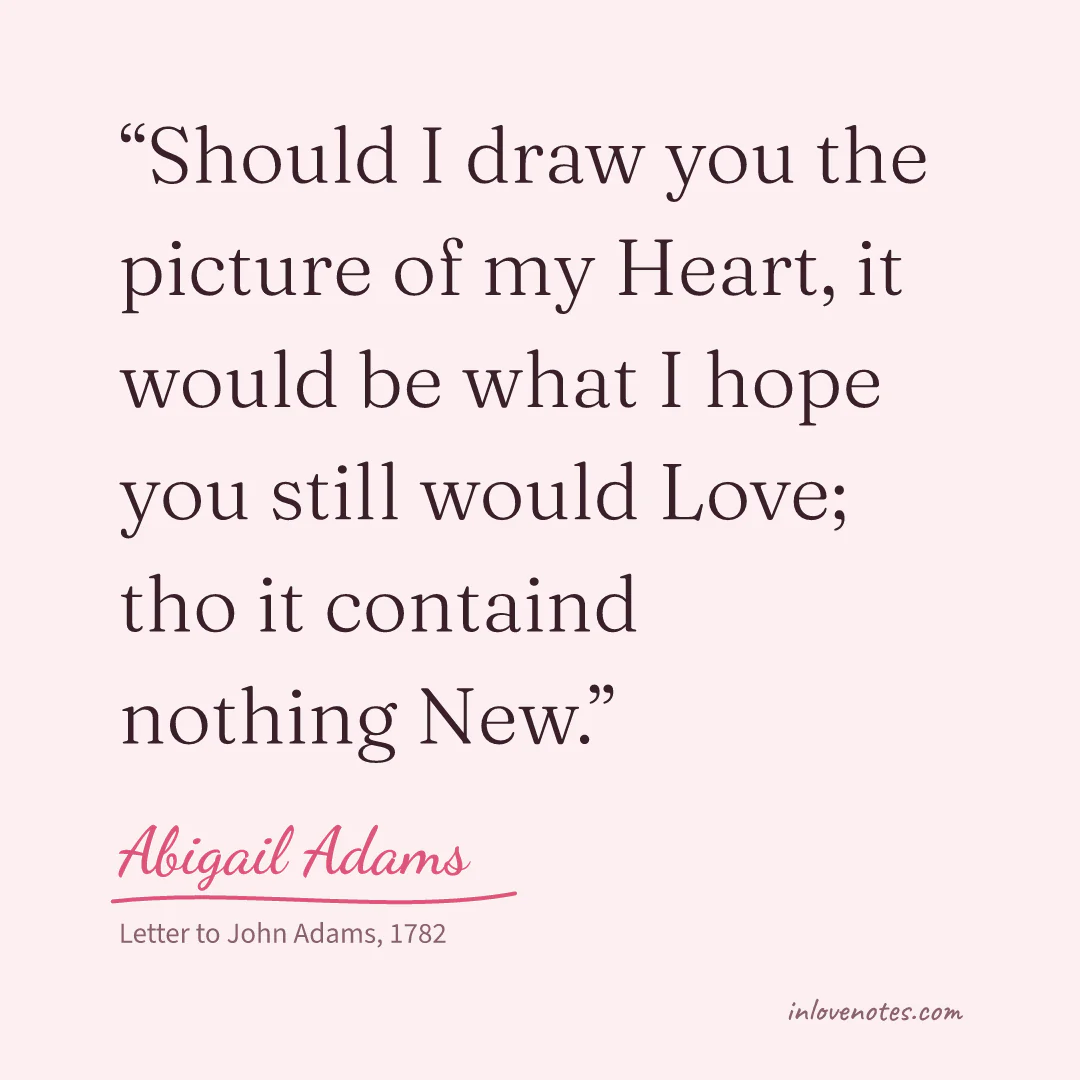
…should I draw you the picture of my Heart, it would be what I hope you still would Love; tho it containd nothing New; the early possession you obtained there; and the absolute power you have ever mantaind over it; leaves not the smallest space unoccupied.
Abigail Adams, Letter to John Adams, 23 December 1782
Abigail kept her spelling ("containd", "mantaind") and so does the Massachusetts Historical Society edition. What makes the passage useful for a long marriage is its admission: "nothing New." Eighteen years into the marriage, she isn't claiming fresh fireworks. She's saying the place he took early on is still entirely his. That's a truer anniversary message than "I love you more every day," and it's one you can paraphrase in plain words: nothing about how I feel is new, and that's the point.
Sample: [Name], [number] years. I tried to think of something new to tell you and couldn't, which I think is the best news I have. This year you [something he carried: the move, your mother's illness, the night feeds]. I saw it, even when I didn't say so. My favorite day of the year wasn't [the big event]; it was [an ordinary scene]. I'd like a lot more of those. Happy anniversary. [Your name]
A long-distance love letter
Distance makes people write about the distance. Resist that. He already knows how many miles there are. What he's missing is your Tuesday: the weather, what you ate, the thing that made you laugh on the way home. A long-distance letter works best when it lets him into a day he couldn't be in.
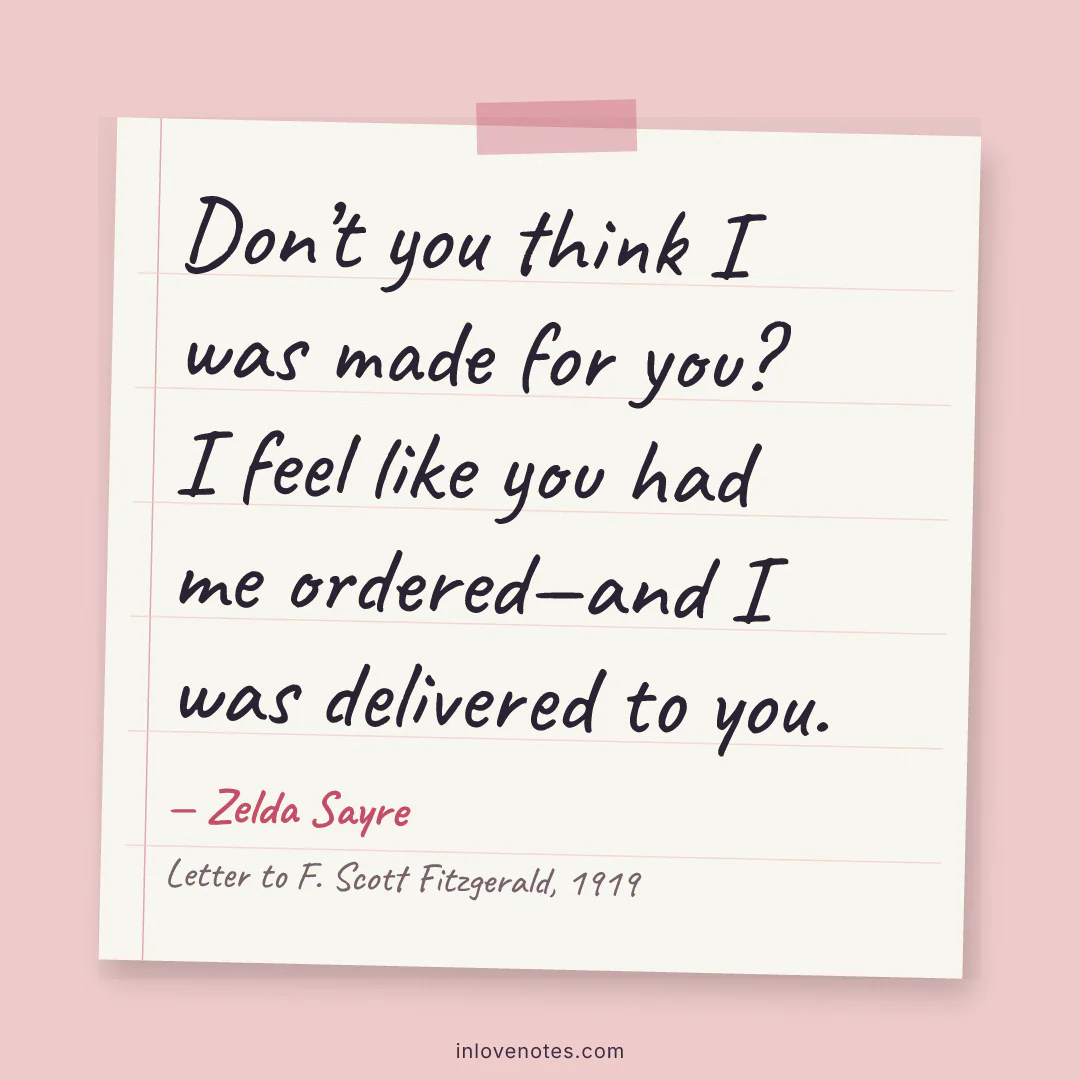
Don't you think I was made for you? I feel like you had me ordered—and I was delivered to you—to be worn—I want you to wear me, like a watch-charm or a button hole boquet—to the world.
Zelda Sayre, Letter to F. Scott Fitzgerald, spring 1919 (in Dear Scott, Dearest Zelda, 2002)
Zelda wrote this from Montgomery, Alabama, while Scott was in New York trying to earn enough to marry her; they married in April 1920. The dashes and the misspelled "boquet" are hers, kept by the editors Jackson R. Bryer and Cathy W. Barks. The line works for distance because it turns being apart into a kind of pride: she wants to be shown to the world as his. If you borrow it, keep the first sentence; it stands alone on a card.
Sample: [Name], today was ordinary, so I'm sending you all of it. [Weather]. I had [what you ate] and thought you'd have [teased me / stolen half]. On the way home [small thing you saw]. I'm putting it in a letter because a text would have been gone by tonight. [Number] days. I'm counting, but quietly. [Your name]
For more short lines to slip into the envelope, see our short love messages for handwritten notes.
After an argument
This is the shortest letter on the page, and it should be. A long apology letter tends to restate the argument, and the argument starts again. Say what you got wrong, say what you still feel, and leave the rest for a conversation.
Sample: [Name], I was wrong about [the specific thing], and I'm sorry I said [the specific line]. I don't want to win this one. I want us back. I'm here when you're ready. [Your name]
Notice what isn't there: no "but", no "you also". If there is something he needs to own, it belongs in a conversation once the door is open again, not in the note that opens it.
When he's going through a hard time
Lost job, lost parent, a diagnosis, a long run of bad weeks: men are often told to cope quietly, and a letter can give him permission not to. The mistake here is trying to cheer him up. A letter that says "I'm not going anywhere" helps more than one that says "everything happens for a reason."
Sample: [Name], you don't have to be okay for me. You don't have to explain it or have a plan. I'm here for the bad days as much as the good ones, and I'm not keeping score. When you want to talk, I'll listen. When you don't, I'll sit with you anyway. [Your name]
If grief is involved, our collection of sad love quotes for him has lines that acknowledge loss without trying to tidy it.
Just because: notes for a pocket or a lunchbox
These are the letters men tend to keep, precisely because no occasion forced them. They should be short enough to read standing up. A borrowed line works well here if you tell him where it's from; it gives him something to look up.
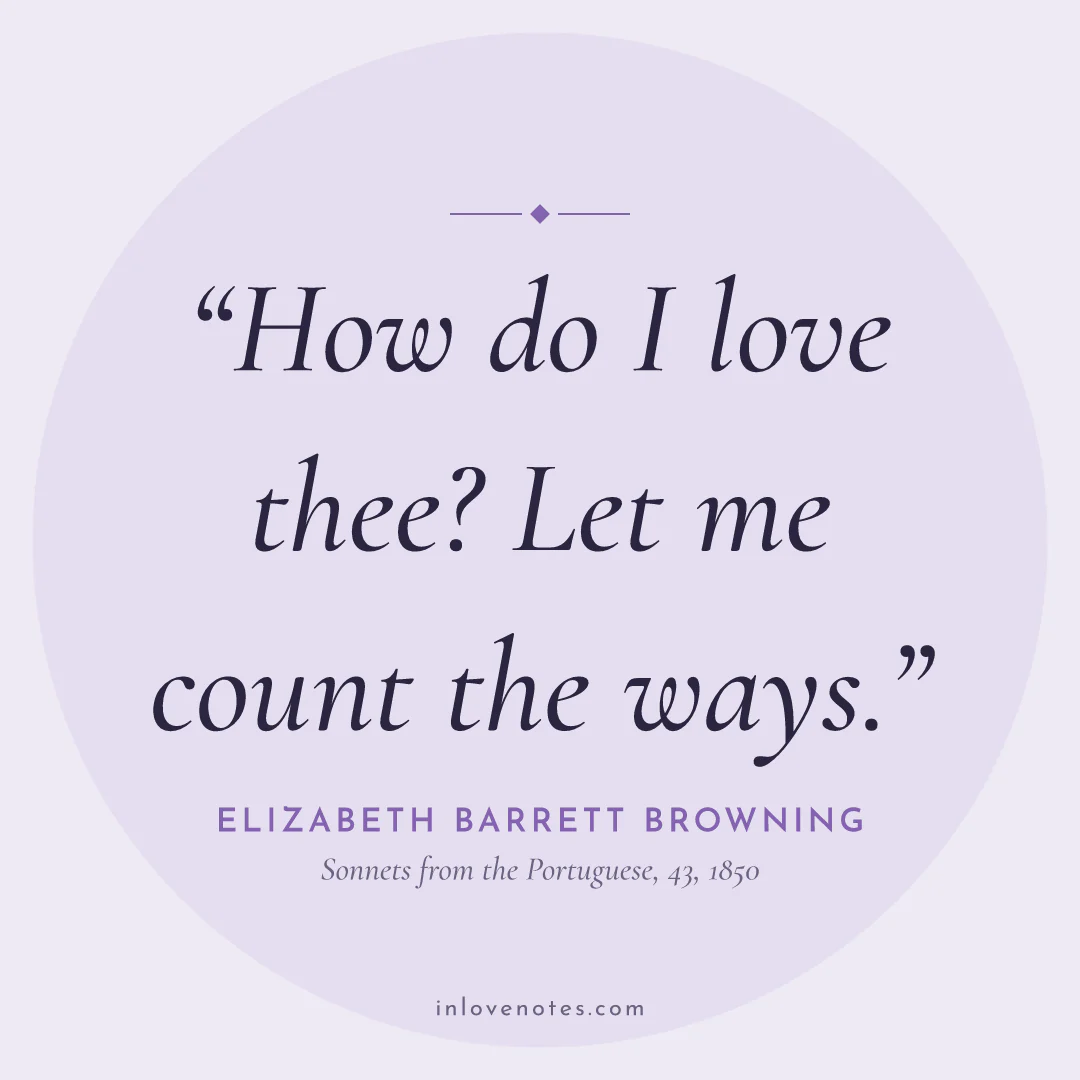
How do I love thee? Let me count the ways. / I love thee to the depth and breadth and height / My soul can reach…
Elizabeth Barrett Browning, Sonnets from the Portuguese, Sonnet 43, 1850
Elizabeth Barrett wrote the sequence during her courtship with the poet Robert Browning in 1845–46 and published it in 1850 under a title meant to disguise how personal it was: the "Portuguese" probably came from his pet name for her, "my little Portuguese". The opening line is so familiar it can sound like a greeting card, so use it with a twist. Write the first line, then actually count: One: the way you [habit]. Two: [thing he does for others]. Three: [private joke]. Three is enough.
More ready-made lines for him, from letters and novels, are in romantic love quotes for him.
Small things that make a letter to him land
- Handwrite it if you can. Even a few lines on paper read as more deliberate than a long message on a phone, and paper gets kept.
- Use his words, not yours. If he calls the dog "the boss" or your apartment "the cave", put that in. Private vocabulary is intimacy he recognizes instantly.
- Thank him for something specific. Specific thanks is rarer than general praise, and it shows you were watching. "Thank you for driving my dad to the hospital" lands harder than "you're amazing."
- Don't ask for a letter back. If he isn't a writer, a request turns a gift into homework.
- Pick the moment of delivery. In a bag he'll open on a trip, under the coffee jar, in the book he's reading. Where it's found is part of the message.
- Sign it the way you'd say it. "Love," is fine. So is his nickname for you. Pet names last: in July 1964, seventeen years after "Dear Nelson Algren", Beauvoir was still opening her letters to him with "My own rat".
One last check before you seal it
Read it out loud once. If any sentence sounds like something you'd find printed inside a card, cut it or replace it with something that could only be about him. Then stop editing. Abigail Adams apologized for having nothing new to say and wrote a letter people still read more than two hundred years later. Yours only has to be read by one person, and it only has to sound like you.