Goodnight Paragraphs for Her: 15 to Send Tonight, and How to Write Your Own
15 goodnight paragraphs for her, long, short and funny, with a four-step way to write your own and verified lines from Shakespeare and Shelley to borrow.

Goodnight paragraphs for her have an unlikely ancestor: a poem arguing that lovers should never say good night at all. Percy Bysshe Shelley copied "Good-Night" into a book he gave to Sophia Stacey on 29 December 1820, and Leigh Hunt printed it in 1822. Its argument is that the night is only "good" for two people who never have to say the word. A goodnight paragraph does the same job. It doesn't close the day. It makes the hours until morning feel shorter for the person reading it in the dark.
This page is a method first and a collection second. You'll find the four moves almost every good goodnight paragraph makes and 15 paragraphs our editors wrote to show those moves at work: long, short, funny, and for harder nights. There's also a table of what to send when, and four lines from poets you can borrow, each checked against its printed source. If she's the one who usually texts first in the morning, the companion page has good morning paragraphs for her.
What a Goodnight Paragraph Has to Do in Thirty Seconds
She'll read it in bed, screen dimmed, probably with one eye already closing. That changes the brief. A daytime message can be a joke or a plan. A goodnight paragraph has to land softly and leave her with one warm thought to fall asleep on. The paragraphs that do this tend to make four moves, in roughly this order:
- Look at her day, not yours. Open with something she did, carried or got through today. "You handled that call so calmly" beats "I'm so tired".
- Add one detail only you noticed. One, not five. The way she said a word, the song she hummed, the thing she almost didn't tell you. A detail is what makes a paragraph impossible to copy from a list.
- Say the feeling in plain words. "I love you" still works. So does "I'm proud of you" or "I like who I am around you". Skip the adjectives that try to do the feeling's job.
- Send her off. Wish her rest, point her to tomorrow, or name the next time you'll see her. This is the line she falls asleep on.
The fourth move is the oldest. Here is Juliet making it on the balcony, the first night she and Romeo speak:
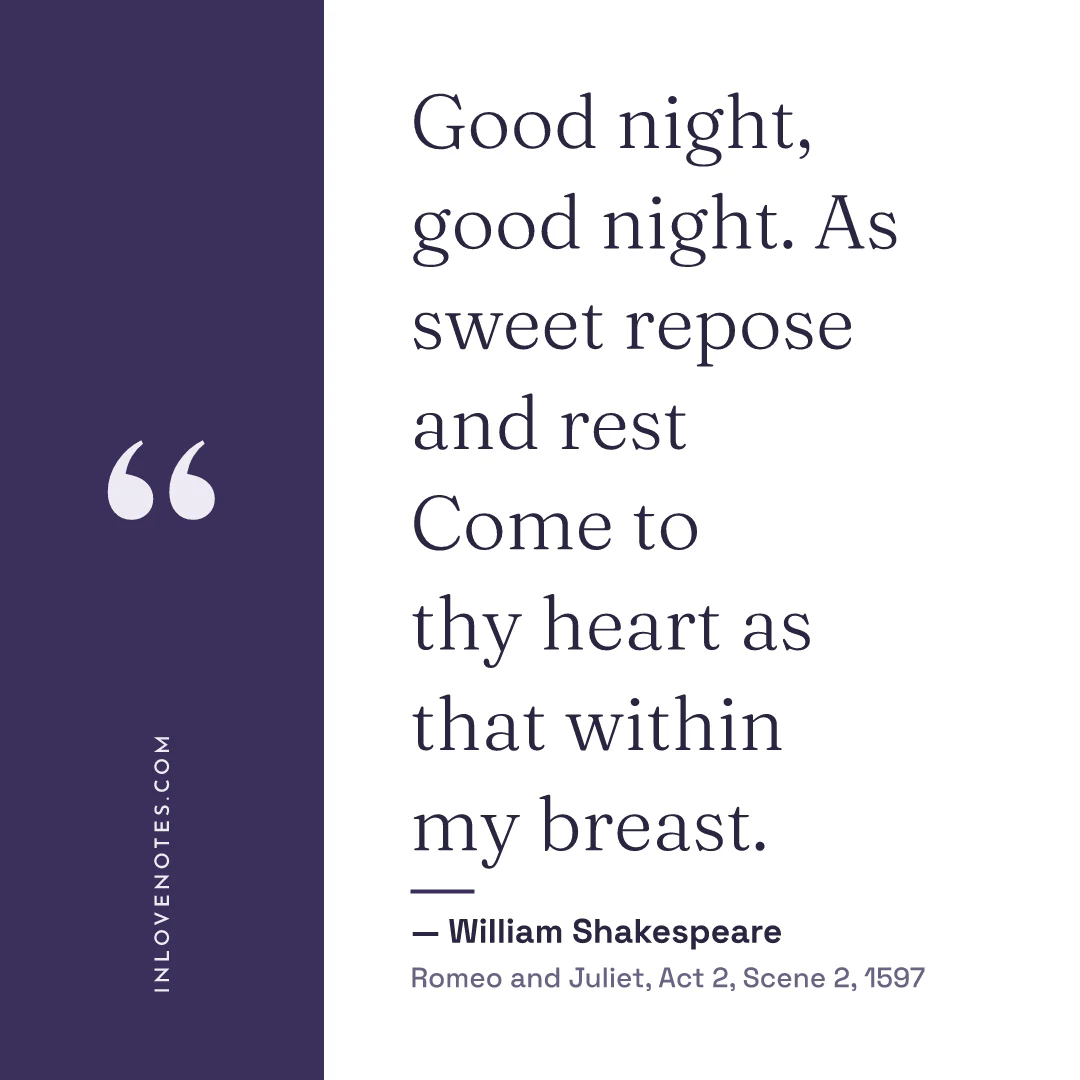
"Good night, good night. As sweet repose and rest / Come to thy heart as that within my breast."
— William Shakespeare, Romeo and Juliet, Act 2, Scene 2 (first printed 1597)
Notice what she wishes him: not sleep in general, but the same calm she feels right now. That's a send-off with a gift in it, and it's the shape of the best last lines below. A small fact worth knowing: in the Project Gutenberg text of that scene Juliet says "good night" eight times and keeps finding reasons to stay at the window. Romeo never says it once. A goodnight paragraph is allowed to be a little reluctant to end.
Long Goodnight Paragraphs for Her, Built Move by Move
Each of these runs about 80 to 130 words, which is as long as a paragraph should get on a lock screen at night. The words in [brackets] are where your own details go. Leave them generic and the paragraph sounds like ours; fill them in and it sounds like you. Under each one is a note on which move is carrying it, so you can borrow the structure even if you rewrite every word.
1. The one about her day
I know today asked a lot of you. [The meeting, the drive, the thing with your sister] would have flattened most people, and you came out the other side still making jokes. I don't think you see how steady you are; I see it every time. So here's your official permission to stop for the night. Put the phone down after this, let your shoulders drop, and sleep like someone who did enough today, because you did. I love you. I'll be here when you wake up.
Doing the work: moves 1 and 4. Most of the paragraph is about her day; the send-off gives her permission to rest.
2. The one about a small thing you noticed
Something I didn't say earlier: when you [laughed at your own joke before finishing it / pushed your hair back while you were reading], I lost track of what I was saying. It's such a small thing and I've thought about it four times since. That's what being with you is like. Not fireworks every day, just a hundred little moments I keep replaying. Sleep well, [her name]. I'm going to fall asleep thinking about that laugh.
Doing the work: move 2. The single detail is the whole paragraph, and the last line circles back to it.
3. The one that says it plainly
I don't always say this well out loud, so I'm writing it while it's quiet. I love you. Not in a big-speech way, in an everyday way: I love hearing about your day, I love the way you make ordinary evenings feel like something, and I love that you're the last person I talk to before I sleep. That's it. That's the paragraph. Good night, my love.
Doing the work: move 3. Short sentences, no adjectives propping up the feeling, and an ending that admits it's simple.
4. The one that points to tomorrow
Before you sleep: tomorrow is [the interview / your first day back / the long shift], and I want you to walk in knowing one thing. You are more ready than you feel tonight. You prepared, you care and you're good at this. Whatever happens, I'll want to hear every detail afterwards, the good parts and the annoying ones. Now close your eyes. Tomorrow-you has got this, and tonight-you just needs to rest.
Doing the work: move 4, aimed at the morning. It works best the night before something she's nervous about.
5. The one for the end of a long week
We made it to [Friday / the end of this ridiculous week]. I've watched you hold a lot together these last few days, and you did it without letting anyone see how heavy it was, except maybe me. Thank you for letting me be the one you tell. This weekend I'd like to [make you breakfast / do nothing with you for a whole morning]. For now: sleep in if you can, and know you're loved exactly as tired as you are.
Doing the work: all four moves in order. Her week, the detail that she let you in, thanks, then a plan and a send-off.
Short Ones for When She's Already Half Asleep
Some nights a long paragraph is the wrong gift. If she said "going to bed" ten minutes ago, send two or three lines she can read without unlocking the phone. These keep move 4 and maybe one other:
- Go to sleep, beautiful. You were wonderful today and I hope you dream about something ridiculous. Good night.
- I'm glad you're mine, and I'm glad I got the last conversation of your day. Sleep well, my love.
- Phone down, eyes closed. I'll still love you this much in the morning, probably more. Good night.
- Thank you for [tonight / the call / the ten minutes you didn't have]. That was my favourite part of the day. Sweet dreams.
To Make Her Smile Before Lights Out
A funny goodnight paragraph should still end soft. Make the joke in the first half and turn tender in the last line, so the joke isn't the final thing she reads. And only tease her about something she already laughs about herself.
- Official notice: you are hereby relieved of all duties, including replying to this message. Your only remaining task tonight is stealing all the blankets in your dreams. Good night, troublemaker. I love you.
- Reminder that you said "five more minutes" [forty minutes ago]. I'm not complaining. Those were the best forty minutes of my day. Now actually sleep, before I start counting again.
- I tried to think of a poem for you tonight and all I got was "roses are red, you're asleep, I'm still texting". That's the paragraph. Sleep well, you're the best part of my day.
Harder Nights: After a Fight, Miles Apart, Before Her Big Day
These are the nights a goodnight paragraph matters most and is easiest to get wrong. After an argument, don't reopen it at midnight. Say the one thing that's still true and leave the rest for daylight. When you're apart, describe the gap between you, not just the feeling. Before something big, keep yourself out of it.
13. After a fight that isn't finished
I don't want to go to sleep with this between us, but I also don't want to solve it by text at midnight. So just this: I'm sorry for [my part / how I said it], I'm not going anywhere, and I love you even when we disagree, maybe especially then. Let's talk properly tomorrow. Sleep, and know we're okay underneath it.
14. When there are miles between you
It's [11 p.m.] here and you're probably already asleep, which means you'll read this with your morning coffee instead. That's fine. I just wanted the last thing I did today to be thinking about you. [Twenty-three] more nights and you'll be close enough to say this out loud. Until then, good night from [the city / the wrong time zone], and good morning to you whenever this finds you.
Long-distance couples have written this kind of paragraph for a long time. Robert Browning's short poem about crossing the dark to reach someone ends on the moment of arrival:
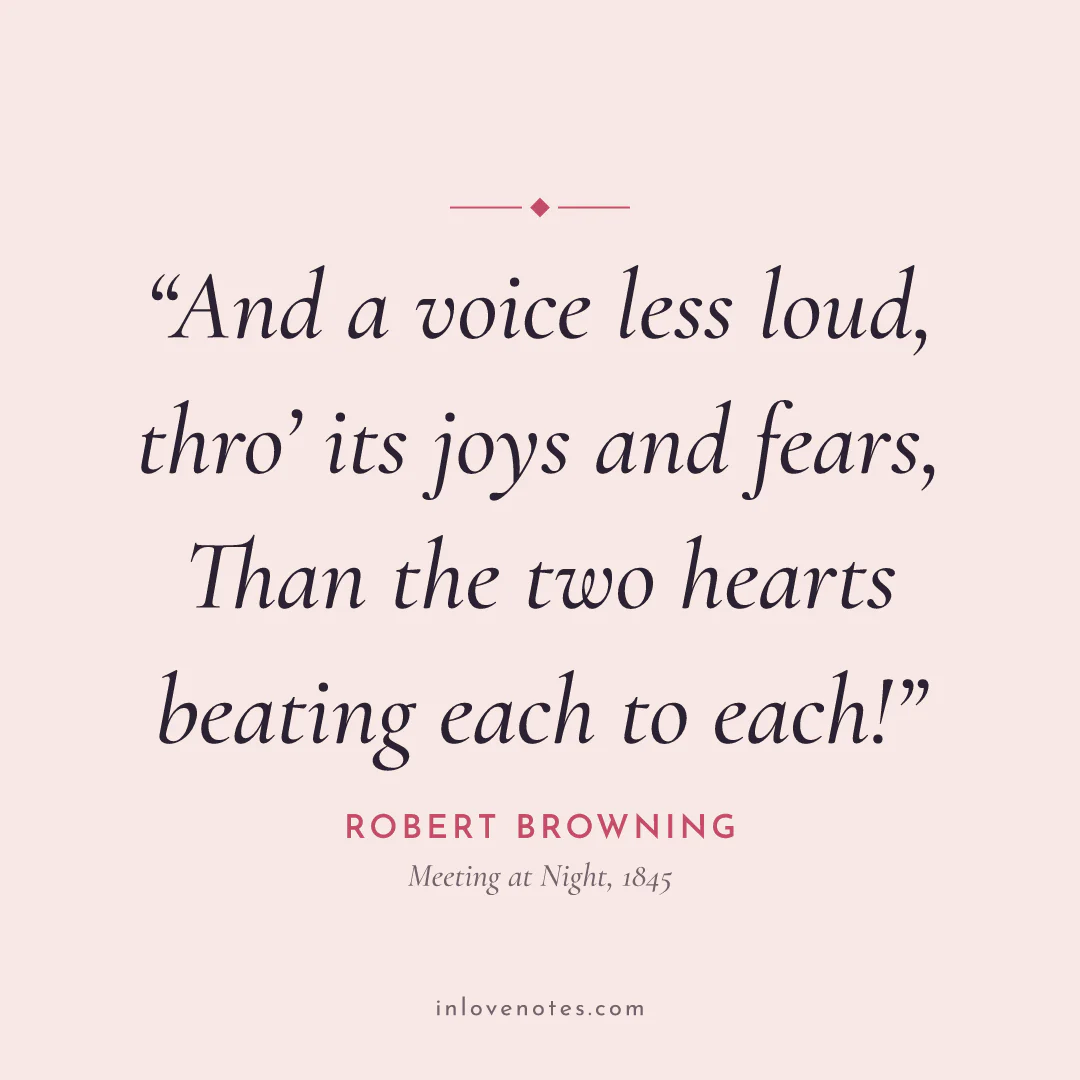
"And a voice less loud, thro' its joys and fears, / Than the two hearts beating each to each!"
— Robert Browning, "Meeting at Night", Dramatic Romances and Lyrics (1845)
Browning first printed it as the opening half of a two-part poem called "Night and Morning". He separated the halves and gave them their present titles in 1849 (see the Wikisource text and note). Its other half, "Parting at Morning", is on our good morning page. The two lines above suit a goodnight message when you're counting down to a visit: the poem is all about the journey, and the lines are about the arrival. For full letters across a distance, see long distance love letters.
15. The night before her big day
Tomorrow is yours. I'm not going to say anything clever, because you don't need clever, you need sleep. You've worked for this, you're ready for this, and whatever the day brings I'll be proud of you at the end of it. Phone on silent, alarm set, eyes closed. I'll be cheering from [wherever I am]. Good night, my love.
Lines From the Poets, and Shelley's Two Versions
If you'd like to end a paragraph with a borrowed line, keep it short and make sure it's real. Many "goodnight love quotes" online have no traceable author (we keep a list of the worst offenders in misattributed love quotes). The last stanza of Shelley's poem is verified, and it says the most romantic thing you can say at bedtime:
"To hearts which near each other move / From evening close to morning light, / The night is good; because, my love, / They never say good-night."
— Percy Bysshe Shelley, "Good-Night", The Literary Pocket-Book (1822)
Hunt printed it under the signature "Sigma". The text above is the 1822 first printing as given in Thomas Hutchinson's Oxford edition of Shelley's poems (1914). The same wording appears in Shelley's Harvard notebook. Hutchinson also prints the variants from the copy Shelley wrote out for Sophia Stacey in December 1820, so the poem survives in two wordings by the same hand. Hutchinson's note doesn't say which came first: read the table below as two versions, not a before and after. Set side by side, they're a lesson in choosing between two drafts of your own.

| Line | Stacey manuscript (1820) | Printed text (1822) |
|---|---|---|
| 1 | Good-night? no, love! the night is ill | Good-night? ah! no; the hour is ill |
| 5 | How were the night without thee good | How can I call the lone night good |
| 9 | The hearts that on each other beat | To hearts which near each other move |
| 11 | Have nights as good as they are sweet | The night is good; because, my love, |
| 12 | But never SAY good night | They never SAY good-night. |
The Stacey wording is warmer and more direct ("no, love!", "without thee", hearts that "beat"). The printed wording is quieter and saves "my love" for the last stanza, where it lands hardest. Neither is wrong. When you have two versions of a goodnight paragraph, ask the same question: where does the word "love" do the most work? Put it there once.
One more verified line, with a warning. Byron's "So, we'll go no more a roving" was written in a letter to Thomas Moore on 28 February 1817, after Carnival had worn him out. It contains "Though the night was made for loving, / And the day returns too soon". Those lines are lovely, but the poem is about giving up late nights, not about missing someone. It's honest on a night when you're both exhausted. Don't use it on a night when you want to sound eager.
When to Send What
| Her night | Length | Lead with | Leave out |
|---|---|---|---|
| Ordinary weeknight | 2–4 sentences | One detail from today (no. 2, 7) | Plans that need a reply |
| She had a hard day | Long (80–130 words) | Her day, then permission to rest (no. 1, 5) | Advice, unless she asked |
| Already in bed | 1–2 sentences | The send-off (no. 6, 8) | Questions of any kind |
| Big day tomorrow | 3–5 sentences | Confidence in her (no. 4, 15) | Your own nerves |
| After a fight | 3–4 sentences | Apology for your part, then "we're okay" (no. 13) | The argument itself |
| Different time zones | Long | The distance, named (no. 14) | Guilt about the gap |
| You're both laughing | Short to medium | The joke, then a soft last line (no. 10–12) | Teasing about anything sore |
Three Things That Spoil It
- A question at the end. "What did you think of…?" turns a goodnight into a conversation she has to keep up with. End with a statement.
- Arriving at the wrong moment. If her phone buzzes at 2 a.m., the sweetest paragraph in the world is still a buzz at 2 a.m. Send it before she sleeps, or use your phone's scheduled-send option if it has one, so it's there when she wakes.
- Pasting without changing a word. Every paragraph on this page, ours included, can be found by anyone with a search bar. Changing even one detail makes it yours. Our guide to long paragraphs for a boyfriend walks through the same swap-in method from the other side.
Questions About Saying Goodnight to Her
How do you say goodnight to a girl in a sweet way?
Mention one specific thing from her day or your conversation, tell her plainly how you feel, and end with a wish for her rest or for tomorrow. Paragraph 2 above is a model: a single noticed detail does more than a list of compliments.
How long should a goodnight paragraph for her be?
On a normal night, two to four sentences. On a night that matters (a hard day, the eve of something big, a long-distance stretch), about 80 to 130 words, which still fits a phone screen without much scrolling. If she has already said she's going to sleep, one or two lines are kinder.
Should you send her a goodnight paragraph every night?
A short goodnight every night is a ritual many couples enjoy. A long paragraph every night tends to turn into a formula. Save the long ones for nights with a reason, and let the everyday ones be brief and specific.
Of Juliet's eight goodnights in the balcony scene, the shortest is the one she calls down before slipping inside: "A thousand times good night." Some nights that's the whole paragraph.