Long Paragraphs for Your Boyfriend: 20 to Copy, Then Make Your Own
20 long paragraphs for your boyfriend: to make him cry, smile, sleep or forgive a fight. Each has slots for your own details, plus SMS length tips.

A long paragraph for your boyfriend reads differently from a card. He gets it on a phone, between other things, and the first two lines decide whether he stops to read the rest. Below are 20 long paragraphs written by our editors for the moments people most often ask about: when you want him to cry the good kind of tears, smile at work, feel close across miles, fall asleep happy, forgive a fight, or mark a year together. Each one has a few [square-bracket slots] for details only you know. Fill them in and the paragraph stops being ours and becomes yours.
None of the paragraphs pretends to be a famous quotation. Where we do quote someone (Anne Bradstreet and Elizabeth Barrett Browning, both writing to the men they married), the words were checked against the published poem, and the source is given. If you would rather send a few short lines than a full paragraph, our deep love messages for him are shorter and built on real letters. For something written to her instead, see the long love messages for her.
Before You Paste: How Long a Paragraph Is on His Phone
If you both use iMessage, WhatsApp, Messenger or another chat app, length doesn't matter: a 200-word paragraph arrives as one bubble. Plain SMS is different. A standard text holds 160 characters, and longer messages are split into segments of 153 characters each. One emoji, or one "curly" quotation mark or apostrophe copied from a website, switches the whole message to a different encoding that holds only 70 characters (67 per segment). These limits are set out in Twilio's SMS documentation.
Most modern phones stitch the segments back together, so he will usually see one message. But on a plan that charges per text, each segment counts, and on some older phones the parts can arrive one by one. Here is roughly what that means for a paragraph, at about 5.5 characters per word including spaces:
| Paragraph length | About how many characters | SMS segments, plain text | SMS segments with one emoji or curly apostrophe | Chat apps (iMessage, WhatsApp) |
|---|---|---|---|---|
| 40 words | 220 | 2 | 4 | 1 bubble |
| 80 words | 440 | 3 | 7 | 1 bubble |
| 120 words | 660 | 5 | 10 | 1 bubble |
| 200 words | 1,100 | 8 | 17 | 1 bubble |
The practical lesson: if you are sending a long paragraph by plain SMS and it arrives in pieces, retype the apostrophes on your keyboard after pasting, and keep emojis for the end, or leave them out. The paragraphs below run from about 70 to 130 words, which is long enough to feel like a letter and short enough to read in one go on a lock screen.
To Make Him Cry (the Good Kind)
These four are for when you want him to stop scrolling and feel it. They work best sent at a quiet time, not when he is in a meeting. Each one turns on one specific memory, so the slot matters more than the wording around it.
1. The one about the night you knew
"I've never told you exactly when I knew. It was [the night / the moment: e.g. when you drove back across town because I'd left my keys at the restaurant]. You didn't make a big deal of it. You just did it, like it was obvious, and I remember thinking: oh, this is what it feels like to be looked after by someone who doesn't keep score. I've had a lot of good days with you since, but that one is the one I go back to when I want to remember why I'm sure. Thank you for being that person before you even knew I was paying attention."
2. The one about who you are now
"I'm different since you. Not in a dramatic way, in the small ways that add up. I [one change: e.g. laugh at myself more / ask for help now / sleep through the night]. I didn't notice it happening, and then [a friend / my sister / my mum] pointed it out, and I realised it started around the time you did. You never tried to change me. You just made it safe to be a bit braver, a bit softer, a bit more myself. I don't think you know you did that. I want you to know."
3. The one for when he doubts himself
"I know [this week / the job thing / your dad's call] has made you feel like you're not enough. I need you to hear this from someone who sees you up close every day: you are. You're the person who [something he does: e.g. remembers every friend's birthday / stays calm when everyone else panics]. You're the one I'd call first in any emergency. You can be tired and unsure and still be the best man I know. Lean on me for a while. You've carried me plenty."
4. The one that borrows a line
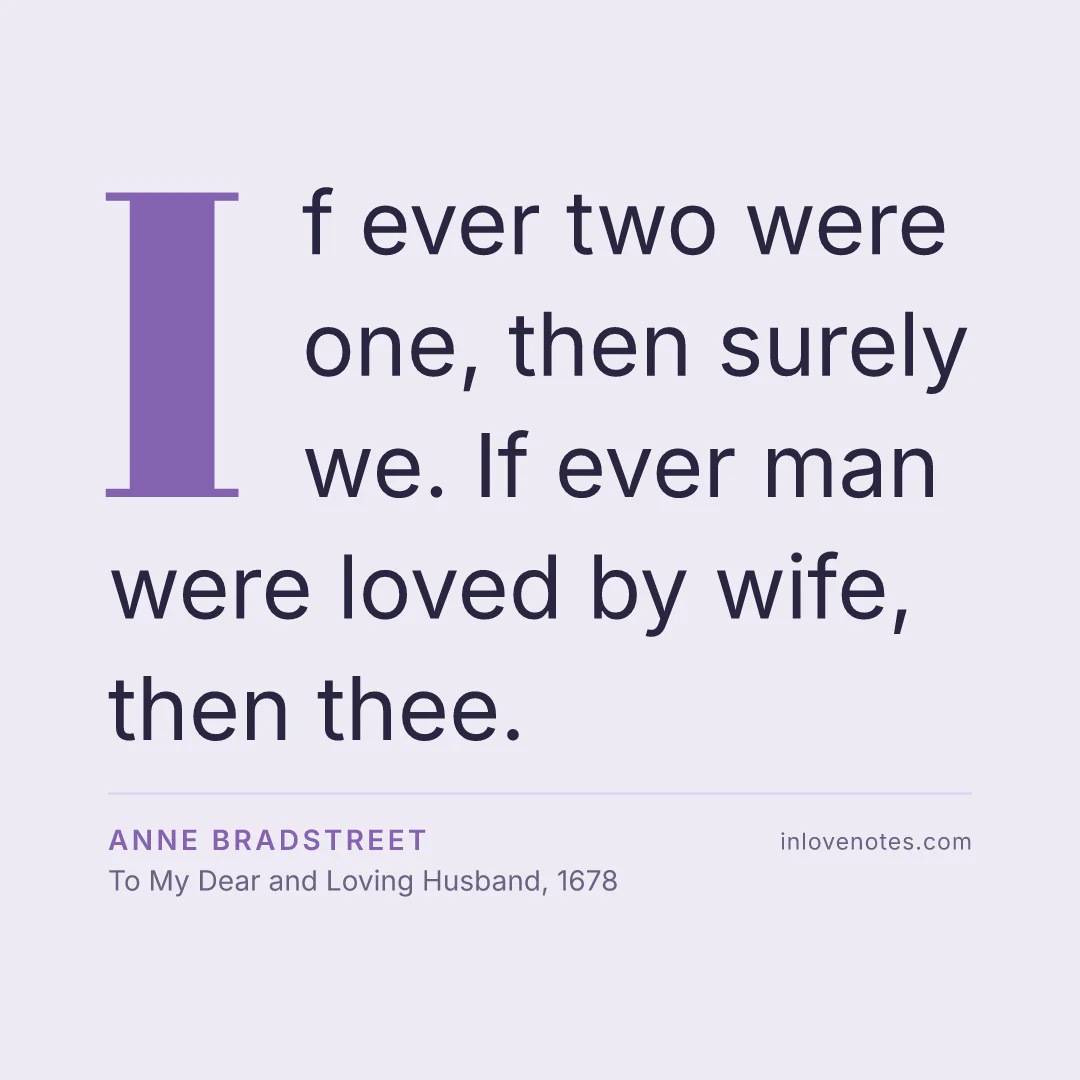
"There's a poem from 1678 that a woman called Anne Bradstreet wrote to her husband, and it starts, 'If ever two were one, then surely we.' I read it and thought of us, which is a slightly embarrassing thing to admit about a poem that's nearly 350 years old. But it's true. [One way you two are 'one': e.g. we finish each other's grocery lists / we can sit in silence for an hour and it feels like talking]. I love being half of this with you."
If ever two were one, then surely we. / If ever man were loved by wife, then thee; / If ever wife was happy in a man, / Compare with me ye women if you can.
Anne Bradstreet, To My Dear and Loving Husband, printed 1678
Bradstreet came to Massachusetts Bay in 1630 as a teenage bride, married to Simon Bradstreet, who spent long stretches away on colony business. This poem was printed six years after her death, in the 1678 Boston edition of her Several Poems, and the text above follows the version reproduced by the Academy of American Poets. It is not a quiet poem: she dares other women to say they are happier. That boldness is why it works inside a paragraph. If you quote it to a boyfriend, quote it as written ("wife" and all) and let your own sentence do the adapting, as paragraph 4 does.
To Make Him Smile on an Ordinary Day
Not every long paragraph needs to be heavy. These are for a Tuesday afternoon, sent for no reason, which is exactly the reason. Keep the tone light, and let one detail be a little bit silly.
5. The inventory
"Things I like about you, in no particular order, written on my lunch break: the way you [a habit: e.g. narrate what the dog is thinking]. Your [physical detail: e.g. terrible, wonderful hoodie]. How you say [a word or phrase he always says]. That you still text me 'home safe?' even when I'm the one who's driving five minutes. The fact that you'll eat the burnt bits so I don't have to. This list is not complete. I'll have more by tonight."
6. The rerun
"I just remembered [a funny moment: e.g. you trying to assemble that bookcase with the instructions upside down] and laughed out loud at my desk, and now [a coworker] thinks I'm unwell. This is your fault. I love that we have enough of these now that they ambush me at random. Here's to making more of them this weekend. I'll bring snacks, you bring the bad ideas."
7. The quiet one
"Nothing's wrong, I promise. I just wanted to tell you, in the middle of an ordinary day, that I like my life with you in it. I like that I know what you'll order. I like that you [small routine: e.g. leave the porch light on for me]. Big romantic stuff is nice, but this is the part I'd choose again: the regular days, the boring ones, with you. That's all. Go back to work."
8. The forward look
"I've been thinking about [a plan: e.g. that trip we keep saying we'll take / the first night in the new place]. Not the details, just the picture of it: you and me, [a scene: e.g. sunburnt and lost, arguing over a map]. It made me grin like an idiot on the train. I'm so glad the future I keep imagining has you in it. Let's actually book it."
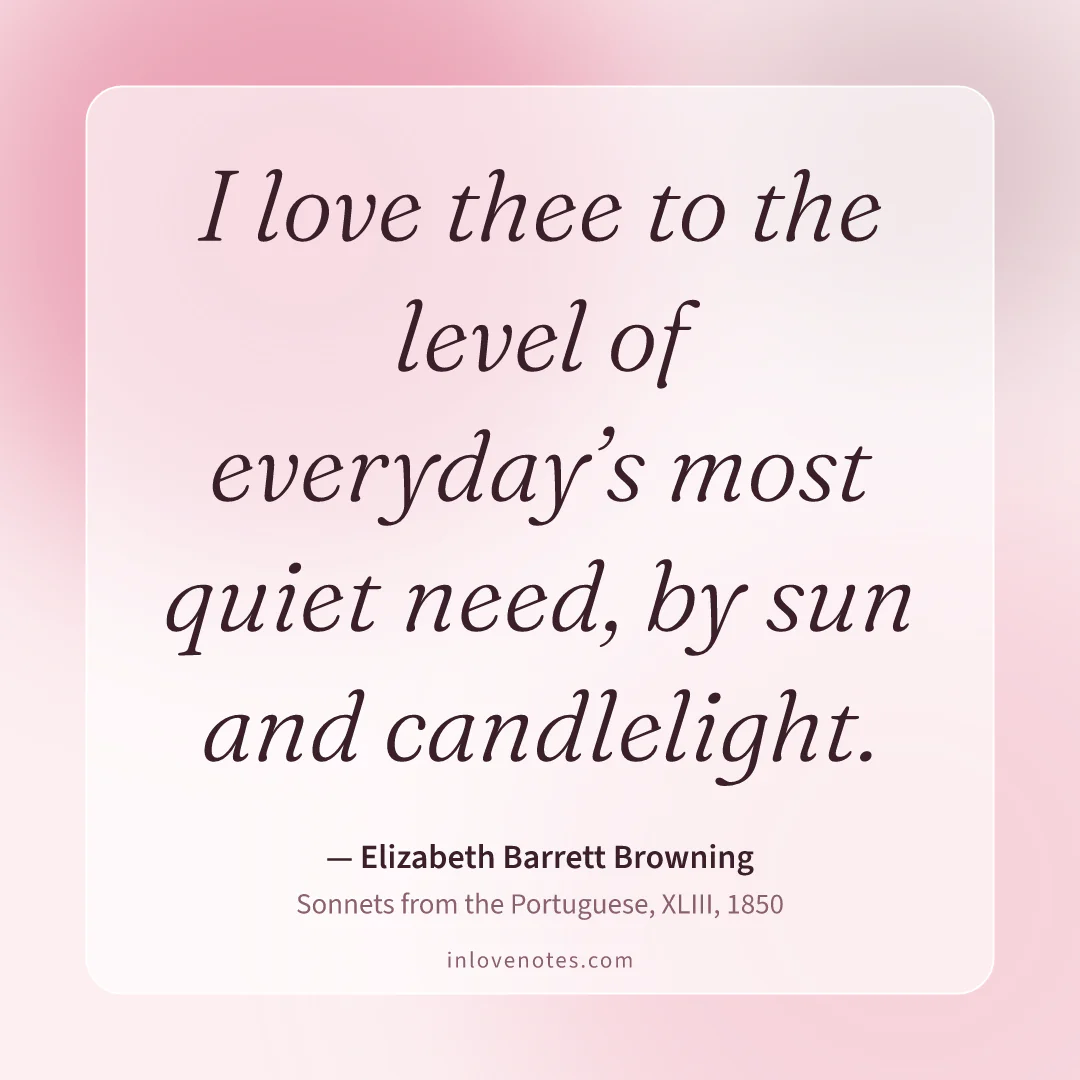
I love thee to the level of everyday's / Most quiet need, by sun and candlelight.
Elizabeth Barrett Browning, Sonnets from the Portuguese, XLIII, 1850
Everyone knows the first line of this sonnet ("How do I love thee? Let me count the ways"). Fewer people get to lines five and six, which are the best fit for a smile-on-a-Tuesday paragraph. Barrett wrote the sequence during her courtship with Robert Browning in 1845 and 1846 and published it in her Poems of 1850. "Everyday's most quiet need" is the whole idea behind paragraph 7: love measured by the dull hours, not only the big moments. The wording here is checked against the Project Gutenberg text of the sonnets.
When There Are Miles Between You
In a long-distance relationship, a paragraph is doing the work that a hug would do. Make it physical: what you can see, what you'd be doing together, when the next visit is.
9. The countdown
"[Number] days. I know because I've been crossing them off like a kid waiting for Christmas, which you're allowed to tease me about when you get here. Today was [one detail of your day], and the whole time I kept thinking how much better it would have been with you there, making fun of [something]. The distance is hard, but it's also made one thing very clear: I don't want this with anyone else. See you soon. Sooner than it feels."
10. The time-zone one
"By the time you read this it'll be [his time of day: e.g. morning] for you and I'll be asleep, so consider this a message from the past. Past me says: I love you, I'm proud of you for [something he's doing there], and I'm wearing your [shirt / jumper] again. Present you should drink some water and send me a picture of whatever you can see from your window. Future us is going to have the best [first meal / first weekend] back together."
11. The honest one
"I won't pretend this part is easy. Some nights the gap between us feels enormous, and the phone screen isn't the same as your face. But I'd rather miss you than not have you. Every call where you [something he does: e.g. fall asleep mid-sentence] reminds me that what we have is real enough to stretch this far. Hold on with me. We're nearly through it."
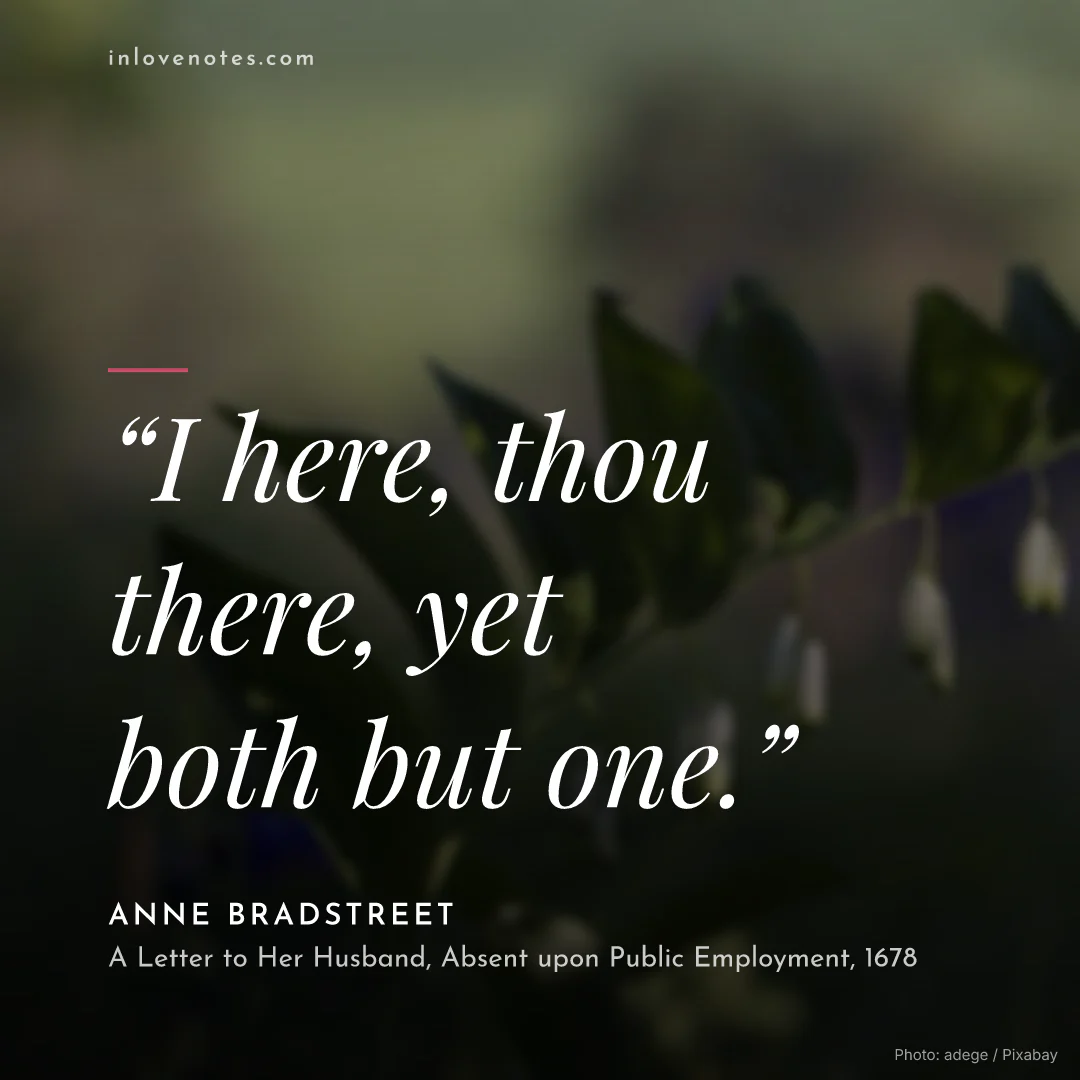
If two be one, as surely thou and I, / How stayest thou there, whilst I at Ipswich lie?" … "I here, thou there, yet both but one.
Anne Bradstreet, A Letter to Her Husband, Absent upon Public Employment, printed 1678
Bradstreet wrote this verse letter from Ipswich, the Massachusetts town where the family lived in the 1630s and 1640s, while Simon was away on the colony's business. The poem opens by asking how two people who are "one" can be in two places, and it closes on the line in the card below: "I here, thou there, yet both but one." It is one of the oldest long-distance love letters in American writing, and its closing line is short enough to put at the end of paragraph 9, 10 or 11. The text follows the version hosted by Virginia Commonwealth University's English department.
If he is away for weeks rather than days, a handwritten letter lasts longer than a text. Our guide to long distance love letters has sample letters for each stage of being apart.
Goodnight Paragraphs He Can Fall Asleep On
Send these as the last thing before sleep. Slow them down: shorter sentences, no questions he has to answer, nothing about tomorrow's problems.
12. The day in review
"Before you sleep: today you [something he did, however small: e.g. fixed the sink / called your grandma / got through that awful meeting]. That counts. You don't have to do anything else tonight except rest. I'm thinking about [a moment from today you shared], and I'm smiling at the ceiling like a fool. Sleep well. I'll be here in the morning."
13. The safe one
"Whatever's on your mind tonight, you can put it down until morning. I've got you. I've had you for [how long you've been together] and I'm not planning on stopping. Close your eyes, think about [a place you love together: e.g. that beach / our kitchen on a Sunday], and know that someone is falling asleep grateful for you. Goodnight, [his nickname]."
14. The sleepy confession
"I'm half asleep so this is going to be honest: I really, really like you. Not just love you, which I do, but like you. I like talking to you more than anyone. I like your [voice / laugh / terrible jokes]. I like that you're the last person I want to talk to every night. Okay. That's it. Goodnight. Don't let this go to your head."
After a Fight, Before the Apology Gets Awkward
A paragraph after an argument should do three things: say what you are sorry for, plainly; say that the relationship is not in question; and suggest the next step. Leave out "but". If you also think he owes an apology, that conversation comes later, in person.
15. The plain apology
"I'm sorry for [exactly what you did: e.g. snapping at you in front of your friends]. You didn't deserve that, and I knew it while I was doing it. I was [the real reason: e.g. stressed about work], but that's my thing to deal with, not yours to absorb. I love you, and I don't like being the person who made your evening worse. Can we talk tonight? I'll listen properly this time."
16. The bigger picture
"We had a bad [night / few days], and I don't want it to sit between us any longer. One argument doesn't change what I think of you: you're still the person I trust most. I'd rather sort this out together than win it. When you're ready, I'm ready. And if you need a bit of space first, that's okay too. I'm not going anywhere."
17. The light touch
"Truce? I'll bring [his favourite food] and the good blanket, and we can talk about [the issue] like two people who actually like each other, which we do. I'm sorry for my part, especially [one specific thing]. I hate it when we're off. You're my favourite person to be on the same side as."
For a One-Year Anniversary (or Any Year)
An anniversary paragraph has room for a look back. The trick is to choose three or four specific moments, not a summary of the whole year. If you would rather write a full letter, see our sample love letters for him, by occasion.
18. The year in moments
"One year. A year ago I [how it started: e.g. was nervously checking my teeth in a café window before our first date]. Since then: [moment one], [moment two], and that night when [moment three]. If you'd told me then how much I'd love you now, I wouldn't have believed it. I'm so glad I didn't know, because finding out has been the best part. Happy anniversary. Here's to year two."
19. The thank-you
"Happy anniversary. I want to thank you for [number] years of [something specific: e.g. making me laugh when I'm trying to be angry / being patient with my chaos]. You've seen me at my best and at my absolute worst, and you stayed for both. That still amazes me. I don't say it enough, so here it is, in writing: I choose you, every year, on purpose."
20. The promise you can keep
"I'm not going to promise you forever in a text. I'll promise things I can actually do: I'll keep [a habit: e.g. making your coffee the way you like it], I'll keep telling you when something's wrong instead of sulking, and I'll keep being on your side. That's my vow for the year ahead. Happy anniversary, [his name]. I love you more than I did last year, and I didn't think that was possible."
Make Any Paragraph His in Five Minutes
A paragraph copied word for word reads like something copied word for word. These steps take a few minutes and make the difference.
- Fill every slot with a real detail. A street name, a dish, a date, something he said. If you can't think of one for a slot, cut the sentence rather than leave it vague.
- Use his words, not ours. If he says "mate" or "babe" or "y'all", put it in. If he'd never say "darling", take it out.
- Do the "anyone" test. Read the paragraph back and ask: could I send this to anyone else? If yes, add one detail that only fits him.
- Cut one big word. "Soulmate", "everything", "forever" and "perfect" are the words that make a message sound copied. Swap one for something smaller and true.
- Read it out loud. If you stumble, he will too. Shorten that sentence.
- Check how it will arrive. On plain SMS, retype curly apostrophes and keep emojis to the end (see the table above).
For writing a full letter from scratch, including how to start and how to sign off, our step-by-step guide on how to write a love letter covers each part.
What Not to Put in a Long Paragraph
- A test. "If you really loved me, you'd reply in five minutes" turns a love note into a trap.
- Old fights. A paragraph meant to make him smile is the wrong place to mention last month's argument.
- Somebody else's famous line without credit. If you borrow from Bradstreet or Barrett Browning, say so. A quick search will show where it came from, and "I found this and thought of you" is sweeter anyway.
- Lines credited to the wrong person. Many love quotes online carry the wrong name. Our page on misattributed love quotes lists the common ones.
- A wall of text at a bad time. A 150-word paragraph sent while he is driving or at work will be skimmed. If it matters, send it when he can read it slowly.
Questions People Ask
What is a long love message I can send to my boyfriend?
One built around a specific moment you shared, what it showed you about him, and how you feel now. Paragraph 1 above ("the one about the night you knew") follows that pattern: fill in the moment, and the rest of the message carries it.
What words melt a man's heart?
Specific ones. "I'm proud of you for…", "I noticed when you…" and "Thank you for…" followed by something real tend to land harder than "you mean everything to me", because they show you were paying attention.
How long should a paragraph for your boyfriend be?
Between about 70 and 150 words for a text. That is long enough to say something real and short enough to read on a lock screen. On plain SMS, a 120-word paragraph splits into about five segments, or ten if it contains an emoji or a curly apostrophe.