Misattributed Love Quotes: Who Really Wrote Them (16 Lines Traced to the Source)
Shakespeare never wrote "when I saw you I fell in love" and Monroe's "at my worst" has no source. 16 love quotes traced to the record, with links and better lines.
On 29 May 2000 the Peruvian daily La República printed a farewell poem said to come from Gabriel García Márquez, who was ill at the time. Within days it had been reprinted in Mexico City, read out on the radio and forwarded by email around the world. García Márquez had not written it. The poem, "La Marioneta" ("The Puppet"), was the work of a Mexican ventriloquist, Johnny Welch, and someone had swapped his name for the novelist's. Twenty-six years later it is still shared as the great writer's last love letter to the world.
Love quotations travel this way more than any other kind. They are copied into wedding programmes, engraved inside rings, written on Valentine's cards and pinned to bedroom walls, and at each copy the name underneath has a chance to drift toward someone more famous. This page traces 16 widely shared love, romance and marriage quotations back to the earliest source we could fetch and read. Eleven of them are misattributed, altered or have no known source. Five are what they claim to be, one of them with an important footnote, and we say so just as plainly. For every line you get the wording people share, the name it travels under, what the record shows (with links to the evidence), a verdict, and a line you can use in its place with a real author, work and date behind it. Last checked: 9 October 2026.
How we proofed each line
A letterpress printer pulls a proof before the run and reads it against the manuscript. We did the same with each quotation, in five steps you can repeat before a line goes on an invitation or a headstone.
- Set the exact wording that circulates. "Hold on to" becomes "hold onto", "minds" becomes "souls", and the new version can then be searched on its own.
- Read it against the author's own text. For writers who died long ago the complete works are on Project Gutenberg, so a text search either finds the line or it does not. For speeches we use the official transcript, such as the Nobel Foundation's.
- Check the specialists. Quote Investigator (Garson O'Toole) searches digitized newspapers and books for the earliest dated appearance. Wikiquote keeps "Misattributed" and "Disputed" sections with cited sources. For one hoax we used Alex Boese's Museum of Hoaxes, which cites the newspaper coverage.
- Date the first appearance and see whose name was on it then. A line that turns up decades after the supposed author died, or turns up first under somebody else's name, has a problem.
- Print a plain verdict. We use five: genuine (in the author's own work), genuine, with context (real, but the speaker or meaning is not what people assume), altered (the author wrote something, but not this), misattributed (someone else wrote it first) and no known source (nobody has found an origin; the famous name came later).
What does not count as evidence: a line appearing on hundreds of quote sites, on a poster, in a gift book with no references, or in an image with a portrait next to it. Repetition is how a misattribution spreads, not proof that it is right.
The proof sheet: all 16 lines at a glance
| Popular line (short form) | Usually credited to | What the record shows | Verdict |
|---|---|---|---|
| "If you can't handle me at my worst, then you sure as hell don't deserve me at my best" | Marilyn Monroe | No source in her lifetime; known from self-help books and social media. | No known source |
| "You know you're in love when you can't fall asleep because reality is finally better than your dreams" | Dr. Seuss | Not in his books; attributed to him on social media. | No known source |
| "We're all a little weird... mutual weirdness... and call it love" | Dr. Seuss | Robert Fulghum, True Love (1998). | Misattributed |
| The "pink, kissing and miracles" credo ("...happy girls are the prettiest girls") | Audrey Hepburn | Not found in print before 2008; traced to a MySpace user, 15 years after her death. | Misattributed |
| "The Puppet" farewell letter ("If for a moment God would forget that I am a rag doll...") | Gabriel García Márquez | Written by ventriloquist Johnny Welch; spread under García Márquez's name in May 2000. | Misattributed |
| "Being deeply loved by someone gives you strength, while loving someone deeply gives you courage" | Lao Tzu | Earliest known: Dean Koontz's novel Lightning (1988), with no source. | No known source |
| "Love is composed of a single soul inhabiting two bodies" | Aristotle | Reported 500 years later by Diogenes Laërtius, about a friend. | Altered |
| "At the touch of love everyone becomes a poet" | Plato | Plato's Symposium, but spoken by the character Agathon, echoing Euripides. | Genuine, with context |
| "When I saw you I fell in love, and you smiled because you knew" | William Shakespeare | Arrigo Boito's libretto for Verdi's opera Falstaff (1893), in English translation. | Misattributed |
| "If I had a flower for every time I thought of you, I could walk through my garden forever" | Alfred, Lord Tennyson | Valentine's ads from 1985; credited to the poet Claudia Adrienne Grandi in 1992. | Misattributed |
| "Your task is not to seek for love, but merely to seek and find all the barriers within yourself..." | Rumi | A Course in Miracles (1976), ch. 16. | Misattributed |
| "Out beyond ideas of wrongdoing and rightdoing, there is a field. I'll meet you there." | Rumi | Coleman Barks's free English version (1995); Rumi's words were "religion" and "infidelity". | Altered |
| "To love oneself is the beginning of a lifelong romance" | Oscar Wilde | An Ideal Husband, Act III (1895). | Genuine |
| "A successful marriage requires falling in love many times, always with the same person" | Mignon McLaughlin (or no one) | The Second Neurotic's Notebook (1966). | Genuine |
| "How do I love thee? Let me count the ways" | Elizabeth Barrett Browning | Sonnets from the Portuguese, XLIII (1850). | Genuine |
| "Love is patient, love is kind" | St Paul, 1 Corinthians 13 | 1 Corinthians 13:4, in modern translations; the King James Version says "Charity suffereth long, and is kind". | Genuine (translation) |
Lines lent to famous names
These five are the ones most likely to appear on a card or a caption with a portrait beside them. In each case the portrait is the problem.
"If you can't handle me at my worst..."
The wording people share: "I'm selfish, impatient and a little insecure. I make mistakes, I am out of control and at times hard to handle. But if you can't handle me at my worst, then you sure as hell don't deserve me at my best."
Usually credited to: Marilyn Monroe.
What the record shows: Monroe died in 1962, and her own words survive in interviews, letters and the diaries published as Fragments (2010). This passage is not among them. Wikiquote lists it under "Misattributed": "Attributed to Monroe in self-help books and on social media, this quotation is of unknown origin and date." No dated printing from her lifetime has been produced.
Verdict: no known source. It is a modern line, and if you share it, share it without her name.
Use instead: if what you want to say is "love that stays when things get hard", the classic statement is four centuries old and checkable line by line.
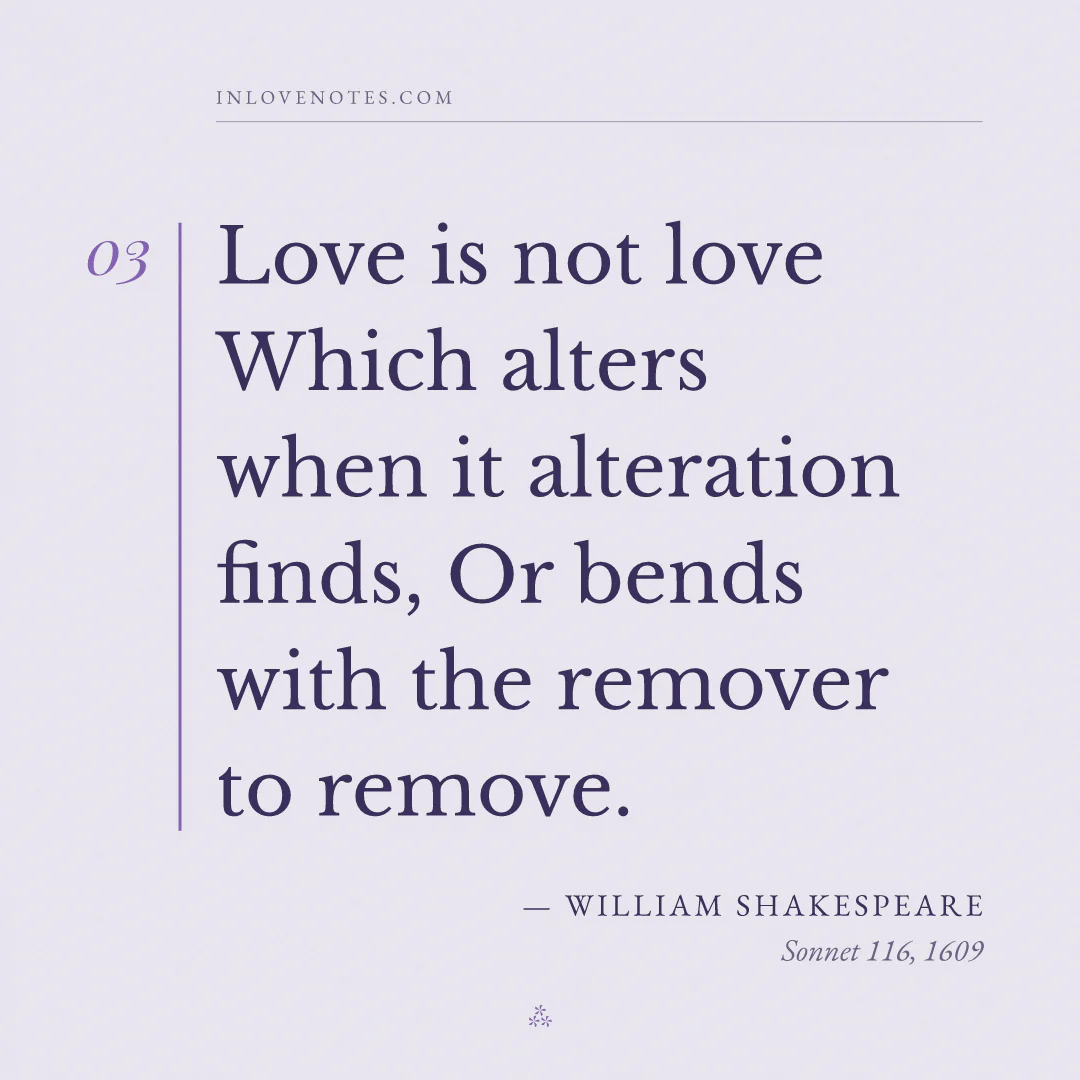
Love is not love / Which alters when it alteration finds, / Or bends with the remover to remove.
William Shakespeare, Sonnet 116, 1609
The sonnet goes on to say love "bears it out even to the edge of doom", which is a sterner promise than the Monroe line makes. It is the reason Sonnet 116 is read at so many weddings: it describes love that does not change when the other person does. The text is in the Project Gutenberg edition of the Sonnets.
"You know you're in love when you can't fall asleep..."
The wording people share: "You know you're in love when you can't fall asleep because reality is finally better than your dreams."
Usually credited to: Dr. Seuss (Theodor Geisel).
What the record shows: The line is not in any of his books, and it does not sound like him: no rhyme, no invented creatures. Wikiquote's Dr. Seuss page lists it under "Misattributed" with a single note: "Attributed to Dr. Seuss on social media." Nobody has found a dated source.
Verdict: no known source.
Use instead: for the sleepless, can't-say-goodnight feeling, go back to the balcony.
Sleep dwell upon thine eyes, peace in thy breast. / Would I were sleep and peace, so sweet to rest.
William Shakespeare, Romeo and Juliet, Act II, scene 2, 1597
Romeo says it just after Juliet's "Parting is such sweet sorrow / That I shall say good night till it be morrow" (Gutenberg text). Neither of them wants the night to end, which is the same idea as the Seuss line, written by someone who actually wrote it.
"We're all a little weird..."
The wording people share: "We're all a little weird. And life is a little weird. And when we find someone whose weirdness is compatible with ours, we join up with them and fall into mutual weirdness and call it love."
Usually credited to: Dr. Seuss, again.
What the record shows: This one has a real author. Wikiquote traces it to Robert Fulghum, the author of All I Really Need to Know I Learned in Kindergarten, in his book True Love (1998). His wording is "fall into mutually satisfying weirdness — and call it love — true love." The Seuss versions usually shorten it to "mutual weirdness".
Verdict: misattributed. Credit it as "Robert Fulghum, True Love (1998)". It is a lovely line for a wedding toast, and Fulghum deserves the credit.
"I believe in pink... I believe in kissing"
The wording people share: "I believe in manicures. I believe in overdressing. I believe in primping at leisure and wearing lipstick. I believe in pink. I believe that loving is the best calorie-burner. I believe in kissing. I believe that happy girls are the prettiest girls... and I believe in miracles."
Usually credited to: Audrey Hepburn.
What the record shows: Wikiquote traces the passage to an unidentified MySpace user around 2007–08, quoted in Richard Kennedy's self-published The Disgrace of MySpace (2008), page 123. It notes that no evidence of the passage exists from Hepburn's lifetime (she died in 1993), that it has not been found in print before 2008, and that it was nonetheless printed as hers in Glamour in March 2012.
Verdict: misattributed. It was written 15 years after her death.
Use instead: if you want Hepburn on love and joy, use something she was recorded saying, and label it as quoted. Melissa Hellstern's How to Be Lovely (2005), a book of Hepburn's quotations listed on the same Wikiquote page, has her saying: "I love people who make me laugh. I honestly think it's the thing I like most, to laugh."
The "Puppet" farewell letter
The wording people share: a long prose poem that begins "If for a moment God would forget that I am a rag doll and give me a scrap of life..." and includes "I wouldn't let a single day go by without saying to people I love, that I love them." It is usually titled "Farewell letter" or "The Puppet".
Usually credited to: Gabriel García Márquez.
What the record shows: The Museum of Hoaxes summarises the episode and cites the press coverage of the time, including the Los Angeles Times of 1 June 2000 ("'Farewell Poem' Fools Readers"). The poem appeared under his name in La República on 29 May 2000 and was soon identified as the work of Johnny Welch, a Mexican ventriloquist who had written it for his puppet, Mofles. Welch told Mexican radio that he felt "the disappointment of someone who has written something and is not getting credit."
Verdict: misattributed, by a hoaxer who replaced one name with another.
Use instead: García Márquez did speak publicly about love, at the most public moment of his career.
A new and sweeping utopia of life, where no one will be able to decide for others how they die, where love will prove true and happiness be possible...
Gabriel García Márquez, Nobel lecture "The Solitude of Latin America", 8 December 1982
The full text is on the Nobel Foundation's site. It is a political speech, not a love letter, and that is what makes the line work at a wedding: love as something worth building a better world for.
Lines lent to the ancients
An old name makes a line feel settled and wise. That is exactly why these three keep drifting toward philosophers.
"Being deeply loved by someone gives you strength..."
The wording people share: "Being deeply loved by someone gives you strength, while loving someone deeply gives you courage."
Usually credited to: Lao Tzu (Laozi), the traditional author of the Tao Te Ching.
What the record shows: It is not in the Tao Te Ching in any translation we checked. Wikiquote files it under "Misattributed" and notes that the earliest book it could be found in is Dean Koontz's thriller Lightning (1988), where it is credited to Lao Tzu with no source given.
Verdict: no known source. The first appearance anyone has found is in a 1988 novel.
Use instead: the Tao Te Ching does link a gentle heart with courage, in chapter 67, where the sage names his "three precious things".
With that gentleness I can be bold.
Lao Tzu, Tao Te Ching, chapter 67, translated by James Legge, 1891
Other translators render Legge's "gentleness" as "compassion" or "kindness" (Legge's translation on Gutenberg). Credit the translator, because the English words are his.
"Love is composed of a single soul inhabiting two bodies"
Usually credited to: Aristotle.
What the record shows: Aristotle left no such sentence in his surviving works. The idea comes from Diogenes Laërtius, who wrote Lives of the Eminent Philosophers roughly five centuries after Aristotle's death. In book V, section 20, he reports that Aristotle was asked "what is a friend?" and answered: "A single soul dwelling in two bodies." Wikiquote gives the 1853 Yonge translation, "A friend is one soul abiding in two bodies", and lists the "Love is composed of..." version as a later variant.
Verdict: altered. The saying was about friendship, and it reaches us as an anecdote told 500 years later.
Use instead: the original, credited honestly: "A friend is one soul abiding in two bodies" (Aristotle, as reported by Diogenes Laërtius, Lives V.20). It still suits a couple who are also best friends.
"At the touch of love everyone becomes a poet"
Usually credited to: Plato.
What the record shows: This one is in Plato, but not in Plato's own voice. In the Symposium each guest at a dinner party gives a speech in praise of Love, and this comes from the speech of the young poet Agathon: "at the touch of him every one becomes a poet, even though he had no music in him before" (Benjamin Jowett's translation). Jowett's note points out that Agathon is echoing a fragment of Euripides' lost play Stheneboea. Straight after the speech, Socrates questions Agathon and takes much of it apart.
Verdict: genuine, with context. The words are in the dialogue, but the speaker is a character Plato lets Socrates correct, and the idea is borrowed from Euripides.
Use instead: keep it, and credit it accurately: "Agathon, in Plato's Symposium (trans. Benjamin Jowett)". That small change also tells readers something true about the book.
Lines borrowed from other poets and translators
Here the words are real and someone did write them, but not the poet whose name is on them. Two come from the opera house and the greeting-card rack, two from a self-help classic and a translator's free version.
"When I saw you I fell in love, and you smiled because you knew"
Usually credited to: William Shakespeare, often "Romeo and Juliet".
What the record shows: Quote Investigator searched the whole Shakespeare corpus and did not find it. The line goes back to Verdi's last opera, Falstaff (1893), whose libretto Arrigo Boito based on The Merry Wives of Windsor. The young lover Fenton sings it to Nannetta, in Italian. English versions followed, from Frederic Lyster's 1894 translation to William Weaver's in 1977. By 2008 a gift book was crediting the line to Romeo and Juliet. The mix-up is understandable, because the opera is built from Shakespeare, but the sentence is Boito's.
Verdict: misattributed. Credit Arrigo Boito, Falstaff (1893), or "from Verdi's Falstaff".
Use instead: Shakespeare does give us a love-at-first-sight line, and it is a quotation within a quotation.
Who ever loved that loved not at first sight?
Christopher Marlowe, Hero and Leander, 1598; quoted by Phebe in Shakespeare's As You Like It, Act III, scene 5
Phebe introduces it with "Dead shepherd, now I find thy saw of might", a salute to Marlowe, who had died in 1593. Both texts are on Gutenberg: Hero and Leander and As You Like It. Crediting it "Marlowe, quoted in Shakespeare" is accurate and has a nice story behind it.
"If I had a flower for every time I thought of you..."
The wording people share: "If I had a flower for every time I thought of you, I could walk through my garden forever."
Usually credited to: Alfred, Lord Tennyson.
What the record shows: Quote Investigator found no support for Tennyson. The earliest close match is an unsigned Valentine's Day message in a Santa Ana, California newspaper in 1985, and the verse kept appearing in Valentine's columns after that. In May 1992 a Georgia newspaper credited it to Claudia Adrienne Grandi, a poet whose work was published by the greeting-card company Blue Mountain Arts. QI considers her the most likely author.
Verdict: misattributed. "Claudia Adrienne Grandi" is the best-supported credit.
Use instead: Tennyson's own best-known lines on love come from In Memoriam A.H.H. (1850), section XXVII: "'Tis better to have loved and lost / Than never to have loved at all" (Wikiquote, with section and stanza). Be aware of the context. He wrote the poem as a requiem for his Cambridge friend Arthur Henry Hallam, who died suddenly, so the lines are about losing someone, not about a breakup.
"Your task is not to seek for love..."
The wording people share: "Your task is not to seek for love, but merely to seek and find all the barriers within yourself that you have built against it."
Usually credited to: Rumi.
What the record shows: Wikiquote's Rumi page lists it under "Misattributed" and gives the source: Helen Schucman's A Course in Miracles (1976), chapter 16, "The Forgiveness of Illusions", page 338. Nothing like it has been found in Rumi's poetry.
Verdict: misattributed. It is a 20th-century American self-help text, not 13th-century Persian verse.
"Out beyond ideas of wrongdoing and rightdoing, there is a field"
The wording people share: "Out beyond ideas of wrongdoing and rightdoing, there is a field. I'll meet you there." It is a favourite at weddings.
Usually credited to: Rumi.
What the record shows: This is Rumi, but at two removes. The English is Coleman Barks's, from "The Great Wagon" in The Essential Rumi (1995), as Wikiquote records. Barks, who died in February 2026, did not read Persian; he reworked earlier English translations into American free verse. In "The Erasure of Islam from the Poetry of Rumi" (The New Yorker, 5 January 2017), Rozina Ali points out that the original "makes no mention of 'rightdoing' or 'wrongdoing.'" Rumi's words were iman ("religion") and kufr ("infidelity").
Verdict: altered. It is a free English version, and its key words are not Rumi's.
Use instead: keep it if you love it, but credit both people: "Rumi, in a version by Coleman Barks". If you know the original says "beyond religion and infidelity", you can decide whether that bolder meaning still suits your ceremony.
Lines that are exactly what they claim
Checking quotes is not only about catching mistakes. Some famous lines survive the proof intact, and they deserve to be shared with confidence.
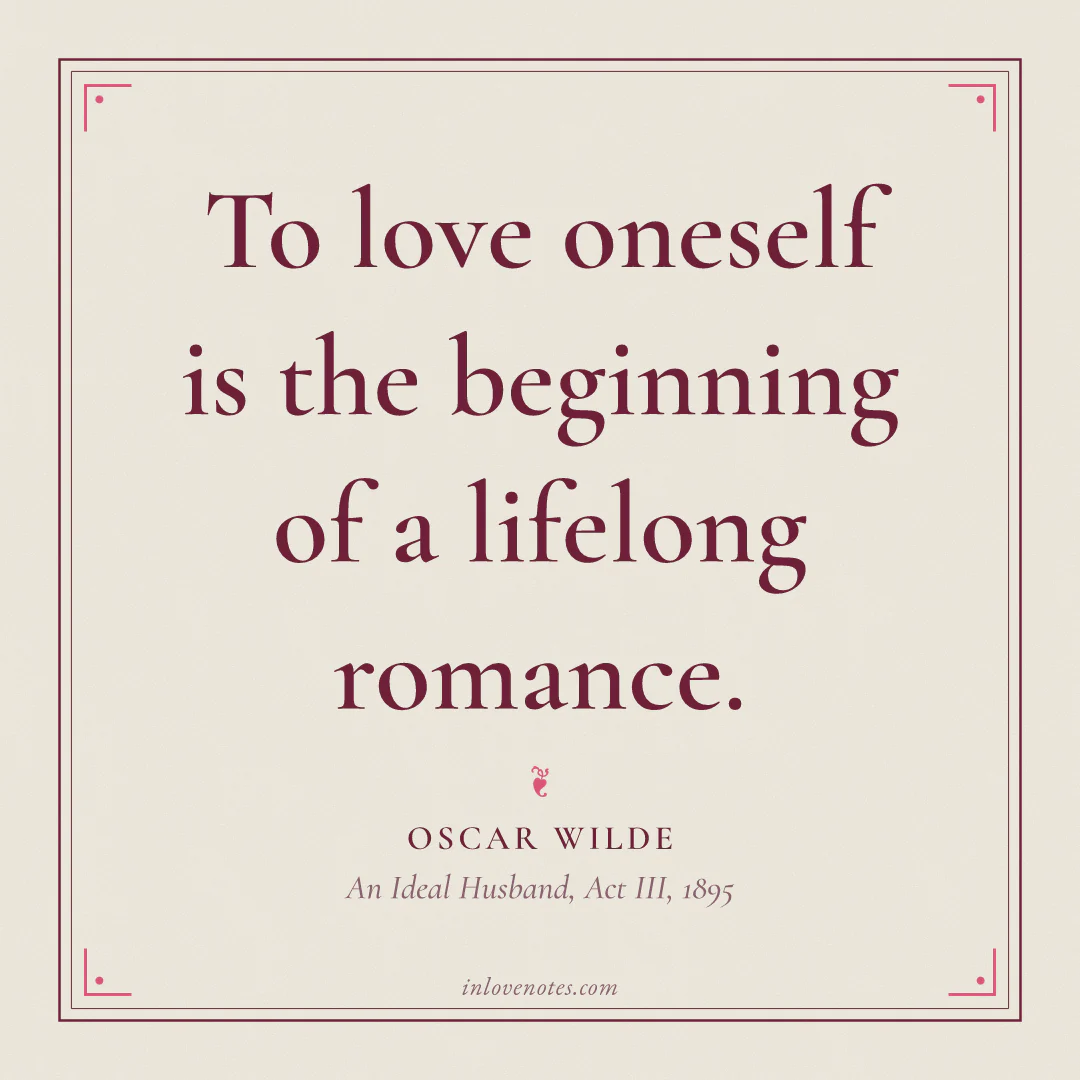
"To love oneself is the beginning of a lifelong romance"
Credited to: Oscar Wilde. Correctly.
What the record shows: It is in An Ideal Husband (first performed 1895), Act III. Lord Goring, a dandy, says it to his butler: "To love oneself is the beginning of a lifelong romance, Phipps." We checked it in the Gutenberg text.
To love oneself is the beginning of a lifelong romance.
Oscar Wilde, An Ideal Husband, Act III, 1895
On stage it is a joke about vanity. Goring delivers it while fitting a fresh buttonhole, a few lines after declaring that "the only possible society is oneself." Shared today as self-care advice, it means something kinder than Wilde intended. That is fine, as long as you know the wink is there.
"A successful marriage requires falling in love many times, always with the same person"
Credited to: Mignon McLaughlin, though it often travels with no name at all.
What the record shows: McLaughlin (1913–1983) was an American journalist and author whose aphorisms ran under the title "The Neurotic's Notebook". The line is in The Second Neurotic's Notebook (1966), chapter 1, according to WIST's quotation file, and Wikiquote lists it in the marriage section of The Complete Neurotic's Notebook (1981).
Verdict: genuine. Put her name on it. An anniversary card is a good place to credit a writer most people have never heard of.
Two wedding readings that check out
Two of the most popular wedding readings in English are both genuine. The only question is which version you are reading.
"How do I love thee? Let me count the ways"
Credited to: Elizabeth Barrett Browning. Correctly.
What the record shows: It is sonnet XLIII of Sonnets from the Portuguese, the sequence she wrote during her courtship with Robert Browning and published in 1850. We read it in the Gutenberg edition. The poem ends "and, if God choose, / I shall but love thee better after death."
How do I love thee? Let me count the ways. / I love thee to the depth and breadth and height / My soul can reach...
Elizabeth Barrett Browning, Sonnets from the Portuguese, XLIII, 1850
The poem counts its ways, from the depth of the soul to "everyday's / Most quiet need, by sun and candlelight." If you read only the first line on a card, consider adding that one too. It is the most ordinary and the most moving image in the poem. Our guide to writing a love letter draws on real letters, Browning's among them.
"Love is patient, love is kind"
Credited to: St Paul, 1 Corinthians 13. Correctly.
What the record shows: The familiar wording is from modern translations. The NIV, for example, has "Love is patient, love is kind. It does not envy, it does not boast, it is not proud" for verse 4 (BibleGateway). The 1611 King James Version translates the same Greek word, agapē, as "charity": "Charity suffereth long, and is kind; charity envieth not" (KJV on Gutenberg).
Verdict: genuine. Name the translation in the order of service, because the words differ. Paul was writing to a quarrelling church ("there are contentions among you", 1:11) about how its members should treat one another, not to a couple, which is perhaps why it reads so well at a wedding: it describes love as daily behaviour.
Before a line goes on the invitation, the ring or the cake
- No source? Drop the name, not the line. The Monroe and Seuss lines read just as well with no credit. A wrong famous name is worse than none.
- Search the author's own text. If the writer died more than a century ago, the full text is almost certainly free online. Ten seconds with a search box settles most Shakespeare, Tennyson and Wilde questions.
- Credit the translator. "Rumi, version by Coleman Barks" and "Lao Tzu, trans. James Legge" are honest and take up only a few more words.
- Read the scene around the line. Wilde's is a joke, Tennyson's is grief, Plato's is a speech that gets corrected. Knowing that may change your choice, or it may make the line mean more to you.
- Be wary of long "farewell letters" and "last words". A beautiful document attributed to a famous person at the end of their life is the classic hoax format, as "The Puppet" shows.
For short, sourced lines that fit a card, see our 24 short love quotes for quiet moments, each checked against its text. If you are writing your own words instead, our notes on how to start and end a love letter cover openings and sign-offs.
Questions readers ask
Did Marilyn Monroe say "If you can't handle me at my worst"?
No source shows that she did. The quotation is not found in her interviews, letters or diaries, and Wikiquote describes it as "of unknown origin and date", spread through self-help books and social media.
Did Shakespeare write "When I saw you I fell in love, and you smiled because you knew"?
No. Quote Investigator traced it to Arrigo Boito's Italian libretto for Verdi's opera Falstaff (1893), which was based on a Shakespeare play. The sentence itself does not appear in Shakespeare.
Did Gabriel García Márquez write the farewell letter "The Puppet"?
No. It was written by the Mexican ventriloquist Johnny Welch for his puppet and circulated under García Márquez's name from May 2000. The hoax was exposed within days, but the poem still circulates.
Corrections welcome. If you have found an earlier source, a better translation or a line we should add, write to editor@inlovenotes.com. We will check it, update this page and credit you if you like.