Pride and Prejudice Love Quotes: 16 Lines From the Novel, Chapter by Chapter
16 Pride and Prejudice love quotes checked against Austen's 1813 text, with chapter and volume numbers, plus the famous lines that come from the 2005 film.
The most-shared version of Mr Darcy's first proposal begins "In vain I have struggled." Jane Austen didn't write it that way. In the novel he says "In vain have I struggled," and the 2005 film changes it again, to "I have struggled in vain." That small slip is a good reason to collect Pride and Prejudice love quotes from the book itself. Lines get copied from image to image until nobody remembers which version came from Austen, which from a screenplay, and which from neither.
Below are 16 love quotes from Pride and Prejudice (1813), each checked word for word against the Project Gutenberg text. They're arranged in the order the story tells them, from Elizabeth's first sting to Darcy's last answer. Each one has its chapter number, the volume-and-chapter number older editions use, and who is speaking to whom. After them comes a short table of the famous lines that come from the 2005 film rather than the novel, and some notes on choosing a line for a wedding reading, a card or a framed print.
Where Each Line Sits: Chapter, Volume and Speaker
People often search for these quotes "with page numbers," but page numbers change from one edition to the next. Chapter numbers don't. Most modern paperbacks number the chapters straight through from 1 to 61. Editions that follow the 1813 first edition restart in each of the three volumes: Volume I is chapters 1 to 23, Volume II is 24 to 42 and Volume III is 43 to 61. Use whichever column matches your copy.
| # | Line begins | Speaker, to whom | Chapter | Vol. / ch. |
|---|---|---|---|---|
| 1 | "I could easily forgive his pride…" | Elizabeth, to Charlotte and the Lucases | 5 | I / 5 |
| 2 | "Happiness in marriage is entirely a matter of chance." | Charlotte Lucas, to Elizabeth | 6 | I / 6 |
| 3 | "A lady's imagination is very rapid…" | Darcy, to Miss Bingley | 6 | I / 6 |
| 4 | "…a pair of fine eyes in the face of a pretty woman…" | Darcy, to Miss Bingley | 6 | I / 6 |
| 5 | "We neither of us perform to strangers." | Darcy, to Elizabeth | 31 | II / 8 |
| 6 | "In vain have I struggled…" | Darcy, to Elizabeth | 34 | II / 11 |
| 7 | "…the last man in the world…" | Elizabeth, to Darcy | 34 | II / 11 |
| 8 | "…exactly the man who, in disposition and talents…" | Narrator, on Elizabeth's thoughts | 50 | III / 8 |
| 9 | "Till I have your disposition, your goodness…" | Elizabeth, to Jane | 55 | III / 13 |
| 10 | "I am only resolved to act in that manner…" | Elizabeth, to Lady Catherine | 56 | III / 14 |
| 11 | "You are too generous to trifle with me…" | Darcy, to Elizabeth | 58 | III / 16 |
| 12 | "…dearest, loveliest Elizabeth!" | Darcy, to Elizabeth | 58 | III / 16 |
| 13 | "Do anything rather than marry without affection." | Jane, to Elizabeth | 59 | III / 17 |
| 14 | "I could not have parted with you, my Lizzy…" | Mr Bennet, to Elizabeth | 59 | III / 17 |
| 15 | "I cannot fix on the hour, or the spot…" | Darcy, to Elizabeth | 60 | III / 18 |
| 16 | "I am the happiest creature in the world." | Elizabeth, in a letter to Mrs Gardiner | 60 | III / 18 |
Before Either of Them Admits Anything (Chapters 5 to 31)
The early love lines in the novel aren't declarations. They're jokes, defences and side remarks, and most of them are said about someone rather than to them. That's part of why they work so well on a card: they're light, and they carry a wink.
"I could easily forgive his pride, if he had not mortified mine."
— Elizabeth Bennet, in Jane Austen, Pride and Prejudice, chapter 5 (1813)
Elizabeth says this when the Lucases call to talk over the Meryton assembly, where Darcy called her "tolerable" within her hearing. The italics are Austen's, and they carry the joke: she isn't above pride, she just wants hers left alone. As a love quote it suits couples who began badly. It works well in an anniversary card for two people who didn't like each other at first.
"Happiness in marriage is entirely a matter of chance."
— Charlotte Lucas, in Jane Austen, Pride and Prejudice, chapter 6 (1813)
Charlotte is talking to Elizabeth about Jane and Bingley, and she means it. Elizabeth laughs and tells her she would never act that way herself. Charlotte goes on to accept Mr Collins for security in chapter 22. This line turns up on wedding sites as if it were Austen's advice, but in the novel it's the view Elizabeth spends the book refusing. Use it only if you're quoting it to disagree with it.
"A lady's imagination is very rapid; it jumps from admiration to love, from love to matrimony, in a moment."
— Mr Darcy, in Jane Austen, Pride and Prejudice, chapter 6 (1813)
"I have been meditating on the very great pleasure which a pair of fine eyes in the face of a pretty woman can bestow."
— Mr Darcy, in Jane Austen, Pride and Prejudice, chapter 6 (1813)
Both lines come from one conversation at Sir William Lucas's party. Miss Bingley asks what he's thinking about, and Darcy admits it's Elizabeth's eyes. She teases him about a wedding, and he answers with the "rapid imagination" line. Read together, they're the first sign that the man who wouldn't dance with Elizabeth has been watching her all evening. "A pair of fine eyes" makes a good private joke for a note to someone whose eyes you noticed first.
"We neither of us perform to strangers."
— Mr Darcy, in Jane Austen, Pride and Prejudice, chapter 31 (1813)
At Rosings, Elizabeth plays the piano and teases Darcy for being so awkward with people he doesn't know. He replies that she has used her time better than he has, and ends with this line. It's the closest he comes, before the proposal, to saying they are alike. Six words long, it's one of the best short Pride and Prejudice quotes for a couple of introverts.
The First Proposal, Chapter 34
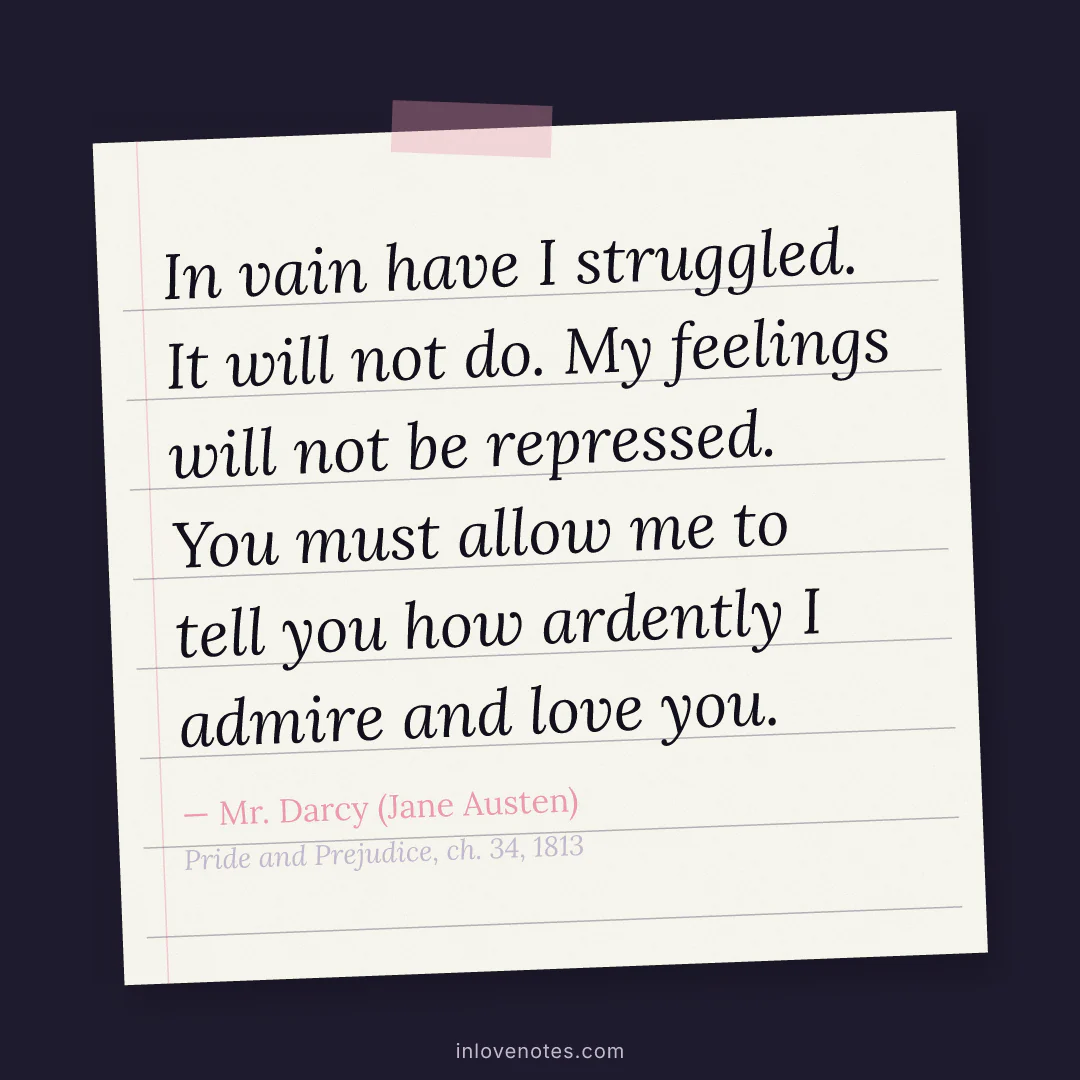
"In vain have I struggled. It will not do. My feelings will not be repressed. You must allow me to tell you how ardently I admire and love you."
— Mr Darcy, in Jane Austen, Pride and Prejudice, chapter 34 (1813)
This is the most romantic opening in the book, and the start of a disastrous proposal. In the paragraphs that follow, Darcy explains at length how much he struggled against loving someone of her family and connections. Austen tells us he "was not more eloquent on the subject of tenderness than of pride." The four sentences quoted here are often printed alone, and alone they read as pure devotion. In context they're the moment his pride shows most. Both readings are fair. Just know which one you mean if you write it inside a card.
"I had not known you a month before I felt that you were the last man in the world whom I could ever be prevailed on to marry."
— Elizabeth Bennet, in Jane Austen, Pride and Prejudice, chapter 34 (1813)
Elizabeth's answer is the novel's great refusal. It isn't a love quote on its own terms, but couples who married after a rocky start like to put it on an anniversary card with the date of the wedding underneath. Notice the wording: "whom I could ever be prevailed on to marry." The 2005 film shortens it to "the last man in the world I could ever be prevailed upon to marry," and that's the version you'll usually see online.
What Changed Her Mind (Chapters 50 to 56)
"She began now to comprehend that he was exactly the man who, in disposition and talents, would most suit her."
— narrator, in Jane Austen, Pride and Prejudice, chapter 50 (1813)
This sentence comes at the low point of the story. Lydia has run off with Wickham, and Elizabeth assumes Darcy will want nothing more to do with her family. Only now that she believes she's lost him does she see how well they would have suited each other. The next lines explain why: "his understanding and temper, though unlike her own, would have answered all her wishes." It's a quieter love quote than any of Darcy's speeches. It suits couples who are very different from each other.
"Till I have your disposition, your goodness, I never can have your happiness."
— Elizabeth Bennet, in Jane Austen, Pride and Prejudice, chapter 55 (1813)
Jane has just accepted Bingley and wishes Elizabeth "such another man." Elizabeth turns the compliment back on her sister, then jokes that with luck she may "meet with another Mr. Collins in time." It's a line about sisters as much as lovers, and it fits a card for a sister's engagement nicely.
"I am only resolved to act in that manner, which will, in my own opinion, constitute my happiness, without reference to you, or to any person so wholly unconnected with me."
— Elizabeth Bennet, in Jane Austen, Pride and Prejudice, chapter 56 (1813)
Lady Catherine arrives at Longbourn to forbid an engagement that doesn't exist yet. Elizabeth refuses to promise she won't accept Darcy, and this is her answer. It isn't addressed to a lover, but it's the line in the book where she claims the right to choose for love. Lady Catherine repeats the conversation to Darcy, and in chapter 58 he tells Elizabeth "It taught me to hope," so the second proposal partly owes itself to this line.
The Second Proposal, Chapter 58
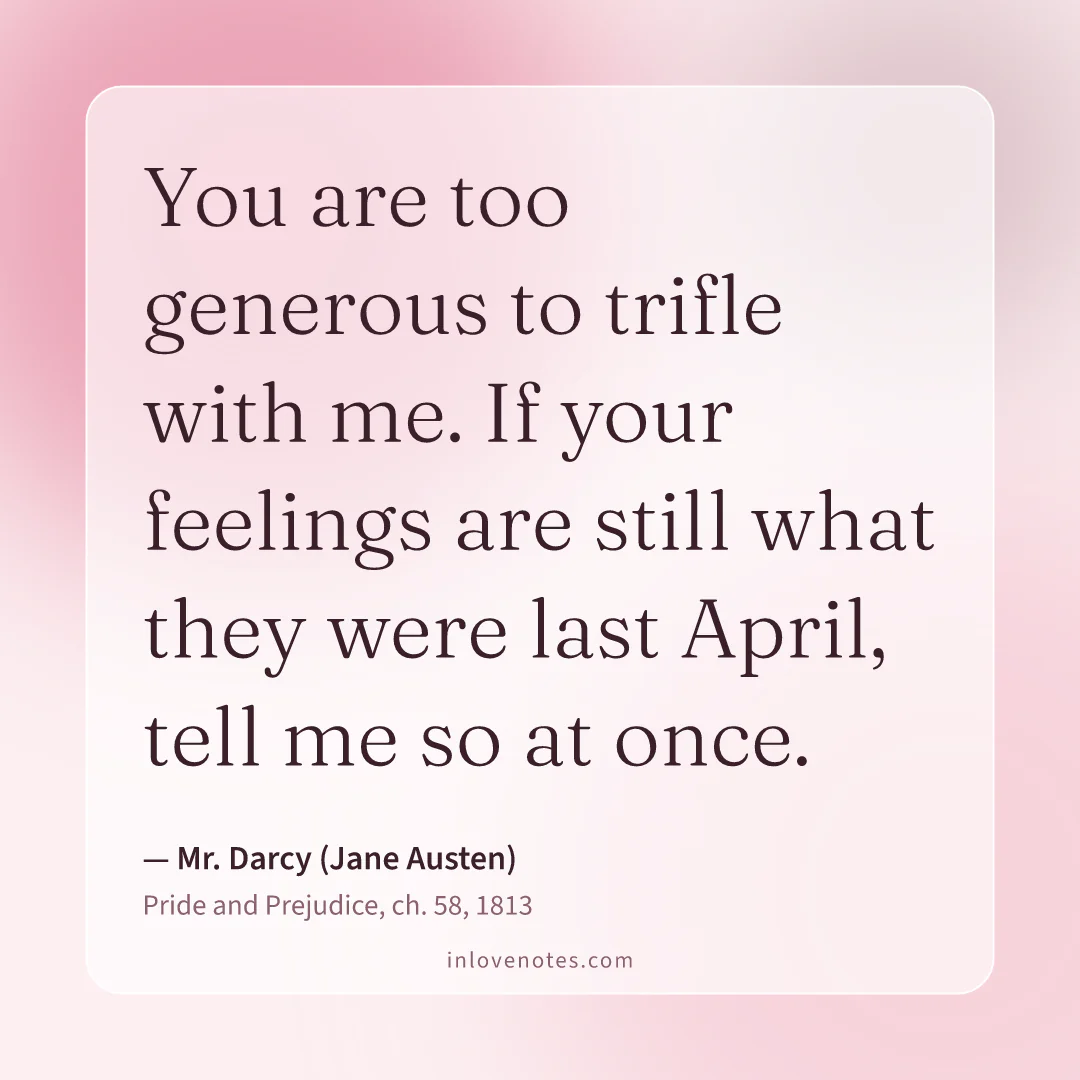
"You are too generous to trifle with me. If your feelings are still what they were last April, tell me so at once. My affections and wishes are unchanged; but one word from you will silence me on this subject for ever."
— Mr Darcy, in Jane Austen, Pride and Prejudice, chapter 58 (1813)
Compare this with chapter 34. The first proposal was all about his feelings and his struggle. This one is short, gives her the deciding word and promises to drop the subject if she says no. "Last April" is the month of the Hunsford proposal, so the line also admits that nothing has changed on his side in all that time. Austen doesn't give Elizabeth's reply as speech; she reports that Elizabeth, "though not very fluently," gave him to understand that her feelings had changed. This is the line to borrow if you're asking someone a real question and want to make it easy for them to answer.
"Such I was, from eight to eight-and-twenty; and such I might still have been but for you, dearest, loveliest Elizabeth! What do I not owe you! You taught me a lesson, hard indeed at first, but most advantageous. By you, I was properly humbled."
— Mr Darcy, in Jane Austen, Pride and Prejudice, chapter 58 (1813)
Later on the same walk, Darcy explains how he became so proud and thanks her for changing him. "Dearest, loveliest Elizabeth" are the warmest words he speaks to her in the whole novel, which is why readers who want the moment Darcy says "I love you" usually land here, not on chapter 34. For a wedding reading or a long love letter, the last two sentences ("You taught me a lesson…") can stand alone.
Telling the Family, and the Last Word (Chapters 59 and 60)
"Oh, Lizzy! do anything rather than marry without affection."
— Jane Bennet, in Jane Austen, Pride and Prejudice, chapter 59 (1813)
When Elizabeth tells Jane about the engagement, Jane at first doesn't believe her. Then she asks, more than once, whether Elizabeth really loves him. Her advice is the novel's plainest statement of what it values, the opposite of Charlotte's "matter of chance" in chapter 6. Pairing the two lines makes a neat opening for a wedding speech.
"I could not have parted with you, my Lizzy, to anyone less worthy."
— Mr Bennet, in Jane Austen, Pride and Prejudice, chapter 59 (1813)
Mr Bennet only gives his consent after Elizabeth convinces him that she really loves Darcy. Spoken by a father who teases everyone else, it's the most moving line he has. It's often used, with "Lizzy" swapped for a daughter's name, in father-of-the-bride speeches. If you change the name, say you've changed it.
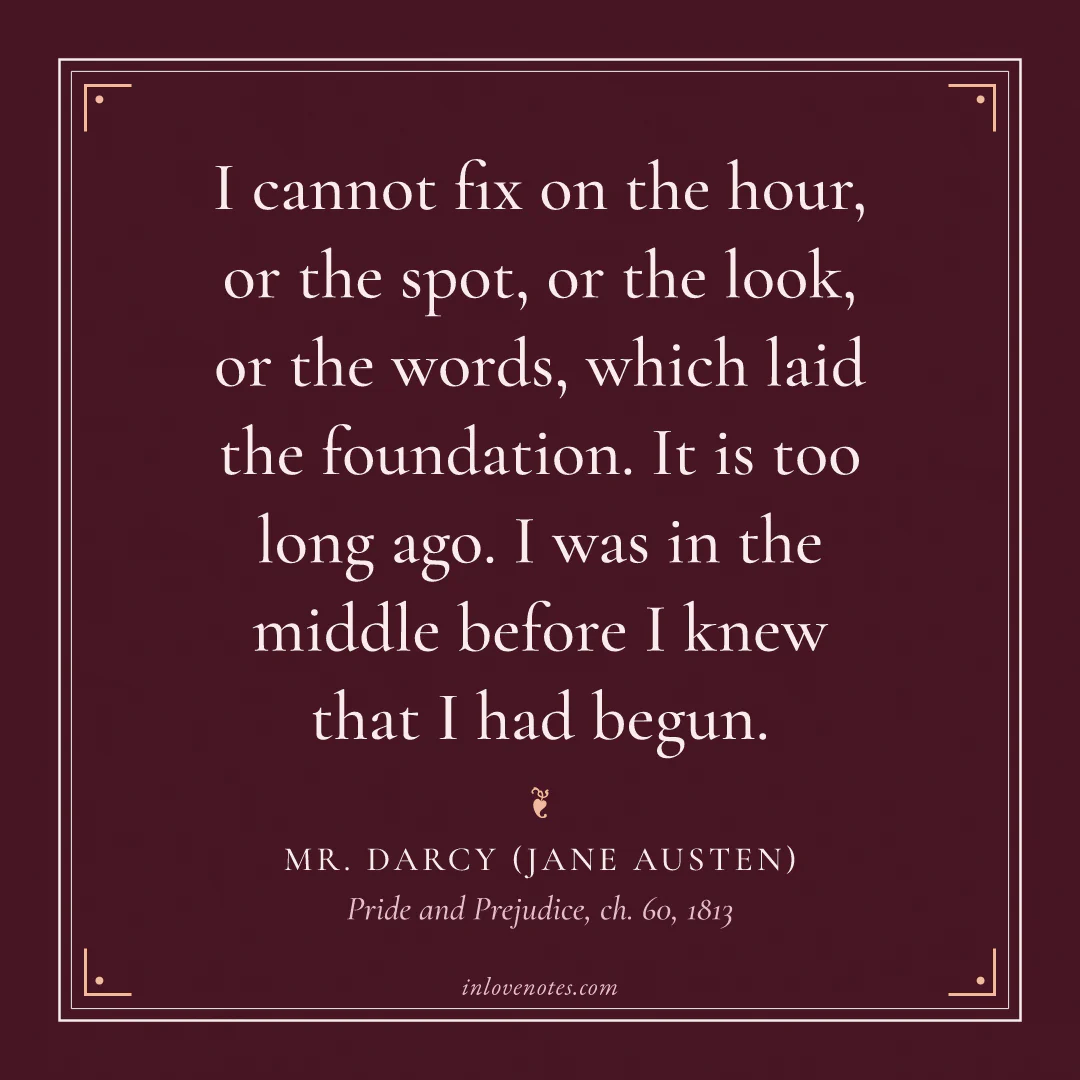
"I cannot fix on the hour, or the spot, or the look, or the words, which laid the foundation. It is too long ago. I was in the middle before I knew that I had begun."
— Mr Darcy, in Jane Austen, Pride and Prejudice, chapter 60 (1813)
Elizabeth, now engaged and teasing again, asks him how he ever started falling in love with her. This is his answer, and many readers think it's the most romantic line in the book, because it describes how love feels for most people. It's short enough for a ring box card or a framed print. Keep the italic on "had" if your printer allows it: Austen marks that word.
"I am the happiest creature in the world. Perhaps other people have said so before, but no one with such justice. I am happier even than Jane; she only smiles, I laugh."
— Elizabeth Bennet, letter to Mrs Gardiner, in Jane Austen, Pride and Prejudice, chapter 60 (1813)
Elizabeth writes this to her aunt, who had seen the two of them together at Pemberley. The same letter ends with "Mr. Darcy sends you all the love in the world that can be spared from me." It's the happiest speech in the novel, and a good model for an engagement announcement to close family.
Book or 2005 Film? Lines People Mix Up
Deborah Moggach's screenplay for Joe Wright's 2005 film keeps much of Austen's plot but rewrites most of the dialogue. Several of its lines are now quoted as Austen's. The film wording below follows Wikiquote's page for the film; the novel column was checked against the Gutenberg text.
| Line as usually quoted | In the 1813 novel? | Where it comes from |
|---|---|---|
| "You have bewitched me, body and soul, and I love, I love, I love you." | No | 2005 film, Darcy's dawn proposal. The novel uses "bewitched" only once, in narration in chapter 10: Darcy "had never been so bewitched by any woman as he was by her." |
| "I love you. Most ardently." | No | 2005 film, the proposal in the rain. Austen's Darcy says "how ardently I admire and love you" (chapter 34). |
| "In vain I have struggled." | No | A mix-up. The novel has "In vain have I struggled"; the film has "I have struggled in vain." |
| "You may only call me Mrs Darcy when you are completely, perfectly, and incandescently happy." | No | 2005 film, the closing scene added for the American release. |
| "…the last man in the world I could ever be prevailed upon to marry." | Close | Film wording. The novel: "the last man in the world whom I could ever be prevailed on to marry." |
None of this makes the film lines worse, and "bewitched me, body and soul" deserves its fame. But if you print it with "Jane Austen" underneath, credit the film instead: "Pride & Prejudice (2005), screenplay by Deborah Moggach." We cover more lines like this in our guide to misattributed love quotes, and other famous screen lines in romantic quotes from movies.
Choosing a Line for a Wedding Reading, a Card or a Frame
Austen's sentences are long and full of commas, so they need some care when you lift them out. A few practical rules:
- For a wedding reading, use a passage, not a single line. Chapter 58 works best: Darcy's "too generous to trifle" speech, then the narrator's account of Elizabeth's reply. It takes under a minute to read aloud. Chapter 34 is the wrong choice for a wedding, however lovely its first sentence sounds, because the proposal goes badly.
- For a card or a ring box, keep it under twenty words: "I was in the middle before I knew that I had begun," "We neither of us perform to strangers," or "dearest, loveliest Elizabeth" with your partner's name swapped in.
- For a framed print, check the punctuation against a real edition before it goes to the printer. Gutenberg spells "eight-and-twenty" with hyphens and keeps Austen's italics. Many online versions drop both.
- For a speech, pair two lines that argue: Charlotte's "matter of chance" (chapter 6) against Jane's "rather than marry without affection" (chapter 59). One sentence of your own between them is all the speech needs.
- Credit it properly: speaker, Pride and Prejudice, chapter number. "Jane Austen" alone is fine for a card, but the speaker matters if the line is Charlotte's or Lady Catherine's.
If you want lines from other novels, we've checked nine more in love quotes from classic novels. And if Darcy's letters have you thinking about writing one of your own, start with how to write a love letter.
Questions About Pride and Prejudice Love Quotes
How does Mr Darcy say "I love you" in the book?
In the novel he never says the bare words "I love you." In chapter 34 he says "You must allow me to tell you how ardently I admire and love you," and in chapter 58 he calls her "dearest, loveliest Elizabeth." "I love, I love, I love you" and "I love you. Most ardently" are from the 2005 film.
What is Mr Darcy's most romantic line?
Readers usually pick one of two. "In vain have I struggled… how ardently I admire and love you" (chapter 34) is the most famous, but it opens a proposal that insults her family. "I cannot fix on the hour, or the spot, or the look, or the words, which laid the foundation… I was in the middle before I knew that I had begun" (chapter 60) is said once they're happily engaged, and many readers find it the more romantic of the two.
What is the most famous line from Pride and Prejudice?
The opening sentence: "It is a truth universally acknowledged, that a single man in possession of a good fortune must be in want of a wife." It's ironic. The rest of chapter 1 shows that it's the neighbouring families, not the single men, who want the marriages.
Is "You have bewitched me, body and soul" in the book?
No. It's from the 2005 film, screenplay by Deborah Moggach. In the novel, "bewitched" appears once, in chapter 10, as narration: Darcy "had never been so bewitched by any woman as he was by her."