John Keats's Letters to Fanny Brawne: 16 Quotes, Dated and Read in Context
16 lines from Keats's letters to Fanny Brawne, each dated and checked against the 1878 first edition, with what was happening when he wrote them.
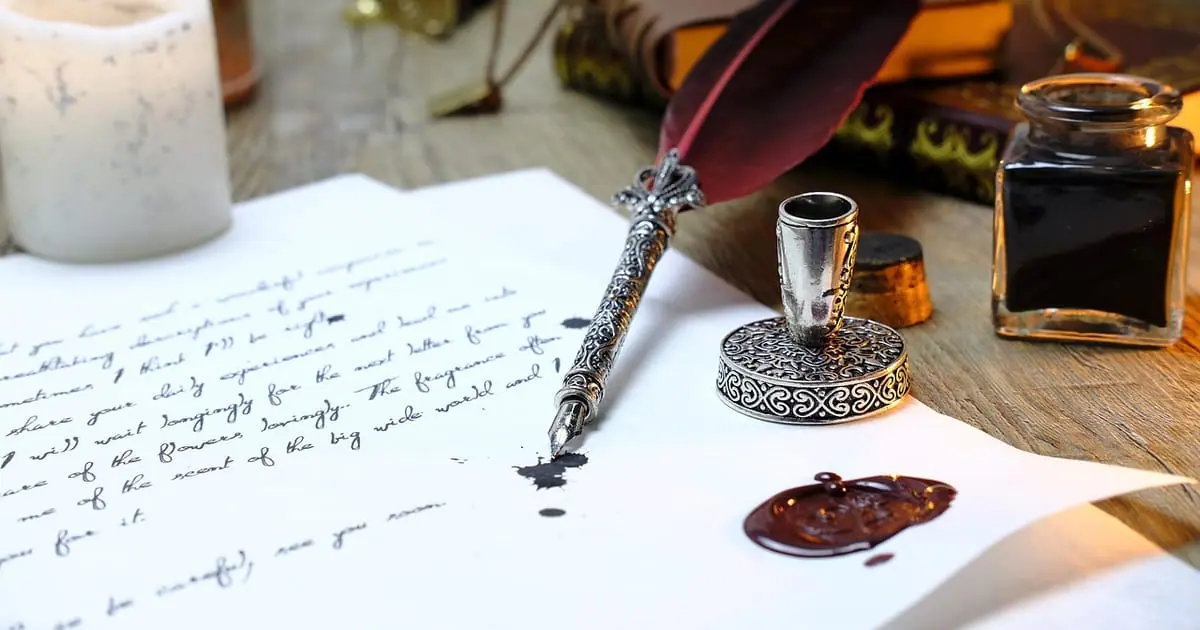
In 1878 a small London firm, Reeves & Turner, published thirty-seven letters that John Keats had written to Fanny Brawne in 1819 and 1820. Keats had been dead for 57 years and Fanny Brawne for 13. Her children sold the originals a few years later, and many readers were shocked to see the poet's jealousy and despair in print. Those letters are where nearly every "Keats love quote" online comes from, and most of those quotes are posted with no date and no hint of what was going on when he wrote them.
This page gives 16 lines from the letters, each one dated and checked word for word against the 1878 edition edited by Harry Buxton Forman (free on Project Gutenberg). For each, you get where Keats was, what had just happened, and what the line meant to him. After the quotes come the lines that get pinned to these letters but come from somewhere else, and a short guide to using a Keats line in a letter of your own. We have kept Keats's own spelling, so you will see "liv’d" and "Heathen" written the way he wrote them.
The two of them, in brief
Fanny (Frances) Brawne was born on 9 August 1800. Her widowed mother rented half of Wentworth Place in Hampstead, the double house Keats's friends Charles Brown and Charles Dilke had built. Forman, writing in 1878, reports that the two met at the Dilkes' and that they were engaged most probably early in 1819. Keats was 23, had no money and owned nothing but his talent. Her mother hoped, as a letter quoted by Forman puts it, that the attachment "will go off".
| When | Where Keats was | What was happening |
|---|---|---|
| Late 1818 | Hampstead | Meets Fanny Brawne; his brother Tom dies of tuberculosis on 1 December. |
| July–Aug 1819 | Shanklin, Isle of Wight | Away writing with Brown, short of money. The first and most famous letters. |
| Aug–Oct 1819 | Winchester, then Westminster | Writes "To Autumn" (Sept). Tries to live apart from her in London and fails within days. |
| 3 Feb 1820 | Wentworth Place | Coughs up blood and, in the account Lord Houghton published in 1848, reads its colour as his "death-warrant". |
| Feb–May 1820 | Wentworth Place, next door to her | Confined to the house; his notes are carried next door by hand. |
| Summer 1820 | Kentish Town, near Leigh Hunt | Bitter, jealous letters, then a second haemorrhage. The Brawnes nurse him. |
| Sept 1820 | At sea, then Naples and Rome | Sails for Italy with Joseph Severn. Never writes to her again. |
| 23 Feb 1821 | Rome | Dies aged 25; buried three days later in the Protestant Cemetery. |
Summer 1819: the Isle of Wight letters
Keats went to Shanklin at the end of June 1819 to write, and to live more cheaply than in London. The first letters he sent from there are the ones most people know. They are also the most playful, because at that point he was still well.
1. "A brighter word than bright"
For myself I know not how to express my devotion to so fair a form: I want a brighter word than bright, a fairer word than fair.
John Keats to Fanny Brawne, Shanklin, 1 July 1819
This is the first letter in the series. It is headed only "Thursday" and the postmark is 3 July, which dates it to 1 July. Keats opens by saying he is glad he did not send the letter he wrote on Tuesday night, "’twas too much like one out of Rousseau’s Heloise". So the sentence above is the calmer, morning version. A poet admitting that words fail him is a joke he expects her to get.
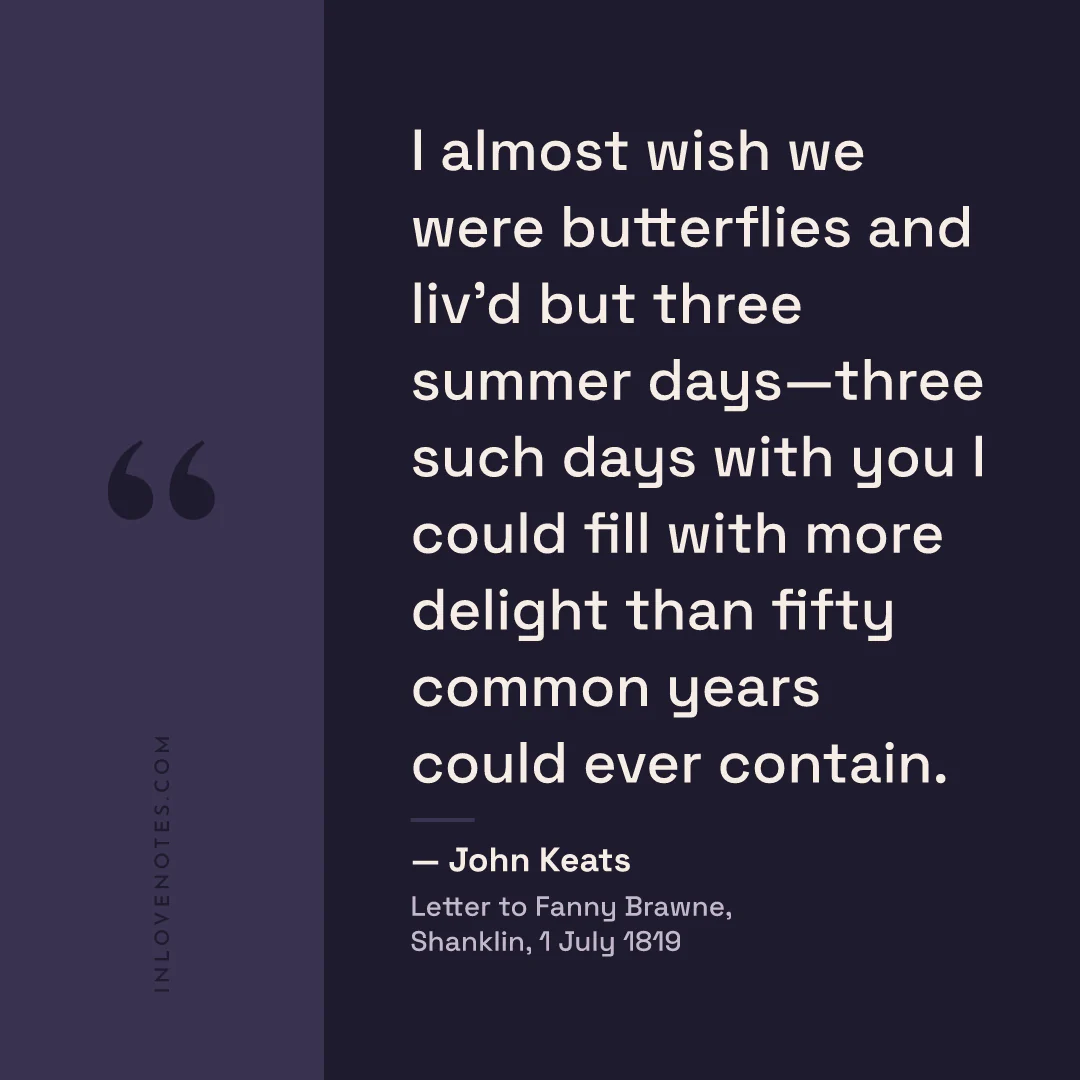
2. Three summer days
I almost wish we were butterflies and liv’d but three summer days—three such days with you I could fill with more delight than fifty common years could ever contain.
John Keats to Fanny Brawne, Shanklin, 1 July 1819
It follows straight on from the line above, and it is the most quoted sentence Keats ever wrote to her. Read in the letter, it is less sunny than it looks on a poster. Two sentences earlier he has told her he has "never known any unalloy’d Happiness for many days together: the death or sickness of some one has always spoilt my hours". Tom had died seven months before. Three perfect days felt like more than he could expect, not less.
3. Kiss the page
Write the softest words and kiss them that I may at least touch my lips where yours have been.
John Keats to Fanny Brawne, Shanklin, 1 July 1819
The same letter asks her to answer "immediately" and to make her reply "rich as a draught of poppies to intoxicate me". It is a request, not a declaration, which is why it works: he gives her something to do. It is still the best line here for anyone writing to a partner who is far away (our guide to long distance love letters builds on the same idea).
4. "Lest it should burn me up"
I never knew before, what such a love as you have made me feel, was; I did not believe in it; my Fancy was afraid of it, lest it should burn me up.
John Keats to Fanny Brawne, Shanklin, 8 July 1819
Her reply had arrived, and Keats begins: "Your Letter gave me more delight than any thing in the world but yourself could do." "Fancy" here means imagination, the faculty a poet lives by. He is admitting that he had written about love for years without believing in it.
5. "For my own sake"
I love you the more in that I believe you have liked me for my own sake and for nothing else.
John Keats to Fanny Brawne, Shanklin, 8 July 1819
The next sentence is the dry one: "I have met with women whom I really think would like to be married to a Poem and to be given away by a Novel." He is telling her she is not one of those women, and that he is glad of it. A note on wording: Forman's 1878 text reads "have liked"; some copies online read "had liked". Either way the sense is the same.
6. A trace of honey
I kiss’d your writing over in the hope you had indulg’d me by leaving a trace of honey.
John Keats to Fanny Brawne, Shanklin, 8 July 1819
The playful answer to his own request a week earlier. Right after it he asks about a dream she had mentioned: "Tell it me and I will tell you the interpretation thereof", borrowing the language of Joseph in Genesis.
7. "Your vassal"
The very first week I knew you I wrote myself your vassal; but burnt the Letter as the very next time I saw you I thought you manifested some dislike to me.
John Keats to Fanny Brawne, Shanklin, Sunday night (postmarked 27 July 1819)
The postmark makes the Sunday 25 July. This is the only place where Keats tells her about the beginning. There had been a first love letter, he burned it, and he had misread her. Forman used this sentence to work out when they met. It is also a reminder that the drafts you throw away still count.
8. Two luxuries
I have two luxuries to brood over in my walks, your Loveliness and the hour of my death. O that I could have possession of them both in the same minute.
John Keats to Fanny Brawne, Shanklin, 25 July 1819
This is the line that shows what these letters are really like. Love and death sit side by side in the same sentence, months before he knew he was ill. He had spent the day, he says, on "a very abstract Poem" (he doesn't name it; Lamia and The Fall of Hyperion were both on his desk that summer). Quote it in an essay, not in a wedding card.
9. Praying to a star
I will imagine you Venus tonight and pray, pray, pray to your star like a Heathen.
John Keats to Fanny Brawne, Shanklin, 25 July 1819
He signs this letter "Your’s ever, fair Star". Venus is the evening star, so this is the earliest place in the letters where Fanny and a star are joined, which is why readers connect her with his sonnet "Bright star" (more on that below).
10. Imprudent moveables
Better be imprudent moveables than prudent fixtures.
John Keats to Fanny Brawne, Shanklin, Thursday night (postmarked 9 August 1819)
Keats is imagining a married life and refusing the respectable kind: a house in "a vile crescent", tea parties where they would "wither", dinners where they would "freeze". He would rather they wandered, to Berne or Zurich, if luck allowed it. It is the most cheerful line in the series about a future together, and it would make a lovely card for a couple who have just moved or are about to travel.
Autumn 1819: Winchester and the London lodgings
In August Keats moved to Winchester for its library. He was working hard and money was getting worse. In October he took rooms at 25 College Street in Westminster, meaning to live apart from her and earn money by journalism. He spent a day with her in Hampstead around 10 October ("I am living today in yesterday", he wrote next morning), and the plan fell apart.
11. "You have absorb’d me"
I cannot exist without you. I am forgetful of everything but seeing you again—my Life seems to stop there—I see no further. You have absorb’d me.
John Keats to Fanny Brawne, 25 College Street, Westminster (postmarked 13 October 1819)
He had sat down to copy out some verses and could not. "I must write you a line or two and see if that will assist in dismissing you from my Mind for ever so short a time." The famous sentences come next. The sentence just before them is less often quoted: "My love has made me selfish."
12. "Love is my religion"
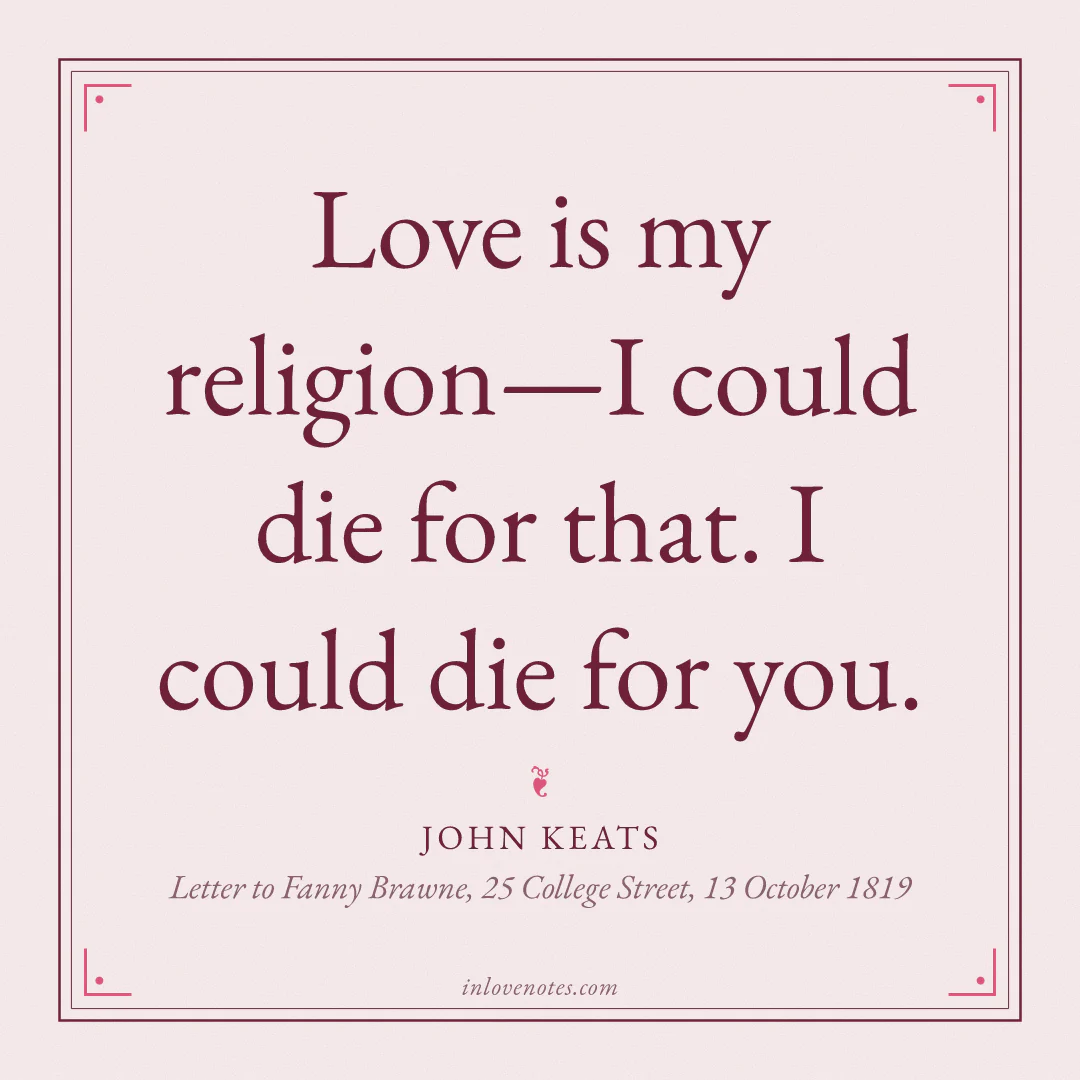
I have been astonished that Men could die Martyrs for religion—I have shudder’d at it. I shudder no more—I could be martyr’d for my Religion—Love is my religion—I could die for that. I could die for you. My Creed is Love and you are its only tenet.
John Keats to Fanny Brawne, Westminster, 13 October 1819
Same letter, a few lines on, after her note "came in just here". "Love is my religion" usually circulates on its own, but in the letter it is part of an argument. Keats, who was not conventionally religious, is saying that he finally understands martyrs. It ends: "My love is selfish. I cannot breathe without you." Within days he gave up the lodgings and moved back to Hampstead, next door to her.
1820: notes from a sickroom next door
On the night of 3 February 1820 Keats came home chilled from riding outside the stagecoach and coughed blood. He had trained in medicine at Guy's Hospital and had nursed Tom, so he knew what it meant. For the next three months he was confined to Brown's half of Wentworth Place, and Fanny lived on the other side of the wall. Most of the letters from this period are short notes carried next door, with no dates. Forman put them in order from internal clues, and he says himself that the order is probable, not certain. So "early 1820" is the honest date for the next two.
13. "The principle of beauty in all things"
If I should die, I have left no immortal work behind me—nothing to make my friends proud of my memory—but I have lov’d the principle of beauty in all things, and if I had had time I would have made myself remember’d.
John Keats to Fanny Brawne, Wentworth Place, early 1820
He tells her this is what he says to himself on "nights anxious and awake". He had already written the odes, "The Eve of St. Agnes" and "To Autumn", and he believed none of it would last. In Keats's text the sentence sits inside quotation marks, because he is quoting his own thoughts back to her. Then he adds that she now shares his attention with this "last infirmity of noble minds", Milton's phrase for the wish to be famous.
14. "You are always new"
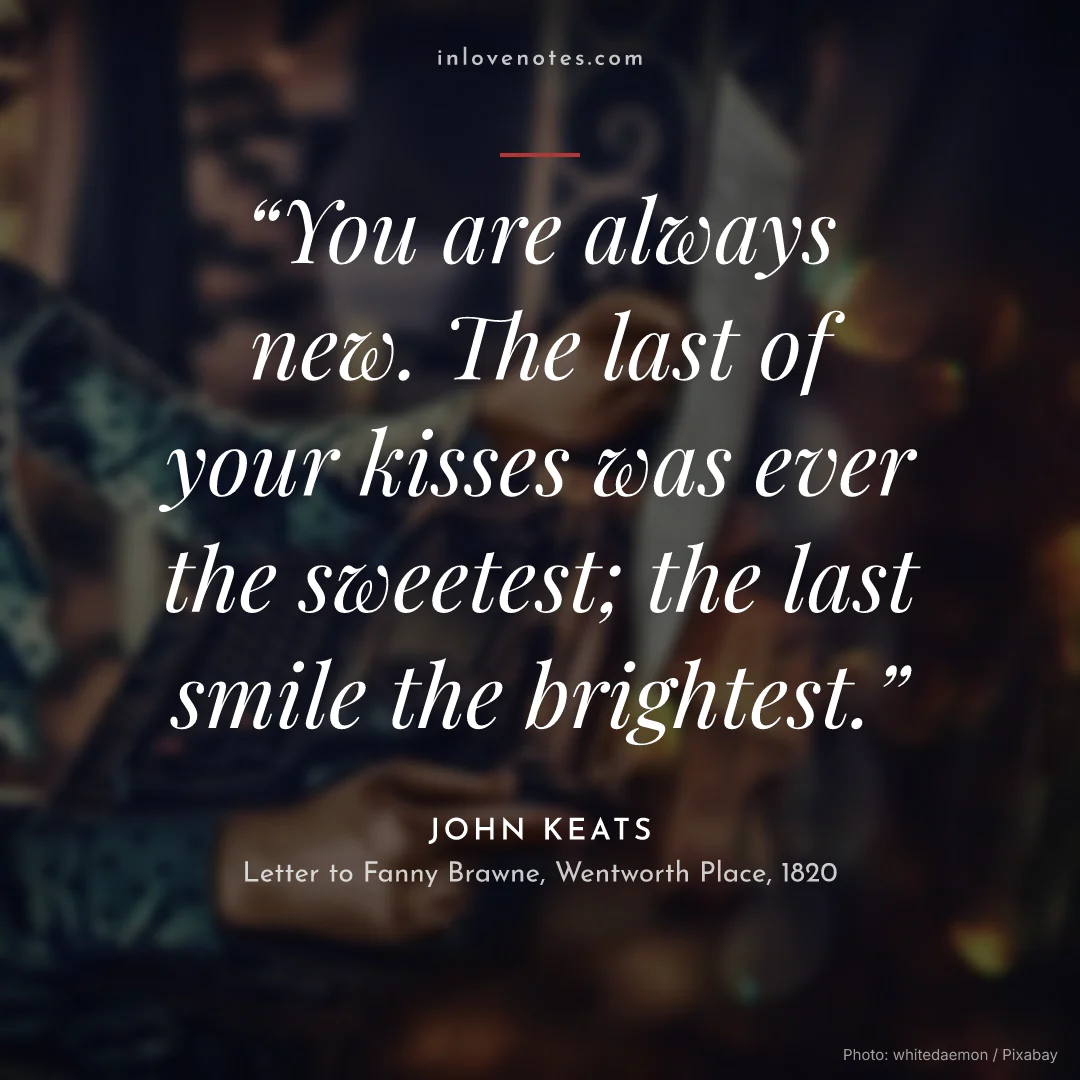
You are always new. The last of your kisses was ever the sweetest; the last smile the brightest; the last movement the gracefullest.
John Keats to Fanny Brawne, Wentworth Place, early 1820
It opens "Sweetest Fanny" and answers a worry of hers: "You fear, sometimes, I do not love you so much as you wish?" A few lines on he admits, "My Mind has been the most discontented and restless one that ever was put into a body too small for it." Keats was about five feet tall. Of all sixteen lines, this is the one we would choose for an anniversary card. It is about a long love that keeps getting better, not about first sight.
15. "I wish to live with you for ever"
I long to believe in immortality. I shall never be able to bid you an entire farewell. If I am destined to be happy with you here—how short is the longest Life. I wish to believe in immortality—I wish to live with you for ever.
John Keats to Fanny Brawne, Kentish Town, summer 1820
This comes from the third group of letters, written from Kentish Town between May and August 1820. They are the hardest letters to read. He accuses her of flirting, rages at friends who "laugh at you", and then apologises: "I swear my love has ever been greater than my cruelty which last but a minute." This passage is the tender centre of one of those letters. Its quieter question, "Will my arm be ever round you again?", is a line worth knowing too.
16. Chaff in my mouth
I wish you could invent some means to make me at all happy without you. Every hour I am more and more concentrated in you; every thing else tastes like chaff in my Mouth.
John Keats to Fanny Brawne, Kentish Town, August 1820
Forman thought this was the last letter Keats ever wrote to her, and Joseph Severn told him that Keats "was absolutely unable to write to her" on the voyage or in Italy. It is headed "I do not write this till the last, that no eye may catch it". Its final sentence is: "I wish I was either in your arms full of faith or that a Thunder bolt would strike me." Soon after, a second haemorrhage brought him back to Wentworth Place, where Mrs Brawne and Fanny nursed him until he sailed.
Keats lines that are not from these letters
Search results and quote images mix the letters up with Keats's poems and his letters to friends. None of the lines in the table below is fake, but each one is regularly given the wrong source, and getting it wrong in a card or an essay is easy to avoid. For more lines like these, see our longer piece on misattributed love quotes.
| Line as usually shared | Often captioned as | Where it really comes from |
|---|---|---|
| "Bright star, would I were stedfast as thou art" | a letter to Fanny | A sonnet. It was not sent as a letter. Scholars disagree on when he wrote it, with dates ranging from 1818 to late 1819. Severn said Keats copied the last version into Severn's Shakespeare on the voyage in 1820. It was first printed in 1838. |
| "Touch has a memory" | a love letter | The poem that begins "What can I do to drive away / Remembrance from my eyes?" (1819), usually titled "To Fanny" or "Lines to Fanny". |
| "I am certain of nothing but the holiness of the Heart’s affections and the truth of Imagination" | Keats to Fanny Brawne | A letter to his friend Benjamin Bailey, 22 November 1817, written about a year before he met her. It is about imagination, not romance. |
| "Beauty is truth, truth beauty" | Keats on love | The last lines of "Ode on a Grecian Urn" (1819), spoken by or about the urn. |
| "I should have had her when I was in health, and I should have remained well" | a letter to Fanny | A letter to Charles Brown from Naples, 1 November 1820. It survives only in Brown's copy. |
| "Love is my religion" | a stand-alone motto | Real (13 October 1819), but it is cut from a longer sentence about martyrs. See line 12 above. |
Here is the sonnet's ending, because people ask for it. In the version printed today, after wishing to be as "stedfast" as the star, the speaker wishes to be
Pillow’d upon my fair love’s ripening breast, / To feel for ever its soft fall and swell, / Awake for ever in a sweet unrest, / Still, still to hear her tender-taken breath, / And so live ever—or else swoon to death.
John Keats, "Bright star, would I were stedfast as thou art" (first printed 1838)
The star is not the lover. It is a model of the one thing he wants from it, its steadiness, without its loneliness ("Not in lone splendour hung aloft the night"). That is the short answer to what "Bright Star" means. Forman also records that Fanny copied the sonnet out in her own hand at the back of a book Keats had marked for her.
What became of the letters, and of her
Fanny's side of the correspondence is lost. When her letters reached Keats in Italy he could not bear to open them, and the Keats chronology kept by the University of Victoria notes that he was buried with a couple of her letters unopened. Before he left, he had asked her to write to his younger sister, also called Fanny. She did, 31 letters over four years starting the day after he left London. Those letters are now at Keats House in Hampstead, which tells how they travelled from Madrid to Boston and back to the house in 1934.
She mourned Keats for years. In the early 1830s she married Louis Lindo (later Lindon) and had three children. She died in 1865 and is buried in Brompton Cemetery. Before she died she told her children about the engagement and gave them his letters. They had Forman publish them in 1878 and sold the originals at auction in 1885. Victorian critics, Matthew Arnold among them, held the letters against Keats, and for decades Fanny was cast as the shallow girl who had made him unhappy. The 2009 film Bright Star, directed by Jane Campion, did most to turn opinion back in her favour.
Borrowing a Keats line for your own letter
These are private letters by a young man in love and, later, very ill. That is why they move people, and it is also why some lines go wrong when you lift them out. A few rules of thumb:
| If you are writing… | Use | Avoid |
|---|---|---|
| an anniversary card | 14 ("You are always new") | 8 and 16, which are about death and despair |
| to someone far away | 3 (kiss the page) or 6 (a trace of honey) | 11 if they're already anxious about the distance |
| an early "I'm falling for you" letter | 1 or 4 | 12, which is a lot to say in month two |
| a wedding or moving-in card | 10 ("imprudent moveables") or 2 | 13, the "If I should die" line |
| an essay or a talk on Keats | 8, 13, 16, with dates | undated quotes from image sites |
- Quote, then add your own sentence. Keats's line does the lifting. Your next sentence, about your real life together, is what makes it a letter and not a poster. Our guide on how to write a love letter shows this in more detail.
- Credit it the short way: "John Keats to Fanny Brawne, 1819". The person reading your letter will like knowing it was a real letter too.
- Steal the moves, not just the words. Asking for something ("write the softest words"), signing off in a private way ("Your’s ever, fair Star"), saying what you threw away (the burned first letter). For more sign-offs, see how to start and end a love letter.
- Keep his spelling or modernise it, but don't mix the two. "Liv’d" on a card looks deliberate. "Liv’d" next to "absorbed" looks like a typo.
Questions readers ask about Keats and Fanny Brawne
Who was Keats's lover?
Fanny Brawne (1800–1865), his neighbour at Wentworth Place in Hampstead. They were engaged, probably early in 1819, but never married. Keats died in Rome in February 1821.
How many letters did Keats write to Fanny Brawne?
Forman's 1878 edition printed 37 surviving letters and notes, from July 1819 to August 1820. Later editions added a few more that came to light afterwards. Her letters to him have not survived.
Are the letters in the film Bright Star real?
The film quotes the letters and poems, but it trims and rearranges them for the screen. If you want a line from the film for a card, check it against the letters above or the Gutenberg text before you credit it to Keats's letters.