9 Love Quotes From Classic Novels, Checked Against the Text
Nine love quotes from classic novels, each checked word for word against the book, with chapter, speaker and what happens next. Austen, Dickens, Brontë.
Most lists of love quotes from classic novels give you a line, an author and a pretty picture. This one gives you the line, the chapter it lives in and what is going on around it, because a sentence that sounds like a vow can turn out to be a failed proposal, a farewell or a confession made to the wrong person. Every line below was checked word for word against the Project Gutenberg text of the novel, and the table further down tells you exactly where to find each one.
Declarations that arrive at the worst moment
The nineteenth-century novel loved a badly timed confession. Three of the best-known lines are spoken to someone who is not ready to hear them, and that is exactly why they still feel true.
In vain have I struggled. It will not do. My feelings will not be repressed. You must allow me to tell you how ardently I admire and love you.
Jane Austen, Pride and Prejudice, ch. 34 (1813)
Darcy says this at the Hunsford parsonage, to a woman who had no idea he was in love with her. It is one of the great opening lines of a proposal and one of the great failures of one: Austen tells us he "was not more eloquent on the subject of tenderness than of pride", and Elizabeth refuses him within minutes. Use the first two sentences when you want the feeling of being overruled by your own heart, and leave the rest of the speech out.
You pierce my soul. I am half agony, half hope.
Jane Austen, Persuasion, ch. 23 (1817)
Captain Wentworth writes this in a letter, at a table while Anne Elliot sits nearby, and leaves it for her to read once he has gone. It has no argument in it, only the two states he is caught between. The letter goes on with "I have loved none but you", which makes a plain, short line for a card after a long separation.
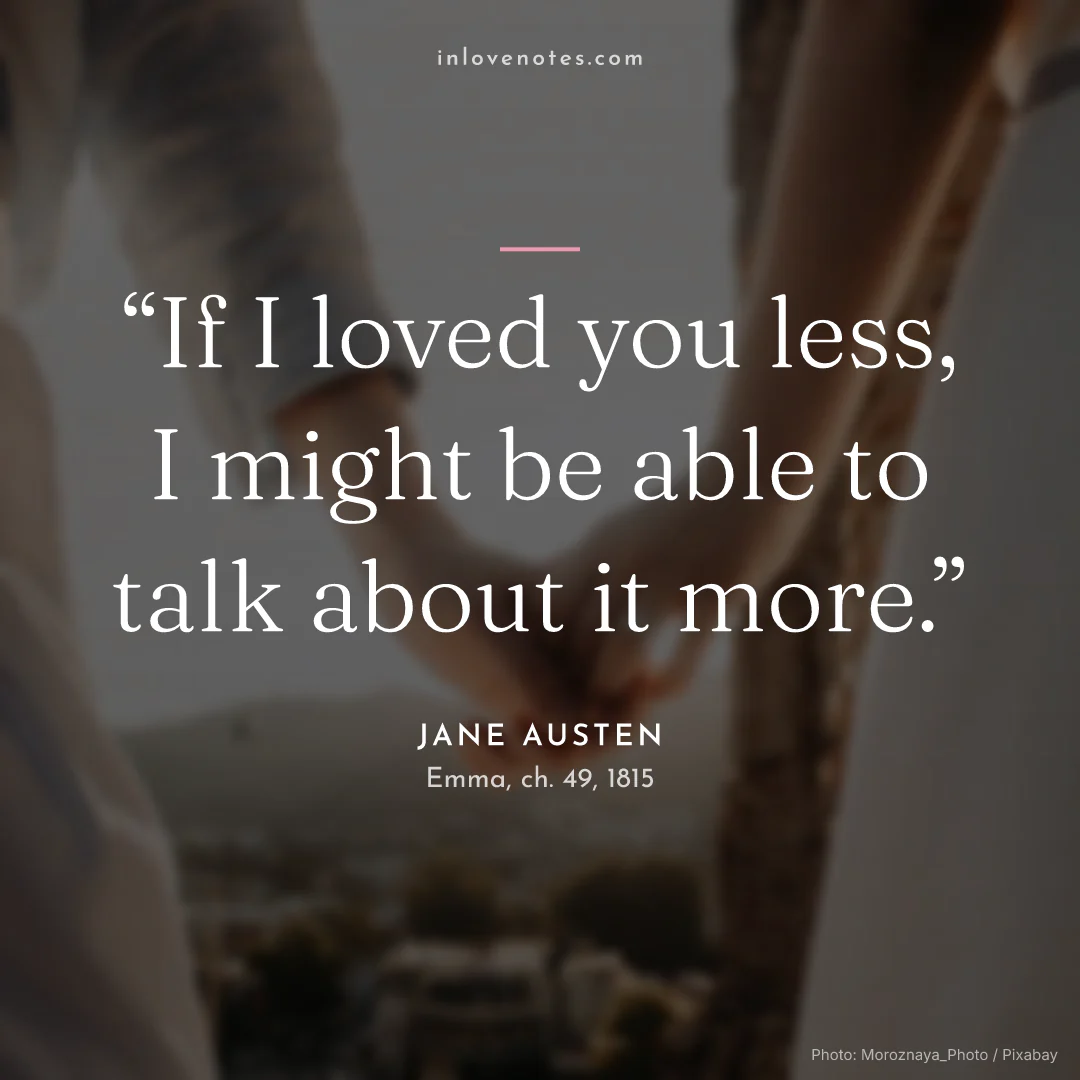
I cannot make speeches, Emma … If I loved you less, I might be able to talk about it more.
Jane Austen, Emma, ch. 49 (1815)
Mr. Knightley is explaining why his proposal is clumsy. The charm is the reasoning: the less he can say, the more he means. It suits people who are embarrassed by flowery messages, and it works as a caption under a very short note.
Love that knows it is unreasonable
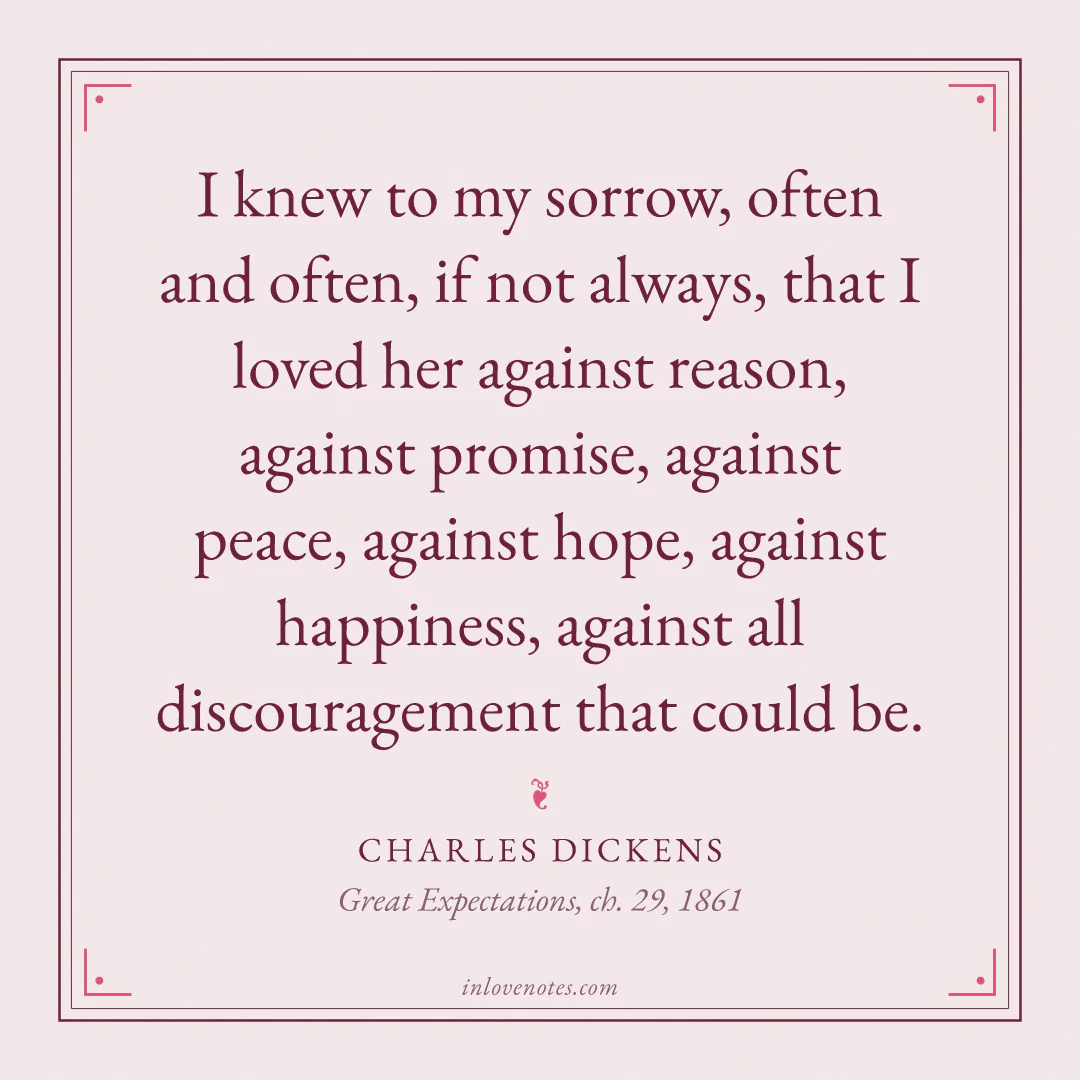
I knew to my sorrow, often and often, if not always, that I loved her against reason, against promise, against peace, against hope, against happiness, against all discouragement that could be.
Charles Dickens, Great Expectations, ch. 29 (1861)
This is Pip, looking back on his love for Estella, and the version people share online usually starts at "I loved her against reason", dropping the words before it. The full sentence matters: he is not boasting, he is confessing that he always knew it was hopeless and loved her anyway. The paragraph around it says he loved her "simply because I found her irresistible", which is a good reminder that Dickens is describing a weakness, not recommending one.
Whatever our souls are made of, his and mine are the same.
Emily Brontë, Wuthering Heights, ch. 9 (1847)
Catherine Earnshaw says this to the housekeeper Nelly, in the very speech where she explains why she is going to marry Edgar Linton instead. She says it would "degrade" her to marry Heathcliff, and he hears that part and walks out of the room before she reaches the line people quote. If you want it for a wedding card, know that you are borrowing the most famous sentence of a love story that does not end well. For an anniversary note about two people who feel like one, it still says something no paraphrase can.
Loving someone you cannot have
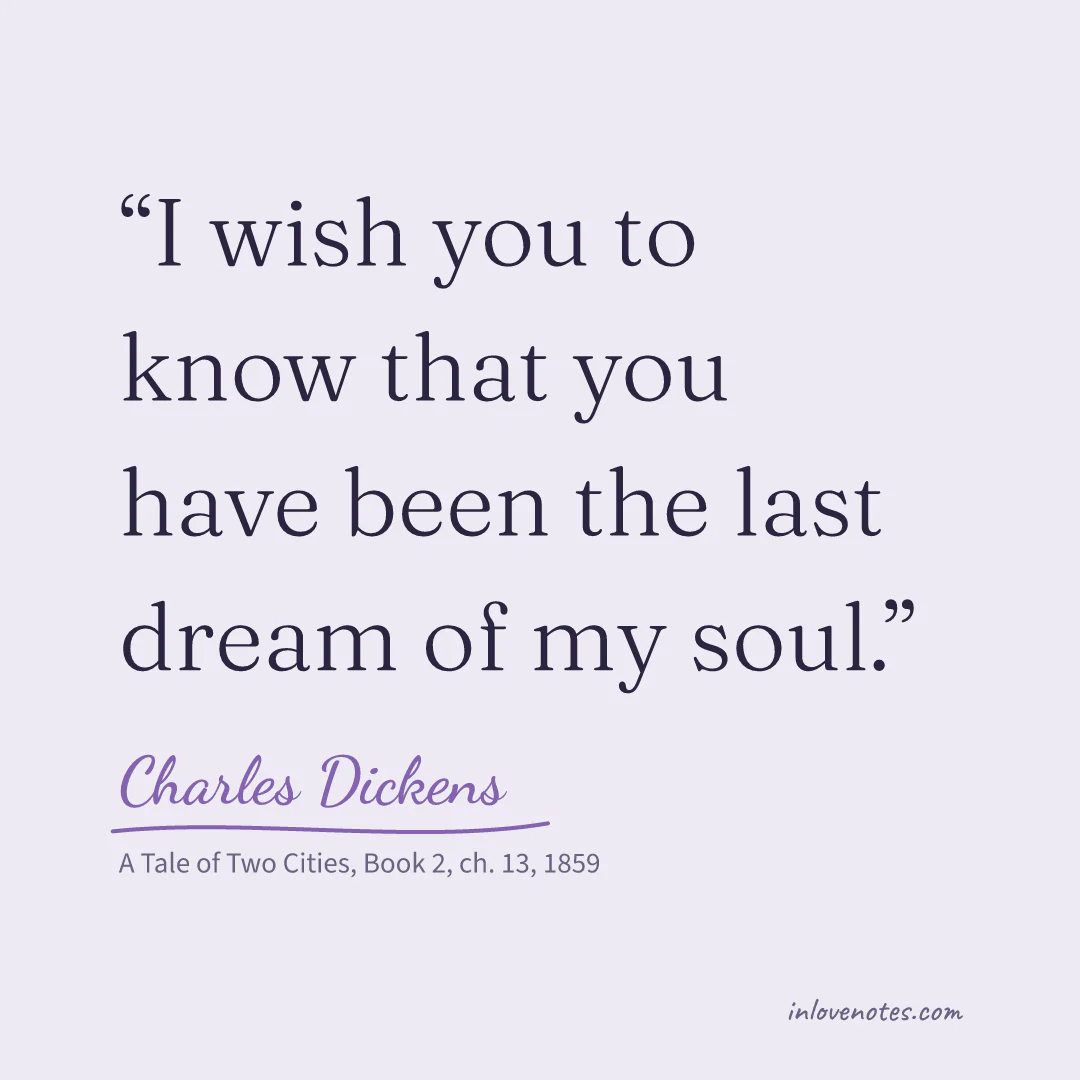
I wish you to know that you have been the last dream of my soul.
Charles Dickens, A Tale of Two Cities, Book 2, ch. 13 (1859)
Sydney Carton says this to Lucie Manette, knowing she cannot return it. He asks for nothing, which is why the line is so quiet: he only wants her to know that seeing her father's home, and her in it, stirred something in him that he thought was dead. Readers who know the ending will hear it differently. It is a good choice when the message is about gratitude to someone who changed you, rather than about winning them.
You are my heart, my life, my one and only thought.
Arthur Conan Doyle, The White Company, ch. 13 (1891)
Doyle's historical adventure is set in the fourteenth century, and this is the young Alleyne Edricson speaking to Maude Loring as he leaves for the wars. Her reaction in the next lines is fear, not delight: "Ah, you shrink, you shudder! My wild words have frightened you", he says. It is a sincere line from a book few people read now, and one that often circulates as a bare quote with no novel named. Crediting the book and chapter is the easy fix.
Seeing someone without looking
He walked down, for a long while avoiding looking at her as at the sun, but seeing her, as one does the sun, without looking.
Leo Tolstoy, Anna Karenina, Part 1, ch. 9 (serialised 1875–77; Constance Garnett translation)
Levin goes to the ice rink knowing Kitty will be there, and the whole scene is about the effort of not staring. Tolstoy wrote in Russian, so the wording depends on the translator: other English editions phrase the sun comparison differently, and quote pages that mix versions are worth a second look. The sentence above is Garnett's, as it appears on Project Gutenberg. If you use another translation, name it.
Ending with a plain sentence
Reader, I married him. A quiet wedding we had: he and I, the parson and clerk, were alone present.
Charlotte Brontë, Jane Eyre, ch. 38 (1847)
The famous first four words open the final chapter, after Jane has left Thornfield and returned to find Rochester blind and living in seclusion. The next sentence is the surprise: no guests, no speech, only two people and the officials. It is the kind of line to write in a card to a partner when the day was small and the feeling was not.
Where each line sits
If you are putting a line in a card, a toast or a caption, copy it from the text and cite the chapter. This table is the quick check; every row was confirmed against the public-domain Project Gutenberg edition named in the last column.
| Opening words | Novel (first published) | Where | Who says it, to whom | Checked in |
|---|---|---|---|---|
| In vain have I struggled | Pride and Prejudice (1813) | ch. 34 | Darcy to Elizabeth | Gutenberg #1342 |
| You pierce my soul | Persuasion (1817) | ch. 23 | Wentworth, in a letter to Anne | Gutenberg #105 |
| If I loved you less | Emma (1815) | ch. 49 | Knightley to Emma | Gutenberg #158 |
| I loved her against reason | Great Expectations (1861) | ch. 29 | Pip, narrating, about Estella | Gutenberg #1400 |
| Whatever our souls are made of | Wuthering Heights (1847) | ch. 9 | Catherine to Nelly, about Heathcliff | Gutenberg #768 |
| The last dream of my soul | A Tale of Two Cities (1859) | Book 2, ch. 13 | Carton to Lucie Manette | Gutenberg #98 |
| My heart, my life, my one and only thought | The White Company (1891) | ch. 13 | Alleyne to Maude | Gutenberg #903 |
| Avoiding looking at her as at the sun | Anna Karenina (serialised 1875–77) | Part 1, ch. 9 | Narrator, about Levin and Kitty | Gutenberg #1399 (Garnett) |
| Reader, I married him | Jane Eyre (1847) | ch. 38 | Jane, narrating | Gutenberg #1260 |
A famous Austen line that is not in Austen
"You have bewitched me, body and soul, and I love, I love, I love you" is attributed to Jane Austen on many quote sites. The Project Gutenberg text of Pride and Prejudice contains no instance of the phrase "body and soul", and Darcy's declaration in chapter 34 is the one printed above. The word "bewitched" does appear once in the novel, in chapter 10, as narration: Darcy "had never been so bewitched by any woman as he was by her". That is Austen's wording; the passionate version is a later adaptation. If you want the real sentence, the Hunsford one above is it. For more cases like this see our sourced guide to misattributed love quotes.
How to use a novel line without getting it wrong
- Know who is speaking and what happens next. Catherine's line in Wuthering Heights comes just before Heathcliff leaves; Darcy's proposal is refused. A line can still work, but pick it knowingly.
- Quote a sentence, not a paraphrase. The wording above is the original; shortened or merged versions look the same in a graphic but are not what the author wrote.
- Name the translation for anything not written in English. Tolstoy is the example here.
- Cut at the end of a sentence, mark every cut with an ellipsis, and keep the speaker's meaning intact.
- Put it in your own handwriting. A single borrowed line under two sentences of your own lands better than a page of quotations. If you are writing a longer note, our guide to how to write a love letter has a structure that works with a quoted opener.
If you want shorter lines for a card, see short love quotes from books. For real love letters rather than fiction, try Keats's letters to Fanny Brawne.
Questions people ask
What are some famous quotes from romantic novels?
The nine above are among the most-quoted: Darcy's declaration in Pride and Prejudice, Wentworth's letter in Persuasion, Pip's confession in Great Expectations, Catherine's speech in Wuthering Heights and the first line of the last chapter of Jane Eyre, among them.
What is the most romantic line from a book?
There is no agreed answer, and it depends on what you need it for. For a letter after a long separation, Wentworth's "You pierce my soul. I am half agony, half hope." is hard to beat; for something understated, Knightley's "If I loved you less, I might be able to talk about it more."
How do I check that a classic-novel quote is real?
Search the novel's full text on Project Gutenberg for two or three consecutive words from the line. If nothing comes back, it is probably from a film, a later adaptation or a paraphrase, as with the "bewitched me, body and soul" line above.