Good Morning Paragraphs for Her to Wake Up To: 24 Messages, Short and Long
24 good morning paragraphs and texts for her, sorted by her day: big days, hard mornings, time zones, after a fight. Plus 5 real morning lines, sourced.
Updated

On the morning of 7 July 1812, Ludwig van Beethoven was still in bed when he went back to a letter he had started the night before, to the woman we now know only as his "Immortal Beloved". The new section opens: "guten Morgen am 7ten Juli – schon im Bette drängen sich die Ideen zu dir meine Unsterbliche Geliebte". In our literal translation: "good morning, on 7 July. Already in bed my thoughts press towards you, my Immortal Beloved." (The German follows the transcription on the German Wikipedia article, which cites Goldschmidt 1977 and Brandenburg 1996. Lady Wallace's 1866 English translation has "Good-morning! Even before I rise, my thoughts throng to you, my immortal beloved!", though she dates the letter to 1800.) He never sent it; it was found among his papers after he died. It may be the most famous good morning paragraph ever written to a woman.
A good morning paragraph for her does the same small job. It is often the first thing she reads that day, before the news and the work email, and it tells her that someone was thinking about her before she opened her eyes. Below are 24 good morning paragraphs and texts for her, written by our editors, sorted by the kind of morning she is about to have: sleeping in beside you, facing a big day, waking up to something hard, waking up hours ahead of you, waking up after an argument, an easy weekend, or a birthday. Each moment has a short text and a longer paragraph. Lines in [square brackets] are for details only you know.
Five times we borrow from writers who wrote about mornings and the people they loved. Each of those lines was checked against the published text, and the source is given with it. If you want something longer and not tied to the morning, our long love messages for her are built on real letters.
Make Sure It's Waiting When She Wakes Up
A good morning text works best if it is already there when she picks up her phone. If you are awake before her, that's easy. If you aren't, you can write it the night before and schedule it.
- iPhone (iMessage): since iOS 18, Messages has a Send Later option. In the conversation, tap the + next to the text field, choose Send Later, and set the date and time. Apple says you can schedule a message up to 14 days ahead. It works only for iMessage (blue bubbles), not SMS, and you need to be online when you schedule it.
- Android (Google Messages): type the message, then touch and hold the Send button, pick a suggested time or set your own date and time, and tap Send. Google says this works on Android 7.0 and up.
- Other apps: scheduling options vary by app and change over time. If yours has none, write the message the night before, save it as a draft, and send it as soon as you wake up.
Pick a time just after her alarm, not before it. A message that lights up her screen at 5 a.m. is not the gift you meant it to be.
Which message you send depends on the morning she is waking up to. Use this table to find the right section:
| Her morning | What she needs to read | Length that works | Go to |
|---|---|---|---|
| Asleep next to you, or in the next room | That you noticed her before the day started | One or two lines, or a note by the coffee | Messages 1–3 |
| Interview, exam, presentation, first day | Calm, not hype; one specific reason you trust her | Short text before, paragraph the night before | Messages 4–7 |
| Grief, illness, bad news, a hard week | That she doesn't have to answer or perform | Short; no questions that need replying to | Messages 8–10 |
| Different city or time zone | That the distance is counted and the gap will end | A full paragraph; she has time to read it | Messages 11–14 |
| The morning after an argument | That you are still on the same side | Short and plain; save the long talk for later | Messages 15–17 |
| An ordinary Tuesday or a slow Saturday | Warmth with no occasion attached | Anything; this is where playful works | Messages 18–21 |
| Her birthday or your anniversary | That you remember the day and what it means | A real paragraph, first thing | Messages 22–24 |
When She's Still Asleep Beside You
These are for the mornings you leave first. Send them as a text, or write them on a sticky note and leave it on the coffee maker, her phone or the bathroom mirror, where her morning starts. For more places to hide a note, see our love notes for her, sorted by where she'll find them.
1. Short
Good morning. You were stealing the blanket again and I let you. Coffee's made. I love you.
2. Short
I left quietly so you could sleep. You looked so peaceful I almost stayed. See you tonight, beautiful.
3. Paragraph
Good morning, love. I watched you sleep for a minute before I left, and I want you to know what I was thinking: I still can't quite believe I get to wake up next to you. You had your hand under your cheek the way you do, and the light was coming in over [the window / your shoulder], and I thought, this is it, this is the good part of my life. Have the best day. I'll be thinking about you around [time you'll miss her most].
Poets have written about lovers waking up together for a long time. John Donne's "The Sun Rising", printed in his Songs and Sonnets in 1633, two years after his death, opens with a man telling the sun off for waking him and the woman beside him:
"Busy old fool, unruly Sun, / Why dost thou thus, / Through windows, and through curtains, call on us?"
— John Donne, "The Sun Rising", Songs and Sonnets (1633)
The poem says morning has no authority over people in love: "Love, all alike, no season knows nor clime, / Nor hours, days, months, which are the rags of time." "Busy old fool" works as a playful first line for a text on a morning when you would both rather stay in bed. Add one line of your own after it so the message sounds like you, not like a quote.

Before Her Big Day
On a morning with an interview, an exam, a presentation or a first day at a new job, she will be nervous, and an over-excited message ("You're going to KILL it!!!") can add to the pressure. What helps more is calm, and one specific reason you believe in her. If you can, send the long one the night before and a short one in the morning.
4. Short
Good morning. You've prepared for this more than anyone in that room. Breathe, be yourself, and call me after. I'm proud of you whatever happens.
5. Short
Today is just one day, and you are already the person they would be lucky to have. Go show them. Love you.
6. Paragraph (the night before)
I know you're nervous about tomorrow, so let me tell you what I see. I've watched you [prepare for this for weeks / stay up rewriting the slides / practise answers in the car]. I've watched you handle [a hard thing she has already handled] without falling apart. Whatever they ask you tomorrow, you've already done harder things. Get some sleep. When you wake up, I want this to be the first thing you read: I believe in you, and I'll be just as proud of you tomorrow night either way.
7. Paragraph (the morning of)
Good morning, [name]. Big day. Eat something, even if it's just toast. Wear the [jacket / shoes] that make you feel like yourself. When you walk in, remember that they asked to see you because you're good at this. I'll have my phone on all day, and I'm taking you to [place] tonight whatever happens.
When Her Morning Starts Hard
Some mornings she will wake up to something heavy: grief, an illness, bad news, a week that has worn her down. Cheerful messages can feel like a demand to cheer up. On these mornings, keep it short. Don't ask anything she has to answer, and make it clear she doesn't have to reply.
8. Short
Good morning. No need to reply. I just want you to know I'm here and I'm thinking about you today.
9. Short
I know today is going to be hard. You don't have to be okay. I'm bringing dinner tonight, so that's one thing off your list.
10. Paragraph
Good morning, love. I know waking up has been the hardest part lately, so I wanted something kind to be waiting for you. You don't need to be strong today or answer anyone fast, including me. Do the next small thing, then the one after it. I'm on your side for all of it, the slow days included. I'll check in at lunch. If you want company, say the word and I'll come. If you want quiet, I'll leave you be.
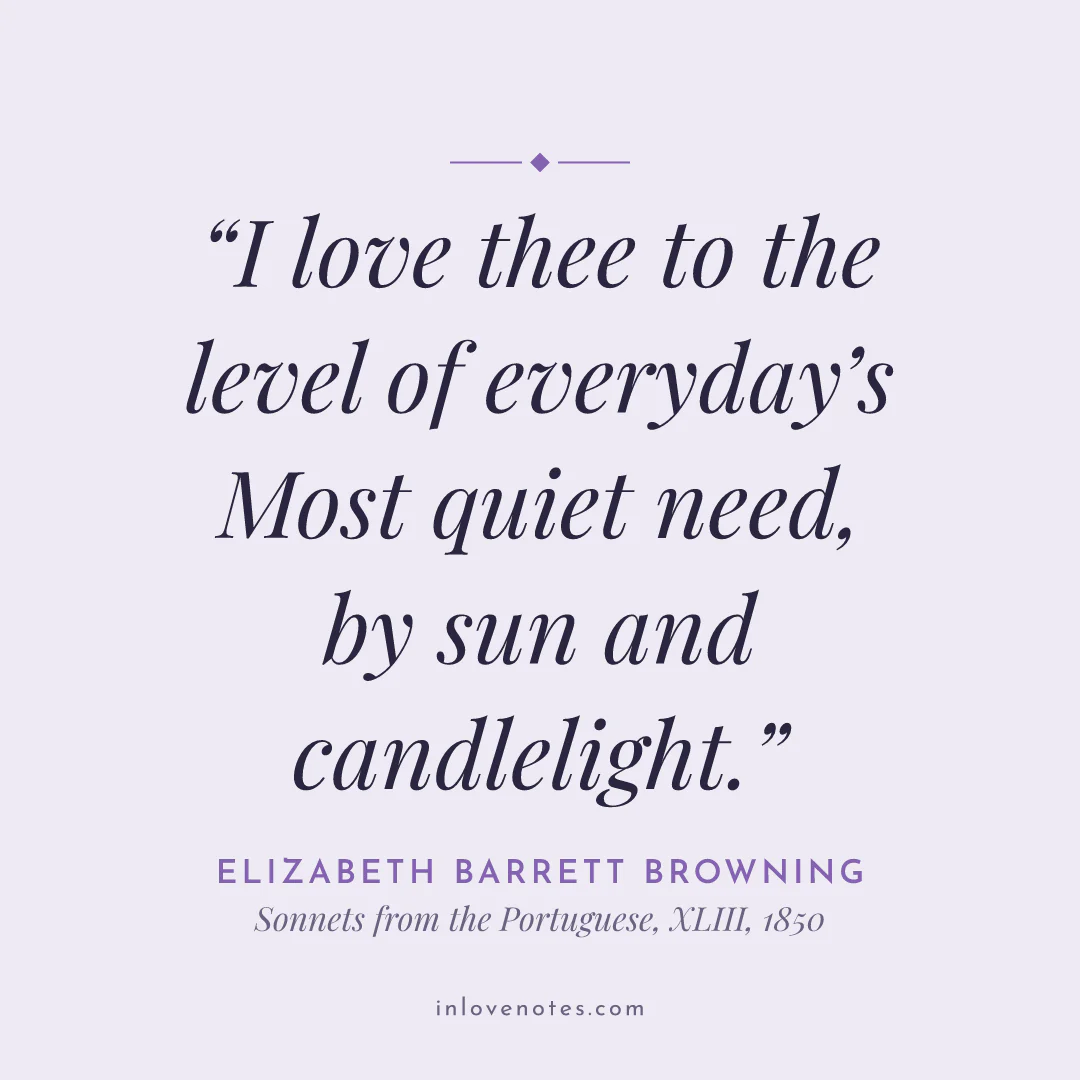
On hard days it helps to remember that love is mostly made of small, daily care. Elizabeth Barrett Browning said this better than anyone in the best-known sonnet from Sonnets from the Portuguese (1850), the sequence she wrote during her courtship with Robert Browning:
"I love thee to the level of everyday's / Most quiet need, by sun and candlelight."
— Elizabeth Barrett Browning, Sonnets from the Portuguese, XLIII (1850)
These two lines are less famous than the sonnet's opening ("How do I love thee? Let me count the ways"), but they suit a hard morning better: they promise to be there for ordinary needs, by day and by night. We follow the spelling of the 1886 Selection used by the University of Toronto's Representative Poetry Online. Some editions print "every day's" and "candle-light".
Good Morning Across Time Zones
When you live in different cities, the good morning message carries more weight. It is often the one daily contact that doesn't depend on both of you being free at the same time. If she is hours ahead, schedule it (see above) so it arrives when her alarm goes off, not in the middle of her night. More on staying close at a distance is in our guide to long distance love letters.
11. Short
Good morning from [number] hours behind you. You've already started a day I haven't reached yet. Save me a bit of it.
12. Short
[Number] more mornings until I wake up next to you instead of texting you. I'm counting every one. Good morning, love.
13. Paragraph
Good morning, beautiful. By the time you read this I'll be asleep, and it's strange to love someone whose sunrise is my midnight. I set this message last night so it would be there when you wake up, because I hate the idea of you starting a day without hearing from me. Have your coffee, look out the window at [her city], and know that someone in [your city] went to sleep thinking about you. [Number] days left. Then we get the same morning again.
14. Paragraph
Good morning, my love. I've been thinking about how many of our mornings have been spent on screens, and I don't want you to think I take them for granted. Every one of these messages is me choosing you from far away. When this distance is over, I want a hundred slow mornings with you: [the café you talked about / breakfast on your balcony / nowhere to be]. Until then, here's today's: I love you, and I'm proud of how we're doing this.
Mornings can also be the time of day when being apart feels most real. Robert Browning, Elizabeth's husband, wrote a four-line poem about it. It first appeared in Dramatic Romances and Lyrics (1845) as the second half of "Night and Morning", and was renamed "Parting at Morning" in 1849:
"Round the cape of a sudden came the sea, / And the sun looked over the mountain's rim: / And straight was a path of gold for him, / And the need of a world of men for me."
— Robert Browning, "Parting at Morning" (1845; titled 1849)
The speaker has spent the night with his lover, and at sunrise the outside world calls him back. If you're in a long-distance relationship and saying goodbye at an airport early in the morning, that is the feeling. The first two lines would make a fitting caption for a sunrise photo sent from where you are.
The Morning After an Argument
If you went to sleep upset with each other, the morning message decides what the day feels like. This is not the moment to argue your side again, or to write a long apology she has to answer before work. Keep it short, warm and honest, and leave the real conversation for when you can talk properly.
15. Short
Good morning. I'm sorry about last night. I love you more than I care about being right. Can we talk tonight?
16. Short
We're on the same team, even when we argue. Have a good day, and I'll be home by [time].
17. Paragraph
Good morning. I didn't sleep great, and I don't think you did either. I'm sorry for [the specific thing you said or did]. I've been thinking about what you said about [her point], and I think you're more right than I let you be last night. I don't want to settle it by text. I just didn't want you to start the day wondering where we stand. We're okay. I love you. Tonight, let's talk properly, and I'll listen better.
Ordinary Mornings, and Slow Ones
Most good morning texts aren't for a special day, and those are often the ones that mean the most, because nothing prompted them. Playful works here. So does just noticing something about her.
18. Short
Good morning to the only person I'd share the last of the coffee with. Reluctantly. But still.
19. Short
Just woke up and you were the first thing I thought about. Again. It's becoming a pattern.
20. Paragraph
Good morning, love. Nothing special about today, which is exactly why I'm writing. I wanted you to know that the ordinary days with you are the ones I like best. The [grocery runs / walks with the dog / bad TV on the couch]. I don't need a big occasion to be glad you're mine. I hope your [meeting / class / shift] goes easy and someone holds the door for you. I'll see you tonight.
21. Paragraph (a Saturday)
Good morning. No alarm, no plans before ten, and you're the only thing on my schedule. Stay in bed as long as you want. I'll bring you [coffee / tea / the croissants from the place on the corner]. Then let's do absolutely nothing useful together.
Napoleon Bonaparte wrote one of the most famous good morning love letters early in his courtship of Joséphine de Beauharnais. Henry Foljambe Hall's translation (Napoleon's Letters to Josephine, 1796–1812, 1901), where it is the first letter, begins with the time of day:
"Seven o'clock in the morning. My waking thoughts are all of thee. Your portrait and the remembrance of last night's delirium have robbed my senses of repose."
— Napoleon Bonaparte to Joséphine, translated by Henry Foljambe Hall (1901)
The letter is undated, and they married in March 1796. "My waking thoughts are all of thee" is a good line to borrow for a lazy Saturday text. The rest of the letter is more feverish than most of us would send on a weekend.
Her Birthday, or Your Anniversary
On her birthday, or the anniversary of your first date or your wedding, your message should be the first one she reads. Write it the night before. Mention one specific memory. That is the difference between a message that feels written for her and one that could have been written for anyone.
22. Short
Happy birthday, love. I wanted to be the first one to say it. Today is all about you, so take your time getting up.
23. Paragraph (birthday)
Good morning, birthday girl. Another year of you, and I'm the lucky one. This time last year we were [where you were], and I remember thinking I couldn't love you more. I was wrong. This year I watched you [something she did this year that you admire], and I'm prouder of you than I know how to say. Today, all you have to do is let people love you. Starting with me. Happy birthday.
24. Paragraph (anniversary)
Good morning, and happy anniversary. [Number] years ago today, [what happened: we met at / you said yes / we had our first date at]. I didn't know then that I was meeting the person I'd want to wake up beside every morning after. I know it now. Thank you for every ordinary morning since, the good ones and the ones where we were both grumpy and running late. I'd choose all of them again. I love you.
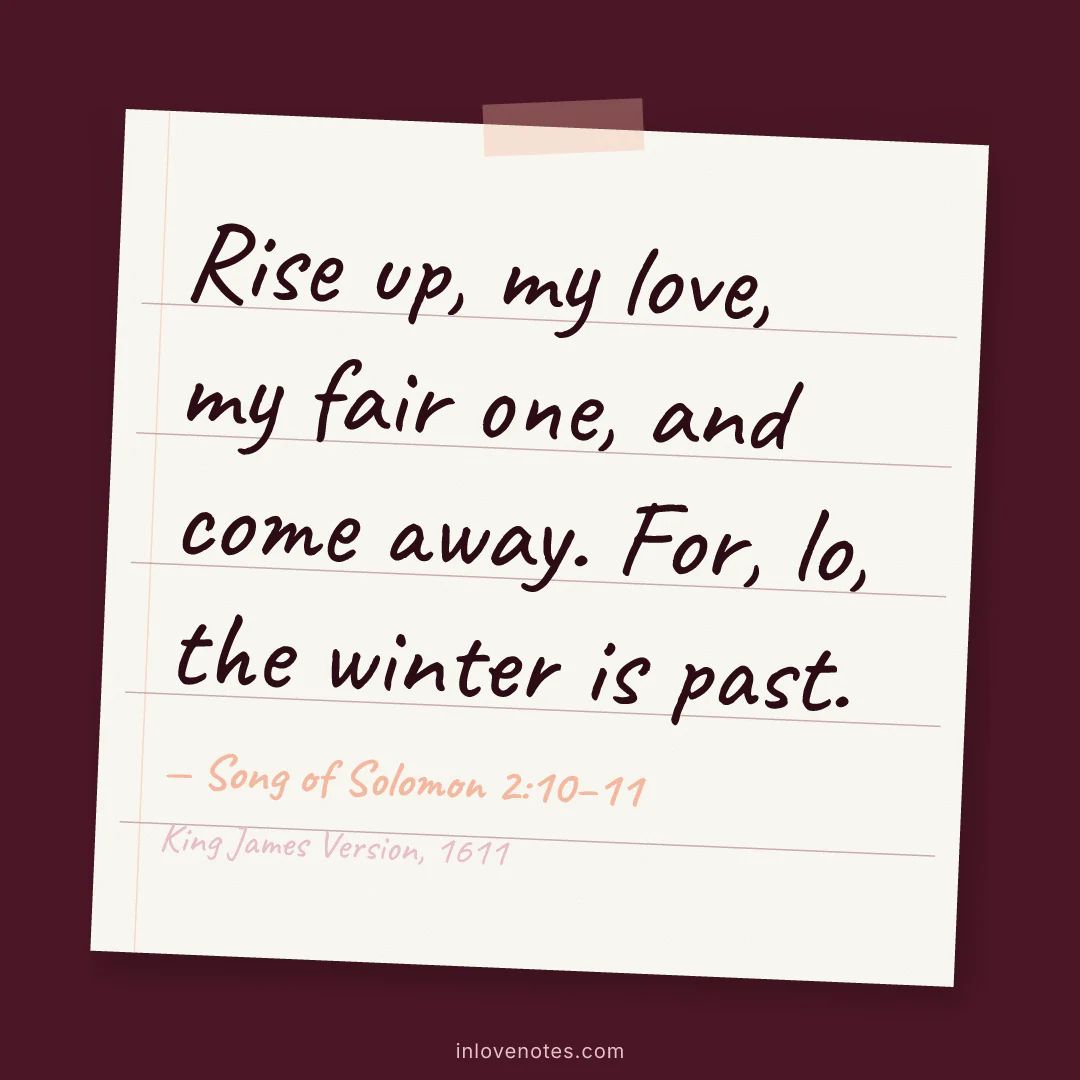
The oldest wake-up line in this collection is from the Bible. In the Song of Solomon, a woman remembers her beloved calling her out into the spring morning:
"My beloved spake, and said unto me, Rise up, my love, my fair one, and come away. For, lo, the winter is past, the rain is over and gone; The flowers appear on the earth; the time of the singing of birds is come."
— Song of Solomon 2:10–12, King James Version (1611)
On an anniversary morning, "Rise up, my love, my fair one, and come away" makes a good opening line, especially if you have planned a day out. "The winter is past" also suits a couple who have come through a hard year together. Write the reason underneath it.
Write Her a Morning Message of Your Own
The messages above are a starting point. One you write yourself will mean more, even if it isn't as polished. A good morning paragraph needs three things, and they can be in any order:
- Something you noticed. How she looked when you left, something she said last night, the song she was humming. This shows you were paying attention, which a generic "good morning beautiful" can't.
- Something about her day. The meeting she's worried about, the long drive, the friend she's seeing. It tells her you know what she's walking into.
- Something to look forward to. Dinner, a phone call, a date, a hug at the door. It gives her day a happy ending before it has started.
A few things to avoid: don't send it at 5 a.m. if her phone isn't on silent; don't ask questions she has to answer before work on a hard day; and don't copy famous-sounding lines without checking them. Many "love quotes" that circulate online were never said by the people they're credited to (we collected the worst ones in misattributed love quotes).
Questions People Ask About Good Morning Messages
What are some sweet paragraphs I can write to my girlfriend in the morning?
The sweetest ones mention something specific: how she looked asleep, what she has on that day, or a plan you share for that evening. Paragraphs 3, 13, 20 and 23 above are good starting points. Replace the bracketed parts with your own details and the paragraph becomes yours.
What's a good morning text to send to a woman?
Keep it short and warm, and say it plainly: "Good morning. I was thinking about you before I was even properly awake." If you've just started seeing her, one light line is better than a paragraph. Save longer messages for when you know each other well.
How do you make a girl smile in the morning?
Make sure the message is there when she wakes up, by sending it early or scheduling it, and include one detail that shows you were paying attention to her. Playful lines like messages 18 and 19 work on ordinary days; on hard days, a message that asks nothing of her (message 8) helps more.
One last practical note: write it the night before. Messages written half-awake at 6 a.m. tend to be generic. Messages written the evening before, when you still remember what she said at dinner and what she's worried about tomorrow, tend to be the ones she keeps.