a note on
How Love Proposal Quotes Became the Architecture of Modern Commitment
The words we borrow to ask for a lifetime reveal our deepest anxieties and highest hopes about the nature of permanent partnership.
penned by Erdi Dogan

I watched my sister on a balcony in Valparaíso, Chile, 2019, pacing with a crumpled piece of notebook paper in her hand. The Pacific Ocean churned below, completely indifferent to the fact that she was about to ask another human being to stay with her until they died. She had spent three weeks agonizing over what to say. The pressure to synthesize a five-year relationship into a thirty-second monologue had paralyzed her entirely. We expect people to suddenly possess the rhetorical genius of a Victorian playwright the moment they produce a ring. They rarely do. This is the exact moment when love proposal quotes transform from mere internet ephemera into functional tools of survival. A borrowed sentence acts as a structural scaffolding for the terrified mind.
For centuries, the act of proposing marriage was a logistical negotiation between families. It involved dowries, land borders, and political alliances rather than emotional confessions. The sudden shift toward romantic individualism in the late eighteenth century placed an unprecedented burden on the individual suitor. Suddenly, you had to prove the depth of your internal emotional landscape. You had to convince another person that your specific brand of affection was worth abandoning all other options. This historical pivot created a linguistic vacuum that poets and novelists eagerly filled.
The Burden of the Blank Page
We demand a lot from the language of commitment. A proposal is not a casual inquiry. It requires a specific gravity. People scour literature and film for the perfect phrasing because professional writers have spent their entire lives trying to isolate the exact frequency of human devotion. When couples search for deeply touching emotional expressions, they are usually hunting for a proxy. They want someone else to articulate the terrifying vulnerability of handing over their future. The right phrase anchors the moment. It gives the speaker a rhythm to follow when their heart rate hits a hundred and forty beats per minute.
Why do we trust a deceased novelist more than our own vocabulary? The answer lies in the psychology of risk. Proposing is inherently dangerous. You are inviting rejection on the most fundamental level. By utilizing established phrases, you are essentially bringing a character witness to the event. You are telling your partner that your feelings are so profound they require the assistance of history’s greatest minds to be properly categorized.
Literary Borrowings for the Asking
Fiction offers a safe harbor for extreme emotional declarations. Novelists can push language to its absolute limit without sounding absurd, providing a template for real-world lovers who need to communicate absolute certainty.
"Whatever our souls are made of, his and mine are the same." — Emily Brontë, Wuthering Heights, 1847
Catherine Earnshaw’s fierce declaration remains the gold standard for describing a love that feels less like a choice and more like a structural inevitability.
"I have for the first time found what I can truly love—I have found you." — Charlotte Brontë, Jane Eyre, 1847
Mr. Rochester’s confession strips away the ornate posturing of nineteenth-century courtship to deliver a blunt, desperate truth.
"You have bewitched me body and soul, and I love, I love, I love you." — Jane Austen, Pride and Prejudice (2005 film adaptation by Deborah Moggach)
Though this specific phrasing belongs to Matthew Macfadyen’s cinematic Darcy rather than Austen’s original 1813 text, it has permanently rewired how modern audiences imagine a perfect romantic surrender.
"Grow old along with me! The best is yet to be." — Robert Browning, Rabbi Ben Ezra, 1864
Browning opens his philosophical poem with a direct invitation to shared mortality, making it an ideal framework for a lifelong proposition.
Cinematic and Stage Declarations
The screenwriters of the late twentieth century effectively rewrote the modern proposal script. They understood that a visual medium requires dialogue that punches through the ambient noise of a scene.
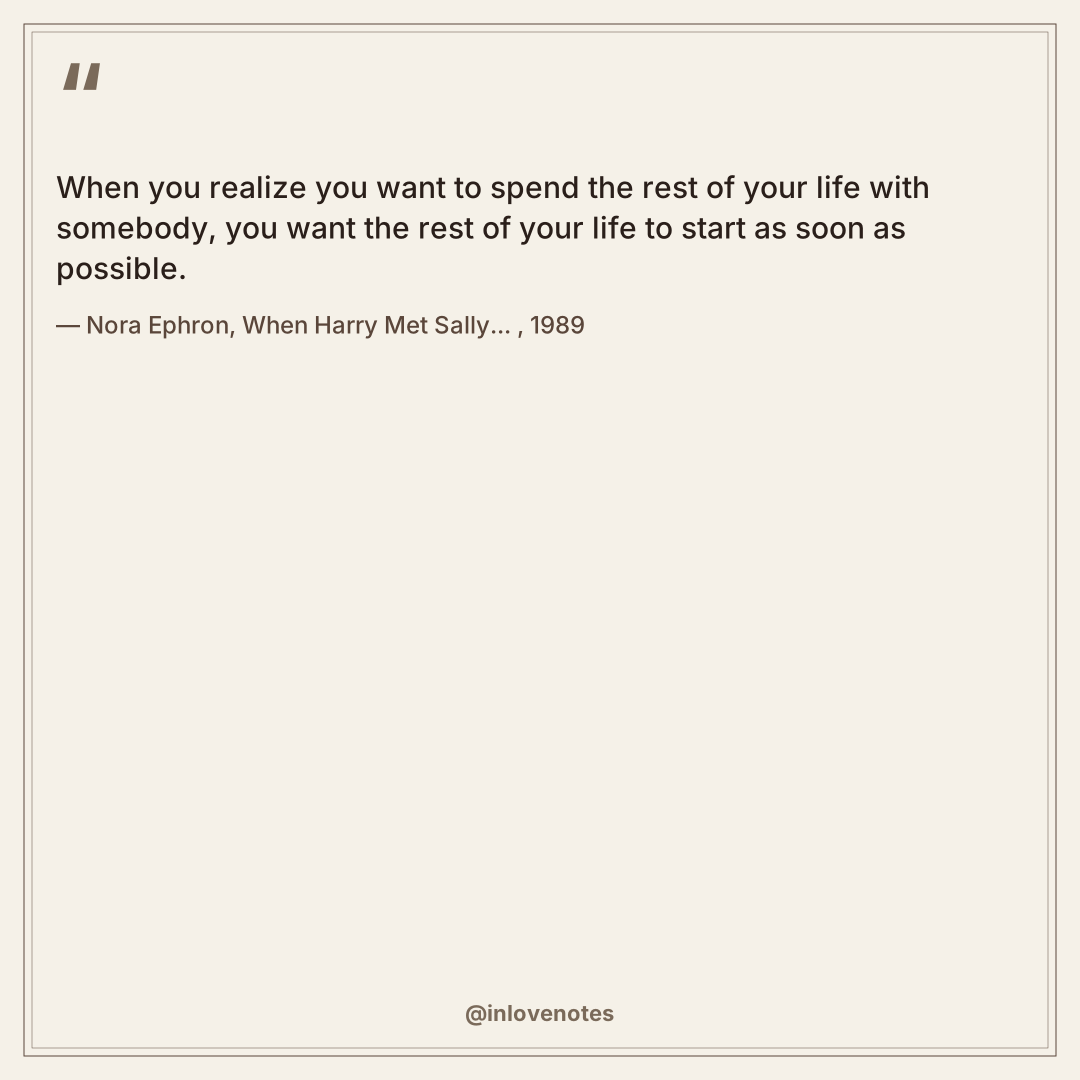
"When you realize you want to spend the rest of your life with somebody, you want the rest of your life to start as soon as possible." — Nora Ephron, When Harry Met Sally..., 1989
Billy Crystal’s frantic New Year’s Eve sprint concludes with this line, capturing the sudden impatience that often precedes a proposal.
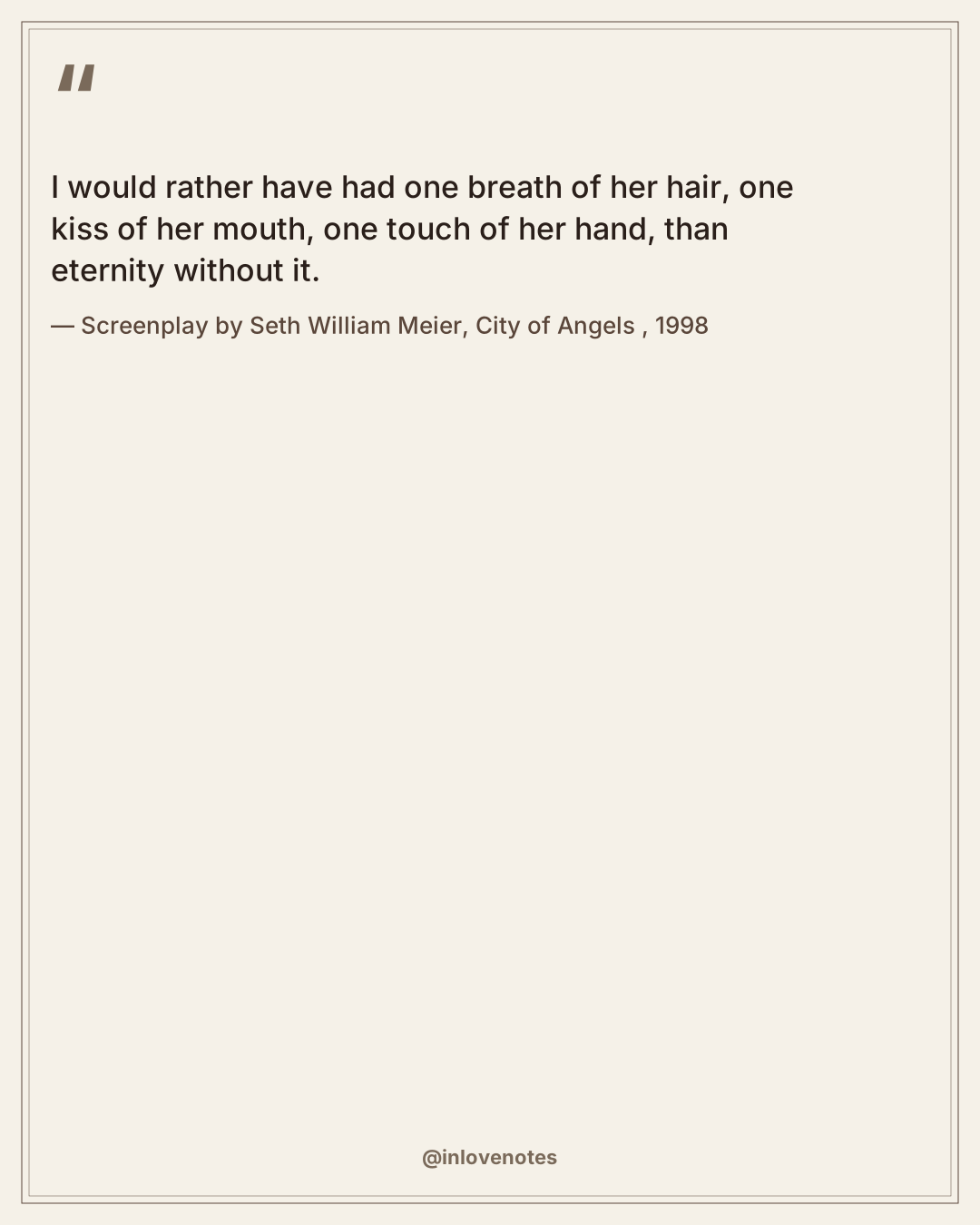
"I would rather have had one breath of her hair, one kiss of her mouth, one touch of her hand, than eternity without it." — Screenplay by Seth William Meier, City of Angels, 1998
This cinematic adaptation of a Wim Wenders concept distills the choice between immortal safety and mortal vulnerability into a single devastating preference.
"If you remember me, then I don't care if everyone else forgets." — Haruki Murakami, Kafka on the Shore, 2002
Murakami isolates the insular nature of deep partnership, reminding us that a marriage often functions as a private universe of two.
Philosophical Frameworks for Forever
Sometimes a proposal requires more than just romance. It requires an acknowledgment of the profound spiritual or philosophical shift that marriage represents. A wedding is an existential wager.
"To love another person is to see the face of God." — Victor Hugo, Les Misérables, 1862
Jean Valjean’s final realization elevates romantic love from a secular arrangement to a divine encounter.
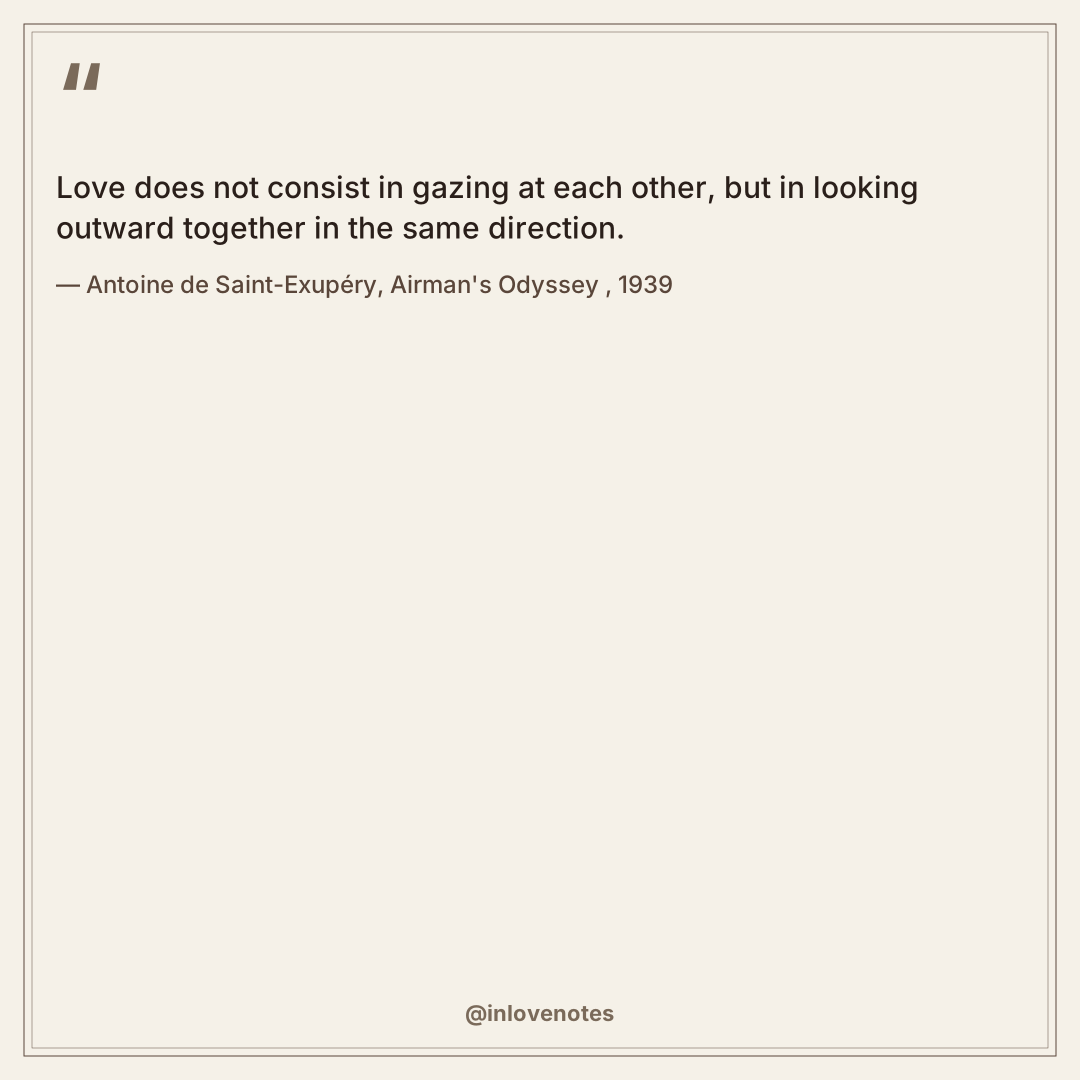
"Love does not consist in gazing at each other, but in looking outward together in the same direction." — Antoine de Saint-Exupéry, Airman's Odyssey, 1939
The French aviator provided the ultimate thesis for companionate marriage, shifting the focus from infatuation to shared purpose.
"We are all a little weird and life's a little weird." — Robert Fulghum, True Love, 1997
Fulghum’s famous essay on mutual weirdness remains a staple for couples who view their relationship as a shared sanctuary from normal societal expectations.
"I love you not only for what you are, but for what I am when I am with you." — Roy Croft, Love, 1936
Often misattributed to a likely pseudonym in a 1936 anthology, this poem captures the transformative nature of a healthy partnership.
Brief Interventions for Quiet Romantics
Sometimes a paragraph is simply too much to memorize. The best approach for an anxious speaker often involves brevity. If you are writing a letter rather than speaking aloud, you might lean on short messages designed for quiet moments to carry the weight. A single sharp sentence can pivot a casual conversation into a life-altering question.
"You are my heart, my life, my one and only thought." — Arthur Conan Doyle, The White Company, 1891
Far removed from his analytical detective fiction, Doyle offered this sweeping romantic absolute through the character of Alleyne Edricson.
"I love you right up to the moon—and back." — Sam McBratney, Guess How Much I Love You, 1994
Originally written for children, this spatial measurement of affection has slipped quietly into adult vows and proposals across the globe.
"My blind eyes are desperately waiting for the sight of you." — Inspired by Richard Burton's letters to Elizabeth Taylor
The Welsh actor’s famously volatile relationship produced correspondence that remains a masterclass in obsessive, consuming devotion.
A Few Honest Corrections
Common claim: A proposal must be entirely original to be meaningful.
Closer to the evidence: Human beings have relied on shared cultural scripts for centuries. Borrowing a line from a poet or a playwright does not dilute your sincerity. It simply means you recognize that someone else has already built the exact linguistic bridge you need to cross.
Common claim: The longer the speech, the more romantic the moment.
Closer to the evidence: Adrenaline severely limits both the speaker's memory and the listener's auditory processing. A brief, anchored statement followed by the actual question is statistically more likely to be remembered than a rambling five-minute monologue.
Common claim: The quote itself does the heavy lifting of the proposal.
Closer to the evidence: Words only function as a container for the underlying intention. A perfectly recited line from Shakespeare falls flat if the delivery lacks genuine presence, while a stumbled, half-remembered movie quote can devastate a partner if the eye contact is absolute.
Further reading
- For those preparing a longer written declaration, examining how couples navigate relationship friction can add necessary realism to your vows.
- If you are slipping a card across a breakfast table instead of dropping to one knee, consider these brief notes for quick handwritten delivery.
- Couples incorporating heritage into their ceremony often look to how older cultures phrase devotion in modern settings.
- If you need broader inspiration for writing to a female partner, browse our dedicated archive of messages crafted specifically for her.
A proposal is a strange and beautiful disruption of ordinary time. You are asking someone to halt their current trajectory and merge it permanently with yours. The words you choose to facilitate this collision matter, but they do not have to be generated entirely from scratch. Let the poets and the screenwriters handle the heavy lifting of articulation. Tomorrow morning, when the ring is on and the adrenaline has finally faded, the borrowed words will fall away. You will be left with the quiet, unscripted reality of the life you actually get to build.