5 Love Quotes for Her Birthday, Checked Against the Source
Five birthday love quotes for her, each traced to its text with speaker and year, plus popular lines that are not in the books they are credited to.
Updated
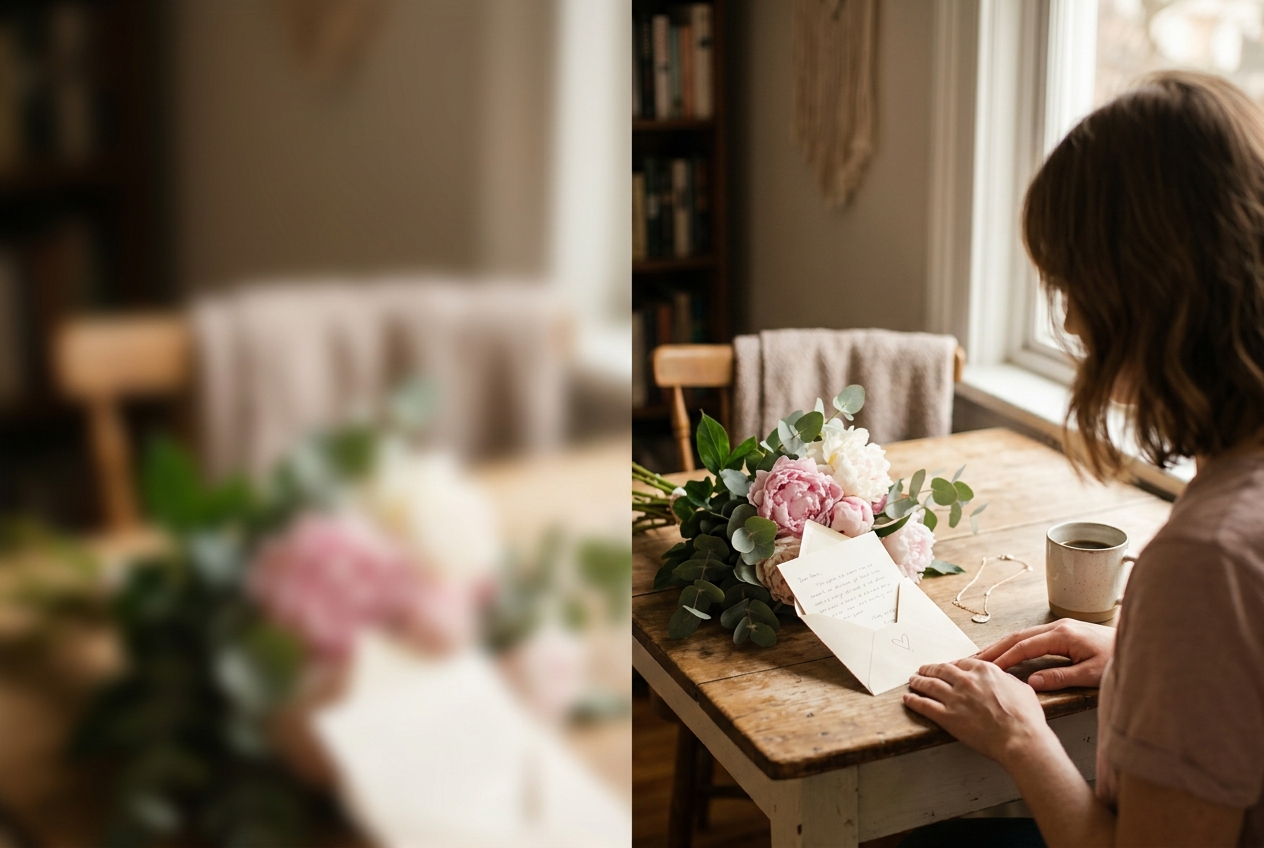
A birthday card has room for about two lines, so the line has to be right. Most "love quotes for her birthday" lists reach for the same famous names and attach lines to them that the authors never wrote. This page keeps five quotes that survive a check against the text, tells you who says each one and in which scene, and ends with a table of birthday favourites that fail the check, so you do not print them on good paper.
Three lines that say she is worth the years
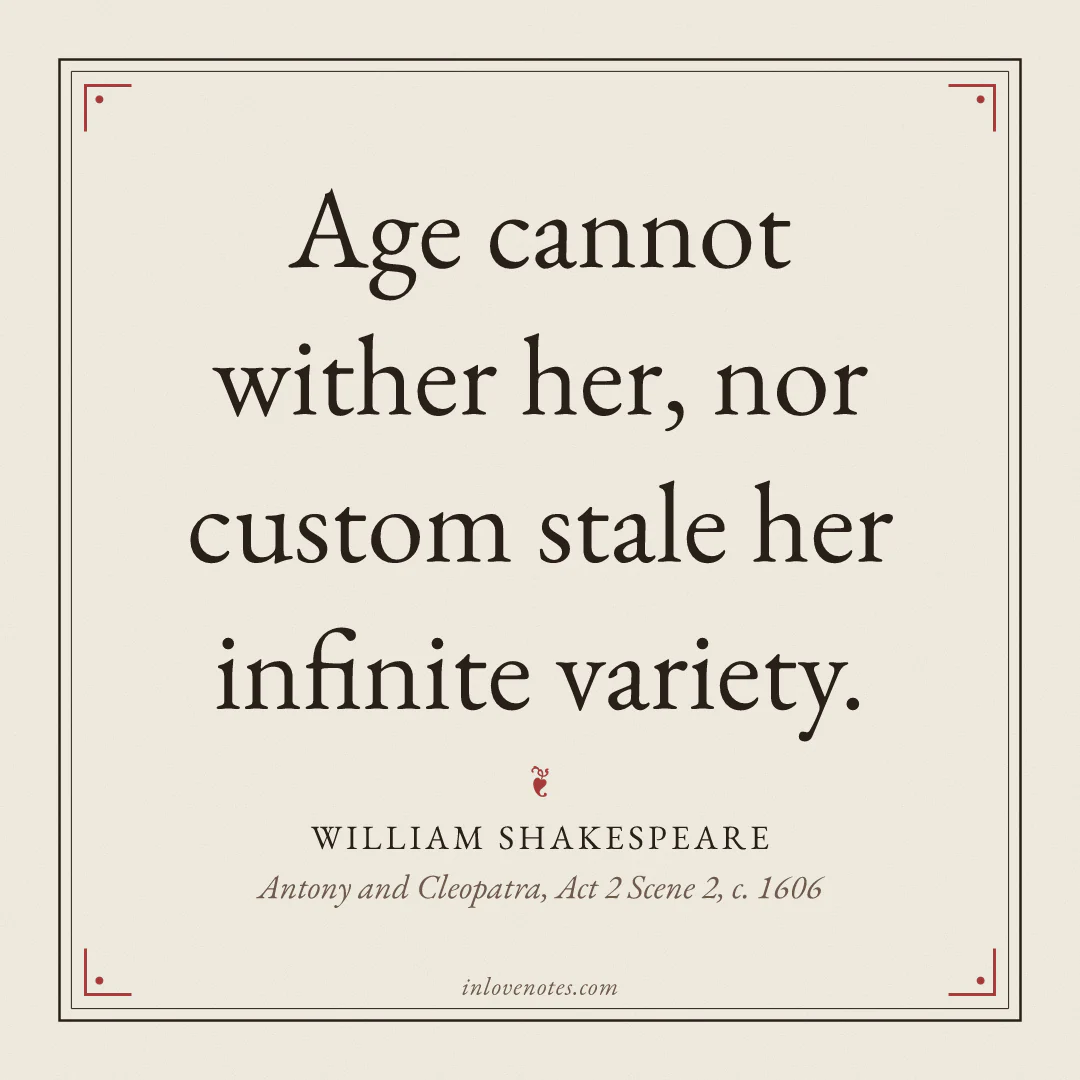
Age cannot wither her, nor custom stale her infinite variety.
William Shakespeare, Antony and Cleopatra, Act 2 Scene 2 (c. 1606)
Enobarbus says this to his fellow soldiers about Cleopatra, and it is a rare line that praises a woman for getting more interesting with age rather than despite it. The next sentence in the play ("Other women cloy the appetites they feed, but she makes hungry where most she satisfies") is blunt and period-specific, so quote only the first sentence. It suits a milestone birthday, or any card to someone you have known for many years.
I would not wish any companion in the world but you.
William Shakespeare, The Tempest, Act 3 Scene 1 (written c. 1610–11)
In the play the line is Miranda's, not Ferdinand's: she says it to Ferdinand, who has been set to carry logs. In the Gutenberg text it runs "I would not wish / Any companion in the world but you", broken across two verse lines. Many sites print it as a single sentence with no mention of who speaks, and some give it to the wrong lover. It works as a plain, modest statement of choice, which is a good fit for a card when you do not want to sound grand.
For the years themselves
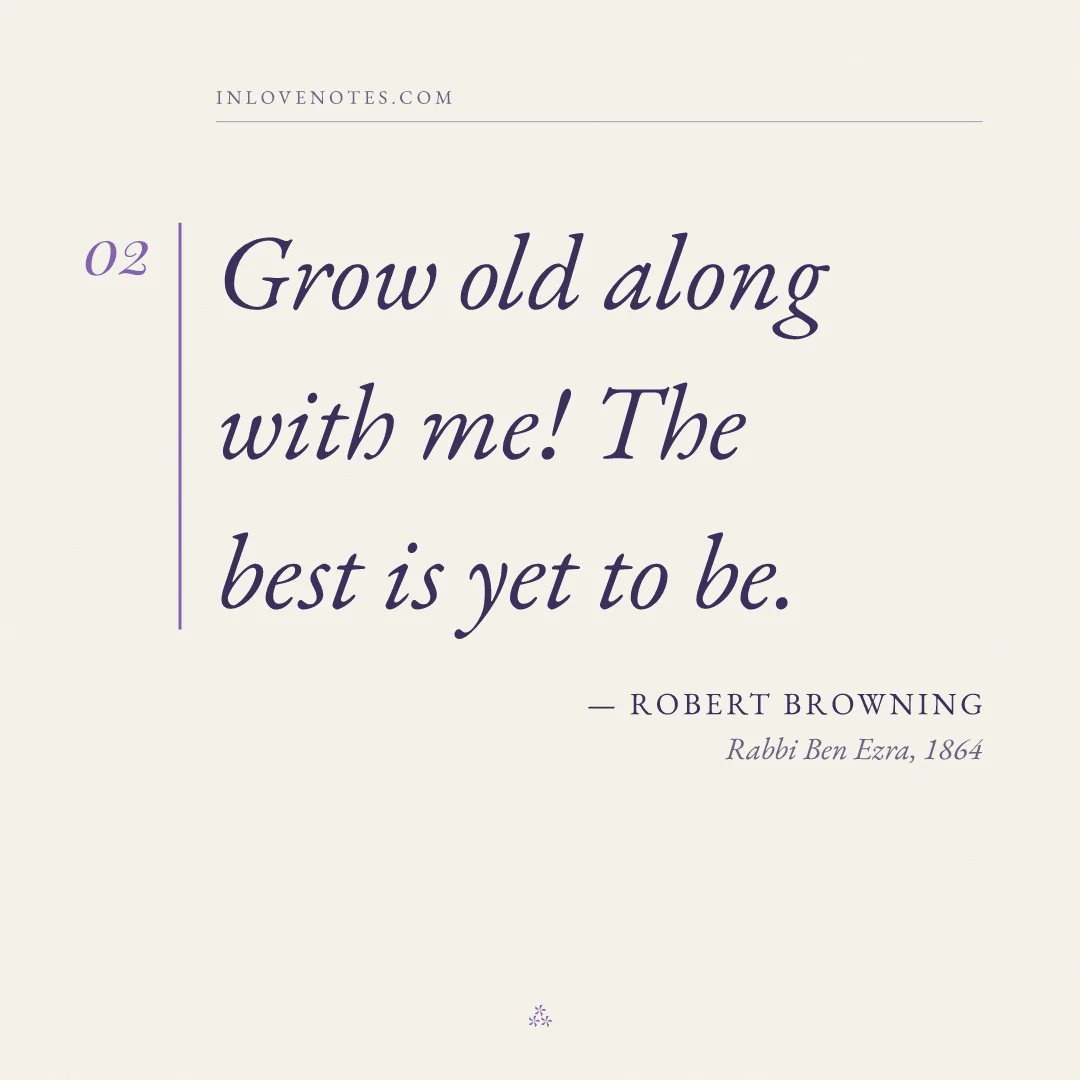
Grow old along with me! The best is yet to be.
Robert Browning, Rabbi Ben Ezra, in Dramatis Personae (1864)
These are the opening words of the poem, published by Chapman and Hall in 1864. The speaker is a medieval Jewish scholar reflecting on old age; Browning built the poem on that voice rather than writing it as a love poem. It became a wedding and anniversary favourite anyway, and it fits a birthday because the subject really is the passing of years. If you use it, say plainly that you are borrowing it, since many readers will know the later lines about youth and age.
I love you, not only for what you are, but for what I am when I am with you.
Mary Carolyn Davies, "To a Friend" (Epworth Herald, 26 October 1918); later circulated as "Love"
This is the lesson of the page: the poem is usually credited to "Roy Croft". That name comes from the 1936 anthology Best Loved Poems of the American People (edited by Hazel Felleman, Doubleday), which printed it under a pseudonym. Felleman corrected the credit in her "Queries and Answers" column in the New York Times Book Review on 2 May 1943, saying that the author was Mary Carolyn Davies, who lived in New York City. The poem first appeared under the title "To a Friend". Print the author's name when you use it; it is also the more interesting thing to say if she asks where the line comes from.
When you would rather borrow a character's voice
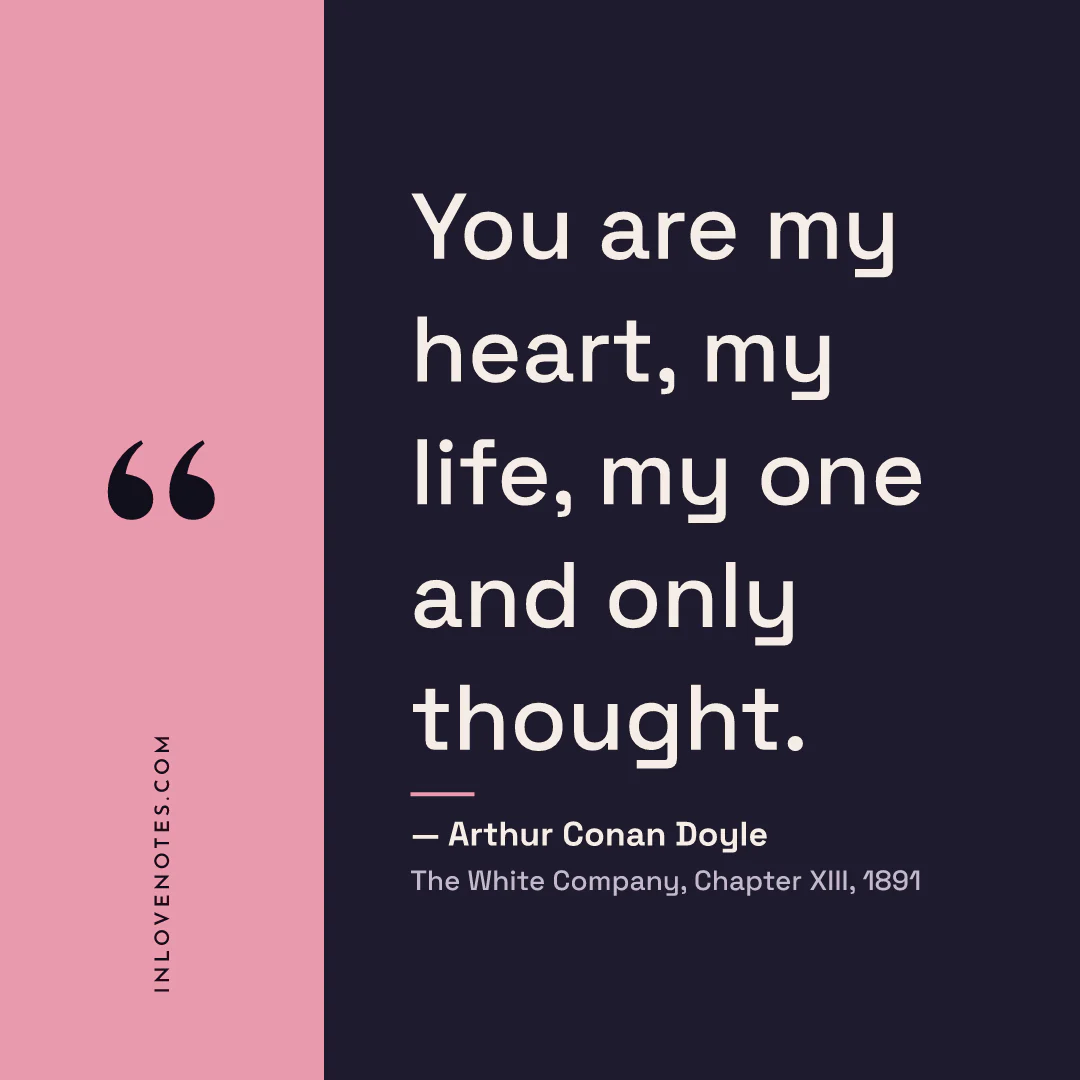
You are my heart, my life, my one and only thought.
Arthur Conan Doyle, The White Company, Chapter XIII (1891)
Doyle is remembered for Holmes, but this historical novel contains a very direct declaration. Alleyne Edricson says it to Maude Loring as he is about to leave for the wars, and asks her for "one word of hope" to take with him. The line is short enough to fit on a card and unusual enough that she is unlikely to have seen it printed on someone else's.
Birthday favourites that fail the check
I searched the full texts on Project Gutenberg for each of these. They are common on birthday lists and none of them turned up where it is said to come from.
| Line as usually printed | Credited to | What the text shows |
|---|---|---|
| "You have bewitched me, body and soul, and I love, I love, I love you." | Jane Austen, Pride and Prejudice | Not in the novel. The word "bewitched" appears only once, in narration about Darcy, never as a declaration. |
| "My heart is, and always will be, yours." | Jane Austen, Sense and Sensibility | Not in the novel's text, so it cannot be quoted as Austen's. |
| "I love her, and that's the beginning and end of everything." | F. Scott Fitzgerald, The Great Gatsby | Not in Gatsby. |
| "If you live to be a hundred, I want to live to be a hundred minus one day…" | A. A. Milne, Winnie-the-Pooh (1926) | Not in Winnie-the-Pooh. I found no Milne source for it. |
| "I love you not only for what you are…" | "Roy Croft", 1936 | Mary Carolyn Davies, 1918 (see above). |
For more on this kind of correction, see the guide to misattributed love quotes.
How to use one of these on her card
A quote on its own reads as borrowed. Pair it with one sentence only you could write, and keep the whole message to three short lines:
- The quote, with the author's name under it.
- One specific thing about the past year: something she did, said or put up with.
- One wish for the year ahead, in your own plain words.
Pick the line by the kind of birthday. For a round-number birthday, Browning or Shakespeare's Cleopatra line makes the years the point. For a quiet one at home, Miranda's line or Doyle's is enough. If you are writing something longer than a card, how to write a love letter walks through the structure, and a quote can be the opening line of a letter to your wife.
Questions readers send in
Should I write the quote exactly as it appears in the original text?
Yes. Keep the original wording, and put the author and work under it. If you must change a pronoun, mark the change with brackets. Check that the line really belongs to the author first, since several popular birthday lines do not.
Is it all right to use a line spoken by a character rather than the author?
Yes, as long as you credit it that way: say the character and the work, as in "Miranda in The Tempest". Crediting the author alone suggests the author said it about their own life.
What if the line I found online is not on this list?
Search for the exact sentence together with the work's title on Project Gutenberg or in a library edition. If it does not appear, either do not use it or write it as your own words rather than someone else's.