Love Letter in Japanese: The Words, a Sample Letter, and the Real Letters Behind the Moon Myth
Write a love letter in Japanese: koibumi vocabulary, a sample with romaji and English, letters by Sōseki and Akutagawa, and the moon myth checked.
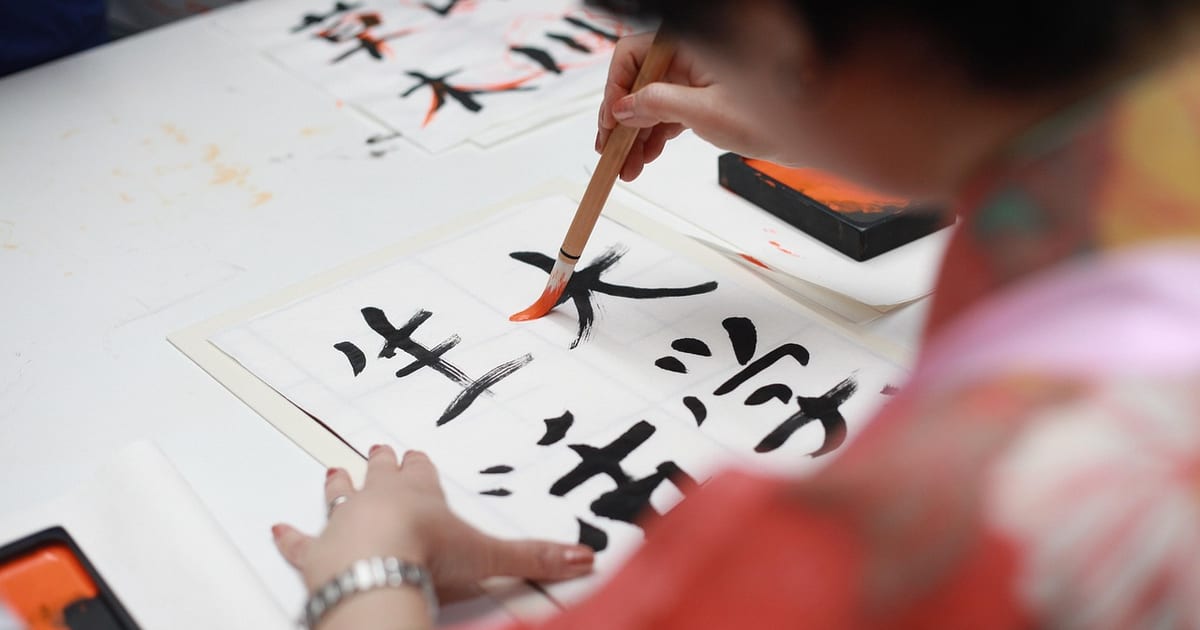
A love letter in Japanese is a koibumi (恋文) or, in everyday speech, a rabu retā (ラブレター). The plainest true sentence you can put in one is suki desu (好きです, "I like you / I'm in love with you"). Most Japanese love letters never say aishiteru (愛してる, "I love you") at all. And the famous line said to replace it, tsuki ga kirei desu ne ("the moon is beautiful, isn't it?"), was not written by Natsume Sōseki: no letter, book or diary of his contains it.
That gap between the legend and the record is what this page is about. Below you'll find the words for a love letter and when each fits; five real documents, from a seventh-century court poem to a 1995 film, each with the Japanese, the romaji and our own literal translation; a check of the two most-shared "Japanese love quote" myths; and a short sample letter you can copy, laid out line by line.
Koibumi, rabu retā, tsukebumi: the words for a love letter
Japanese has more than one word for the thing you're writing, and the choice tells the reader something about you before they open it.
| Japanese | Romaji | Meaning | When it fits |
|---|---|---|---|
| 恋文 | koibumi | Love letter (literally "love writing") | Literary and a little old-fashioned. It suits a handwritten letter or the title of an essay. |
| ラブレター | rabu retā | Love letter, borrowed from English | The everyday word. Teenagers, songs and the 1995 film all use it. |
| 付け文 | tsukebumi | A love letter slipped to someone secretly | Old-fashioned. As a verb, 付け文する means to pass one secretly. |
| 好きです | suki desu | "I like you", and in a romantic setting "I'm in love with you" | The standard confession. Safe in almost any love letter. |
| 大好きです | daisuki desu | "I like you very much / I love you" | Warm and common between couples. |
| 愛してる | aishiteru | "I love you", from the verb 愛する (aisuru, to love) | Heavy and rarely said aloud. Keep it for a letter that has earned it. |
The dictionary sense matters here. Jisho lists the romantic meaning of 好き ("being in love with; beloved") as a second sense of the same word that means "being fond of", which is why suki desu can carry a whole confession: context does the work. That habit of leaving the biggest word unsaid runs through every document below.
Before envelopes: a poem was the letter
For most of Japanese history, a love letter was a short poem. The oldest anthology, the Man'yōshū, preserves an exchange between Princess Nukata and Prince Ōama, set during Emperor Tenji's hunting party at Gamō field. She is now another man's wife; he waves his sleeve at her across the royal meadow anyway.
あかねさす 紫野行き 標野行き 野守は見ずや 君が袖振る
Akane sasu / murasakino yuki / shimeno yuki / nomori wa mizu ya / kimi ga sode furu
"Going through the madder-glowing fields of murasaki, going through the restricted fields: won't the field-guard see you waving your sleeve?"— Princess Nukata (額田王), Man'yōshū (8th-century anthology), book 1, poem 20 (our literal translation)
His reply (poem 21) is the part people remember: "If I hated you, my love, fragrant as the murasaki, would I long for you like this, though you are another's wife?" Notice how she never writes "I love you" or "stop". She writes about a guard who might be watching, and lets the danger say the rest. It is the oldest example we know of the indirect Japanese love line, and it is real, which is more than can be said for the moon.
By the Heian period the poem-letter had its own etiquette. After a night together, the man went home and sent the woman a letter or a waka, the kinuginu no fumi (後朝の文, "morning-after letter"). Sei Shōnagon describes her ideal version of that parting in The Pillow Book. Love was conducted in writing, and the most quoted love poems of the age belong to a woman: Ono no Komachi, whose dream poems sit in the love books of the Kokinshū, the first imperial anthology.
思ひつつ寝ればや人の見えつらむ夢と知りせば覚めざらましを
Omoitsutsu / nureba ya hito no / mietsuramu / yume to shiriseba / samezaramashi o
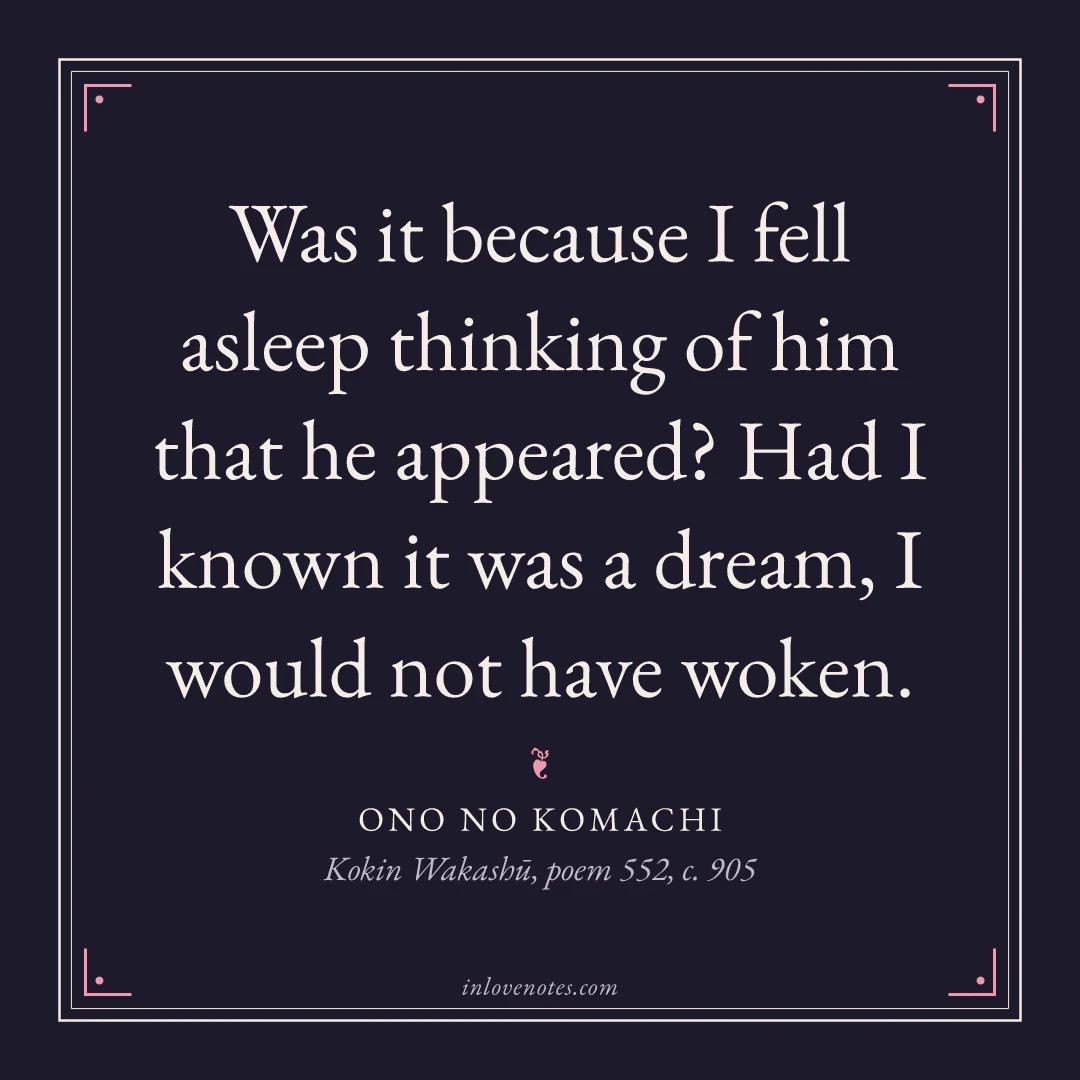
"Was it because I fell asleep thinking of him that he appeared to me? Had I known it was a dream, I would not have woken."— Ono no Komachi, Kokin Wakashū (compiled c. 905), book 12 "Love II", poem 552 (our literal translation)
Komachi's poem is 31 syllables long and contains no declaration at all. The whole confession sits in the last line: she would rather have stayed in a dream of him than wake up into a day without him. That's a model worth copying in a modern letter. "I dreamed about you last night and I was annoyed at the alarm" is a very Komachi sentence, and it says more than "I miss you" does.
1901: Sōseki writes home from London
Natsume Sōseki, the novelist on the old 1,000-yen note, spent two unhappy years in London as a government scholar. His wife Kyōko stayed in Tokyo and wrote rarely; he kept asking her to write more. On 20 February 1901 he sent her this:
段々日が立つと[略]おれの様な不人情なものでも頻りに御前が恋しい
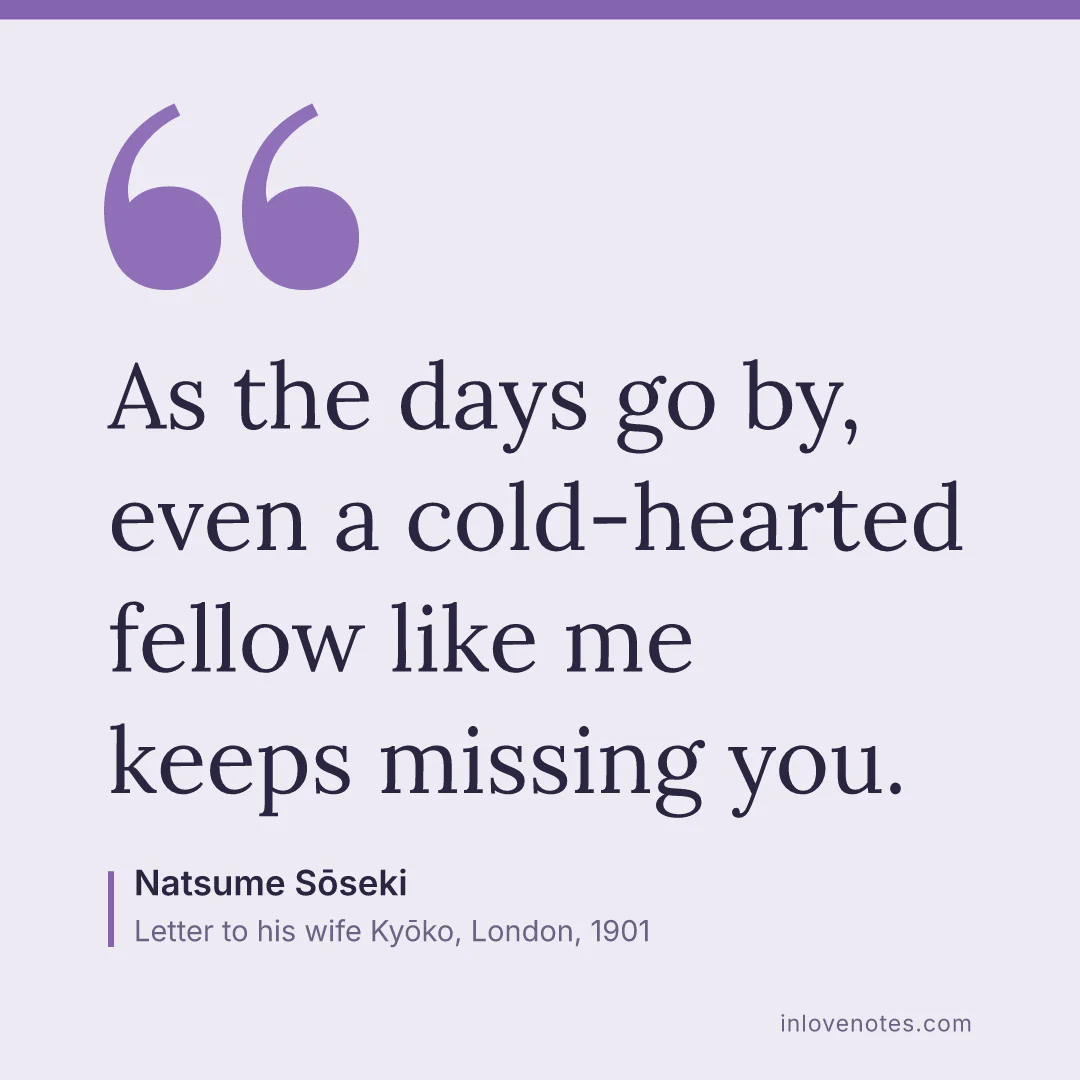
Dandan hi ga tatsu to [...] ore no yō na funinjō na mono demo shikiri ni omae ga koishii
"As the days go by [...] even a cold-hearted fellow like me keeps missing you."— Natsume Sōseki to his wife Kyōko, London, 20 February 1901, Sōseki zenshū, "Shokan" (Iwanami Shoten), as quoted by Natsume Fusanosuke, Bungeishunjū Plus, 2023 (our literal translation; [略] marks a cut made by that article)
The next sentence in the letter is pure Sōseki: for this much, he says, he deserves to be praised. He teases himself in the same breath that he admits the longing, which keeps the confession from sounding grand. The key word is koishii (恋しい), "missing someone you love", not aishiteru. If you're writing to a partner who is away, koishii is the word you want: anata ga koishii desu (あなたが恋しいです), "I miss you".
Sōseki also left a scholar's note on the subject, quoted by Japanese Wikipedia from his papers: 「I love you ハ日本ニナキformulaナリ」, roughly "'I love you' is a formula Japan does not have." That note is real. It is about translation, and there is no moon in it.
1916: "I like you, Fumi-chan"
Akutagawa Ryūnosuke, the author of Rashōmon, proposed to Tsukamoto Fumi by letter in 1916. The inn where he stayed that year, in Ichinomiya on the Chiba coast, says he wrote it there. They signed an engagement agreement that December and married in February 1918. His letter is often called the most famous love letter in modern Japanese, and its key line is almost bare:
僕は文ちゃんが好きです。それでよければ来て下さい。
Boku wa Fumi-chan ga suki desu. Sore de yokereba kite kudasai.
"I like you, Fumi-chan. If that's enough for you, please come to me."— Akutagawa Ryūnosuke to Tsukamoto Fumi, 1916, as quoted by Waraku Web from the transcript published by the Ichinomiya-kan inn (our literal translation)
A source note: the letters to Fumi are not on Aozora Bunko, and we could not check this line against the printed Complete Works, so we quote it through Waraku Web, which credits the inn's transcript. The exact day that circulates online (25 August 1916) we could not confirm, so we leave it out. What the line shows is clear enough. A writer who could produce any sentence he liked chose suki desu, then a condition, then a request. Earlier in the same letter, by Waraku's quotation, he warns her that his trade "makes the least money in Japan today". Honesty first, then the confession: that order still works.
Two "Japanese love quotes" the record doesn't support
Both of these turn up on almost every list of romantic Japanese phrases. Here is what we found when we went looking for the original documents.
| The claim | What the record shows | Earliest trace found | Verdict |
|---|---|---|---|
| Sōseki told a student to translate "I love you" as 月が綺麗ですね, "the moon is beautiful, isn't it?" | Japanese Wikipedia, citing Kawashima Kōki (2020): no such story survives in Sōseki's writings or records, and no one close to him reported hearing it. | Moon-as-confession lines without Sōseki appear in 1958 and 1962 books. The Sōseki version spreads from the 1970s. | Legend. Dictionary editor Iima Hiroaki calls it "an urban legend that appeared in the 1970s" (Bungeishunjū, 2024). |
| Futabatei Shimei translated "I love you" as 死んでもいいわ, "I wouldn't mind dying". | The line comes from his 1896 translation of Turgenev's Asya (片恋, Katakoi). In the Russian, the heroine whispers one word, «Ваша…», "Yours…". Nobody says "I love you" in that scene. | Turgenev, Asya, chapter 16 (1858). | Misdescribed. It translates "yours", not "I love you". Kansai Gaidai University's Japanese studies department calls the "I love you" version a popular myth. |
Does that mean you shouldn't write tsuki ga kirei desu ne in a letter? Not at all. Plenty of Japanese readers know the line and enjoy it, and it works well as a playful wink. Just don't credit it to Sōseki. If you want an indirect confession with a real author behind it, Komachi's dream poem above is the honest substitute. We keep a longer list of famous lines that are routinely credited to the wrong person in our guide to misattributed love quotes.
1995: the letter most searchers mean
If you typed "love letter Japanese" and expected a film, you're thinking of Shunji Iwai's Love Letter, released in Japan on 25 March 1995. A woman named Hiroko writes to her late fiancé's old address in Otaru, expecting no reply. Her letter opens with the most ordinary phrase in Japanese correspondence, and in the film's best-known scene she shouts it across a snowy mountainside where he died:
お元気ですか。私は元気です。
O-genki desu ka. Watashi wa genki desu.
"Are you well? I am well."— Hiroko, Love Letter, film written and directed by Shunji Iwai, 1995
Japanese Wikipedia notes that the line became a catchphrase in South Korea. Its power comes from how plain it is: o-genki desu ka is how any Japanese letter might begin, to a friend or a cousin. Spoken to someone who can't answer, the polite formula becomes grief. For your own letter, the lesson runs the other way: a familiar opening is fine. You don't need a poetic first line, because the reader already knows why you're writing.

How to write a short love letter in Japanese
A formal Japanese letter has a fixed frame. It opens with a heading word such as haikei (拝啓), then a seasonal greeting (時候の挨拶, jikō no aisatsu, for example a remark on the cold), and it closes with keigu (敬具), which pairs with haikei the way "Dear" pairs with "Yours sincerely". For a love letter, our advice is to leave most of that frame out:
- Skip haikei and keigu. The Daijisen dictionary defines them as the greeting and closing of a letter, and they belong to business mail and formal thanks. In a love letter they read like a contract.
- Keep the seasonal touch, made personal. One line about the weather where you are is very Japanese and very warm: kochira wa mō samuku narimashita (こちらはもう寒くなりました, "it's already turned cold here").
- Open with the name. Write the name followed by へ (e, "to"), for example 花子へ, or use o-genki desu ka as Hiroko did.
- Choose one strong word and stop there. Pick suki, daisuki or koishii, and don't stack them. Akutagawa needed only one.
- Sign with より (yori, "from"). Put your name, then より, on the last line: 太郎より.
- Write it by hand if you can. Horizontal writing is normal today. Vertical writing (縦書き, tategaki) on letter paper looks more traditional, and it reads from top to bottom, right to left.
If you're still learning Japanese, keep the sentences short and ask a native speaker to check them. A slightly simple letter that is correct will move the reader far more than an ambitious one with a wrong particle. The same advice holds for our pages on writing a love letter in Spanish and on French love quotes: grammar mistakes are what make a letter sound machine-translated.
A sample love letter in Japanese, line by line
This is an example our editors wrote, not a historical letter. Replace the names and the station with your own. Each line is given in Japanese, then romaji, then English.
花子へ
Hanako e
To Hanako,
お元気ですか。こちらはもう寒くなりました。
O-genki desu ka. Kochira wa mō samuku narimashita.
Are you well? It's already turned cold here.
この前、駅で手を振ってくれたとき、うまく言えなかったことを書きます。
Kono mae, eki de te o futte kureta toki, umaku ienakatta koto o kakimasu.
The other day, when you waved to me at the station, there was something I couldn't put into words. So I'm writing it.
あなたといると、毎日が少しやさしくなります。
Anata to iru to, mainichi ga sukoshi yasashiku narimasu.
When I'm with you, every day becomes a little gentler.
ずっと好きでした。これからも、そばにいてください。
Zutto suki deshita. Korekara mo, soba ni ite kudasai.
I've liked you all along. Please stay by my side from now on too.
太郎より
Tarō yori
From Tarō
Two adjustments depending on who you're writing to. Zutto suki deshita ("I've liked you all along") is a confession, for someone who doesn't know yet. For a partner, change it to daisuki desu (大好きです). For a partner far away, add aitai desu (会いたいです, "I want to see you") or Sōseki's koishii. For more on the parts every love letter needs in any language, see how to start and end a love letter, and for letters by famous writers in other languages, love letters of great men.
Short answers
How do you say "I love you" in a Japanese love letter?
Most letters use 好きです (suki desu) or 大好きです (daisuki desu). 愛してる (aishiteru) is the literal "I love you", but it is heavy and rarely said, so it carries the most weight when it is saved for a serious letter.
Did Natsume Sōseki say "the moon is beautiful" means "I love you"?
No source shows that he did. Japanese Wikipedia, citing Kawashima Kōki (2020), says the story appears nowhere in his writings or records, and dictionary editor Iima Hiroaki calls it a 1970s urban legend. What Sōseki did write is a note saying "I love you" is a formula Japan doesn't have.
What is a love letter called in Japanese?
恋文 (koibumi) is the literary word and ラブレター (rabu retā) the everyday one. 付け文 (tsukebumi) is an old word for a love letter passed secretly.
How do you end a love letter in Japanese?
Write your name followed by より (yori, "from"), for example 太郎より. Skip the formal closing 敬具 (keigu), which belongs to business and formal letters.
Sources
- Princess Nukata, Man'yōshū 1:20, and Prince Ōama's reply 1:21: Japanese Wikipedia, 額田王.
- Ono no Komachi, Kokin Wakashū, book 12, poem 552: Japanese Wikisource, 古今和歌集/巻十二 (printed without voicing marks; the voiced reading above is our normalisation).
- 後朝の文 (kinuginu no fumi): Jisho, きぬぎぬ; Waraku Web, 後朝(きぬぎぬ)とは (11 March 2021).
- Natsume Sōseki to Kyōko, 20 February 1901: Natsume Fusanosuke, 「漱石と鏡子」, Bungeishunjū Plus (9 July 2023), quoting Sōseki zenshū, "Shokan" (Iwanami Shoten).
- Sōseki's "I love you" note and the moon legend: Japanese Wikipedia, 夏目漱石 (section 月が綺麗ですね, citing Kawashima Kōki, 『140字の文豪たち』, 2020); Iima Hiroaki, 「日本語探偵」, Bungeishunjū (July 2024).
- Akutagawa Ryūnosuke to Tsukamoto Fumi, 1916: Waraku Web, citing the Ichinomiya-kan transcript; engagement and marriage dates: Japanese Wikipedia, 芥川文.
- Turgenev, Asya (1858), chapter 16: Russian Wikisource; Futabatei's 片恋 (1896): National Diet Library exhibition; the "I love you" myth: Kansai Gaidai University, Department of International Japanese Studies (22 June 2023).
- Love Letter (1995), release date and the "o-genki desu ka" scene: Japanese Wikipedia, Love Letter (1995年の映画).
- Vocabulary: Jisho for 恋文, 好き and 愛する; Wiktionary for 付け文; Daijisen (Kotobank) for 拝啓 and 敬具; seasonal greetings: Precious.jp (27 October 2023).