Breakup Letter: 8 Examples for Every Situation, How to Write One Kindly, and Three Real Ones From History
8 breakup letter examples (boyfriend, girlfriend, long distance, still in love, unsent), a 6-step method, and 3 real letters from history, all sourced.

A breakup letter is a letter that ends a romantic relationship, or that follows a breakup conversation and puts the ending into words that can be kept. The good ones are short, clear in the first lines, honest about one real reason, and kind without leaving a door half open. Below are 8 example breakup letters for different situations (to a boyfriend, to a girlfriend, long distance, after years together, when you still love them, and one you never send), a six-step method, a table of when a letter is the right choice and when it is not, and three real breakup letters from history that show what to copy and what to avoid.
Is a letter the right way to end it? A quick table
A letter is not automatically the cowardly option, and a face-to-face talk is not automatically the kind one. It depends on what the other person will need afterwards: a chance to ask questions, a record of what was said, or simply distance. If you are unsure how to begin any letter, our guide on how to start and end a love letter covers greetings and sign-offs; the table below covers the harder question of whether to write at all.
| Situation | Letter? | Why |
|---|---|---|
| A few dates, no commitment yet | A short message is enough | A long letter can feel heavier than the relationship was. |
| A relationship of months or years, you live near each other | Talk first, then a letter if it helps | They deserve to hear it from you and to ask questions; a letter afterwards can say calmly what got lost in the conversation. |
| Long distance | Call or video first, letter as a follow-up | Distance makes a letter-only ending more likely to feel like a disappearance. |
| Every conversation turns into a fight | Yes, a letter can be kinder | Writing lets you choose words you will not regret and gives them time to react in private. |
| You feel unsafe, or they have been controlling or abusive | A short written message, sent from a safe place | Your safety comes first; you owe no meeting and no long explanation. In the US, the National Domestic Violence Hotline (1-800-799-7233) can help you plan. |
| It is already over and you need closure | Write it, and decide later whether to send it | An unsent letter can do most of the work (see the last example below). |
How to write a breakup letter in six steps
- Say it in the first three sentences. The most common mistake is a long, warm opening that makes the reader hope, followed by the ending in paragraph four. Open with their name and the decision: "I've decided to end our relationship."
- Give one honest reason, not a case file. One true sentence ("I don't see a future for us that I can commit to") helps more than a list of what they did wrong. A list invites a reply point by point.
- Use "I", not "you". "I've stopped feeling the way I want to feel about a partner" is true and can't be argued with; "you never make time for me" starts a debate.
- Name something real you are grateful for. Specific, not general: a habit of theirs, a hard time they helped you through. Leave out anything that sounds like a reason to stay.
- Be clear about what happens next. Your things, their things, shared friends, whether you want contact. Vague offers ("maybe we can still be friends someday") are often the cruellest line in the letter, because they keep the other person waiting.
- Close simply, then wait a day before sending. Read it once as if you were them. Delete anything written to win, to hurt, or to be forgiven.
What to leave out: other people they might hear about anyway, comparisons with exes, diagnoses of their personality, and "I'm sorry you feel that way". If you owe a genuine apology for something specific, give it in one plain sentence.
8 breakup letter examples for different situations
These examples are written by our editors as models, not real letters from real people. Replace everything in [brackets], cut what does not fit, and keep the parts that sound like you. Each one follows the six steps above, so the decision always comes first.
1. Breakup letter to a boyfriend when nothing went wrong
The hardest letter to write is the one with no villain. The temptation is to invent a reason; don't. "It stopped being right for me" is a real reason.
[Name],
I'm writing because I've decided to end our relationship, and I wanted you to have it in words you can come back to, after we talked. You didn't do anything wrong. Somewhere in the last few months I stopped feeling the way I want to feel about the person I'm with, and staying would mean pretending, which isn't fair to you.
I'm grateful for [one specific thing: how you looked after me when I was ill / the way you talk to my sister]. That was real, and I won't forget it.
I'll drop off your [things] on [day] unless you'd rather collect them. I think it's best if we don't talk for a while. I hope you find someone who feels sure, because you deserve that.
[Your name]
2. Breakup letter to a boyfriend who doesn't care anymore
People search for this one often, usually after months of trying. The letter is not the place to prove he stopped caring; it is the place to say what you are no longer willing to accept.
[Name],
I'm ending things between us. I've asked, more than once, for [time together / plans we keep / a reply when I'm worried], and I've realised I'm asking for things I shouldn't have to ask for. I don't want to keep counting.
I'm not writing to argue or to get you to change. I'm writing because I want to leave without a fight, and I find it easier to say clearly on paper.
Thank you for [one real good thing]. Please don't call tonight; if you want to talk, give it a week.
[Your name]
3. Breakup letter to a girlfriend
[Name],
After our conversation on [day] I wanted to write down what I said, because I don't think I said it well. I'm ending our relationship. I've thought about it for a long time, and I'm sure.
The reason is mine, not yours: I want [different things: to move / not to marry / a different kind of life], and I don't think that will change. You'd be waiting for a version of me that isn't coming.
You made [something specific] better than it had any right to be. I'll be glad, later, that it was you. For now I think we both need distance, so I won't be in touch unless you'd like me to be.
[Your name]
4. Long-distance breakup letter
Long distance is the situation where a letter is most often the only thing that arrives, so make it a follow-up to a call, never a replacement for one. Our long-distance love letters guide is the opposite of this page; this letter is for when the distance won.
[Name],
I meant every word on the phone last night, and I wanted you to have it written down too. I'm ending our relationship. It isn't the miles on their own; it's that neither of us can say when they'll end, and I've started to dread the calls I used to wait for.
I'm grateful for [the letters you sent / the visits / how you stayed up across time zones]. Those were not wasted.
I'll send back [things] by post. I'd rather we didn't stay in daily touch for now. I hope wherever you land, the person next to you is actually next to you.
[Your name]
5. Breakup letter when you still love them
Love is not always enough, and a letter can say that without sounding like a door left open. The rule: state the love once, then state the decision, and do not reverse the order.
[Name],
I love you, and I'm still ending this. I know those two sentences don't seem to belong together, but both are true. We keep hurting each other over [the same thing], and I don't think love on its own is going to change that.
Please don't read this as an invitation to try one more time. I've tried, and so have you, and I want us both to stop.
Thank you for [one thing]. I hope one day we can both look back on this without it hurting.
[Your name]
6. After years together
Long relationships need more practical detail, not more feelings. The other person will reread this letter while sorting out a lease, a pet or a shared account.
[Name],
We talked on [day], and I'm writing so that what I said is clear and doesn't change with the next difficult evening. I'm ending our relationship. After [number] years, this isn't sudden for me, even if it feels sudden to you, and I'm sorry I didn't say more sooner.
I'm grateful for [two specific things]. You were good to me at [a hard time], and that stays true.
Practically: I'll [move out / stay at my sister's] from [date]. I'd like to sort out [the flat / the car / the dog] by [date] and I'm happy to do it in writing if that's easier. I'll tell [shared friends/family] only that we've separated.
[Your name]
7. A short breakup letter
Five lines is enough when the relationship was short, or when there is nothing left to explain.
[Name], I've decided to end things between us. It's not about one thing you did; I just don't feel this is right for me. I enjoyed [one real thing] and I'm glad we met. I'd rather not stay in touch for now. Take care of yourself. [Your name]
8. To someone who broke your heart: the letter you don't send
Sometimes the relationship ended without you, and what is left is everything you didn't get to say. Write it in full, put it away, and read it again in a week before deciding anything. Many people find the writing was the point. If you find you're also hard on yourself, a love letter to yourself is a gentler next page to write.
[Name],
You ended it, and I didn't get to say anything that mattered, so I'm saying it here. It hurt. Not only the leaving, but [the way it happened / that I found out from someone else]. I'm angry, and I'm also still grateful for [one thing], and I'm allowed to be both.
I'm not asking for anything. I'm writing this so I can stop rehearsing it.
I hope you're well. I'm going to be.
[Your name]
Three real breakup letters, and what each one teaches
Breakup letters were written long before anyone had a phone, and some of the best known survive because the people who received them kept them. These three come from texts we checked against primary or near-primary sources (see the source notes at the end).
Mary Wollstonecraft to Gilbert Imlay: end in peace
The philosopher Mary Wollstonecraft had a daughter, Fanny, with the American writer Gilbert Imlay, who drifted away from them both. Her letters to him, published after her death and reprinted in Roger Ingpen's 1908 edition, follow the whole collapse. The last one is Letter LXXVII, which the editor dates "London, Dec. 1795" (some later accounts give March 1796).
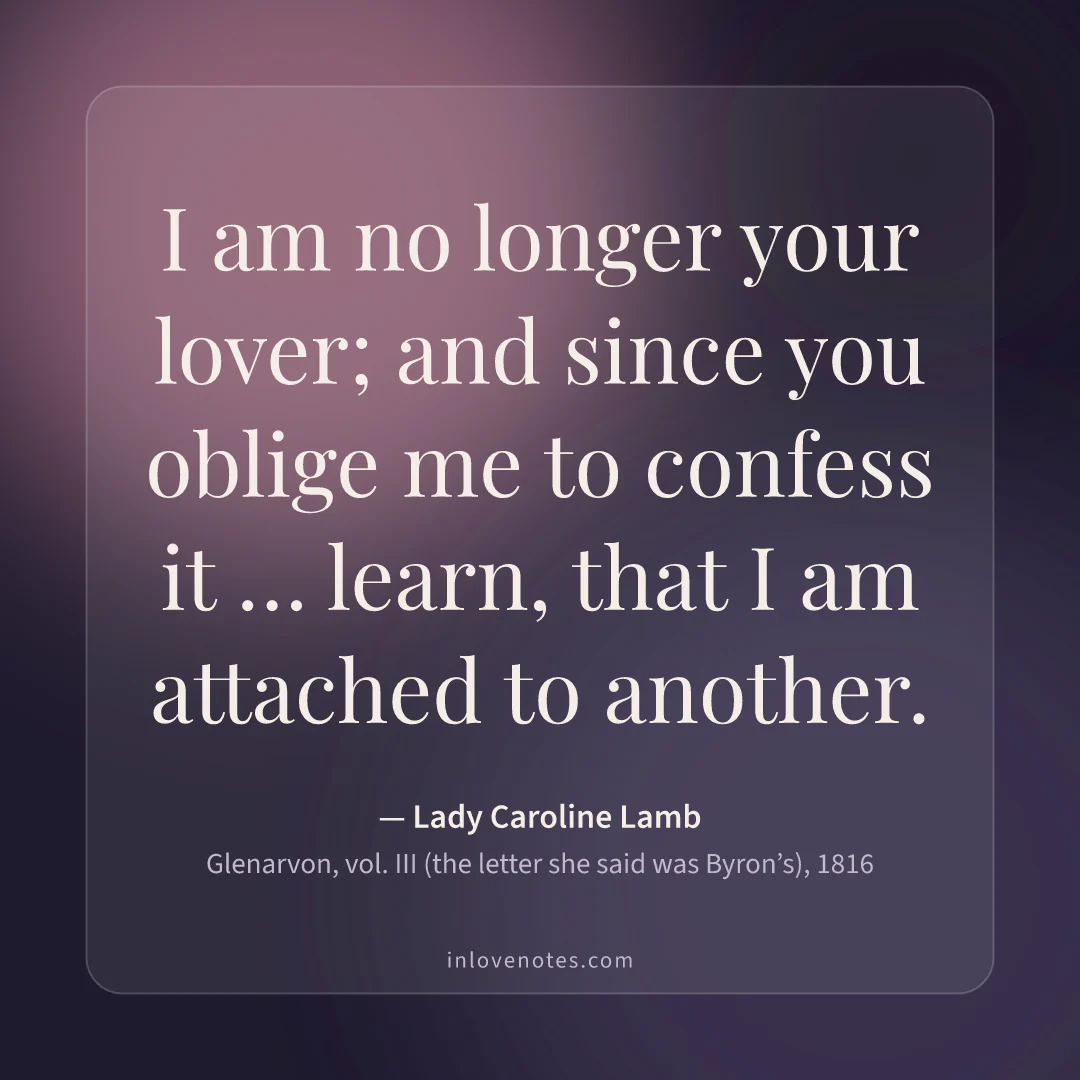
I now solemnly assure you, that this is an eternal farewel.—Yet I flinch not from the duties which tie me to life.
— Mary Wollstonecraft, Letter LXXVII to Gilbert Imlay ("London, Dec. 1795"), in The Love Letters of Mary Wollstonecraft to Gilbert Imlay, ed. Roger Ingpen (1908)
The letter is not calm all the way through: she calls his idea of "delicacy" the opposite of delicacy and says his senses have mistaken desire for principle. But it is clear from its first lines ("It is now finished"), it settles the practical question of their child in the first sentence, and it ends with five words most of us would like to manage: "I part with you in peace." The spelling "farewel" is hers, as printed. The lesson for your own letter: let the last line be the one you want to be remembered by.
Agnes von Kurowsky to Ernest Hemingway: kind, but watch the one line that stings
In 1918 the young Ernest Hemingway was wounded in Italy and fell in love with Agnes von Kurowsky, an American Red Cross nurse several years older than him, who looked after him in the Milan hospital. Back home in America, he received her letter dated 7 March 1919. It was printed in Henry Serrano Villard and James Nagel's Hemingway in Love and War (1989).
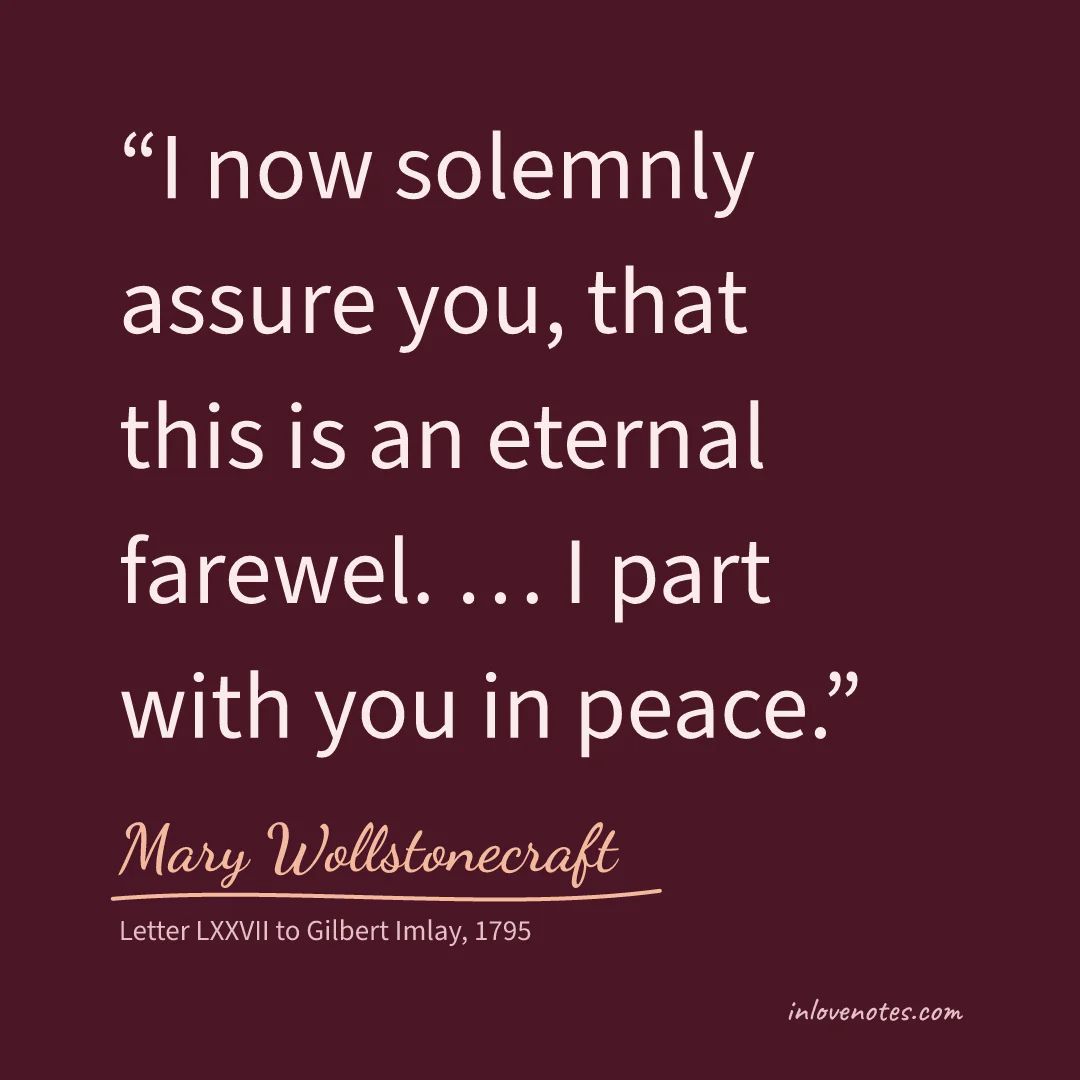
I know that I am still very fond of you, but, it is more as a mother than as a sweetheart.
— Agnes von Kurowsky, letter to Ernest Hemingway, 7 March 1919, as printed in Villard and Nagel, Hemingway in Love and War (1989)
She explains herself, takes responsibility, and asks him to forgive her; she also tells him she expects to marry an Italian officer (she never did). But the line most often remembered is the one where she calls him a boy and a kid. Hemingway turned the episode into fiction more than once, most directly in "A Very Short Story" (1924), and she is widely seen as a model for Catherine Barkley in A Farewell to Arms (1929). The lesson: one sentence about their age, looks or character can outlive everything kind in the letter. Your reason should be about you and the relationship, not a verdict on them.
Byron, Lady Caroline Lamb and Glenarvon: assume your letter will be kept
The affair between Lord Byron and Lady Caroline Lamb in 1812 ended badly, and so did the letter that ended it. In 1816 Lamb published a novel, Glenarvon, in which the Byron-like hero sends the heroine this note, sealed with another woman's seal. In a letter to Thomas Medwin in 1824 (printed in the appendix to Prothero's edition of Byron's letters) Lamb said the letter was really Byron's, dated 9 November 1812, and that Lady Oxford, his new lover, was "no doubt the instigator".
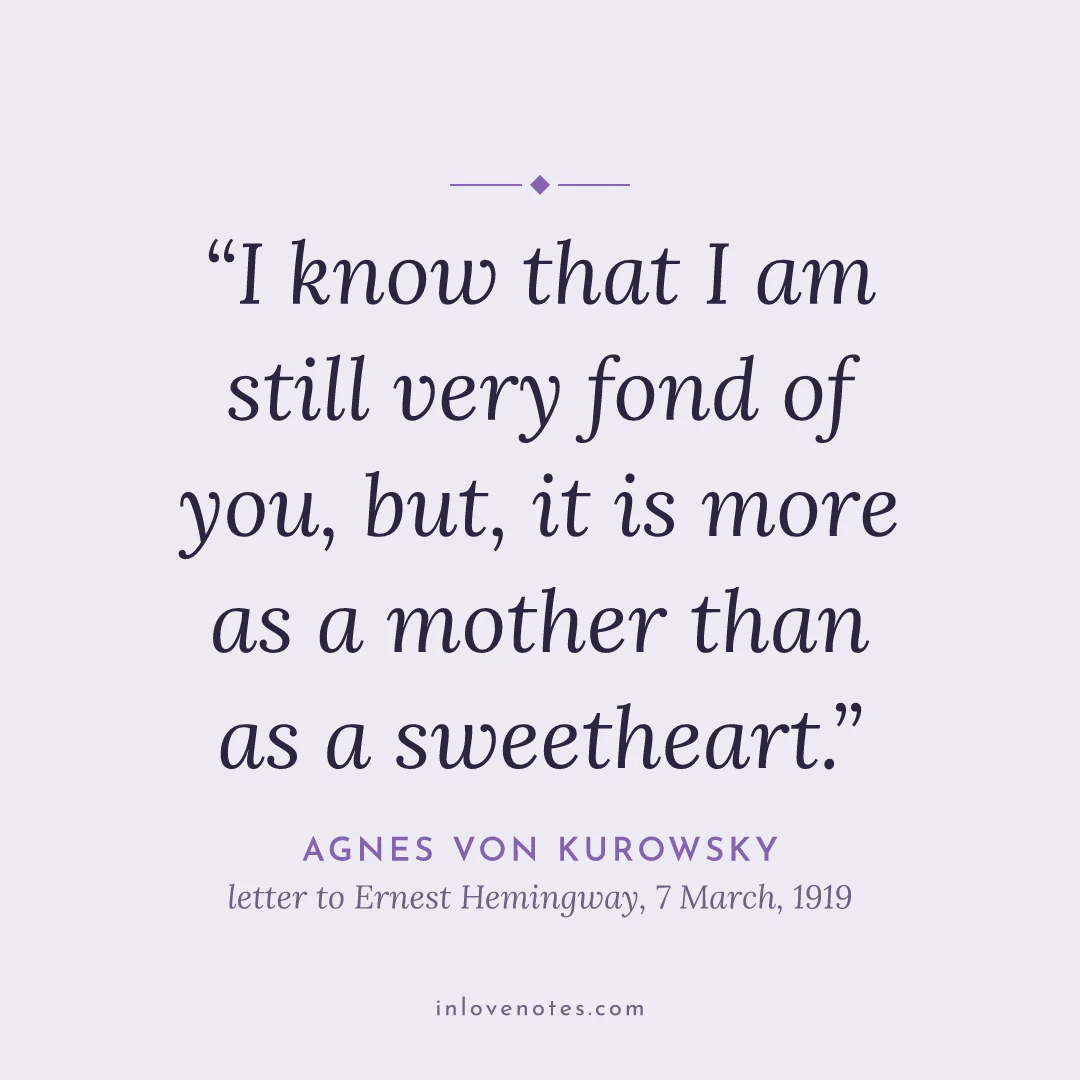
I am no longer your lover; and since you oblige me to confess it, by this truly unfeminine persecution,—learn, that I am attached to another; whose name it would of course be dishonourable to mention.
— Lady Caroline Lamb, Glenarvon, vol. III (1816), the letter signed "Glenarvon"
The novel's letter goes on to offer "a first proof of my regard": "correct your vanity, which is ridiculous; exert your absurd caprices upon others; and leave me in peace." It is a complete catalogue of what not to do: blame in the first sentence, a third person behind the scenes, contempt dressed as advice. And it was not private for long. Two hundred years later it is still being read, which is the real lesson: write every breakup letter as if it might be kept, shown to friends and reread in ten years, because it might.
For more letters by the same generation of writers, including Byron's earlier, happier ones, see Love Letters of Great Men.
Sending it, and the days after
- Handwritten or typed? Handwriting feels personal, which is good after a long relationship and strange after three dates. A typed letter sent as an email is fine if that is how you two always wrote.
- Timing. Not on their birthday, before an exam, or the night before a trip. If you talk first, give them the letter at the end of the conversation or send it the next day, not during it.
- Don't send it from the middle of the feeling. Write the angry draft if you need to, then write the real one a day later.
- Keep a copy. If things get confused later, you will want to know exactly what you said.
- Writing helps the writer too. In a 2009 study in The Journal of Positive Psychology, Gary Lewandowski asked 87 recently single people to write for 15 to 30 minutes on three days. Those who wrote about the positive side of the breakup gained more positive emotion than those who wrote about the negative side or about neutral topics, though negative feelings did not differ. It is a small study, but it is a fair reason to write the unsent letter too.
If you want words for the days after rather than for the letter itself, our short heartbreak quotes are sourced and short enough for a journal.
Questions people ask about breakup letters
Is it okay to break up with someone in a letter?
Yes, in the right situation. After a few dates, or when talking always ends in a fight, or when you don't feel safe, a letter can be kinder and clearer than a conversation. After a long relationship it works best as a follow-up to a talk, so the other person can ask their questions.
How long should a breakup letter be?
Usually 100 to 300 words: the decision, one honest reason, one real thank-you and the practical next steps. Longer letters tend to fill up with arguments and reasons that read like an invitation to negotiate.
Should I write a breakup letter I don't send?
Often, yes. Writing out everything you didn't get to say can bring a sense of closure, and in Lewandowski's 2009 study, people who wrote about a breakup's positive side came away with more positive emotion. Put it away for a week before you decide whether sending it would help you or only them.
What is a "Dear John" letter?
A letter in which a woman ends a relationship with a man, usually one who is away. The phrase is commonly traced to American servicemen in the Second World War; its exact origin is unknown, and a 1945 newspaper column is among the earliest printed uses. "Dear Jane" is the later reverse.
Sources
- Mary Wollstonecraft, Letter LXXVII, in The Love Letters of Mary Wollstonecraft to Gilbert Imlay, ed. Roger Ingpen (Hutchinson / Lippincott, 1908): Project Gutenberg #34413.
- Agnes von Kurowsky to Ernest Hemingway, 7 March 1919, in Henry Serrano Villard and James Nagel, Hemingway in Love and War (Northeastern University Press, 1989); wording as quoted by Mental Floss and a published transcription, cross-checked; Hemingway fiction: Wikipedia, Agnes von Kurowsky.
- Lady Caroline Lamb, Glenarvon, vol. III (1816): Project Gutenberg #68776; Lamb's letter to Thomas Medwin, November 1824, in The Works of Lord Byron: Letters and Journals, vol. 2, appendix III.
- Gary W. Lewandowski Jr., "Promoting positive emotions following relationship dissolution through writing", The Journal of Positive Psychology 4(1), 21–31 (2009).
- "Dear John letter": Wikipedia (origin uncertain; WWII usage).