Traditional Wedding Vows Examples: The Exact Words of Seven Ceremonies, and Where Each Came From
Exact traditional wedding vows from seven ceremonies: the 1662 Prayer Book, Catholic, Quaker, Jewish and Hindu rites, each checked against its source.
The words most people mean by "traditional wedding vows" (to have and to hold, from this day forward, for better for worse) were printed in the first English Book of Common Prayer in 1549, and couples in Anglican, Episcopal and many Protestant churches still say almost the same sentence 477 years later. Other traditions have their own fixed words: Catholics choose from four approved formulas, Quakers make one equal declaration with no officiant, a Jewish groom speaks a single sentence as he gives the ring, and a Hindu couple takes seven steps with a vow for each. This page gives the exact wording of each, copied from the official or historic texts, and says where each one came from.
You'll also find what changed between 1549 and today (the word "obey" included), the famous lines that people think are vows but aren't, and a practical section on making a traditional vow sound like the two of you when the official words can't be changed. Every vow below links to the text it was copied from, in the Sources list at the end.
Seven traditional vows at a glance
If you only need to know which wording belongs to which ceremony, start here. "Fixed" means the church or meeting does not allow the couple to rewrite the vow itself.
| Tradition | Source text | Core promise | Who speaks | Fixed? |
|---|---|---|---|---|
| Anglican, historic | Book of Common Prayer, 1662 | To have and to hold, for better for worse, till death us do part; the bride also promises to obey. | Groom first, then bride, repeating after the minister. | Yes |
| Church of England, modern | Common Worship, The Marriage Service | The same promises, with no "obey" and a closing "In the presence of God I make this vow". | Each in turn, holding right hands. | Yes, for legal reasons |
| Episcopal (US) | Book of Common Prayer, 1979 | The same promises, ending "until we are parted by death. This is my solemn vow." | Groom, then bride. | Yes |
| Catholic | Order of Celebrating Matrimony, 2013 English translation | Faithfulness in good times and in bad, love and honor for life (or the older "to have and to hold" form). | Both, or the priest asks and each answers "I do". | One of four formulas |
| Quaker (Britain) | Quaker faith & practice, 16.52 | To be a loving and faithful spouse, so long as both on earth shall live. | Both, in either order, with no officiant. | Yes, with listed options |
| Jewish | Traditional ring declaration (kiddushin) | By the ring the bride is consecrated to the groom according to the law of Moses and Israel. | The groom (in double-ring ceremonies, both). | Yes, the formula |
| Hindu | Saptapadi (seven steps) | One vow for each of seven steps or rounds of the sacred fire. | Both; wording varies by region and priest. | Rite fixed, English wording varies |
The 1662 Prayer Book: where "to have and to hold" comes from
The Book of Common Prayer of 1662 is the version most English-speaking couples are quoting without knowing it. In its "Form of Solemnization of Matrimony", the minister first asks each of them a question ("Wilt thou have this woman to thy wedded wife...?") and each answers "I will". Only then come the vows proper, which the groom says first, holding the bride's right hand in his:
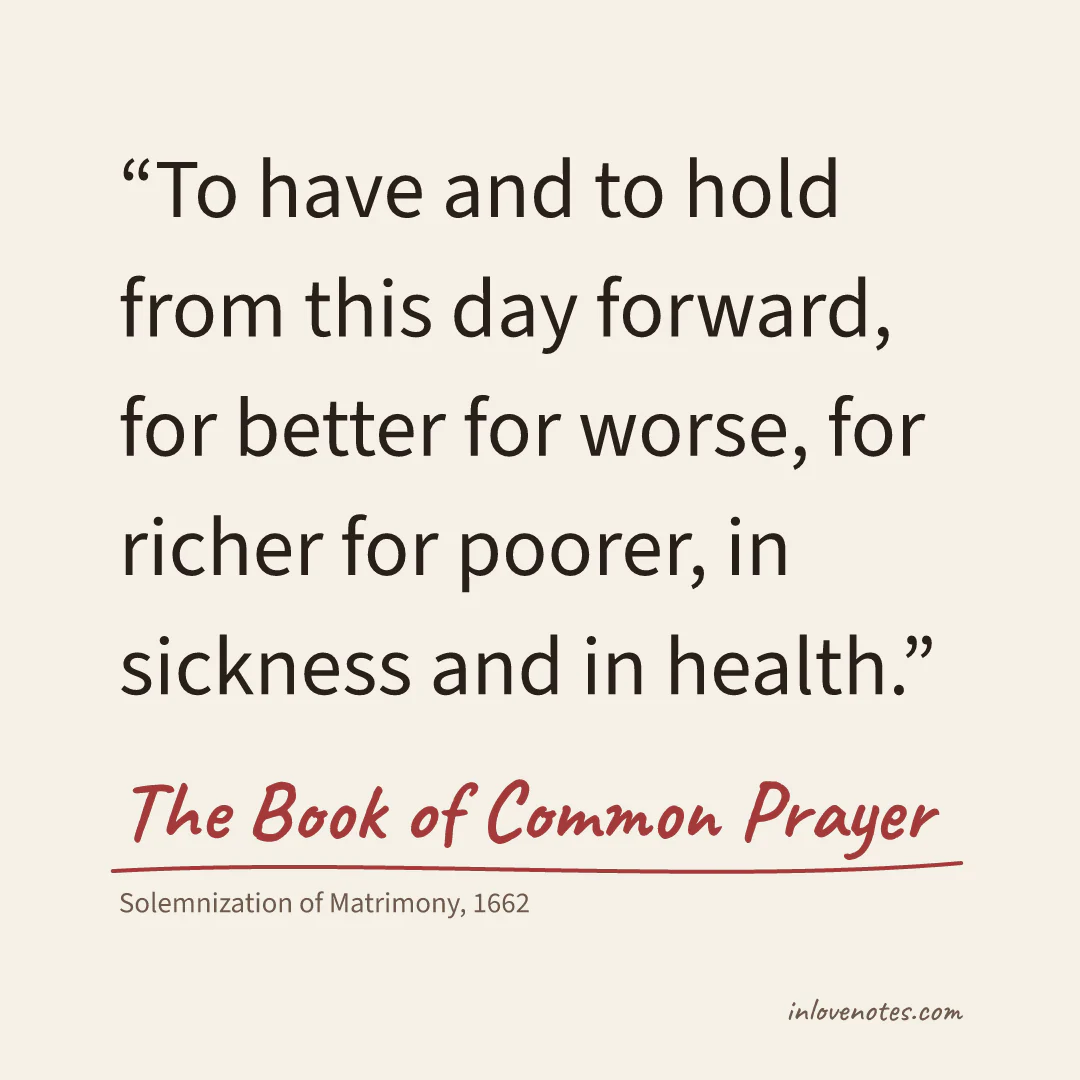
"I N. take thee N. to my wedded wife, to have and to hold from this day forward, for better for worse, for richer for poorer, in sickness and in health, to love and to cherish, till death us do part, according to God's holy ordinance; and thereto I plight thee my troth."
— The Book of Common Prayer (1662), The Form of Solemnization of Matrimony, the man's vow
"Plight thee my troth" means "pledge you my faithfulness": troth is the same word as truth. The bride's vow is identical except for two changes. She promises "to love, cherish, and to obey", and she ends "thereto I give thee my troth" rather than "plight". The groom then puts the ring on "the fourth finger of the woman's left hand" and says, "With this ring I thee wed, with my body I thee worship, and with all my worldly goods I thee endow." In the English of the time, "worship" could still mean to honour someone, which is how the line was meant.
The pairs in the vow (better and worse, richer and poorer, sickness and health) are the reason it has lasted. Each pair covers the whole range of what can happen, so the promise is not tied to any one hope. That is also the easiest structure to borrow if you write your own vows: name two opposite states and promise to stay in both.
From "til death us departe" to "until we are parted by death"
The sentence has been edited only a few times in nearly five centuries, and every change tells you something about what each generation was willing to promise. Here is the short history, taken from the texts themselves:
- 1549. The first Prayer Book, under Edward VI, has the vow almost word for word, in Tudor spelling: "to have and to holde from this day forwarde, for better, for wurse, for richer, for poorer, in sickenes, and in health, to love and to cherishe, til death us departe". The bride promises "to love, cherishe, and to obey". The rubric "The man first saying" puts the groom first, and with the ring he gives "golde and silver".
- 1662. The restored Church of England's book turns "til death us departe" into "till death us do part". In older English "depart" could mean to separate, so the meaning is the same: until death separates us. The 1662 book is still the Church of England's official Prayer Book.
- 1928. The American Episcopal Church's Prayer Book drops "obey" from the bride's vow, so both now promise "to love and to cherish". The ring words are cut to "With this Ring I thee wed", and "with my body I thee worship" disappears from the American text.
- 1979. The current Episcopal book puts the vow into modern English, starting "In the Name of God", and replaces "till death us do part" with "until we are parted by death. This is my solemn vow."
- 29 July 1981. Lady Diana Spencer, marrying Prince Charles at St Paul's Cathedral, became the first royal bride to leave "obey" out of her vows.
- Today. The Church of England's modern service, Common Worship, has no "obey" in either vow, and adds a sentence each person says at the end.
Here is the Common Worship vow as the Church of England prints it for couples planning a church wedding:
"I, (name), take you, (name), to be my wife/husband, to have and to hold from this day forward; for better, for worse, for richer, for poorer, in sickness and in health, to love and to cherish, till death us do part, according to God's holy law. In the presence of God I make this vow."
— Church of England, Common Worship: Pastoral Services, The Marriage Service (2000)
The Church is blunt about these words: they "can not be re-written or changed in any way for legal reasons", because they are what makes the couple legally married. The American Episcopal ring words in the 1979 book are worth knowing too, because many couples borrow them even when they marry somewhere else:
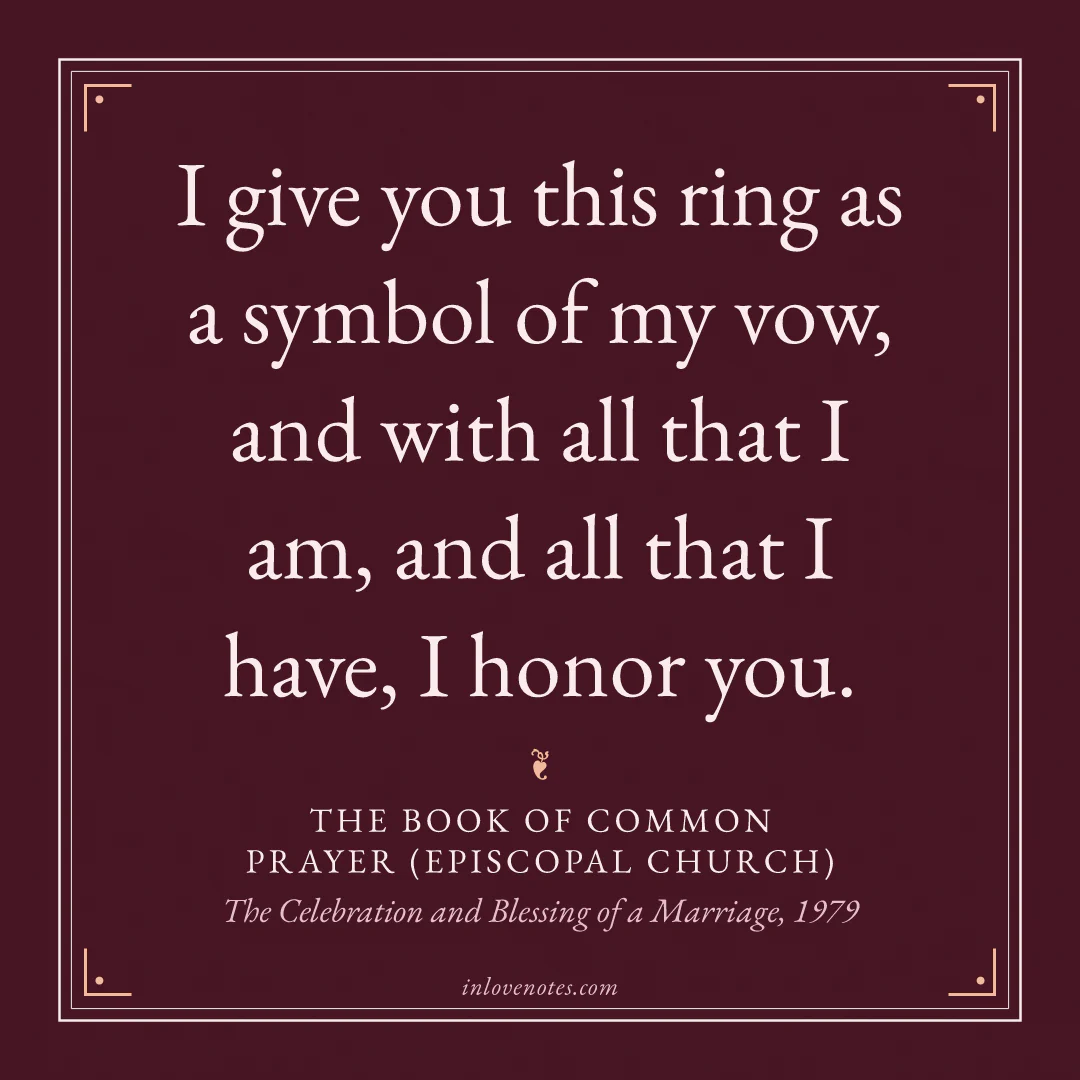
"N., I give you this ring as a symbol of my vow, and with all that I am, and all that I have, I honor you, in the Name of the Father, and of the Son, and of the Holy Spirit (or in the Name of God)."
— The Book of Common Prayer (1979), Episcopal Church, giving of the rings
Compare it with the 1662 ring words and you can see the old promise kept and translated: "with all my worldly goods I thee endow" has become "all that I have", and "with my body I thee worship" has become "all that I am... I honor you". It is a good model for anyone updating an old vow: keep the shape, change the vocabulary.
Catholic wedding vows: the four approved formulas
In a Catholic wedding the vows are called the consent, and the Church teaches that this exchange is what "makes the marriage". The current English text is the 2013 translation of the Order of Celebrating Matrimony, published on the US bishops' For Your Marriage site. The couple uses one of four formulas. Two are spoken by the bride and groom themselves:
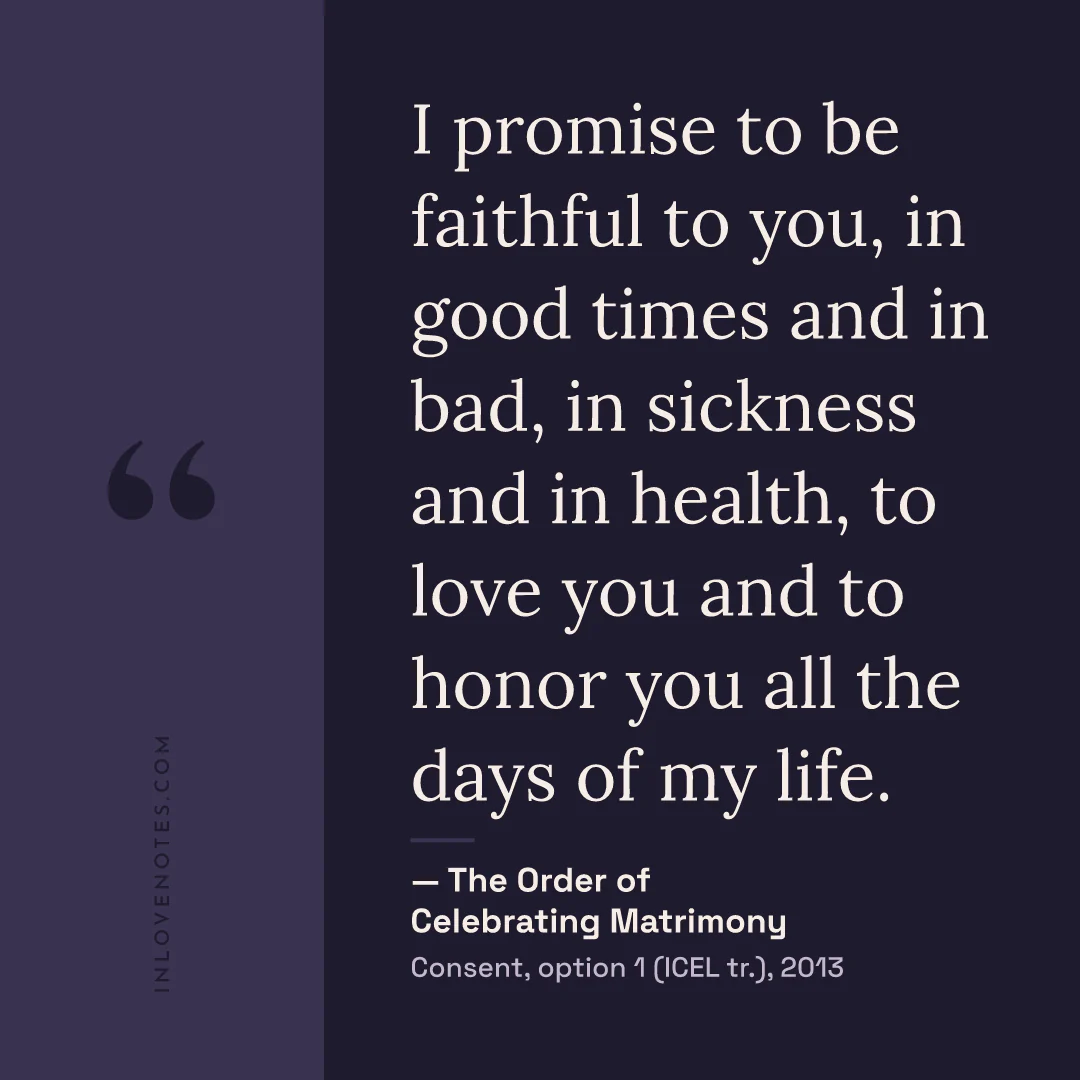
"I, (name), take you, (name), to be my wife/husband. I promise to be faithful to you, in good times and in bad, in sickness and in health, to love you and to honor you all the days of my life."
— The Order of Celebrating Matrimony (English translation 2013, ICEL), consent, option 1
Option 2 is the older Prayer Book pattern: "I, (name), take you, (name), for my lawful wife/husband, to have and to hold, from this day forward, for better, for worse, for richer, for poorer, in sickness and in health, to love and to cherish until death do us part." Options 3 and 4 put the same words into a question from the priest or deacon, and each answers "I do". Notice that the Catholic text says "until death do us part", the word order most people use today, while the Anglican books keep "till death us do part".
Option 1 is the one that sounds least like a legal formula, and many couples choose it for that reason. "All the days of my life" says the same as "till death" without mentioning death at the altar.
The Quaker declaration: equal words, and no one marries you
Quaker weddings take place in a meeting for worship, and there is no minister to lead the vows. When the couple feel ready, they stand, take each other's hands and each make the same declaration. This is the current wording from Quaker faith & practice, the book of discipline of Britain Yearly Meeting:
"Friends, I take this my friend [full name] to be my spouse, promising, through divine assistance, to be unto [pronoun] / [commonly used name] a loving and faithful spouse, so long as we both on earth shall live."
— Quaker faith & practice, 16.52
The book allows a few listed changes and nothing else: "spouse" may become "wife", "husband" or "partner in marriage"; "through divine assistance" may become "with God's help"; and "so long as we both on earth shall live" may become "until it shall please the Lord by death to separate us". The rule behind all of it is one sentence: "their promises must be equal and reciprocal." If you want a short traditional vow that treats both of you identically, this is the model.
Jewish and Hindu weddings: a sentence with a ring, and seven steps
A traditional Jewish wedding has no exchange of vows in the Prayer Book sense. The legal act is the giving of the ring, in front of witnesses, with one sentence in Hebrew. The groom places the ring on the bride's right index finger and says:
"Harei at mekudeshet li b'taba'at zo k'da'at moshe v'yisrael." (Behold, with this ring, you are consecrated to me according to the law of Moses and Israel.)
— Traditional Jewish ring declaration, as given by My Jewish Learning
In double-ring ceremonies, now common in many communities, the bride answers with the masculine form, "harei ata mekudesh li b'taba'at zo...". Many couples later move the ring to the left ring finger, since that is where Western wedding bands are worn.
In a Hindu wedding the rite that completes the marriage is the Saptapadi, "seven steps". The couple take seven steps together, or walk seven times around the sacred fire, with a vow for each, and the marriage is regarded as complete after the seventh. The words vary by region, language and family priest, so there is no single English text. One English version often printed in American vow books (Diane Warner's 2006 collection and Michael Macfarlane's 1999 one are the usual citations) begins:
"We have taken the Seven Steps. You have become mine forever. Yes, we have become partners. I have become yours. Hereafter, I cannot live without you."
— English rendering of the words said after the Saptapadi, as printed in modern vow collections
If you are using this in a ceremony, ask the priest which version your families use. The English above is a modern rendering for readers, not a translation of one fixed Sanskrit text, and a family may hear it as a little loose.
Lines people think are vows, and where they really come from
A few famous wedding phrases are misplaced, misquoted or not vows at all. These come up every time someone searches for "the traditional vows":
- "I do." In the 1662 and 1928 Prayer Books the answer to the minister's question is "I will". "I do" is the answer in the Catholic question forms (options 3 and 4 above) and in many civil ceremonies.
- "Speak now or forever hold your peace." Not a vow and not said by the couple. It is the minister's challenge to the congregation, and the 1662 wording is longer: "if any man can shew any just cause, why they may not lawfully be joined together, let him now speak, or else hereafter for ever hold his peace." The 1549 book has the same sentence.
- "Till death do us part." The Prayer Books say "till death us do part" (1662) or "til death us departe" (1549). The modern word order is in the Catholic option 2.
- "Whither thou goest, I will go." Often read or even spoken as a vow, but in the Book of Ruth these are Ruth's words to her mother-in-law, Naomi, after Ruth's husband has died (Ruth 1:16–17). The passage ends "if ought but death part thee and me", which is perhaps the oldest English ancestor of "till death us do part". We cover it and other wedding readings in Bible verses about love and marriage.
- "Love, honour and obey." Only the bride promised to obey, in 1549 and 1662. The groom's vow never contained the word.
Making traditional vows personal, without breaking the rules
Many couples want the old words but also want to say something of their own. How you do that depends on where you marry.
- In a Church of England or Catholic wedding, the vow itself can't be changed. The Church of England suggests saying the personal part elsewhere in the service: "as an additional reading, or using poetry or an extract from a book". Ask the vicar or priest where it can go; a short personal statement before the vows or a reading chosen by the two of you is usually possible.
- In a civil or celebrant-led ceremony, the legal words required vary by country and state, so check them first. Around them you can usually build whatever you like, including a traditional vow followed by a personal paragraph.
- In a vow renewal, nothing is legally required, which is why many couples go back to the traditional words they said the first time and add one sentence about the years since.
Here are four examples written by our editors that do exactly that. Replace the bracketed parts with your own facts; the more specific they are, the better they work. Keep each personal part to three or four sentences, because spoken aloud, in front of people, a minute feels long.
Traditional vow plus a personal line, for her:
"I, [name], take you, [name], to be my wife, to have and to hold from this day forward, for better, for worse, for richer, for poorer, in sickness and in health, to love and to cherish, till death us do part. And I add one promise of my own: that on the days when [the thing she does when the world is too much, e.g. goes quiet], I will notice first, and I will stay."
— inlovenotes editors, example vow built on the Common Worship text (2026)
The Catholic option 1, followed by a personal statement for him (the personal part said earlier in the service, where the priest allows it):
"[Name], you make ordinary days feel like they were worth waiting for. You [a specific habit of his, e.g. leave the porch light on], and I have never once had to ask. Today I'm going to make the same promise couples have made for centuries, and I want you to know I mean every word of it."
— inlovenotes editors, example statement to precede the Catholic consent (2026)
A short vow on the Quaker pattern, for a civil ceremony where both of you want identical words:
"[Name], in front of these friends, I take you to be my [wife / husband / partner], promising to be loving and faithful to you for as long as we both shall live."
— inlovenotes editors, example vow adapted from Quaker faith & practice 16.52 (2026)
For renewing your vows, the old words with the years written in:
"[Number] years ago I promised you better and worse, richer and poorer, sickness and health. We have had [a specific example of each, e.g. the year of the two jobs, the hospital in March]. I would make the same promise again today, and I do: to have and to hold, from this day forward."
— inlovenotes editors, example vow for a renewal (2026)
If you need help with the personal paragraph, the same method we use for letters works for vows: one concrete memory of your own, one quality named plainly, one promise about the future. Our guide to writing a letter to your future wife walks through it, and couples marrying in Italy or with Italian family can find vows and blessings in Italian on our page of Italian quotes for love and marriage. For a reading to go with the vows, our love poems for her include a section of poems for a wedding or an engagement.
Questions couples ask
What are the traditional wedding vows?
In English-speaking churches the traditional vow is the Book of Common Prayer wording: "I take thee to my wedded wife (or husband), to have and to hold from this day forward, for better for worse, for richer for poorer, in sickness and in health, to love and to cherish, till death us do part." Catholics, Quakers, Jewish and Hindu weddings have their own fixed words, shown in the table above.
Who goes first in traditional wedding vows?
In the 1549, 1662 and 1979 Prayer Books the man speaks first ("The man first saying" in 1549), then the woman. Quaker faith & practice says the couple speak "the one after the other in either order". In most modern ceremonies the order is simply agreed with the officiant.
Is "obey" still in traditional wedding vows?
It is still printed in the 1662 Book of Common Prayer, and only in the bride's vow. The American Episcopal Church removed it in 1928, the Church of England's modern Common Worship vow does not contain it, and the Catholic formulas do not contain it.
Can we write our own vows in a church wedding?
Not in place of the official ones in a Church of England or Catholic wedding: the Church of England says the vows "can not be re-written or changed in any way for legal reasons". You can usually add personal words as a reading, a poem or a short statement elsewhere in the service; ask the vicar or priest.
What are the 7 marriage vows?
This usually means the Saptapadi, the "seven steps" of a Hindu wedding, where the couple take seven steps or seven rounds of the sacred fire with one vow for each. The wording varies by region and family, so there is no single official English list.
Sources
- The Book of Common Prayer (1549), Marriage: Society of Archbishop Justus transcription.
- The Book of Common Prayer (1662), The Form of Solemnization of Matrimony: 1662 BCP online (Lynda Howell).
- The Book of Common Prayer (1928, Episcopal Church, USA), Solemnization of Matrimony: Society of Archbishop Justus transcription.
- The Book of Common Prayer (1979, Episcopal Church), The Celebration and Blessing of a Marriage: bcponline.org.
- Church of England, "Wedding vows" (Common Worship, The Marriage Service): churchofengland.org.
- United States Conference of Catholic Bishops, "The Marriage Vows" (Order of Celebrating Matrimony, English translation © 2013 ICEL): foryourmarriage.org.
- Britain Yearly Meeting, Quaker faith & practice, chapter 16, paragraph 16.52: qfp.quaker.org.uk.
- "All About Jewish Wedding Rings": My Jewish Learning.
- "Saptapadi": Wikipedia, with its citations to Diane Warner, Complete Book of Wedding Vows (2006) and Michael Macfarlane, Wedding Vows: Finding the Perfect Words (1999).
- "The royal wedding of Prince Charles and Lady Diana Spencer": ABC7 News, citing Vanity Fair, for the omission of "obey" in 1981.
- The Bible, King James Version, Ruth 1:14–17: Project Gutenberg #8008.