Love Letter to Myself: How to Write One, With 3 Examples, a Template and What the Research Found
How to write a love letter to yourself in 7 steps, with 3 example letters, a fill-in template and the studies behind self-compassion letters, all sourced.

A love letter to myself, or to yourself, is a letter you write in the voice of someone who already loves you, addressed to the person you are now, and kept to be reread on a hard day. It is not a list of affirmations and it does not have to feel silly. The version that works best, and the one psychologists actually test, borrows the structure of an ordinary love letter: a specific greeting, the honest truth about where you are, kindness instead of a verdict, and a promise you can keep. Below you'll find what the research found, a seven-step method, three example letters and a fill-in template.
Does writing to yourself actually do anything? What the studies found
Letters to the self have been tested more often than most writing habits. The findings are modest but consistent, and they tell you how to write the letter, not just whether to.
- 1986, the expressive-writing study. James Pennebaker and Sandra Beall asked 46 students at Southern Methodist University to write for 15 minutes on four consecutive evenings. Those who wrote about both the facts and the feelings of a hard experience made fewer visits to the health centre over the next six months than a control group who wrote about trivial topics. The authors themselves called the results "promising rather than definitive", and mood dipped right after writing before it improved. The lesson: honesty first, comfort second.
- 2010, the "love letters" study. Psychologists Leah Shapira and Myriam Mongrain at York University in Toronto had more than 200 people write online for seven nights in a row. In the self-compassion condition they addressed an upsetting event, "attempting to comfort themselves as they would a friend in a similar situation". York's announcement called it writing yourself "love" letters: participants were less depressed up to three months later and happier at six months (people with very high neediness did not improve).
- 2012, self-compassion and self-improvement. Juliana Breines and Serena Chen ran four experiments in which taking a self-compassionate view of a weakness or a failure was compared with boosting self-esteem. The self-compassion groups were more motivated to fix a mistake, spent longer studying after failing a test, and were more willing to change. Kindness to yourself did not make people lazy; it made the next step easier.
- 2020-21, the letter to your future self. Yuta Chishima and Anne Wilson had Japanese high-school students write a letter to their future self and then answer it as that future self, in about 30 minutes. Compared with writing the letter alone, the exchange made students feel more connected to who they would become and led to more career planning and willingness to study a month later.
The exercise most of these studies build on is Kristin Neff's self-compassion letter. In her version you first write about something that "tends to make you feel inadequate or bad about yourself", then imagine "an imaginary friend who is unconditionally loving, accepting, kind and compassionate" and "write a letter to yourself from the perspective of this imaginary friend". Afterwards you put it down for a while, then come back and read it again, "really letting the words sink in". That structure (truth, a loving voice, a pause, a reread) is the backbone of the method below.
A note of care: these are short studies with student and volunteer samples. A letter can help you through a rough patch; it is not a treatment for depression, and if a low mood lasts for weeks, talking to a doctor or therapist is the better step.
Before you start: pick the kind of letter
"Love letter to myself" covers several different exercises. They ask different things of you, so choose one before you pick up the pen.
| Letter | Written to | Best when | Main move |
|---|---|---|---|
| Self-compassion letter | You, today | You are being hard on yourself about one thing | Write as a kind friend who knows the whole story |
| Letter to your younger self | You at a past age | An old hurt or decision still stings | Tell that person what you know now that they could not |
| Letter to your future self | You in 1, 5 or 10 years | You are at a turning point | Say what you hope for and what you want them to remember |
| After-a-breakup letter | You, now single | The relationship took up the space you used to give yourself | Take back the attention you gave away |
| Birthday or anniversary letter | You, on a date that matters | You want a yearly habit | Notice what changed this year and thank yourself for it |
How to write a love letter to yourself in seven steps
- Pick one subject. One thing you dislike about yourself, one decision, one rough season. A letter about everything turns into a pep talk; a letter about one thing turns into a conversation.
- Choose the voice. Imagine a friend who loves you without conditions and knows every part of the story, including the parts you skip when you tell it. Write as that friend. This is the core of the self-compassion exercise described above, and it is what stops the letter from sounding like a motivational poster.
- Open with your name, the way a person who loves you would write it. "Dear [nickname]" is warmer than "Dear me". If no one has ever called you by a nickname you liked, give yourself one.
- Tell the truth first. Write what happened and how it felt in plain words, without softening it. Kindness is only believable after honesty.
- Put the struggle in company. Remind yourself that this is a common human problem, not a personal defect. Neff's research calls this "common humanity", and it is the sentence most self-letters forget.
- Offer one concrete kindness or change. Not "be better" but "go to bed before midnight this week" or "phone [friend] on Sunday". Breines and Chen's finding is the point here: self-compassion is meant to make the next step easier, not to excuse it.
- Sign it, date it, put it away. Leave it for at least a day before you reread it, then decide where it lives (see the last section).
If you want help with the opening and closing lines, our guide to how to start and end a love letter works for a letter to yourself as well; the general rules in how to write a love letter apply too, with one change: here the person you are praising is also the one reading.
Seneca on becoming your own friend
The idea of befriending yourself is much older than self-help. This passage and the two in the next sections were each checked in the text.
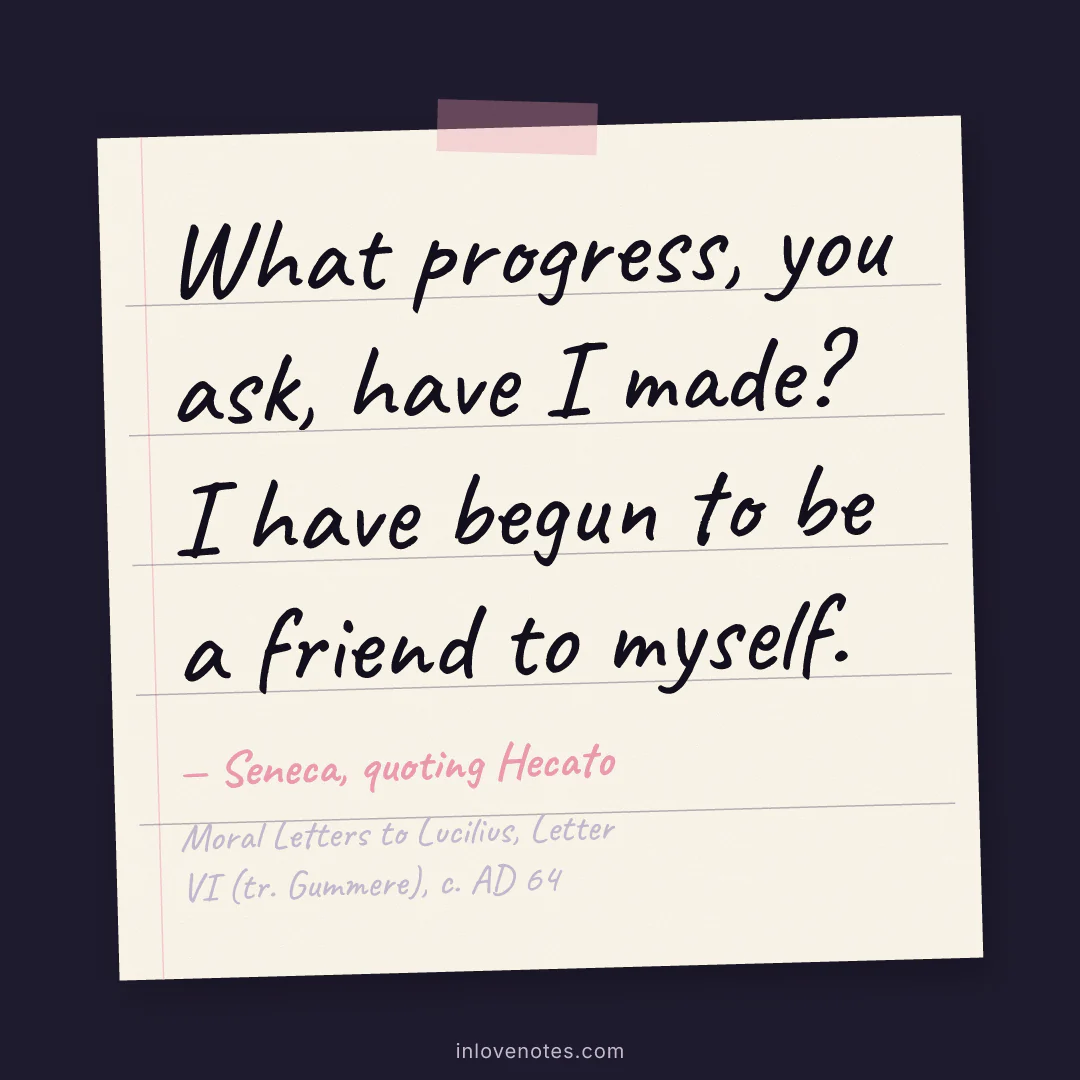
What progress, you ask, have I made? I have begun to be a friend to myself.
— Hecato, quoted by Seneca in Moral Letters to Lucilius, Letter VI (c. AD 64), tr. Richard M. Gummere (Loeb, 1917)
Seneca's letters to his friend Lucilius were real correspondence turned into a book, and Letter VI ends with this line from the Stoic philosopher Hecato. Seneca adds that such a person "can never be alone" and is "a friend to all mankind". It is a useful test for your own letter: if you would be embarrassed to send the same words to a friend, they are probably not friendly enough.
Montaigne's back room of the self
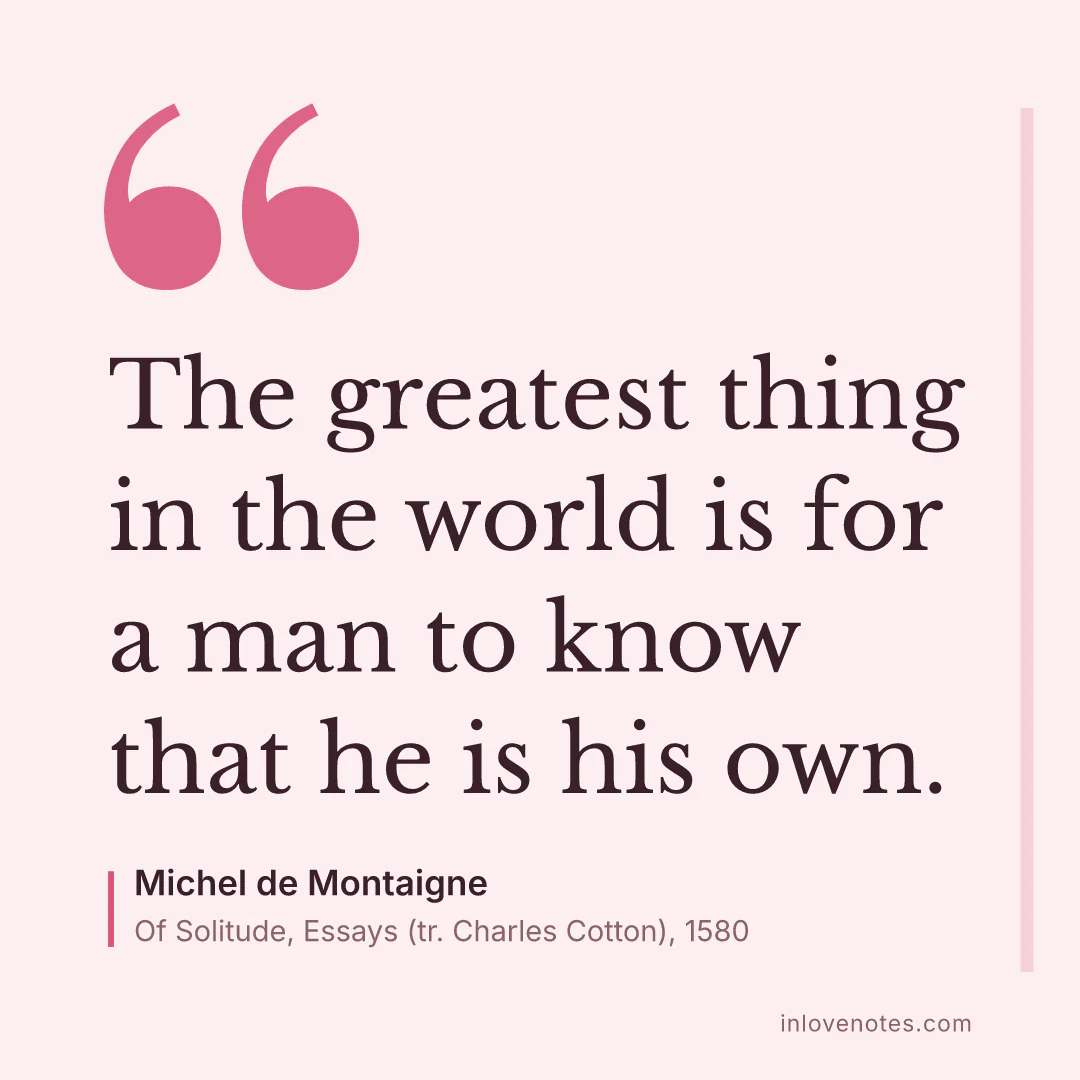
The greatest thing in the world is for a man to know that he is his own.
— Michel de Montaigne, "Of Solitude", Essays (1580), tr. Charles Cotton
In the same essay Montaigne says we must "reserve a backshop, wholly our own and entirely free", a private back room where we talk and laugh with ourselves so that losing other things is not the end of us. A letter to yourself is a small version of that back room. Montaigne wrote "a man", in the language of his time; the advice is for anyone.
After a breakup: Derek Walcott's "Love After Love"
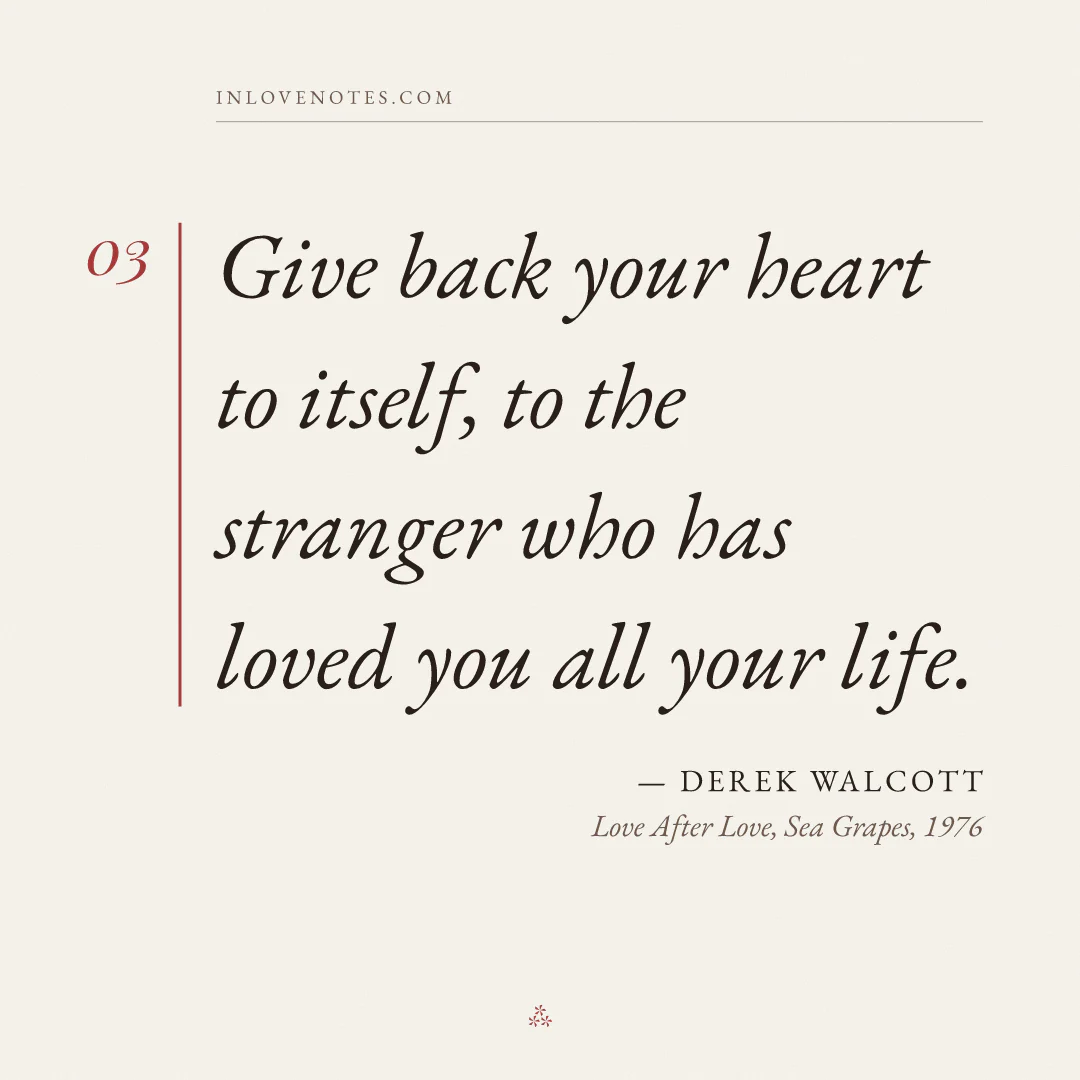
Give wine. Give bread. Give back your heart
to itself, to the stranger who has loved you
all your life, whom you ignored
for another, who knows you by heart.— Derek Walcott, "Love After Love", Sea Grapes (1976)
Walcott's poem is the one most often read after a breakup, and it is a close cousin of the self-love letter. A few lines later he tells the reader to "take down the love letters from the bookshelf, / the photographs, the desperate notes" and to sit with the self that was there all along. If you are writing after the end of a relationship, read the whole poem first (it is short and in print in his Collected Poems), then let your letter answer it. Our page of short heartbreak quotes has more sourced lines for that stage.
Example letters to borrow from
These three examples were written by our editors to show the method in practice. They are written in the second person, as from a loving friend to you, which is the voice the self-compassion exercise uses. Replace every bracket with your own details; the specific detail is the part that makes it yours.
A self-compassion letter (about one mistake)
Dear [name], about [the thing that went wrong]: yes, it happened, and yes, it cost something. You have been replaying it for [days/weeks] as if replaying it were a way to fix it. Here is what a friend who saw all of it would say. You were tired, you were doing three jobs at once, and you made the call that looked right with what you knew on [day]. Plenty of people would have done the same, and plenty of good people have done worse. This week, do one thing: [small repair or next step]. That is enough. With love, [the friend in your head]
A letter to your younger self
Dear [name] at [age], you think [the thing you believed then] is the whole truth about you. It isn't. The part of you that [quality you were teased or criticised for] is going to turn out to be [what it became]. You will lose [something you were afraid to lose] and survive it. You will also keep [something you didn't expect to keep]. You don't have to believe this yet. Just know that someone made it here, and they are on your side. [Your name, now]
A letter to open on your next birthday
Dear [name], open this on [date]. Today, a year earlier, you are [where you are] and hoping for [one or two things]. Whatever happened between then and now, here is what was true when this was written: you were trying, you were kind to [someone] when it was not easy, and you deserved more patience than you were giving yourself. When you read this, write the next one. Happy birthday, [name]
A fill-in template
If a blank page stops you, copy this frame and fill each line. Five sentences are enough for a first letter.
- Greeting: Dear [the name someone who loves you would use],
- The truth: I know you're [what you are going through] and that it feels [honest word].
- Company: You're not the only one; [why this is a common, human struggle].
- What a friend sees: What I see in you is [two specific qualities, with one example each].
- One promise: This week I'll [one small, doable kindness or change].
- Sign-off: [Warm closing], [your name], [date].
What to do with it once it's written
- Reread it after a day, not straight away. Neff's exercise asks you to put the letter down for a little while, then read it again, "really letting the words sink in". Distance makes the kind voice sound like someone else's, which is the point.
- Keep it where bad days happen. In the notes app you open when you can't sleep, in the wallet, in the drawer by the bed. A letter you can't find on the hard day is only a diary entry.
- Seal it for later. Write "open on [date]" on the envelope, or use a delayed-email service. A set of sealed letters for specific moods works as well for yourself as for a partner: see our open when letters guide for labels.
- Don't post it unless you want an audience. A letter written for strangers turns into a performance. If you want to share something, share one line and keep the rest.
- Make it a habit. One letter on each birthday gives you a record of who you were each year, in your own handwriting.
If words won't come at all, start with one: our list of one-word self-love quotes pairs single words with the real lines behind them, and any of them can be the first word of your letter.
Questions people ask about writing a love letter to yourself
How do I write a love letter to myself?
Choose one subject, imagine a friend who loves you without conditions, and write to yourself in that friend's voice: say honestly what is going on, remind yourself it is a common human struggle, name two things the friend admires, and end with one small promise. Then put it away and reread it the next day.
What can I write in a letter to myself?
Write about one thing you are being hard on yourself about, what you have survived, what you want your future self to remember, or what you would tell your younger self. Specific details work better than general praise.
Is writing a letter to yourself actually helpful?
In small studies, yes: in Shapira and Mongrain's 2010 study, a week of nightly self-compassionate writing left people less depressed three months later, and Breines and Chen found that a self-compassionate view of a weakness made people more motivated to improve, not less. It is a support, not a treatment; if low mood lasts, talk to a professional.
Should a letter to myself be written in "I" or "you"?
Either works, but many people find "you" easier, because it lets the letter sound like it comes from a friend rather than from the part of you that is criticising.
Sources
- Kristin Neff, "Exercise 3: Exploring self-compassion through writing", exercise packet from the Center for Mindful Self-Compassion: PDF hosted by NHS Lothian; variant wording at Greater Good in Action (UC Berkeley).
- J. W. Pennebaker and S. K. Beall, "Confronting a traumatic event: Toward an understanding of inhibition and disease", Journal of Abnormal Psychology 95(3), 274-281 (1986).
- L. B. Shapira and M. Mongrain, "The benefits of self-compassion and optimism exercises for individuals vulnerable to depression", Journal of Positive Psychology 5(5), 377-389 (2010), doi:10.1080/17439760.2010.516763; York University news release, 8 Nov. 2010.
- J. G. Breines and S. Chen, "Self-compassion increases self-improvement motivation", Personality and Social Psychology Bulletin 38(9), 1133-1143 (2012), doi:10.1177/0146167212445599.
- Y. Chishima and A. E. Wilson, "Conversation with a future self: A letter-exchange exercise enhances student self-continuity, career planning, and academic thinking", Self and Identity 20(5), 646-671 (2021), doi:10.1080/15298868.2020.1754283; the authors' summary on the SPSP blog.
- Seneca, Moral Letters to Lucilius, Letter VI, tr. Richard M. Gummere: Wikisource.
- Montaigne, "Of Solitude", Essays, tr. Charles Cotton: Project Gutenberg #3600.
- Derek Walcott, "Love After Love", Sea Grapes (1976): text and context at LitCharts.