Letter to My Future Wife: 7 Example Letters, From "I Haven't Met You Yet" to the Wedding Morning
7 example letters to your future wife, before you meet her, while engaged and on the wedding morning, plus what Darwin, Hawthorne and Twain wrote first.
A letter to your future wife is written for one of two readers: a woman you haven't met yet, or the woman you are about to marry. For the first, write about the husband you are trying to become and keep the letter short enough to rewrite once you know her name. For the second, tell her what you see in her now, make two or three promises she could actually hold you to, and give it to her before the wedding or on the morning itself. Below are 7 example letters for both cases, written by our editors, plus what three nineteenth-century men put on paper before their own weddings.
Those three are worth reading first, because they cover the whole range: Charles Darwin weighed marriage in a two-column list before he had proposed to anyone, Nathaniel Hawthorne was calling Sophia Peabody "wife" three years before their wedding, and Mark Twain told his family exactly what kind of ring he had bought and why. Each one shows something to copy and something to avoid.
What do you write to a wife you haven't met yet?
The honest answer is: less about her than you think. You don't know her, so a page of compliments ends up describing a type, and she will notice that when she reads it years later. The letters in this group that still work when they are finally handed over talk about the writer: what he is learning, what he is working on, what he hopes their home will feel like.
The clearest warning comes from Darwin. In July 1838, months before he proposed to his cousin Emma Wedgwood, he wrote a memorandum headed "This is the Question" with two columns, Marry and Not Marry. Under Marry he listed children, a "constant companion, (& friend in old age) who will feel interested in one", and a wife as an "object to be beloved & played with", adding "better than a dog anyhow". Under Not Marry: "Freedom to go where one liked", and the fear that he "cannot read in the Evenings". His verdict, at the bottom of the page:
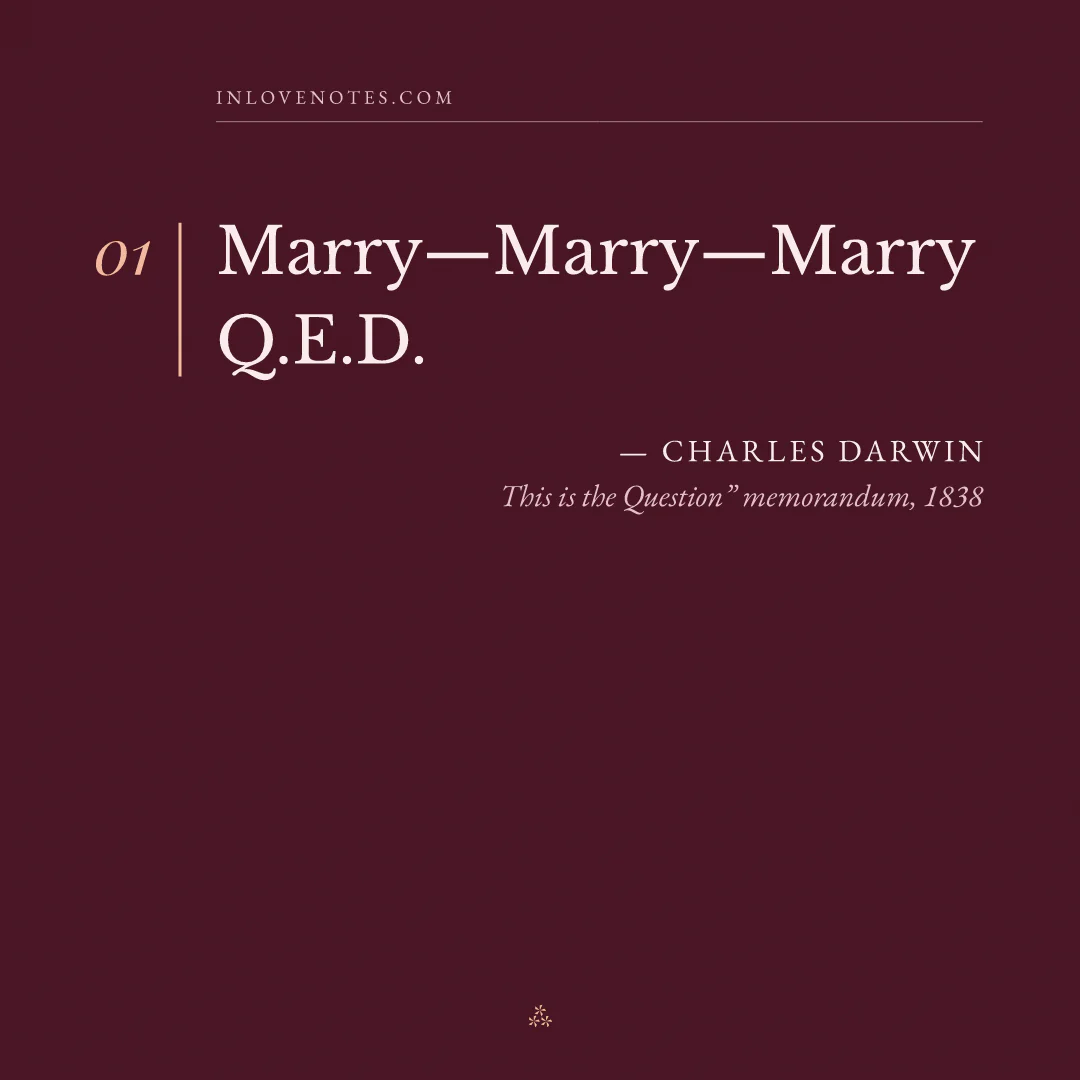
"Marry—Marry—Marry Q.E.D."
Charles Darwin, "This is the Question" memorandum, July 1838 (Cambridge University Library, CUL-DAR210.8.2)
Everything on Darwin's list is about what a wife would do for him. That's fine for a private note to yourself, and it is funny now, but it is the wrong frame for a letter she will one day read. He proposed on 11 November 1838, wrote "The day of days!" in his journal, and married Emma on 29 January 1839. The marriage lasted until his death in 1882, but nobody quotes the list as a love letter. Write the opposite column: what you mean to bring.
Three things to keep in a before-we-met letter:
- Something true about you right now. Your age, where you live, what you're struggling with this year. It dates the letter, and the date is the charm.
- One habit you are building for her sake. Saving money, learning to cook, going to therapy, calling your mother more. Keep it to something you're actually doing.
- A line that leaves room for the real person. You don't know if she likes mornings or hates them. Say so.
Example 1: The "I haven't met you yet" letter
Editor-written example. Replace the details with your own.
To my future wife,
I'm 26, I live in a one-bedroom apartment with a radiator that knocks all night, and I have no idea who you are. That's a strange thing to admit in a letter, so let me start with what I do know.
I know I want to be the kind of man who notices when you're tired before you have to say it. I'm not there yet. This year I'm learning to finish what I start, and I'm learning to cook more than eggs. By the time you read this I hope the second one, at least, has worked out.
I don't know if you're loud or quiet, if you like the beach or hate sand in everything. I'm not going to guess. I'd rather find out.
Whenever we meet, I hope I recognise you. And if I don't at first, I hope you're patient with me.
Yours, already, in a way neither of us understands yet
Example 2: A short promise letter to my future wife
Editor-written example.
Dear future wife,
Three promises, written before I know your name, so you can check whether I kept them: I'll tell you the truth even when it's awkward. I'll do my share of the boring things without being asked. And I'll never make you compete with my phone at dinner.
That's all for now. The rest I want to work out with you.
When should you give her a letter you wrote before you met?
Most men who write one keep it sealed until the engagement, the wedding morning or the first anniversary. Any of those works. Two practical notes: date the envelope on the outside so she knows how old it is before she opens it, and add a short new page in your current handwriting. The old letter shows you were hoping for someone; the new page shows the someone turned out to be her. Without the new page, a letter addressed to "whoever you are" can feel oddly impersonal to the person who actually turned up.
What should a letter to your fiancée say right now?
Once she has a name, the letter changes job. You are no longer imagining a wife; you are writing to the woman who said yes, and the most useful thing you can do is tell her what being engaged feels like from your side. Hawthorne did this better than almost anyone. He and Sophia Peabody were engaged in 1839 and did not marry until July 1842, partly because he was saving to support a household. In the meantime he wrote to her from the Boston Custom House, where he measured coal and salt, and in the summer of 1839 he stopped pretending they were not married yet:
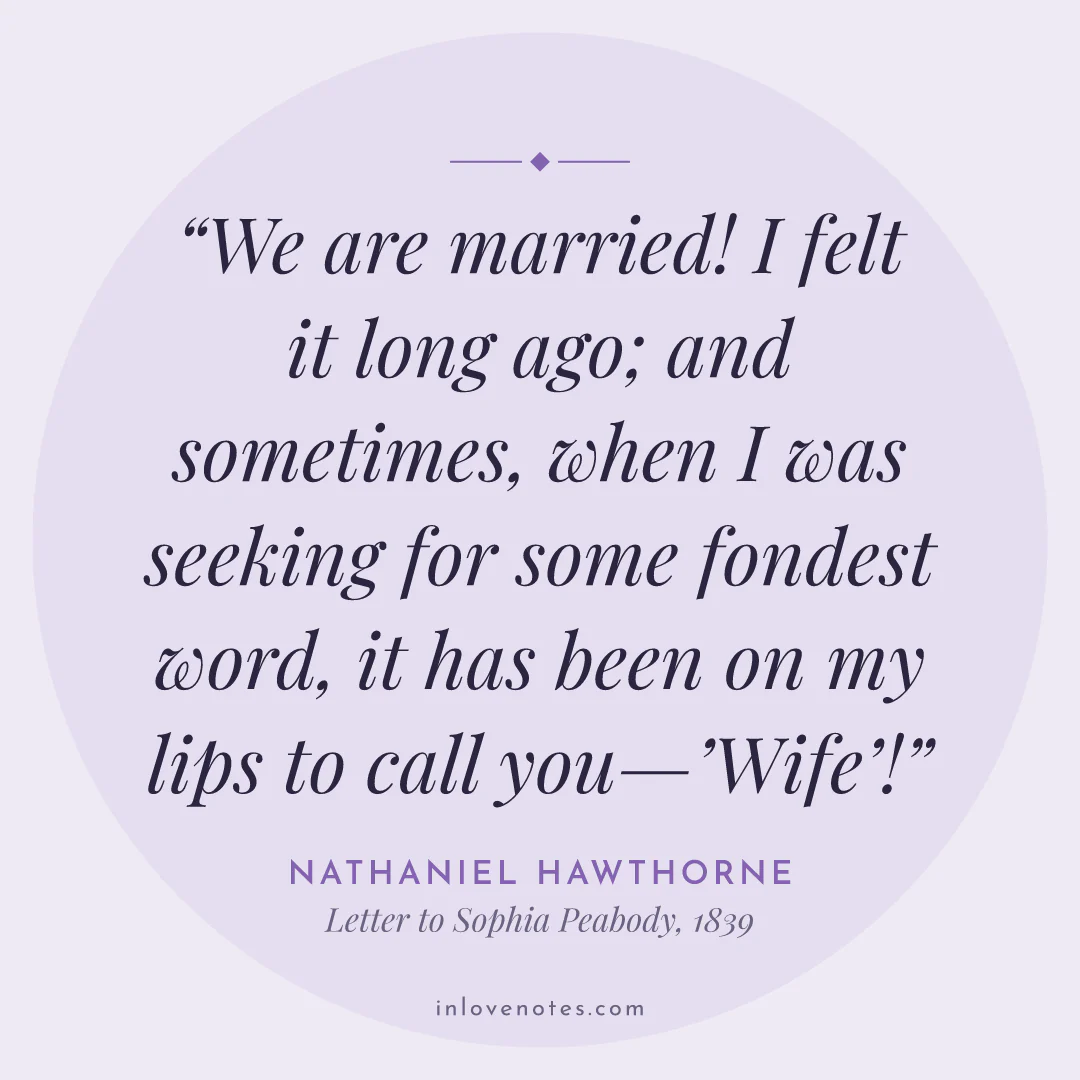
"We are married! I felt it long ago; and sometimes, when I was seeking for some fondest word, it has been on my lips to call you—'Wife'!"
Nathaniel Hawthorne, letter to Sophia Peabody, Boston, 24 July 1839 (Love Letters of Nathaniel Hawthorne, vol. 1, 1907)
What makes this work is the confession inside it: he admits he had been holding the word back because he was afraid she would "shrink back". A fortnight later, after she began signing her own letters as his wife, he wrote, "I kiss that word when I meet it in your letters." You can borrow the move without the nineteenth-century language: tell her the word you can't wait to call her, and why you haven't said it out loud yet.
Example 3: A letter to my future wife while we're engaged
Editor-written example.
Maya,
I've started saying "my fiancée" to people who didn't ask. The guy at the hardware store. My dentist. I can't stop, and I'm not sorry.
Here's what I want you to know before the planning eats every evening we have: I'm not marrying you for the wedding. I'm marrying you for Tuesday nights, for the way you narrate what the dog is thinking, for how you went quiet and then furious when my dad was in hospital and you drove four hours without being asked.
The seating chart will get done. If I'm short with you about it, remind me of this letter.
Seven months. I'm counting.
Daniel
Example 4: A thank-you letter to my future wife
Editor-written example, for the weeks of planning.
Thank you for the spreadsheets. I know that's not romantic, but you built them, and I've watched you carry the venue, the caterer and both of our mothers, and I haven't said it properly.
So: thank you. Tonight I'm cooking, the laptop is closed, and nobody says the word "centrepieces" until tomorrow.
Example 5: A birthday letter to my future wife
Editor-written example, for her last birthday before the wedding.
Happy birthday to the last version of you who isn't married to me.
I hope she's had a good year. I've liked her a lot. Next year I get to wish happy birthday to my wife, which is a sentence I am going to say out loud several times today just to hear it.
Love you. Cake's in the fridge. Don't look.
What should I write in a letter to my future wife on our wedding day?
The wedding-morning letter is the one most people mean when they search for this, and it has practical limits the others don't. She will read it in a room full of people, often while someone is doing her hair, and she may be wearing make-up she doesn't want to redo. So:
| Decision | What works | Why |
|---|---|---|
| Length | One side of one page | She can read it twice in the time she has, and still re-read it that night. |
| Who delivers it | Her maid of honour, her mother, or your best man | Someone who knows when she has five quiet minutes. |
| When | After hair and make-up have started, before the dress | Not first thing (she's busy), not right before the aisle (no time to recover). |
| Content | One memory, one thing you see in her today, one line about tonight | The vows will carry the big promises; the letter can be personal and small. |
| Avoid | Long apologies, inside jokes about exes, anything she'd need to explain | Bridesmaids will ask what it said. |
Example 6: The wedding-morning letter
Editor-written example.
Good morning, almost-wife.
I'm writing this the night before, at the hotel desk, in a shirt I'm not allowed to wrinkle. I keep thinking about the first time you laughed at me, really laughed, when I tried to parallel park outside your sister's place and gave up and drove around the block twice. I think I decided that day.
Today I'm going to be standing at the front, and I'm going to see you before anyone else in that room has the right to look at you the way I will. I've been waiting for that more than for any part of the day.
Take your time getting ready. I'm not going anywhere. That's sort of the point.
See you at the end of the aisle,
J.
Example 7: A short note to go with a wedding-morning gift
Editor-written example, short enough for a card.
Something to wear today, from the man who gets to marry you in it. I love you. Don't cry, you'll be told off by the photographer. See you soon.
Which promises belong in the letter?
Promises are what make a letter to a future wife different from a love letter to a girlfriend, and they are also where these letters go wrong: "I'll make you happy every day" sounds kind and can't be kept. Twain had a better instinct. In a letter to his family written after his engagement to Olivia Langdon was settled in February 1869, he explained why he had bought her a cheap ring:
"I gave her only a plain gold engagement ring, when fashion imperatively demands a two-hundred dollar diamond one, and told her it was typical of her future lot—namely, that she would have to flourish on substantials rather than luxuries."
Mark Twain, letter to Jane Clemens and family, Lockport, N.Y., 27 February (Mark Twain's Letters, vol. 2, ed. Albert Bigelow Paine, 1917)
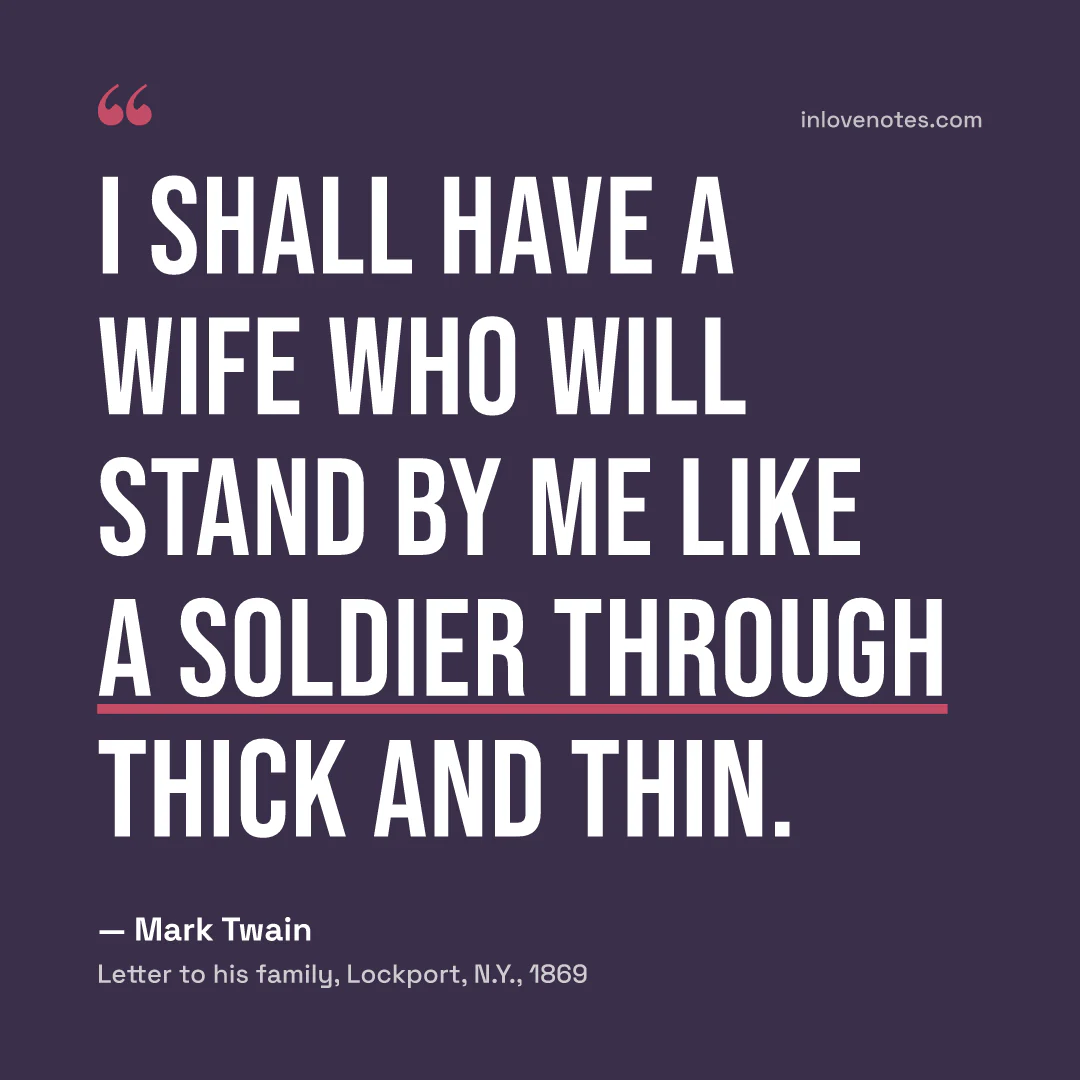
Paine's edition prints the year as 1868, but his own commentary places the letter after the engagement was "finally ratified" in February 1869, so read it as 1869. In the same letter Twain writes that he "shall have a wife who will stand by me like a soldier through thick and thin". The ring line is the part to learn from: he told her plainly what he could and couldn't offer, and made a promise about substance rather than luxury. A promise she can check is worth more than one that only sounds big.
| Vague promise | A version she can hold you to |
|---|---|
| I'll always make you happy. | When you're unhappy, I'll ask what's wrong before I try to fix it. |
| I'll never let you down. | When I let you down, I'll say so first, before you have to point it out. |
| I'll love you forever. | I'll still plan dates when we've been married twenty years. |
| You'll never want for anything. | We'll make money decisions together, out loud, with nothing hidden. |
| I'll always be there for you. | When your family needs you, I'll come too, even when it's inconvenient. |
Two or three of these are enough for a letter. Save the rest for your vows, or for the next letter.
What can I say to my future wife out loud?
Sometimes the question isn't a letter at all but what to say across the table, or in a text when she's stressed about the guest list. These short lines are our editors' own wording, not quotations; adjust them until they sound like you.
- "I keep forgetting we're getting married and then remembering, and it's good news every time."
- "You don't have to be perfect on the day. You just have to show up, and so do I."
- "I'm marrying you, not the venue. Whatever goes wrong, that part's fine."
- "I can't wait to be boring with you."
- "When this is over, I want a whole Saturday with no plans and you."
- "I'm proud of how you're handling all of this. I should say that more."
How do you start and end a letter to your future wife?
Start with something only you would write: her name, a nickname, or a plain observation about today ("I'm writing this at the kitchen table while you're asleep"). Avoid opening with "Dear future wife" if she is already your fiancée; it reads as a template. End with a line that points forward: Hawthorne often closed with a blessing and a parting word to his "Dove", and a modern equivalent is as simple as "See you at the end of the aisle" or "Seven months, I'm counting." There are more openings and sign-offs, with real examples, in our guide on how to start and end a love letter, and a step-by-step method in how to write a love letter.
If you are still at the stage before a relationship, our example letters to a crush cover that first step. And once she is your wife, the letters change again: see what real husbands wrote to their wives, from anniversaries to long separations.
Sources
- Charles Darwin, "This is the Question" memorandum, July 1838, CUL-DAR210.8.2, transcribed on Darwin Online.
- Proposal date, "The day of days!" journal entry and wedding date: Darwin Correspondence Project, "Darwin's marriage".
- Nathaniel Hawthorne to Sophia Peabody, 24 July and 8 August 1839, in Love Letters of Nathaniel Hawthorne, vol. 1 (Chicago: Society of the Dofobs, 1907), Project Gutenberg.
- Mark Twain to Jane Clemens and family, Lockport, N.Y., 27 February, in Mark Twain's Letters, vol. 2, ed. Albert Bigelow Paine (1917), Project Gutenberg.