A Letter to My Crush About My Feelings: 8 Example Letters and How to Hand One Over
8 example letters to your crush (short, funny, to a friend, by text), a fill-in version, and what research and Pushkin's Tatiana teach about confessing.
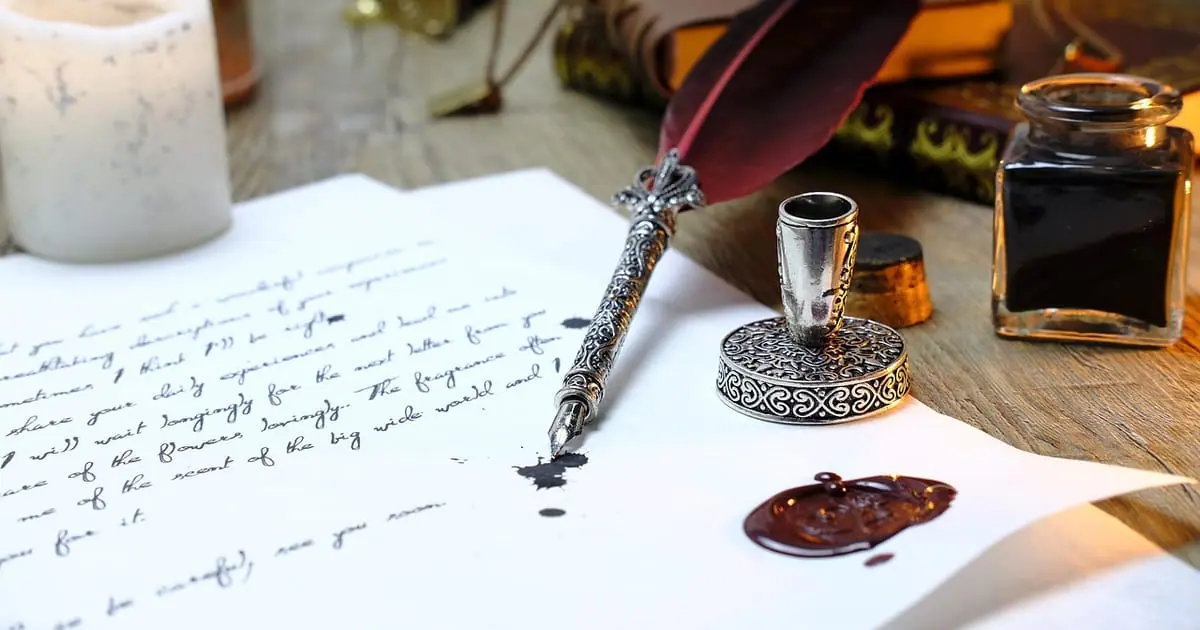
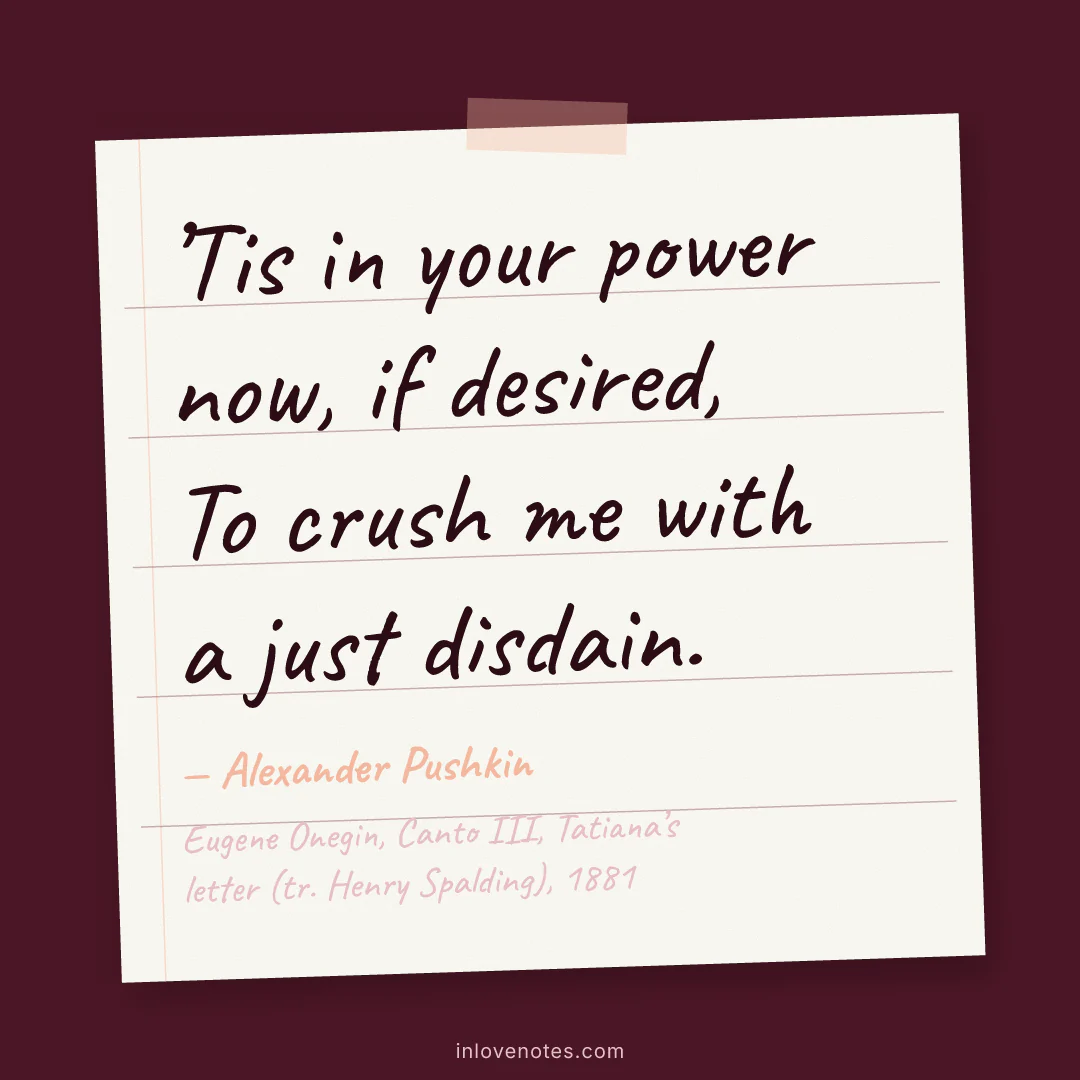
The most famous letter to a crush in literature was written by moonlight and regretted by sunrise. In the third canto of Alexander Pushkin's Eugene Onegin, a shy country girl, Tatiana, sits up all night writing to a man she has met only briefly, and she writes it in French because she can't find the words in Russian. When she finishes, the letter shakes in her hand and the moon is fading over the valley. Her second line hands him all the power: it is "in your power now, if desired, / To crush me with a just disdain."
A letter to your crush about your feelings needs to do three things, and Tatiana managed only two. It should say what you noticed about this one person, in details only they would recognise. It should say plainly how you feel. And it should leave them an easy way to say no. This page gives you eight example letters written by our editors for different situations, a fill-in version, the research behind those three jobs, and what Pushkin and Edmond Rostand's Cyrano de Bergerac show about how confessions go right or wrong. The [square-bracket slots] are for the details only you know.
Should I Write a Letter to My Crush, or Just Tell Them?
Write the letter if speaking would make you freeze or ramble, or if you want them to have time to think before they answer. Tell them in person, or by a short text, if you already talk easily and a long letter would feel heavier than the friendship. A letter gives the other person something no conversation can: a private minute to react without anyone watching their face.
| Way to confess | Works best when | Watch out for |
|---|---|---|
| Handwritten letter or card | You know each other a little, and you want to be clear and kind | Handing it over in front of friends; it turns a private question into a public one |
| Long message or email | You talk online more than in person, or live far apart | Sending it late at night and then watching for "seen" |
| Short text, then talk | You're already close and joke easily | A line so jokey they can't tell if you mean it |
| Anonymous note | Almost never. It feels safe to write, but it leaves them unable to answer | Guessing games that make them uneasy rather than flattered |
| In person | You can keep it short and give them room to answer later | Asking for an answer on the spot |
Two situations call for no letter at all: when the person has power over you or you over them (a teacher, a manager, a coach), and when they're in a relationship and have given no sign of wanting out. In both, a confession puts them in an awkward spot they didn't choose.
Should I send an anonymous letter to my crush? Almost never. An anonymous note feels safe to write, but it leaves them unable to answer, and guessing games tend to make people uneasy rather than flattered. If you're hoping a secret-admirer note will reveal itself later, sign it now instead. A name gives your crush something to answer, and a mystery only gives them something to worry about.
What Tatiana's Letter Gets Right, and What Not to Copy
Tatiana's letter runs to about seventy lines in Henry Spalding's 1881 English translation (checked against the Project Gutenberg text). Its strongest passage is not the passionate one. It is the modest wish in the middle, where she says she would have kept quiet forever if she could only have seen him now and then:
"To see you by our fireside stand, / To listen to the words you speak, / Address to you one single phrase / And then to meditate for days / Of one thing till again we met."
— Tatiana's letter, in Alexander Pushkin, Eugene Onegin, Canto III (tr. Henry Spalding, 1881)
That is the part worth borrowing. It is small, specific and true, and any reader can picture it. The rest of the letter climbs much higher: he is a "guardian angel," she has dreamed of him, and "My destiny / From henceforth I confide to thee!" That is where she goes wrong. A letter that makes the other person responsible for your whole future is very hard to answer kindly, because any answer short of "yes" sounds cruel. Keep your feelings big if they are big, but keep your request small: a coffee, a walk, a reply when they're ready.
How Should I Express My Feelings to My Crush in a Letter?
Show it is about them with details only they would recognise, say the feeling in one plain sentence early on, and make "no" easy to say. Every good confession letter, long or short, does those three jobs, in that order.
- Show it is about them, not about having someone. In a 2007 study in Psychological Science, Paul Eastwick, Eli Finkel, Daniel Mochon and Dan Ariely ran seven speed-dating sessions with 156 students. People who felt a particular spark for one partner tended to get that interest returned, while people who were keen on nearly everyone were liked less. Finkel's explanation, in the press release about the study (February 2007): people who like everyone "may exude desperation in a romantic context." In a letter, specificity is how you show that your interest is selective. "You're so pretty and nice" could go to anyone. "You laughed at the wrong part of the film and then explained why you were right" could only go to one person.
- Say the feeling in one plain sentence. "I like you, as more than a friend" does more work than three paragraphs that circle it. Put it early, in the first third of the letter, so they don't read the whole thing wondering where it's going.
- Make "no" easy to say. Roy Baumeister, Sara Wotman and Arlene Stillwell studied both sides of unrequited love in a 1993 paper whose title lists what they found: "heartbreak, anger, guilt, scriptlessness, and humiliation" (Journal of Personality and Social Psychology 64(3), 377–394). "Scriptlessness" is the key word. The person being confessed to often has no idea how to say no kindly, and the rejectors in the study felt guilty, not just relieved. One sentence such as "If you don't feel the same, just tell me, and I promise we're fine" hands them that missing script.
Eight Letters to My Crush, by Situation
These were written by our editors as starting points, not as letters to send word for word. Each works for a boy or a girl; change the pronouns and the details. The parts in brackets are where the letter becomes yours.
1. A short letter to my crush (to fold into a book or a pocket)
[Name],
I've rewritten this note four times, so here is the short version. I like you. Not in a "you're a nice person" way, although you are. It's the way I look for you when I walk into [place]. If you'd like to get [coffee / a slice of pizza / a walk after class] sometime, I'd love that. If not, no awkwardness, I promise.
[Your name]
2. A letter to my crush about my feelings (the paragraph version)
Dear [Name],
I've been trying to work out when this started, and I think it was [the specific moment: the day you lent me your charger and told me the story about your brother]. Since then I notice small things: [how you always ask the quiet person in the group what they think / the way you hum when you're concentrating]. I'm writing it down because when I try to say it out loud I end up talking about the weather. So, plainly: I have feelings for you, more than a friend would. I'm not asking you to feel the same. I'd just rather you knew than spend another month wondering what you'd say. Whatever your answer is, I'm glad I know you.
[Your name]
3. To a friend I've fallen for
[Name],
This is the hardest letter I've written, because I don't want to lose what we have. You're the first person I want to tell when something funny happens, and somewhere in the last [few months / year] that turned into something more for me. I'm telling you because hiding it was starting to make me act strange around you, and you deserve better than that. If you don't feel the same, say so, and I'll take a little time and then be the same friend I was. Our friendship matters more to me than this letter.
[Your name]
4. To someone I barely know (school, college, work in another department)
Hi [Name],
We've only talked a few times, mostly about [the class / the bus being late], so this might be a surprise. I'd like to know you better. You [one thing you've genuinely noticed: asked the question everyone else was too shy to ask], and I've thought about it since. Would you want to [grab lunch / study together] one day? If you'd rather not, that's completely fine, and you don't have to explain.
[Your name], [how they know you: the one who sits by the window]
5. A funny letter to my crush
Dear [Name],
After careful research, I have concluded that I like you. Evidence: I laugh at your jokes, including [the bad one about the stapler]. I know your [coffee order / favourite band] without having asked. I rehearsed saying hi to you in the mirror, and it went badly. I'm putting this in writing so you can laugh at it in private. If you'd like to discuss these findings over [snacks], my schedule is suspiciously open. If not, please return this letter so I can destroy the evidence.
[Your name]
Humour works only if the feeling still comes through. Keep one sentence completely straight ("I really do like you") so the joke doesn't become a place to hide.
6. For Valentine's Day or their birthday
Happy [Valentine's / birthday], [Name].
I wanted to give you a card that says more than "have a good one." The truth is I like you, and today felt like a good excuse to be brave. You make [ordinary days at work / Tuesday chemistry] much better. No pressure to reply in a particular way. I just wanted you to have one more nice thing today.
[Your name]
On a birthday, keep the confession short and the card mostly about them. Their day shouldn't turn into a day about your question.
7. A letter to my crush who doesn't like me back (one you may never send)
[Name],
I know now that you don't feel the same, and I'm okay, or I will be. I want to say thank you for [being kind about it / never making me feel stupid]. Liking you taught me [that I can be brave / what I want in someone]. I'm going to step back a little for a while, not because I'm angry but because it's easier to be your friend when I'm not hoping. I wish you something good.
[Your name]
Many people write this one only for themselves and keep it. That's a fine use for a letter. If you do send it, send it once, and don't use it to reopen the question.
8. The text version
"Okay, I'm just going to say it before I lose my nerve: I like you, as more than a friend. You don't have to answer now, and it's fine if it's a no. I just didn't want to keep pretending I don't."
The Fill-In Version, and Cyrano's Warning About Copy and Paste
Plenty of people search for a letter to copy and paste, and there's no shame in borrowing a shape. But Rostand's 1897 play Cyrano de Bergerac is a whole evening about what happens when the words aren't yours. Cyrano writes love letters to Roxane in the name of the handsome Christian, and they work, on the wrong man. In Act IV she tells Christian it was the letters that won her:
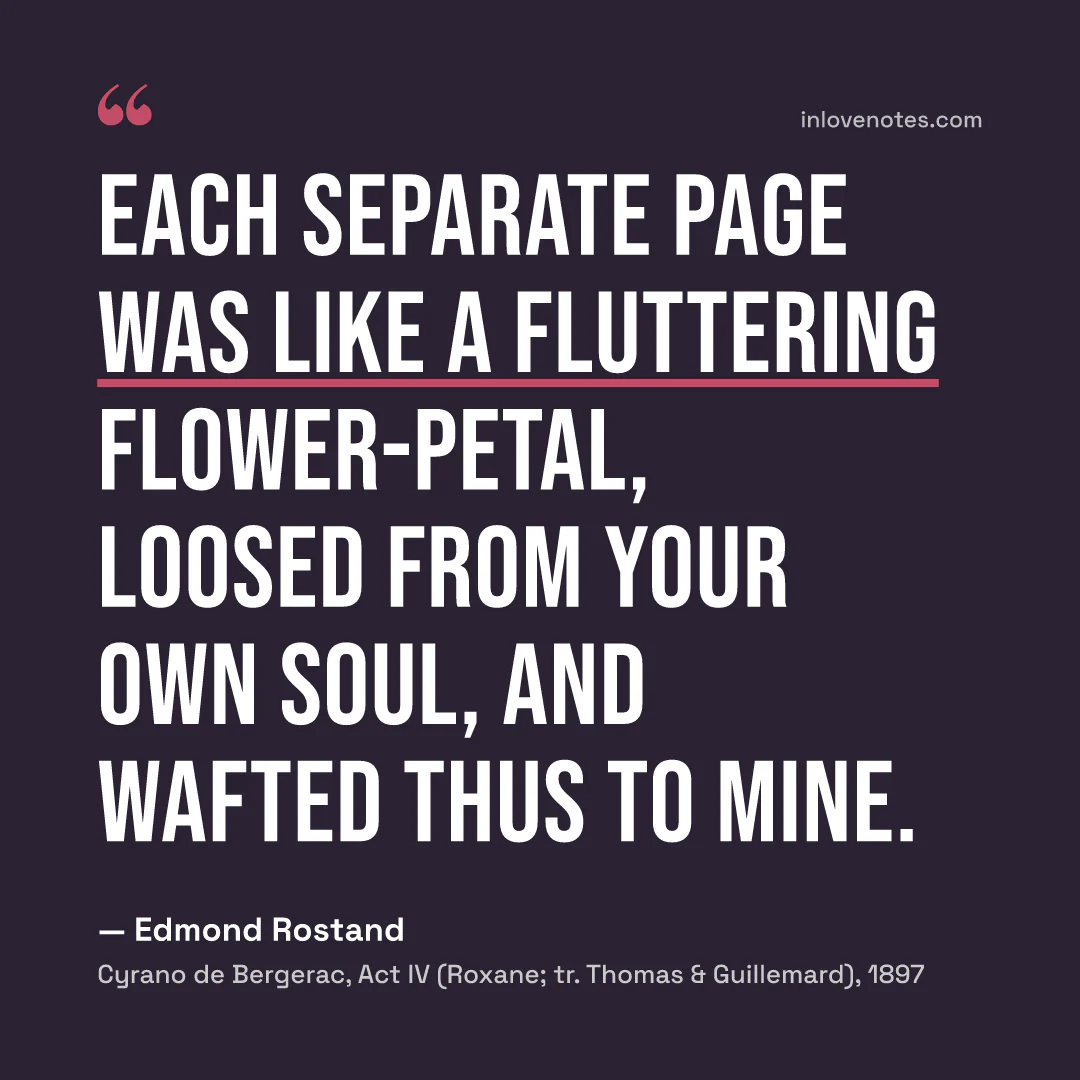
"I read, read again—grew faint for love; / I was thine utterly. Each separate page / Was like a fluttering flower-petal, loosed / From your own soul, and wafted thus to mine."
— Roxane, in Edmond Rostand, Cyrano de Bergerac, Act IV (tr. Gladys Thomas and Mary F. Guillemard; Project Gutenberg)
She goes on to say she now loves Christian "only for your soul," and Christian steps back from her, because that soul belonged to someone else. A copied letter carries the same risk on a smaller scale. If your crush says yes to words you found online, they've said yes to a stranger's voice, and you'll have to keep it up. Use a frame like the one below, then let every bracket be something only you could write.
Fill-in letter:
[Name],
I've wanted to tell you something since [moment]. I like you, as more than [a friend / a classmate / someone I say hi to]. What I like most is [specific thing they do], and the time you [specific memory] still makes me smile. Would you want to [small, easy plan]? If you don't feel the same, just tell me. I promise [we're fine / it won't be weird], and I'm glad I said it either way.
[Your name]
For greetings and sign-offs that match your tone, see how to start and end a love letter. If you're past the crush stage and writing to someone you're already with, our guide to writing a love letter covers longer forms.
If the Answer Is No: What Onegin Got Wrong
Onegin does answer Tatiana's letter, in person, in Canto IV, and he starts well:
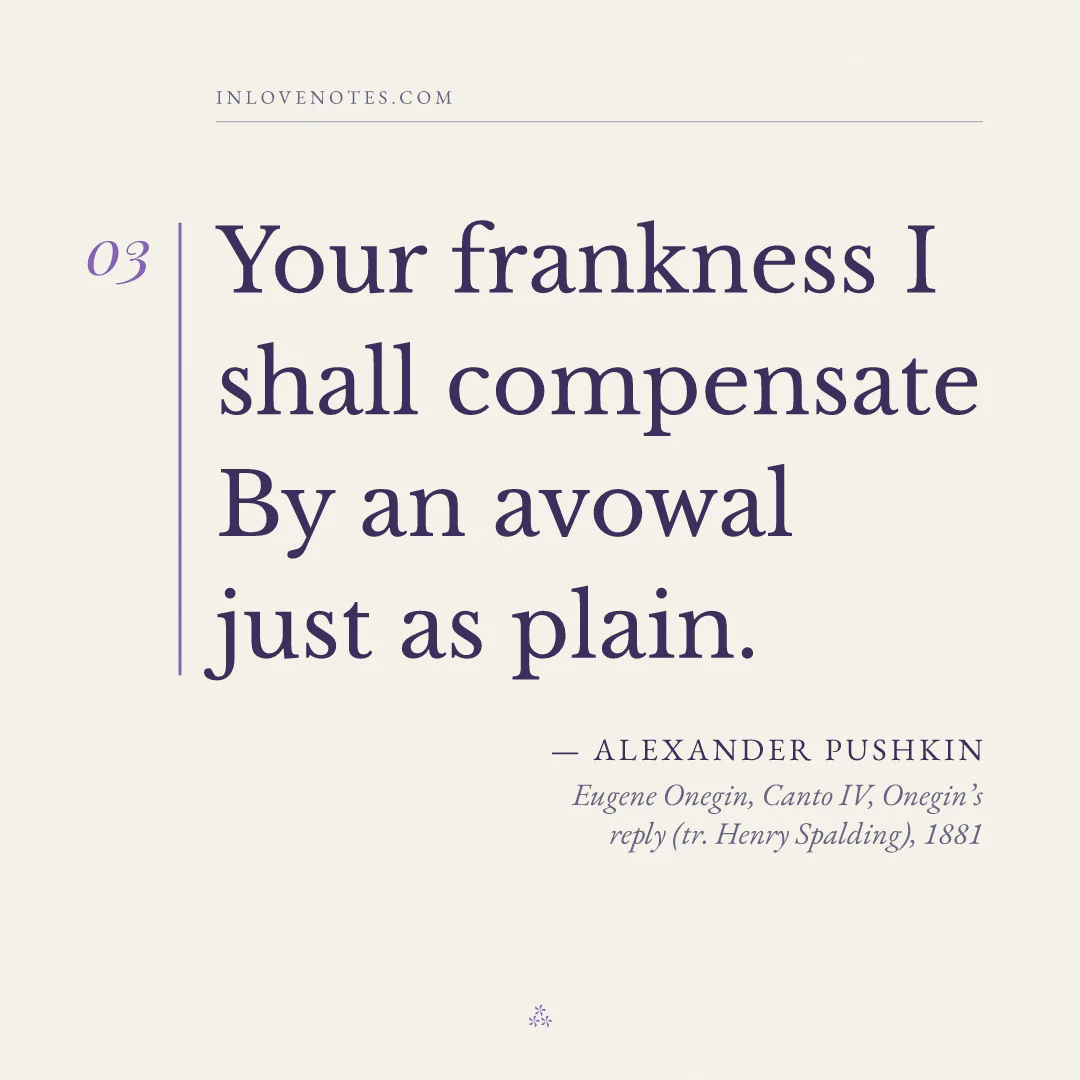
"You have a letter to me sent. / Do not excuse yourself. I read / Confessions which a trusting heart / May well in innocence impart. / Charming is your sincerity."
— Onegin, in Alexander Pushkin, Eugene Onegin, Canto IV (tr. Henry Spalding, 1881)
He thanks her, tells her the truth, and says he loves her "with a brother's love." Then he spoils it. He lectures her that a girl may fall in love again, and ends: "Learn to possess more self-control." That one line turns a kind refusal into a lecture. If you're the one sending the letter, know that a no can be clumsy even when it's honest, as Onegin's was. If you're the one who received a letter like this, his opening is a fine model and his ending is the warning. Thank them, be clear, and leave out the advice.
If the answer is no, reply once and briefly ("Thank you for telling me. I'm glad I did too"), then give it a few weeks before you try to act normal. Don't ask why, and don't send a second letter to argue. And if there's no answer at all after a week or so, take the silence as the answer. Chasing it usually costs the friendship that a quiet no would have kept.
Handing It Over
Give it somewhere private and leave soon after, so they can read it alone. Paper beats a screen for a first confession: it can't be screenshotted into a group chat by accident, and it shows effort. A plain envelope with their name on the front is enough. If your letter feels thin, cut rather than add; the best ones on this page are under 200 words. If it goes well, the next problem is a nice one, and our cute messages for a girlfriend and love letters for him are there when you need them.
Tatiana, by the way, gets the last word. Years later, in Canto VIII, Onegin writes her a love letter of his own. By then she is married, and although she admits she still loves him, she turns him down. Pushkin's point, and ours, is that the person who writes the honest letter is not the one who loses.