100 Reasons Why I Love You: A List to Adapt, and How to Write Your Own
100 example reasons why I love you in ten groups, a 5-step way to write your own, and jar and 52-card deck ideas, with Browning and Montaigne sourced.
A "100 reasons why I love you" list is a gift made of one hundred short, specific sentences, each finishing the words "I love you because…", written out on a page, folded into a jar, printed on a deck of cards or bound as a little book. Below you will find 100 example reasons in ten groups of ten, written by our editors as starting points rather than finished lines, a five-step way to turn them into a list that could only be about your person, and a table to help you choose between a list, a jar, a 52-card deck and a book. The idea is older than any craft blog. Between 1845 and 1846, Elizabeth Barrett was writing sonnets to Robert Browning, and one of them is a list that numbers its own reasons.
The oldest "reasons" list in English poetry has fourteen lines
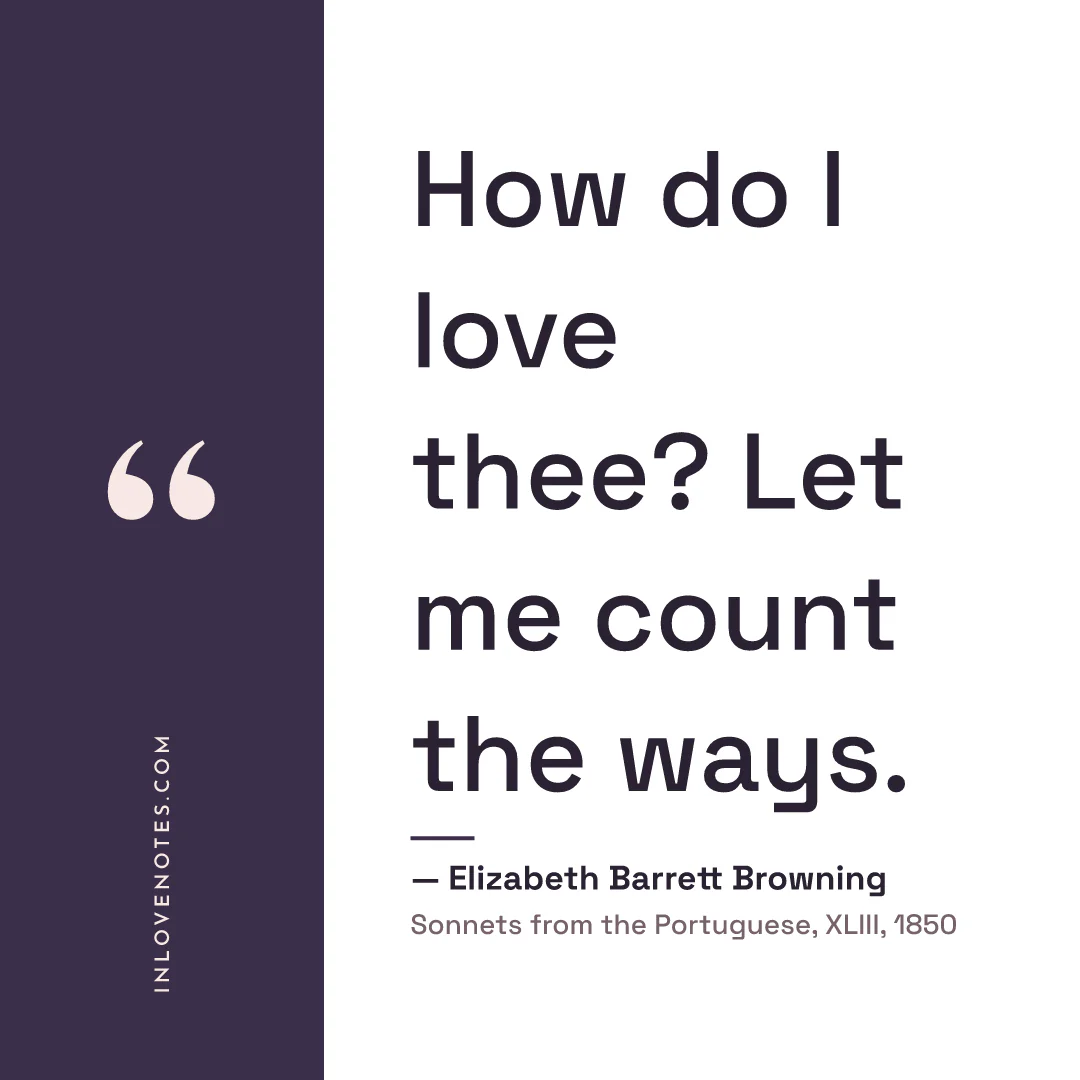
Elizabeth Barrett wrote the forty-four Sonnets from the Portuguese during her courtship with Robert Browning in 1845 and 1846, and kept them private until he persuaded her to publish them in 1850. The title pretends they are translations so the poems would seem less personal. Sonnet XLIII is the one everyone half-remembers, and its first line is an invitation to count:
How do I love thee? Let me count the ways. / I love thee to the depth and breadth and height / My soul can reach, when feeling out of sight / For the ends of Being and ideal Grace. / I love thee to the level of everyday's / Most quiet need, by sun and candlelight.
Elizabeth Barrett Browning, Sonnets from the Portuguese, XLIII (1850)
Read it as a list and you notice how it is built. She does not rank his virtues. She counts the ways she loves: to the farthest reach of the soul, and then, in the very next breath, at the level of "everyday's / Most quiet need, by sun and candlelight". The grand and the domestic sit side by side. That is the best advice anyone can give about a reasons list: put the large reason ("you make me braver") next to the small one ("you warm the car before I get in"), and let each make the other believable.
The poem also ends on a reason that cannot be proved: "if God choose, / I shall but love thee better after death." A good list can end the same way, with one reason you can't explain. We come back to that below, because Browning herself wrote a sonnet arguing the other side.
Why small, specific reasons land harder than big ones
Specific reasons work because they prove you were paying attention. "You are kind" could be said of anyone; "you always ask the cashier how their day is going, and you listen to the answer" could only be said by someone who has stood next to this person in a queue.
There is some research behind the instinct. In a study published in Personal Relationships in 2010, Sara Algoe, Shelly Gable and Natalya Maisel followed more than sixty-five couples in committed relationships and tracked day-to-day changes in how satisfied and connected each partner felt. Those everyday ups and downs were reliably marked by one partner's feelings of gratitude, and the effect was still visible the following day. The authors called everyday gratitude a "booster shot" for romantic relationships, and the paper's title says where it lives: "It's the little things."
That study measured gratitude, not reasons lists, so treat it as a hint rather than proof. But a reasons list is, in practice, gratitude written down a hundred times, and the "little things" finding matches what people say when they describe the list they kept: the line about the coffee, not the line about their beautiful soul.
How to write your own 100 reasons in five steps
Writing a hundred reasons from scratch in one evening is hard; most people stall around twenty-five. The answer is to collect first and write later.
- Collect for a week before you write. Keep a note on your phone titled with their name. Every time they do something that makes you glad, type four or five words: "fixed my bike chain, didn't mention it". Seven days of noticing usually gives you forty raw reasons.
- Use ten groups of ten. A hundred feels endless; ten small lists of ten do not. The groups below (small daily things, how you treat people, how you love me, your mind, your humour, hard times, our history, the future, things only you do, reasons I can't explain) are one way to divide it. Swap any group that doesn't fit.
- Run the "only you" test. Read each reason and ask whether it could be said about anyone else you know. If it could, add a detail: a place, a habit, a phrase they use. "You're thoughtful" becomes "you remember which of my friends doesn't drink and buy them something anyway".
- Mix the sizes. Alternate one-line reasons with the occasional longer one. A list of a hundred equally weighted sentences reads like a form; a few that run to two sentences make the reader slow down.
- Cut anything that compares or criticises. "You're not like my ex" and "you've finally stopped being late" are reasons in disguise for something else. Keep appearance to a few lines at most, for the reason Browning gives below. Then end with a reason you cannot explain.
If you want the reasons to grow into a full letter afterwards, our guide on how to write a love letter picks up where this list leaves off.
100 example reasons, in ten groups of ten
These are editor-written examples, not quotations. Words in [square brackets] are blanks for you to fill in. Read them for the shape, then rewrite each one with your own details; a list copied word for word will sound like everyone else's.
The small daily things
- You always leave the last bit of coffee in the pot for me.
- You text me when you get there, even when I forget to ask.
- You warm my side of the bed on cold nights before I come in.
- You remember how I take my tea, down to the exact milk.
- You hum without noticing when you cook.
- You send me photos of dogs you pass on the street.
- You put my phone on charge when I've left it at 4%.
- You always say goodbye properly, even when we're late.
- You notice when I've had a haircut, even a small one.
- You save me the crispy corner of [the lasagne / the brownies].
How you treat other people
- You are kind to waiters, and you mean it.
- You call your [mum / grandmother] every Sunday without being reminded.
- You stop for people who look lost.
- You remember the names of my colleagues' children.
- You never talk down to anyone, whoever they are.
- You are the first to offer help when a friend moves house.
- You give credit to other people in public.
- You apologise to children when you get something wrong.
- You stay friends with people through their difficult years.
- You tip well, and you never make a show of it.
How you love me
- You make me feel chosen, not tolerated.
- You ask about my day and then ask a second question.
- You let me be quiet without asking what's wrong.
- You tell people good things about me when I'm not in the room.
- You hold my hand in public as if it's the most normal thing in the world.
- You never make me feel silly for being scared.
- You learned the things I care about, even the boring ones.
- You still look at me across a room at parties.
- You say "I'm proud of you" and I believe it.
- You love me on the days I'm hard to love.
Your mind
- You ask questions nobody else thinks to ask.
- You change your mind when you hear a good argument.
- You explain things without making me feel slow.
- You read the plaque at every museum exhibit.
- You know the words to songs I've never heard of.
- You are curious about people who disagree with you.
- You can fix almost anything with [a screwdriver / a YouTube video] and patience.
- You notice details in films that I miss the first three times.
- You make plans that actually work.
- You think out loud, and I like listening.
Your humour
- You make me laugh when I'm trying to stay annoyed.
- You do the voices when you read anything out loud.
- You laugh at your own jokes before the punchline.
- You can turn a missed train into a story.
- You send me memes that only make sense to us.
- You are terrible at keeping a straight face.
- You dance badly and with total confidence.
- You still find [our oldest joke] funny.
- You can make my family laugh, which is not easy.
- Your laugh is the best sound in our house.
When things are hard
- You stayed with me in the waiting room.
- You never say "I told you so", even when you did.
- You fight fair, and you come back first.
- You hold me without trying to fix it.
- You take over the small jobs when I'm overwhelmed.
- You keep your promises when keeping them is inconvenient.
- You said sorry first the time it was mostly my fault.
- You remind me of what I've already survived.
- You stay calm when I can't.
- You never once made me feel like a burden.
Our history
- You [said yes / smiled back] on [the day we met].
- You were nervous on our first date, and it showed.
- You kept [the ticket / the receipt / the note] from [our first trip].
- You learned to love [my hometown] even though it rained the whole visit.
- You still tell the story of how we met slightly wrong, on purpose.
- You made [the first apartment] feel like home with almost nothing.
- You drove [three hours] to see me when it mattered.
- You remember our anniversaries better than I do.
- You were the first person I wanted to tell about [the job / the news].
- You made every year better than the one before it.
The future
- You talk about "us" in the future tense without hesitating.
- You make me want to be a better version of myself.
- You save for things we'll do together.
- I can picture us old, and I like what I see.
- You make big decisions with me, not for me.
- You want me to grow, even if it means change.
- You make the boring parts of life feel like a team sport.
- You are the person I want to show the world to.
- You make me less afraid of getting older.
- With you, home is a person, not a place.
Things only you do
- You call me [your nickname for me], and nobody else is allowed to.
- You fold [the towels / the maps] in that strange way of yours.
- You name every plant in the house.
- You sing [our song] wrong, every time.
- You eat [the crusts / the olives] off my plate without asking, and I let you.
- You make the same face when you're thinking hard.
- You leave notes in my [bag / coat pocket].
- You know exactly where I'm ticklish.
- You make [Sunday pancakes / your grandmother's recipe] better than anyone.
- You say goodnight to [the cat / the dog] before you say it to me.
Reasons I can't quite explain
- The world makes more sense when you're in the room.
- I feel at home in your silence.
- I still get excited when your name lights up my phone.
- You feel like a place I've always known.
- I trust you without having to think about it.
- My first thought in good news is you.
- I've loved you on ordinary days, and those count the most.
- I would choose you again, every time.
- I've run out of ways to say it, and I still mean it.
- Because it's you.
The last group matters more than its length suggests. The two writers in the next sections explain why.
Browning's warning: "Do not say I love her for her smile"
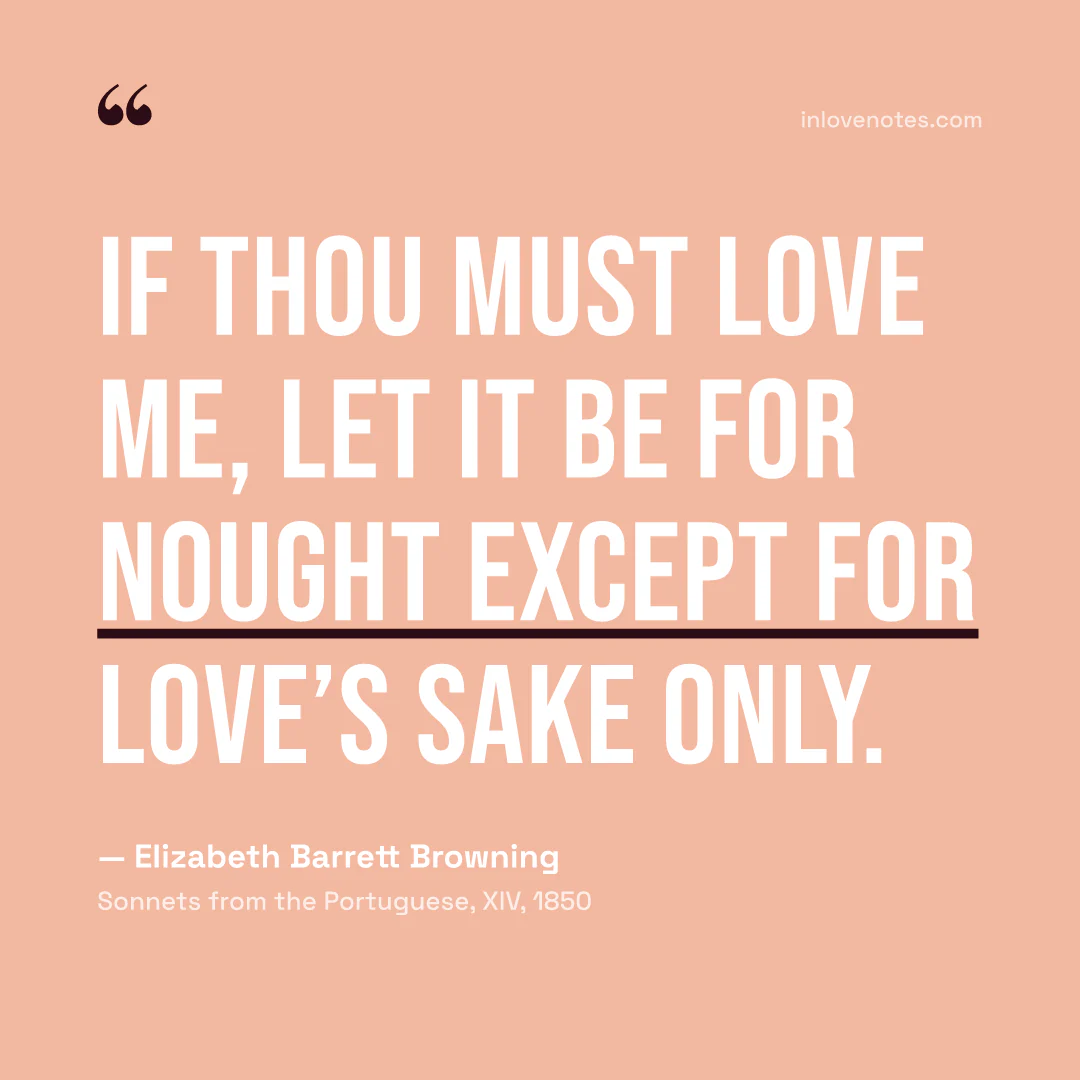
The same sequence that gave us "Let me count the ways" contains a sonnet that argues against counting. In Sonnet XIV, Elizabeth Barrett asks Robert not to list her qualities at all:
If thou must love me, let it be for nought / Except for love's sake only. Do not say / 'I love her for her smile—her look—her way / Of speaking gently,—for a trick of thought / That falls in well with mine…' / For these things in themselves, Belovëd, may / Be changed, or change for thee,—and love, so wrought, / May be unwrought so.
Elizabeth Barrett Browning, Sonnets from the Portuguese, XIV (1850)
Her worry is practical as well as romantic. A smile, a look and a way of speaking can change with illness or age, and love built only on them "may be unwrought so". She even rules out love for "Thine own dear pity's wiping my cheeks dry", because comfort, too, can stop being needed.
For a reasons list, the lesson is not to give up reasons. It is to weight them. Lines about looks are fine, but if half the list is about someone's eyes, the list quietly says the love depends on them. Reasons about character, choices and shared history age well; that is why only a few of the hundred above mention appearance.
"Because it was he": the reason Montaigne refused to give
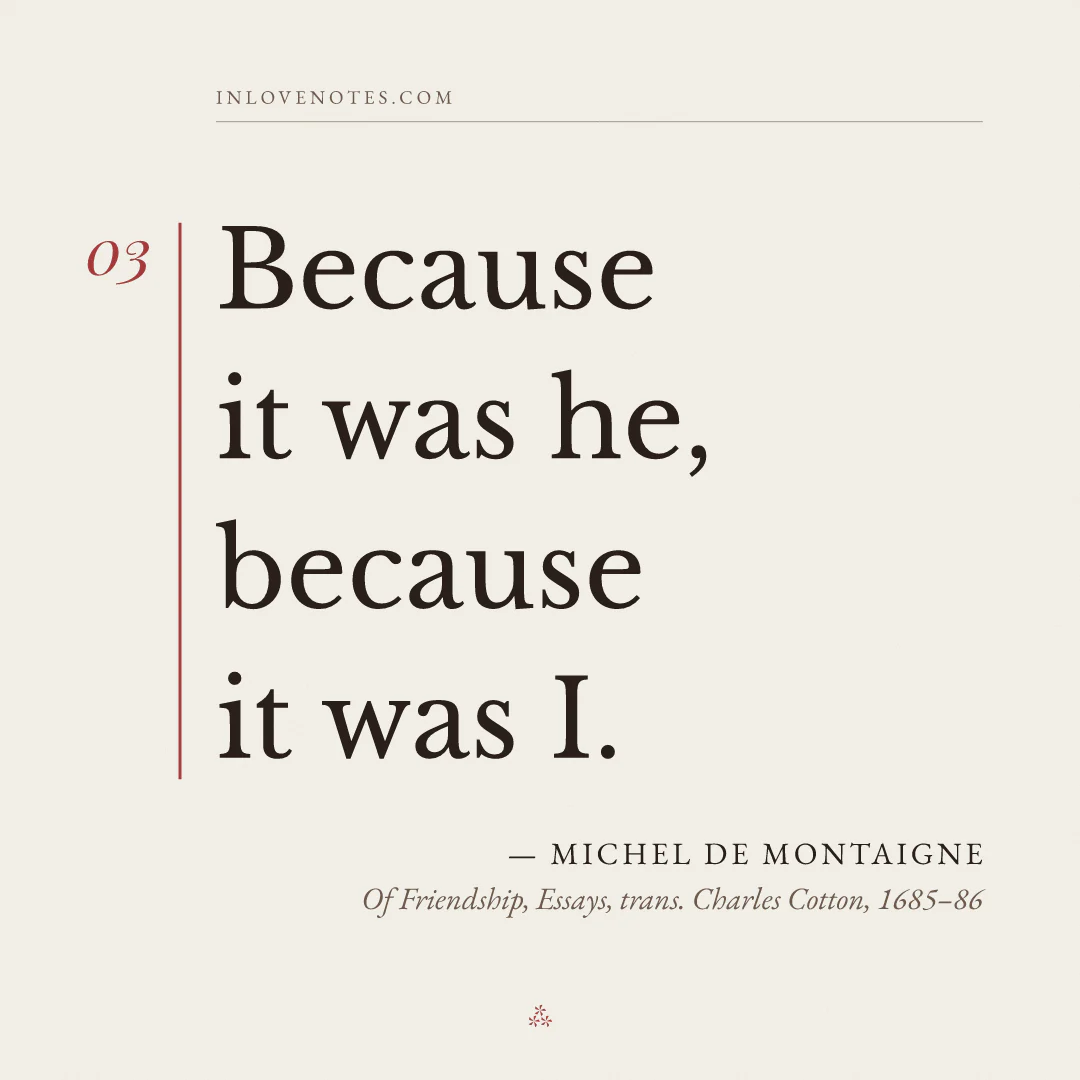
The most famous answer to "why do you love him?" is a refusal. Michel de Montaigne's essay "Of Friendship" is about Étienne de La Boétie, the friend who died in August 1563, and when Montaigne tries to explain the bond he gives up:
If a man should importune me to give a reason why I loved him, I find it could no otherwise be expressed, than by making answer: because it was he, because it was I.
Michel de Montaigne, "Of Friendship", Essays, Book I, trans. Charles Cotton (1685–86)
The essay first appeared in 1580, but the famous answer at the end of that sentence came later. Montaigne kept revising his own printed copy of the 1588 edition, now known as the Bordeaux copy, and parce que c'estoit luy, parce que c'estoit moy is one of his handwritten additions. Ink analysis reported by the University of Chicago's Montaigne Project found that the line was written at two different sittings, and that "because it was I" was put down before "because it was he". The best-known statement of unexplainable love was written in two goes, years after the friend had died, which may be the most encouraging fact a list-writer can hear: you are allowed to come back and add the last reason later.
Montaigne was writing about a friend, not a lover, but the line has become a standard of love writing in French (the original, parce que c'était lui, parce que c'était moi, is on our page of French love quotes with translations). On a list, it earns its place as reason 100. After ninety-nine reasons you can see, the last one admits that the whole thing is bigger than the list.
List, jar, deck or book: which format suits your hundred?
The format changes how the reasons are read. A list is read in one sitting; a jar is read one slip at a time; a deck is shuffled; a book is kept. Choose by how you want the words to arrive.
| Format | Usual number of reasons | How it's read | Best for | Watch out for |
|---|---|---|---|---|
| Written list or letter | 10, 25, 50 or 100 | All at once | Anniversaries, birthdays, a long-distance envelope | Repetition shows up fast when read in one go |
| Jar of folded slips | 100 or 365 (one a day) | One slip at a time | A long separation, a hard season, a whole year | 365 is a lot; 100 good slips beat 365 thin ones |
| Deck of 52 cards | 52 (4 suits of 13) | Shuffled, in any order | Valentine's Day, a playful gift | Each card must stand alone, with no "as I said above" |
| Small book or journal | 50 to 100+ | Kept and reread | Weddings, big anniversaries, keepsakes | Handwriting takes hours; draft on paper first |
For a 52-card deck, use the suits as your groups: hearts for how they love you, diamonds for what you admire in them, clubs for things you do together, spades for how they carry you through hard times. Thirteen per suit is easier to fill than fifty-two in a row, and the person can tell from the suit what kind of reason is coming.
For a jar, write each reason on its own slip, fold it twice so it can't be read through the glass, and add a label: "Open one when you need it". If you are apart for a while, the jar pairs well with a set of "open when" letters for the bigger moments.
Small changes for a boyfriend, a girlfriend, a husband or a wife
The method is the same for anyone; what changes is which groups carry the most weight.
- For a boyfriend or girlfriend in the first year or two, lean on "our history" and "things only you do". The firsts are still fresh, and naming them shows you kept them.
- For a husband or wife, lean on "when things are hard" and "the future". After years together, the most moving reasons are usually the ones about staying.
- For a long-distance partner, add a group about the distance itself: the calls at bad hours, the trips, the parcels. Our long, deep love messages for her show how those details read in paragraph form.
Whatever the relationship, read the finished list aloud once before you give it. Any line that makes you wince will make them wince too.
Questions people ask about reasons-why-I-love-you lists
How do I write 100 reasons why I love you?
Collect reasons for a week in a phone note, then sort them into ten groups of ten (daily habits, how they treat people, how they love you, their mind, their humour, hard times, your history, the future, things only they do, reasons you can't explain). Make each reason specific enough that it could only be about them, and finish with one reason you can't explain.
What are 52 reasons I love you?
It usually means a deck of playing cards with one reason on each card, often given on Valentine's Day. The easiest way to fill it is to give each suit a theme and write thirteen reasons per suit, so every card makes sense on its own when the deck is shuffled.
Can I copy a list of 100 reasons from the internet?
You can borrow the shape, but rewrite every line. A copied list sounds generic because it is: none of it refers to your person. Use the examples above as prompts and replace each one with a detail only the two of you would recognise.
How long does it take to write 100 reasons?
Plan on two or three evenings after a week of collecting notes. Writing the reasons is quick once you have the raw material; the slow part is noticing, which is why the collecting week matters.
Sources
- Elizabeth Barrett Browning, Sonnets from the Portuguese, Sonnets XIV and XLIII. Text checked against the Project Gutenberg edition (eBook #2002, transcribed from the 1906 Caradoc Press edition). First published 1850.
- Michel de Montaigne, "Of Friendship", Essays, Book I, chapter XXVII in the Charles Cotton translation, edited by William Carew Hazlitt. Text checked against Project Gutenberg eBook #3600.
- The Montaigne Project, University of Chicago: analysis of the "parce que c'estoit luy, parce que c'estoit moy" addition in the Bordeaux copy (ink, two sittings, order of writing).
- Algoe, S. B., Gable, S. L., and Maisel, N. C. (2010). "It's the little things: Everyday gratitude as a booster shot for romantic relationships." Personal Relationships, 17(2), 217–233. doi:10.1111/j.1475-6811.2010.01273.x. Summary consulted in the ScienceDaily release of 24 May 2010.
- The 100 example reasons were written by the In Love Notes editors for this page.