Love Letter to My Wife: What Real Husbands Wrote, and How to Write Yours
How to write a love letter to your wife, with samples for her birthday, your anniversary and hard times, plus seven real husbands' letters, all sourced.

On 4 July 1804 Alexander Hamilton sat down and wrote a letter he hoped his wife would never read. It was to be delivered to Eliza only if he died in the duel he had agreed to fight with Aaron Burr a week later. It runs to a few short paragraphs, and it ends: "Adieu best of wives and best of Women. Embrace all my darling Children for me." He was shot on 11 July and died the next day. Eliza kept the letter for the rest of her long life.
Most letters to a wife are written in calmer circumstances than that one: a birthday, an anniversary, a hard year, an ordinary Tuesday. But Hamilton's note shows what makes a letter to a wife different from a first love letter. You are not trying to win her. You are writing to someone who has seen you at your worst and stayed, and the letter works when it says so plainly. This guide shows how seven husbands did it in real letters (each one sourced), turns what they did into a short method, and ends with sample letters our editors wrote for the occasions people most often search for.
What a wife letter has that a dating letter doesn't
A love letter early in a relationship is mostly about the future: what you hope for, what you feel when she walks in. A letter to your wife has something better to work with, which is shared history. Years of it. The best letters below are almost all built from three things a newer couple can't write about:
- Time: how long you have been together, and what the years did to the love (Reagan and Cash both play with this).
- Debt: what she has carried, forgiven or made possible (Churchill's letter is nothing but this).
- The ordinary: the habits, the irritations, the jokes nobody else gets. Cash admits the two of them "irritate each other a little bit", and that one honest sentence is why people still share the letter.
If you only take one thing from this page, take that: a line about a real, small, shared thing will move her more than any adjective. If you are writing to a boyfriend or husband instead, our love letters for him are arranged by occasion in the same way.
Seven real letters from husbands, and the move each one makes
| Year | Husband to wife | Occasion | The move worth borrowing |
|---|---|---|---|
| 1804 | Alexander to Eliza Hamilton | Before a duel | Says the biggest thing in the fewest words |
| 1861 | Sullivan to Sarah Ballou | Before a battle | Promises something about the future |
| 1888 | Mark Twain to Olivia Clemens | Her 43rd birthday | Thanks her for existing, not for a favour |
| 1935 | Winston to Clementine Churchill | Reply while she travelled | Answers something she wrote to him |
| 1946 | Richard to Arline Feynman | Written after her death | Uses plain, almost blunt sentences |
| 1972 | Ronald to Nancy Reagan | 20th anniversary | Makes a joke out of the number of years |
| 1994 | Johnny Cash to June Carter Cash | Her 65th birthday | Admits the boring parts before the praise |
Alexander Hamilton, 1804: the farewell
Adieu best of wives and best of Women. Embrace all my darling Children for me.
Alexander Hamilton, letter to Elizabeth Hamilton, 4 July 1804
Hamilton had married Elizabeth Schuyler in December 1780, and by 1804 they had eight children. The letter opens by explaining that it "will not be delivered to you, unless I shall first have terminated my earthly career", and the original is in the Hamilton Papers at the Library of Congress (the full text is on the National Archives' Founders Online). The phrase "best of wives and best of women" became famous again through the musical Hamilton. What to borrow: a short superlative at the very end, after the practical paragraphs, lands harder than a page of praise at the start.
Sullivan Ballou, 1861: the promise
Sarah, my love for you is deathless.
Sullivan Ballou, letter to Sarah Ballou, 14 July 1861
Ballou, a Rhode Island lawyer and Union major, wrote to his wife from Camp Clark near Washington a week before the First Battle of Bull Run, where he was mortally wounded on 21 July. The same letter contains the line "never forget how much I love you, nor that, when my last breath escapes me on the battle-field, it will whisper your name" (text as given by the National Park Service). One caution if you quote it: no copy in Ballou's own handwriting has been found. The version everyone knows survives in copies and was first printed in 1868, while the Rhode Island Historical Society holds a second, brisker letter of the same date in his hand. What to borrow: a promise about the future ("whatever happens, this stays true") is the natural ending for a letter written before a hard stretch.
Mark Twain, 1888: the birthday thank-you
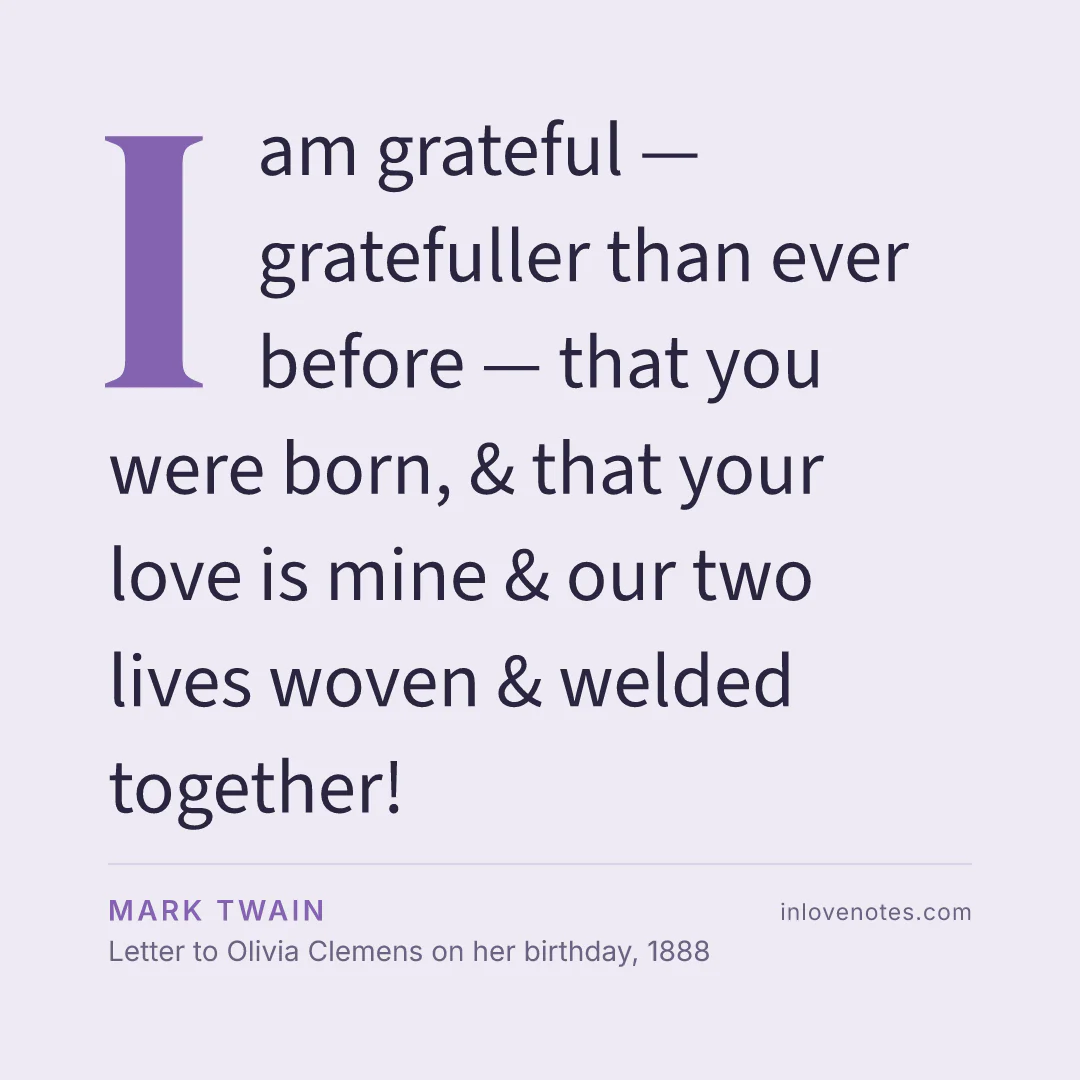
Livy darling, I am grateful — gratefuller than ever before — that you were born, & that your love is mine & our two lives woven & welded together!
Mark Twain, birthday note to Olivia Clemens, 27 November 1888
Samuel Clemens wrote this on his wife's 43rd birthday, eighteen years into their marriage; it is printed in The Love Letters of Mark Twain (1949), page 251. The made-up word "gratefuller" is the point. A professional writer let himself sound clumsy because the feeling was bigger than the grammar. What to borrow: on a birthday, thank her for being born and for choosing you, not for what she does around the house.
Winston Churchill, 1935: the reply
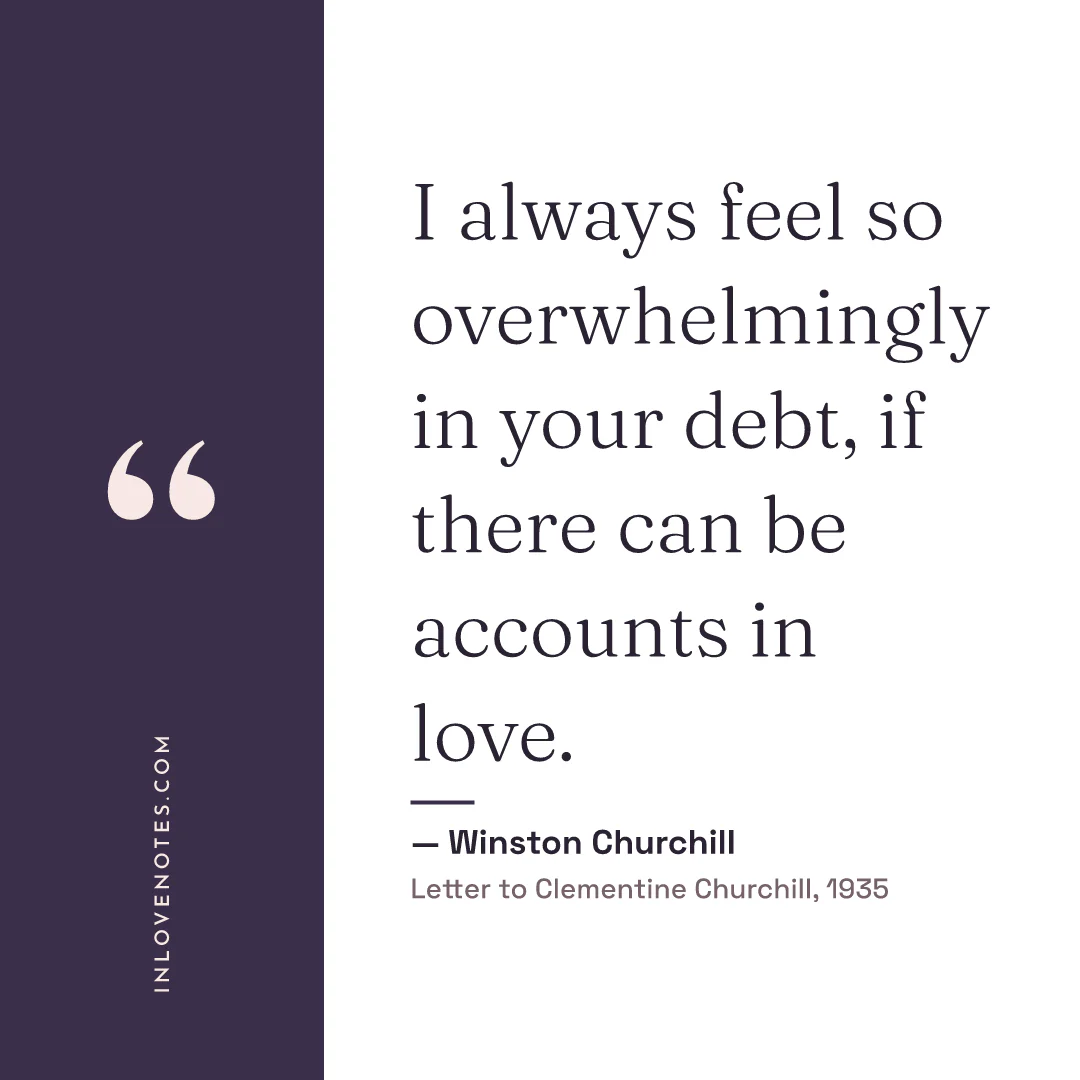
In your letter from Madras you wrote some words very dear to me about my having enriched your life. I cannot tell you what pleasure this gave me, because I always feel so overwhelmingly in your debt, if there can be accounts in love.
Winston Churchill, letter to Clementine Churchill, 23 January 1935
The Churchills had been married for more than 26 years when Clementine left for a months-long voyage to the South Seas, and her letters reached him from ports along the way; this one answers a letter she sent from Madras. It is quoted in Martin Gilbert's official biography. What to borrow: start from something she said to you. Quoting her own words back, and showing they stayed with you, is one of the most loving things a letter can do.
Richard Feynman, 1946: the plain sentence
I love my wife. My wife is dead.
Richard Feynman, letter to Arline Feynman, 17 October 1946
Arline died of tuberculosis in June 1945, three years after they married. Sixteen months later Feynman wrote her a letter and sealed it, and it was only read after his own death in 1988; it is printed in Perfectly Reasonable Deviations From the Beaten Track (2005). It begins "I adore you, sweetheart" and ends with a postscript: "Please excuse my not mailing this — but I don't know your new address." It is a grief letter, not a model for an anniversary, but it teaches one thing every husband can use: short declarative sentences sound truer than ornate ones.
Ronald Reagan, 1972: the joke about the years
I can't remember ever being without you and I know I was born more than 20 mins ago.
Ronald Reagan, letter to Nancy Reagan on their 20th anniversary, 4 March 1972
Reagan wrote Nancy hundreds of letters and notes, collected in I Love You, Ronnie (2000). In this one he pretends to dispute the claim that they have been married 20 years: twenty minutes, maybe. What to borrow: on an anniversary, play with the number. It turns the date from a statistic into a compliment.
Johnny Cash, 1994: the honest birthday letter
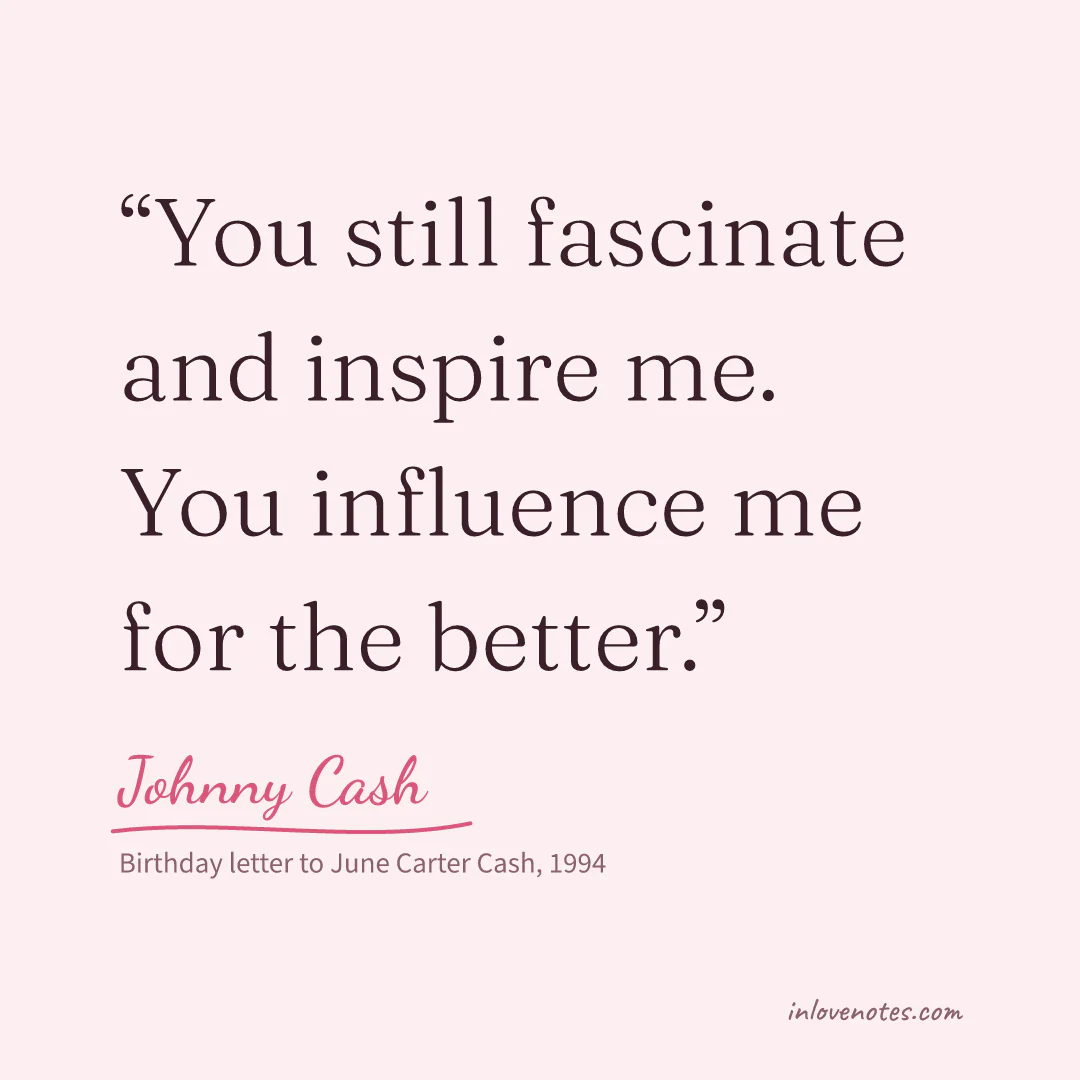
We get old and get use to each other. We think alike. We read each others minds. We know what the other wants without asking. Sometimes we irritate each other a little bit.
Johnny Cash, birthday letter to June Carter Cash, 23 June 1994
Cash wrote this from Odense, Denmark, on June's 65th birthday, 26 years after they married; the spelling is his, as reproduced by Letters of Note. In a 2015 British poll it was voted the most romantic letter of all time. It goes on: "You still fascinate and inspire me. You influence me for the better." What to borrow: the admission comes before the praise. Because he has just been honest about the irritations, she can believe the compliments.
A five-step way to write yours
Put the seven letters side by side and the same moves keep coming back. You don't need all five, but a letter that has three of them will rarely fall flat.
- Open with one specific thing. Not "you are amazing" but the time she drove four hours to fetch you, or the way she reads in the bath with the door open. Write it in a sentence or two.
- Admit something true about the two of you. The Cash move: the routine, the arguments about the dishwasher, the year that was hard. Honesty here earns the praise that follows.
- Name what she gave you. The Churchill move. What can you do, or who are you, because of her? Be concrete: "I would never have taken that job", "the kids know how to say sorry because of you".
- Say the main thing plainly. The Feynman move. One short sentence with no adjectives: "I love you. I would marry you again tomorrow."
- End with the future. The Ballou and Reagan move: the next year, the next twenty, the trip you keep postponing. Then sign it the way you sign everything to her, nickname included.
On paper, a page is plenty. Handwriting matters more to most people than length, and a few crossings-out are fine. For openings and sign-offs that fit the tone you want, see how to start and end a love letter.
Sample letters to your wife, by occasion
These are samples written by the inlovenotes editors, not real letters. Replace everything in square brackets with your own details; a sample with your specifics in it will mean far more than any of them does as written.
| Occasion | Length | What it should do | Where to leave it |
|---|---|---|---|
| Her birthday | Half a page | Thank her for being born; one memory from this past year | Inside the card, or under her coffee cup |
| Wedding anniversary | One page | Play with the number of years; then the future | Read aloud at dinner, or tucked in the gift |
| After a hard year | One page | Name what she carried; no fixing, no speeches | Somewhere she will read it alone |
| After you hurt her | Short | Own it without excuses; say what will change | Hand it to her, then give her space |
| Just because | Three lines | One small, specific observation | Her bag, the car, the bathroom mirror |
For her birthday (sample)
My [nickname],
Happy birthday. I've been trying to work out what to get you, and I keep landing on the same problem: the thing I am most grateful for this year is that you exist, and there is no wrapping paper for that. So here it is in writing instead.
This year I watched you [handle your father's move / start the new job / get us through the winter], and you did it while still remembering [the dentist appointment, my mother's birthday, the dog's pills]. I don't say it enough: I notice.
I'm glad you were born. I'm gladder that you picked me. Let's do [the thing she keeps mentioning] before your next one.
All my love, [name]
For your wedding anniversary (sample)
[Name],
They tell me it's been [number] years. I don't believe it. I remember [the dress / the rain / the song at the reception] like it was last spring, and I still get the same jolt when I see your car pull into the drive.
We are not the same two people who said those vows. We have [moved twice, raised two kids, buried a cat, argued about the thermostat roughly a thousand times]. And I love the person you've become more than the one I married, which I didn't think was possible back then.
Here's to the next [number]. I'd marry you again tomorrow, and I'd still let you pick the music.
Yours, [name]
After a hard year (sample)
My love,
This year asked more of you than it should have. You [kept working through the diagnosis / held the family together when I couldn't / grieved and still got up every morning]. I saw it, even on the days I didn't say anything.
I don't have a speech, and I know a letter doesn't fix anything. I just want it written down somewhere you can find it again: I'm proud of you, I'm grateful for you, and I'm not going anywhere. Whatever next year looks like, we do it together.
[Name]
After you hurt her (sample)
[Name],
I was wrong when I [said / did / forgot what happened]. There's no "but" coming. You didn't deserve it, and I understand why you're hurt.
Here is what I'm going to do differently: [one concrete change]. You don't have to answer this letter or forgive me on any schedule. I wanted you to have it in writing because you deserve more than a quick sorry in the hallway.
I love you. [Name]
Just because (sample)
Saw you laughing at your phone in the kitchen this morning and forgot what I came in for. [Twelve] years and you still do that to me. — [name]
"A letter that will make her cry": what actually does it
It's the most common thing people type when they look for a letter to their wife, and the honest answer is that no copied paragraph will do it. What makes a wife cry when she reads a letter is recognition: proof that you saw something she assumed nobody saw. The sacrifice she never mentioned. The joke from your first apartment. The night she sat with you in the hospital car park.
So before you write, make a quick list of five moments only the two of you know about. Use one or two of them. Then cut these, which make a letter sound borrowed:
- "Words cannot express…" (then use different words, or fewer).
- Stacks of adjectives: "my beautiful, amazing, wonderful, perfect wife".
- Lines from a quote site she may already have seen, unless you say where it comes from and why it made you think of her.
- Promises you won't keep. She has known you long enough to notice.
If you do want a borrowed line, take one from a real letter above and name the writer: "Johnny Cash once wrote to June that…" reads as thoughtful, not lifted. Our page of long, deep love letters for her has more real lines with their sources, and if you are apart right now, long distance love letters covers each stage of the separation.
Questions husbands ask
How do I write a letter for my wife?
Open with one specific memory, admit something true about your life together, name what she has given you, say "I love you" plainly, and end with something about the future. Handwrite it if you can. Half a page to one page is enough.
Can a letter win my wife back after I hurt her?
A letter can open the door, but it can't do the work. Keep it short: say exactly what you did wrong, don't add excuses, say one concrete thing you will change, and don't ask her to respond on your timetable. Then let your behaviour over the next weeks prove the letter true. If the hurt is serious, a couples counsellor is a better next step than a longer letter.
What is a sweet, short message I can send to my wife?
Something that shows you noticed her today: "Watched you with the kids this morning and fell for you all over again." A short line about a real moment beats a long generic one. The "just because" sample above is one model.
One last detail from Feynman's letter. Its postscript apologised for not posting it because he didn't know her new address. It's the only joke in the letter, and it's the line people remember. A letter to your wife doesn't need to be perfect. It needs to sound like you.