Apology Letter to Girlfriend: 6 Examples and How to Write One She'll Believe
Six apology letters to your girlfriend, for a fight, hurt feelings, ignoring her or a forgotten date, built on a 2016 study of what makes apologies work.
In 2016, researchers at Ohio State University asked 755 people to rate apologies that had been taken apart into six pieces: regret, an explanation, an admission of responsibility, a promise to change, an offer to put things right, and a request for forgiveness. The piece people valued most was the admission of fault. The piece they valued least was the one most of us end with: "please forgive me." That finding is a useful place to start an apology letter to your girlfriend, because the letters that fail usually fail in the same way. They explain a lot, admit little, and close by asking her to do the work.
This guide turns that research into a plan you can follow tonight. Below you'll find the six parts and what each one sounds like on paper, six example letters written by our editors for the situations people search for most (after a fight, for hurting her, for ignoring her, for a forgotten date, a long emotional letter and a short text version), the phrases that quietly cancel an apology, and what two of Jane Austen's letter-writers got right and wrong. The examples have [square-bracket slots] for details only you know. Fill them in; an apology that could have been sent to anyone convinces no one.
The Six Parts Researchers Tested, and the One That Matters Most
The study was led by Roy Lewicki with Robert Lount and Beth Polin and published in Negotiation and Conflict Management Research in May 2016. In Ohio State's summary of the study, Lewicki puts the main lesson bluntly: "Say it is your fault, that you made a mistake." The request for forgiveness, he adds, is "the one you can leave out if you have to." The participants were rating apologies in a work setting, not between partners, so treat the ranking as a strong hint rather than a law of love. Still, it matches what most people feel when they are on the receiving end.
| Part (as named in the study) | What it sounds like in a letter to her | Common mistake |
|---|---|---|
| Acknowledgment of responsibility (rated most important) | "I was wrong to [what you did]. That was my choice, not something you caused." | "Mistakes were made," or blaming the mood you were in |
| Offer of repair | "Next weekend is yours. I've already told [friend] I'm not coming." | An offer so vague it costs nothing ("I'll make it up to you") |
| Expression of regret | "I hate that I made you feel [how she felt]." | Regret about the consequences for you ("I hate that we're fighting") |
| Explanation of what went wrong | "I was stressed about [thing], and I took it out on you." | An explanation that runs longer than the apology and turns into an excuse |
| Declaration of repentance | "I don't want to be the person who does that, and here's how I'll stop." | A promise you have broken before, repeated in the same words |
| Request for forgiveness (rated least important) | "Take whatever time you need." | "Can you just forgive me so we can move on?" |
A practical reading of the table: if your letter can only hold three sentences, make them the first three rows. Name the fault, offer something concrete, and say you're sorry for what it did to her. The other parts help, but they can't carry a letter on their own.
Before You Write: Is a Letter the Right Move?
A written apology has one real advantage over a spoken one: she can read it without having to manage your face while she does. It also has a cost. She can't interrupt, and you can't see how it lands. A letter works best in three situations: when talking keeps turning into round two of the fight, when the thing you did deserves more than a hurried "sorry," and when you are apart and a call would be rushed. It works worst as a way of avoiding a conversation she has asked for. If she wants to talk, talk first and write afterwards.
Timing matters as much as wording. Write the first draft while the feeling is fresh, then wait until the next day to send it. Read it out loud once. Anything that sounds like a closing argument, cut. If you are apart, our guide to long distance love letters has a section on what to write after a fight on the phone, when the silence afterwards stretches across time zones.
Six Example Apology Letters to Your Girlfriend
These were written by our editors as starting points, not as quotations. Each one follows the order from the table: fault first, repair next, request last or not at all. Swap every bracket for something true. If a sentence doesn't fit what happened, delete it rather than leaving it in because it sounds nice.
1. After a fight where you said something cruel
[Name], I've been replaying what I said on [day], and there's no version of it that I can defend. When I told you [the words, or a fair summary], I meant to hurt you, and I did. You didn't deserve that, and the fact that we were both angry doesn't make it fair. I was frustrated about [the real issue], and instead of saying so, I went for the thing I knew would sting. I'm sorry. I'd like us to talk about [the real issue] again, calmly, when you're ready, and this time I'll stay on the subject instead of on you. I love you, and I want you to feel safe arguing with me.
2. For hurting her feelings without meaning to
[Name], I didn't realise until later how much [the joke / the comment / what I did in front of your friends] hurt you, and I should have noticed sooner. It doesn't matter that I didn't mean it that way. What matters is how it felt to you, and you told me: [what she said]. You were right to be upset. I'm sorry I made you feel [small / embarrassed / not taken seriously]. I'm going to keep that kind of comment out of our jokes from now on, and if I slip, I want you to call it out on the spot. You won't have to explain twice.
3. For not giving her time, or ignoring her
[Name], you've told me more than once that you feel like you come after [work / my phone / the game / my friends], and I kept answering with reasons instead of listening. The truth is simple: I've let you get the leftover hours of my week, and that's not how you treat someone you love. I'm sorry. [Day] evening is ours from now on: no phone at the table, and I'll plan it. I'm not asking you to take my word for it. Just watch the next month and judge me on that.
4. For forgetting her birthday or an important date
[Name], I forgot [your birthday / our anniversary / your interview], and no apology turns that into something smaller than it was. You remember the things that matter to me, and I didn't return that. I'm sorry. I don't want to make up for it with a rushed present; I want to give the day back properly. [Concrete plan: "Saturday, the place you've wanted to try, and the whole afternoon before it."] And the date is now in my calendar with three reminders, because you deserve better than my memory on a busy week.
5. A long, emotional apology letter, for a pattern rather than one mistake
[Name], I've started this letter four times, because every first sentence I wrote was about me. So here's the one that isn't: you have been patient with something in me for a long time, and I have treated that patience as if it would never run out.
When [describe the pattern honestly: "I go quiet for days after an argument" / "I cancel when something better comes up"], you are the one left guessing. I've told myself it's just how I am. That was an excuse, and a lazy one. I can see now how it made you feel: [what she has told you, in her words if you can].
I'm not going to promise I'll change overnight, because you've heard that before and it didn't hold. Here is what I am doing instead: [a specific step: "I've booked a first session with a counsellor for the 14th" / "when I need space, I'll say so and say when I'll be back"]. You'll be able to see whether I keep it.
I love you. Not the easy, good-days version of loving you, but the version that has to do something difficult. You don't owe me an answer to this letter. I wanted you to have it in writing, so it can't be taken back.
6. A short version, for a text or a note on the pillow
I was wrong about [thing] and I'm sorry. Not "sorry you're upset": sorry I [what you did]. I'll [one concrete thing] tomorrow. No need to reply tonight. I love you.
If you want help with the first and last lines specifically, our comparison of how to start and end a love letter lays out greetings and sign-offs by tone. For an apology, a plain first name and a plain "I love you" at the end usually beat anything grand.
Darcy's Letter: An Explanation Is Not an Apology
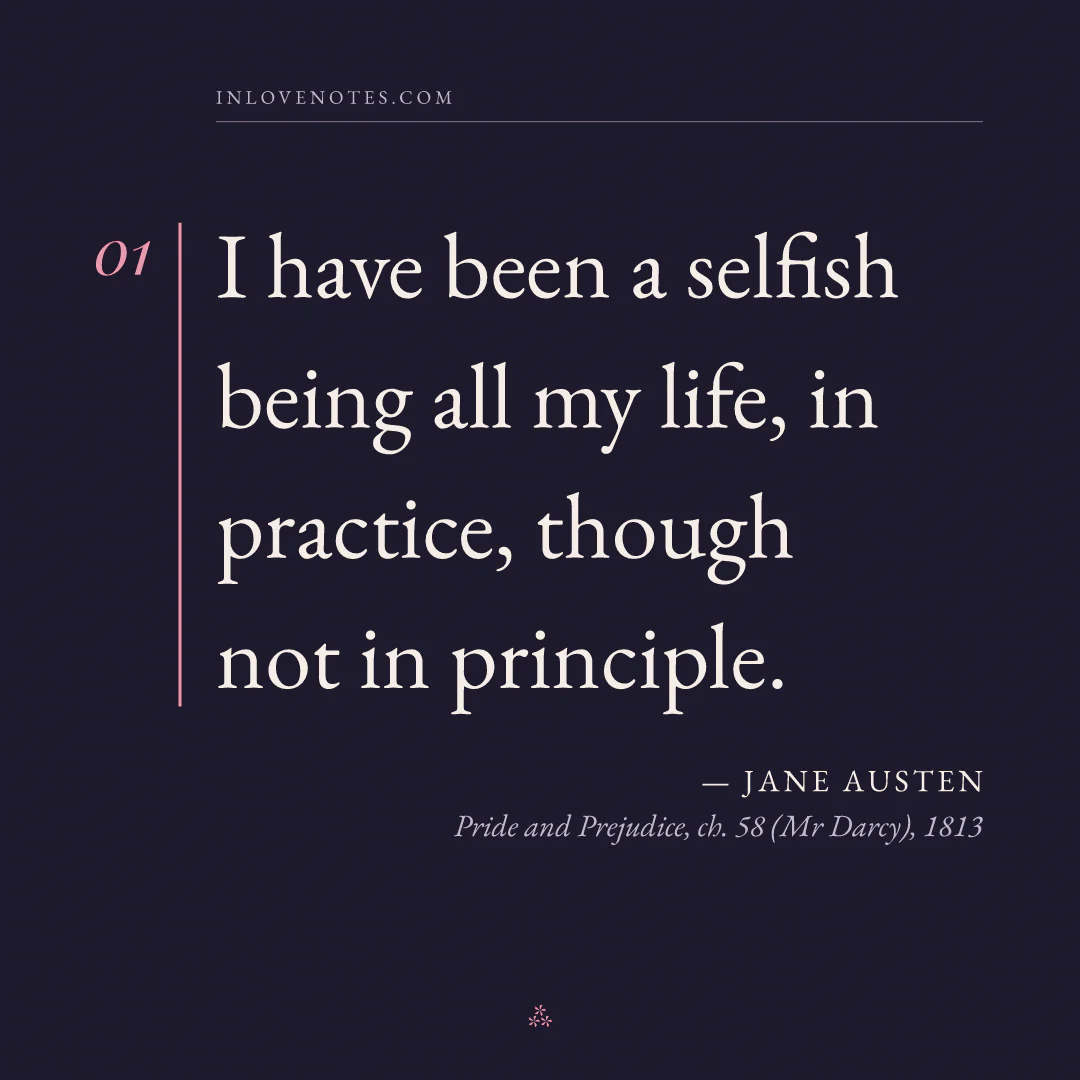
The most famous letter in English fiction written the morning after a disastrous argument is Mr Darcy's to Elizabeth Bennet, in chapter 35 of Pride and Prejudice (1813). It is long, careful and largely accurate, and it is not an apology. He says so in his second sentence: he writes "without any intention of paining you, or humbling myself." What follows is a defence of his conduct. It changes Elizabeth's mind about the facts, but it is only later, in chapter 58, that Darcy looks back at the letter and at himself:
"I have been a selfish being all my life, in practice, though not in principle."
— Mr Darcy, in Jane Austen, Pride and Prejudice, chapter 58 (1813)
In the same conversation he admits that when he wrote the letter he believed himself "perfectly calm and cool," but was "since convinced that it was written in a dreadful bitterness of spirit." That is the trap every apology writer should know. You can feel calm and still write a letter whose real purpose is to win. The fix is the order from the table: lead with what you did, and let the explanation shrink to a sentence. Darcy's later line works precisely because it is an admission with no "but" attached. (The text above was checked against the Project Gutenberg edition.)
Wentworth's Letter: Name the Fault, Then Name What Never Changed
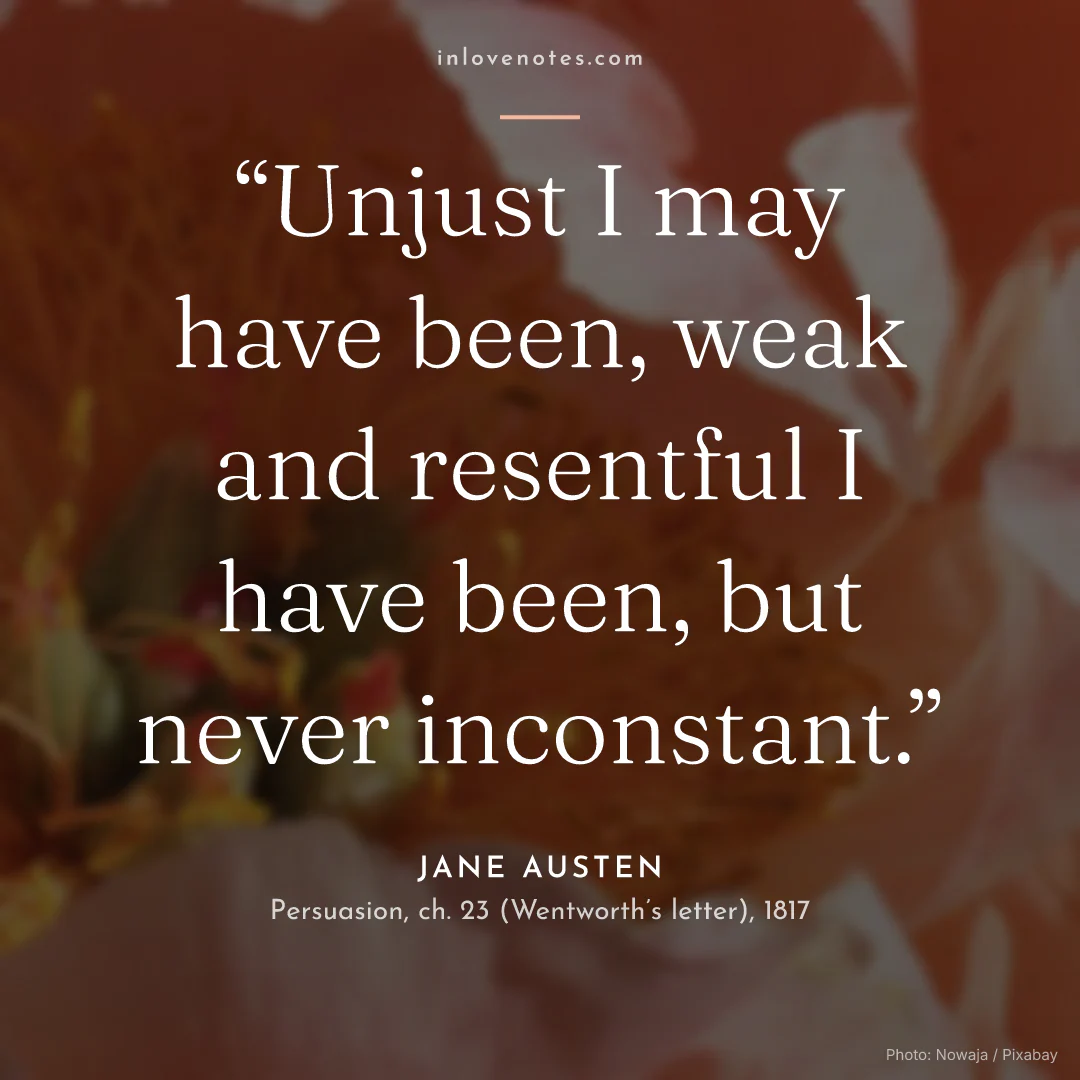
Austen gave the opposite example four years later. In chapter 23 of Persuasion (1817), Captain Wentworth writes to Anne Elliot while she is in the same room, after eight and a half years of pride on both sides. His letter is short and does three things in a few lines: it admits the fault, it says what stayed true, and it leaves the decision with her.
"I have loved none but you. Unjust I may have been, weak and resentful I have been, but never inconstant."
— Captain Wentworth's letter, in Jane Austen, Persuasion, chapter 23 (1817)
Notice the grammar. "Unjust I may have been" hedges; "weak and resentful I have been" doesn't. Wentworth moves from a maybe to a plain admission inside one sentence, and only then claims something in his own favour. For a letter to your girlfriend, the useful pattern is: one honest sentence about what you did wrong, then one honest sentence about what never changed ("I was careless with your feelings. I was never careless about you"). Keep the second sentence true and small. If it's grander than the apology, it reads as a bargain.
Phrases That Quietly Cancel the Apology
Most apology letters don't fail because of what's missing. They fail because of one sentence that turns them around. Read your draft for these:
| If your letter says | What she hears | Write this instead |
|---|---|---|
| "I'm sorry if you were hurt" | The hurt might be her imagination | "I'm sorry I hurt you" |
| "I'm sorry, but…" | Everything before "but" is a warm-up | Two sentences: the apology, full stop; the context, later and short |
| "You know I didn't mean it" | She should do the forgiving for you | "I didn't mean to, and it hurt you anyway" |
| "We both said things" | Your apology comes with an invoice | Apologise for your part only; her part is hers to raise |
| "I'll never do it again" | A promise she may have heard before | One specific change she can see this week |
| "Please, just forgive me" | Pressure | "Take the time you need" |
You'll often see the line "Never ruin an apology with an excuse" credited to Benjamin Franklin on images and quote sites. There's no evidence he wrote it. The word sleuth Barry Popik traces it to 1996 Usenet posts with no author, then to a 1997 credit to a "Kimberly Johnson," repeated as a "Gem of the Day" in Ann Landers's column that December. The advice is sound; just don't put Franklin's name under it. And the most quoted line about love and apology, "Love means never having to say you're sorry," comes from Erich Segal's Love Story (novel and film, 1970), where Jenny says it to Oliver. It was ranked 13th on the American Film Institute's list of 100 movie quotes, and it has been argued with ever since. As advice for a real relationship, the research above points the other way. Our page on misattributed love quotes covers more lines that carry the wrong name.
Asking for Forgiveness Without Demanding It
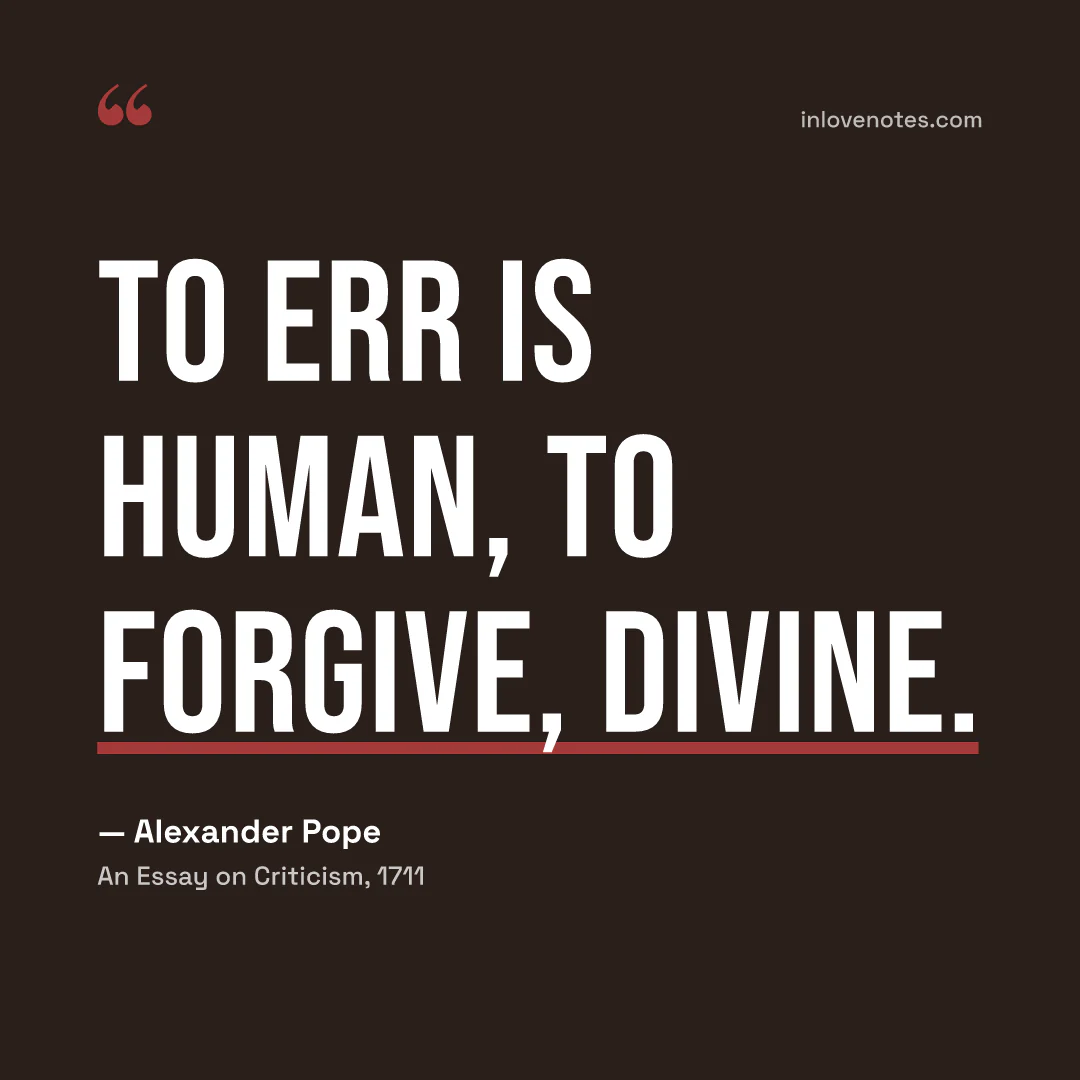
The Ohio State finding about the request for forgiveness surprises people, but it makes sense once you read your own draft from her side. A letter that ends "so can you forgive me?" turns the last thing she reads into a task. Forgiveness given under pressure doesn't last, and both of you know it. The oldest line on the subject in English puts it in the right place:
"To err is human, to forgive, divine."
— Alexander Pope, An Essay on Criticism, part II (1711)
Pope was writing about literary critics, who he thought were too quick to savage other people's work, not about couples. But the shape of the line is the point: the error belongs to the one who made it, and the forgiving belongs to the one who was wronged. It is hers to give, on her schedule. So end your letter with something that hands her the time instead of a question: "No need to answer tonight," or "I'll be here when you want to talk." (Pope's wording, including the comma after "forgive," is checked against the Gutenberg text of his poems.)
When It's About Cheating, or She's Now Your Ex
Two situations need a different letter, and neither is helped by copying and pasting.
If you cheated, a letter can't be the whole apology, and it shouldn't arrive before an honest conversation. If you write one afterwards, everything in the table applies with more force: full responsibility, no description of the other person, no explanation that sounds like a reason ("we were going through a rough patch"), and no request to move on quickly. Answer the questions she asks honestly. Let her decide what happens to the relationship; a letter that argues for a second chance makes the decision harder for her, not easier.
If she's your ex, ask yourself who the letter is for. If she has asked for no contact, respect that; an apology she didn't want is one more thing she has to deal with. If you are in touch and owe her an apology, keep it short, admit what you did, wish her well, and don't use it to reopen the relationship. "I'm sorry for how I treated you near the end. You deserved better, and I hope things are good for you" is enough. Anything longer starts to sound like it needs a reply.
Questions People Ask About Apology Letters
How do I apologize to my girlfriend for hurting her?
Name exactly what you did, say you were wrong without adding "but," tell her you're sorry for how it made her feel, and offer one concrete thing you'll do differently. The study above found that admitting responsibility counts for more than any other part of an apology. Letter 2 above is built for this situation.
How long should an apology letter to a girlfriend be?
Long enough to name the fault and the repair, which can be four sentences. For a single mistake, 100 to 200 words is plenty. Longer letters (300 words and up) make sense for a pattern of behaviour, like letter 5, but every extra paragraph should be about her or the change, not about defending yourself.
Should I handwrite the apology letter or send it as a text?
A handwritten letter shows effort and can't be skimmed in a notification, so it suits serious apologies. A text suits small, quick repairs and long-distance moments when a letter would take days. If you text a long apology, follow it up in person; the text opens the conversation, it doesn't replace it.
How do I write a romantic apology?
Apologise first, and only then be romantic. A sentence in the style of Wentworth's, admitting the fault and then saying what never changed, is the most romantic thing an apology can contain. If you'd like to borrow some real lines from love letters for the closing, our collection of long, deep love messages for her draws on letters with checked sources.