Long Distance Love Letters: What to Write at Each Stage of Being Apart
Six sample long distance love letters, one for each stretch of being apart, with real lines from Osborne, Keats and Abigail Adams, sourced and explained.
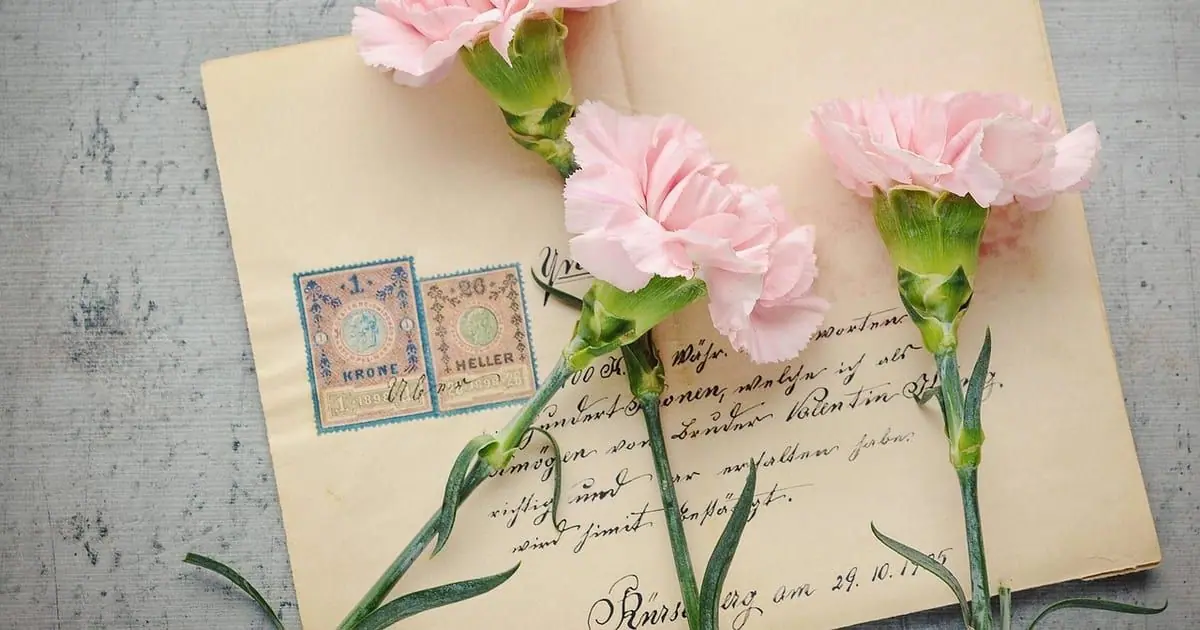
In March 1654 William Temple left for Ireland. The road to Holyhead was bad enough that the journey to Chester alone took four days, and Dorothy Osborne, writing from Chicksands in Bedfordshire, had no idea when her letter would catch up with him. She wrote anyway, and in the middle of news about a dog he had sent her, she said the thing every couple living apart eventually discovers:
My heart has failed me twenty times since you went, and, had you been within my call, I had brought you back as often, though I know thirty miles' distance and three hundred are the same thing.
Dorothy Osborne, letter to William Temple, Chicksands, March 1654 (Letter 54 in The Love Letters of Dorothy Osborne to Sir William Temple, 1652–54, ed. Edward Abbott Parry, 1888)
Thirty miles or three hundred: once you can't reach someone's hand, the number stops mattering. What does matter is that a long-distance relationship isn't one long ache. It has stretches, and each one asks for a different letter. This guide walks through six of them, with a line from someone who actually wrote across a distance, what that line teaches, and a sample letter you can adapt. The samples are written by our editors as models, not quoted from anyone.
Six stretches of being apart, and what each letter has to do
Use this as a map before you write. Most long-distance letters go wrong because they answer the wrong moment: a heavy letter in the easy middle, a breezy one the week after a goodbye.
| Stretch | What they need to hear | Leave out | Length |
|---|---|---|---|
| The first week after the goodbye | That missing them is normal and survivable | Countdown maths, "I can't do this" | Short, sent fast |
| The long middle | Your ordinary days, in detail | Pressure to reply at the same length | As long as you like |
| Different time zones | Something to wake up to | Complaints about the hour they called | Half a page |
| A missed birthday or anniversary | That the date still counts | Apologising for the distance more than once | One full page |
| After a fight on the phone | Calm, and where you stand | Relitigating the argument | Short |
| The countdown and the goodbye after a visit | What the visit meant, and what comes next | Making the next goodbye bigger than the visit | Short, or written in advance |
The first week after the goodbye
Osborne's line above belongs here, and it works because she doesn't dramatise. She admits she'd have called him back twenty times, then shrugs at her own logic: the distance is already total, so there is no point measuring it. She goes straight on to chatter about her greyhounds and who is coming to stay. That mix is the lesson. In the first week, the person reading wants proof that you are sad and fine, both at once.
What to put in: one honest sentence about the goodbye itself (the station, the airport, the empty side of the bed), one small piece of news, and one plan, however modest: the next call, a film you'll both watch, a parcel on its way.
Sample letter 1 (editors' model):
I made it home and left your mug where you put it down. I'm not moving it yet. The flat is very quiet and I'm being very sensible about that, mostly. Your plant has been watered twice, which is probably once too many. Thursday at eight my time is ours. Bring the bad film you promised, and I'll bring the snacks I am not supposed to eat. I miss you in the plain, everyday way. Speak Thursday.
The long middle, when nothing much happens
The weeks between visits are where many letters stall, because there is "nothing to say". Osborne had the opposite problem. Temple kept apologising for the length of his letters, and in 1653 she told him off for it:
Can you think it necessary to me, or believe that your letters can be so long as to make them unpleasing to me? Are mine so to you? If they are not, yours never will be so to me.
Dorothy Osborne, letter to William Temple, Chicksands, 1653 (Letter 13 in Parry's edition, 1888)
She is giving permission, and that permission is the best thing a middle-stretch letter can carry. Nobody in a long-distance relationship is bored by your commute, the argument at the bakery, what the light did on the river this evening. Those details are what they lost when you moved apart, more than the big feelings, which they already know.
Practical tip: keep a running note on your phone during the week. Jot one line a day ("dog in a raincoat outside the post office", "boss said 'synergy' four times"). On Sunday the letter writes itself from the list.
Sample letter 2 (editors' model):
Nothing happened this week, so here is all of it. Monday: the bus broke down and a stranger shared her umbrella and her opinions about the council. Wednesday: I tried your recipe and it tasted like yours, which felt like cheating. Friday: I walked past the café where we sat in the window in June and the same chair was empty. Saturday: this letter. Tell me everything about your nothing too. Every word.
When your night is their morning
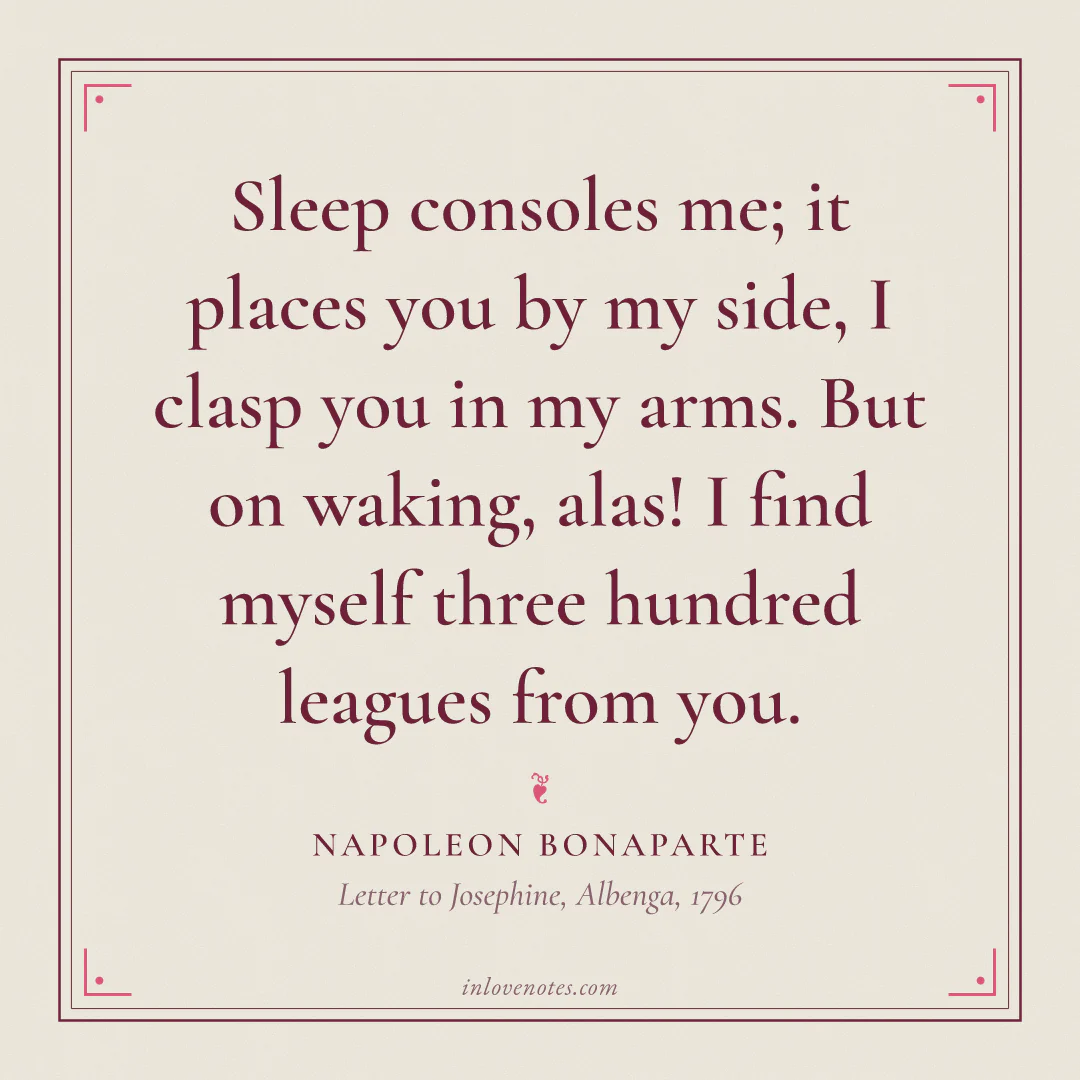
Time zones turn a relationship into a relay: one of you is going to bed while the other is getting up. Napoleon, writing to Josephine from the Italian front in April 1796, put the feeling into one cruel pair of sentences:
Sleep consoles me; it places you by my side, I clasp you in my arms. But on waking, alas! I find myself three hundred leagues from you.
Napoleon Bonaparte, letter to Josephine, Albenga, 5 April 1796, in Napoleon's Letters to Josephine, 1796–1812, trans. Henry Foljambe Hall (1901)
He was 26, newly married and newly in command, and his letters from that campaign are famously over the top. But this one notices something real: the hard moment is waking up, not going to sleep. So use the gap. Write a short letter in your evening that lands in their morning: an email scheduled for their breakfast, a voice note, or a paper letter marked "open with coffee".
What to put in: one thing from your day, which is now their yesterday; one thing to look forward to in theirs; nothing that needs an urgent answer while you are asleep and can't reply.
Sample letter 3 (editors' model):
Good morning from last night. While you were asleep I finished the book you lent me (you were right about the ending, don't gloat). By the time you read this I'll be dreaming, so you get the whole day without me interrupting. Go and have it. I'll ring when your lunch is my dinner. I'm already looking forward to your voice being croaky.
A birthday or anniversary you can't be there for
Abigail and John Adams spent most of the American Revolution apart. In December 1782, with John in Europe on diplomatic missions and no letter from him for months, she wrote this:
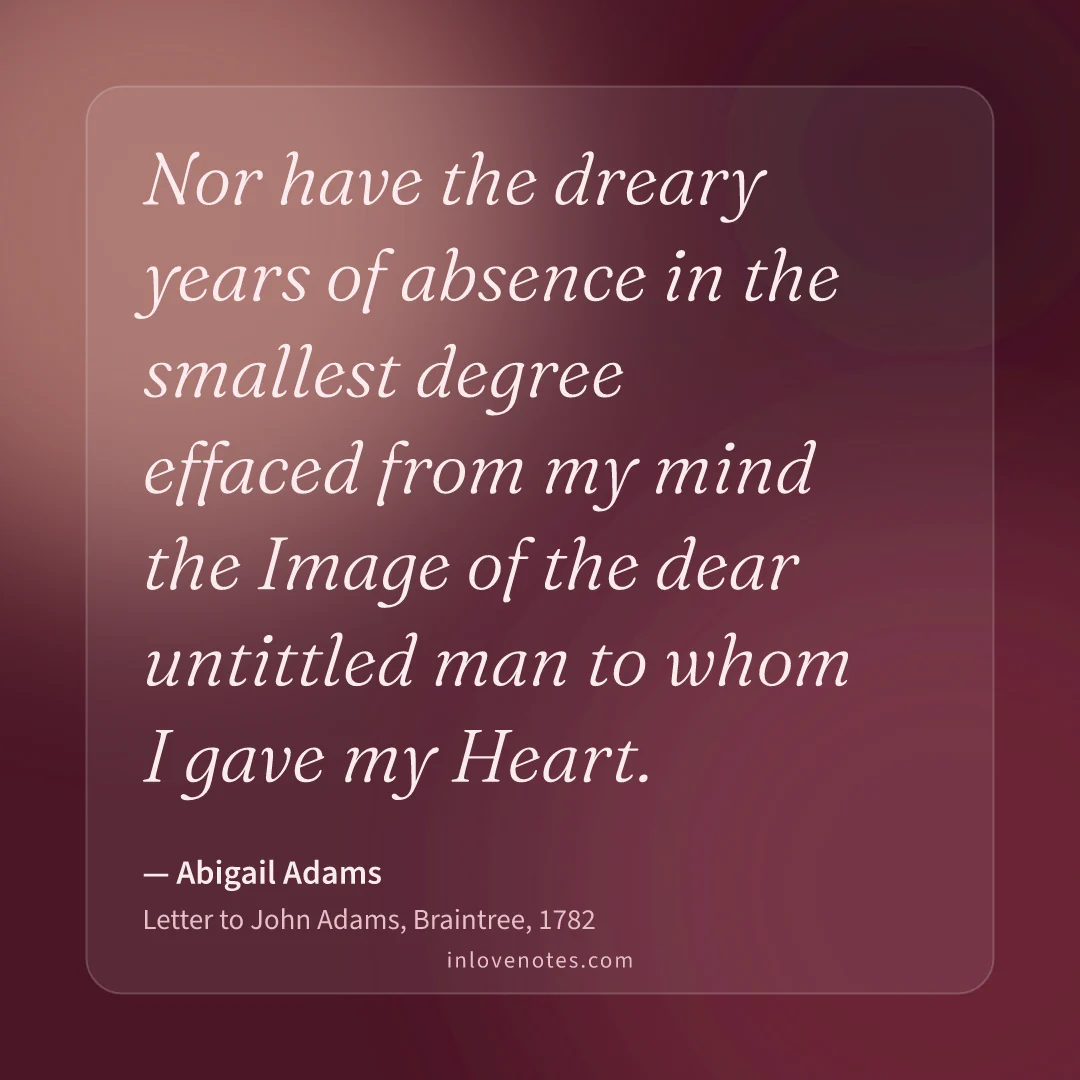
with an undiscribable pleasure I have seen near a score of years roll over our Heads, with an affection heightned and improved by time—nor have the dreary years of absence in the smallest degree effaced from my mind the Image of the dear untittled man to whom I gave my Heart.
Abigail Adams, letter to John Adams, Braintree, 23 December 1782, Adams Family Papers, Massachusetts Historical Society (her spelling kept)
Look at how she does it. She names the time ("near a score of years"; they had married in 1764), names the absence without whining about it ("dreary years"), and then puts the love on the other side of the scale. "Untitled" is also pointed: John was by then a celebrated envoy, and she is telling him she married the man, not the honours. A missed-date letter should do the same three things: count the years or the milestones, admit the distance once, and say what has not changed.
Post it early. International letters can take a week or more, so check your postal service's own delivery estimate and send well before the date. If it may arrive late, say on the envelope "open on the 14th" so it can wait.
Sample letter 4 (editors' model):
Happy birthday. This is the second one I've missed, and I've decided that's the last time I'll mention it. Here is what I'd have done: woken you too early, burned the toast, sung badly. Consider all three done. Three years ago today you wore that ridiculous hat to your own party and I decided I was in trouble. I still am. The miles have made a lot of things harder. They haven't touched that.
After a fight on the phone
Phone arguments are worse at a distance: no hug at the end, a dropped line, a time zone that ends the call before the feeling ends. In July 1819 John Keats was on the Isle of Wight, writing to Fanny Brawne in Hampstead. On the Tuesday night he'd written her a letter that was, he admitted, "too much like one out of Rousseau's Heloise"; glad he hadn't had the chance to post it, he wrote a calmer one on the Thursday morning. He ends it like this:
I know before night I shall curse myself for having sent you so cold a Letter; yet it is better to do it as much in my senses as possible. Be as kind as the distance will permit to your J. Keats.
John Keats, letter to Fanny Brawne, Shanklin, Isle of Wight, postmarked 3 July 1819, in Letters of John Keats to Fanny Brawne, ed. Harry Buxton Forman (1878)
That is a very good model for the morning after. Keats knows his calmer letter might read as cold, says so, and sends it anyway, because a letter written "in my senses" is safer than one written at midnight. Then he asks for kindness without demanding it: "as kind as the distance will permit".
What to put in: an acknowledgement of the call (not a rerun of who said what), one sentence about what you actually feel underneath the argument, and a clear next step: "Can we talk on Saturday when neither of us is tired?" Write it, wait a few hours, read it again, then send.
Sample letter 5 (editors' model):
Last night went badly, and I hung up angrier than I am. It's daytime now, I've had coffee, and what's left is this: I miss you, I was tired, and I made a small thing into a big one. I'm not writing to settle who was right. I'm writing so you don't have to spend today guessing where we stand. We're fine. Saturday morning, your time, properly awake?
The countdown, and the goodbye after a visit
Visits come with two letters: one before (the countdown) and one after (the leaving). The second is harder. In January 1926 Vita Sackville-West was on a train to Persia to join her husband, a few days after leaving Virginia Woolf in London. She wrote from Milan:
I am reduced to a thing that wants Virginia. I composed a beautiful letter to you in the sleepless nightmare hours of the night, and it has all gone: I just miss you, in a quite simple desperate human way.
Vita Sackville-West, letter to Virginia Woolf, Milan, 21 January 1926 (as published in Letters of Note: Love)
She admits that the "beautiful letter" vanished, and what survived is plainer and better. After a visit, nobody needs a beautiful letter. They need to know that the days together were real and that you are counting again. If you can, write it before you leave and hide it in their bag or under their pillow, so it is waiting when the flat goes quiet. If you are short of time, Osborne once ended a rushed note like this, and it is hard to improve on:
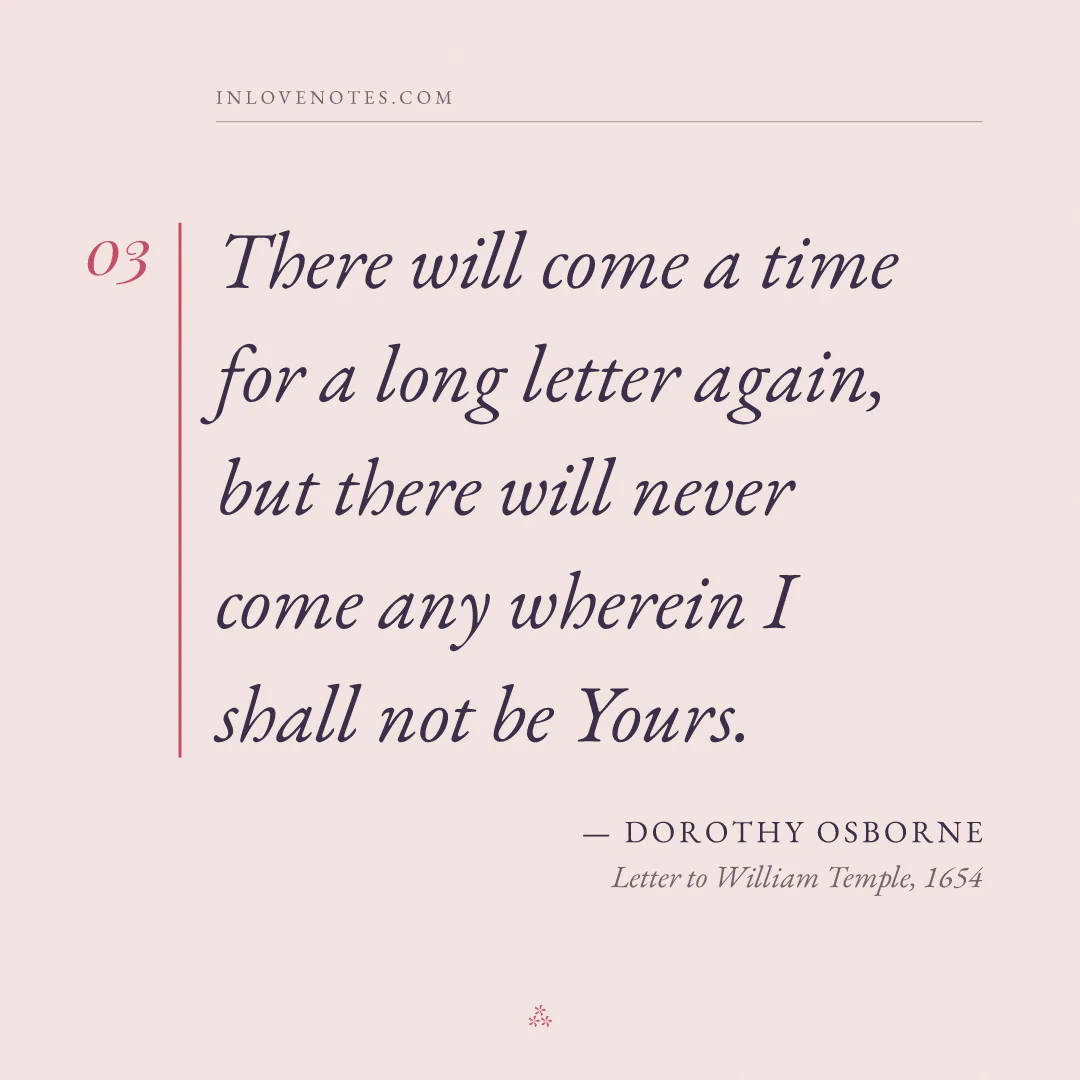
There will come a time for a long letter again, but there will never come any wherein I shall not be Yours.
Dorothy Osborne, letter to William Temple, Chicksands, 2 April 1654 (Letter 56 in Parry's edition)
She wrote it in a hurry, the week she was preparing to leave Chicksands, "perhaps never to see it more", and it still says the one thing a short note after a goodbye has to say.
Sample letter 6 (editors' model):
If you're reading this, I've gone and you've found the envelope. Sorry about the crumbs on the sofa. Thank you for the market on Saturday, the terrible karaoke and the long quiet breakfast on Sunday, which was my favourite part. I'm already writing the dates of the next visit in pen. Go and eat the last of the cake. I left it for you on purpose.
Paper or screen, and how often to write
Both count. A message on a screen is quick, which suits the first-week letter and the after-a-fight letter, where waiting days for the post would make things worse. Paper is slower and stays: it can sit on a bedside table, be reread, travel in a coat pocket. Many couples apart do both: quick daily messages, and a paper letter every week or two.
On frequency, Napoleon was blunt in another letter, written at Ala on 3 September 1796: "Write me often, very often: in absence it is the only remedy" (Hall, 1901). Often doesn't have to mean long. A regular rhythm (every Sunday, every first of the month) matters more than length, because the other person can start looking forward to it.
- Date every letter, and number them if you send many. Post doesn't always arrive in order.
- Put something physical in the envelope: a photo of your view, a ticket stub, a pressed leaf from a walk, a card with three songs written on it.
- Prepare a set for the hard days. Our guide to open when letters covers labels and what goes inside.
- Get the first and last lines right. They carry more weight when the reader can't hear your voice; see how to start and end a love letter.
Lines that land badly across a distance
- Keeping score. "I've written three times and you've written once" reads twice as hard on paper. Ask for what you want instead: "I love getting your letters; tell me about your week?"
- The countdown as a complaint. "Still 94 days" is fine at a celebration; in a sad letter it becomes a sentence.
- Only "I miss you". It is true, but on its own it gives them nothing to hold. Say what you miss: the way they hum while cooking, the weight of their arm at night.
- Big decisions by letter. Whether to move, whether to end things, whether to change plans: talk about these on a call, then write about them.
If you want a fuller walk-through of structure and tone, our guide on how to write a love letter covers it step by step, and love letters for him has samples for other occasions.
Questions couples apart ask
What should I write in a long-distance love letter?
Match the letter to the stretch you're in (see the table above), then include three things: a concrete detail from your life, something specific you miss about them, and something to look forward to. Real details beat big declarations.
What is the 777 rule for long-distance relationships?
It is an informal rule of thumb shared online for couples in general: a date every 7 days, a weekend away every 7 weeks, a holiday every 7 months. Couples apart often adapt it, for example a video date every week and a visit every seven weeks if money and distance allow. It isn't research-based, so treat it as a prompt to plan, not a test.
How often should I send letters in a long-distance relationship?
There's no right number. A steady rhythm the two of you can keep up, such as a paper letter every week or two plus quick daily messages, works better than bursts of long letters followed by silence.
Osborne and Temple's letters ended the best way such letters can: they married on 25 December 1654, and the stack of her letters he kept is why we can still read them. Yours don't need to be historic. They need to arrive, and to sound like you.