Letter to My Future Husband: 6 Example Letters and the One Emma Wedgwood Sent Darwin
6 example letters to your future husband, from before you meet him to the wedding morning, plus what Emma Wedgwood and Abigail Smith really wrote.
A letter to your future husband works best when it does two things at once: it tells him something ordinary about your life right now, and it says one thing you are afraid to say out loud. Write it to a man you haven't met yet, to the boyfriend you plan to marry, or to your fiancé on the wedding morning, and keep it to a page. Below are 6 example letters written by our editors for each of those moments, a table of lines from real letters with their sources, and the letter we think shows the method best: the one Emma Wedgwood wrote to Charles Darwin ten days after she agreed to marry him.
Emma accepted Darwin's proposal on 11 November 1838, and they married at Maer, Staffordshire, on 29 January 1839. In between she sent him the letter below. Most of it is family news, a new dress and a mishap with some stones. One paragraph is about the biggest disagreement of their marriage. That mix is the whole lesson.
Ten days after yes: Emma Wedgwood's letter from Maer
The letter, dated 21–22 November 1838 by the editors of the Darwin Correspondence Project, opens with a joke about etiquette. She is writing before his letter has arrived, which she suspects "the Dr would not think it according to the strictest etiquette." Then she confesses that she had been "very stupid & flat all day" after he left, and that she had thrown the stones he had left with her into the pool, only to remember too late that he might want them back. Then, without a break, the tone changes:
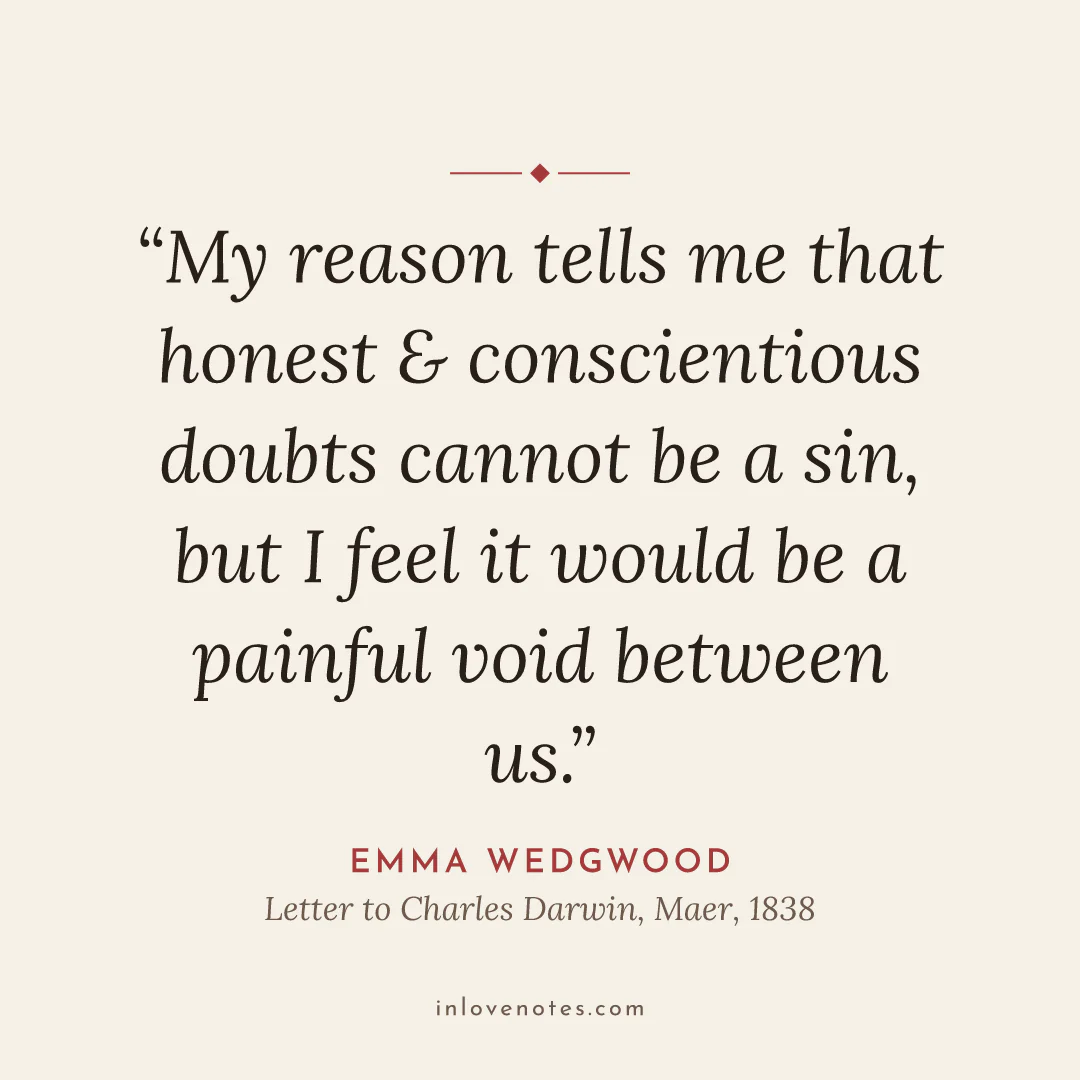
"When I am with you I think all melancholy thoughts keep out of my head but since you are gone some sad ones have forced themselves in, of fear that our opinions on the most important subject should differ widely. My reason tells me that honest & conscientious doubts cannot be a sin, but I feel it would be a painful void between us. I thank you from my heart for your openness with me & I should dread the feeling that you were concealing your opinions from the fear of giving me pain."
— Emma Wedgwood, letter to Charles Darwin from Maer (1838)
"The most important subject" was religion. Emma was a believing Christian and Darwin had already told her about his doubts. She doesn't argue with him and she doesn't pretend the difference is small. She names it, thanks him for being honest, and asks him not to hide anything to spare her. Then she asks a small favour (read the farewell discourse in the Gospel of John, which "begins at the end of the 13th Chap"), says she doesn't want his opinion on it, and goes straight back to the plaid gown he sent: "blue black & green with a narrow scarlet cross bar." She signs off with a postscript asking him to correct her spelling, "as in the wife of a literary man it wd not do you credit."
Read as a model, the letter does four things you can copy. It starts with the day she is actually having. It admits she misses him in plain words. It raises one hard thing, once, with no ultimatum attached. And it ends lightly, so the hard paragraph sits inside an ordinary letter instead of becoming the letter. A letter to your own future husband doesn't need a disagreement in it, but it does need that one paragraph you would find hard to say across a table.
The letter he kept for the rest of his life
A few weeks after the wedding, Emma wrote to him again on the same subject, this time as his wife. The Darwin Correspondence Project dates it to about February 1839. It is longer and more careful, and it ends like this:
"I do not wish for any answer to all this—it is a satisfaction to me to write it & when I talk to you about it I cannot say exactly what I wish to say, & I know you will have patience, with your own dear wife. Don't think that it is not my affair & that it does not much signify to me. Every thing that concerns you concerns me & I should be most unhappy if I thought we did not belong to each other forever."
— Emma Darwin, letter to Charles Darwin (c. February 1839)
Two details show what the letter meant to him. Decades later, in the manuscript of his autobiography, Darwin added a pencil note referring to "her beautiful letter to me, safely preserved, shortly after our marriage" (the Project quotes it in a footnote to the letter). And at the bottom of the letter itself he wrote: "When I am dead, know that many times, I have kissed & cryed over this. C. D." That note is recorded in Darwin Online's catalogue of the manuscript (Cambridge University Library, DAR 210.8: 14) and reproduced widely; we read the wording on a secondary page because the archive's transcription didn't load when we checked.
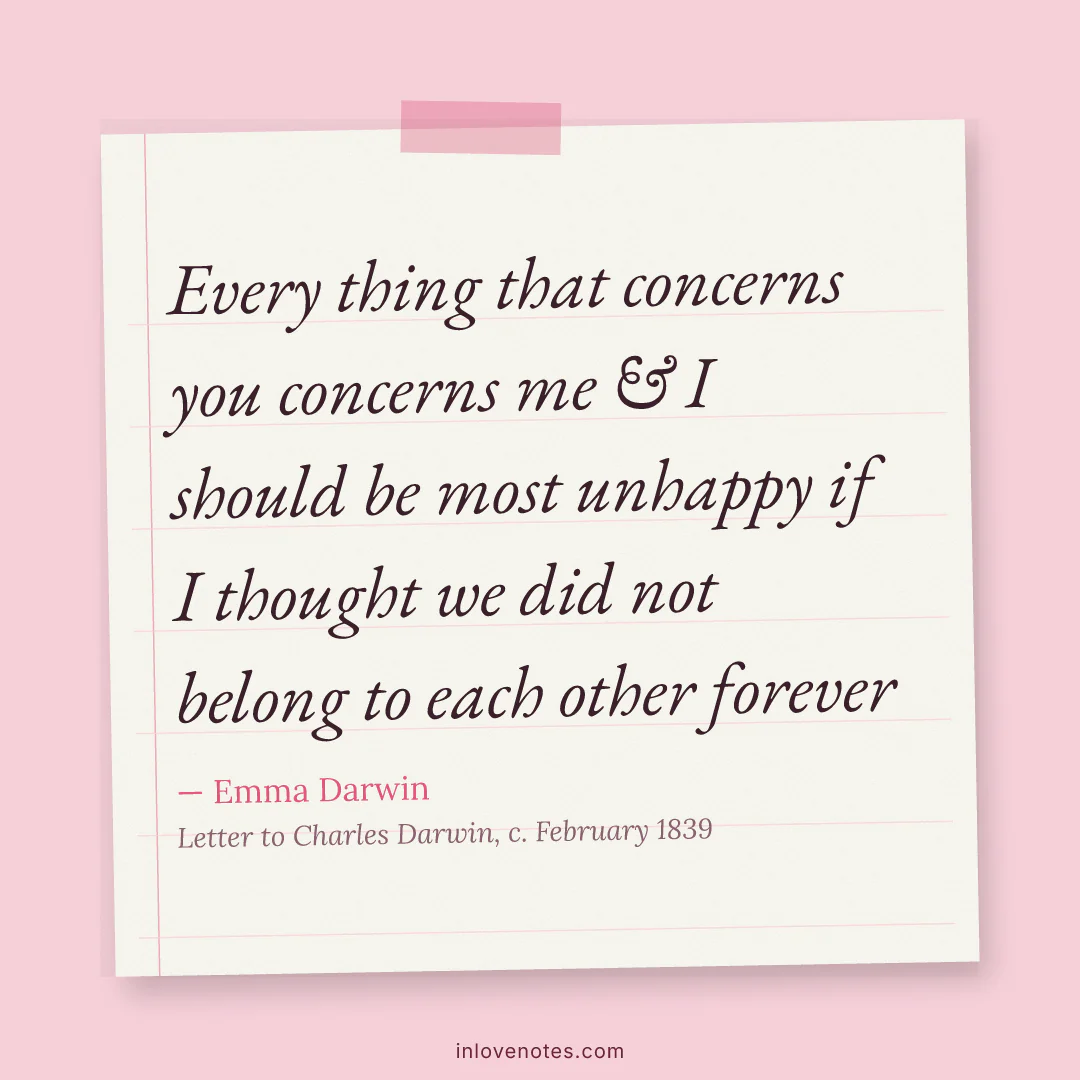
Notice what she says about why she wrote at all: when she talks to him about it, she "cannot say exactly what I wish to say." That is the best reason to write a letter to a future husband instead of saying the same things over dinner. A letter lets you finish your sentence. It also lasts: whatever you write now may be reread at a wedding anniversary, during a bad year, or long after one of you is gone. Write the kind of letter you would be glad to have found.
Abigail Smith, three weeks before her wedding
Seventy-four years earlier, in Boston, Abigail Smith was writing to the lawyer John Adams. In their courtship letters they used pen names: he signed himself Lysander, and she was his Diana. Her letter of 4 October 1764, now in the Adams Papers at the Massachusetts Historical Society, is mostly practical: which servant to hire, how many of her things the cart could carry. Then comes the best sentence anyone has written to a future husband about moving day:
"The cart you mentiond came yesterday, by which I sent as many things as the horse would draw the rest of my things will be ready the Monday after you return from Taunton. And—then Sir if you please you may take me."
— Abigail Smith, letter to John Adams from Boston (1764)
Further down, she does what Emma did. She refers to a sharp remark he had made (she calls it "a corosive applied when a Lenitive would have answerd the same good purpose") and turns it into a rule for the marriage rather than a complaint: she has learned "never to say a severe thing because to a feeling heart they wound to deeply to be easily cured." She adds, "Pardon me this is not said for to recriminate." She closes: "tis an old Story tho I hope as pleasing as it is true, to tell you that I am unfeignedly Your Diana." They married at Weymouth on Thursday, 25 October 1764, according to the editors' note on her next letter.
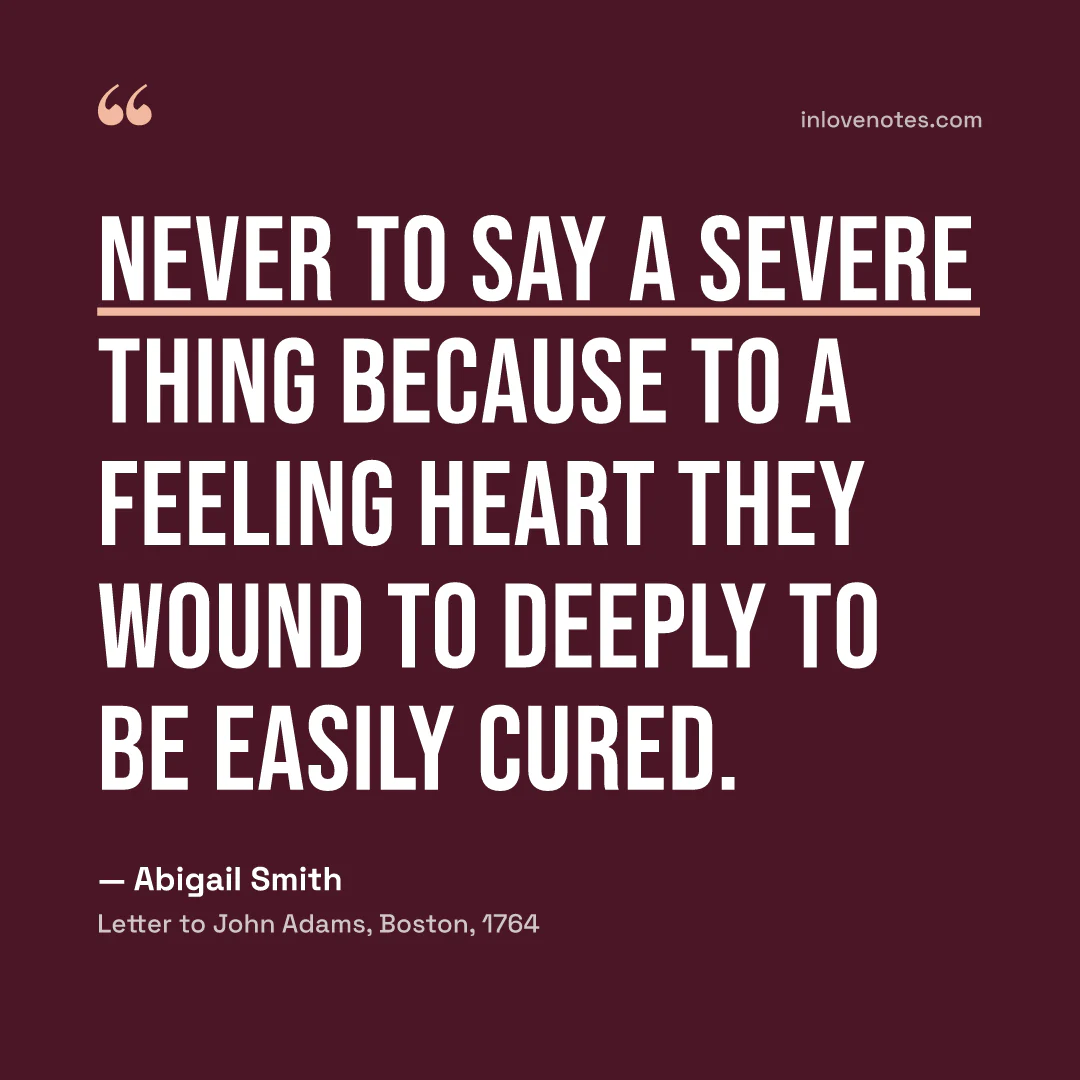
Abigail's letter is the one to borrow from if you are writing in the last weeks before a wedding, when most of your days really are lists and logistics. She doesn't apologize for the practical part. She lets it carry the joke, and then she spends three sentences on what kind of wife she means to be. (Her spelling is her own; we have left it as the Adams Papers print it.)
What both letters do, and how to do it in yours
Put side by side, the two letters follow the same pattern. Here it is as a checklist, with the line each woman used and a version for a letter you might write now.
| Move | Emma Wedgwood, 1838 | Abigail Smith, 1764 | In your letter |
|---|---|---|---|
| Start with today | The walk after he left, the stones in the pool | The cart, the horse, her things | Where you are sitting and what happened this week |
| Say you miss him | "very stupid & flat all day" | "you may take me" | One plain sentence, no metaphors |
| Name one hard thing | Their different beliefs | A severe word he had used | The thing you are nervous about: money, faith, family, distance |
| Turn it into a promise | "I should dread the feeling that you were concealing your opinions" | "never to say a severe thing" | One promise he could actually hold you to |
| End lightly | The spelling postscript | "unfeignedly Your Diana" | A pet name, a joke you share, the date |
If you want more on openings and sign-offs, our guide to starting and ending a love letter compares the common choices. For the other side of the aisle, see letters men wrote to their future wives, including the list Darwin drew up before he proposed to Emma.
Six example letters to your future husband
These were written by our editors as starting points, not as letters to copy word for word. Change the details until every sentence is true for you; a letter he can tell was borrowed is worse than a short one he can tell is yours.
1. Before you've met him
Write this one for a drawer, not an envelope. Date it, keep it short, and write about yourself, because you don't know him yet.
To my future husband,
It's a Sunday in October and I'm writing this at the kitchen table with cold coffee. I don't know your name, so I'll tell you about me instead. This year I learned to ask for help before I'm already drowning. I'm still bad at answering texts and good at remembering birthdays. I hope by the time you read this I've taught you my grandmother's soup.
I don't need you to be perfect. I'd like you to be kind when you're tired, and honest when it would be easier not to be. I'm working on being both of those things too.
Whenever you get here, I've been on my way.
2. A short promise letter to the boyfriend you mean to marry
For a card or a note in his coat pocket. Three promises, each one specific enough that he'd notice if you broke it.
You don't have a ring yet and I don't need one to tell you this. When we argue, I'll say what I'm actually upset about instead of the dishes. I'll keep asking about your day even when I've had a worse one. And I'll keep choosing you on the boring Tuesdays, not only the good weekends. I'm planning on all of them with you.
3. The engagement letter
This is the Emma Wedgwood letter: everyday news, then the paragraph you've been carrying around.
My love,
I've told everyone at work, twice, and my mother has already asked about the church. I keep looking at my hand in meetings.
There's one thing I want to put on paper while it's easy. I'm nervous about money: not about having less, but about us being different with it, because I watched my parents fight about it for years. I'm not asking you to change anything. I'm asking us to talk about it early, before it gets the chance to be a fight. Thank you for never making me feel silly about it.
Now come home, the cat has opinions about the new rug.
4. The wedding-morning letter
Short enough to read in two minutes while someone is fixing his tie. Give it to his best man or a brother to hand over before the ceremony.
Good morning, husband (nearly).
I'm in a room full of hairspray and I'm thinking about the night we got lost driving to your cousin's and you made it into a game. That's what I'm marrying: someone who turns a wrong turn into a good story.
Today I'll make promises in front of everyone. Here's a small one just for you: I'll always tell you when I'm scared, even when I'd rather pretend I'm fine. See you at the end of the aisle. I'll be the one trying not to cry.
5. After a hard year together
Searches for an "emotional letter to my future husband" often come from couples who got through something before the wedding: illness, distance, a loss. Name it, then say what it showed you.
We were supposed to get married last spring. Instead we spent it in hospital car parks and on the phone with insurance companies, and you never once made me feel like a burden.
I used to think the vows were about the future. Now I know what they look like, because I've already seen you keep them. When I say "in sickness" this time, I'll be thinking of you asleep in that awful plastic chair.
I'm not afraid of hard years with you. I've had one.
6. A letter of faith
Emma asked Darwin to read one passage of scripture without telling her his opinion of it. If faith matters to you, a single chosen passage says more than a page of verses.
To the man I'm going to marry,
I've been praying for you for a long time, even before I knew it was you. I want our home to be a place where both of us can bring our doubts as well as our thanks.
Will you read 1 Corinthians 13 before the wedding? Not because you don't know it, but because I'd like us both to have read it in the same week. You don't need to tell me what you think. I'll know.
If what you want to write is closer to a love letter than a letter about the future, our love letters for him are arranged by occasion, and the letters from a wife to her husband are worth keeping for your first anniversary.
Lines from real letters you can borrow
People searching for quotes for a future husband usually find unsourced lines on image sites. These come from letters written by women to the men they were about to marry (and one from a future husband), each checked against the published edition linked in Sources.
| Line | Who, where, when | Use it when |
|---|---|---|
| "my own dear Charley we now do belong to each other & I cannot help being open with you." | Emma Wedgwood to Charles Darwin, Maer, 21–22 Nov 1838 | You're about to say something honest |
| "When I am with you I think all melancholy thoughts keep out of my head" | Same letter | You're apart before the wedding |
| "I should dread the feeling that you were concealing your opinions from the fear of giving me pain." | Same letter | You want him to always tell you the truth |
| "And—then Sir if you please you may take me." | Abigail Smith to John Adams, Boston, 4 Oct 1764 | Moving in, the last weeks before the wedding |
| "tis an old Story tho I hope as pleasing as it is true, to tell you that I am unfeignedly Your Diana" | Same letter | Signing off with a pet name |
| "the sincerest of all Affections, that of Lysander for Diana." | John Adams to Abigail Smith, 8 May 1764 | A line he might send back |
| "Every thing that concerns you concerns me" | Emma Darwin to Charles Darwin, c. Feb 1839 (just after the wedding) | A card for the first weeks of marriage |
Quote them with the name and year, the way you would a line from a book. Several of the lines that circulate as "letters to my future husband" on social media have no traceable author at all; our page on misattributed love quotes explains how to check one before you write it into a card.
Questions people ask before they write
What should I write in a letter to my future husband?
Something true about your life today, one plain sentence saying what he means to you, one thing you find hard to say aloud, and a promise small enough to keep. Emma Wedgwood's letter to Darwin did all four in a single letter. Skip the list of qualities you want in a man; it reads like a job advert when he finally sees it.
What is a good short message for my future husband?
One specific promise and one specific memory: "I'll always tell you when I'm scared. I still think about the night we got lost on the way to your cousin's." Short messages work when they could only have been written to him.
When should I give him the letter?
A letter written before you met can wait for the engagement or the wedding morning; add a dated page in your current handwriting so he sees both versions of you. An engagement letter can go in the post, the way Emma's did. A wedding-day letter should reach him before the ceremony, through someone you trust.
Sources
- Emma Wedgwood to Charles Darwin, [21–22 November 1838], Darwin Correspondence Project, letter 441.
- Emma Darwin to Charles Darwin, [c. February 1839], Darwin Correspondence Project, letter 471 (source DAR 210.8: 14; footnote 1 quotes the autobiography pencil note).
- Darwin's annotation on the February 1839 letter: catalogued by Darwin Online, CUL-DAR210.8.14.
- Engagement (11 Nov 1838) and wedding (29 Jan 1839, Maer): Emma Darwin, Wikipedia, citing the Darwin correspondence.
- Abigail Smith to John Adams, 4 October 1764, Adams Family Correspondence, vol. 1, Massachusetts Historical Society.
- Abigail Smith to John Adams, 13 October 1764 (editors' note on the 25 October 1764 wedding at Weymouth), Adams Papers.
- John Adams to Abigail Smith, 8 May 1764, Adams Papers.