Love Letter to My Husband: 6 Sample Letters From a Wife, by Occasion
Six sample love letters to your husband for your anniversary, his birthday, time apart and hard days, next to real letters wives wrote, all sourced.
Martha and George Washington were married for forty years, and almost none of their letters to each other survive. After George died in 1799, Martha destroyed their correspondence. One of the two notes from her that escaped is a postscript she added to his cousin and estate manager Lund Washington's letter in March 1767, while George was away at the House of Burgesses in Williamsburg. It is not poetic at all. It's about the weather.
My Dearest / It was with very great pleasure I see in your letter that you got safely down. We are all very well at this time but it still is rainney and wett. I am sorry you will not be at home soon as I expected you… Your most Affectionate / Martha Washington
Martha Washington, postscript to George Washington, 30 March 1767 (Martha Washington digital collection)
Read it twice and it is a love letter anyway: glad you arrived, sorry you're not home yet, signed "your most affectionate". That is worth remembering before you sit down to write a love letter to your husband. He does not need a sonnet. He needs to hear, in your own words, that you notice him and want him home. Below are six sample letters our editors wrote for the occasions wives search for most (anniversary, birthday, while he's away, a hard conversation, a heavy season, and just because), each paired with a real letter or poem a wife wrote to her husband, with the source.
Which letter are you writing?
Pick the occasion first, because it decides the length and the one thing the letter has to do.
| Occasion | Good length | The one job of the letter | Real model on this page |
|---|---|---|---|
| Wedding anniversary | One page | Say what the years have done to your love | Anne Bradstreet, 1678 |
| His birthday | Half a page | Thank him for one specific thing he did this year | Martha Washington, 1767 |
| While he's away (deployment, shifts, travel) | Half a page, often | Bring him into the house for a minute | Anne Bradstreet, Ipswich |
| Something hard needs saying | Short, and slept on | Tell the truth without leaving the marriage in doubt | Clementine Churchill, 1940 |
| He's carrying something heavy | A few lines | Remind him what he is to you | Abigail Adams, 1777 |
| Just because | A note | Prove you were paying attention today | Martha Washington, 1767 |
If you have never written him a letter before, our guide to how to start and end a love letter covers greetings and sign-offs in detail. The rest of this page assumes you have the pen in your hand.
For your anniversary: say what the years did
One of the best-known love poems a wife ever wrote to her husband in English is twelve lines long. Anne Bradstreet married Simon Bradstreet in England in 1628, when she was sixteen, sailed with him to Massachusetts in 1630 and raised eight children with him. Her poems were first printed in London in 1650 as The Tenth Muse Lately Sprung Up in America, but this one appeared only after her death, in the expanded Several Poems of 1678 (Academy of American Poets).
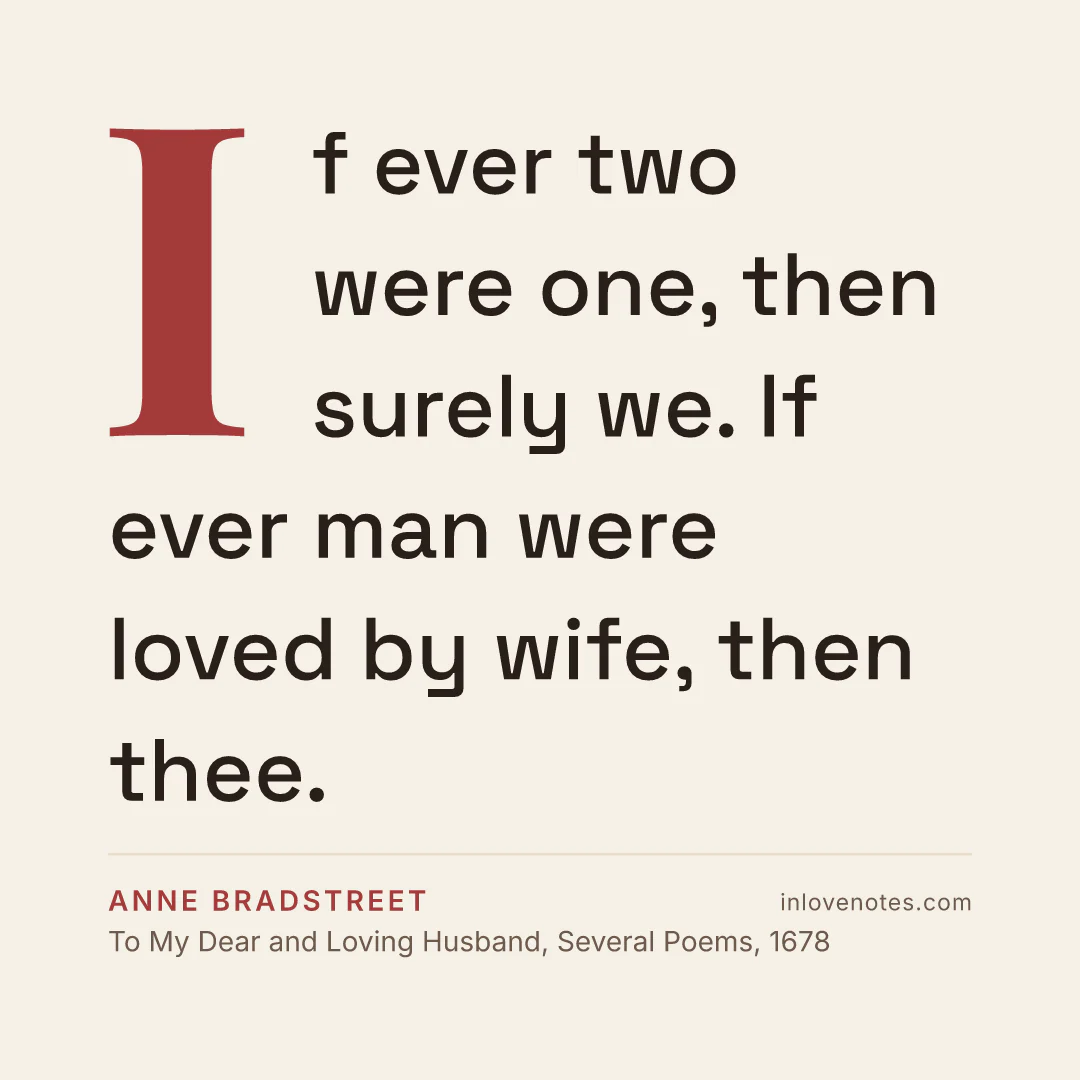
If ever two were one, then surely we. / If ever man were loved by wife, then thee; / If ever wife was happy in a man, / Compare with me ye women if you can.
Anne Bradstreet, "To My Dear and Loving Husband", Several Poems (1678) (poets.org)
Notice what she does: she doesn't describe him at all. She describes the marriage, and dares anyone to match it. Later lines borrow from the Song of Songs ("My love is such that rivers cannot quench") and end on a hope that the two of them will "live ever". That's the anniversary move. Write about the two of you, about what the marriage has become, and let the praise of him come through that. Couples who have been married a long time often find this easier than listing his qualities, and it sounds less like a card.
Sample letter: wedding anniversary
Written by our editors. Replace everything in [brackets] with your own details.
[His name],
[Number] years ago today you stood at the front of [the church / the courthouse / your aunt's garden] looking like you might faint, and I loved you for it. I thought I knew then what I was promising. I didn't have a clue.
Since then we have [moved three times, raised two loud children, survived your mother's Christmas lists, painted the hallway twice because I changed my mind]. We are not the two people in the wedding photos anymore. I like these two better. I like that you still [make my coffee before you make your own / check the locks twice / sing in the car when you think nobody's listening].
If I had to do it again, I would. I'd just ask you to breathe before the vows.
Happy anniversary. Yours, still and always, [your name]
For his birthday: one thing, said properly
Birthday letters go wrong when they try to cover everything. Pick one thing he did this year that nobody thanked him for: the night he sat up with a sick child, the job he kept going to when he hated it, the way he handled your father. Martha Washington's postscript is the right scale: a few sentences, one piece of real news, a warm sign-off. A birthday letter to a husband can be the same size and still be the best thing he opens that day.
Sample letter: his birthday
Written by our editors. Replace everything in [brackets].
Happy birthday, [nickname].
I could write a list, but I want to tell you about one thing. In [month], when [the car died / my mom was in hospital / work went sideways], you [took the week off without being asked / drove there and back twice in one day / never once said "I told you so"]. You probably don't remember it. I do. I think about it whenever someone asks me what kind of man you are.
So that is my present, along with the actual present: I noticed. I always notice, even when I forget to say so.
[Number] looks good on you. Love you, [your name]
While he's away: deployment, night shifts, long trips
Bradstreet wrote a second poem, a verse letter to Simon while he was away on colonial business and she was home in Ipswich with the children. Helen Campbell's 1890 biography explains that the General Court kept him away for long stretches during their Ipswich years (Anne Bradstreet and Her Time, Project Gutenberg). The poem opens with a pile of names for him, "My head, my heart, mine Eyes, my life", then asks the question every wife of a travelling husband has asked:
If two be one as surely thou and I, / How stayest thou there, whilst I at Ipswich lie?
Anne Bradstreet, "A Letter to Her Husband, Absent upon Public Employment", Several Poems (1678), text as printed in Campbell (1890)
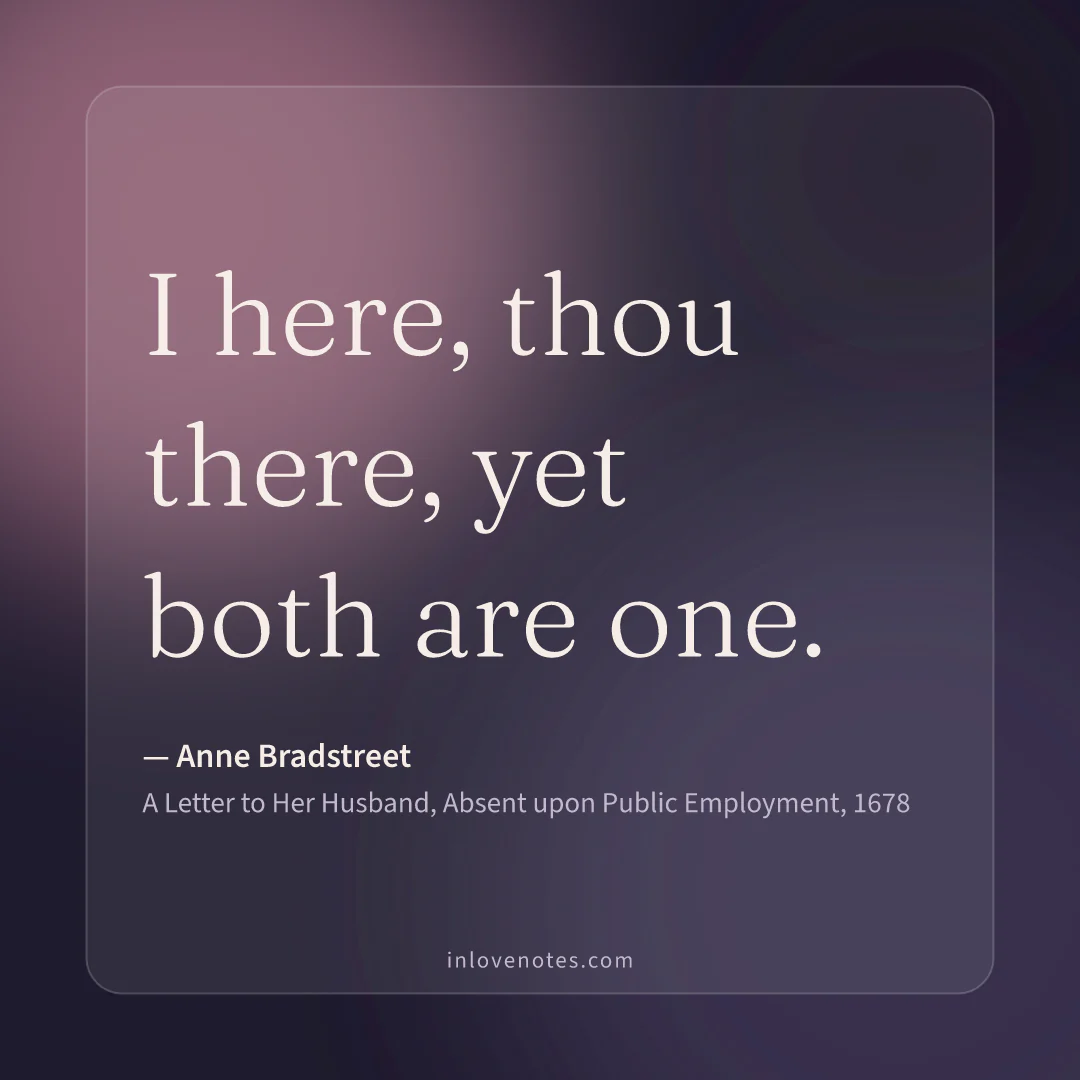
She then tells him what home looks like without him: winter, cold limbs, and the children, "True, living Pictures of their Father's face". She ends with the line most worth borrowing: "I here, thou there, yet both are one." The lesson for a letter to a deployed or travelling husband is to bring the house to him. Tell him what the kitchen smells like, what the youngest said at dinner, which of his jobs is waiting for him. Keep letters short and frequent rather than long and rare. If he's away for months, a set of "open when" letters works well alongside them.
Sample letter: while he's away
Written by our editors. Replace everything in [brackets].
Hi, you.
Day [number]. The house is too quiet and the [dog / furnace / youngest] is making up for it. [Child] asked at dinner whether you have [pancakes / a bed / weekends] where you are, and I said yes, but not as good as ours.
Your [boots / mug / side of the bed] is exactly where you left it. I haven't moved it and I'm not going to. The [gutter / fence / shelf] is waiting for you too; I've decided that's your welcome-home present.
I'm proud of you, I'm counting, and I'm fine. Mostly fine. Come home in one piece.
Here, thinking of you there, [your name]
For more on writing across distance, including how often to write and what to avoid, see our long distance love letters.
When something hard needs saying
Not every love letter to a husband is sweet. Some of the most loving letters say something he won't want to hear. In June 1940, seven weeks after Winston Churchill became prime minister, his wife Clementine, married to him for nearly thirty-two years, wrote him a letter at Chequers about the way he had started treating the people around him. It opens:
I hope you will forgive me if I tell you something that I feel you ought to know.
Clementine Churchill to Winston Churchill, 27 June 1940 (Churchill Archives Centre; text in Letters of Note)
She reports what a friend had told her, then adds her own observation in one sentence: "you are not so kind as you used to be." She signs it "your loving devoted & watchful Clemmie". At the bottom she admits she wrote it the Sunday before, tore it up, and is giving it to him anyway. The original is held at the Churchill Archives Centre in Cambridge, and it's quoted so often because of its shape:
- It asks permission first. "Forgive me if I tell you" lowers his guard before the hard part.
- It says the hard thing once, plainly. No list of every grievance.
- It is clearly on his side. She wants people to "love as well as admire" him; the complaint is that he is falling short of himself.
- The sign-off settles the question of the marriage. "Loving devoted" comes before "watchful".
- It was slept on. She wrote it, waited, and only then gave it to him.
Use the same shape if he has hurt you, or if something has been building for months. Keep it to what happened and how it felt, not a verdict on his character. Say what you want next. One honest point: a letter can start a conversation, but it can't carry a marriage through a serious problem on its own; a couples counselor is a better next step than a longer letter. And if you are afraid of him, a letter is the wrong tool. In the US, the National Domestic Violence Hotline is 1-800-799-7233.
Sample letter: when you need to tell him something hard
Written by our editors. Replace everything in [brackets].
[His name],
I'm writing this down because when we talk about it, we both get defensive and it turns into something else. Please read it to the end.
When [you made the joke about my job in front of your brother / you missed the appointment again / you went quiet for three days], I felt [small / alone in this / like I didn't matter]. I don't think you meant it that way. But it has happened [more than once / since the spring], and I've been carrying it on my own.
What I'm asking for is [one evening a week where we talk with the phones off / that you tell me when you're struggling instead of going silent]. That's it. I'm not going anywhere. I'm writing this because I want us back.
Your [wife], who loves you and is paying attention, [your name]
When he's carrying something heavy
Job loss, illness, a parent's death, the slow grind of a bad year: in these seasons, a husband rarely needs advice in writing. Abigail Adams found out how much a single phrase could do. On 10 July 1777, with John in Philadelphia at the Continental Congress, she was ill and in pain late in a pregnancy, and a letter from him arrived. She wrote back about its first words:
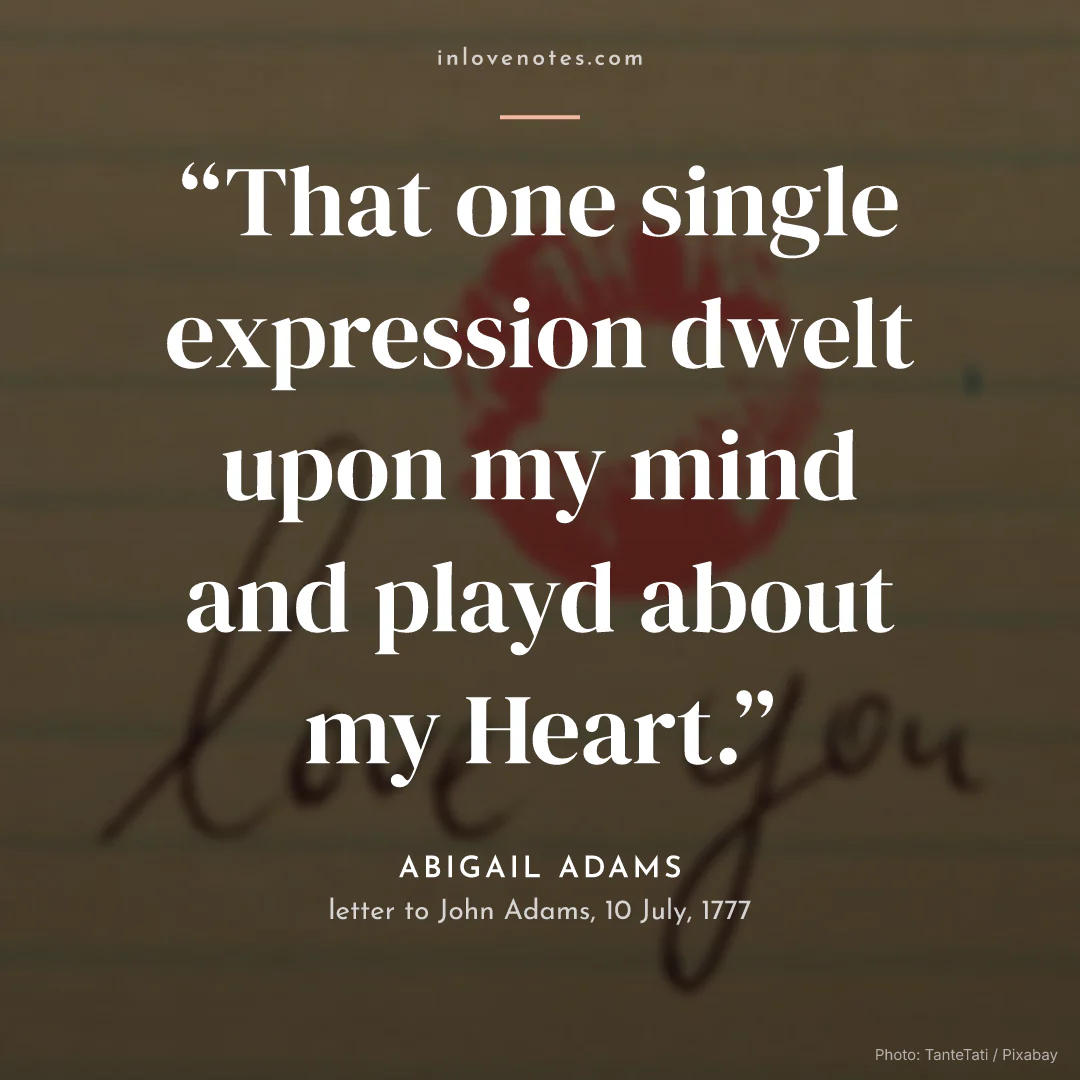
About an Hour ago I received a Letter from my Friend dated June 21: begining in this manner 'my dearest Friend.' It gave me a most agreable Sensation, it was a cordial to my Heart. That one single expression dwelt upon my mind and playd about my Heart, and was more valuable to me than any part of the Letter, except the close of it.
Abigail Adams to John Adams, 10–11 July 1777 (Adams Papers, Massachusetts Historical Society)
She explained why: she "wanted the personal and tender soothings" of her husband while she was suffering. On 11 July she gave birth to a stillborn daughter, the news John Thaxter sent to John Adams two days later. The lesson runs both ways in a marriage. When your husband is going through something, the name you call him and the way you sign off may matter more than anything in between. Don't try to fix it in the letter. Tell him who he is to you, and that you're staying.
Sample letter: when he's going through a hard time
Written by our editors. Replace everything in [brackets].
My dearest [name],
I'm not going to tell you it will all be fine, because you'd know I was guessing. Here is what I do know.
You are the man who [carried my grandmother up the stairs at the wedding / taught [child] to ride a bike in one afternoon / stayed with me all night in the hospital]. [Losing the job / This diagnosis / Losing your dad] doesn't change one bit of that. You don't have to be strong in this house. You just have to be here, and so will I.
Whatever the next months look like, we'll do them together.
Always your [wife], [your name]
Just because: the rainy-Tuesday letter
Go back to Martha Washington's postscript: weather, health, "sorry you will not be at home soon". A just-because letter to a husband works best when it's that ordinary. Leave it on the steering wheel, in his work bag, under his coffee mug. Mention something you saw him do in the last 24 hours. That's the whole trick.
Sample letter: just because
Written by our editors. Replace everything in [brackets].
[Nickname],
Nothing's wrong. Nobody's birthday. I watched you [fix the kid's bike in the rain / fall asleep on the sofa with the cat on your chest / talk my sister down on the phone] last night and thought: I married well.
That's all. Go to work. Come home.
Your most affectionate [your name]
Six short lines for a card, text or lunchbox
Also written by our editors, for when a whole letter is too much:
- "I'd still pick you. Even today. Especially today."
- "Thank you for [the thing he did this morning]. I saw it."
- "The house is louder when you're home and I like it that way."
- "You're my favorite person to do nothing with."
- "[Number] years and you still make me laugh at the worst moments."
- "Come home soon. The [kettle / dog / bed] misses you. So do I."
Swap the greeting-card phrases for your own
Most letters to a husband sound generic because of a handful of phrases. Each one below is fine on a card; in a letter, the version on the right will mean more to him.
| Instead of… | Try something like… |
|---|---|
| "You are my everything." | "You are the first person I want to tell when anything happens." |
| "You're my rock." | "When [the hard thing] happened, you [the specific thing you did]." |
| "I love you more than words can say." | Say it in words anyway: "I love you. I love the way you [habit]." |
| "Thank you for everything." | Thank him for one thing, named. |
| "You're the best husband in the world." | "You're a better husband than you were ten years ago, and you were good then." |
| "Forever and always." | Your own sign-off: a private name, a joke, a line only he understands. |
Two more small things make a letter land. First, use what you call him at home, not "Dear Husband"; Abigail Adams is proof that the greeting can matter more than the body. Second, write by hand if you can. Handwriting is the part he'll keep. If you want to compare notes with the other side, our love letter to my wife page collects real husbands' letters, and love letters for him covers boyfriends as well as husbands.
Quick answers
What should I write in a love letter to my husband?
Start with what you actually call him. Then write about one specific moment from your life together, one thing he does that you're grateful for, and something about your future. Say "I love you" plainly once. End with a sign-off that sounds like you. Half a page to a page is plenty.
How do I write a short love letter to my husband?
Use three sentences: what you saw him do recently, what it made you feel, and a sign-off. "I watched you with the kids this morning. I married well. Come home early." The just-because sample and the six short lines above are built this way.
How do I make a letter to my husband deep and emotional without it sounding fake?
Replace adjectives with memories. "You're so caring" is easy to skim; "you sat in the hospital parking lot with me until 3 a.m." is not. Admit one hard thing you went through together, then say why you're still glad you chose him. Read it aloud before you send it, and cut any line you wouldn't say to his face.
Clementine Churchill's letter has a last line most people skip: "I wrote this at Chequers last Sunday, tore it up, but here it is now." Whatever you write, the one that reaches him beats the perfect one in the trash. Send it.