Love Poems for Her From the Heart: 10 Classics, the Moment Each One Suits, and the True Story Behind It
Ten love poems for her from the heart, Spenser to Yeats, each checked against an early printing, with the story behind it and the moment it suits best.
Which poem should you give the woman you love? It depends on the moment. A poem that is perfect at a wedding can feel wrong on a Tuesday morning, and one that makes a wife of thirty years cry can sound like a warning to a new girlfriend. Below are ten love poems for her, written from the heart by poets who meant them for real women, from Edmund Spenser in 1595 to Paul Laurence Dunbar in 1895. They are grouped by the moment they suit best. Each one has been checked against an early or standard printing, and each comes with the story behind it. We say which stories are documented and which are only legends, because several of the famous ones are less certain than the internet suggests.
Ten poems, ten moments: the short list
All ten poems were published long before 1927, so they are in the public domain in the United States and you can copy them in full into a card or letter. The last column says how solid the usual story about the woman behind the poem is. It is explained in more detail further down.
| Poem | Poet, first printed | Moment it suits | The woman behind it |
|---|---|---|---|
| The Good-Morrow | John Donne, 1633 | A morning text, the first morning together | Unknown; often linked to Anne More, not proven |
| Song: To Celia | Ben Jonson, 1616 | A dinner, a toast | "Celia" is a poetic name; the lines adapt Philostratus |
| Love's Philosophy | Percy Bysshe Shelley, 1819 | Asking for a kiss | Not named |
| Rondeau ("Jenny kiss'd me") | Leigh Hunt, 1838 | A playful note, a birthday when you feel old | Jane Welsh Carlyle, a friend (well documented) |
| To Lucasta, Going beyond the Seas | Richard Lovelace, 1649 | Long distance, a trip, a deployment | Said to be Lucy Sacheverell (one old source) |
| Amoretti LXXV ("One day I wrote her name") | Edmund Spenser, 1595 | A wedding, an engagement | Elizabeth Boyle, whom he married (documented) |
| She Was a Phantom of Delight | William Wordsworth, 1807 | An anniversary, a wife | His wife Mary (his own words, 1842) |
| Believe Me, If All Those Endearing Young Charms | Thomas Moore, 1808 | A long marriage, growing older | The smallpox story is unproven |
| When You Are Old | W. B. Yeats, 1892 | To make her cry (with care) | Maud Gonne, who would not marry him |
| Invitation to Love | Paul Laurence Dunbar, 1895 | After a quarrel, a hard season | Not named |
For the first morning, or any morning
John Donne's "The Good-Morrow" was first printed in 1633, two years after his death, in the first collected edition of his Poems. It opens with a lover waking up and wondering what he and the woman beside him did with their lives "till we lov'd". The second stanza is the one to send:
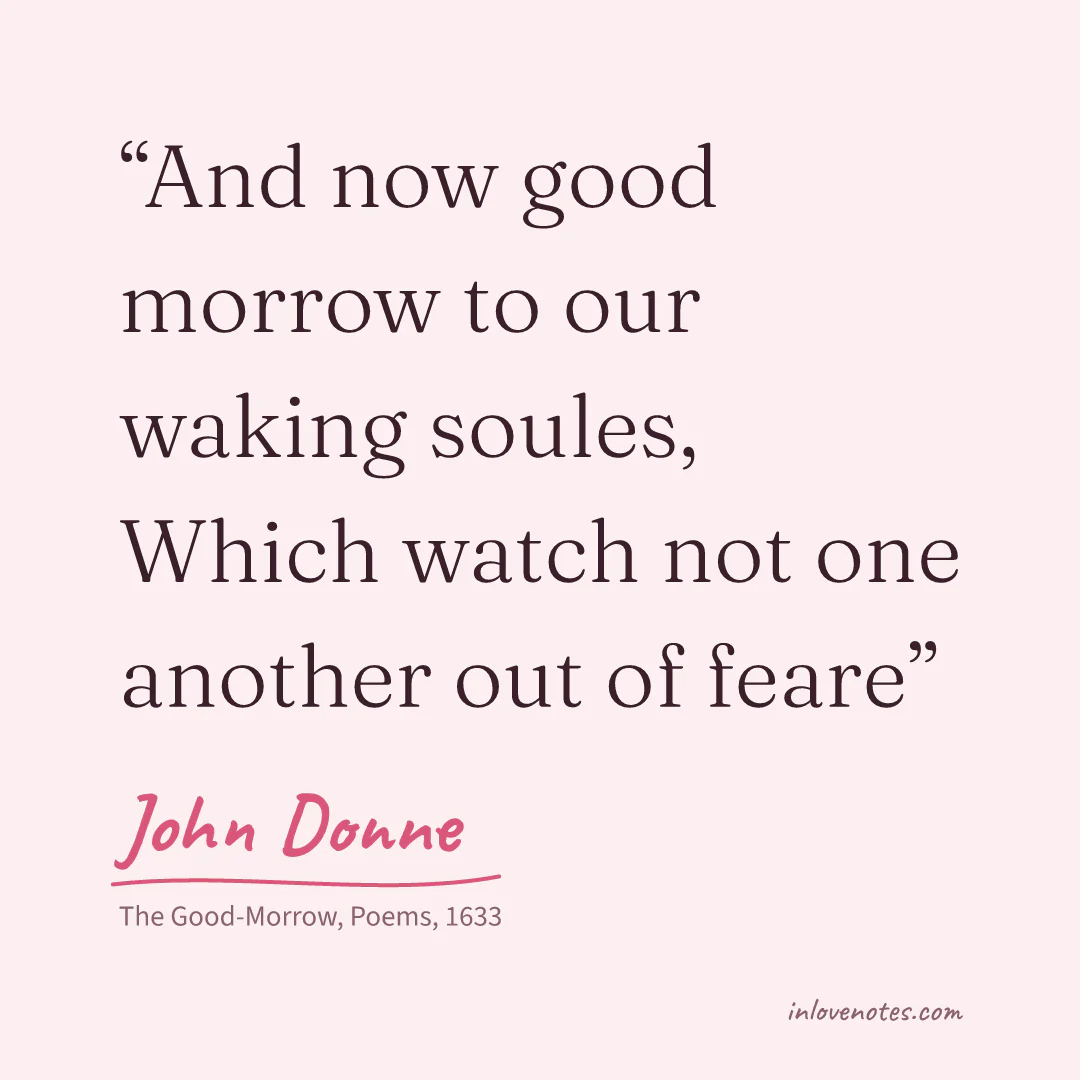
And now good morrow to our waking soules, / Which watch not one another out of feare; / For love, all love of other sights controules, / And makes one little roome, an every where.
John Donne, "The Good-Morrow", Poems (1633)
"Good morrow" is simply "good morning", so the poem works as a morning text with no explanation. The idea that two people who trust each other no longer need to "watch" each other is what lifts it above a pretty greeting. And "one little roome, an every where" is the best description of a small flat shared by two people that anyone has written. Readers often assume Donne wrote it for his wife, Anne More. That is possible, but the poem does not name her, and it can't be dated precisely. Keep the old spelling if you write it out by hand. It looks deliberate and lovely in ink.
Across a dinner table, or when you want a kiss
Ben Jonson printed "Song: To Celia" in The Forest in 1616. Set to music, it became one of the best-known love songs in English. The first stanza is a toast:
Drink to me only with thine eyes, / And I will pledge with mine; / Or leave a kiss but in the cup / And I'll not look for wine.
Ben Jonson, "Song: To Celia", The Forest (1616)
What few people know is that Jonson borrowed much of it. Scholars long ago traced both stanzas to the prose love letters of Philostratus, a Greek writer of the Roman imperial period: the lover's thirst at the sight of his beloved, and the wreath of roses sent back after she breathed on it. In Jonson's day, reworking a classical source this well was a mark of skill, not theft. It makes the poem perfect for a dinner. Raise a glass, say the four lines, and you've given her a compliment that has been passed from lover to lover since the days of the Roman empire.
If the dinner is going well, Shelley's "Love's Philosophy" makes the next move. Leigh Hunt published it in his weekly paper The Indicator on 22 December 1819, and Mary Shelley collected it in Posthumous Poems in 1824. Its whole argument is that everything in nature mingles, so why not the two of you:
See the mountains kiss high heaven / And the waves clasp one another; / No sister-flower would be forgiven / If it disdain'd its brother: / And the sunlight clasps the earth, / And the moonbeams kiss the sea— / What are all these kissings worth, / If thou kiss not me?
Percy Bysshe Shelley, "Love's Philosophy" (1819)
It is a flirt, not a vow, and it reads best that way. Write the last two lines on a note and leave it on her pillow. Don't put it in a wedding speech.
A note that makes her laugh: Leigh Hunt's eight lines
The shortest poem here, and the only funny one, is by the same Leigh Hunt who first printed Shelley's poem. It appeared in the Monthly Chronicle in November 1838 under the title "Rondeau", and it is now known by its refrain:
Jenny kiss'd me when we met, / Jumping from the chair she sat in; / Time, you thief, who love to get / Sweets into your list, put that in! / Say I'm weary, say I'm sad, / Say that health and wealth have miss'd me, / Say I'm growing old, but add, / Jenny kiss'd me.
Leigh Hunt, "Rondeau" (1838)
Here is the twist. Jenny was not Hunt's sweetheart. Jenny was Jane Welsh Carlyle, the wife of his friend Thomas Carlyle, and the kiss was a friend's delighted greeting. The Carlyle Encyclopedia identifies her and says she kissed him on hearing he had recovered from one of his illnesses. Hunt put the compliment down to their shared love of books, a kiss "from a young enthusiast to an old one". Knowing that doesn't spoil the poem; it makes it warmer. Use it on her birthday when you are the one feeling old, or change "Jenny" to her name for a note on the fridge. Changing the name is the one edit to a poem that nobody minds.
When one of you is far away
Richard Lovelace, a royalist poet of the English Civil War years, published Lucasta in 1649. "To Lucasta, Going beyond the Seas" is his answer to anyone who thinks distance ends a love:
Though seas and land betwixt us both, / Our faith and troth, / Like separated souls, / All time and space controls: / Above the highest sphere we meet / Unseen, unknown; and greet as Angels greet.
Richard Lovelace, "To Lucasta, Going beyond the Seas", Lucasta (1649)
The poem opens with a clever logical trick: if being absent meant being away from her, he would fear the wind and the waves; but it doesn't, so he doesn't. For a partner on a long trip, a posting or a deployment, that stanza says "we are fine" without pretending it is easy. As for who Lucasta was, the usual answer is Lucy Sacheverell. That identification comes from the seventeenth-century antiquary Anthony Wood, and later writers have mostly repeated it without finding anything to confirm it, so treat it as a tradition. If you are writing a longer letter to go with it, our long-distance love letters page has real letters from couples who were apart, with notes on what made each one work.
For a wedding or an engagement
Of all the poems here, Edmund Spenser's has the best-documented happy ending. Amoretti, a sequence of 89 sonnets, was published in 1595 together with "Epithalamion", the long poem Spenser wrote for his own wedding. The sonnets follow his courtship of Elizabeth Boyle, whom he married in 1594. In Sonnet LXXV he writes her name in the sand, the tide erases it, and she tells him he is wasting his time. His answer is the poem:
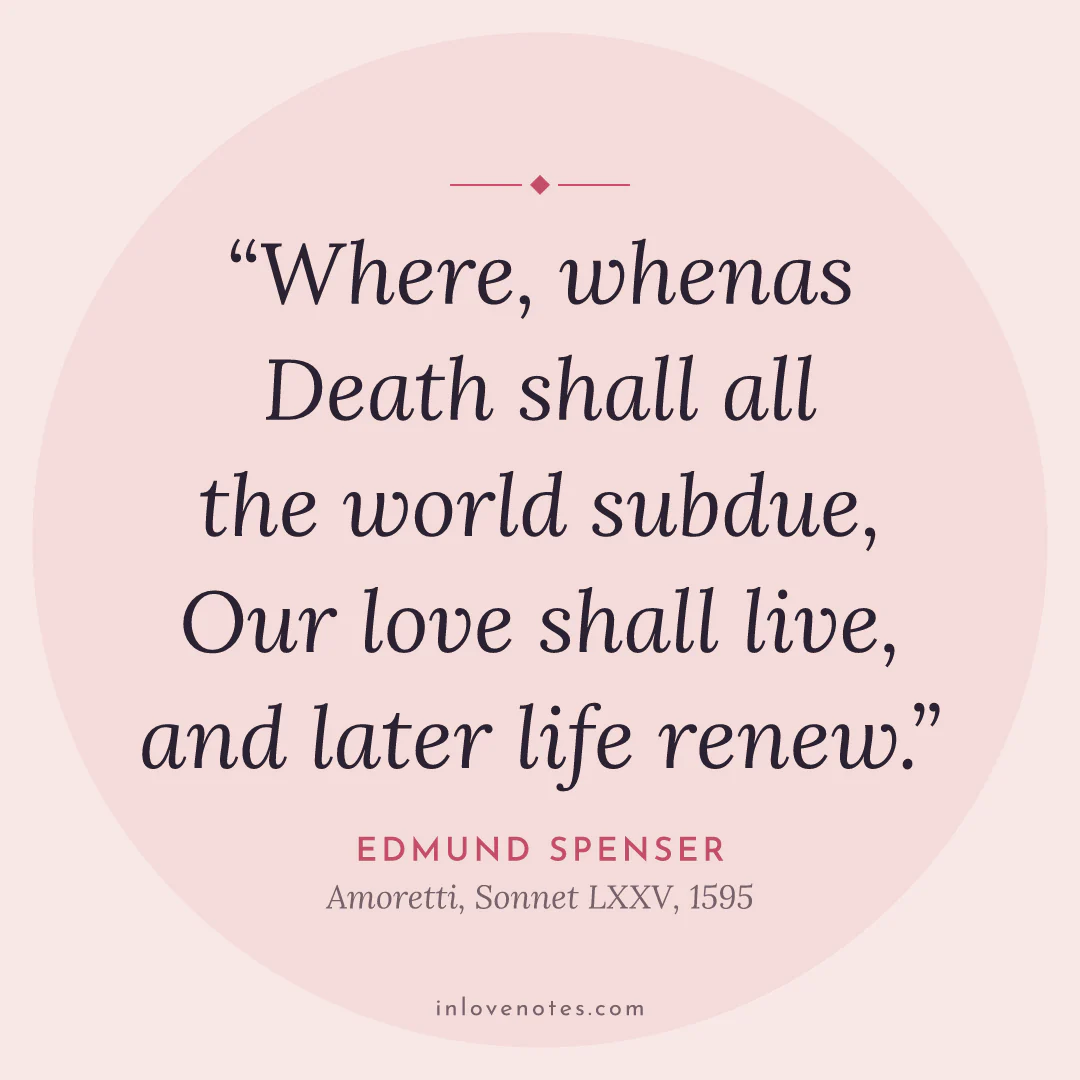
'Not so,' quoth I; 'let baser things devise / To die in dust, but you shall live by fame; / My verse your virtues rare shall eternize, / And in the heavens write your glorious name: / Where, whenas Death shall all the world subdue, / Our love shall live, and later life renew.'
Edmund Spenser, Amoretti, Sonnet LXXV (1595)
Read the whole sonnet at a wedding, not just the couplet. The little argument on the beach, with her teasing him ("Vain man," said she), is what makes it human. It also happens to be true: over four hundred years later we still know her name. For an engagement card, the final couplet alone is enough.
For an anniversary, choose William Wordsworth's "She Was a Phantom of Delight", composed in 1804 and published in 1807. Its three stanzas move from first sight ("a lovely apparition") to daily life ("A creature not too bright or good / For human nature's daily food") to the woman he has come to know:
And now I see with eye serene / The very pulse of the machine; / A being breathing thoughtful breath, / A traveller between life and death: / The reason firm, the temperate will, / Endurance, foresight, strength, and skill; / A perfect woman, nobly plann'd, / To warn, to comfort, and command
William Wordsworth, "She Was a Phantom of Delight" (1807)
That movement from infatuation to respect is why it suits a wedding anniversary better than a first date. The poem was once the subject of gossip. In 1859 a writer in the Daily News (then thought to be Harriet Martineau) claimed it described some earlier "phantom" before Mary Hutchinson, Wordsworth's wife. Wordsworth had already answered that. His note to Isabella Fenwick says the poem "was written from my heart, as is sufficiently obvious". On 12 May 1842 Henry Crabb Robinson recorded him saying that this poem and three others should be read together "as exhibiting the different phases of his affection to his wife." For more words from husbands to wives, see our love letter to my wife guide.
For a long marriage, or to make her cry
Thomas Moore wrote "Believe Me, If All Those Endearing Young Charms" for an old tune and published it in 1808 in the second volume of A Selection of Irish Melodies. It is a promise that he will love her as she ages:
Believe me, if all those endearing young charms, / Which I gaze on so fondly to-day, / Were to change by to-morrow, and fleet in my arms, / Like fairy-gifts fading away, / Thou wouldst still be adored, as this moment thou art, / Let thy loveliness fade as it will
Thomas Moore, "Believe Me, If All Those Endearing Young Charms" (1808)
Almost every page about this song repeats the same story: Moore wrote it for his wife Bessy after smallpox scarred her face, and he sang it outside her door. We could not find a source for it. Even the Wikipedia article calls it only "a common notion" and cites nothing for it. Tell it as a legend if you tell it at all. The poem doesn't need it. Its second stanza ends with the sunflower that turns "to her god when he sets / The same look which she turned when he rose", and that is enough for a fortieth anniversary.
W. B. Yeats's "When You Are Old" is the poem people mean when they ask for a love poem that will make her cry. Yeats wrote it in 1891, at twenty-six, and in his own preface he says it appeared with the lyrics of The Rose in 1892:
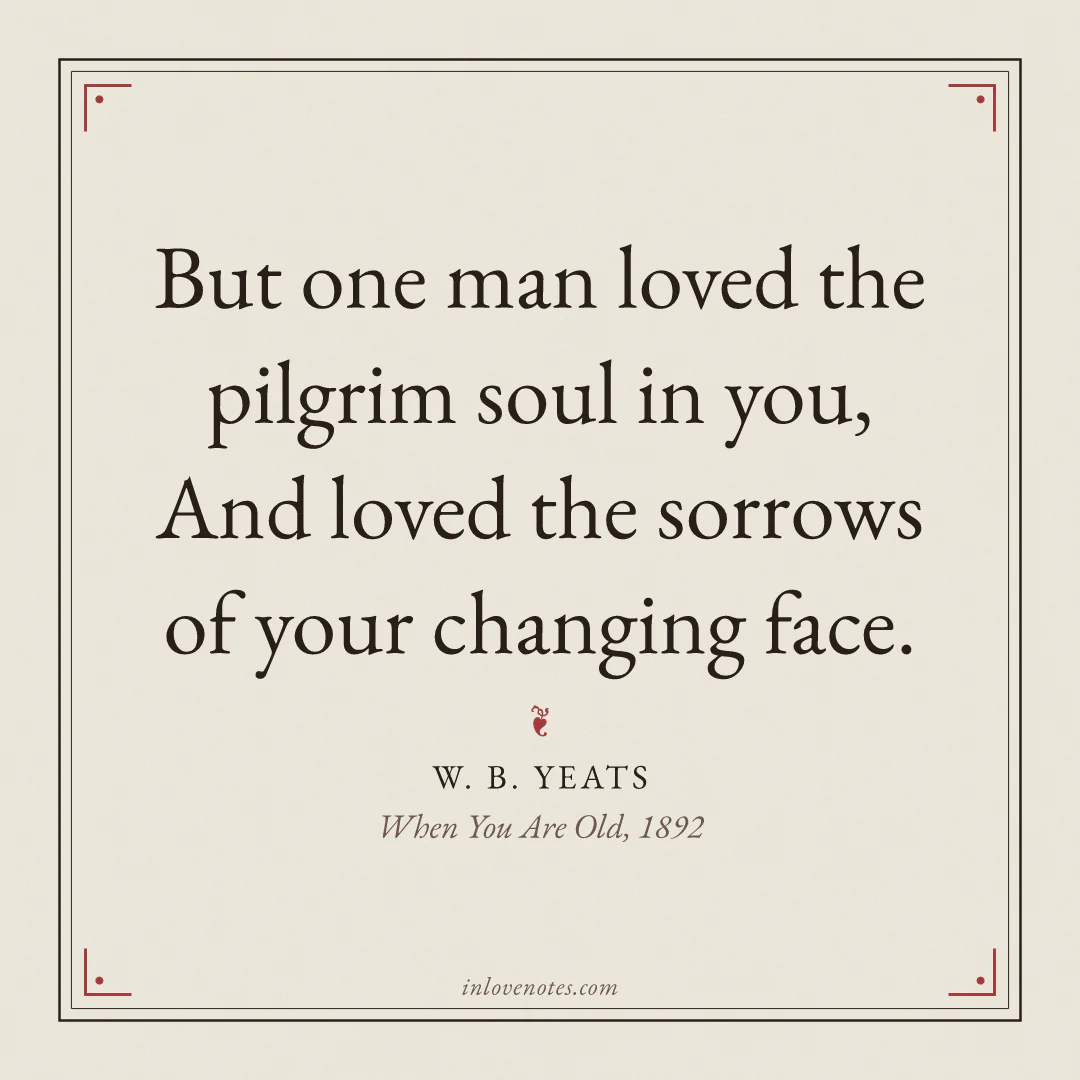
When you are old and gray and full of sleep, / And nodding by the fire, take down this book, / And slowly read, and dream of the soft look / Your eyes had once, and of their shadows deep; / How many loved your moments of glad grace, / And loved your beauty with love false or true; / But one man loved the pilgrim soul in you, / And loved the sorrows of your changing face.
W. B. Yeats, "When You Are Old" (1892)
Before you send it, know what it is. Yeats wrote it for Maud Gonne, who turned down his proposals, and it adapts a sonnet by the French poet Pierre de Ronsard, "Quand vous serez bien vieille". In both, the poet tells the woman she will regret him when she is old. The final stanza says "how love fled". Given to a wife of many years, with a line of your own such as "I am still the one by the fire", it becomes a poem about staying. Given to someone who has just left you, it reads as a reproach, so don't.
After a quarrel, or a hard season
Paul Laurence Dunbar published "Invitation to Love" in Majors and Minors in 1895, when he was in his early twenties. It is an open door. Love may come in any weather, and it will be welcome:
Come when my heart is full of grief / Or when my heart is merry; / Come with the falling of the leaf / Or with the redd'ning cherry. / Come when the year's first blossom blows, / Come when the summer gleams and glows, / Come with the winter's drifting snows, / And you are welcome, welcome.
Paul Laurence Dunbar, "Invitation to Love" (1895)
Strictly, the poem speaks to Love itself rather than to a woman. That is what makes it useful after a fight. It doesn't argue, apologize or ask for anything. It just says the door is open whenever she is ready. Leave the third stanza on the kitchen table and let her decide when to come back to the conversation. If an apology is owed as well, write that separately and plainly. A poem can open the door, but it can't do the apologizing for you.
The stories behind the poems: documented, likely or legend
Love poems collect stories, and the stories get repeated until they sound like facts. Here is what we found when we checked the ones attached to these ten poems.
| The story | Verdict | What it rests on |
|---|---|---|
| Spenser's Amoretti tell his courtship of Elizabeth Boyle, whom he married in 1594 | Documented | The marriage and the 1595 volume, with "Epithalamion" for the wedding |
| "She Was a Phantom of Delight" is about Wordsworth's wife | Documented | Wordsworth's Fenwick note and Crabb Robinson's diary, 12 May 1842 |
| Jenny is Jane Welsh Carlyle | Well supported | The Carlyle Encyclopedia and Hunt's own account of the kiss |
| "When You Are Old" is for Maud Gonne and follows Ronsard | Well supported | Standard Yeats scholarship; the Ronsard sonnet is printed and can be compared |
| "To Celia" is adapted from Philostratus | Documented | The Greek letters survive and can be set beside Jonson's lines |
| Lucasta was Lucy Sacheverell | Tradition | Anthony Wood's identification, repeated rather than confirmed |
| Donne wrote "The Good-Morrow" for Anne More | Possible, unproven | The poem names no one and can't be dated precisely |
| Moore wrote "Believe Me" for his wife after smallpox | Legend | No source found; repeated without citation |
The same habit of repeating stories without checking them produces fake quotations too. Lines get pinned on famous writers who never wrote them. Our page on misattributed love quotes traces the worst of those back to where they really came from.
Putting a poem in her card or letter
A borrowed poem works best when it is clearly a gift from you, not a filler. Four habits help.
- Take a stanza, not the whole poem, unless it is short (Hunt's eight lines, Jonson's first stanza). Four to eight lines fit a standard card. If you cut lines from the middle, mark the cut with an ellipsis (…).
- Keep the line breaks. Write each line on its own line, or use a slash ( / ) if space is tight. A poem copied as one run-on sentence loses its music.
- Credit the poet under it, with the year if you like: "John Donne, 1633". She may want to look it up, and getting the name right is part of the gift.
- Add one sentence of your own that ties it to her. The poem says the general thing; your sentence says the particular one.
Three examples of that last step, written by our editors for this page (adapt them, and put your own details in the brackets):
- Under Donne's stanza: "Our [one little room] has been [the flat on ___ Street] for [three] years, and it is still everywhere I want to be."
- Under Lovelace's: "[Eleven] more days. Until then we greet as angels greet, and I'll call at [nine]."
- Under Yeats's: "When we are old I will still be the one by the fire, reading this to you."
If you'd rather write your own words than borrow a poet's, our collection of long, deep love messages for her is drawn from real love letters and shows how other people found the words. And if it's Shakespeare she loves, our guide to Shakespeare love quotes for her notes who says each line, and to whom.
Questions about love poems for her
What is the most romantic love poem for her?
There is no single answer, but for a wedding or engagement Spenser's Amoretti LXXV is hard to beat: it has a real courtship behind it, a small argument on a beach, and a final couplet promising that "Our love shall live". For a long marriage, Moore's "Believe Me, If All Those Endearing Young Charms" is the classic.
What is a sweet love poem that can melt her heart?
Leigh Hunt's "Jenny kiss'd me" is sweet, short and funny. Put her name in place of Jenny's. If you want tears rather than smiles, Yeats's "When You Are Old" is the one, but read the caution above first, because the poem was written to a woman who refused him.
How long should a love poem in a card be?
Four to eight lines fit most cards: one stanza of Donne, Jonson, Lovelace or Dunbar, or all of Hunt's eight lines. Save full sonnets like Spenser's or long poems like Wordsworth's for a letter, or read them aloud.
Can I copy these poems for free?
Yes. All ten were published before 1927 and are in the public domain in the United States. Modern poems by writers such as Neruda or E. E. Cummings are still under copyright. A short quotation in a private card is fine, but don't reprint them in full on a blog or on anything you sell. For poems written by women to the men they loved, see our companion page of short love poems for him.
Sources
- John Donne, "The Good-Morrow", in The Poems of John Donne, ed. H. J. C. Grierson, vol. 1 (Oxford, 1912), Project Gutenberg eBook #48688; Grierson's apparatus gives the 1633 first edition.
- Ben Jonson, "To Celia"; Richard Lovelace, "To Lucasta, Going beyond the Seas"; Percy Bysshe Shelley, "Love's Philosophy"; William Wordsworth, "She Was a Phantom of Delight": texts from F. T. Palgrave, The Golden Treasury (1861), Project Gutenberg eBook #19221.
- Jonson's debt to Philostratus and The Forest (1616): "Song: To Celia", Poetry for Students, encyclopedia.com.
- Shelley's first publication in The Indicator, 22 December 1819, and Posthumous Poems (1824): reference summaries (Wikipedia, "Love's Philosophy").
- Leigh Hunt, "Rondeau": text from The Oxford Book of English Verse, ed. A. Quiller-Couch (1900), Project Gutenberg eBook #66619; first publication in the Monthly Chronicle, November 1838, and the identification of Jenny: Representative Poetry Online (University of Toronto) and Grammarphobia, "Jenny kissed me" (2019), citing the Carlyle Encyclopedia and Hunt.
- Lovelace's Lucasta (1649) and Anthony Wood's identification of Lucasta: reference summaries of Lovelace scholarship (search results; not checked against Wood directly).
- Edmund Spenser, Amoretti LXXV and Thomas Moore, "Believe Me, If All Those Endearing Young Charms": texts from B. E. Stevenson, The Home Book of Verse, vol. 2 (1912), Project Gutenberg eBook #2620. Spenser's courtship of Elizabeth Boyle: East Carolina University, "Teaching Amoretti 75". Moore's 1808 publication: Wikipedia and Queen's University Belfast, Irish Song Project.
- Wordsworth's Fenwick note, the 1859 Daily News claim and Crabb Robinson's diary entry of 12 May 1842: William Knight's notes in The Poetical Works of William Wordsworth, vol. 3, Project Gutenberg eBook #12383.
- W. B. Yeats, "When You Are Old": text from The Collected Works in Verse and Prose, vol. 1 (1908), Project Gutenberg eBook #49608; the 1892 date from Yeats's preface to Poems (1895), eBook #38877; Maud Gonne and Ronsard: Interesting Literature, "A Summary and Analysis of W. B. Yeats' 'When You Are Old'".
- Paul Laurence Dunbar, "Invitation to Love": text from The Complete Poems of Paul Laurence Dunbar (1913), Project Gutenberg eBook #18338; first publication in Majors and Minors (1895): Poets.org and the University of Dayton Dunbar collection.
- The card examples and the which-poem table were written by the In Love Notes editors for this page.