Love Quotes for My Wife: 7 Lines Real Husbands Wrote, and When to Use Each
Seven love quotes for your wife from men who wrote them about their own wives: Darwin, Burns, Stevenson, Browning, Twain and more, each one sourced.
In the summer of 1876 Charles Darwin, then sixty-seven and famous for On the Origin of Species, sat down most afternoons for about an hour to write an account of his life. It wasn't meant for the public. It was for his children, and the chapter on his marriage opens "You all know well your Mother". There he stops describing his work and writes about her. That passage is the first of seven love quotes for your wife on this page, and all seven have the same thing in common: a husband wrote each one about his own wife, in a letter, a poem, a memoir or a book. None of them is an anonymous "wife quote" passed from one website to the next. Each one comes with what was happening in the marriage when he wrote it, where we read the text, and what it is good for: an anniversary card, a text while you're away, a toast, or the hard months after losing her. Near the end there's a table for choosing quickly, a note on the most famous wedding reading that is credited to the wrong person, and a short method for turning a borrowed line into your own.
"She made my life better": two husbands who said it plainly
Darwin married his cousin Emma Wedgwood on 29 January 1839. He was often ill for the rest of his life, with stomach trouble, exhaustion and palpitations, and she nursed him through decades of it while raising their ten children. This is what he wrote in 1876 about her:
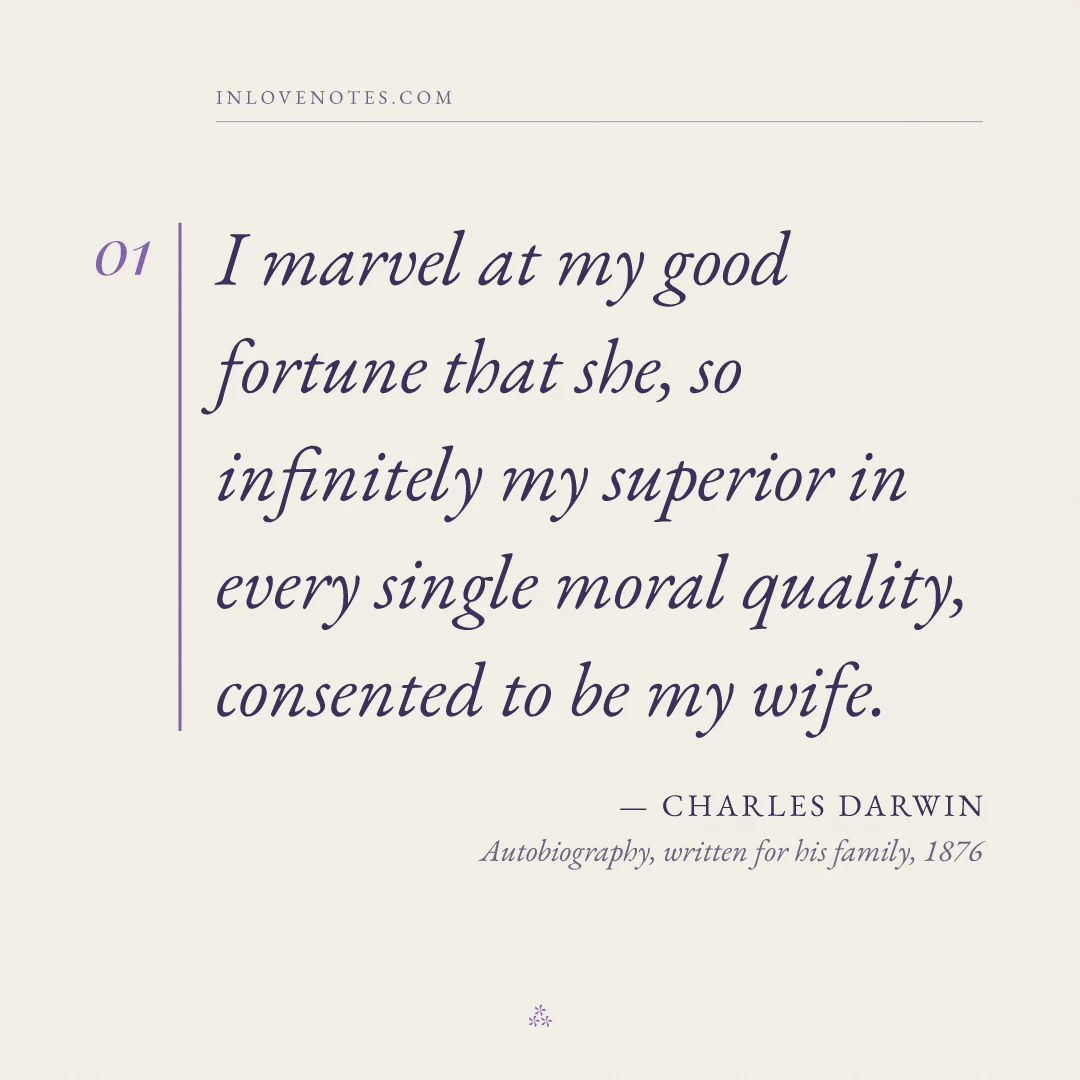
She has been my greatest blessing, and I can declare that in my whole life I have never heard her utter one word which I had rather have been unsaid. … I marvel at my good fortune that she, so infinitely my superior in every single moral quality, consented to be my wife. She has been my wise adviser and cheerful comforter throughout life, which without her would have been during a very long period a miserable one from ill-health.
Charles Darwin, Autobiography, written in 1876 for his children (complete text first printed 1958)
His son Francis left this passage out of the edition he published in 1887. It appeared in full only in 1958, when Darwin's granddaughter Nora Barlow restored what had been cut. We read it on pages 96 and 97 of her edition, on Darwin Online. What makes it work is that Darwin doesn't call Emma beautiful or perfect. He says she was kinder than he was and that she made illness bearable. If your wife has carried you through something, such as a long illness, a lost job or a bad year, the line "my wise adviser and cheerful comforter" says it without fuss. The "marvel at my good fortune" sentence is the one to use for an anniversary card. Emma's own letters to Darwin before the wedding are in our letter to my future husband page, if you want the other side of this marriage.
Robert Louis Stevenson married Fanny Van de Grift Osbourne, an American ten years older than him and already a mother, in San Francisco in 1880. She travelled with him through years of illness and finally to Samoa, where he died in 1894. Among his last poems, published two years after his death in Songs of Travel, is one with the plainest title in this collection:
Trusty, dusky, vivid, true, / With eyes of gold and bramble-dew, / Steel-true and blade-straight, / The great artificer / Made my mate. // Honour, anger, valour, fire; / A love that life could never tire, / Death quench or evil stir, / The mighty master / Gave to her. // Teacher, tender, comrade, wife, / A fellow-farer true through life, / Heart-whole and soul-free / The august father / Gave to me.
Robert Louis Stevenson, "My Wife", Songs of Travel and Other Verses (1896)
Notice "anger" in the second verse. Stevenson isn't describing a gentle, pretty wife. He's describing a woman with a temper and a fierce sense of honour, and he puts that on the list of things he loves. That's why the poem suits a wife who is strong-willed and won't recognise herself in soft, sugary quotes. The last verse, "Teacher, tender, comrade, wife, / A fellow-farer true through life", fits inside an anniversary card. The first verse, ending "Made my mate", is short enough for a caption under a photo of the two of you.
Missing her: a honeymoon apart and a night before execution
Robert Burns married Jean Armour in 1788, after years of trouble with her family and the kirk. In the first weeks of the marriage they had to live apart. He was getting a farmhouse ready at Ellisland, near Dumfries, while she stayed at Mossgiel in Ayrshire, to the west. Andrew Lang's note in the standard edition says the song was written during that separation, "in their honeymoon":
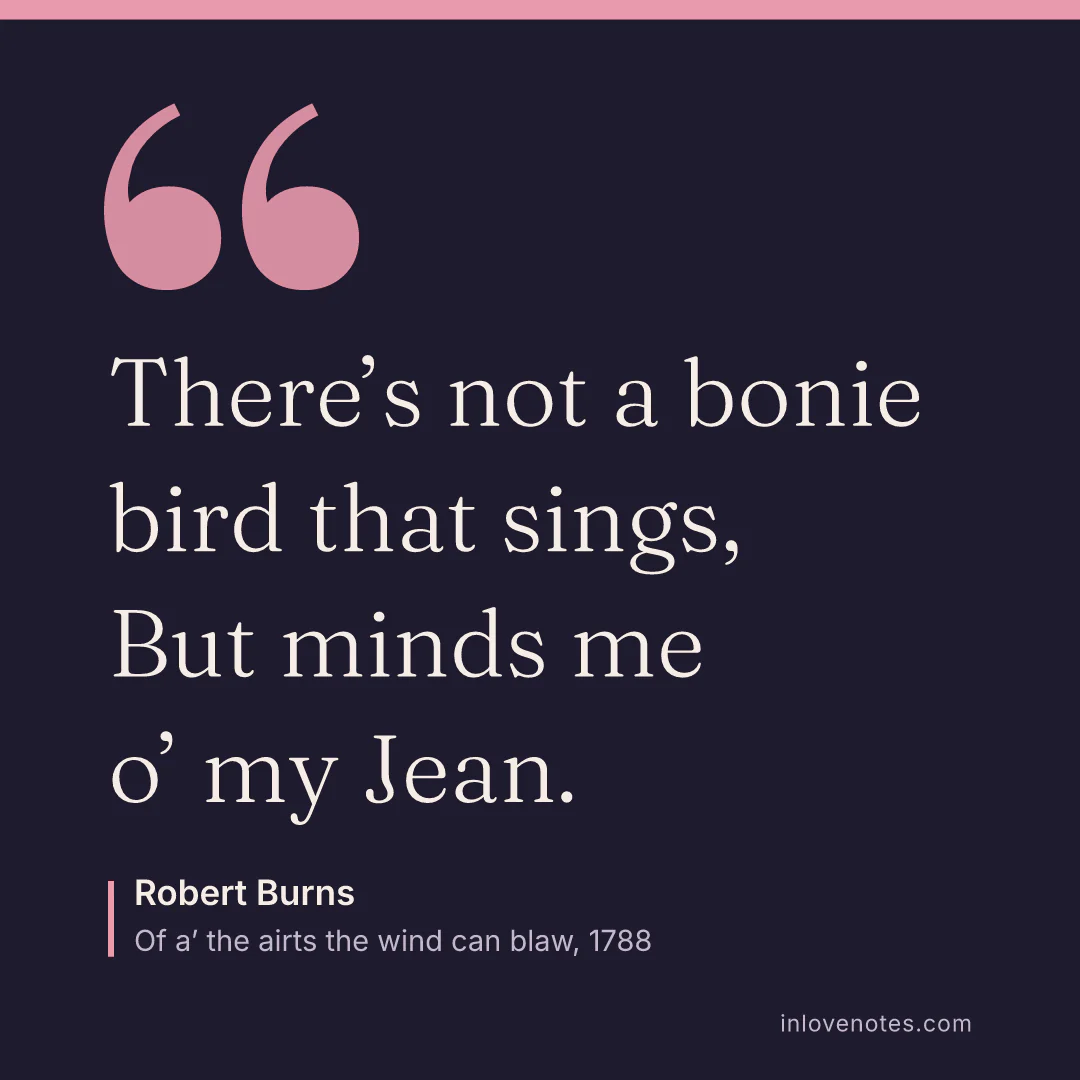
Of a' the airts the wind can blaw, / I dearly like the west, / For there the bonie lassie lives, / The lassie I lo'e best: … I see her in the dewy flowers, / I see her sweet and fair: / I hear her in the tunefu' birds, / I hear her charm the air: / There's not a bonie flower that springs, / By fountain, shaw, or green; / There's not a bonie bird that sings, / But minds me o' my Jean.
Robert Burns, "Of a' the airts the wind can blaw" (1788)
"Airts" are directions (points of the compass), and "minds me o'" means "reminds me of". Everyone quotes Burns's "red, red rose", but this is the poem he wrote for the woman he had actually married, and it's about the plain fact of being in a different place from her. It's the right one for a work trip, a deployment, or the weeks when one of you has moved ahead to a new job. Send the last two lines on their own as a text. Change "Jean" to your wife's name only if her name scans; otherwise keep his and tell her where it comes from.
The second letter is much darker. In 1603 Sir Walter Raleigh was convicted of treason against the new king, James I, and expected to be executed at Winchester. The night before, he wrote to his wife, Elizabeth Throckmorton, whom he called Bess. The manuscript is in the Bodleian Library in Oxford, and the letter was printed in London in 1644. It begins:
You shall receive my last words in these my last lines; my love I send you that you may keepe it when I am dead, and my counsel that you may remember it when I am no more. I would not with my will present you sorrows (dear Besse) let them go to the grave with me, and be buried in the dust.
Sir Walter Raleigh, letter to his wife Elizabeth, Winchester (1603; printed London, 1644)
He was reprieved at the last minute and lived another fifteen years, mostly in the Tower of London, before he was executed in 1618. Most of the letter is practical advice about money, debts and their son. That's what makes the opening hit so hard: a man with one night left uses his first sentence to send his love "that you may keepe it". The spelling is the 1644 printing's. Quote it for what it is, a letter from the edge. It suits a husband going into dangerous surgery or a deployment, or a widow choosing words for a grave. It doesn't belong on a birthday card.
"Everything I make is yours": Browning's dedication
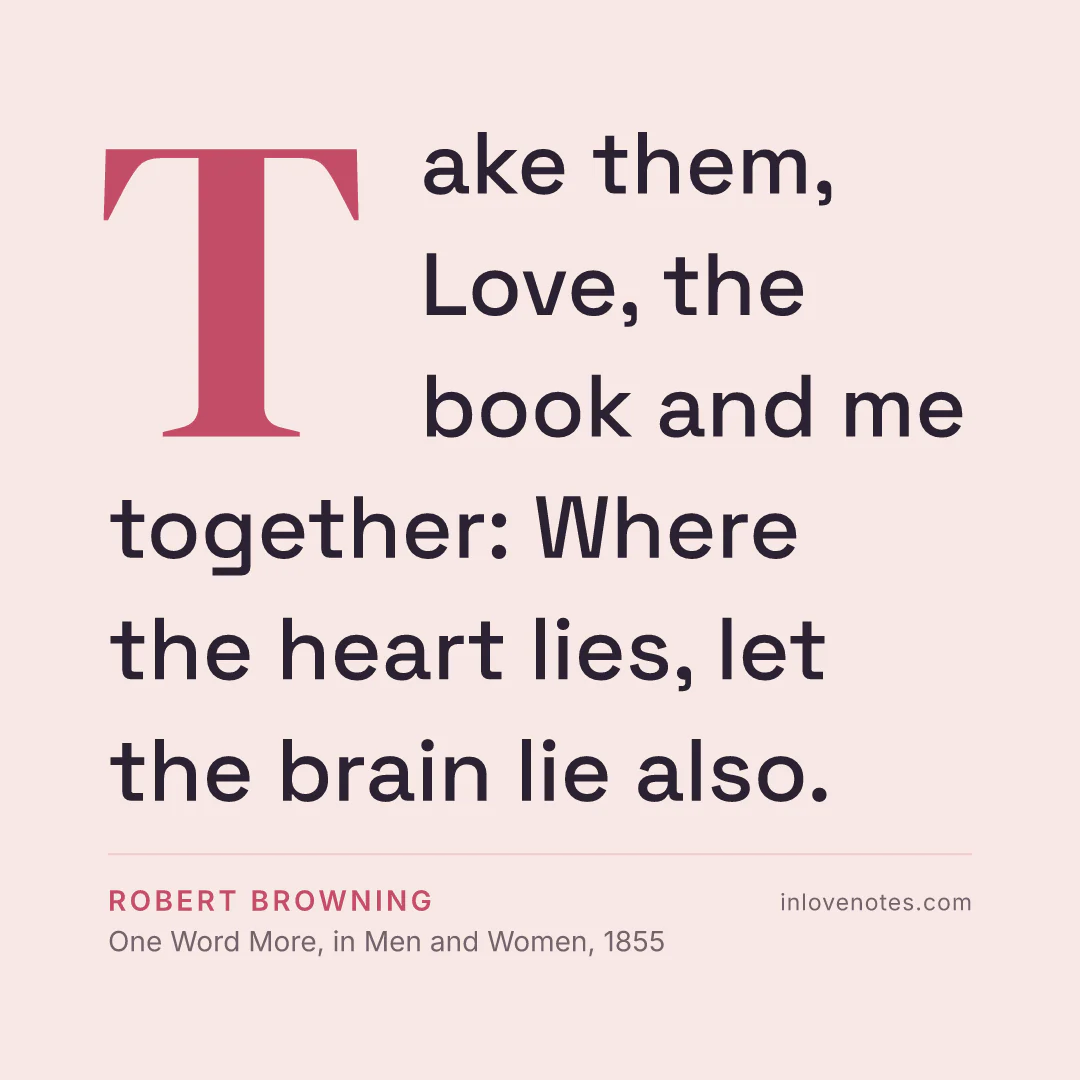
Robert Browning married the poet Elizabeth Barrett in secret in September 1846, and they fled to Italy. Nine years later he published Men and Women, fifty poems in two volumes. He closed the book with a poem addressed to her, headed "To E. B. B.", which opens:
There they are, my fifty men and women / Naming me the fifty poems finished! / Take them, Love, the book and me together: / Where the heart lies, let the brain lie also.
Robert Browning, "One Word More", Men and Women (1855)
Browning is giving his wife the work he is proudest of, and saying that his mind belongs where his heart already is. This is the quote for when you hand her something you made or finished: a thesis, a business, a house you renovated, a book, even a garden. Write the third and fourth lines on the first page, or say them as part of a toast if she supported the work for years. Later in the same poem he calls her "my moon of poets". She was the more famous poet when they met, and he knew it. Her side of the marriage, including one of her sonnets to him, is in our love quotes for my husband.
The shortest lines: for a ring, a caption or one line in a card
Mark Twain's wife Olivia (Livy) died in Florence in June 1904, after thirty-four years of marriage. In the year after her death he wrote Eve's Diary, a short comic story in which Adam and Eve take turns keeping a journal. It ends in a different tone, with Adam at Eve's grave:
Wheresoever she was, THERE was Eden.
Mark Twain, Eve's Diary (1906)
The book itself never names Livy, but it was written in his first year as a widower, and readers have taken it as a tribute to her ever since. The line has six words and works almost anywhere: inside a ring if the jeweller has room, on a photo of your home together, or as the only line in an anniversary card. Twain puts "THERE" in capitals. Keep that if you're writing by hand; in a text, it can read like shouting.
If you want something even shorter, look at the words on a grave in the churchyard of St Mary's, Eversley, in Hampshire. The novelist and clergyman Charles Kingsley, author of The Water-Babies, married Frances (Fanny) Grenfell in 1844 and died in January 1875. They are buried together under a white stone cross. According to its heritage listing, the inscription reads "Charles Kingsley, January 23rd 1875: and Fanny His Wife: Amavimus Amamus Amabimus". The Latin means "We loved, we love, we shall love". We haven't found a source that says which of them chose the words, so we don't count them among the seven lines. As an engraving for a ring or a watch, though, three Latin words are hard to beat.
When she has died: Hardy's "The Voice"
Thomas Hardy and his first wife, Emma Gifford, had a cold marriage for many years. By the end they lived almost separate lives under the same roof. When she died suddenly in November 1912, Hardy was overwhelmed with grief and guilt. Over the next months he wrote a sequence of poems about her, later printed as "Poems of 1912–13". In "The Voice", dated December 1912, he imagines her calling to him, not as she became, but as she was when they first met in Cornwall:
Woman much missed, how you call to me, call to me, / Saying that now you are not as you were / When you had changed from the one who was all to me, / But as at first, when our day was fair.
Thomas Hardy, "The Voice", Satires of Circumstance, Lyrics and Reveries (1914)
Few love poems admit that a marriage went wrong. This one does, and it still says that the first love was real. That makes it right for a husband whose marriage was imperfect and who lost his wife before the two of them could put it right. "Woman much missed" works on its own in a memorial card or an order of service. The stanza is honest enough to read at a funeral where everyone knows the marriage had hard years. In the second stanza he remembers her "original air-blue gown", the dress she wore when they met. If you remember a detail like that about your own wife, use your detail with his first line.
Which line fits what you want to tell her
All seven quotes in one table (Darwin's passage gets two rows). "Words" is the length of the part we suggest you use, not the whole poem or letter.
| What you want to say | Line to use | Who, when | Words | Best place |
|---|---|---|---|---|
| You are the best thing that happened to me. | "I marvel at my good fortune that she … consented to be my wife." | Darwin, 1876. | about 20. | Anniversary card, toast. |
| You carried me through a hard time. | "my wise adviser and cheerful comforter throughout life" | Darwin, 1876. | 8. | After an illness or a bad year. |
| I love who you really are, temper included. | "Teacher, tender, comrade, wife, / A fellow-farer true through life" | Stevenson, 1896. | 11. | Card for a strong-willed wife. |
| I miss you while we're apart. | "There's not a bonie bird that sings, / But minds me o' my Jean." | Burns, 1788. | 13. | Text on a trip or deployment. |
| If anything happens to me, keep my love. | "my love I send you that you may keepe it when I am dead" | Raleigh, 1603. | 13. | Before surgery or deployment, never a birthday. |
| What I made is yours too. | "Take them, Love, the book and me together" | Browning, 1855. | 8. | Dedication, first page of a gift. |
| Home is wherever you are. | "Wheresoever she was, THERE was Eden." | Twain, 1906. | 6. | Ring, caption, one-line card. |
| I miss you, and I remember how we began. | "Woman much missed, how you call to me, call to me" | Hardy, 1912. | 10. | Memorial card, funeral reading. |
The wedding reading that is credited to the wrong person
If you search for love quotes for your wife, you'll soon come across a poem called "Love" that begins "I love you, not only for what you are, but for what I am when I am with you." It's printed everywhere under the name Roy Croft, and it's read at a great many weddings. Roy Croft didn't write it. The poem is by Mary Carolyn Davies. It was first printed in the Epworth Herald on 26 October 1918 under the title "To a Friend". The editor Hazel Felleman credited it to "Roy Croft" in her 1936 anthology Best Loved Poems of the American People, and that error has been copied ever since. Felleman corrected it herself in her "Queries and Answers" column in the New York Times Book Review in May 1943. So the poem was written by a woman, as a poem to a friend, and it's not a husband's line at all. You can still use it. Just credit Mary Carolyn Davies. Our misattributed love quotes page tracks more lines like this.
From a borrowed line to a note in your own words
A quote is a good start, but your wife wants to hear from you. The husbands above were writing about real wives, not about wives in general, so the trick is to make the borrowed line point at something only the two of you know. Four steps:
- Pick the line by what you want to say, not by how pretty it is. Use the table above. If none of the rows matches what you feel, none of these quotes is the right one, and that's fine.
- Write it out exactly, with the name. "— Robert Burns" under the line tells her you chose it on purpose and didn't copy a meme.
- Add one sentence of your own that proves the quote is about her. Darwin's line works because of the illness. Yours needs your own detail: the night shift she covered, the joke she still makes, the city where you met.
- End with something plain. "I love you" is enough. All seven men on this page wrote far more than these lines, and in every case the quote is only a small part of the whole letter or poem.
Here are three short examples we wrote for this page to show the method. Change the details in them to fit your own marriage:
- For an anniversary: "Darwin wrote that he marvelled at his good fortune that his wife consented to marry him. Same here. You said yes to a man with a bad back and worse cooking, and you've been my wise adviser ever since. Happy anniversary. I love you."
- For a text when you're away: "'There's not a bonie bird that sings, but minds me o' my Jean.' Burns, written when he was away from his new wife. No birds outside this hotel, just a vending machine, and it still reminds me of you."
- With a finished project: "Take them, Love, the book and me together. Browning wrote that to his wife in the front of his poems. This kitchen took eleven months and most of your patience. It's yours, and so am I."
For a longer piece in the same spirit, our love letter to my wife page walks through a whole letter. If she prefers poems to letters, start with love poems for her.
Questions husbands ask
How do I tell my wife I love her in a way that sounds like me?
Say what she did, not what she is. "You're amazing" is easy to forget. "You stayed up with me the night before my interview" is not. If you'd like to borrow a line, borrow one that fits a real event, then add your own sentence. Darwin, Burns and Browning all wrote about something specific: an illness, a separation, a book.
What can I write as a caption for a photo of my wife?
Keep it under ten words and credit the author. "Wheresoever she was, THERE was Eden." (Mark Twain), "Made my mate." (R. L. Stevenson) and "Amavimus, amamus, amabimus" (We loved, we love, we shall love) all fit on a single line. Leave out quotes about grief or danger. They're too heavy for social media unless that's the point of the post.
What is a deep love quote for my wife?
The deepest ones on this page are Darwin's, written after nearly forty years of marriage, and Raleigh's, written the night he expected to die. Both sound deep because the men had something at stake. If you want her to feel the depth, add a line from your own life, such as the year you nearly lost something or the thing she gave up for you.
Sources
- Charles Darwin, The Autobiography of Charles Darwin 1809–1882, with the original omissions restored, ed. Nora Barlow (London: Collins, 1958), pp. 96–97, read on Darwin Online (darwin-online.org.uk, F1497). The 1887 edition by Francis Darwin (Project Gutenberg #2010) omits the passage.
- Robert Louis Stevenson, "My Wife" (no. XXVI), Songs of Travel and Other Verses (1896), Project Gutenberg #487.
- Robert Burns, "Of a' the airts the wind can blaw", with Andrew Lang's note on the honeymoon separation, in Poems and Songs of Robert Burns, Project Gutenberg #1279.
- Sir Walter Raleigh, letter to his wife, 1603, as printed in London "for R.H." in 1644; transcription at the University of Oregon's Renascence Editions (pages.uoregon.edu/rbear/raleigh2.html). The manuscript is Bodleian Library MS. Tanner 299, fol. 25b (per the Bodleian archives catalogue).
- Robert Browning, "One Word More. To E. B. B.", Men and Women (1855), Project Gutenberg #17393.
- Mark Twain, Eve's Diary (1906), "At Eve's Grave", Project Gutenberg #8525.
- Thomas Hardy, "The Voice", dated December 1912, in "Poems of 1912–13", Satires of Circumstance, Lyrics and Reveries (1914), Project Gutenberg #2863.
- Charles Kingsley: marriage, death and burial from Leslie Stephen's entry in the Dictionary of National Biography, vol. 31 (on Wikisource). The grave inscription is as quoted from the Historic England listing on britishlistedbuildings.co.uk; the translation is also given by epitaphsofthegreatwar.com.
- Mary Carolyn Davies and "Roy Croft": Wikipedia, "Roy Croft", citing the Epworth Herald (26 October 1918) and Hazel Felleman in the New York Times Book Review (2 May 1943).