Love Quotes for My Husband: 9 Lines Real Wives Wrote, and the Story Behind Each
Nine love quotes for your husband that wives really wrote, from Dolley Madison in 1805 to Ruth Bader Ginsburg in 2016, each dated and sourced, by moment.
The best love quotes for your husband come from women who wrote them to their own husbands. Most "husband quotes" online are anonymous sayings with nobody behind them. Below are nine lines that wives really wrote, in letters, journals, a sonnet and a newspaper essay, between 1805 and 2016. Six women wrote them: Dolley Madison, Queen Victoria, Sophia Hawthorne, Mary Lincoln, Elizabeth Barrett Browning and Ruth Bader Ginsburg. For each one we give the date, what was happening in the marriage when she wrote it, and the moment it suits. We checked each line against the best source we could reach: a published edition of her letters, the archive that holds the letter, or, for the queen's journal and the 2016 essay, the biographies and reports that quote them. The Sources list at the end says which is which. At the end are two popular "wife" quotes we could not trace, and a short guide to putting a line in a card for him.
The nine lines at a glance
Here they are in date order. The last column is our suggestion. The sections below tell the story behind each line, so you can judge whether it fits your own marriage.
| Year | Wife | What she says | Good for |
|---|---|---|---|
| 1805 | Dolley Madison | Only writing to him eases the hours after he left | When he's away, the first night apart |
| 1840 | Queen Victoria | Her wedding night was the best evening of her life | A wedding night, a first anniversary |
| 1842 | Sophia Hawthorne | His face was a fairer world than the one around them | The first year, a honeymoon photo |
| 1848 | Mary Lincoln | She wishes they were together instead of writing | A text when he's traveling |
| 1849 | Sophia Hawthorne | With him and the children she feels rich, job or no job | A job loss, a money worry |
| 1850 | Elizabeth Barrett Browning | Earth is enough: a place to stand and love for a day | A big anniversary, a vow renewal |
| 1851 | Sophia Hawthorne | His voice reading aloud is the best music | An ordinary Tuesday |
| 1861 | Queen Victoria | Her happy life ended when he died | Grief, a memorial (not a card) |
| 2016 | Ruth Bader Ginsburg | Of all her luck, he was the biggest piece | A long marriage, a toast to him |
1805: "speaking to you in this only way"
In the summer of 1805 Dolley Madison had an ulcerated knee that would not heal. Her husband James, then Secretary of State, took her to Philadelphia to be treated by Dr. Philip Syng Physick, the celebrated Philadelphia surgeon. On 23 October he had to go back to Washington. She had to stay behind for about another month. She wrote to him the same day:
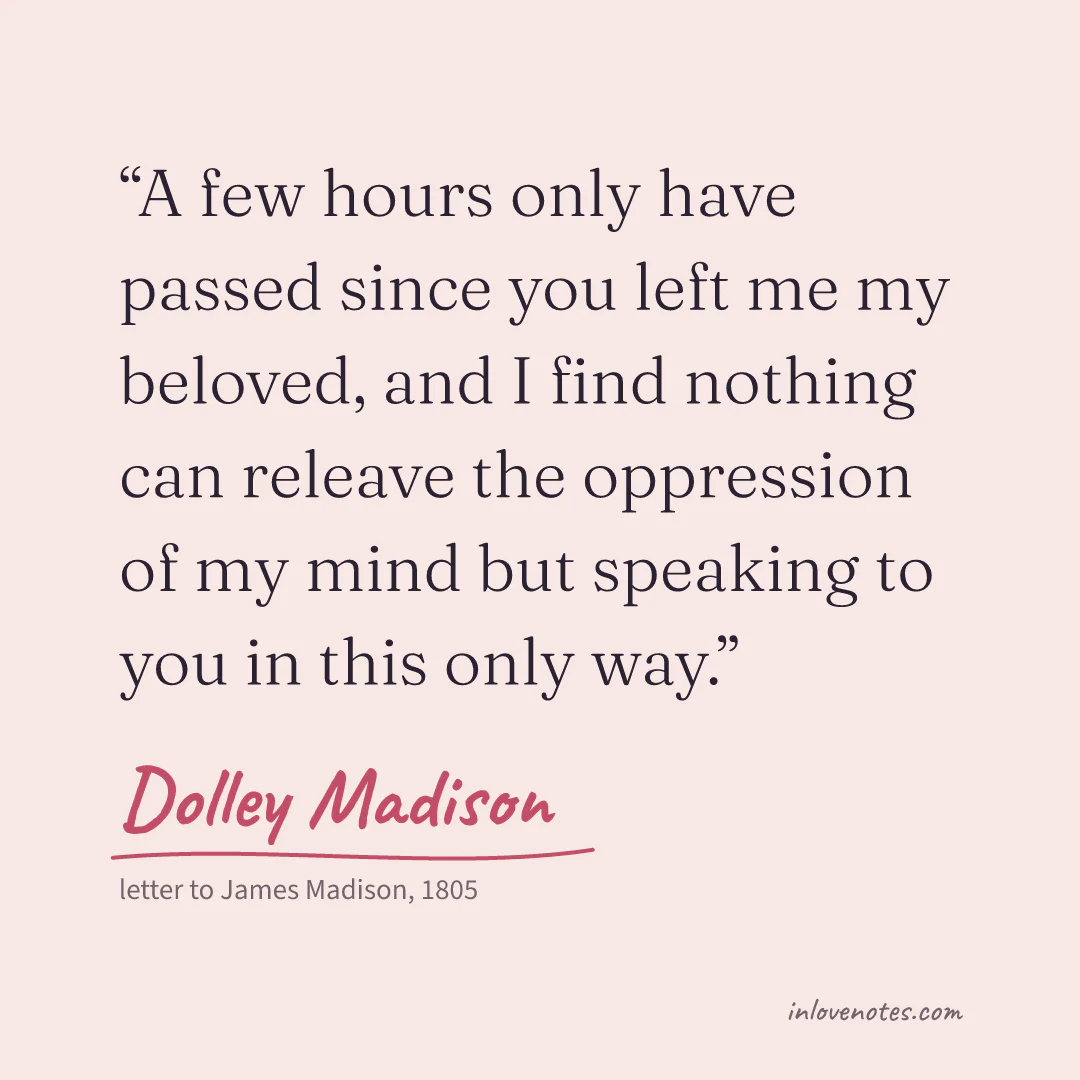
A few hours only have passed since you left me my beloved, and I find nothing can releave the oppression of my mind but speaking to you in this only way.
Dolley Madison, letter to James Madison, Philadelphia (23 October 1805)
The spelling "releave" is hers. The letter is printed in The Papers of James Madison and can be read free on the National Archives' Founders Online site. She goes on to tell him small things: the doctor came, the knee looks better, two friends are sitting with her. That is why the line works. It isn't a grand declaration. It's the first thing a wife writes when the house goes quiet. Use it for the first night of a work trip, a deployment, or a hospital stay when one of you has to go home. If he's the kind of man who likes history, keep "releave" as she spelled it and tell him why.
1840 and 1842: two brides, two first winters
Queen Victoria married her cousin Prince Albert at the Chapel Royal, St James's Palace, on 10 February 1840. She was twenty. That night she wrote in her journal, in capitals and with three exclamation marks:
I NEVER, NEVER spent such an evening!!! MY DEAREST DEAREST DEAR Albert … his excessive love & affection gave me feelings of heavenly love & happiness I never could have hoped to have felt before!
Queen Victoria, journal (10 February 1840)
This is the most unguarded thing on this page. It was written by a reigning monarch who did not expect anyone but herself to read it. Her biographers Cecil Woodham-Smith, Elizabeth Longford and Christopher Hibbert all quote it. Use the opening "I never, never spent such an evening" for a wedding-night or honeymoon note, or on a first anniversary card. Leave out the capitals unless you want him to laugh. They were hers, and they work best when you say so.
Two years later, in July 1842, the painter Sophia Peabody married the writer Nathaniel Hawthorne. They rented the Old Manse in Concord, Massachusetts, and spent a summer there almost alone. In December she wrote to a friend in Salem, Mary Foote, to describe it:
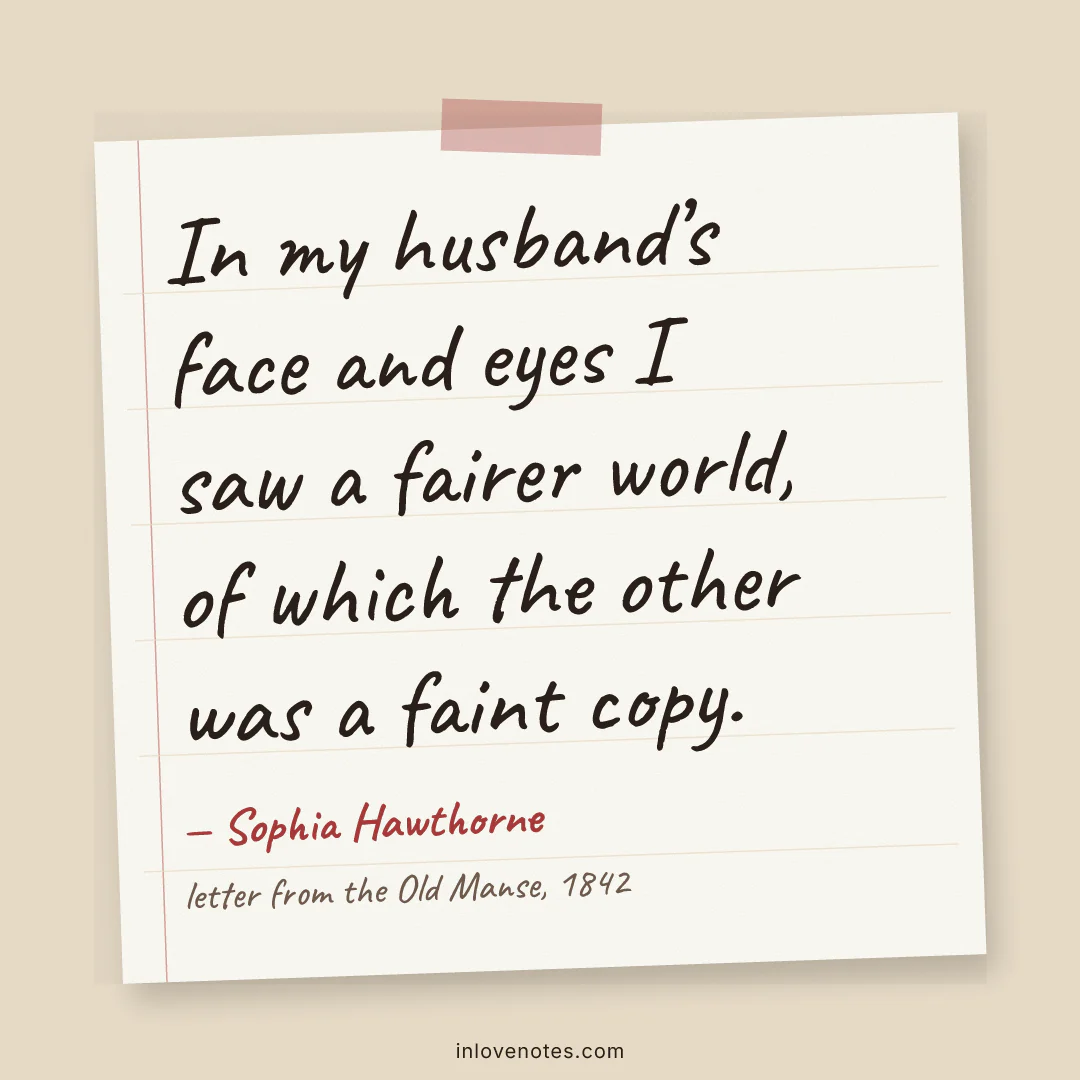
In my husband's face and eyes I saw a fairer world, of which the other was a faint copy.
Sophia Hawthorne, letter to Mary Foote, Concord (18 December 1842)
The sentence comes in the middle of a description of the river, the trees and the garden. She is saying that, in the end, she was looking at him instead. The letter is printed in Memories of Hawthorne (1897), compiled by their daughter Rose. In the same letter she says she danced before her husband to a music box while the maid said it did her good "to see us as joyful as two children." It's a good line for a first-year anniversary, or written on the back of a honeymoon photo. Because she wrote it about him rather than to him, it also works when you are telling other people about your husband, for example in a toast.
1848 to 1851: ordinary weeks, bad news, a winter evening
The love in a long marriage mostly shows up in small, unremarkable letters, and these four lines come from those. In the spring of 1848 Abraham Lincoln was a first-term congressman in Washington. Mary had been there with him, but in April she took their two small sons to her family in Lexington, Kentucky. She began one letter by apologizing that she could never remember the date. All she knew was that it was "Saturday night, our babies are asleep." Then:
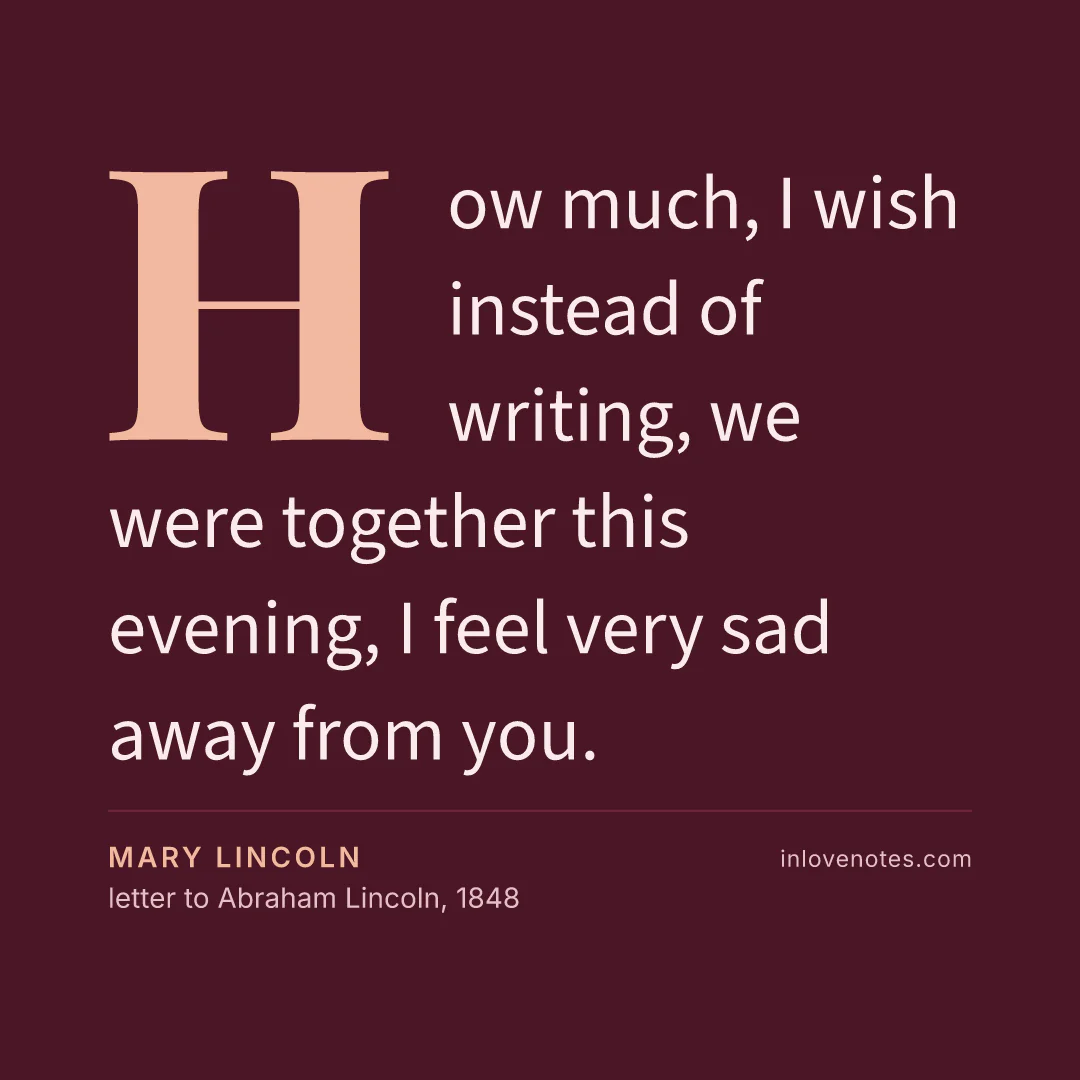
How much, I wish instead of writing, we were together this evening, I feel very sad away from you.
Mary Lincoln, letter to Abraham Lincoln, Lexington (May 1848)
The transcription, with her punctuation, is in the Papers of Abraham Lincoln. In the next breath she moves on to a drive with her mother to visit a neighbor's "splendid place." That's how a real letter sounds: feeling and gossip side by side. The line is short enough to send as a text when he's on the road, and it doesn't pretend you are coping better than you are.
In June 1849 Nathaniel Hawthorne lost his government job as Surveyor of the Salem Custom House when the new Whig administration came in. The family had little money. Sophia wrote to her mother:
As for me, you know I am composed of Hope and Faith, and while I have my husband and the children I feel as if Montezuma's diamonds and emeralds were spiritually in my possession.
Sophia Hawthorne, letter to her mother, Salem (June 1849)
A few lines later she adds, "I have not seen my husband happier than since this turning out." Within months he was writing The Scarlet Letter. If your husband has just been laid off, passed over or turned down, this is the quote. It tells him the thing he is most afraid of (that you think less of him) is not true, and it does so without a pep talk. Cut "and the children" if it doesn't fit your family. Mark the cut with an ellipsis.
Elizabeth Barrett Browning's Sonnets from the Portuguese were written during her secret courtship with Robert Browning in 1845 and 1846. They married in September 1846 and ran away to Italy. The sonnets were printed in her Poems of 1850, four years into the marriage. Sonnet XXII imagines their two souls rising "face to face" and decides that heaven can wait:
Let us stay / Rather on earth, Belovëd,—where the unfit / Contrarious moods of men recoil away / And isolate pure spirits, and permit / A place to stand and love in for a day, / With darkness and the death-hour rounding it.
Elizabeth Barrett Browning, Sonnets from the Portuguese, XXII, Poems (1850)
This is the sonnet for couples who have been through something: an illness, a hard decade, a near miss. "A place to stand and love in for a day" is a modest promise, and that is its strength. Her more famous sonnet, "How do I love thee?", is on so many cards that it can feel generic. Number XXII almost never shows up. For a twentieth or thirtieth anniversary, or a vow renewal, write out all six lines. Another of her sonnets, XXXVIII, is in our short love poems for him.
The last of the four is the plainest. In the winter of 1851 the Hawthornes were living in a small red farmhouse near Lenox, in the Berkshires. Sophia kept a journal of ordinary evenings: snow, the children, what her husband read aloud. On one of them he proposed Southey's Thalaba, a poet she didn't much like:
But I like to be familiar with such things, and to hear my husband's voice is the best music.
Sophia Hawthorne, journal, Lenox (January 1851)
She married a man whose books are now read in schools, and what she wrote down was the sound of his voice on a dull evening. Put this line on a note in his coat pocket, or under a photo of him reading to your children. It says what a lot of long marriages are actually about, more convincingly than any slogan.
1861 and 2016: when he is gone
Prince Albert died at Windsor on 14 December 1861, at forty-two. Six days later Victoria wrote to her uncle, King Leopold of the Belgians, who had been like a father to her:
The poor fatherless baby of eight months is now the utterly broken-hearted and crushed widow of forty-two! My life as a happy one is ended! the world is gone for me!
Queen Victoria, letter to King Leopold I, Osborne (20 December 1861)
The text is in The Letters of Queen Victoria, volume 3 (1907). She wore black for the rest of her life, nearly forty years. This is not a card line. It belongs here because many women who search for quotes about their husband have just lost him. A widow can find it a relief to read that a queen said "the world is gone for me" and meant it. If you are writing for a memorial, the next sentence of her letter is more usable: she will go on "in only doing what I know and feel he would wish, for he is near me."
Ruth Bader Ginsburg married Martin Ginsburg in June 1954, the month she graduated from Cornell. He was a tax lawyer and a very good cook, and he worked hard behind the scenes to get her considered for the Supreme Court. He died in June 2010. Six years later she wrote, in an essay for The New York Times adapted from her book My Own Words:
I have had more than a little bit of luck in life, but nothing equals in magnitude my marriage to Martin D. Ginsburg.
Ruth Bader Ginsburg, essay in The New York Times (October 2016)
The next sentence calls him her "supersmart, exuberant, ever-loving spouse." The line is precise, which is why it moves people. She doesn't say he was everything. She says that, of all her luck, he was the biggest piece. It is the best line on this page for a fortieth or fiftieth anniversary toast, or for an obituary or eulogy. Change his name to your husband's, keep the "D." if he has a middle initial, and credit her in a small line underneath.
Which line for which moment
| The moment | Our pick | Why |
|---|---|---|
| He just left for a trip or deployment | Dolley Madison, 1805 | Written hours after a goodbye |
| A text while he's away | Mary Lincoln, 1848 | One sentence, honest about missing him |
| First anniversary | Victoria, 1840, or Sophia, 1842 | Both written in the first months of marriage |
| He lost his job or had a setback | Sophia, 1849 | Written the week her husband was fired |
| Just because, an ordinary day | Sophia, 1851 | About a dull evening, not a big occasion |
| Twentieth anniversary or later, vow renewal | Browning, Sonnet XXII | A promise for couples who have weathered things |
| A toast to him at a big anniversary | Ruth Bader Ginsburg, 2016 | Short, precise, easy to say aloud |
| Memorial, sympathy, grief | Victoria, 1861 (with care) | Says plainly how loss feels |
Two famous "wife" quotes we could not trace
Two lines turn up on almost every list of quotes for husbands, each credited to a well-known wife. We looked for the original interview, book or speech for both and did not find one. You can still use them, but credit them honestly.
| The quote | Usually credited to | What we found |
|---|---|---|
| "Sexiness wears thin after a while and beauty fades, but to be married to a man who makes you laugh every day, ah, now that's a real treat." | Joanne Woodward, about Paul Newman | Repeated on Biography.com, Goodreads and many quote sites, but none gives an interview, date or publication. No primary source found. |
| "A happy marriage is the union of two good forgivers." | Ruth Bell Graham, wife of Billy Graham | The Billy Graham Library's own blog (2014) says she "once said" it, but gives no date or publication. It is family tradition, not a dated text. |
If you put either one in a card, write "attributed to" before the name. For more lines that circulate under the wrong name, see our misattributed love quotes, traced to their sources.
Putting one of these lines in a card for him
A quote on its own reads like something you found, which you did. What makes it yours is the sentence you add underneath. Here is a simple way to do it:
- Pick by moment, not by beauty. Use the table above. A line about missing him means more when he's actually away.
- Quote it short. One or two sentences. Use an ellipsis (…) when you cut words, and keep the original spelling.
- Credit her, briefly. "Dolley Madison to James, 1805" is enough. Knowing that a real wife wrote it to a real husband is half of its charm.
- Add one sentence of your own that only you could write. Name a real place, habit or day.
Three examples, written by our editors to show the pattern:
- After Mary Lincoln's line: "The boys asked to call you twice before bed. I let them, because I wanted to."
- After Sophia's 1849 line: "You lost a job. We lost nothing. Pancakes on Saturday, same as always."
- After Ginsburg's line, for a thirtieth anniversary: "Thirty years, two houses, one very bad tent. Still the biggest piece of luck I've had."
If you'd rather write a whole letter, our love letter to my husband has six sample letters by occasion, along with letters Martha Washington and Clementine Churchill really sent. For lines from poems, plays and novels instead of wives' letters, see our deep love quotes for him.
Questions readers ask
What is the best quote about a husband?
For a long marriage, Ruth Bader Ginsburg's "nothing equals in magnitude my marriage to Martin D. Ginsburg" (2016) is hard to beat: it is short, it is documented, and she wrote it after more than fifty years with him. For a newer marriage, Sophia Hawthorne's "In my husband's face and eyes I saw a fairer world" (1842).
What is the sweetest thing a wife has written to her husband?
Our vote goes to Sophia Hawthorne's "to hear my husband's voice is the best music" (1851), because she wrote it about an ordinary evening rather than a special occasion. Dolley Madison's letter of 23 October 1805, written a few hours after he left, comes a close second.
How do I make my husband feel special with a quote?
Choose a line that fits what is happening right now (a trip, a setback, an anniversary). Tell him who wrote it and when. Then add one sentence about something only the two of you share. The quote sets the tone, and your sentence is the part he will remember.
Sources
- Dolley Madison to James Madison, 23 October 1805: The Papers of James Madison, Secretary of State Series, vol. 10, via Founders Online (National Archives).
- Queen Victoria's journal, 10 February 1840: as quoted by Woodham-Smith, Longford and Hibbert (see Wikipedia, "Wedding of Queen Victoria and Prince Albert"). Queen Victoria to the King of the Belgians, 20 December 1861: The Letters of Queen Victoria, vol. 3 (1907), Project Gutenberg #28649.
- Sophia Hawthorne's letters of 18 December 1842 and June 1849 and her Lenox journal of 1851: Rose Hawthorne Lathrop, Memories of Hawthorne (1897), Project Gutenberg #6926.
- Mary Lincoln to Abraham Lincoln, May 1848: The Papers of Abraham Lincoln (papersofabrahamlincoln.org).
- Elizabeth Barrett Browning, Sonnets from the Portuguese XXII: Project Gutenberg #2002.
- Ruth Bader Ginsburg, essay in The New York Times, October 2016, adapted from My Own Words (Simon & Schuster, 2016); wording checked in later reports quoting the essay.
- Ruth Bell Graham attribution: Billy Graham Library blog, "What makes a marriage work?" (2014).