Short Love Poems for Him: 9 Poems by Women, Checked Against the First Printings
Nine short love poems for him by women poets, Bradstreet to Dorothy Parker, each checked against an early printing, with tips for copying one into a card.
The copies of Georgia Douglas Johnson's "I Want to Die While You Love Me" going around online usually leave out a line. The 1922 printing has "And bear to that still bed" in the second stanza. The usual web copy drops it, so the stanza has three lines and doesn't scan. That is the kind of thing this page checks for. Below are nine short love poems for him, all written by women in the voice of a woman speaking to her love. Some name the man, and some leave the beloved unnamed. Each one has been checked word for word against an early printing and comes with its poet, book and year. There is also a table to help you choose one, notes on how to copy a poem into a card, and a short method for writing four lines of your own.
The nine poems at a glance
Every poem here is in the public domain in the United States, so you can copy it in full into a card, a letter or a caption. The line counts are for the whole poem as printed. Where we only quote part of a poem, the notes below say so.
| Poem | Poet, year | Lines | Tone | Best for |
|---|---|---|---|---|
| I Would Live in Your Love | Sara Teasdale, 1911 | 4 | Devoted, quiet | A note in his pocket, a text |
| The Look | Sara Teasdale, 1915 | 8 | Playful, then tender | Early days, a first anniversary |
| Song of Songs 8:6–7 | King James Version, 1611 | 2 verses | Solemn | Wedding cards, vows |
| To My Dear and Loving Husband | Anne Bradstreet, 1678 | 12 | Grateful, lifelong | A husband, a long marriage |
| I Want to Die While You Love Me | Georgia Douglas Johnson, 1922 | 16 | Intense, bittersweet | A letter, not a card |
| Sonnet XXXVIII ("First time he kissed me") | Elizabeth Barrett Browning, 1850 | 14 | Romantic, remembering | Anniversaries, a wedding morning |
| Wild Nights | Emily Dickinson, 1891 | 12 | Longing, sensual | Long distance, a private note |
| A Birthday | Christina Rossetti, 1862 | 16 | Joyful | His birthday, the day you met |
| One Perfect Rose | Dorothy Parker, 1926 | 12 | Funny, dry | Valentine's Day with a wink |
Four to eight lines: the shortest poems to give him
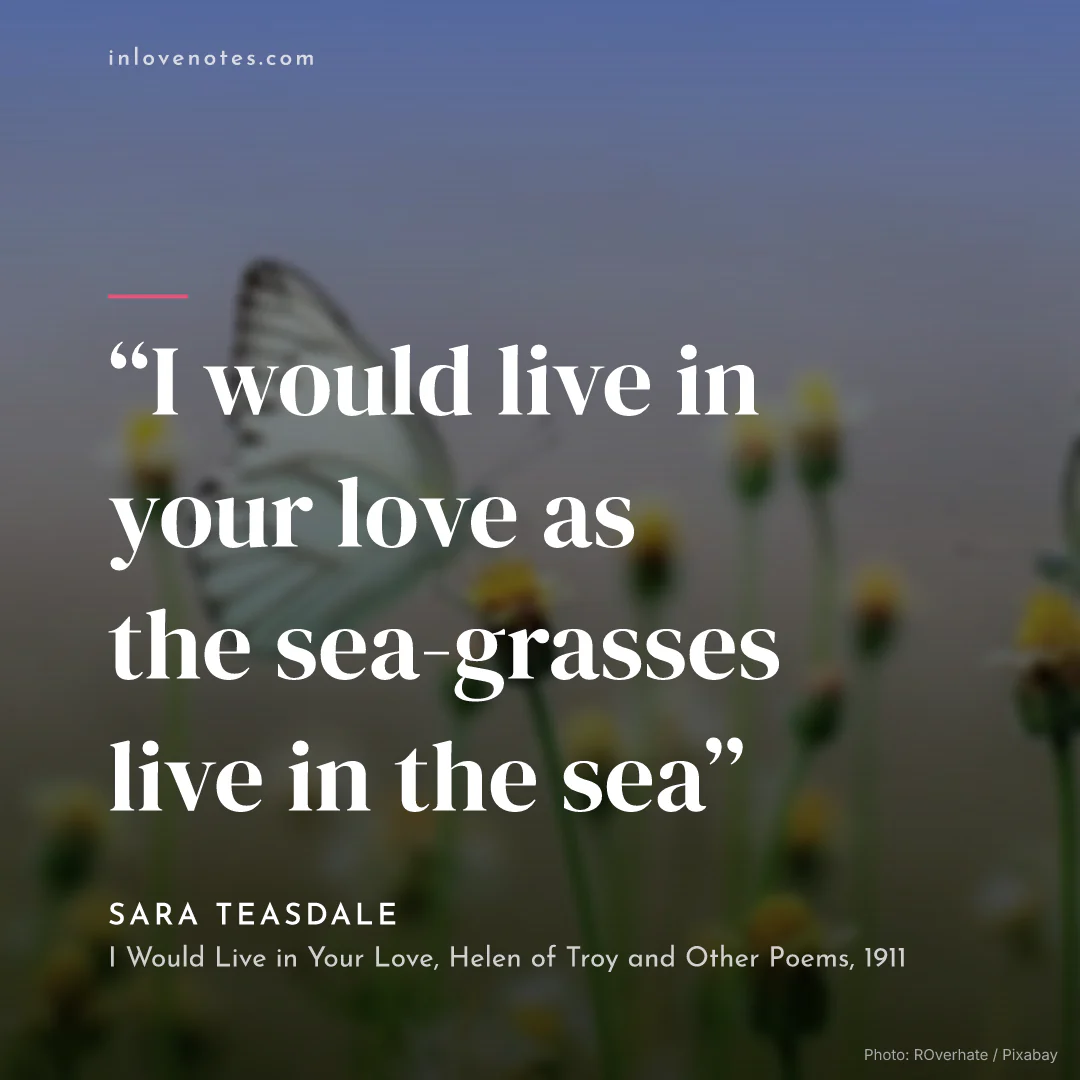
Sara Teasdale published "I Would Live in Your Love" in Helen of Troy and Other Poems (New York, 1911), the book that made her name. Then she put it in Love Songs (1917). The whole poem is one long, rolling sentence:
I would live in your love as the sea-grasses live in the sea, / Borne up by each wave as it passes, drawn down by each wave that recedes; / I would empty my soul of the dreams that have gathered in me, / I would beat with your heart as it beats, I would follow your soul as it leads.
Sara Teasdale, "I Would Live in Your Love", Helen of Troy and Other Poems (1911)
The picture is seagrass held up and pulled down by the tide, so the poem promises to go with him through good days and bad ones, not just good ones. That's why it reads as deep rather than sugary. It's four lines long, so it fits on the back of a photo. If "I would empty my soul of the dreams that have gathered in me" sounds like more self-erasure than you mean, copy only the first two lines. They stand well on their own.
"The Look" came four years later, in Rivers to the Sea (1915), and was reprinted in Love Songs. The names Strephon, Robin and Colin are the stock shepherds of old pastoral poetry, so the poem sounds like a folk song. Then it turns quietly serious:
Strephon kissed me in the spring, / Robin in the fall, / But Colin only looked at me / And never kissed at all. // Strephon's kiss was lost in jest, / Robin's lost in play, / But the kiss in Colin's eyes / Haunts me night and day.
Sara Teasdale, "The Look", Rivers to the Sea (1915)
It works best for a man who is shy, or for the early part of a relationship when one glance across a room counted for more than anything said. Write his name in the margin beside "Colin" and he will understand.
The oldest lines here are also the shortest. In the Song of Songs most readers hear the woman speaking in the closing chapter, and the King James Version (1611) gives her this:
Set me as a seal upon thine heart, as a seal upon thine arm: for love is strong as death; jealousy is cruel as the grave: the coals thereof are coals of fire, which hath a most vehement flame. Many waters cannot quench love, neither can the floods drown it.
Song of Songs 8:6–7, King James Version (1611)
A seal was a signet, worn on a cord or a ring and pressed into wax to mark what belonged to its owner, so "set me as a seal upon thine heart" asks him to wear her the way he'd wear his own name. For a wedding card, most couples leave out the clause about jealousy and stop at "many waters cannot quench love". If you shorten a verse that way, put an ellipsis (…) where the words are cut.
Poems that might make him cry
People who search for poems "to make him cry" usually mean one that sounds like the whole relationship, not just a mood. These three do that. Use them in a letter or a long card, where there is room for them to breathe.
Anne Bradstreet wrote in Puritan Massachusetts in the 1600s. "To My Dear and Loving Husband" was addressed to Simon Bradstreet and first printed in the second edition of her poems, published in Boston after her death (1678). The text below is the one quoted in Helen Campbell's Anne Bradstreet and Her Time (1891):
If ever two were one then surely we, / If ever man were loved by wife, then thee; / If ever wife was happy in a man, / Compare with me ye women if you can. / I prize thy love more than whole Mines of Gold, / Or all the riches that the East doth hold. / My love is such that Rivers cannot quench, / Nor ought but love from thee give recompense. / Thy love is such I can no way repay, / The heavens reward thee, manifold I pray. / Then while we live in love let's so persevere, / That when we live no more, we may live ever.
Anne Bradstreet, "To My Dear and Loving Husband" (1678)
Notice "Rivers cannot quench". It echoes the Song of Songs verse above, which Bradstreet, a Puritan reader of the Bible, would have known well. She is also bold for her time: "Compare with me ye women if you can" is a public boast about a private marriage. For a husband of many years, the last couplet is the one to underline. Spelling varies between editions ("ought" for "aught", the capital M in "Mines"), and either form is fine to copy. We printed more of Bradstreet's letters to Simon in our guide to writing a love letter to your husband.
Georgia Douglas Johnson's poem is the one with the missing line. Here it is in full as James Weldon Johnson printed it in The Book of American Negro Poetry (1922):
I want to die while you love me, / While yet you hold me fair, / While laughter lies upon my lips / And lights are in my hair. // I want to die while you love me, / And bear to that still bed, / Your kisses turbulent, unspent / To warm me when I'm dead. // I want to die while you love me / Oh, who would care to live / Till love has nothing more to ask / And nothing more to give! // I want to die while you love me / And never, never see / The glory of this perfect day / Grow dim or cease to be.
Georgia Douglas Johnson, "I Want to Die While You Love Me", in The Book of American Negro Poetry (1922)
Without "And bear to that still bed", the kisses have nowhere to go: she wants to take his kisses with her to the grave, still "unspent". Johnson was a Washington poet and playwright whose Saturday-evening salon brought together writers of the Harlem Renaissance. The composer Gary Bachlund, who set the poem to music, notes that it was read at her funeral in 1966. That's a reason to think before giving it. It is a poem about wanting love to stay at its height, and it speaks of death in every stanza. Some men will find that the most moving thing anyone has written to them, and some will just be alarmed. Put it in a letter where you can say what you mean by it.
Elizabeth Barrett wrote the Sonnets from the Portuguese while Robert Browning was courting her in 1845–46 and published them in 1850. Most pages quote Sonnet XLIII ("How do I love thee?"). Sonnet XXXVIII is less known and more personal: it counts his first three kisses.
First time he kissed me, he but only kissed / The fingers of this hand wherewith I write; / And ever since, it grew more clean and white. / … The second passed in height / The first, and sought the forehead, and half missed, / Half falling on the hair. … / The third upon my lips was folded down / In perfect, purple state; since when, indeed, / I have been proud and said, 'My love, my own.'
Elizabeth Barrett Browning, Sonnets from the Portuguese, XXXVIII (1850)
We cut a few lines (marked …) to keep it short, and the full sonnet is fourteen lines if you want all of it. It suits an anniversary: hand, forehead, lips is a whole courtship in three steps, and the "half missed" kiss makes him human. You could add your own first-time-he memory under it. The other famous Browning sonnet, and why it suits a list, is on our page of 100 reasons why I love you.
When he is far away
Emily Dickinson's "Wild Nights" stayed in her drawers until after her death. Mabel Loomis Todd and Thomas Wentworth Higginson printed it in Poems by Emily Dickinson, Second Series (1891). This is their text:
Wild nights! Wild nights! / Were I with thee, / Wild nights should be / Our luxury! // Futile the winds / To a heart in port, — / Done with the compass, / Done with the chart. // Rowing in Eden! / Ah! the sea! / Might I but moor / To-night in thee!
Emily Dickinson, "Wild Nights", Poems, Second Series (1891)
The whole poem turns on "Were I with thee". These are nights she isn't spending with him, which makes it a long-distance poem as much as a passionate one. The middle stanza is the steadiest image of commitment in the collection: a heart that has reached port doesn't need a compass or a chart any more. Nobody knows who "thee" was, and Dickinson gives no name. The 1891 editors used exclamation marks and a comma. Modern editions based on her handwritten copy show more of her dashes, so if you see "Wild nights - Wild nights!" elsewhere, it isn't a misquote, just a different edition. For a partner in another city, pair it with a letter. Our long-distance love letters page has examples you can adapt.
For his birthday, or the day you met
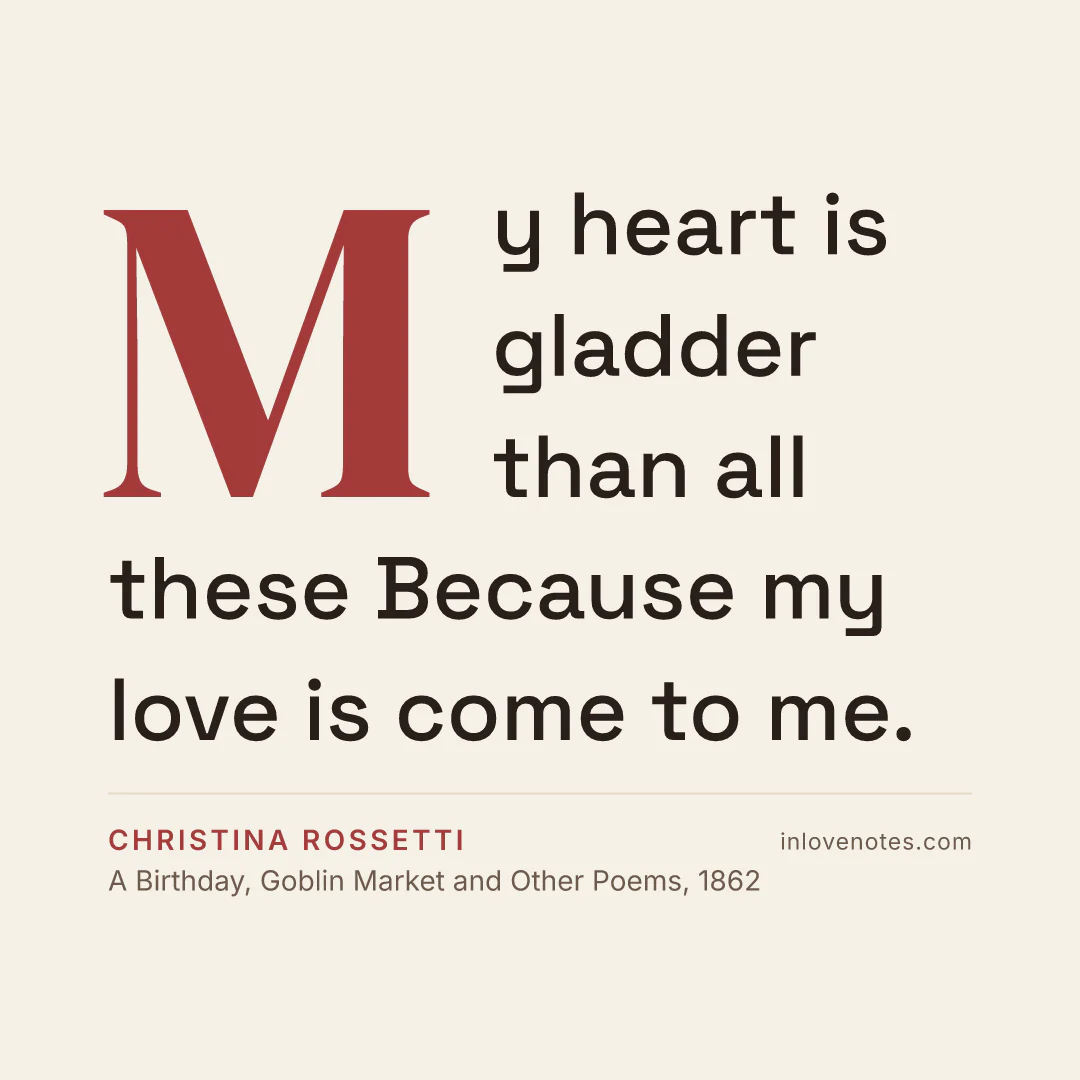
Christina Rossetti's "A Birthday" appeared in Goblin Market and Other Poems (1862). The "birthday" isn't the day she was born. It's the day her love arrived, which makes the poem as right for an anniversary as for his actual birthday.
My heart is like a singing bird / Whose nest is in a watered shoot; / My heart is like an apple-tree / Whose boughs are bent with thickset fruit; / My heart is like a rainbow shell / That paddles in a halcyon sea; / My heart is gladder than all these / Because my love is come to me. // Raise me a dais of silk and down; / Hang it with vair and purple dyes; / Carve it in doves, and pomegranates, / And peacocks with a hundred eyes; / Work it in gold and silver grapes, / In leaves, and silver fleurs-de-lys; / Because the birthday of my life / Is come, my love is come to me.
Christina Rossetti, "A Birthday", Goblin Market and Other Poems (1862)
The first stanza piles up three images of fullness: a bird singing, a tree heavy with fruit, a shell on a calm sea. The second stanza asks for a celebration fit for a queen ("vair" is a squirrel fur once used for royal trim). On a card the first eight lines are enough, and the last two lines make a good inscription inside a gift. Rossetti never married, and the poem doesn't say who the love is. So it works for any "him", and we don't claim it was written to anyone in particular.
One to make him laugh
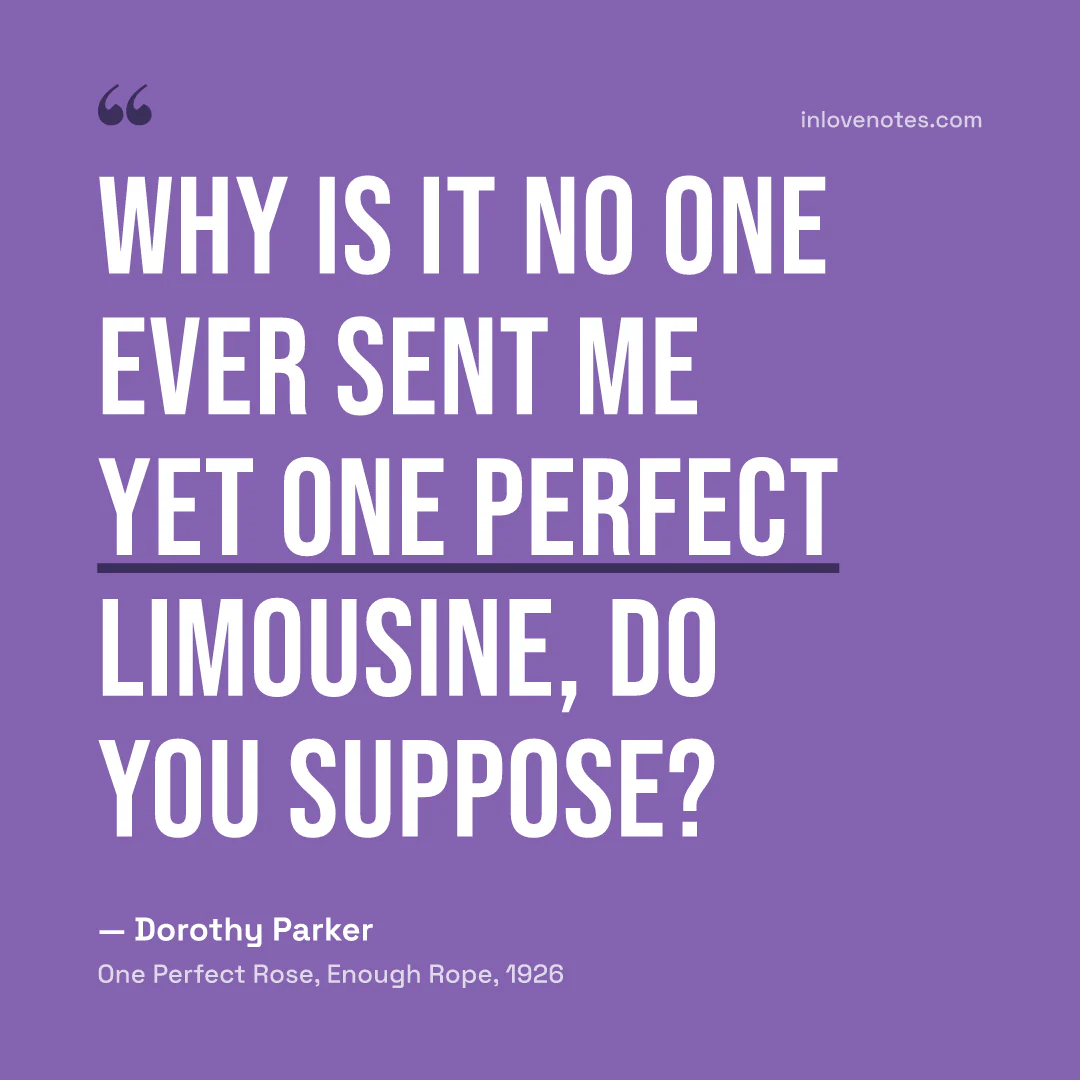
Not every love poem has to be solemn. Dorothy Parker's "One Perfect Rose" is in Enough Rope (1926), her first book of verse, and entered the US public domain in 2022. It spends two stanzas being perfectly romantic and then lands the joke:
A single flow'r he sent me, since we met. / All tenderly his messenger he chose; / Deep-hearted, pure, with scented dew still wet— / One perfect rose. // I knew the language of the floweret; / 'My fragile leaves,' it said, 'his heart enclose.' / Love long has taken for his amulet / One perfect rose. // Why is it no one ever sent me yet / One perfect limousine, do you suppose? / Ah no, it's always just my luck to get / One perfect rose.
Dorothy Parker, "One Perfect Rose", Enough Rope (1926)
Give it to a man with a sense of humour, ideally with a single rose that you bought him. Then the joke runs both ways. It's a good choice for a Valentine's card when the two of you would rather laugh than gush, and a poor one for a reconciliation or a hard week.
How to copy a poem into a card without spoiling it
- Keep the line breaks. A poem copied as one block of prose loses half its music. On a phone, use a new line for each line of verse. In a narrow card, break stanzas with a blank line, not with slashes.
- Name the poet under it. Write "— Sara Teasdale" (and the year if there's room). It tells him you chose a real poem, not something off a mug, and it stops the card from looking as if you claim the words as your own.
- Cut only at a natural pause, and show the cut. Stop at the end of a sentence or a stanza. If you skip lines inside a poem, put "…" where they were, as we did with Sonnet XXXVIII.
- Add one sentence of your own. The poem says the big thing, and your sentence says why you chose it: "This is us in the first month, when you only looked." One specific line from you is worth more than a second poem.
- Check the copy you found. Many online versions are retyped from memory. Johnson's missing line is one example. Compare against an early printing (Project Gutenberg has most of the books listed below) before you write it out by hand.
If you're after a longer piece of prose rather than a poem, our love letters for him page has full examples and a structure to follow.
Writing a four-line poem of your own
Teasdale's poem shows how little you need: one image, said four ways. Here is a method you can finish in ten minutes.
- Pick one thing he does that steadies you (makes coffee, drives at night, laughs at his own jokes).
- Find one image from nature or daily life that does the same thing: the tide, a lighthouse, a porch light, a winter coat.
- Write "I would ___ as ___" or "You are ___ the way ___", one line each, four times, each line a little more specific.
- Read it aloud and cut every word that is only there to rhyme. Rhyme is optional. Rhythm isn't.
An example our editors wrote to show the shape, not as a finished poem: "You are the porch light I drive home toward, / the coat on the hook that still smells of the cold, / the second cup poured before I ask, / the hand that finds mine in a dark room." Swap each image for one that's true of your own man.
Questions people ask about short love poems for him
What is the best short love poem to give a man?
For a short card, Sara Teasdale's four-line "I Would Live in Your Love" (1911) is hard to beat: it is one sentence, easy to copy and sounds devoted without being sugary. For a husband of many years, Anne Bradstreet's "To My Dear and Loving Husband" (1678) is the classic choice.
How do I say "I love you" in a short poem?
Choose one image and repeat it, as Rossetti does with "My heart is like…" in "A Birthday", then end on the plain words. Her stanza ends "Because my love is come to me", which says "I love you" without using the phrase. Our four-step method above shows how to build four lines of your own.
Can I write a short love poem to my husband in a card?
Yes. Write it out with its line breaks, sign the poet's name under it and add one sentence of your own about why it fits him. The last couplet of Bradstreet's poem ("Then while we live in love let's so persevere, / That when we live no more, we may live ever") is short enough for the smallest card.
Are these poems free to copy?
All nine were first published before 1927, so they are in the US public domain and you can copy them in full. Modern poems are a different matter. Short quotes in a private card are fine, but don't reprint a modern poem in full on a blog or a product you sell. Popular "love poems" online are also often misattributed. Our guide to misattributed love quotes lists the worst offenders.
Sources
- Sara Teasdale, "I Would Live in Your Love", Helen of Troy and Other Poems (New York, 1911): Project Gutenberg eBook #400. Also in Love Songs (1917): eBook #442. Publication years from the Gutenberg editors' notes.
- Sara Teasdale, "The Look", Rivers to the Sea (1915): Project Gutenberg eBook #596; also in Love Songs, eBook #442.
- Song of Songs 8:6–7, King James Version (1611): Project Gutenberg eBook #10.
- Anne Bradstreet, "To My Dear and Loving Husband": text as quoted in Helen Campbell, Anne Bradstreet and Her Time (1891), Project Gutenberg eBook #6854, which also notes that the second edition of her poems was published after her death.
- Georgia Douglas Johnson, "I Want to Die While You Love Me", in James Weldon Johnson (ed.), The Book of American Negro Poetry (1922): Project Gutenberg eBook #11986. The note that it was read at her funeral and the background on her salon are from composer Gary Bachlund's notes to Four Songs of a Woman (2007), bachlund.org.
- Elizabeth Barrett Browning, Sonnets from the Portuguese, XXXVIII (1850): Project Gutenberg eBook #2002.
- Emily Dickinson, "Wild Nights", Poems by Emily Dickinson, Second Series, ed. Mabel Loomis Todd and T. W. Higginson (1891): Project Gutenberg eBook #2679.
- Christina Rossetti, "A Birthday", Goblin Market and Other Poems (1862): Project Gutenberg eBook #16950, which gives the 1862 date of first publication.
- Dorothy Parker, "One Perfect Rose", Enough Rope (Boni & Liveright, 1926): Project Gutenberg eBook #68353.
- The four-line example poem and the card tips were written by the In Love Notes editors for this page.