Shakespeare Love Quotes for Her (and Him): 15 Lines, Who Says Them and to Whom
15 Shakespeare love lines for her or him, each with speaker, scene and a note on fit, checked against the complete works, plus 3 lines he never wrote.
The best Shakespeare love quotes for her are the ones a character actually says to the woman he loves: Romeo under Juliet's window, Ferdinand to Miranda, Benedick to Beatrice. Plenty of the lines on quote lists are said by someone else entirely, about someone else, in a scene that ends badly. Below are 15 lines from the plays and sonnets, each with the speaker, the person they are speaking to, the act and scene, and a note on whether it suits a card for her, a card for him, or neither. We also list three "Shakespeare" love quotes he never wrote.
Every line was checked against the complete works on Project Gutenberg and the MIT edition of the plays, and each one links to its scene. We give act and scene rather than line numbers, because line numbers shift between editions. The year after each line is when that play or poem was first printed.
All 15 lines at a glance: who says it, and to whom
Use this table to rule lines in or out before you read the context. "Careful" means the line is real and beautiful but the scene around it changes its meaning.
| Line (opening words) | Speaker → listener | Where | Best for |
|---|---|---|---|
| "But, soft! what light through yonder window breaks?" | Romeo → himself, about Juliet | Romeo and Juliet II.2 | Her |
| "The very instant that I saw you, did / My heart fly to your service" | Ferdinand → Miranda | The Tempest III.1 | Her |
| "Shall I compare thee to a summer's day?" | The poet → the beloved | Sonnet 18 | Her or him |
| "I do love nothing in the world so well as you" | Benedick → Beatrice | Much Ado About Nothing IV.1 | Her |
| "I love you with so much of my heart that none is left to protest" | Beatrice → Benedick | Much Ado About Nothing IV.1 | Him |
| "My bounty is as boundless as the sea" | Juliet → Romeo | Romeo and Juliet II.2 | Him |
| "Men have died from time to time, and worms have eaten them, but not for love" | Rosalind (disguised) → Orlando | As You Like It IV.1 | Him, with a wink |
| "For thy sweet love remember'd such wealth brings" | The poet → the beloved | Sonnet 29 | Either; anniversaries |
| "If this be error and upon me prov'd" | The poet → the reader | Sonnet 116 | Weddings, long marriages |
| "There's beggary in the love that can be reckon'd" | Antony → Cleopatra | Antony and Cleopatra I.1 | Either |
| "The course of true love never did run smooth" | Lysander → Hermia | A Midsummer Night's Dream I.1 | Careful |
| "Love looks not with the eyes, but with the mind" | Helena → herself | A Midsummer Night's Dream I.1 | Careful |
| "But love is blind and lovers cannot see" | Jessica → Lorenzo | The Merchant of Venice II.6 | Careful |
| "Doubt thou the stars are fire" | Hamlet's letter, read aloud by Polonius | Hamlet II.2 | Careful |
| "Sir, I love you more than word can wield the matter" | Goneril → her father, Lear | King Lear I.1 | Avoid |
For her: what Romeo, Ferdinand and the sonnets actually say
"But, soft! what light through yonder window breaks? / It is the east, and Juliet is the sun."
— Romeo, Romeo and Juliet, Act II, scene 2 (1597)
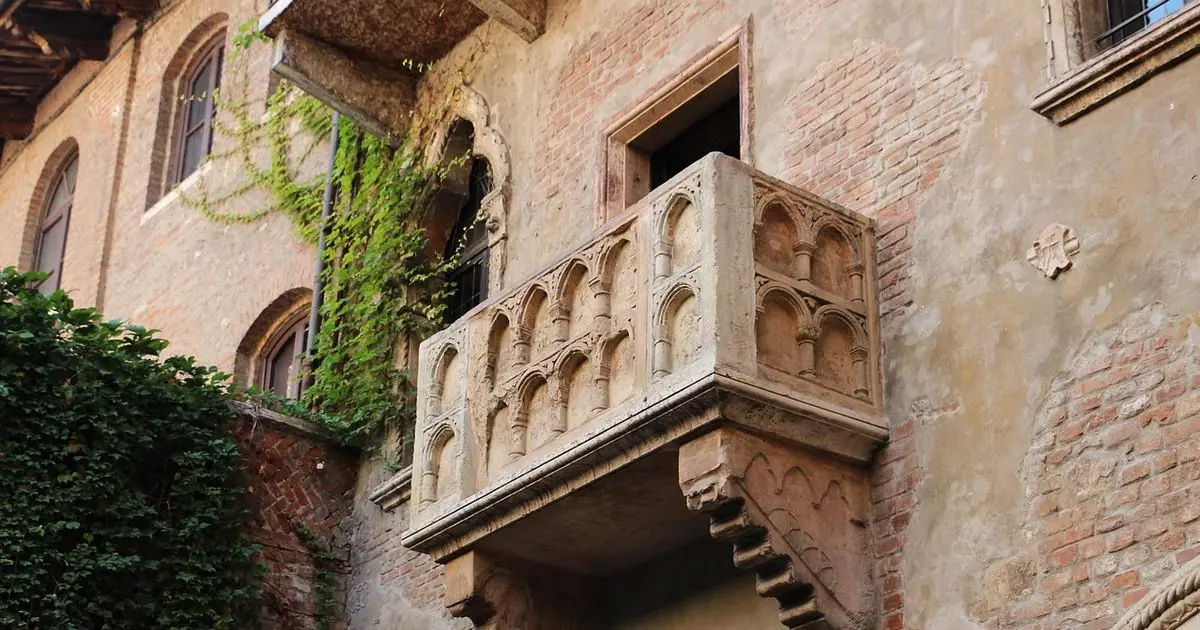
Romeo has climbed into the Capulet orchard after the feast, and Juliet appears above him without knowing he is there. He is talking to himself, which is why the speech can be so extravagant. Note the word: it is a window. The word "balcony" does not appear anywhere in Shakespeare's complete works (we searched the full Gutenberg text); it came later, from stage productions. The line suits a card for her because it is pure admiration and asks nothing back. Read the whole scene.
"The very instant that I saw you, did / My heart fly to your service; there resides, / To make me slave to it."
— Ferdinand, The Tempest, Act III, scene 1 (1623)
Ferdinand, a shipwrecked prince, is carrying logs for Miranda's father as a test, and he jokes that he is a "patient log-man" for her sake. It is the best love-at-first-sight line Shakespeare wrote in his own voice, and it is said to her face, in daylight, by a man doing hard work for her. That makes it a good line for an engagement card or a note left after a long day. Miranda answers in the same scene with "I would not wish / Any companion in the world but you".
"Shall I compare thee to a summer's day? / Thou art more lovely and more temperate."
— Sonnet 18 (1609)
Everyone knows this opening, and it works on a card for anyone. One thing to know before you use it: in the 1609 sequence, most editors read Sonnets 1 to 126 as addressed to a young man, and Sonnet 18 sits in that group. The poem itself never names a gender, so it is honest to give it to a woman or a man. The closing couplet, "So long as men can breathe or eyes can see, / So long lives this, and this gives life to thee", is a promise that the poem will keep the beloved alive. It reads well on a birthday card (full text).
Shakespeare's plainest "I love you": Benedick and Beatrice
If you want the moment in Shakespeare where two people just say it, it is in a church in Much Ado About Nothing, minutes after Beatrice's cousin Hero has been shamed and abandoned at the altar. Beatrice is crying. Benedick, who has spent four acts trading insults with her, stays behind.
"I do love nothing in the world so well as you: is not that strange?"
— Benedick, Much Ado About Nothing, Act IV, scene 1 (1600)
The "is not that strange?" is what makes it. He is surprised at himself, and he says so. For a partner who was a friend first, or someone you never expected to fall for, this is the line.
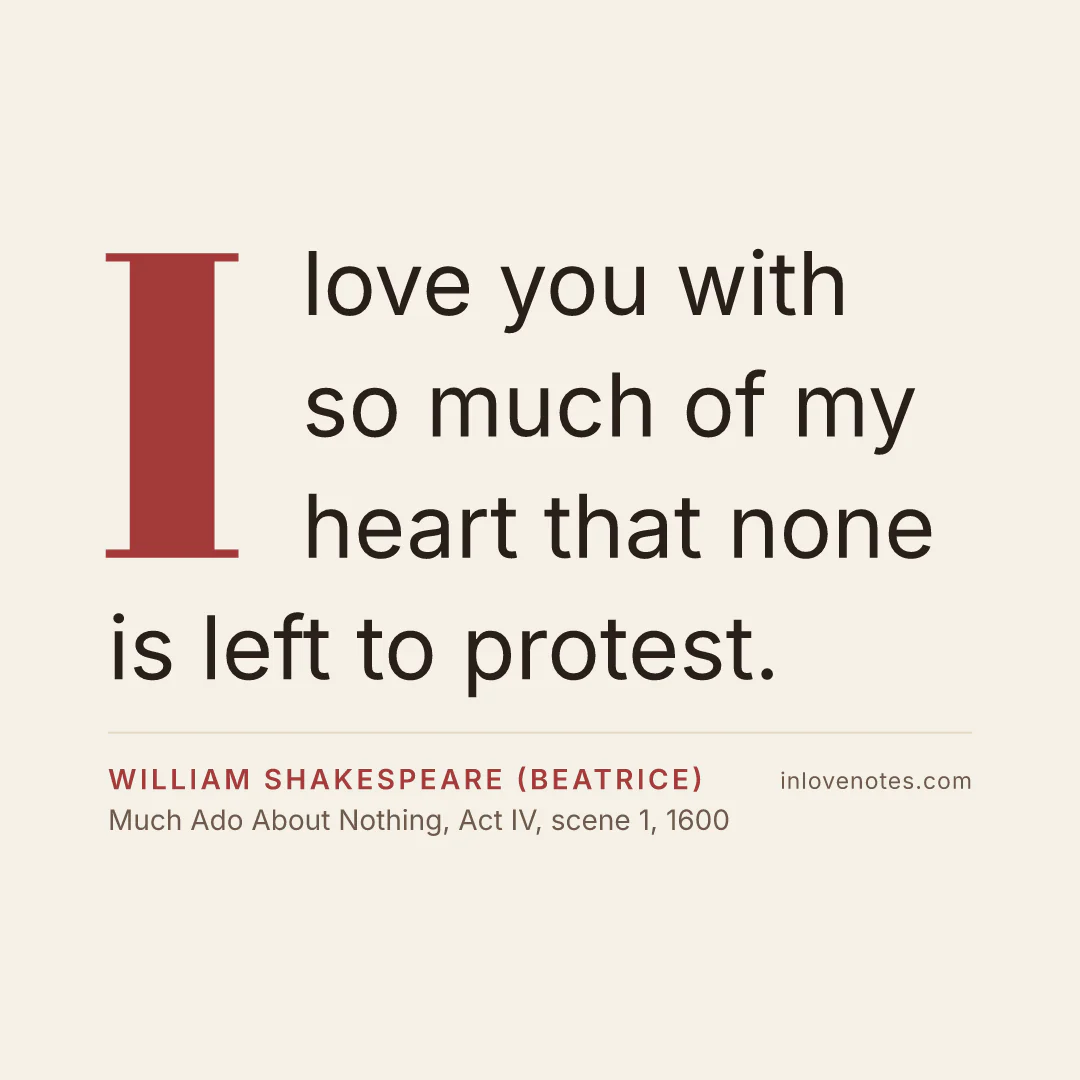
"I love you with so much of my heart that none is left to protest."
— Beatrice, Much Ado About Nothing, Act IV, scene 1 (1600)
Just before it, she tells him "I was about to protest I loved you", and he answers "And do it with all thy heart." "Protest" here means "declare", so she is saying she loves him too much to have any heart left over to make speeches with. Her very next request is "Kill Claudio", so the scene turns dark quickly, but the exchange itself is the cleanest declaration in the plays. It is our pick for a card for him (read the exchange).
For him: two lines the women say first
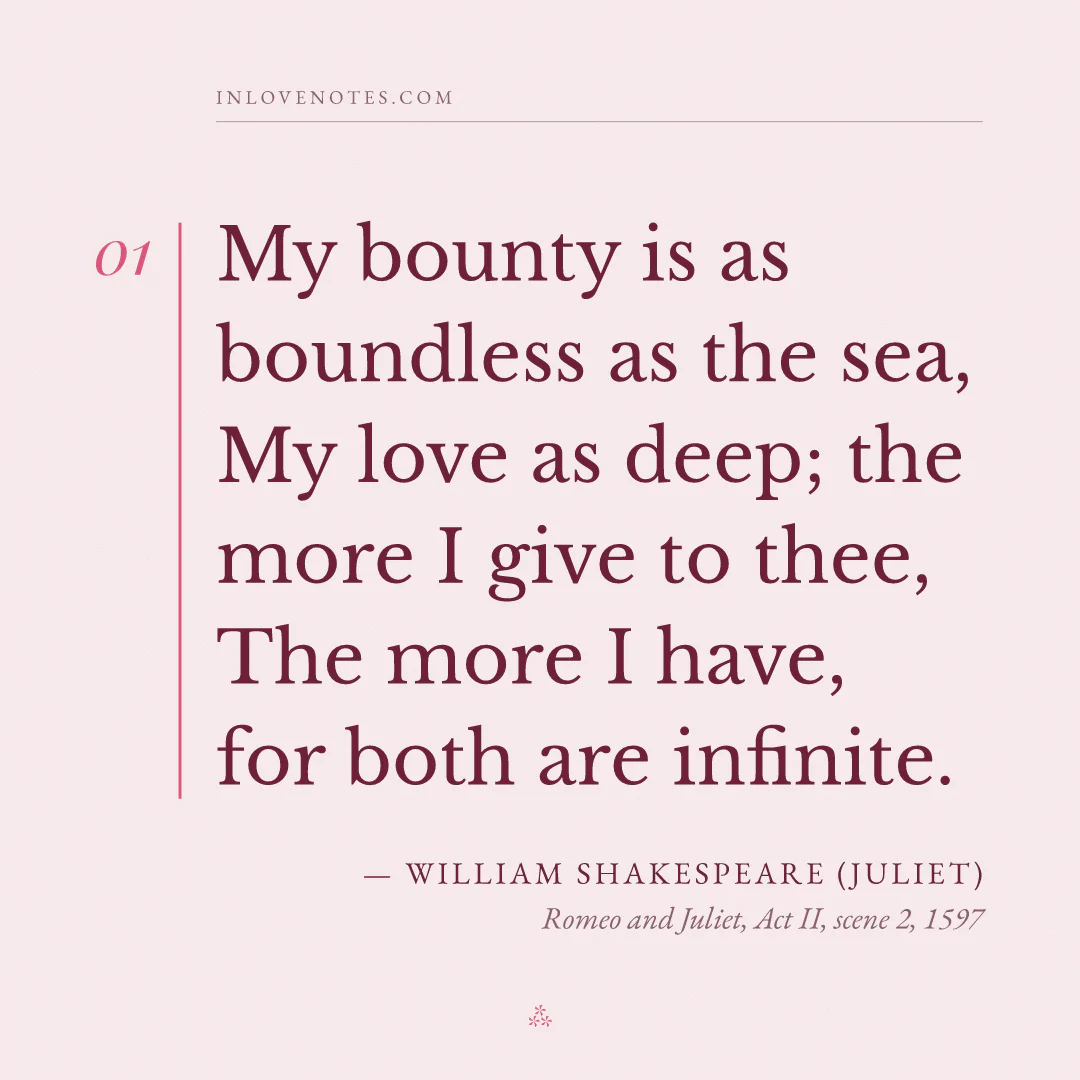
"My bounty is as boundless as the sea, / My love as deep; the more I give to thee, / The more I have, for both are infinite."
— Juliet, Romeo and Juliet, Act II, scene 2 (1597)
Romeo asks for "the exchange of thy love's faithful vow for mine", and Juliet answers that she gave hers before he asked. Then come these three lines, the most generous thing anyone says in the play. They suit a card from her to him, and they are a common reading at weddings because they describe love as something that grows the more you spend it. In the same scene Juliet says "Good night, good night! parting is such sweet sorrow": that line is hers, not Romeo's. For more goodnight wording, see our goodnight paragraphs for her.
"Men have died from time to time, and worms have eaten them, but not for love."
— Rosalind, As You Like It, Act IV, scene 1 (1623)
Rosalind, disguised as a young man called Ganymede, is coaching Orlando in how to woo "Rosalind". When he says he would die if she refused him, she tells him nobody has ever died of love, and runs through Troilus and Leander to prove it. The joke is that she adores him. For a man who rolls his eyes at sentimental cards, this is a love line that teases instead (scene).
For an anniversary or a long marriage
"For thy sweet love remember'd such wealth brings / That then I scorn to change my state with kings."
— Sonnet 29 (1609)
The sonnet starts with the speaker "in disgrace with fortune and men's eyes", envying other men's looks, friends and talents. Then he thinks of the beloved, and the mood lifts "like to the lark at break of day arising". The couplet is the payoff: remembering your love makes him richer than a king. It fits an anniversary after a hard year better than almost anything (Sonnet 29).
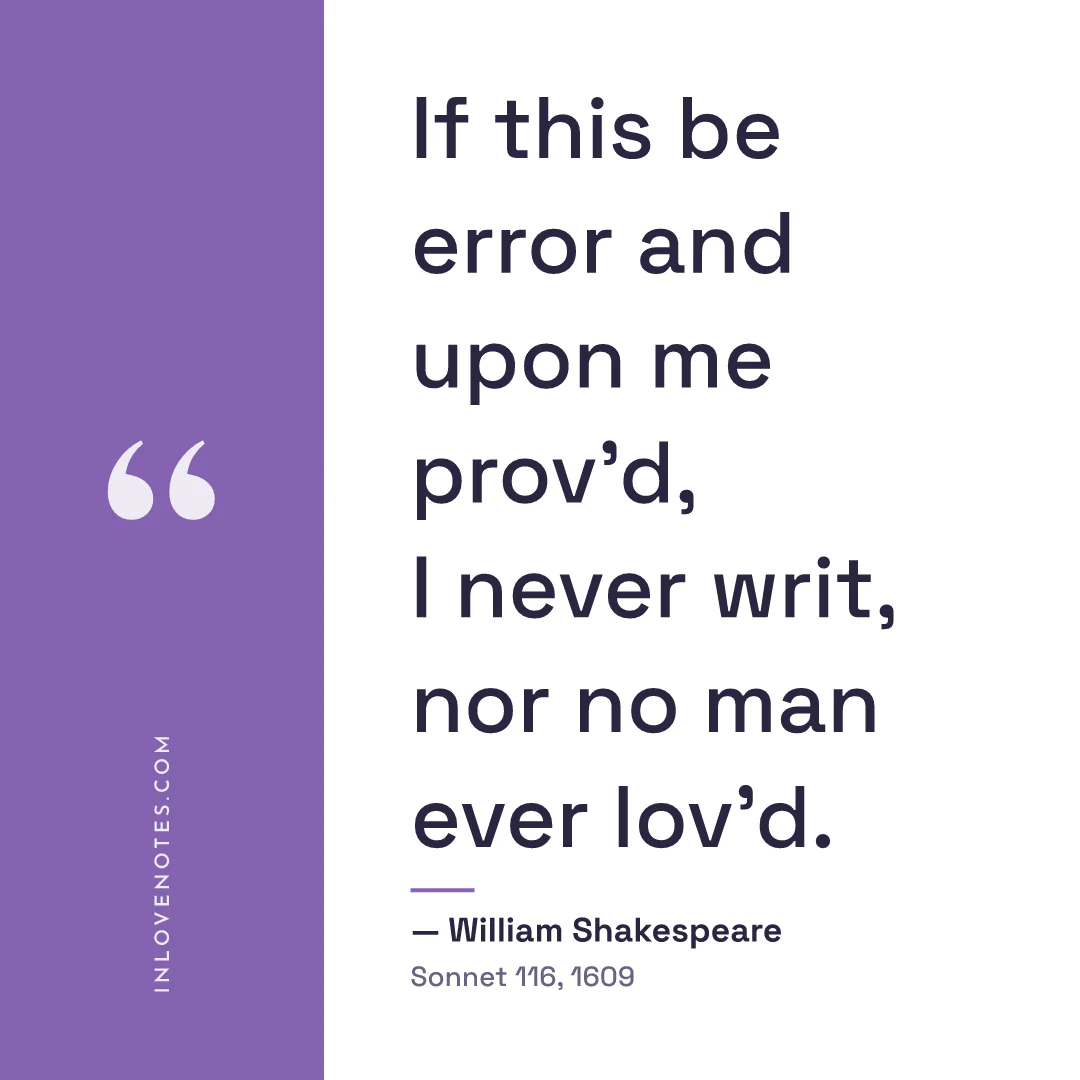
"If this be error and upon me prov'd, / I never writ, nor no man ever lov'd."
— Sonnet 116 (1609)
Sonnet 116 opens with "Let me not to the marriage of true minds / Admit impediments", which echoes the marriage service, and it is read at weddings more than any other Shakespeare poem. Most people quote the opening; we like the closing couplet for a long marriage, because it stakes everything on the claim: if I am wrong about love, then I never wrote anything and nobody ever loved. Our misattributed love quotes guide uses the opening lines (Sonnet 116).
"There's beggary in the love that can be reckon'd."
— Antony, Antony and Cleopatra, Act I, scene 1 (1623)
In the play's first scene Cleopatra demands, "If it be love indeed, tell me how much." Antony refuses to put a number on it: love you can count is a poor man's love. It is a good answer to "how much do you love me?" in a card or a text. If you want the play's most famous line about a woman, "Age cannot wither her, nor custom stale / Her infinite variety", note that Enobarbus says it to his friends in Rome, not to Cleopatra. We discuss it in our love quotes for her birthday.
Five famous lines to handle with care
These five are real Shakespeare and they turn up on every list. The context changes what they mean, so read the note before you use one.
"The course of true love never did run smooth."
— Lysander, A Midsummer Night's Dream, Act I, scene 1 (1600)
Lysander says it to Hermia right after her father and the Duke have told her to marry another man, become a nun, or die. It is a comfort to a couple facing opposition, not a description of a happy relationship. It works for a couple who got through something hard together; it reads oddly on a wedding cake.
"Love looks not with the eyes, but with the mind; / And therefore is wing'd Cupid painted blind."
— Helena, A Midsummer Night's Dream, Act I, scene 1 (1600)
Helena is alone on stage, bitter that Demetrius loves Hermia instead of her. In her mouth the line means love is irrational and unfair, not that love sees past appearances. Fine for a reflective caption; wrong for a card that is meant to flatter.
"But love is blind and lovers cannot see / The pretty follies that themselves commit."
— Jessica, The Merchant of Venice, Act II, scene 6 (1600)
This is the source of "love is blind" quotes credited to Shakespeare. Jessica is eloping with Lorenzo at night, dressed as a boy and carrying her father Shylock's money, and she is embarrassed to be seen. It is affectionate and a little sheepish, which suits a playful note about the silly things you do for someone.
"Doubt thou the stars are fire; / Doubt that the sun doth move; / Doubt truth to be a liar; / But never doubt I love."
— Hamlet's letter to Ophelia, Hamlet, Act II, scene 2 (1604)
We never see Hamlet write or send this. Polonius reads it aloud to the King and Queen as evidence that Hamlet is mad with love, and in the next act Hamlet tells Ophelia to her face, "I loved you not." Only at her grave does he say "I loved Ophelia: forty thousand brothers / Could not, with all their quantity of love, / Make up my sum." Use the poem if you like it, but know the story (II.2, III.1).
"Sir, I love you more than word can wield the matter."
— Goneril, King Lear, Act I, scene 1 (1608)
Goneril says this to her father during the love test that opens the play, to win a third of his kingdom. It is the model of empty flattery; her honest sister Cordelia answers "Nothing" and is disinherited. Some editions print "words" instead of "word". It is on many love lists, but please don't put it in a card.
Three "Shakespeare" love quotes he never wrote
Searching the complete works takes seconds, and these three fail the test. Credit them correctly or choose a real line from above.
| Shared as Shakespeare | What the record shows | Real line to use instead |
|---|---|---|
| "Love me or hate me, both are in my favor. If you love me, I'll always be in your heart; if you hate me, I'll always be in your mind." | Not in the complete works (we searched the Gutenberg text for "in my favour" and "always be in your"). The blog Shakespeare Geek traced it in 2010 and found no source. Origin unknown. | Beatrice, IV.1, for a confident declaration. |
| "When I saw you I fell in love, and you smiled because you knew." | From Arrigo Boito's libretto for Verdi's opera Falstaff (1893), in English translation. Details in our misattributed love quotes guide. | Ferdinand, The Tempest III.1. |
| "Who ever loved that loved not at first sight?" | Real words in a Shakespeare play, but Phebe is quoting Christopher Marlowe's Hero and Leander: "Dead shepherd, now I find thy saw of might" (As You Like It III.5). | Credit it "Marlowe, quoted in As You Like It". |
Two smaller corrections come up often. "O Romeo, Romeo, wherefore art thou Romeo?" means "why are you Romeo", that is, why are you a Montague; Juliet is not asking where he is. And as noted above, it is Juliet, not Romeo, who says "parting is such sweet sorrow".
Putting a Shakespeare line in a card, a text or a toast
Shakespeare wrote for actors speaking aloud, so his lines run long and lean on "thee" and "thou". A few habits keep a quote from feeling like a homework assignment.
- Cut at a breath. Stop where a speaker would pause: "The very instant that I saw you, did my heart fly to your service" is complete without the rest of the sentence.
- Say who said it. "Beatrice, in Much Ado About Nothing" tells the reader you chose the line on purpose. It also stops you from giving him Goneril's flattery by mistake.
- Keep the old spelling or modernise it, not both. "Remember'd" and "lov'd" look deliberate; "remembered" and "loved" look clean. Mixing them looks like a typo.
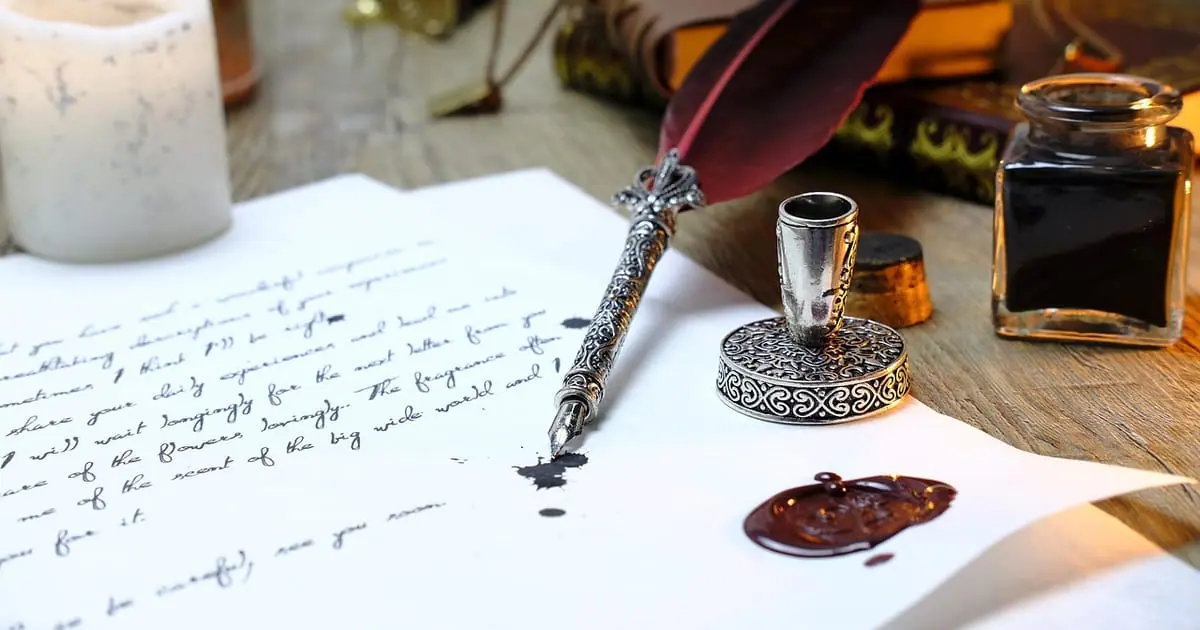
- Add one plain sentence of your own. After "There's beggary in the love that can be reckon'd", write "So I'm not going to try. Happy anniversary." The quote sets the tone and your sentence makes it yours. Our guide on how to write a love letter has more on that.
- For a toast, use the couplets. The two-line endings of the sonnets are built to be said aloud and remembered, and they finish cleanly before anyone's glass gets heavy.
| Occasion | Line | Why it fits |
|---|---|---|
| Valentine's card for her | Ferdinand, "The very instant that I saw you" | Said to her face, about the first meeting |
| Valentine's card for him | Beatrice, "so much of my heart" | Short, direct, a little witty |
| Anniversary after a hard year | Sonnet 29 couplet | The whole poem turns from bad luck to gratitude |
| Wedding reading or toast | Sonnet 116; Juliet's "bounty" lines | Both describe love that holds or grows |
| Text when they ask "how much?" | Antony, "beggary in the love" | A ready-made answer to that exact question |
| Partner who hates mush | Rosalind, "not for love" | Affection disguised as a joke |
Questions people ask about Shakespeare's love lines
What is the most romantic line in Shakespeare?
Juliet's "My bounty is as boundless as the sea, / My love as deep" is the line most often chosen for weddings, and it has the advantage of being said directly to Romeo. For a single short sentence, Benedick's "I do love nothing in the world so well as you: is not that strange?" is hard to beat.
What is a Shakespearean way to say "I love you"?
Use the Much Ado exchange. Benedick says "I do love nothing in the world so well as you", and Beatrice answers "I love you with so much of my heart that none is left to protest." Both are in Act IV, scene 1, and both work almost unchanged today.
Did Shakespeare write "When I saw you I fell in love, and you smiled because you knew"?
No. It comes from Arrigo Boito's libretto for Verdi's Falstaff (1893), an opera based on Shakespeare. The sentence does not appear in Shakespeare's own plays or poems.
Is Sonnet 18 about a woman?
The poem never says. It belongs to the group of sonnets (1 to 126) that most editors read as addressed to a young man, but nothing in its fourteen lines rules out giving it to anyone you love.
If you like reading love lines in their setting, our Pride and Prejudice love quotes do the same thing for Austen, chapter by chapter.
Sources
- William Shakespeare, The Complete Works, Project Gutenberg eBook #100: searched for every line above and for the misattributed lines.
- The MIT Complete Works of William Shakespeare (Moby text): act and scene pages linked in each note.
- Shake-speares Sonnets (1609), Project Gutenberg eBook #1041: Sonnets 18, 29 and 116.
- Shakespeare Geek (blog), "Love me or hate me, both are in my favor", 7 August 2010.