a note on
21 Romantic Love Quotes for Him Drawn from Letters and Literature
These historical letters and literary excerpts provide the exact phrasing needed to express deep affection for the men in our lives.
penned by Erdi Dogan

People often assume that writing a romantic letter requires a sudden strike of poetic genius. They stare at blank paper, convinced that true affection must be translated into original, flawless prose before it counts. The reality involves far less pressure and much more historical theft. You simply borrow the right phrasing from someone who already did the heavy lifting. Anthologies exist for exactly this purpose: a paperback of Victorian correspondence or a well-thumbed copy of Pride and Prejudice will supply an opening line faster than three hours spent staring at a blank anniversary card.
Men appreciate directness, but they also value the historical weight of a well-chosen line. When you examine classic romantic messages exchanged between partners, the most effective ones rely on clarity rather than complex metaphors. Sometimes a single sentence from a nineteenth-century novel says exactly what you need. If you want to see how short declarations anchor handwritten letters, you can look to authors who mastered brevity under pressure. Even a quick text message benefits from a literary upgrade.
Literary Declarations of Devotion
We start with the novelists and playwrights. These writers spent their entire lives studying human connection. Their words survive because they ring true across centuries.
"Whatever our souls are made of, his and mine are the same." — Emily Brontë, Wuthering Heights, 1847
Catherine Earnshaw delivers this fierce defense of her connection to Heathcliff, defining love as a fundamental alignment of character.
"I ask you to pass through life at my side—to be my second self, and best earthly companion." — Charlotte Brontë, Jane Eyre, 1847
Mr. Rochester strips away the societal expectations of his era to offer Jane a partnership based entirely on intellectual and emotional equality.
"You have bewitched me body and soul, and I love, I love, I love you." — Jane Austen, Pride and Prejudice, 1813
Mr. Darcy finally drops his guarded pride to deliver one of the most famous confessions in English literature.
"If I know what love is, it is because of you." — Hermann Hesse, Narcissus and Goldmund, 1930
Hesse distills the realization that true affection acts as a sudden, clarifying teacher.
"I have found the paradox, that if you love until it hurts, there can be no more hurt, only more love." — Daphne Rae, Love Until It Hurts, 1981
Though frequently misattributed to Mother Teresa on social media, Rae's observation captures the vulnerability required to sustain a long-term bond.
"In all the world, there is no heart for me like yours. In all the world, there is no love for you like mine." — Inspired by Maya Angelou
This sentiment echoes Angelou's broader poetic focus on the absolute singularity of a committed partnership.
"You are my heart, my life, my one and only thought." — Arthur Conan Doyle, The White Company, 1891
Conan Doyle steps away from his famous detective to pen a historical romance filled with absolute, unhesitating loyalty.
Short Affirmations for Daily Notes
Not every message needs to carry the gravity of a marriage proposal. Sometimes you just need to leave a quick note on the kitchen counter before work. Understanding phrasing suited for quiet morning letters helps you maintain intimacy during busy weeks. If you prefer a lighter touch, you might enjoy seeing how satirists handle devotion on stage with sharp humor.
"I look at you and see the rest of my life in front of my eyes." — Inspired by contemporary wedding vows
Modern ceremonies often rely on this simple projection of a shared future.
"He stepped down, trying not to look long at her, as if she were the sun, yet he saw her, like the sun, even without looking." — Leo Tolstoy, Anna Karenina, 1877
Levin's overwhelming awareness of Kitty captures the physical sensation of walking into a room and instantly locating the person you love.
"It was a million tiny little things that, when you added them all up, they meant we were supposed to be together." — Nora Ephron, Sleepless in Seattle, 1993
Ephron understood that grand romances are built entirely out of mundane, overlapping details.
"I saw that you were perfect, and so I loved you. Then I saw that you were not perfect and I loved you even more." — Angelita Lim
Lim highlights the crucial transition from early infatuation to actual, reality-based devotion.
"Every atom of your flesh is as dear to me as my own: in pain and sickness it would still be dear." — Charlotte Brontë, Jane Eyre, 1847
Brontë makes a second appearance here because she understood the visceral, protective nature of true attachment.
"If you live to be a hundred, I want to live to be a hundred minus one day so I never have to live without you." — A.A. Milne, Winnie-the-Pooh, 1926
Children's literature frequently contains the most profound, stripped-down truths about companionship.
"I swear I couldn't love you more than I do right now, and yet I know I will tomorrow." — Leo Christopher
Christopher frames affection not as a static state, but as an expanding capacity.
Poetic Vows and Long-Term Promises
When anniversaries arrive, you need words that acknowledge the passage of time. These lines excel at expressing deeper emotional undercurrents without sounding overly dramatic. They remind us what grounds a restless romantic mind during challenging seasons.
"I love you as certain dark things are to be loved, in secret, between the shadow and the soul." — Pablo Neruda, 100 Love Sonnets, 1959
Neruda offers a moody, private alternative to loud, public declarations of affection.
"Yours is the light by which my spirit's born: you are my sun, my moon, and all my stars." — E.E. Cummings, Poems, 1940
Cummings abandons his usual structural tricks to deliver a straightforward, cosmic compliment.
"Grow old along with me! The best is yet to be." — Robert Browning, Rabbi Ben Ezra, 1864
Browning treats aging not as a decline, but as the anticipated climax of a shared life.
"Two minds with but a single thought, two hearts that beat as one." — Friedrich Halm, Ingomar the Barbarian, 1842
This translated German play gave English speakers one of their most enduring romantic concepts.
"Doubt thou the stars are fire; Doubt that the sun doth move; Doubt truth to be a liar; But never doubt I love." — William Shakespeare, Hamlet, 1609
Hamlet writes these lines to Ophelia, offering astronomical certainties as the only valid comparison to his feelings.
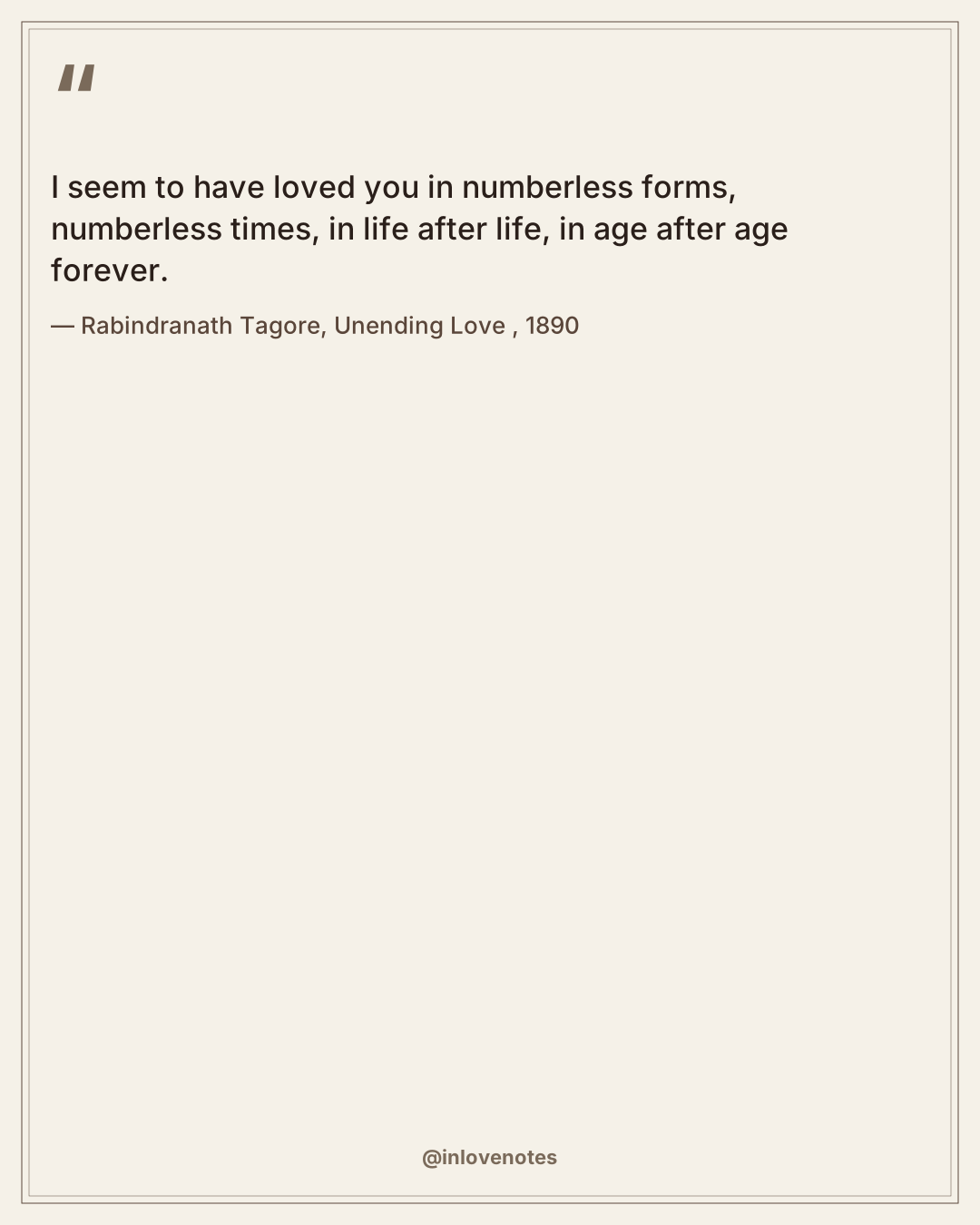
"I seem to have loved you in numberless forms, numberless times, in life after life, in age after age forever." — Rabindranath Tagore, Unending Love, 1890
Tagore scales up the concept of devotion until it spans multiple lifetimes and historical eras.
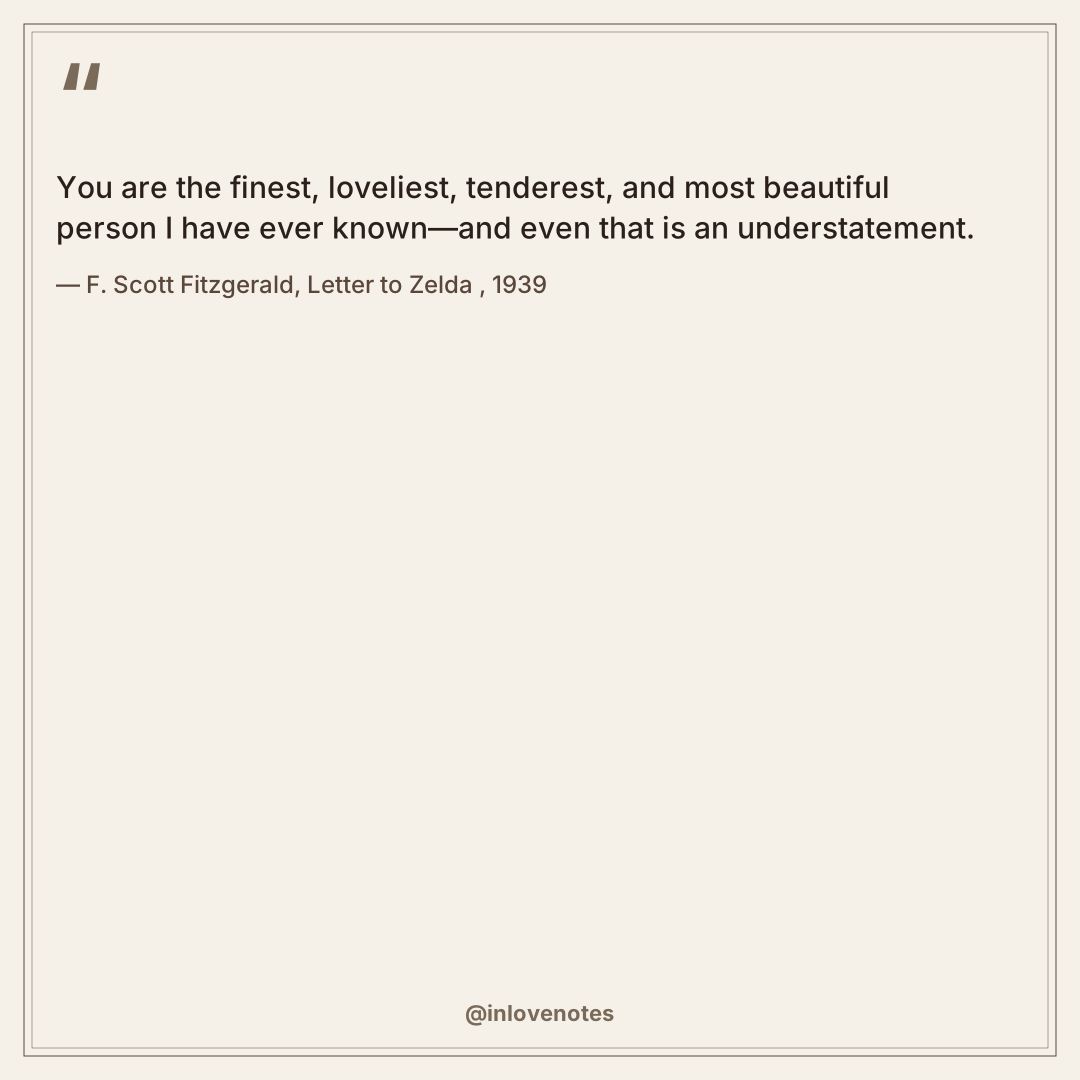
"You are the finest, loveliest, tenderest, and most beautiful person I have ever known—and even that is an understatement." — F. Scott Fitzgerald, Letter to Zelda, 1939
Fitzgerald wrote this near the end of a notoriously difficult marriage, proving that core admiration can survive immense practical turmoil.
Finding the right sentence does not require an English degree. It just requires a willingness to let someone else speak for you when your own vocabulary falls short. The blank page suddenly looks a lot less intimidating when you realize history is full of people who already solved the exact problem you are facing. You just have to pick the line that sounds like him.
The Short Version
- Borrowing words from literature removes the pressure of inventing original prose for every anniversary.
- Nineteenth-century novelists like the Brontë sisters offer some of the most direct, unpretentious declarations of partnership.
- Short, daily affirmations sustain intimacy much more effectively than rare, grand gestures.
- Children’s literature and classic poetry frequently share the same straightforward approach to explaining loyalty.
- The goal is not to sound like a poet, but to find a historical sentence that accurately reflects your actual relationship.