6 Inspirational Quotes About Love and Life, Checked Against the Source
Six quotes about love and life checked against the text: Tennyson, Alcott, Thoreau, Hugo, Kempis, Saint-Exupéry, plus six lines we could not source.
Updated

Six lines on this page survived a check against the text they are said to come from. Six more, which an earlier version of this page printed with confident dates and titles, did not, and they are listed near the end so you can see why. Each verified quote below comes with the scene or chapter it sits in, because a line about love and life reads differently once you know who said it and to whom.
Where does "Love is the only gold" come from?
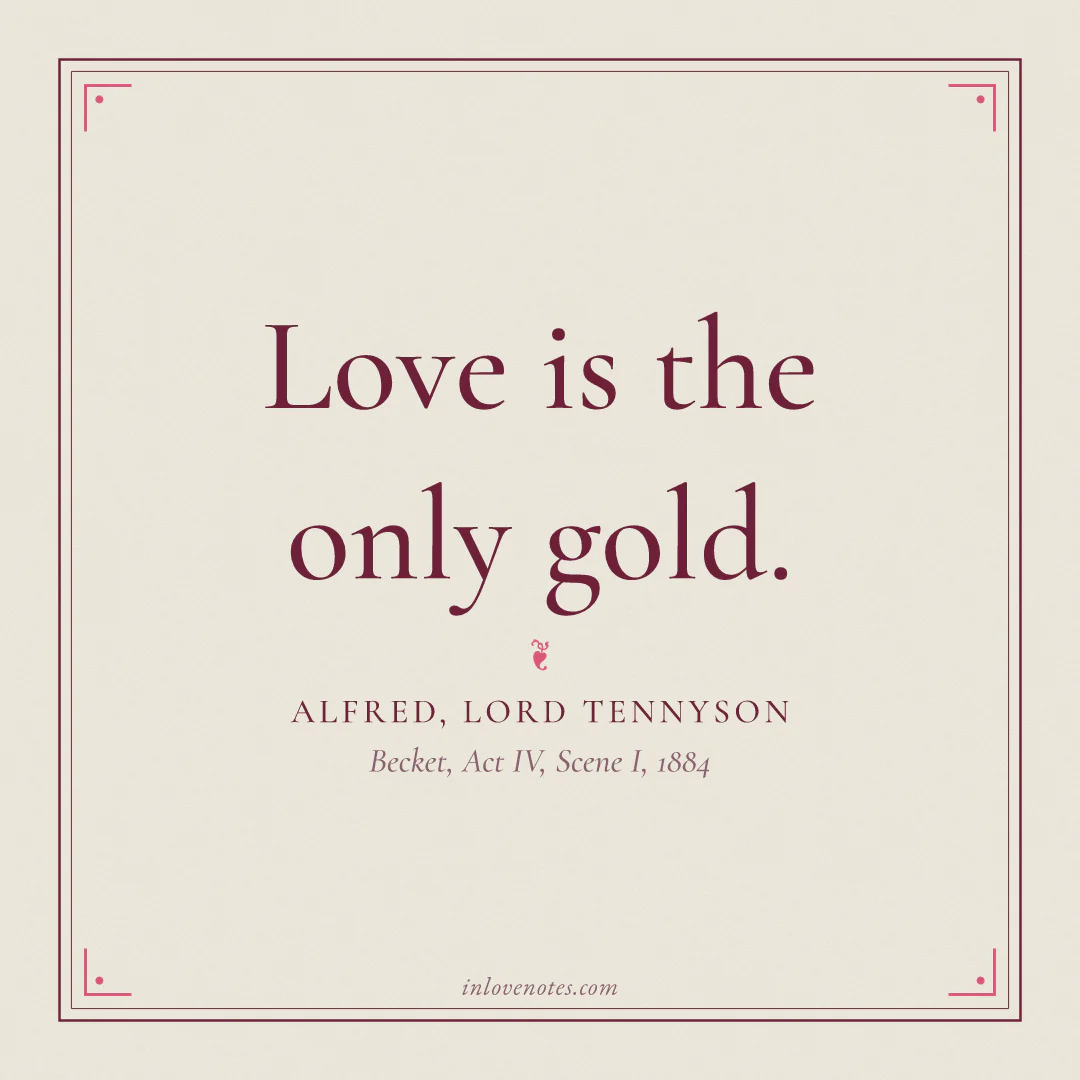
It is spoken by a child in a play, not by a poet in his own voice. In Tennyson's Becket (published 1884), Queen Eleanor finds the hidden bower of Rosamund, Henry II's mistress, and meets Rosamund's small son Geoffrey. She offers him a golden chain if he will lead her to his mother. He refuses.
No—no gold. Mother says gold spoils all. Love is the only gold.
Alfred, Lord Tennyson, Becket, Act IV, Scene I (1884)
Read in place, the line is a boy's answer to a bribe, and the stakes are real: Eleanor is a jealous queen and he is protecting someone. That makes it a good line for a note about what you would not trade, and a poor one for a generic card about "true love". The text is on Project Gutenberg.
What does love do to a face? Louisa May Alcott on Meg
Alcott's sentence is narration, not dialogue, and it is easy to miss. Part 2 of Little Women opens with chapter 24, "Gossip", three years after the story of Part 1. Meg has spent the time waiting for her engagement to turn into a wedding, "growing womanly in character, wise in housewifely arts, and prettier than ever, for love is a great beautifier."
…prettier than ever, for love is a great beautifier.
Louisa May Alcott, Little Women, Part 2, ch. 24, "Gossip" (1869)
The next sentence is the useful one: Meg also felt some disappointment at how humble her new life would be. Alcott lets both be true at once, which is a better description of ordinary love than most quotations manage. If you want to compliment someone in writing, this is the gentle version: you do not say they are beautiful, you say what being loved has done to them.
Can you cure love? Thoreau's journal entry
The Walden Woods Institute dates Thoreau's line to his journal entry of 25 July 1839, when he was twenty-two. It is one sentence, written as a private note, not as a published maxim.
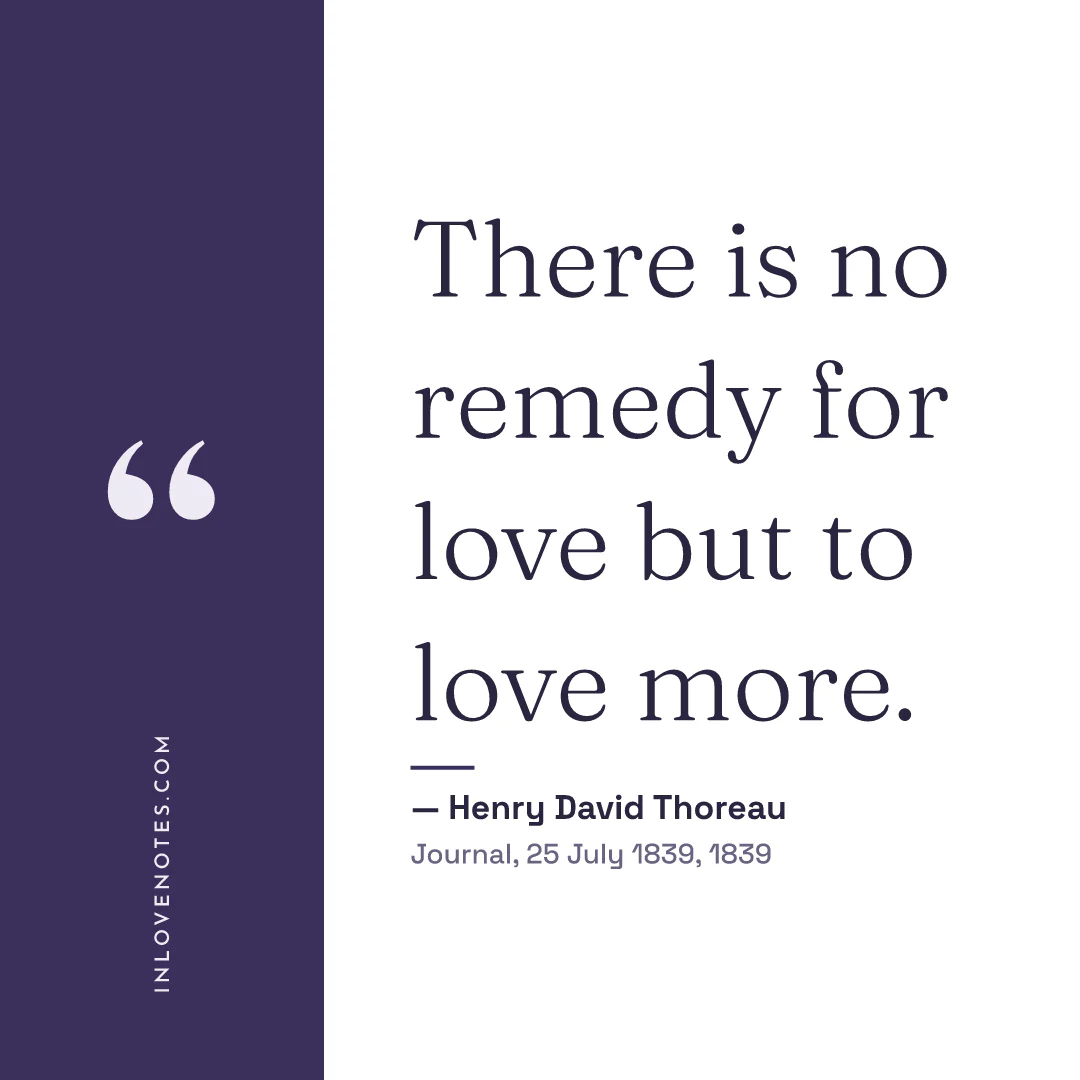
There is no remedy for love but to love more.
Henry David Thoreau, Journal, 25 July 1839
The entry gives no further context, so read it as a private rule of thumb: when love hurts, the answer is not retreat. It is a fair line for a letter to someone you are afraid of losing, as long as you do not use it to argue that someone should stay in a relationship that is harming them. Source: walden.org.
Who is the "supreme happiness of life" about? Victor Hugo's blind bishop
This is the line most often printed alone, and it loses the most that way. In Les Misérables (Part 1, Fantine, Book Five, ch. 4 in the Gutenberg edition) Hugo notes that the Bishop of D—, Myriel, had been blind for years before his death, "and content to be blind, as his sister was beside him." Hugo then pauses the story to say that to be blind and to be loved is one of the most exquisite forms of happiness on earth.
The supreme happiness of life consists in the conviction that one is loved; loved for one's own sake—let us say rather, loved in spite of one's self.
Victor Hugo, Les Misérables, Part 1, Fantine, Book Five, ch. 4 (1862)
Note the wording. The common online form, "the supreme happiness of life is the conviction that we are loved", is a shortened paraphrase, and the part that matters is the second half: loved in spite of yourself. That is a better thing to write to someone than "I love you": it says you know their faults and the love is still there. See the text on Project Gutenberg.
What does love feel like from the inside? Thomas à Kempis
The Imitation of Christ is a devotional book from the early fifteenth century, and Book III, chapter 5 ("Of the wonderful power of the Divine Love") describes love at length. The passage is about divine love, but readers have borrowed it for human love for centuries, and the borrowing is easy to see why.
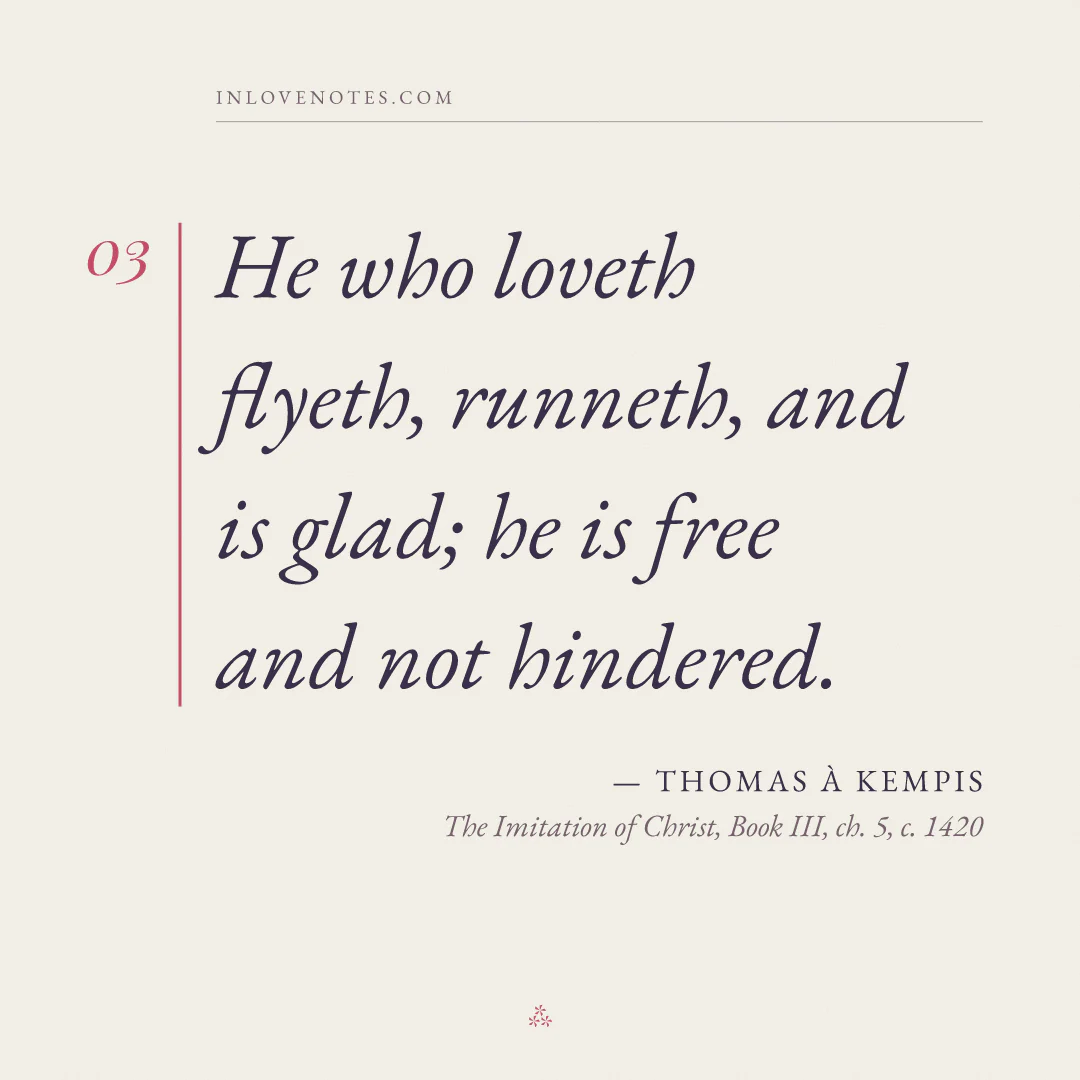
He who loveth flyeth, runneth, and is glad; he is free and not hindered.
Thomas à Kempis, The Imitation of Christ, Book III, ch. 5
The wording is from the English edition on Project Gutenberg; other translations differ ("He that loveth, flieth, runneth, and rejoiceth"), so if you quote it, say which edition. Do not date it to an exact year: the book circulated in manuscript from about the 1420s.
What does "looking outward together" really say?
Saint-Exupéry's line comes from Terre des hommes (1939), published in English the same year as Wind, Sand and Stars in Lewis Galantière's translation. Secondary sources place it in the chapter on the Spanish war. The French is "aimer, ce n'est point nous regarder l'un l'autre, mais regarder ensemble dans la même direction", and the English that circulates most is a loose rendering.
Life has taught us that love does not consist in gazing at each other, but in looking outward together in the same direction.
Antoine de Saint-Exupéry, Wind, Sand and Stars (1939), Galantière translation, as cited by secondary sources
Two corrections to what this page said before. The book is not Airman's Odyssey, which is the 1940 US omnibus that later included it, and the line is not about Sahara mail flights. I could not open a scan of the page myself, so treat the chapter reference as secondhand and check the print edition before quoting it with a page number.
Which line fits which note?
| You want to say… | Use | Why it works |
|---|---|---|
| I would not trade you for anything | Tennyson, "Love is the only gold" | It was said in refusing a bribe |
| You look happy lately | Alcott, "love is a great beautifier" | Warm, gently teasing, about a change in a face |
| Stay with me through the hard part | Thoreau, "no remedy but to love more" | A private note, so it suits a private letter |
| I know your flaws and I am here | Hugo, "loved in spite of one's self" | The unabridged line names the flaws |
| Loving you makes life lighter | À Kempis, "flyeth, runneth, and is glad" | Movement and gladness, with no sentimentality |
| Let's plan the next ten years | Saint-Exupéry, "looking outward together" | About a shared direction, not just a feeling |
For shorter lines to copy by hand, see the short love quotes for quiet moments; for how to put a quotation into a real letter, how to write a love letter.
Six lines this page no longer prints
An earlier version of this page gave exact books and years for the lines below. I checked the English text of the sources where they are free to read, or searched for the line, and could not confirm the attribution. They may be real somewhere; they are not confirmed.
| Line | Was credited to | What the check found |
|---|---|---|
| "A loving heart is the truest wisdom." | Dickens, David Copperfield, 1850 | No match in the full Gutenberg text of the novel |
| "To love is to act." | Hugo, Les Misérables | No match in the Gutenberg text of the novel |
| "Life is the flower for which love is the honey." | Hugo, The King Amuses Himself, 1832 | No match in Les Misérables; I did not check the play, so the credit is unconfirmed |
| "Where there is love there is life." | Gandhi, Young India, 1925 | No primary source found |
| "The inner reality of love can be recognized only by love." | Tillich, The Dynamics of Faith | No primary source found |
| "We are shaped and fashioned by what we love." | Goethe, Elective Affinities | No primary source found; widely shared without a citation |
The same habit of attaching a famous name to a good sentence is covered in misattributed love quotes.
Questions readers ask
Are these quotes good for a wedding or anniversary card?
Yes, with care. Hugo and Saint-Exupéry suit a marriage best; Tennyson works for a card to a partner or a child, because it was said by one. Credit the author and the work, as above, so the line is not mistaken for your own.
Why are some of the wordings different from other sites?
Most of these were written in another language or an older English, and every translation phrases them differently. The wordings here are from the cited edition; if yours differs, name your edition.
What if I only remember the short version of a quote?
Look it up in the book. The short form is usually a later paraphrase, as with Hugo's "supreme happiness" line, and the full sentence is usually the better one.