Thanksgiving Love Quotes: 10 Lines of Thanks for the One You Love, Checked at the Source
Ten Thanksgiving love quotes for him or her, from Bradstreet, Austen, Gibran and Ruth 2:10, each checked at the source, with where to use it and who to.
When the psychologists Sara Algoe, Shelly Gable and Natalya Maisel followed more than 65 couples through their ordinary days, the partner who felt grateful on a given day reported a closer, more satisfying relationship, and the lift was still there the next day. A thank-you, in other words, is not a polite extra. This page gathers ten Thanksgiving love quotes that say thank you to a husband, wife, boyfriend or girlfriend, each checked against the book, poem or Bible text it comes from, with who wrote it, to whom, and where it fits: a card by the plate, a short toast, a text on the drive home. After the ten lines you'll find a table for choosing one, a way to turn any of them into your own thanks, and four gratitude quotes that circulate every November under the wrong name. More checked lines live in the love quotes collection.
For him: husband, boyfriend, the man who carried the year
The oldest thank-you in this set was written in New England, which is about as close to the first Thanksgiving as a love poem gets. Anne Bradstreet crossed from England on the Arbella in 1630 with her husband Simon and in 1650 became the first English settler in North America to have a book of poems published.
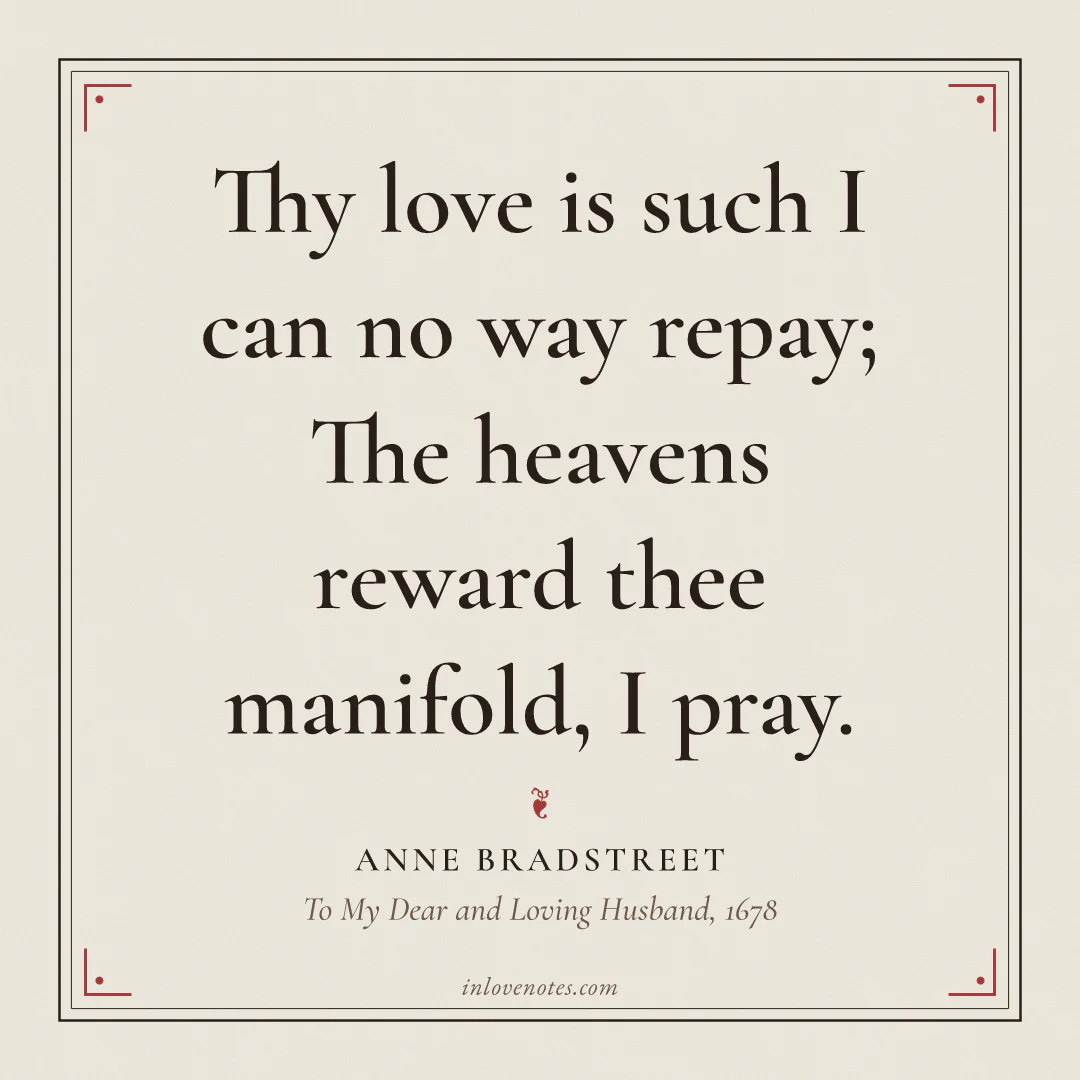
"Thy love is such I can no way repay;
The heavens reward thee manifold, I pray."— Anne Bradstreet, "To My Dear and Loving Husband", Several Poems (Boston, 1678)
Most people know the poem's first line, "If ever two were one, then surely we." These two lines come near the end, and they are the grateful part: she admits she cannot pay back what she has been given, so she asks heaven to do it for her. The poem was printed six years after her death, so Simon read it in a book, not a letter. It works best for a husband or a long-term partner, written in a card where the old "thy" and "thee" look deliberate rather than odd. If you want more lines in this voice, our page of love quotes for a husband written by real wives has the rest of Bradstreet's poem in context.
Elizabeth Barrett wrote her thank-you to a living reader. The sonnets she later called Sonnets from the Portuguese were written while Robert Browning was courting her in 1845 and 1846, and number 41 thanks him for truly listening to her poetry when others only paused and passed by.
"I thank all who have loved me in their hearts,
With thanks and love from mine. …
Instruct me how to thank thee!"— Elizabeth Barrett Browning, Sonnet 41, Sonnets from the Portuguese (in Poems, 1850)
The sonnet starts by thanking everyone who stopped near "the prison-wall" to hear her music, then turns to the one man who did more than stop. "Instruct me how to thank thee!" is the turn, and it is the most usable half-line here: five words that admit gratitude is hard to say well. For a boyfriend who doesn't care for poetry, write that half-line alone and then say, in plain words, the one thing he did this year that you are thanking him for.
The third line for him comes from a man speaking to a man. In Twelfth Night, Antonio has followed Sebastian into a hostile town out of love, at real risk to himself, and Sebastian has nothing to give back.
"I can no other answer make but thanks,
And thanks, and ever thanks."— Sebastian to Antonio, William Shakespeare, Twelfth Night, Act 3, Scene 3 (first printed 1623)
Sebastian goes on to say that kindness is often "shuffled off with such uncurrent pay", that is, repaid in coin that's no good. Read on its own, the first two lines are a warm, slightly helpless thank-you that suits anyone who gave more than they had to this year, and its repetition makes it easy to say aloud as a toast.
For her: wife, girlfriend, the person who kept everything together
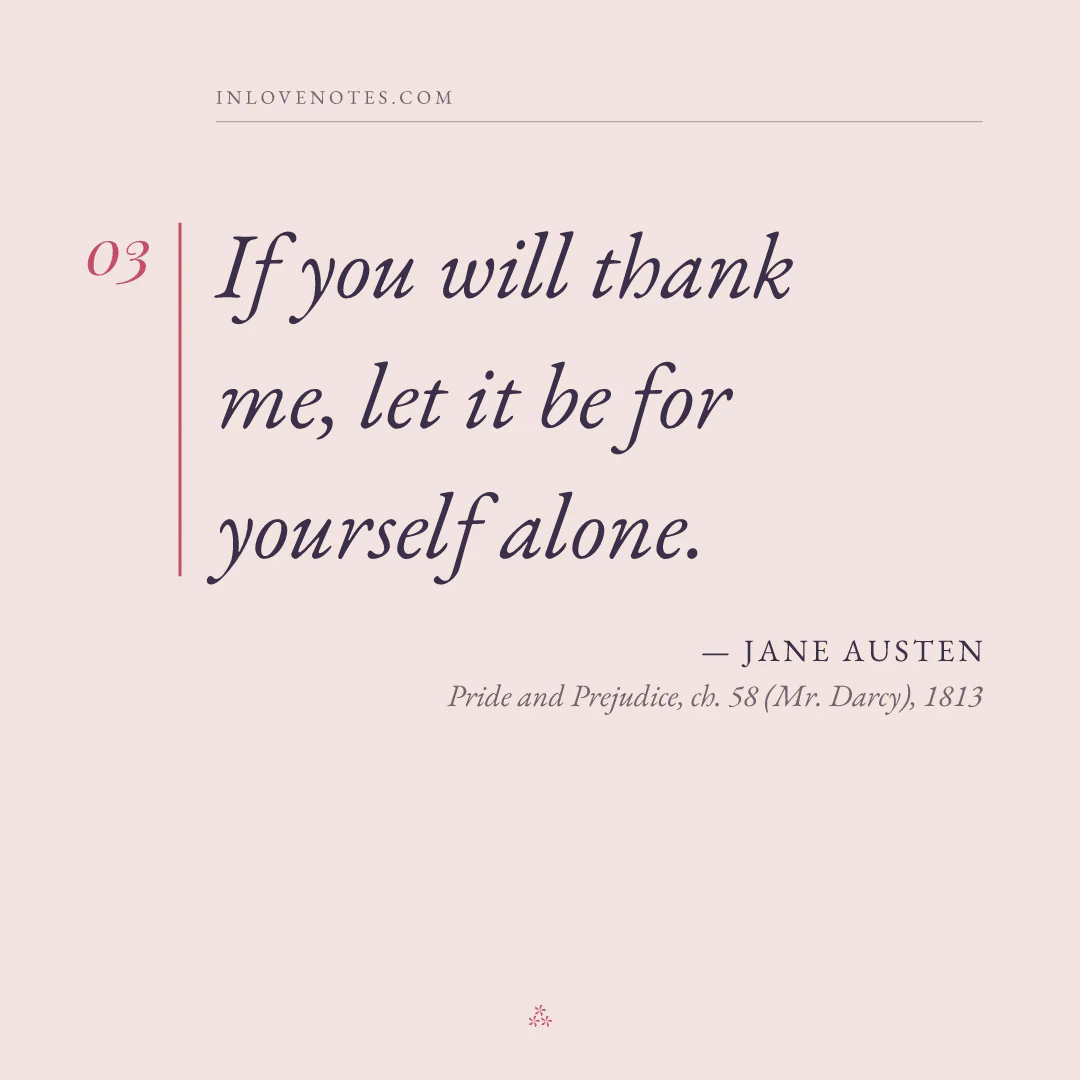
The best thank-you scene in English fiction may be the one where the thanks gets turned down. In chapter 58 of Pride and Prejudice, Elizabeth Bennet finally thanks Mr. Darcy for quietly paying to rescue her sister Lydia from disgrace. His answer:
"If you will thank me, let it be for yourself alone. That the wish of giving happiness to you might add force to the other inducements which led me on, I shall not attempt to deny. But your family owe me nothing."
— Mr. Darcy to Elizabeth Bennet, Jane Austen, Pride and Prejudice, ch. 58 (1813)
The italics are Austen's. Darcy refuses the debt and keeps the love: she owes him nothing, and he did it for her. A few lines later he asks whether her feelings have changed, and the novel resolves. The first sentence alone, eleven words, is the strongest Thanksgiving line on this page to give a wife or girlfriend, because it turns the usual thank-you around: you are telling her that what she gave you was a gift, not a favour you now owe back. The rest of the novel's love lines are traced chapter by chapter in our Pride and Prejudice love quotes.
Shakespeare's Sonnet 30 does the opposite kind of counting. For twelve lines the speaker tallies old losses like unpaid bills, "the sad account of fore-bemoaned moan", and then the couplet clears the whole account at once.
"But if the while I think on thee, dear friend,
All losses are restor'd and sorrows end."— William Shakespeare, Sonnet 30, Shake-speares Sonnets (1609)
Readers usually place Sonnet 30 among the poems addressed to a young man, and "dear friend" was ordinary Elizabethan language for a beloved, so the couplet works for anyone. It is right for a hard year: a partner who stayed through a loss, an illness or a lean stretch. On a card, swap nothing; the old spelling "restor'd" is part of its charm.
For the morning of the day itself
Kahlil Gibran's The Prophet is a book of short sermons, and in "On Love" the prophet Almustafa lists what a person in love should wish for. One wish is a whole day built around gratitude.
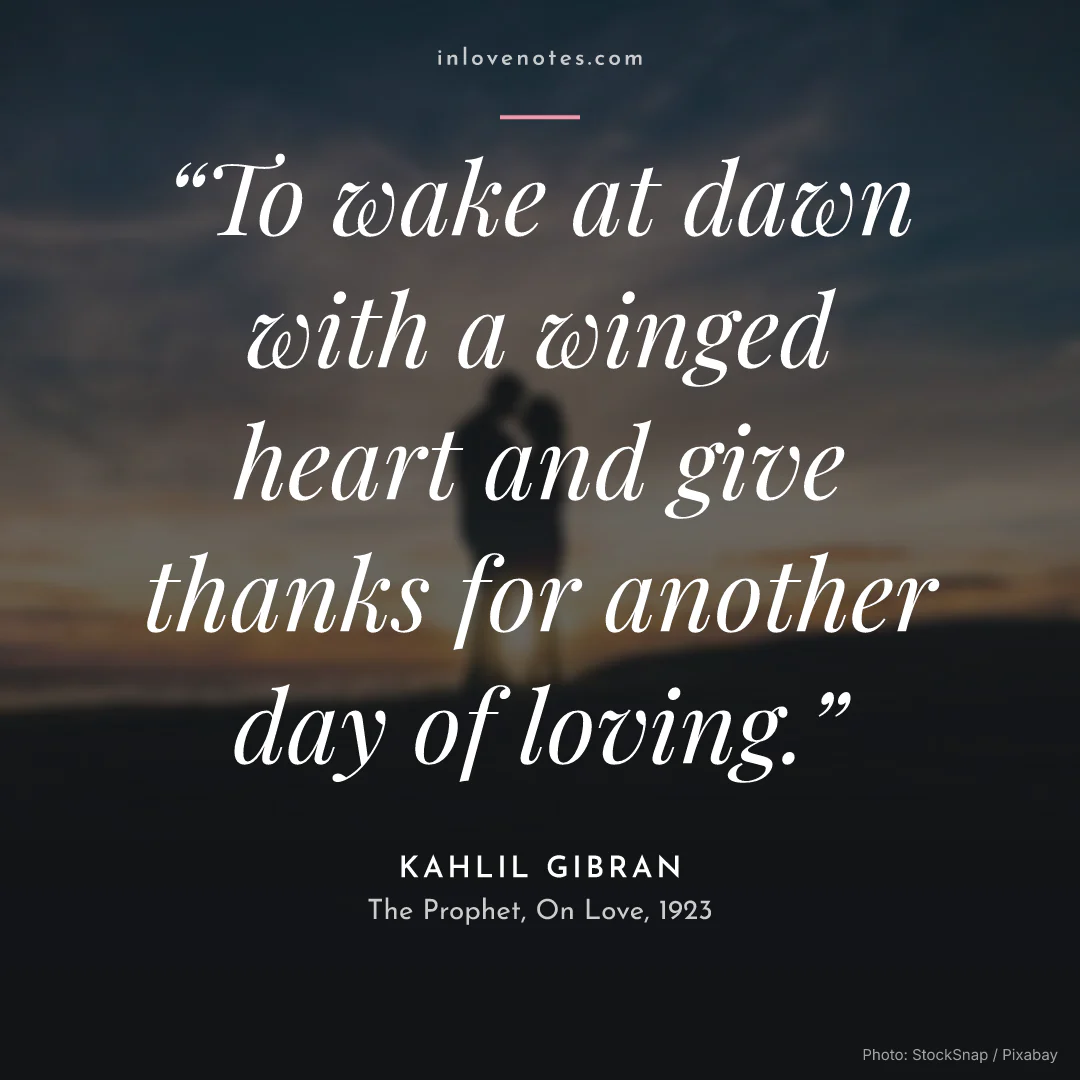
"To wake at dawn with a winged heart and give thanks for another day of loving;
To rest at the noon hour and meditate love's ecstacy;
To return home at eventide with gratitude."— Kahlil Gibran, "On Love", The Prophet (New York: Alfred A. Knopf, 1923)
"Ecstacy" is the spelling in the 1923 first edition, and most websites quietly correct it. The first clause is the part people use, and it is a natural first text on Thanksgiving morning, sent before the kitchen gets busy. The passage then moves through the day to evening, which makes all three lines a good fit for the end of a long-distance call or a note left on the pillow.
Thornton Wilder's line is the one everyone quotes in November and almost everyone misquotes. It comes from his short novel The Woman of Andros, where the courtesan Chrysis tells her dinner guests a story about a hero allowed to return from the dead for one day.
"… we can only be said to be alive in those moments when our hearts are conscious of our treasure."
— Chrysis, Thornton Wilder, The Woman of Andros (1930), as quoted by the Thornton Wilder Society
The original says "treasure", singular, and the sentence begins earlier, with what the hero comes to understand about the living. Most quotation sites print "treasures" and credit it to Our Town, the 1938 play that reuses the same idea in Emily's return to her twelfth birthday. Used at a table, the line says what a toast should: notice the person next to you while you still have the day.
For a grace said at the table
Many couples say grace at Thanksgiving, and two short verses give thanks for a person rather than for the food. The first is set at a harvest. Ruth, a widow and a foreigner, is gleaning leftover barley in Boaz's field when he tells his workers to protect her and let her drink from their water. She asks him why.
"Then she fell on her face, and bowed herself to the ground, and said unto him, Why have I found grace in thine eyes, that thou shouldest take knowledge of me, seeing I am a stranger?"
— Ruth 2:10, King James Version (1611)
Boaz and Ruth marry two chapters later (Ruth 4:13), so this is the start of a love story told in a harvest field. Her question is the whole of gratitude in love: astonishment at being noticed. Read aloud, the second half alone ("Why have I found grace in thine eyes?") works as a quiet line for a newly married couple's first Thanksgiving.
"I thank my God upon every remembrance of you."
— Philippians 1:3, King James Version (1611)
Paul wrote this to the church at Philippi, not to a spouse, so it is friendship and fellowship in its first setting. It has become one of the most used verses on anniversary and Thanksgiving cards because it fits in nine words and says exactly what a thank-you note should: you come to mind, and each time that brings thanks. Say where it comes from if you use it in a toast; it's honest, and the setting is part of its warmth.
Gratitude, not debt: what the research adds
The 2010 study behind the opening of this page, published in Personal Relationships as "It's the little things: Everyday gratitude as a booster shot for romantic relationships", separated two feelings that look alike. On days when partners felt grateful, both they and their relationship did better, into the next day. On days when they felt indebted, owing something back, it did not help the relationship. Algoe put it plainly in the press release: "Gratitude triggers a cascade of responses within the person who feels it in that very moment." In later work she described gratitude's job in close relationships as "find, remind, and bind": it helps us find a good partner, reminds us of one we already have, and binds us closer.
That is Darcy's point in chapter 58, made two centuries earlier: don't make her feel she owes you. The Roman orator Cicero made a related claim in his defence speech for Gnaeus Plancius, a friend who had protected him in exile.
"haec enim est una virtus non solum maxima sed etiam mater virtutum omnium reliquarum."
"For this one virtue is not only the greatest but also the mother of all the other virtues."— Cicero, Pro Plancio 80 (54 BC), on gratitude; our translation
The popular version, "Gratitude is not only the greatest of virtues, but the parent of all the others", is a fair paraphrase of this sentence; Cicero names gratitude a few words earlier ("me et esse gratum et videri", to be grateful and to be seen to be). It is a speech in a courtroom, not a love letter, so keep it for a toast that thanks everyone at the table, partner included.
Which line, for whom, and where
Word counts are for the part you would actually copy, which is what decides whether a line fits a place card, a text or a toast.
| Line | Who wrote it, to whom | Words | Best for |
|---|---|---|---|
| "Thy love is such I can no way repay" | Anne Bradstreet to her husband Simon. | 16 | Husband, long marriage; a card |
| "Instruct me how to thank thee!" | Elizabeth Barrett to Robert Browning, Sonnet 41 | 5 | Boyfriend or husband; a text, then your own words |
| "And thanks, and ever thanks" | Shakespeare: Sebastian to Antonio, Twelfth Night | 13 | Anyone who went out of their way; a spoken toast |
| "If you will thank me, let it be for yourself alone" | Austen: Darcy to Elizabeth, ch. 58 | 11 | Wife or girlfriend; a card or a place card |
| "All losses are restor'd and sorrows end" | Shakespeare, Sonnet 30, to a "dear friend" | 17 | A partner after a hard year; a card |
| "To wake at dawn with a winged heart" | Gibran, The Prophet, "On Love" | 16 | Morning text; long-distance couples |
| "Conscious of our treasure" | Wilder, The Woman of Andros, spoken by Chrysis | 19 | A toast at the table |
| "Why have I found grace in thine eyes" | Ruth to Boaz, Ruth 2:10 | 20 | Grace before the meal; newlyweds |
| "Upon every remembrance of you" | Paul to the Philippians, 1:3 | 9 | Card, grace, or a short caption |
| "The mother of all the other virtues" | Cicero, Pro Plancio 80 | 17 | A toast to the whole table |
Turning a quote into your own thank-you
A quote on its own sounds like a card from a shop. What makes it yours is the sentence you write next. Algoe's research points to what that sentence should contain: the specific thing your partner did, and what it shows about them, rather than how it helped you. Three steps:
- Pick one act from this year, not a general virtue. "You drove four hours every other weekend" beats "you're always there for me".
- Say what it cost them. Time, sleep, money, patience: naming the effort is what tells them you noticed.
- Say what it shows about who they are, then put the quote after it, not before, so the old line confirms your words instead of replacing them.
Short Thanksgiving love lines written by our editors, to adapt (the brackets are for your details):
- Of everything on this table, [name], you're the thing I'm most thankful for.
- Thank you for [one specific thing]. It cost you more than you let on, and it didn't go unnoticed.
- Grateful for the year, and for the person who made it bearable.
- You never asked to be thanked. Here it is anyway.
- Two places at the table, one very full heart.
For placing a line on the card itself (where to put the attribution, how long is too long), see our guide to love quotes for cards. If you are writing to a wife, the lines in love quotes for my wife come with the husbands' stories behind them.
Four gratitude quotes with the wrong name on them
These turn up on Thanksgiving cards and posts every year. None of them is a bad sentiment, but the name attached is shaky, so if you use one, use the honest credit.
- "If the only prayer you ever say in your entire life is thank you, it will be enough." Credited everywhere to Meister Eckhart, the 14th-century German mystic. Wikiquote lists it as disputed and traces the first wording to A Bucket of Surprises (2002) by J. John and Mark Stibbe. Eckhart did write something close in a sermon: "If a man had no more to do with God than to be thankful, that would suffice." Use that sentence with Eckhart's name, or the popular one with no name.
- "Feeling gratitude and not expressing it is like wrapping a present and not giving it." Credited to William Arthur Ward, an American writer of short sayings whose epigrams ran in Reader's Digest. It sounds like his style, but no book, column or date has been found for it. Write "attributed to William Arthur Ward".
- "Let us be grateful to the people who make us happy; they are the charming gardeners who make our souls blossom." Credited to Marcel Proust. The sites that print it name no book or letter, and we could not trace a French original. Treat it as "commonly attributed to Proust (no primary source found)".
- "We can only be said to be alive in those moments when our hearts are conscious of our treasures." This one is real but bent: it is Thornton Wilder, from The Woman of Andros (1930), not Our Town, and the word is "treasure". See above.
Our longer file of misattributed love quotes traces sixteen more, from "Roy Croft" to Winnie-the-Pooh.
Quick answers
What is a short Thanksgiving love quote?
The shortest verified ones here are Elizabeth Barrett Browning's "Instruct me how to thank thee!" (Sonnet 41, five words), Philippians 1:3 "I thank my God upon every remembrance of you" (nine words) and Mr. Darcy's "If you will thank me, let it be for yourself alone" (Pride and Prejudice, ch. 58, eleven words).
What is a good Thanksgiving love quote for a boyfriend?
For a boyfriend, the five words from Sonnet 41, "Instruct me how to thank thee!", followed by one plain sentence about something he did this year, read as personal rather than poetic. Sebastian's "I can no other answer make but thanks, and thanks, and ever thanks" from Twelfth Night works as a spoken toast.
How do you express gratitude to your partner on Thanksgiving?
Name one specific thing they did, say what it cost them, and say what it shows about who they are; then add a quote if you want one. Research by Algoe, Gable and Maisel (2010) found that everyday gratitude between partners lifted relationship satisfaction into the next day, while feeling indebted did not.
Did Meister Eckhart say "If the only prayer you ever say is thank you, it will be enough"?
Not in those words. Wikiquote lists the line as disputed and traces it to a 2002 book by J. John and Mark Stibbe. The nearest Eckhart sentence is "If a man had no more to do with God than to be thankful, that would suffice", from one of his sermons.
Sources
- Sara B. Algoe, Shelly L. Gable and Natalya C. Maisel, "It's the little things: Everyday gratitude as a booster shot for romantic relationships", Personal Relationships 17 (2010), 217–233; Gable lab record; findings and Algoe quotation from the ScienceDaily release, 24 May 2010.
- Anne Bradstreet, "To My Dear and Loving Husband": text at the Poetry Foundation (from The Complete Works of Anne Bradstreet, 1981).
- Elizabeth Barrett Browning, Sonnets from the Portuguese, Sonnet 41: Project Gutenberg #2002.
- William Shakespeare, Twelfth Night 3.3: Project Gutenberg #1526; Sonnet 30: Project Gutenberg #1041.
- Jane Austen, Pride and Prejudice, chapter 58: Project Gutenberg #1342.
- Kahlil Gibran, The Prophet (Knopf, 1923), "On Love": Project Gutenberg #58585.
- Thornton Wilder, The Woman of Andros: Thornton Wilder Society, "Wilder Queries: Exploring Quotations #1" (wording, speaker, scene, and the Our Town confusion).
- Ruth 2:10, Ruth 4:13 and Philippians 1:3, King James Version: Project Gutenberg #10.
- Cicero, Pro Plancio 80, Latin text: The Latin Library; translation ours.
- Meister Eckhart, disputed quotations: Wikiquote.