1 Corinthians 13 Wedding Reading: Which Verses, Which Translation, and How to Read It Aloud
The 1 Corinthians 13 wedding reading in full: four cuts with timings, the verses in six translations, why the KJV says charity, and how to read it aloud.

The wedding reading from Corinthians is chapter 13 of Paul's first letter to the church at Corinth, and most couples read only part of it: verses 4 to 8a, the lines that begin "Love is patient and kind" and stop at "Love never ends." That cut runs to 58 words in the English Standard Version and takes under a minute to read aloud. Below you will find the four cuts that churches actually use, the full chapter set out as a reading copy, the same verses in six translations, and why the King James Version says "charity" where every modern Bible says "love." There is also practical advice for whoever has to stand up and read it. It belongs with our other Bible verses about love, and every verse here was checked against the published translation.
Four places to start and stop
Nobody is obliged to read the whole chapter, and the official lists don't all agree on where the reading begins. The Catholic Order of Celebrating Matrimony lists it as 1 Corinthians 12:31–13:8a. The "a" means the reading stops halfway through verse 8, after "Love never ends" and before the line about prophecies passing away. The Church of England's Common Worship marriage service prints the whole of chapter 13 among its suggested readings, and quotes verses 4 to 7 elsewhere in its marriage material. Here is what each choice gives you.
| Cut | Words (ESV) | Time at a slow pace | Who lists it | Last words the guests hear |
|---|---|---|---|---|
| 13:4–7 | 55 | about 35 seconds | Common Worship quotes these verses; many civil and mixed ceremonies | "endures all things" |
| 13:4–8a | 58 | about 35 seconds | The usual short cut for weddings | "Love never ends" |
| 12:31–13:8a | 152 | about 1.5 minutes | Catholic Order of Celebrating Matrimony (N-5 in the England and Wales lectionary, no. 802 in the US list) | "Love never ends" |
| 13:1–13 | 253 | about 2.5 minutes | Common Worship (Church of England) reading list | "the greatest of these is love" |
The times assume an unhurried 100 words a minute, the pace we use for planning ceremony readings, which is slower than normal speech. If you want the famous list and nothing else, take 4–8a. It ends on the strongest short sentence in the chapter. If you want the reading to make an argument, start at verse 1. The opening, which says that every gift is worth nothing without love, is what gives the list its weight. The Catholic cut begins one verse earlier still, at the bridge sentence "And I will show you a still more excellent way," so the listener hears that what follows is being set above something else.
The full chapter, as a reading copy
This is the English Standard Version text, a widely used modern translation. Verse numbers are left out so it can be printed and read straight through. Paragraph breaks fall where a reader would naturally pause.
If I speak in the tongues of men and of angels, but have not love, I am a noisy gong or a clanging cymbal. And if I have prophetic powers, and understand all mysteries and all knowledge, and if I have all faith, so as to remove mountains, but have not love, I am nothing. If I give away all I have, and if I deliver up my body to be burned, but have not love, I gain nothing.
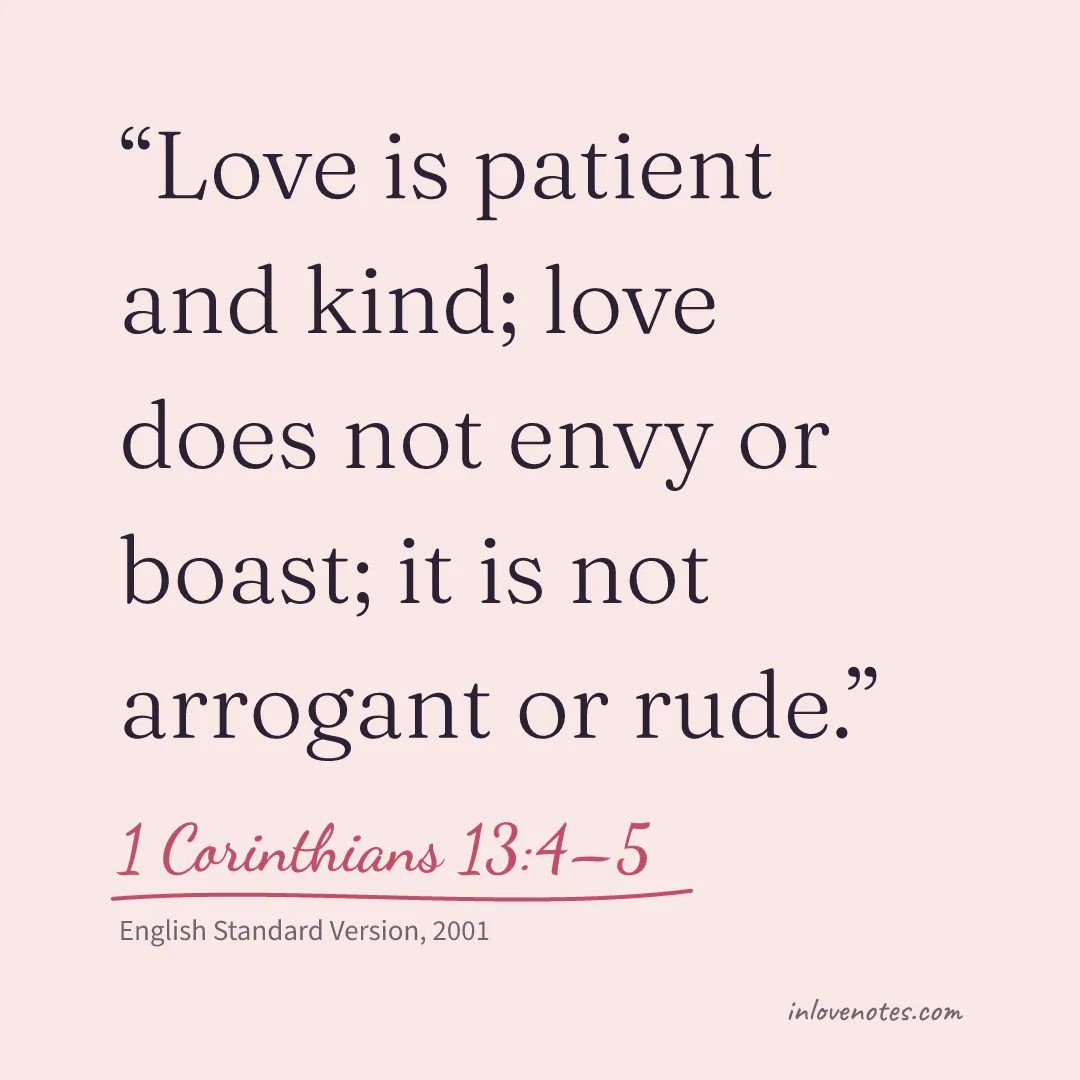
Love is patient and kind; love does not envy or boast; it is not arrogant or rude. It does not insist on its own way; it is not irritable or resentful; it does not rejoice at wrongdoing, but rejoices with the truth. Love bears all things, believes all things, hopes all things, endures all things.
Love never ends. As for prophecies, they will pass away; as for tongues, they will cease; as for knowledge, it will pass away. For we know in part and we prophesy in part, but when the perfect comes, the partial will pass away. When I was a child, I spoke like a child, I thought like a child, I reasoned like a child. When I became a man, I gave up childish ways. For now we see in a mirror dimly, but then face to face. Now I know in part; then I shall know fully, even as I have been fully known.
So now faith, hope, and love abide, these three; but the greatest of these is love.1 Corinthians 13:1–13, The Holy Bible, English Standard Version (2001)
Read it as three movements and the chapter makes sense on its own. The first paragraph says what life is worth without love: noise, nothing, no gain. The second is the list, fifteen short descriptions, most of them saying what love does not do. The third looks forward to a time when gifts like prophecy and knowledge stop, and love is still there. A reading that keeps all three shows the couple a promise with a reason behind it. A reading that keeps only the middle gives them a checklist. Both are honest uses of the text. They are simply different readings.
Written for a quarrelling church, not a couple
Paul was not thinking about weddings. He wrote this letter from Ephesus (he says so in 16:8), usually dated to the mid-50s AD, to a congregation he had founded and which was now falling apart. The trouble is named in the first chapter:
For it has been reported to me by Chloe's people that there is quarreling among you, my brothers. What I mean is that each one of you says, 'I follow Paul,' or 'I follow Apollos,' or 'I follow Cephas,' or 'I follow Christ.'
1 Corinthians 1:11–12, The Holy Bible, English Standard Version (2001)
By chapter 12 the argument has moved on to spiritual gifts: who speaks in tongues, who prophesies, whose gift counts for more. Chapter 14 goes back to the same subject and the rules for orderly worship. Chapter 13 sits between them as a rebuke. Every gift the Corinthians were competing over is named in its first three verses and declared worthless without love. The list in verses 4 to 7 describes how to behave toward people who annoy you, in a room full of rivals.
Some ministers raise this with couples, and a few gently steer them toward another passage, on the grounds that the chapter is about a church and not a marriage. The other view is that this is exactly why it fits. The marriage it describes is the one that exists after the wedding, when the other person is tired, wrong or irritating. "It is not irritable or resentful" is easy to promise at an altar and hard on an ordinary Tuesday. If you choose the reading, a single sentence in the order of service saying where it comes from costs nothing and makes it land harder. Our page of Bible verses about love and marriage covers other wedding favorites that were written about something else, Ruth 1:16 among them.
Love or charity? Five centuries of one word
Paul's Greek word is agapē. When Jerome's Latin Vulgate became the Bible of the Western church, it rendered the word here as caritas ("Caritas patiens est, benigna est"). English translators then had to choose between following the Latin and following the Greek. The table gives each version's own spelling of verse 4.
| Translation | Year | Word chosen | Verse 4 as printed |
|---|---|---|---|
| Latin Vulgate (Jerome) | late 4th century | caritas | "Caritas patiens est, benigna est" |
| William Tyndale, New Testament | 1526 | love | "Love suffreth longe and is corteous" |
| Coverdale Bible | 1535 | love | "Loue is pacient & curteous" |
| Bishops' Bible | 1568 | love | "Loue suffreth long, and is curteous" |
| Geneva Bible (1587 printing) | 1587 | love | "Loue suffreth long: it is bountifull" |
| Douay-Rheims (Catholic; later revised text) | NT 1582 | charity | "Charity is patient, is kind" |
| King James Version | 1611 | charity | "Charity suffereth long, and is kind" |
| Revised Version | 1881 | love | "Love suffereth long, and is kind" |
Tyndale's choice was controversial. Thomas More attacked his New Testament in the Dialogue Concerning Heresies (1529), and "love" for "charity" was one of the words he objected to, along with "congregation" for "church" and "senior" for "priest." Coverdale, the Bishops' Bible and the Geneva Bible all kept Tyndale's word, but the King James translators of 1611 went back to "charity," as the Catholic Rheims New Testament had done. The chapter was read that way in English churches for almost three centuries, until the Revised Version restored "love" in 1881. Tyndale's verse 13 already reads almost the way modern couples hear it:
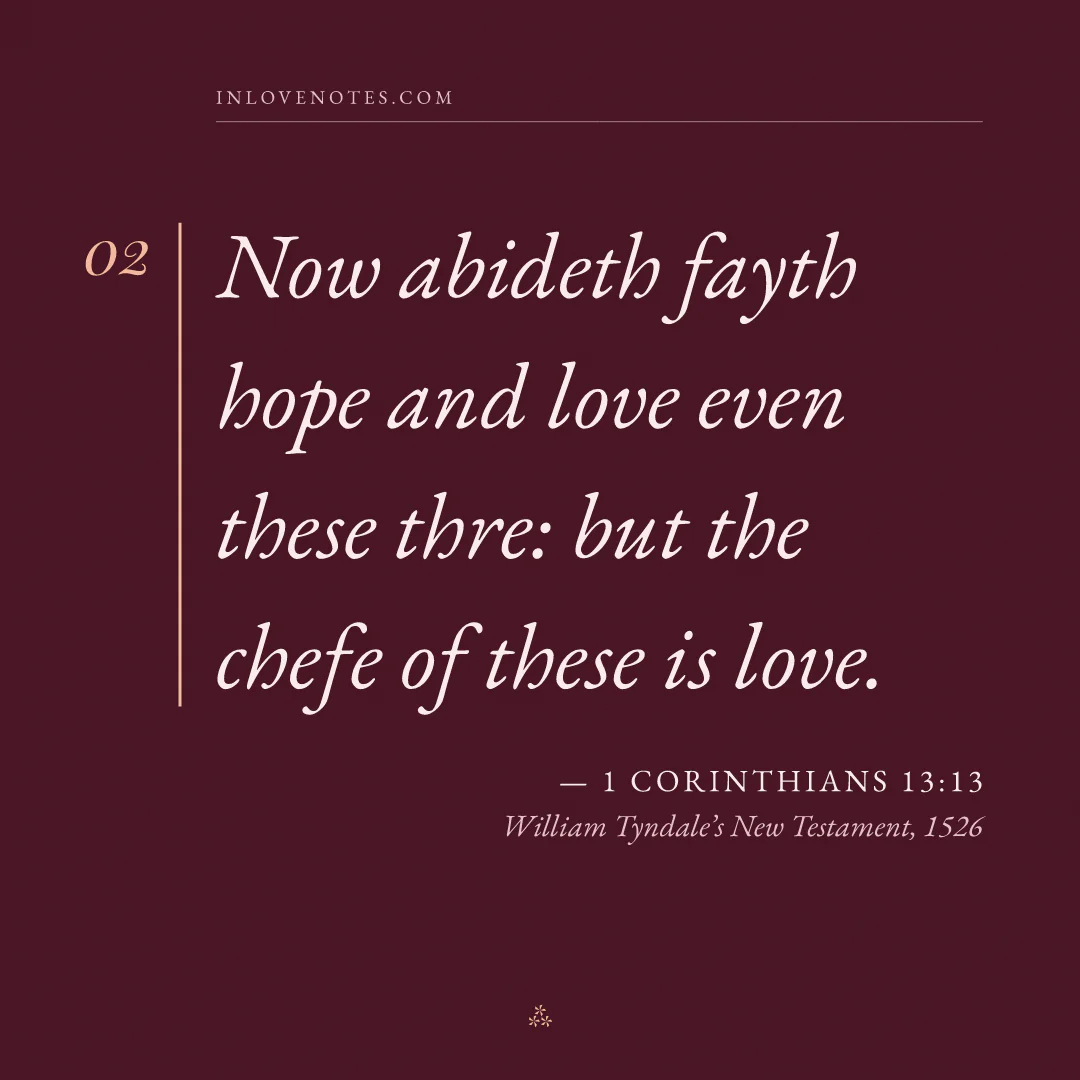
Now abideth fayth hope and love even these thre: but the chefe of these is love.
1 Corinthians 13:13, William Tyndale's New Testament (1526)
This history matters at a wedding for one practical reason. "Charity" has narrowed since 1611 and now usually means giving to the poor. If you read the KJV, many guests will hear "the greatest of these is charity" as a line about donations. Couples who love the KJV's rhythm usually keep it and swap that one word, or print a note in the program. Either is fine, but say which you did, so nobody thinks the text has been misquoted.
Which translation to read: one verse, six versions
Most churches will tell you which Bible they read from, and at a Catholic Mass the lectionary text is used. In a civil or mixed ceremony the choice is yours. These are verses 4 and 5 as each translation prints them.
| Version | Verses 4–5 | What stands out |
|---|---|---|
| KJV (1611) | "Charity suffereth long, and is kind; charity envieth not; charity vaunteth not itself, is not puffed up, doth not behave itself unseemly, seeketh not her own, is not easily provoked, thinketh no evil" | Beautiful rhythm; "charity" and "vaunteth" need explaining |
| ESV (2001) | "Love is patient and kind; love does not envy or boast; it is not arrogant or rude. It does not insist on its own way; it is not irritable or resentful" | Close to the Greek, easy to read aloud |
| NIV (2011) | "Love is patient, love is kind. It does not envy, it does not boast, it is not proud. It does not dishonor others, it is not self-seeking, it is not easily angered, it keeps no record of wrongs." | "Love is patient, love is kind" is the phrasing most guests know |
| NRSVUE (2021) | "Love is patient; love is kind; love is not envious or boastful or arrogant or rude. It does not insist on its own way; it is not irritable; it keeps no record of wrongs" | Common in mainline Protestant churches; Common Worship prints the NRSV |
| NABRE (2011) | Includes "it does not brood over injury" | The US Catholic bishops' translation; check with the parish |
| The Message (1993) | "Love never gives up. Love cares more for others than for self. Love doesn't want what it doesn't have." | A paraphrase, not a translation; warm, but say so in the program |
Two translation details are worth knowing before you choose. The first is in verse 5. The ESV's "is not irritable or resentful" has a footnote giving the Greek more literally as "does not count up wrongdoing," which is where the NIV and NRSVUE get "keeps no record of wrongs." Those four words are often the line couples remember. The second is in verse 3. Some ancient manuscripts say "deliver up my body to be burned" and others say "hand over my body so that I may boast." The two Greek verbs look almost the same. The ESV prints "burned" and footnotes "boast"; the NRSVUE does the opposite. Neither reading is a mistake, and neither changes what the chapter means.
Reading it aloud on the day
The person reading usually gets the text a week before and reads it out for the first time at the ceremony. A few things make a large difference:
- Print it in large type on a single card or sheet, in the exact translation the program names. Don't read it from a phone.
- Give the reference first. In a church service the minister will tell you the formula. Catholic readings begin "A reading from the first Letter of Saint Paul to the Corinthians" and end "The word of the Lord." In a civil ceremony a plain "A reading from Paul's first letter to the Corinthians, chapter 13" is enough.
- Pause after each "but have not love" in verses 1 to 3. The repetition is the whole point, and it only works if the listeners can hear it coming.
- Slow down for the list. Verses 4 to 7 are fifteen short clauses. Read too fast, they blur into one. Take a breath after "rude" and after "resentful."
- Give the last line its own beat. "So now faith, hope, and love abide, these three; but the greatest of these is love." Stop before "but," then look up.
- Rehearse once out loud, standing up, with a timer. Nerves make almost everyone read faster than they think.
For a ceremony where many guests are not churchgoers, a one-line introduction helps. Here is an example our editors wrote, which you are free to adapt: "This reading was written nearly two thousand years ago to a community that couldn't stop arguing. [Name] and [Name] chose it because it describes the kind of love that lasts after today." Keep it to one or two sentences. The text does the rest.
Pairing it with a second reading
Many ceremonies have two readings. If 1 Corinthians 13 is one, the other works best when it says something the first doesn't. These pairings all come from the Church of England's suggested list for weddings:
- Song of Solomon 8:6–7 ("Set me as a seal upon your heart"): desire and permanence, where Corinthians is about patience.
- Colossians 3:12–17: practical virtues ("compassionate hearts, kindness, humility") that end with love binding them together, a close cousin of Corinthians but in instructions instead of a portrait.
- 1 John 4:7–12: the source of love, where Corinthians describes its behavior. The two together make a complete small sermon.
- John 15:9–17 ("Greater love has no one than this"): a Gospel reading, if the service needs one.
- Genesis 1:26–28: the creation of humankind, male and female, for couples who want to begin at the beginning.
Ruth 1:16–17 ("where you go I will go") is a popular choice too, though it is not on the Common Worship list. It is a promise between a widow and her mother-in-law, which makes it lovely for a family member to read. If you also want a reading that isn't from the Bible, our guide to traditional wedding vows shows where the familiar vow words come from. The Browning sonnet and other readings that check out are on our page of misattributed love quotes.
At a funeral: why verse 12 changes the room
The same chapter is read at funerals, and the most famous funeral reading of it was a public one. On 6 September 1997, at the funeral of Diana, Princess of Wales, in Westminster Abbey, the Prime Minister, Tony Blair, read 1 Corinthians 13. The order of service released beforehand named the passage and the reader, and the BBC recording of the service lists it. At a funeral the weight shifts away from the list in verses 4 to 7 and onto the end of the chapter:
For now we see through a glass, darkly; but then face to face: now I know in part; but then shall I know even as also I am known.
1 Corinthians 13:12, King James Version (1611)
"Through a glass, darkly" is the KJV's phrase for looking into an ancient mirror of polished metal, which gave a dim, imperfect image; the ESV says "in a mirror dimly." At a wedding the verse is about how little two people know of each other at the start. At a funeral it is about the hope of seeing someone again. If you are choosing for a funeral, read from verse 8 to verse 13, or the whole chapter. Ending on 4–8a leaves out the part that speaks to grief.

Questions couples ask about the Corinthians reading
What is the wedding reading from Corinthians?
It is 1 Corinthians 13, Paul's passage on love. Most weddings use verses 4 to 8a, from "Love is patient and kind" to "Love never ends." The Catholic Order of Celebrating Matrimony lists it as 1 Corinthians 12:31–13:8a, and the Church of England suggests the whole chapter.
Is 1 Corinthians 13 about marriage?
Not originally. Paul wrote it to a divided church in Corinth that was competing over spiritual gifts, and chapters 12 and 14 around it are about worship. Its description of patient, unselfish love is why churches have long used it for weddings, but a note in the program saying where it comes from is a good idea.
Why does the King James Version say "charity" instead of "love"?
The 1611 translators followed the Latin Vulgate's caritas rather than Tyndale's 1526 "love." At the time "charity" meant Christian love in general. The Revised Version of 1881 went back to "love," and almost every modern translation uses it.
How long does the reading take?
Verses 4 to 8a are 58 words in the ESV, about 35 seconds at an unhurried pace. The full chapter is 253 words, about two and a half minutes.
Sources
- 1 Corinthians 12:31–13:13 and 1:11–12, ESV and KJV texts, and 13:4–8 in NIV, NRSVUE, NABRE, The Message and the Vulgate: read at BibleGateway on 30 October 2026, including the ESV footnotes on verses 3 and 5 and the NRSVUE footnote on verse 3. Word counts are ours, made from the ESV and KJV texts.
- Tyndale (1526), Coverdale (1535), Bishops' (1568), Geneva (1587), Douay-Rheims and Revised Version readings of verses 4 and 13: Bible Hub parallel texts.
- Church of England, Common Worship: Marriage: the rubric "At least one reading from the Bible is used," the suggested readings, and 1 Corinthians 13 in the NRSV.
- Liturgy Office of England and Wales, Order of Celebrating Matrimony lectionary (N-5, 1 Corinthians 12:31–13:8a), and the US lectionary list at catholic-resources.org (no. 802).
- Funeral of Diana, Princess of Wales, 6 September 1997: Anglican Communion News Service, Westminster Abbey funeral details.
- Scripture quotations marked ESV are from the ESV® Bible (The Holy Bible, English Standard Version®), © 2001 by Crossway, a publishing ministry of Good News Publishers. NIV: Holy Bible, New International Version®, NIV® Copyright © 1973, 1978, 1984, 2011 by Biblica, Inc.® Used by permission. NRSVUE: New Revised Standard Version, Updated Edition, Copyright © 2021 National Council of Churches of Christ in the United States of America. Used by permission. The Message: Copyright © 1993, 2002, 2018 by Eugene H. Peterson. NABRE phrase: New American Bible, revised edition © 2010, 1991, 1986, 1970 Confraternity of Christian Doctrine, Inc. KJV, Tyndale and the other early English Bibles are in the public domain.