Emotional Relationship Quotes
12 Short Heart Touching Love Quotes for Her, From Poems and Letters
Short, heart touching love quotes for her from Keats, Yeats, Austen, Byron and Tagore, each with its real source, the story behind it and the moment it suits.
Updated
How short can a love line be and still land? Yeats needed eight words to end one of the best-known love poems in English, and Robert Browning needed ten to open another. The twelve lines below are all short enough to fit on a sticky note, a phone screen or the inside flap of a card. Every one of them was checked against the poem, play, novel or letter it comes from. Under each line you'll find who wrote it, what was happening at the time, and the kind of moment it suits. Further down there is a table for matching a line to the occasion, a few example notes, and three popular "heart touching" quotes you should stop sending because nobody can find where they came from.
Lines for telling her she is beautiful
Compliments are the hardest thing to write without sounding like a greeting card. The three lines here earn their praise by being specific: a party, a balcony, a word that doesn't exist yet.
She walks in beauty, like the night / Of cloudless climes and starry skies
Lord Byron, She Walks in Beauty, 1815
Byron wrote this the morning after a London party on 11 June 1814, where he had been struck by Anne Beatrix Wilmot, the wife of his cousin Sir Robert Wilmot. It was printed in Hebrew Melodies (John Murray, 1815). The poem doesn't praise brightness. It praises a mix of dark and light, so it suits an evening rather than a sunny day: a note left before a dinner out, or a caption under a photo taken at night. Quote the first two lines only. The rest of the poem moves on to her "thoughts serenely sweet", which needs more room than a card gives.
It is the east, and Juliet is the sun!
William Shakespeare, Romeo and Juliet, Act II, scene 2 (first printed 1597)
Romeo says this in the orchard below Juliet's window, hours after meeting her and before she knows he is listening. Few lines are more famous. Swap in her name and the line stops being a quotation and becomes a joke she'll recognise, which is often the point. It works best for a morning message ("It is the east, and [name] is the sun") and worst in anything solemn.
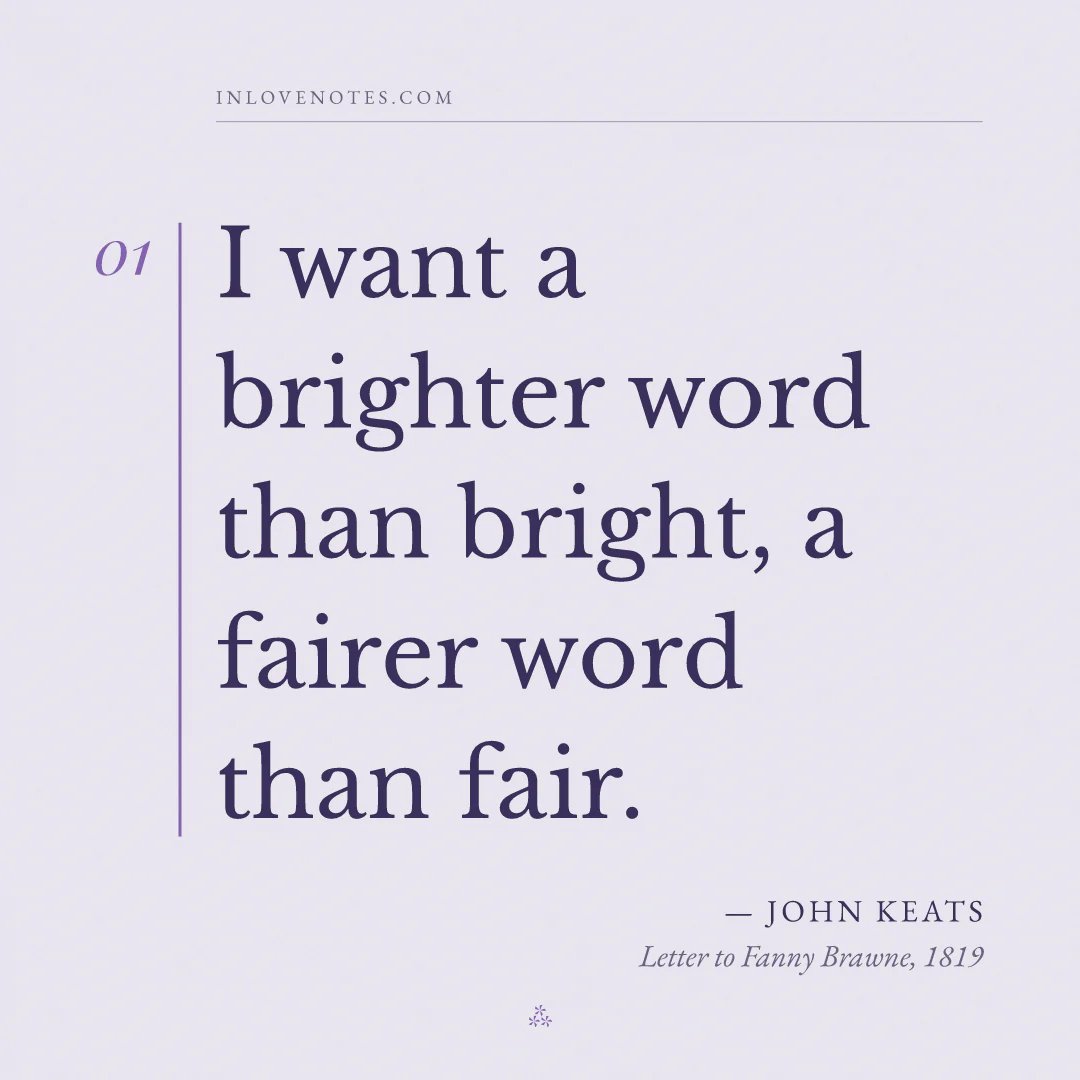
I want a brighter word than bright, a fairer word than fair.
John Keats, Letter to Fanny Brawne, postmarked 3 July 1819
Keats was on the Isle of Wight, writing at "a very pleasant Cottage window" with "a glimpse of the sea", and complaining that he couldn't find language big enough for the woman next door in Hampstead. A few lines later he wishes they "were butterflies and liv'd but three summer days". The brighter-word line is the honest one to borrow when you feel your own compliments sound flat. It admits the problem and solves it at the same time. Good for a birthday card, where every adjective has already been used.
Lines for a gentle day
Some of the most touching lines are about care rather than passion: the trust it takes to hand someone your hopes, or the warmth that makes a person easy to love. These three suit a hard week, an apology or a quiet "thinking of you".
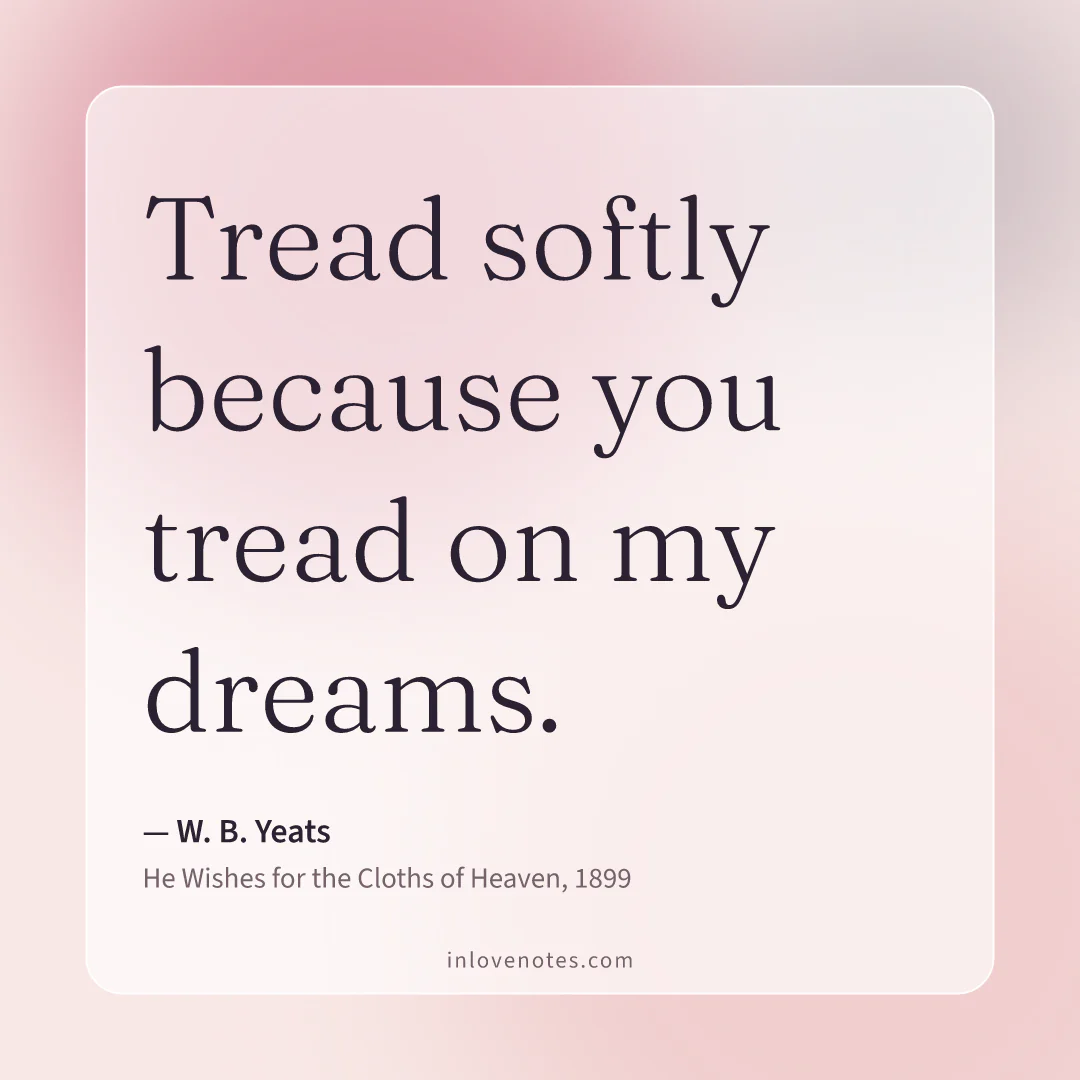
Tread softly because you tread on my dreams.
W. B. Yeats, He Wishes for the Cloths of Heaven, 1899
The poem first appeared in The Wind Among the Reeds (1899) as "Aedh Wishes for the Cloths of Heaven". The speaker says that if he were rich he would spread the heavens' embroidered cloths under her feet, "But I, being poor, have only my dreams". It's the most tender admission in this list. He isn't promising anything grand, only trusting her with what he has. Send it when you are giving her something fragile: a plan, a confession, the first draft of anything.
There is no charm equal to tenderness of heart.
Jane Austen, Emma, Volume II, chapter 13, 1815
Emma thinks this to herself after her friend Harriet tearfully promises to stop dwelling on Mr Elton. Emma adds that "warmth and tenderness of heart, with an affectionate, open manner, will beat all the clearness of head in the world, for attraction". In the novel the line is about friendship, not romance. That's why it works so well in a love note: it praises her kindness rather than her looks. Write it on a card after she has looked after someone, you included.
You pierce my soul. I am half agony, half hope.
Jane Austen, Persuasion, chapter 23, 1817
Captain Wentworth scribbles these words in a letter while Anne Elliot is in the same room, eight years after she broke off their engagement. He leaves the room, comes straight back for his "forgotten" gloves, draws the letter from under the scattered paper on the writing table and places it in front of her. It is the most direct confession in Austen. Use it when you are the one taking the risk: after a row, after a long silence, or when asking for a second chance. The two short sentences carry it, so don't add more than a line of your own.
Lines for saying it plainly
When you finally say "I love you" out loud, a borrowed line can steady your hand. Each of these has a catch worth knowing first.
You must allow me to tell you how ardently I admire and love you.
Jane Austen, Pride and Prejudice, chapter 34, 1813
Mr Darcy's first proposal, delivered at Hunsford parsonage, goes badly. Elizabeth turns him down flat, partly because of what he says after this sentence. Couples who know the book love this line for exactly that reason. It is a declaration with a sense of humour about itself. Use it for an anniversary when the beginning of your story was awkward too. Avoid it for a real first confession, unless you're sure of the answer.
My bounty is as boundless as the sea, / My love as deep; the more I give to thee, / The more I have, for both are infinite.
William Shakespeare, Romeo and Juliet, Act II, scene 2 (first printed 1597)
Juliet says this later in the same balcony scene, and it's the better speech. Love here isn't something you run out of: giving it away makes more. Because the words are hers, it reads well quoted back to her as "you said it first". A small piece of affectionate cheek for a Valentine's card or a wedding-day note.
I seem to have loved you in numberless forms, numberless times, / In life after life, in age after age, forever.
Rabindranath Tagore, Unending Love, translated by William Radice
The Bengali original, "Ananta Prem", appeared in Tagore's collection Manasi (1890). The English most people know is William Radice's translation in Tagore's Selected Poems (Penguin). Tagore's idea is that the two of you have met before, again and again. It suits couples who share a South Asian background, and anyone who would like a line that isn't from the English canon. If you quote it, credit the translator. It's a small courtesy, and readers who know Bengali will notice.
Lines for the long run
The last three are about time: growing older, staying, and becoming one household. They are the ones people engrave, embroider and read aloud at weddings.
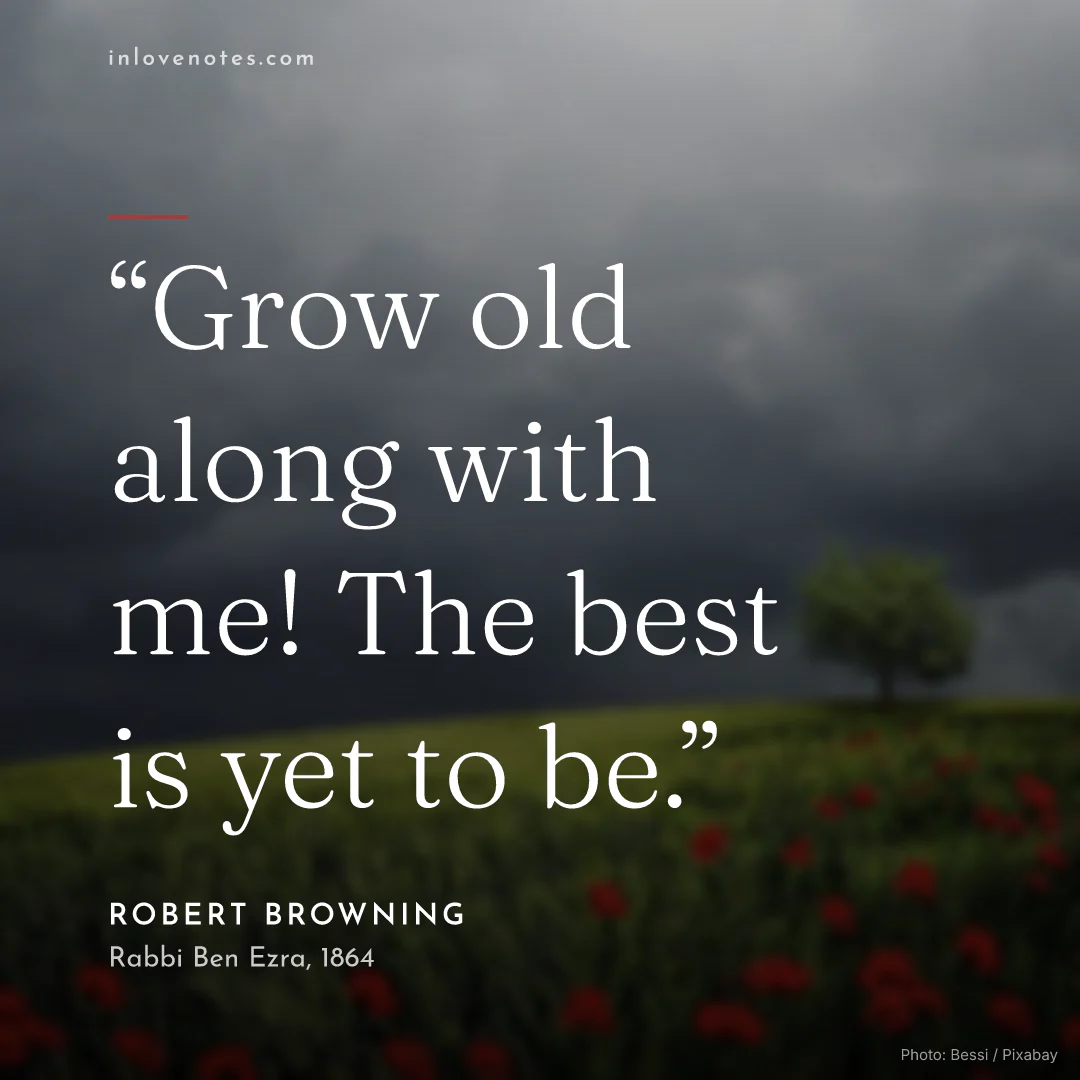
Grow old along with me! / The best is yet to be
Robert Browning, Rabbi Ben Ezra, in Dramatis Personae, 1864
The poem isn't a love poem. It's a monologue by the 12th-century scholar Abraham ibn Ezra about age being the point of life, not its decline: "The last of life, for which the first was made". The opening lines were adopted by couples long ago, and they carry that original hopefulness about getting older. That makes it the right line for a milestone birthday or a long anniversary, where youth is the less interesting part of the story.
I love thee to the depth and breadth and height / My soul can reach
Elizabeth Barrett Browning, Sonnets from the Portuguese, Sonnet 43, 1850
Barrett Browning wrote the sonnets during her courtship with Robert Browning, the author of the previous line, and published them in 1850, four years after their marriage. Sonnet 43 begins "How do I love thee? Let me count the ways". The measuring lines are the ones that fit a card. Pair them with the Browning line above for a gift to a long-married wife. Then the card quotes a married couple, each speaking to the other.
Two souls with but a single thought, / Two hearts that beat as one.
Friedrich Halm, Ingomar the Barbarian (Der Sohn der Wildnis, 1842), Act II, English version by Maria Lovell
Halm was the pen name of the Austrian dramatist Eligius Franz Joseph von Münch-Bellinghausen, and the German reads "Zwei Seelen und ein Gedanke, / Zwei Herzen und ein Schlag". Maria Lovell's English adaptation turned it into the couplet that ended up in Bartlett's Familiar Quotations and has been printed on wedding stationery ever since. It is the most worn line here. That's fine for an engraving or a joint signature, but it's weak on its own in a handwritten note, where it needs a sentence of yours next to it.
Matching the line to the moment
A short quotation only works if the occasion fits it. Use this table as a starting point, then trust your knowledge of her.
| Where it goes | Line to try | What to add in your own words |
|---|---|---|
| Morning text | Shakespeare, "It is the east…" (with her name) | Nothing; let the joke stand |
| Birthday card | Keats, "a brighter word than bright" | One thing she did this year that you admired |
| After an argument | Austen, "half agony, half hope" | What you're sorry for, in one plain sentence |
| Before her big day (interview, exam, launch) | Yeats, "Tread softly…" | That you believe in what she's about to do |
| Thank-you note at home | Austen, "tenderness of heart" | The specific kindness you noticed |
| Anniversary | Browning, "Grow old along with me!" | The year you met and one detail from it |
| Engraving, wedding favour | Halm, "Two souls…" or Tagore | Initials and date only |
Three short notes built around a borrowed line
These are examples written by our editors to show the shape, not real letters. Replace everything in brackets.
For a birthday: "Keats once complained he wanted 'a brighter word than bright, a fairer word than fair.' I know the feeling. Happy birthday, [name]. This year you [one specific thing], and I've been looking for the right word ever since."
After a difficult week: "'There is no charm equal to tenderness of heart.' Austen wrote that about a friend, but I thought of you when you [what she did]. Thank you. I noticed."
For an anniversary: "[Number] years since [place where you met]. Browning said it better than I can: 'Grow old along with me! The best is yet to be.' I'm holding him to it."
The pattern is the same each time: the borrowed line, then one sentence only you could write. For more on finding that sentence, see our guide to how to write a love letter. If even a full sentence feels like too much, there are ready-made one-liners in our short love messages for handwritten notes.
Popular "quotes" with no source
An earlier version of this page included three lines that turn up on countless quote sites. We could not find any of them in the work they are credited to, so they are gone from the list above. If you see them elsewhere, treat them as anonymous.
| Line as it circulates | Usually credited to | What we found |
|---|---|---|
| "She was more than human to me. She was a Fairy, a Sylph…" | John Keats, letter to Fanny Brawne, 1819 | Not in the published letters to Fanny Brawne (H. Buxton Forman's edition). No primary source found. |
| "You are the finest, loveliest, tenderest, and most beautiful person I have ever known…" | F. Scott Fitzgerald, letter to Zelda | Widely shared without a date or a collection reference; we could not trace it to Dear Scott, Dearest Zelda or any dated letter. |
| "You have a place in my heart no one else ever could have." | F. Scott Fitzgerald, The Beautiful and Damned | Not in the text of the novel (1922). No primary source found. |
If a short line matters to you, look for a book, a year and, ideally, a chapter or a date before you write it in a card. When you want something longer than a line, our long, deep love messages for her are drawn from real letters, with dates for every one.