3 Hindi Film Song Lines for Her, With Sources and English Meaning
Three Hindi film lines for her by Gulzar, Javed Akhtar and Shahryar, in Devanagari, Roman and English, with film, year and how to send each.
Updated
Many of the Hindi lines people send to someone they love were never printed in a poetry book first. They were sung in a film. This page keeps three of them, each traced to a named lyricist and a named film, gives them in Devanagari, Roman letters and English, and says how to use each one in a message to her. For couplets by Ghalib, Mir, Faiz and Dushyant Kumar, see the sourced Hindi couplets page; this one is only about film songs.
| Line | Lyricist | Film, year | Music, voice |
|---|---|---|---|
| Tere bina zindagi se koi shikwa to nahi | Gulzar | Aandhi, 1975 | R.D. Burman; Kishore Kumar and Lata Mangeshkar |
| Main aur meri tanhai | Javed Akhtar | Silsila, 1981 | Shiv-Hari; recited by Amitabh Bachchan |
| In aankhon ki masti ke mastane hazaron hain | Shahryar | Umrao Jaan, 1981 | Khayyam; Asha Bhosle |
A life without you, and no complaint about it
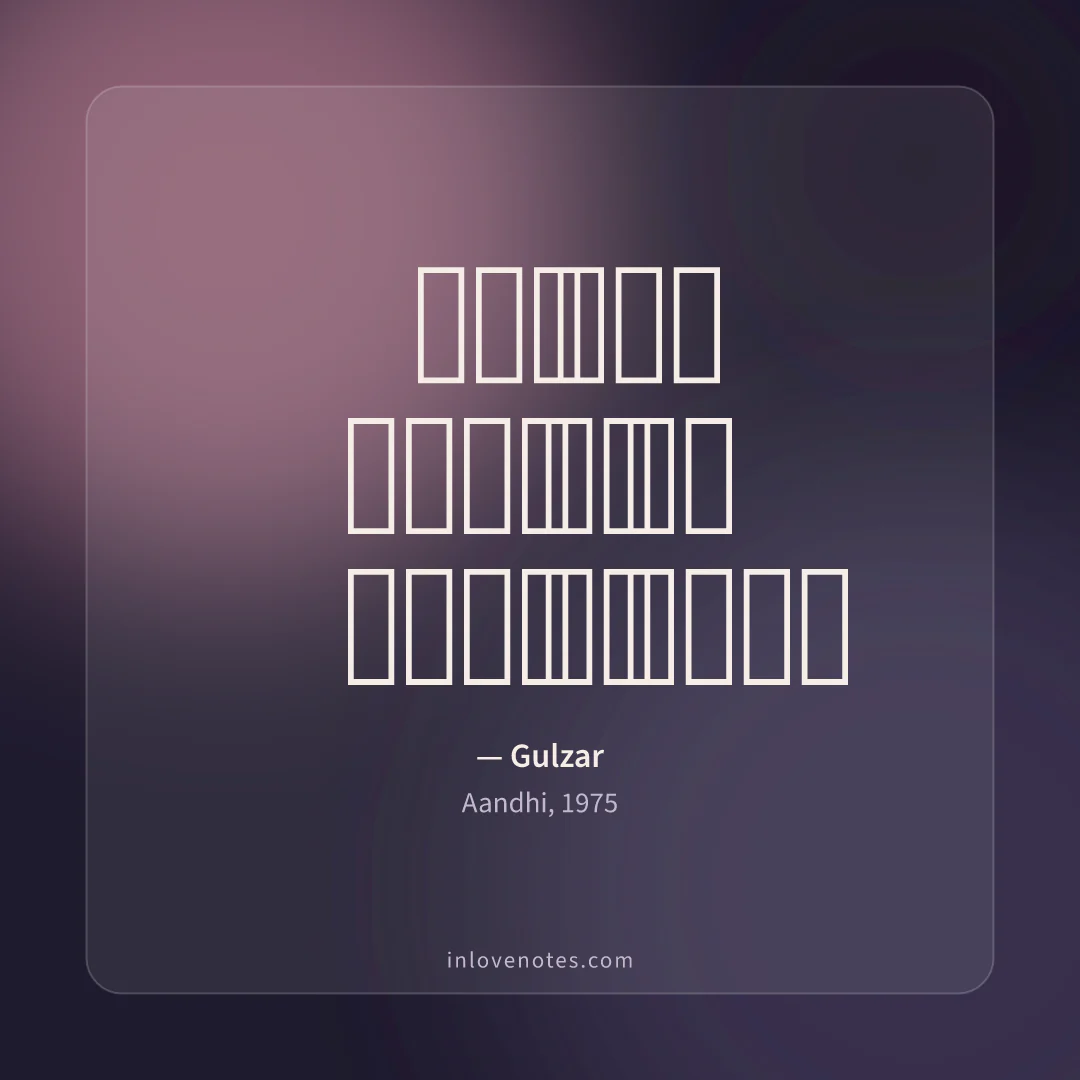
Gulzar directed Aandhi himself, and wrote the lyrics for its duet. The opening line sets two sentences against each other, which is why it is so quotable.
तेरे बिना ज़िंदगी से कोई शिकवा तो नहीं, शिकवा नहीं
तेरे बिना ज़िंदगी भी लेकिन ज़िंदगी तो नहीं, ज़िंदगी नहींTere bina zindagi se koi shikwa to nahi, shikwa nahi / Tere bina zindagi bhi lekin zindagi to nahi, zindagi nahi
"I have no complaint against a life without you. And yet a life without you is not a life at all." — Gulzar, Aandhi, 1975
The first half is calm and the second half takes it back. That makes it a good line for someone who is away: it says you are managing, and that managing is not the same as living. It is gentler than "I can't live without you," and easier to send in a text.
When loneliness starts to talk
Javed Akhtar wrote his first film lyrics for Silsila. The best-known piece from it is not the song itself but a short poem that Amitabh Bachchan recites over "Yeh Kahaan Aa Gaye Hum".
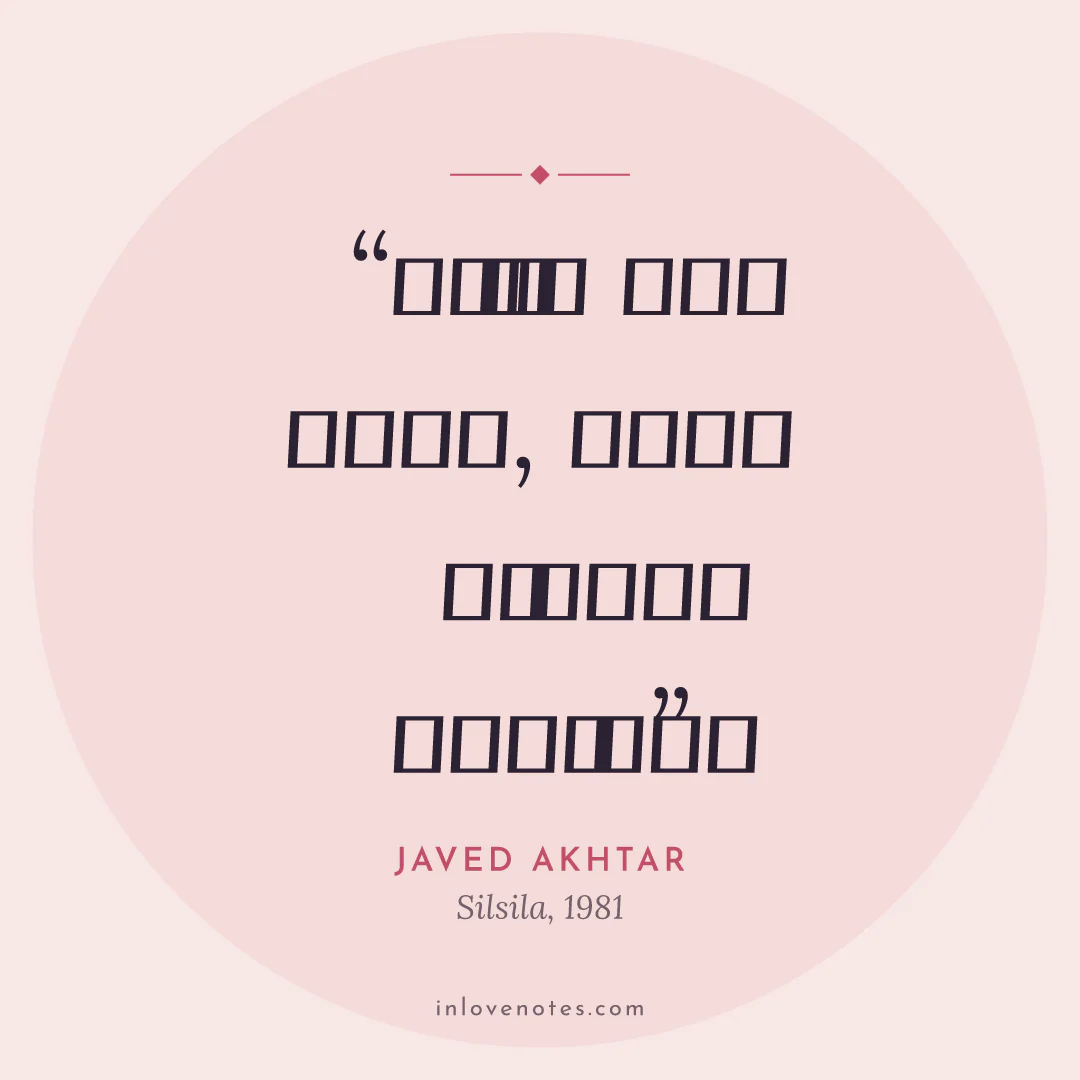
मैं और मेरी तन्हाई, अक्सर ये बातें करते हैं
Main aur meri tanhai, aksar ye baatein karte hain
"Me and my loneliness often have these conversations." — Javed Akhtar, Silsila, 1981
In the film the poem continues with "what if you were here". The first line alone is a statement about being alone, so if you want to send it to her, add the second half in your own words ("and every one of them ends with you") rather than quoting more of the lyric than you need.
The ghazal that was written for a dancer's eyes
Shahryar was a poet of Urdu ghazals before he wrote for cinema. In Umrao Jaan, Rekha sings this ghazal at the title character's first mujra, and it is the scene where she first sees Nawab Sultan, played by Farooq Sheikh.
इन आँखों की मस्ती के मस्ताने हज़ारों हैं
In aankhon ki masti ke mastane hazaron hain
"Thousands are intoxicated by the charm of these eyes." — Shahryar, Umrao Jaan, 1981
It is a compliment about eyes, but in the song it is also boasting: many admire her, and only one matters. If you quote it, quote it as the first half of a thought, for example by adding that you are the one who noticed. On its own it can read as flattery to a crowd.

Lines from the old version of this page that we removed
An earlier version of this page listed twelve "Hindi quotes" and credited many of them to "Anonymous", to invented archive names such as "Delhi Literary Circle Archives" or "Digital Note Archives", or to years with no book behind them. Those lines are gone because no source could be found for them.
| What the old page claimed | What we found |
|---|---|
| Several couplets credited to "Anonymous" with a made-up collection and year | No source found; removed. |
| A line credited to "Inspired by Roy Croft", about loving someone for what you become with them | That idea is an English-language poem. The Hindi sentence on the old page was an unsourced rewording, so it was removed. |
| Dushyant Kumar's "tu kisi rail si guzarti hai" and Faiz's "mujh se pehli si mohabbat" | Both are real, and they are on the sourced couplets page. |
How to send a film line to her
A song line works best when she knows the song, because then it brings the melody with it. If she does not, send the line with a sentence about why you chose it.
- Script: Devanagari looks more finished on a card; Roman letters are easier to read on a phone. Put the English meaning underneath if either of you reads one script better.
- Length: one line, not the whole lyric. Lyrics by living writers and recent composers are still protected, so quote briefly and name the film.
- Add your own sentence: a line from a song says what the lyricist felt. One sentence of yours says what you feel. Then how to write a love letter and longer messages for her can help you finish the message.
Questions readers ask
Are these Hindi or Urdu?
Both, in practice. Shahryar's ghazal is an Urdu ghazal, and the other two lyrics use everyday speech that Hindi and Urdu speakers share. They appear in Hindi films, so they are usually written in Devanagari.
Can I use a film lyric on a card or in a caption?
A single line with credit to the film and lyricist is normal. Do not print a whole song. If you need more, write your own lines.