a note on
15 Short Bible Verses About Love for Quiet Reflection
The briefest scriptural passages often carry the heaviest philosophical weight when read in moments of absolute stillness.
penned by Erdi Dogan

The Architecture of a Single Sentence
Scriptural passages detailing relational devotion often stretch across lengthy chapters of theological discourse, yet the most enduring lines require very little space. Rain tapped against the windowpane in my aunt's kitchen in Portland, Maine, 2014, while a small leather-bound New Testament sat open on the table. She had highlighted just a few scattered fragments, favoring brevity over long, complex arguments. Small phrases carry immense weight. A reader can spend an entire afternoon parsing the implications of a five-word imperative written two millennia ago.
Ancient writers understood the power of condensation when addressing early communities scattered across the Mediterranean. They needed maxims that could be easily memorized, passed down orally, and recalled during moments of intense pressure or daily friction. The resulting texts function less like exhaustive legal codes and more like compass needles pointing toward a specific ethical north. To read them today requires slowing down enough to let the density of the language unfold naturally.
"Let all that you do be done in love." — Paul the Apostle, First Epistle to the Corinthians, c. 54 CE
Written to a fractured community in Corinth, this sweeping directive attempts to align every human action under a single, unifying motivation.
"Above all, keep loving one another earnestly, since love covers a multitude of sins." — Peter the Apostle (traditionally attributed), First Epistle of Peter, c. 60 CE
This text addresses early believers facing social alienation, suggesting that internal grace provides the necessary shelter against external hostility.
"Anyone who does not love does not know God, because God is love." — John the Evangelist (traditionally attributed), First Epistle of John, c. 95 CE
The author equates the divine nature directly with the act of loving, making interpersonal affection the primary metric for spiritual understanding.
"Let love be genuine. Abhor what is evil; hold fast to what is good." — Paul the Apostle, Epistle to the Romans, c. 57 CE
Paul demands authenticity over performative affection, instructing the Roman church to root their interactions in unfeigned sincerity.
Moving Beyond the Theoretical
Understanding how writers articulate deep connection requires looking past abstract nouns and focusing on the verbs that drive the text. The biblical framework rarely treats affection as a passive emotional state that simply happens to a person without their consent. It is consistently framed as a deliberate choice, an action requiring effort, discipline, and sometimes immense sacrifice. The authors demand physical manifestation of internal feelings.
This pragmatic approach strips away the romanticized gloss often applied to ancient texts in modern contexts. When a first-century writer commands their audience to love, they are usually talking about sharing resources, forgiving debts, or maintaining solidarity in the face of political persecution. The brevity of the instruction belies the difficulty of the execution. Doing the work matters more than feeling the sentiment.
"Little children, let us not love in word or talk but in deed and in truth." — John the Evangelist (traditionally attributed), First Epistle of John, c. 95 CE
The writer explicitly contrasts empty verbal declarations with tangible actions, setting a standard for verifiable devotion.
"Hatred stirs up strife, but love covers all offenses." — Solomon (traditionally attributed), Book of Proverbs, c. 700 BCE
Ancient wisdom literature frequently employs parallel structures to contrast the destructive nature of malice with the healing capacity of grace.
"And above all these put on love, which binds everything together in perfect harmony." — Paul the Apostle, Epistle to the Colossians, c. 62 CE
Using the metaphor of getting dressed, this passage frames compassion as the final, essential garment that holds a community intact.
"This is my commandment, that you love one another as I have loved you." — Jesus of Nazareth (recorded by John), Gospel of John, c. 90 CE
This directive shifts the baseline for human interaction, establishing a standard of radical self-sacrifice modeled by the speaker.
Foundations That Outlast the Moment
Examining what the apostles wrote regarding interpersonal bonds reveals a profound interest in endurance. Fleeting passions hold little value in these texts compared to the steady, unglamorous work of remaining present year after year. The ancient world was highly volatile, plagued by famine, shifting empires, and sudden violence. In such an environment, reliable affection became a critical survival mechanism.
The language used to describe this endurance often draws on elemental imagery—water, fire, stone, and seasons. By anchoring human emotion to the physical world, the writers elevate the concept of commitment from a fragile human promise to a fundamental law of nature. The words remain stark and unyielding. They ask the reader to build something capable of withstanding inevitable storms.
"Many waters cannot quench love, neither can floods drown it." — Solomon (traditionally attributed), Song of Solomon, c. 900 BCE
This poetic fragment pits the strength of human devotion against the most destructive natural forces known to the ancient Near East.
"A friend loves at all times, and a brother is born for adversity." — Solomon (traditionally attributed), Book of Proverbs, c. 700 BCE
The proverb defines true companionship not by shared joy, but by steadfast presence during periods of severe hardship.
"Love does no wrong to a neighbor; therefore, love is the fulfilling of the law." — Paul the Apostle, Epistle to the Romans, c. 57 CE
Paul distills the entirety of the complex Torah into a single, negative constraint that ultimately produces a positive communal environment.
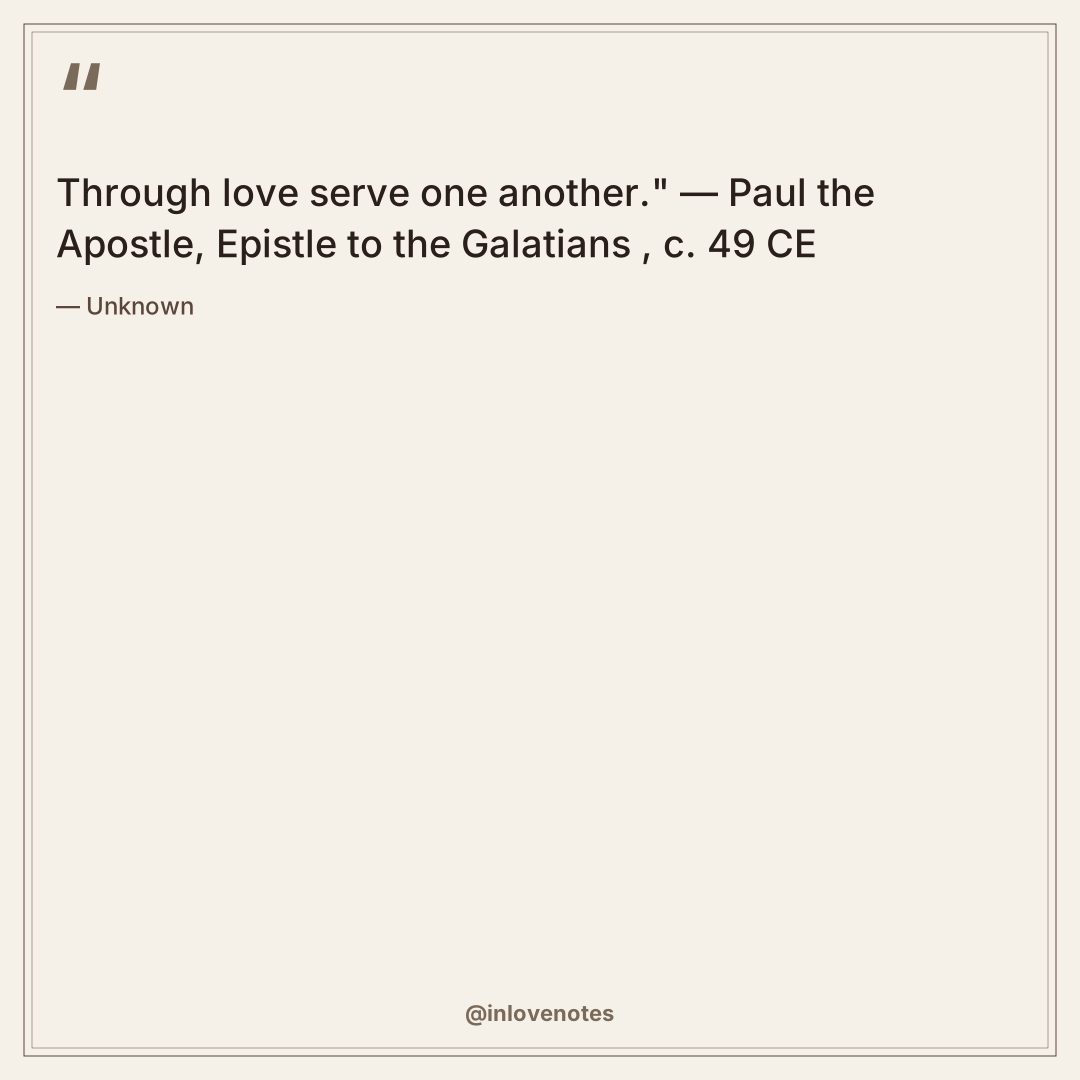
"Through love serve one another." — Paul the Apostle, Epistle to the Galatians, c. 49 CE
This five-word command flips the social hierarchy of the Roman Empire, demanding voluntary servitude driven by mutual care.
Quiet Directives for the Inner Life
While navigating affection during seasons of transition, the focus of the text often turns sharply inward. Before a person can act charitably toward their neighbor, the internal landscape must be cleared of resentment, pride, and fear. The briefest verses frequently target this hidden psychology, operating as quiet meditations rather than loud public declarations. They demand a profound internal restructuring.
These final fragments serve as anchors for the mind when external circumstances become chaotic. They do not promise easy resolutions or immediate comfort, but rather offer a steady rhythm for daily contemplation. Reading them slowly allows the ancient syntax to interrupt modern anxieties. The mind finds a brief, necessary pause within the cadence of the text.
"And may the Lord make you increase and abound in love for one another and for all." — Paul the Apostle, First Epistle to the Thessalonians, c. 50 CE
Framed as a blessing rather than a command, this sentence acknowledges that human capacity for affection often requires external, divine expansion.
"With all humility and gentleness, with patience, bearing with one another in love." — Paul the Apostle, Epistle to the Ephesians, c. 62 CE
The author lists the unglamorous prerequisites for maintaining long-term relationships, emphasizing the sheer tolerance required to live alongside others.
"The aim of our charge is love that issues from a pure heart and a good conscience and a sincere faith." — Paul the Apostle, First Epistle to Timothy, c. 64 CE
This verse traces the origin of genuine affection back to its deepest roots, requiring absolute internal integrity before any outward action occurs.
Second Looks at Familiar Claims
Common claim: Short verses lack theological depth.
Closer to the evidence: Brief imperatives often distill highly complex ethical frameworks into actionable daily practices that early communities could easily memorize and transmit orally.
Common claim: These phrases only apply to romantic relationships.
Closer to the evidence: The original Greek texts primarily utilize the word agape, denoting a broad, communal, and unconditional goodwill rather than the exclusive romantic attachment prevalent in modern interpretations.
Common claim: Ancient instructions translate perfectly into modern idioms.
Closer to the evidence: Historical context fundamentally changes the weight of words, requiring contemporary readers to bridge a massive cultural gap between first-century Mediterranean survival tactics and modern emotional paradigms.
The space between the ink and the margin holds as much meaning as the letters themselves. When we strip away the heavy commentaries and the centuries of accumulated dogma, we are left with the raw, immediate impact of a few chosen words. They sit quietly on the page, waiting for the noise of the day to subside before revealing their architecture. The text remains patient, outlasting the fleeting concerns of the present moment.