Love Letter Ideas: 21 Ways to Write, Shape and Send One, and the Real Letters That Did It First
21 love letter ideas for him, for her or long distance: what to write, puzzle and alphabet letters, letterlocking, each with a sourced historical example.
What do you put in a love letter when "I love you" feels too small for the page? The love letter ideas that work best are rarely clever. They are one specific memory, one honest reason or one promise you mean, written in a shape the other person will want to keep. Below are 21 ideas in three groups: what to write about, how to shape the letter, and how to make and send it. Each has a note on who it suits and how long it takes, and, where one exists, a real letter from history that did it first.
If you have never written one before, start with our step-by-step guide on how to write a love letter, then come back here for an idea to build it around.
Which love letter idea should you pick? A quick comparison
Choose by the time you have and by what the other person values. Someone sentimental keeps paper, someone playful remembers a puzzle, and someone far away needs a letter that lasts more than one reading.
| Idea | Best for | Time | You need |
|---|---|---|---|
| 1. First-meeting replay | New couples, anniversaries | 30 min | One clear memory |
| 2. One ordinary day | Long marriages | 30 min | A normal day you noticed |
| 3. Reasons letter | Birthdays, Valentine's Day | 1 hour | A list kept for a week |
| 4. Thank-you letter | Partners who do unseen work | 20 min | Three specific things |
| 5. Nickname letter | Couples with private jokes | 20 min | Your pet names and their stories |
| 6. Future letter | Engagements, big moves | 40 min | One concrete plan |
| 7. "Only you" letter | Anyone, any time | 20 min | What you tell only them |
| 8. Counting letter | Playful partners | 20 min | A week of tallies |
| 9. Alphabet letter | Anniversaries, gifts | 2 hours | 26 memories or traits |
| 10. Puzzle letter | Puzzle and game lovers | 2 hours | Grid paper, a second envelope |
| 11. Letter in installments | Long distance | A week, 10 min a day | One sheet you add to daily |
| 12. Map letter | Travellers, long distance | 1 hour | A printed or hand-drawn map |
| 13. Letter in their language | Bilingual couples | 1 hour | A dictionary, or a native speaker to check |
| 14. Open-when set | Long distance, deployments | Half a day | Several envelopes and labels |
| 15. Letterlocked letter | Lovers of history and craft | 30 min to learn | One sheet, scissors, glue or wax |
| 16. Pressed-flower letter | Gardeners, romantics | A week to press | A heavy book, one flower |
| 17. Drawing letter | Anyone, skill not required | 1 hour | Coloured pencils |
| 18. Letter with a token | Engagements, partings | 20 min | One small object |
| 19. Wax-sealed letter | Formal occasions, weddings | 15 min | Sealing wax and a stamp |
| 20. Posted or hidden letter | Couples who live together | 10 min | A stamp, or a book they are reading |
| 21. Letter to open later | Weddings, milestones | 30 min | A date written on the envelope |
Ideas for what to write about
The content matters more than the stationery. Each of these gives you a reason to sit down and a natural first line, so you are not staring at "Dear…" for twenty minutes.
1. Replay the first time you met
Write the day you met from your side: what you noticed first, what you thought they thought of you, what you almost said. Most people never hear the other person's version of that day, which is why this letter gets reread. Keep it to one scene; a whole relationship history turns into a summary.
2. Describe one ordinary day
Pick a normal Tuesday and write what they did in it that you loved: the way they answered the phone, the song they hummed while cooking. Ordinary details prove attention in a way that big adjectives cannot. This is the idea for long relationships, where "you are amazing" has been said a thousand times and "you hum when you chop onions" has not.
3. Write down your reasons
Keep a note on your phone for a week and write down every small reason you notice, then copy the best ones by hand. Elizabeth Barrett Browning's "How do I love thee? Let me count the ways" (Sonnet 43, 1850) is the famous model, and our page of reasons why I love you has a full list of prompts if you get stuck.
4. Say thank you for specific things
A thank-you letter is a love letter in work clothes. Name three things they did this year that nobody thanked them for: the car they took in for its service, the call they made to your mother, the night they stayed up with the sick dog. Specific gratitude reads as love because it shows you saw the effort.
5. Collect your nicknames
List every pet name you have for each other and where each one came from. Writers have always done this. Anton Chekhov opened his letters to the actress Olga Knipper, whom he married in 1901, with "Dear actress" and variations on it ("dear enchanting actress" on 20 May 1900), and teased her about her two audiences:
To the director you are precious, to the author you are priceless.
— Anton Chekhov, letter to Olga Knipper, Yalta (10 February 1900), in Letters of Anton Chekhov to His Family and Friends, tr. Constance Garnett, 1920
Vladimir Nabokov went further in his letters to his wife Véra: reviewers of the collected Letters to Véra (2014) counted endearments such as "Pussykins", "my greenikin" and "Poochums". A nickname letter works because the names are already a private language; you are just writing down the dictionary.
6. Write about the future, concretely
Not "I want forever with you" but the trip, the kitchen, the dog's name, the town you would retire to. A concrete plan is a promise someone can picture. Date the letter, because rereading it once some of the plan has come true is half the gift.
7. Tell them what you can only tell them
Every couple has subjects that only make sense between the two of them. Nabokov put this at the centre of one of his first letters to Véra:
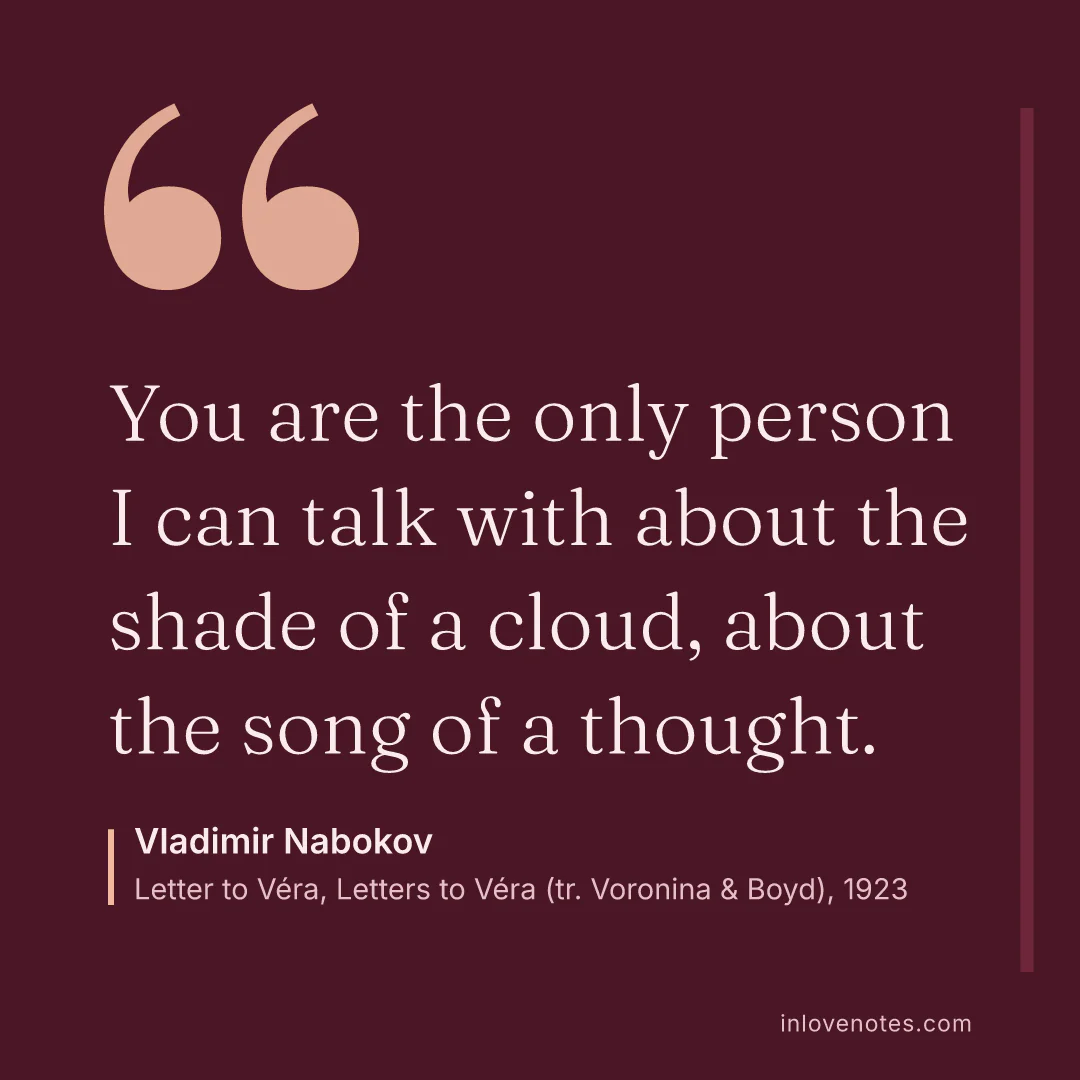
I need you, my fairy-tale... you are the only person I can talk with about the shade of a cloud, about the song of a thought.
— Vladimir Nabokov, letter to Véra Slonim (1923), in Letters to Véra, ed. and tr. Olga Voronina and Brian Boyd, 2014
The line works because it is specific about the kind of conversation, not about her looks or his feelings. Borrow the structure: "you are the only person I can talk with about…", then finish it with your own two or three subjects, however small or odd they are.
Ideas for the shape of the letter
A shape is a rule you set yourself: an alphabet, a count, a puzzle, a map. Rules make writing easier because they tell you what the next sentence has to be.
8. Count something absurd
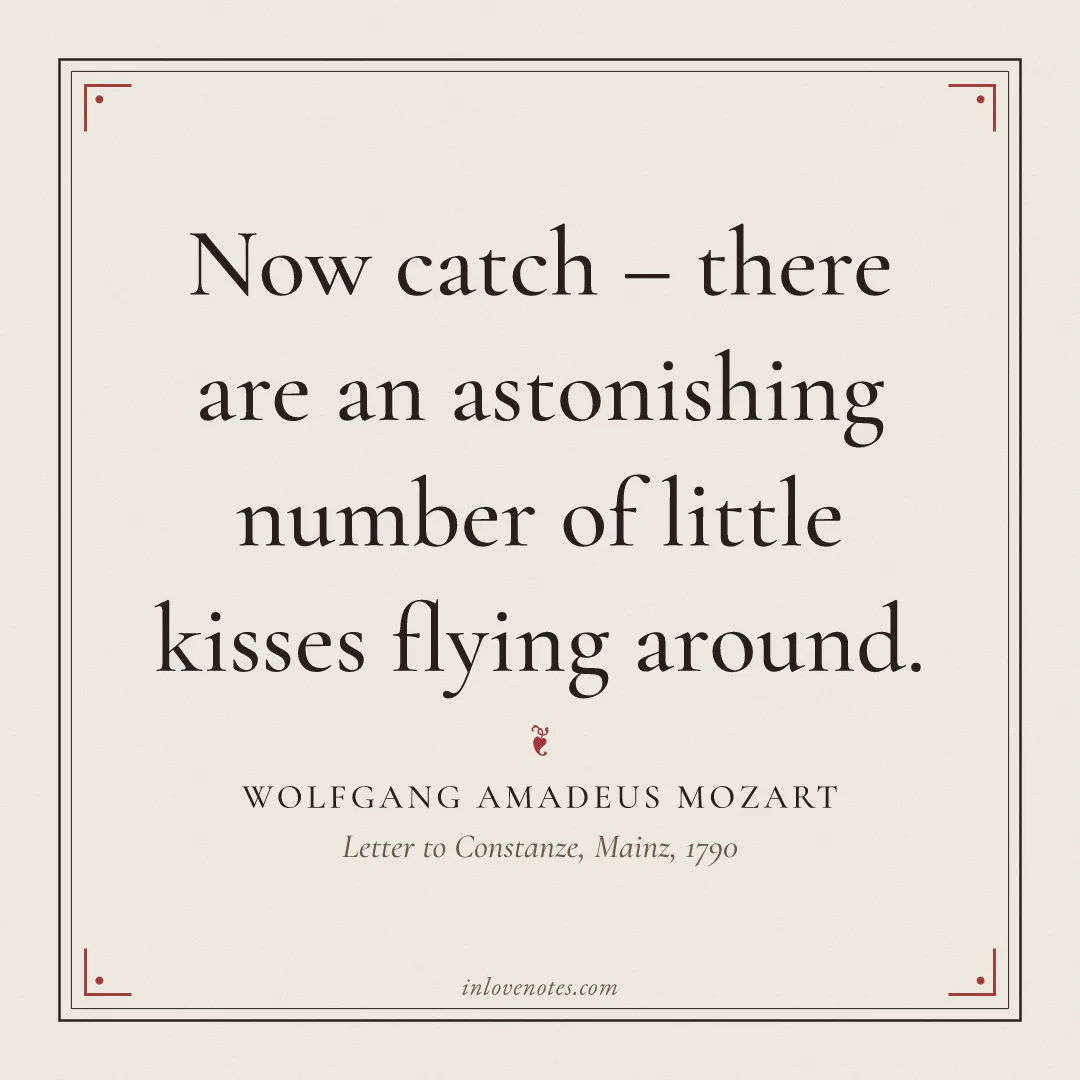
Tally what you love for a week: coffees made, songs sung badly, times they stole the duvet. Mozart did the comic version of this in his letters to his wife Constanze while he was away on a concert tour in 1790:
now catch – there are an astonishing number of little kisses flying around. ... I managed to grab 3 – they are precious!
— Wolfgang Amadeus Mozart, postscript to Constanze Mozart, Mainz (17 October 1790), BD 1141, Digital Mozart Edition English translation
The same postscript begins with tears falling on the page, then turns to "something funny". That turn is worth copying: a counting letter can be silly precisely because the rest of the letter has been sincere. Older editions, such as Lady Wallace's 1866 translation, print the same passage as "Swarms of kisses are flying about — quick! catch some!" and date it 30 September; the Mozarteum's scholarly edition places it in Mainz on 17 October.
9. Write an alphabet letter
One line for each letter, A to Z: a place, a habit, a joke, a word they mispronounce. It takes a couple of hours, and the hard letters (Q, X, Z) usually produce the funniest lines. If 26 is too many, use the letters of their name.
10. Turn it into a puzzle
Write a short crossword or riddle whose answers are your private references, and seal the solution in a second envelope. Nabokov sent Véra puzzles and drawings throughout their correspondence; his publisher's edition of Letters to Véra reproduces facsimiles of "the puzzles and drawings Vladimir often sent to Véra". A puzzle letter is read three times: once to solve, once to check, once to keep.
11. Write it in installments
Add a few lines every day for a week and post it on the seventh. The letter then covers a week of your life rather than one evening's mood, and the changes in handwriting and ink become part of it. This suits long distance best.
12. Draw a map letter
Print or draw a map of the places that matter to the two of you, number them, and write a short paragraph for each on the back. For couples apart, mark both homes and the halfway point where you will meet next.
13. Write it in their language
If your partner grew up speaking another language, even three sentences in it say more than a page in yours. Write it yourself first, then ask a native speaker to check it; a well-meant mistake is charming, a machine translation is not.
14. Make an open-when set
Several sealed letters, each labelled for a moment: "open when you can't sleep", "open when you miss me", "open when we've had a fight". Our page on open when letters has label ideas and sample letters for a full set.
Creative ways to make and send a love letter
How a letter arrives is part of the message. These ideas cost little, and most take under an hour once the words are written.
15. Letterlock it
Before envelopes were common, writers folded, cut and tucked the sheet itself until it became its own envelope, a practice researchers call letterlocking. In March 2021 a team led by Jana Dambrogio and Amanda Ghassaei published in Nature Communications how they read a sealed letter dated 31 July 1697 without opening it, using X-ray scans. It came from the Brienne collection in The Hague, a postmaster's trunk of 3,148 items that includes 577 letterpackets never opened, some with hand-made love tokens, according to The Art Newspaper. The paper notes that many locks were tamper-evident: the letter tears if someone else opens it. The research team's project site is letterlocking.org; a simple fold takes a few tries to learn. A locked letter tells the reader you took care that only they would open it.
16. Press a flower into it
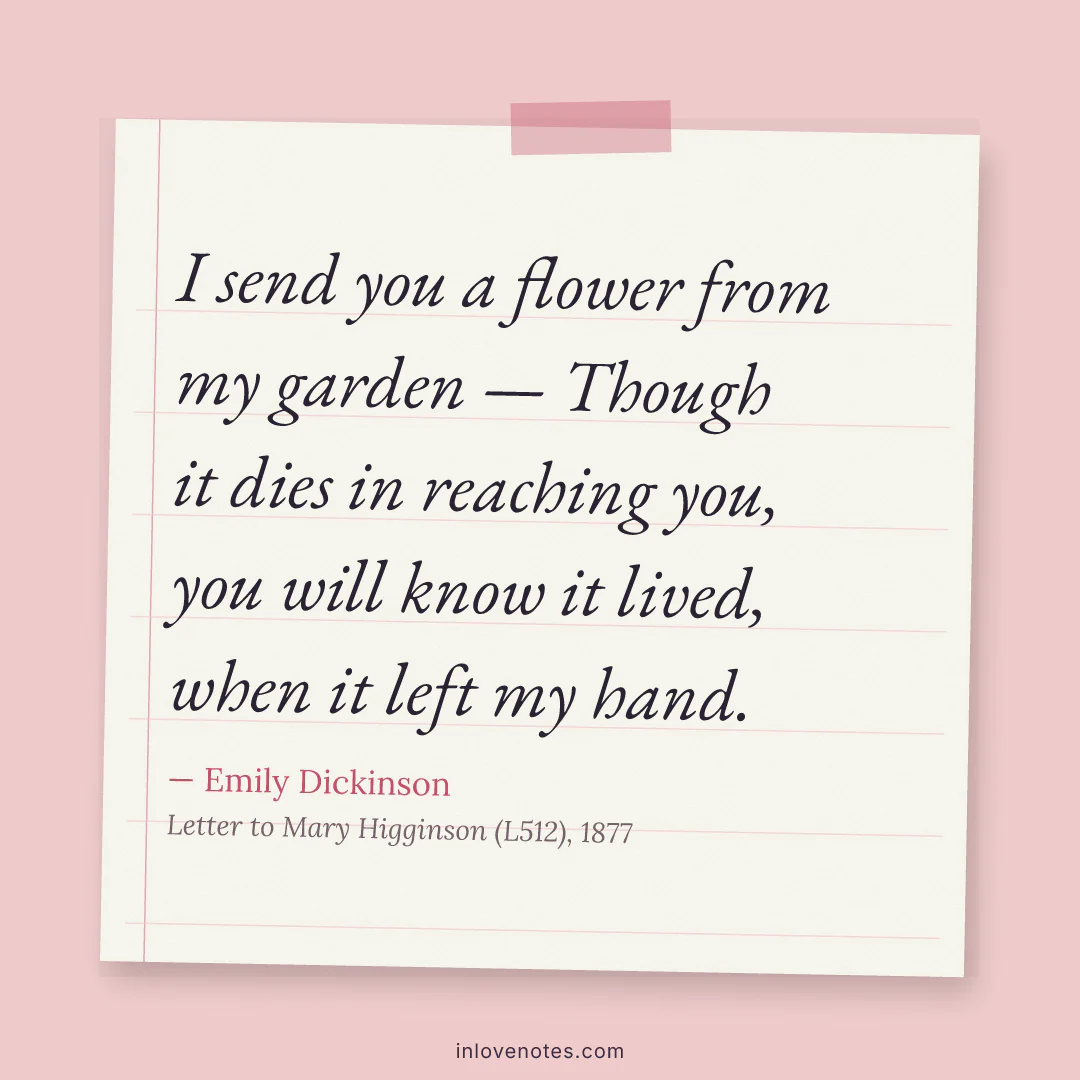
Press one flower from a place that matters to you both for a week in a heavy book, then tape it to the letter. Emily Dickinson regularly sent flowers from her garden with notes, and wrote this with one of them:
I send you a flower from my garden - Though it dies in reaching you, you will know it lived, when it left my hand -
— Emily Dickinson, letter to Mary Higginson (summer 1877), Johnson L512
That letter went to a friend, not a lover, but the idea transfers perfectly: the flower is proof of a moment, and the line admits that it will fade. Frida Kahlo did the same in her love letters to the painter José Bartolí (1946–1949), which, when sold at Doyle New York in 2015, came with drawings, photographs and pressed flowers, according to Fine Books Magazine.
17. Draw on it
You do not need to draw well. Kahlo's letters to Bartolí, signed with the code name "Mara", carried drawings and lipstick kisses, and one of them, from October 1946, admits the problem every letter-writer has:
I don't know how to write love letters. But I wanted to tell you that my whole being opened for you.
— Frida Kahlo, letter to José Bartolí (October 1946), English translation as quoted by Fine Books Magazine, 2015
Doodle a border of the things in your letter: the coffee cup, the dog, the train you take to see them. A drawing tells the reader you spent time on the page, not only on the words.
18. Send a small token with it
A ticket stub, a ring, a key, a guitar pick. Simone de Beauvoir wrote to the novelist Nelson Algren in 1947 about the ring he gave her: "I do not put the ring away for one minute. I like this secret sign of my belonging to you" (quoted in the London Review of Books review of her letters, Beloved Chicago Man). The Chicago History Museum notes she was buried wearing it. Write one line in the letter about why you chose the object.
19. Seal it with wax
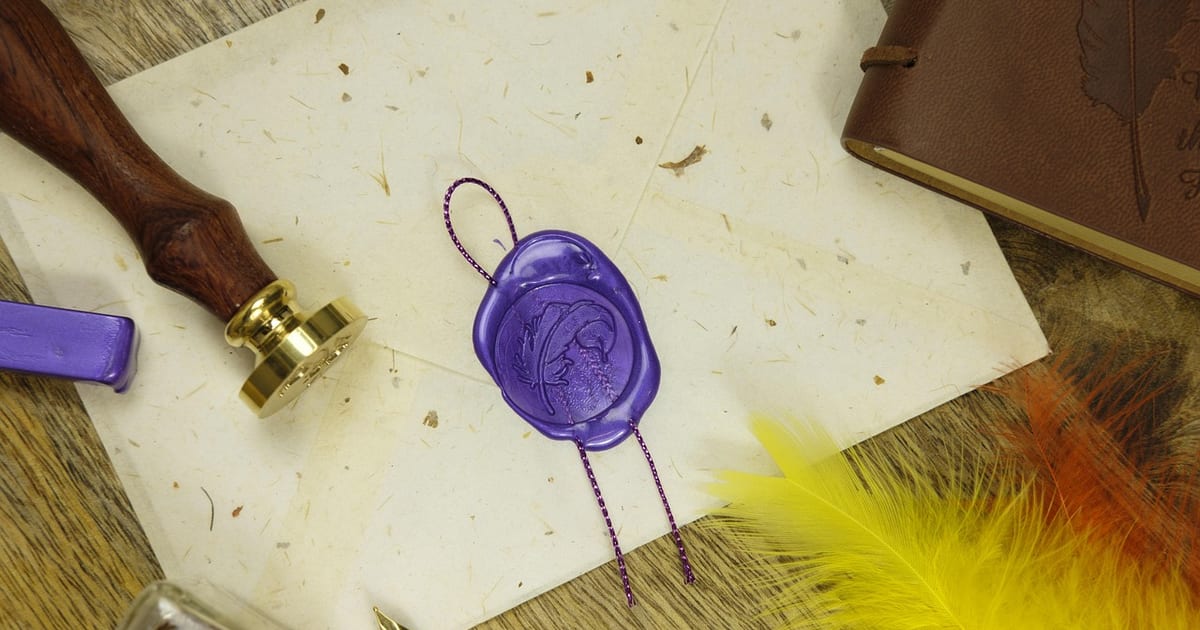
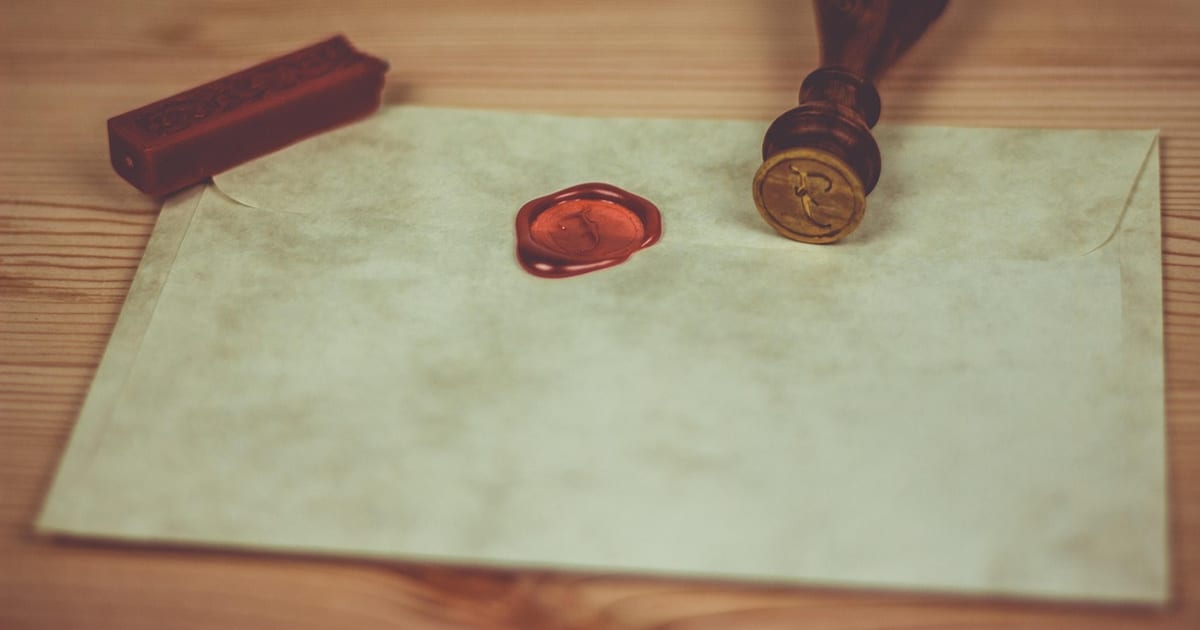
Sealing wax and an initial stamp cost little and turn any envelope into an occasion. If the letter goes by post, put the sealed envelope inside a plain outer one so the seal arrives whole.
20. Post it, or hide it
If you live together, post the letter anyway: a handwritten envelope in a pile of bills is a surprise in itself. Or hide it in the book they are reading, a few pages ahead of their bookmark.
21. Write a letter to be opened later
Write the date on the envelope: your next anniversary, the wedding morning, the first night in a new house. A letter to be opened later is two gifts, because the waiting is part of it.
Love letter ideas for him, for her and for long distance
Most ideas above work for anyone; what changes is the register. These pairings are a starting point, not a rule about what men or women like.
Love letter ideas for him
- The thank-you letter. Name three things he did this year that nobody thanked him for. Practical, specific gratitude often lands harder than adjectives.
- The puzzle letter. A crossword whose answers are your private jokes, with the solution sealed in a second envelope.
- The future letter. A plan, not a fantasy: the trip, the house, the dog's name. Date it and ask him to open it on a set day.
For full sample letters to a boyfriend or husband, see love letters for him.
Love letter ideas for her
- The first-meeting replay. Write the evening you met from your side, including what you noticed and never said.
- The pressed-flower letter. One flower from a walk you took together, with one line on why that walk mattered.
- The nickname letter. Every name you have called her, and where each one came from.
Love letter ideas for long distance
- The letter in installments. Write a few lines every day for a week and post it on the seventh, so the letter covers a week of your life.
- The map letter. Draw the distance between you and mark the halfway point you will meet at.
- The open-when set. Several sealed letters for the days the distance is worst.
Three short examples built from these ideas
These are example letters written by our editors to show how an idea turns into words. Swap in your own details: the specific memory is the part that makes a letter yours.
Example 1: the counting letter
My love, a census of you, taken this week: [number] times you made coffee before I was awake. [Number] times you said my name in the voice you use only for me. One time you laughed so hard at [private joke] that you had to sit on the stairs. The totals are rising, and I have no plans to stop counting. Yours, [name]
Example 2: the alphabet letter (first five letters)
A is for the afternoon at [place] when the rain started and we stayed anyway. B is for your terrible, brilliant breakfast experiments. C is for courage, which is what you call it when you phone the plumber. D is for the dance in the kitchen nobody else will ever see. E is for every ordinary evening, which turned out to be the best part.
Example 3: the letter to open later
Open this on [date]. By now we will have [the thing you are waiting for]. Whatever happened between today and the day you read this, here is what was true when I wrote it: I chose you on an ordinary [weekday], with nothing special going on, and I would choose you again on the next one. Write back and tell me if I was right about us.
Questions people ask about love letter ideas
What should you say in a love letter?
Say one specific thing you noticed, one thing you feel, and one thing you promise or hope for. Specific memories and reasons are what people reread; general praise is forgotten. Ideas 1 to 7 above each give you a starting point.
How can I make a love letter cute?
Give it a playful shape or a small object: a counting letter, a puzzle, doodles in the margins, a pressed flower or a nickname list. Cute comes from the personal detail, not from stickers.
What is a creative way to give a love letter?
Post it even if you live together, hide it in the book they are reading, letterlock it so it becomes its own envelope, or write a date on the envelope for them to open it later.
How long should a love letter be?
Long enough to say one true thing well. One handwritten page is plenty for most occasions; a longer letter works for anniversaries or distance, as long as every paragraph adds something specific.
Sources
- Chekhov to Olga Knipper, 10 Feb., 26 Mar. and 20 May 1900: Letters of Anton Chekhov to His Family and Friends, tr. Constance Garnett (1920), Project Gutenberg #6408 (text read on readbookonline.org).
- Nabokov, Letters to Véra, ed. and tr. Olga Voronina and Brian Boyd: Penguin Random House book page; Publishers Weekly review; Kirkus review.
- Mozart to Constanze, Mainz, 17 Oct. 1790 (BD 1141): Digital Mozart Edition, Mozarteum Salzburg; Lady Wallace tr., The Letters of Wolfgang Amadeus Mozart, vol. II (1866), archive.org.
- Letterlocking: Dambrogio, Ghassaei et al., "Unlocking history through automated virtual unfolding of sealed documents imaged by X-ray microtomography", Nature Communications 12, 1184 (2021), PMC copy; MIT News, 2 Mar. 2021; The Art Newspaper, 2 Mar. 2021.
- Dickinson L512 to Mary Higginson: Emily Dickinson Electronic Archives; flowers as "emissaries": Emily Dickinson Museum.
- Kahlo to Bartolí: Fine Books Magazine; Remezcla.
- Beauvoir to Algren: Michael Rogin, review of Beloved Chicago Man, London Review of Books 20:18; Chicago History Museum, 9 Jan. 2021.