Apology Letter to My Wife: 7 Examples, and the Questions Husbands Ask Before Sending One
Seven apology letters to your wife (fight, lying, drinking, years of distance), with two real 1796 Napoleon letters and research on when to apologize.
At noon on 15 June 1796, in the town of Tortona, a 26-year-old general who had been married for barely three months sat down to apologise to his wife. For weeks Napoleon Bonaparte had been accusing Josephine of lingering in Paris instead of joining him in Italy. Then he learned she was ill. His letter does in one sentence what most apology letters to a wife never manage: "I accuse you of staying in Paris, and you were ill there. Forgive me." It names the exact wrong, puts it on himself, and doesn't ask her to explain anything. That is the short answer to how an apology letter to your wife should work. Say precisely what you did, own it without a "but", say what will change, and leave her the time to decide.
This page is built around the questions husbands actually type before writing one, from "how do I apologize to my wife after hurting her?" to "what if I cheated?". You'll find seven example letters written by our editors for the situations people search for most, two real letters from the same husband in the same year (one that works and one that doesn't), what research says about timing, and three lines from Milton and Shakespeare that are worth borrowing. If you're apologising to a girlfriend rather than a wife, our apology letter to your girlfriend guide is organised differently, around the six parts of an apology that researchers tested.
What should an apology letter to my wife actually say?
Three things, in this order: what you did (in plain words she would recognise), why it was wrong from where she stood, and what you are going to do differently. Marriage adds one more. She already knows your habits, your excuses and your usual promises, so an apology that sounds like the last one will be read as the last one. The fastest way to see the difference is to read two letters by the same man, written five months apart, both to Josephine. Both come from the 1901 English translation by Henry Foljambe Hall, which is on Project Gutenberg.
The first is the Tortona letter, written while Josephine was still in Paris and unwell:
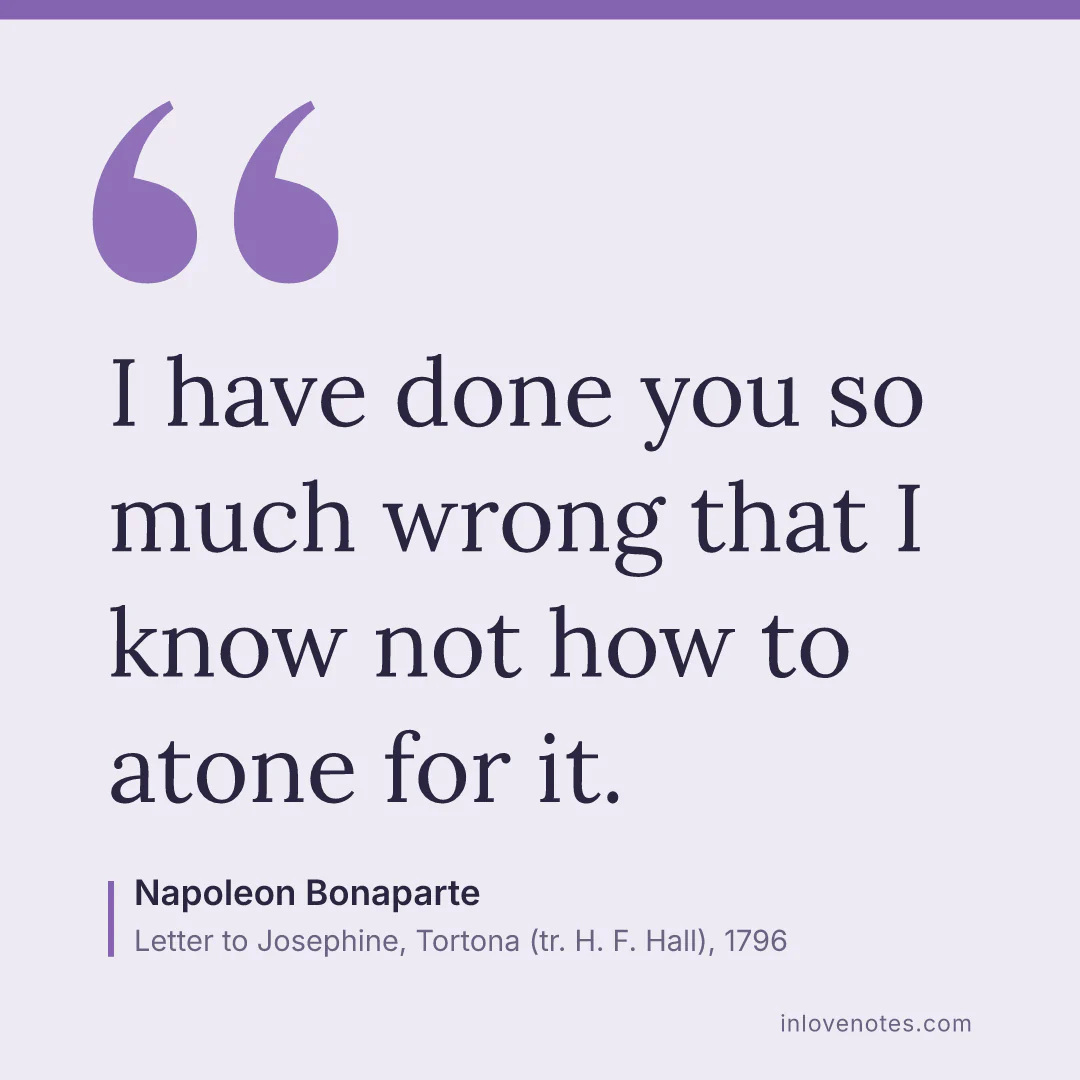
"You are ill, you love me, I have made you unhappy, you are in delicate health, and I do not see you!—that thought overwhelms me. I have done you so much wrong that I know not how to atone for it; I accuse you of staying in Paris, and you were ill there. Forgive me, my dear; the love with which you have inspired me has bereft me of reason."
— Napoleon Bonaparte to Josephine, Tortona, 15 June 1796 (letter no. 7 in Hall's edition)
Look at the order. He states her situation first ("you are ill"), then his part in it ("I have made you unhappy"), then the specific accusation he now regrets. He doesn't argue that he had reasons to be suspicious, though he clearly thought he did. The excuse at the end ("bereft me of reason") is the weakest sentence in the passage, and a modern letter can drop it. What survives two centuries later is the sentence most husbands find hardest to write: I was wrong about you.
The second letter was written in Milan on 28 November 1796. Napoleon had hurried back expecting to find Josephine there, and she had gone on to Genoa. He uses the words "I was wrong" twice, and it is not an apology at all:
"Be happy, do not reproach me, do not concern yourself in the happiness of a man who lives only in your life, rejoices only in your pleasure and happiness. When I exacted from you a love like my own I was wrong; why expect lace to weigh as heavy as gold?"
— Napoleon Bonaparte to Josephine, Milan, 28 November 1796 (letter no. 19 in Hall's edition)
"I was wrong" here means "I was wrong to expect so much of someone as shallow as you." She is the lace and he is the gold. It is a reproach wearing an apology's clothes, and most of us have written a version of it after a fight: "I'm sorry I care so much," "I'm sorry I expected you to notice." If your draft contains a sentence where your fault turns out to be loving too hard, it's the November letter. Rewrite it.
| What to check in your draft | Tortona, 15 June 1796 | Milan, 28 November 1796 |
|---|---|---|
| Does it name one specific thing he did? | Yes: he accused her of staying away when she was ill | No: the "wrong" is having expected her love |
| Who carries the blame? | He does ("I have done you so much wrong") | She does, by comparison ("lace" against "gold") |
| Whose feelings come first? | Hers ("you are ill... I have made you unhappy") | His ("a man who lives only in your life") |
| What does it ask of her? | Forgiveness, once | Not to reproach him, which shuts the conversation down |
| Would it work today? | Yes, minus the closing excuse | No: it reads as sarcasm |
Napoleon's other letters, including the famous ones from the same Italian campaign, are collected with sources in our guide to the love letters of great men.
Should I apologize right away, or wait until she's calmer?
Usually, wait until she has said her piece. This is one of the few questions about apologies that has been tested directly. In 2005 the psychologists Cynthia McPherson Frantz and Courtney Bennigson published "Better late than early: The influence of timing on apology effectiveness" in the Journal of Experimental Social Psychology (volume 41, pages 201–207). In the first study, 24 college students described real conflicts. In the second, 83 participants read about a conflict in which the apology came at the start of a follow-up conversation, at the end, or not at all. In both, the apologies that worked best came later, after the hurt person felt heard and understood.
For a marriage, that suggests a simple order. If she wants to talk, let her talk first and don't defend yourself while she does. Write the letter afterwards, when you can quote back what she told you. A letter slid under the door ten minutes after a fight often reads as a way of closing the subject. A letter the next morning that says "you told me last night that [her words], and you were right" reads as proof that you listened.
The exception is when she has asked for an apology in writing, or when you are apart and the fight happened on the phone. Then don't make her wait for it.
How do I apologize to my wife after hurting her? Seven example letters
These were written by our editors as starting points, not as real letters from real couples. The [square brackets] are for details only you know. Fill every one. If a sentence doesn't fit what happened, delete it rather than keeping it because it sounds good. Your wife knows how you write. A paragraph that doesn't sound like you will do more harm than a plain one that does.
1. After a fight, especially one the children heard
[Name], I raised my voice at you on [day], and I did it in front of [the kids / your mother / our friends]. Whatever we were arguing about, that part was mine alone. You shouldn't have to feel embarrassed in your own house, and they shouldn't have to watch us like that. I'm sorry. I've already told [child's name] that I was wrong to shout at you, because I don't want them to learn that it's normal. Next time I feel it building, I'll say "I need ten minutes" and walk out of the room instead of getting louder. I'd like to finish the conversation about [the actual issue] when you're ready, just the two of us.
2. For something cruel you said
[Name], I keep hearing what I said to you: [the words, or an honest summary]. I said it because I knew it would hurt, and it did. Being angry doesn't make that fair. You've trusted me with the things you're most unsure about, and I used one of them in an argument. That is the part I'm most ashamed of. I'm sorry. I'm not going to ask you to forget it. I'm asking you to watch whether I ever do it again, and to call it out the moment I come close.
3. For lying to her
[Name], I lied to you about [the money / where I was / what happened with ___], and I kept the lie going when you asked me directly. You weren't paranoid. You were right, and I let you doubt yourself. I'm sorry for the lie and sorrier for that. Here is everything, so you don't have to dig for it: [the full truth, briefly]. From now on, [specific step: "you'll have access to the account" / "I'll tell you before, not after"]. I know trust comes back slowly and that I don't get to set the speed.
4. For drinking, and what happened because of it
[Name], on [day] I drank too much and [what happened: "said things to you I don't fully remember" / "drove home" / "missed ___"]. I'm not going to blame the drink, because I chose to keep going. I'm sorry for what you had to deal with that night and the next morning. This isn't the first time, and I know a promise from me isn't worth much on this subject any more. So instead of a promise: [a concrete step: "I've made an appointment with ___" / "I'm not drinking for the next ___ months, and I've told ___ so someone else is holding me to it"]. You can judge me on whether I do it.
5. For leaving her to carry the house alone
[Name], you've told me more than once that you feel like the only adult in this house, and each time I listed what I do instead of looking at what you do. So I looked. [Be specific: "You book every appointment, remember every birthday, notice when we're out of everything, and plan every meal."] I've been helping when asked, and that isn't the same as sharing. I'm sorry. Starting this week, [named tasks] are mine from start to finish, including remembering them. You shouldn't have to remind me. If I drop one, tell me, and I won't argue.
6. A long letter, for years of being a distant husband
[Name], I've started this letter several times, and each version was really about me. So here is the one that isn't. For a long time now, you have been married to someone who comes home but isn't really there.
I can name some of it. [Two or three honest examples: "I'm on my phone at dinner." "I stopped asking about your work." "I let you plan every weekend and then complained about the plans."] You raised this with me [when / how], and I said I was tired, or busy, or that you were exaggerating. You weren't.
I'm not going to promise to become someone else by next week. Here is what I'm doing instead: [one or two specific, checkable steps, e.g. "I've found a couples counsellor and I'd like us to go, but I'll go alone first if you'd rather"]. I'd like you to see the change before you believe it.
I married you because [something true and specific from the beginning]. That hasn't changed for me. What changed is how much of me you got. I'm sorry it took this long to see it. You don't have to answer this letter. I wanted you to have it in writing.
7. The short version, for the kitchen table or a text
I was wrong about [thing] and I'm sorry. Not sorry you're upset: sorry I [what you did]. I'll [one concrete thing] today. No need to reply. I love you.
For the first and last lines in particular, our comparison of how to start and end a love letter sets out greetings and sign-offs by tone. In an apology, her name and a plain "I love you" usually beat anything grand. If the apology is behind you and you want to write the other kind of letter, the one that simply says what she means to you, start with our love letter to my wife page and its real letters from husbands.
Does it have to be beautifully written?
No, and that should be a relief. The Gottman Institute, which has studied married couples for decades, calls the small moves that stop a fight from spiralling "repair attempts." A 2017 piece by Kyle Benson on the Institute's site sums up one of John Gottman's findings: "how a repair attempt was made did not necessarily predict the effectiveness of the repair attempt. Some people would make repair attempts in a beautiful way, and their partner just couldn't hear it. Other couples made repair attempts in really clumsy ways and were successful." What decided it, in Gottman's words as quoted there, was the friendship: "Your repair attempt is only going to work well if you have really been a good friend to them, especially lately."
For a letter, that means two things. Don't spend an evening polishing sentences; spend it on getting the facts right. And if the last month has been cold between you, the letter is only the first step. The next week of ordinary kindness is what makes her believe it.
What did the first married couple in English poetry say after their worst fight?
In Book X of John Milton's Paradise Lost (first published in 1667; the book numbering here follows the twelve-book edition of 1674), Adam and Eve have just been judged for eating the fruit, and Adam turns on Eve with a long, bitter speech. The apology that follows comes from the wife, not the husband. It's still the best model in the poem for what a spouse's apology should contain, because she names exactly what she did and to whom:
"Both have sinned; but thou
Against God only; I against God and thee;"— Eve to Adam, Paradise Lost, Book X (1674 text; lines 930–931 in standard editions)
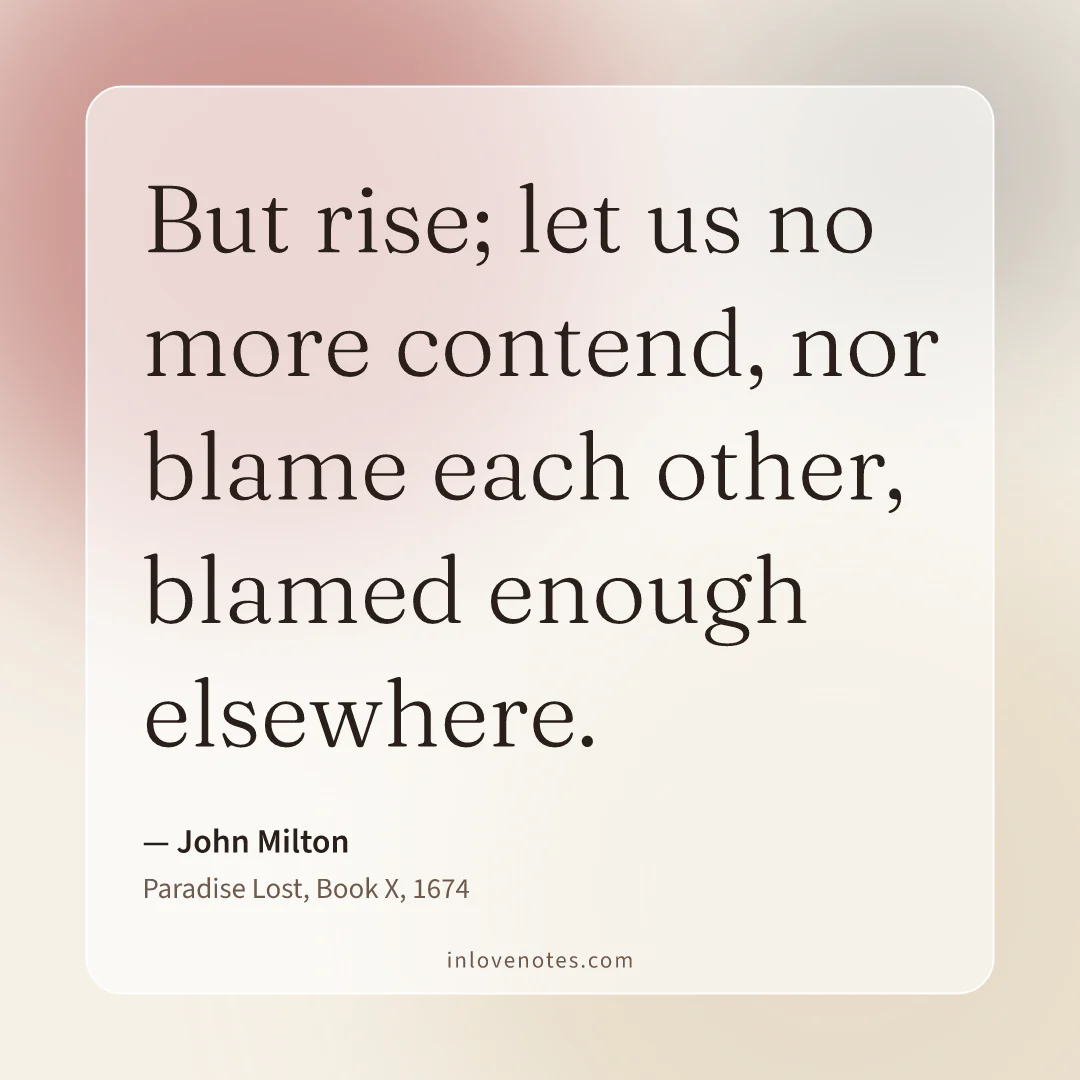
Adam's answer is the part husbands should read. He doesn't make her keep apologising, and he doesn't keep score. He changes the subject from who is to blame to what they can do for each other:
"But rise;—let us no more contend, nor blame
Each other, blamed enough elsewhere; but strive
In offices of love, how we may lighten
Each other's burden, in our share of woe;"— Adam to Eve, Paradise Lost, Book X (1674 text; lines 958–961 in standard editions)
"Offices of love" means the everyday jobs of love: small, practical help. That's the turn a good apology letter makes in its last paragraph, from regret to what you'll actually do. It's also why example 5 above ends with named chores rather than a promise to "be better."
What if I cheated, or she has asked for space?
An apology letter for an affair is not the same document as the ones above, and no example letter can do the work for you. A few honest rules:
- Don't write it to end the conversation. She will have questions for months. The letter is one of the first things you say, not the last.
- Take full responsibility and don't share the blame. Leave out anything about the state of the marriage, how lonely you were, or the other person's part. Those conversations may come later, if she wants them, with a counsellor in the room.
- Don't put graphic details in writing. Answer what she asks, honestly, when she asks it. A letter that volunteers details she didn't ask for hurts her twice.
- Say what has ended and how. "I ended contact on [date]; here is how" means more than "it's over."
- If she has asked for no contact, respect it. If you are separated, one letter delivered the way she agreed to is acceptable. A stream of letters is pressure, not apology.
A couples therapist trained in affair recovery is worth more here than any paragraph, and saying in the letter that you will go, alone if necessary, is often the most convincing sentence in it.
Is there a line I can quote to close the letter?
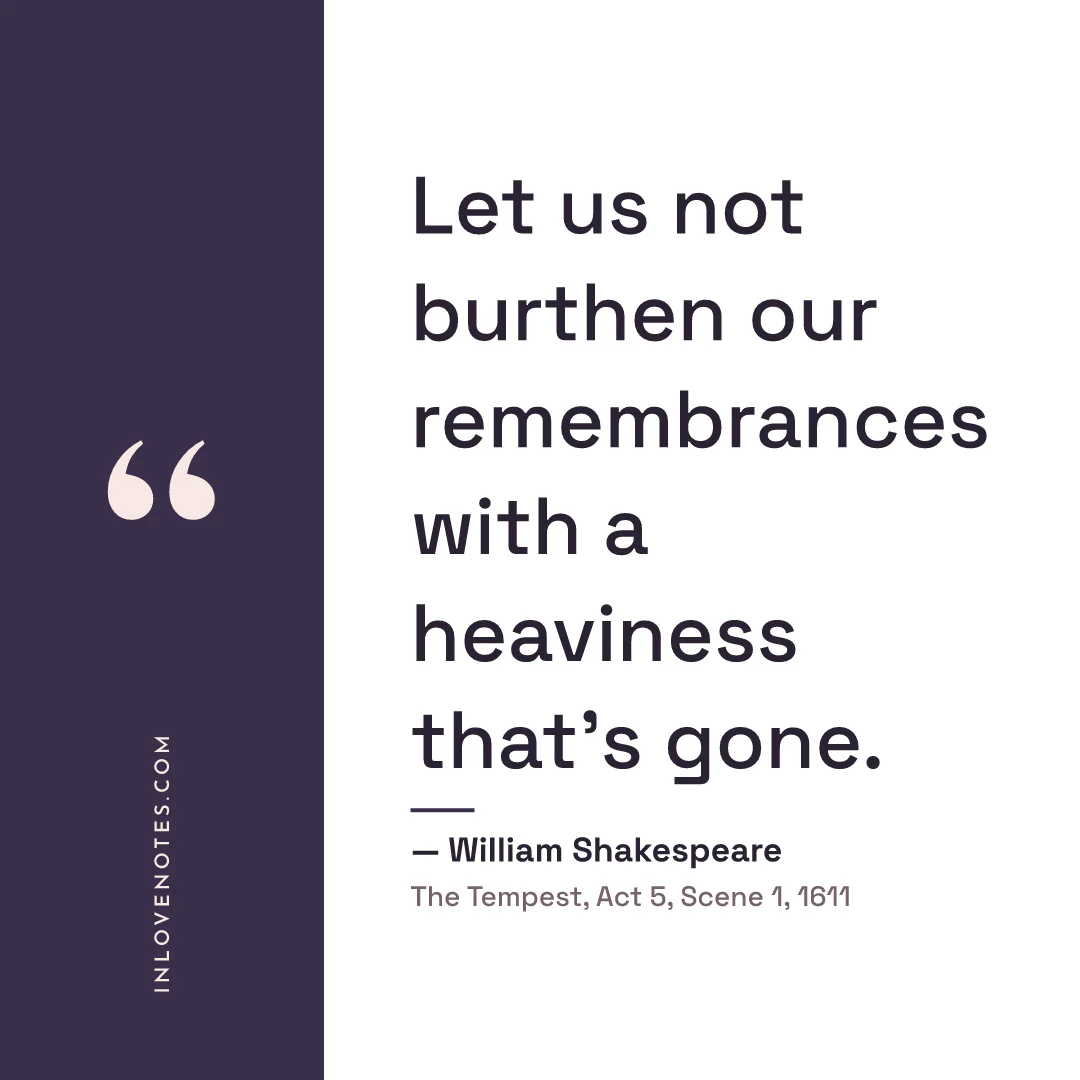
Use a quotation sparingly in an apology. It should never stand in for your own words. The best closing lines come from the moment of forgiveness itself, so the line works as a hope rather than an excuse. Near the end of Shakespeare's The Tempest, Alonso, the king who once helped drive Prospero from his dukedom, says how oddly it will sound for him to ask forgiveness of Prospero's daughter, soon to be his own son's wife. Prospero stops him:
"There, sir, stop:
Let us not burthen our remembrances with
A heaviness that's gone."— Prospero, The Tempest, Act 5, Scene 1 (written about 1611; Project Gutenberg text)
In the play it is the wronged man who says this, which is exactly why it doesn't belong in your mouth as an instruction. "Let's not dwell on it" from the person who did the damage is the November letter again. As a hope, though, it works: "One day I hope we can say, like Prospero, that this is a heaviness that's gone. I know that day is yours to decide."
A line to check before you use it: "A happy marriage is the union of two good forgivers" appears on countless wedding and apology pages. The Billy Graham Library credits it to Ruth Bell Graham. Quote collections also give it to Robert Quillen (1887–1948), the syndicated newspaper paragrapher, in a slightly different form: "Successful marriage: The union of two good forgivers." We could not find a dated original for either version. If you use it, write "as the saying goes" rather than signing someone's name to it. We track lines like this in our page on misattributed love quotes.
Questions husbands ask
How long should an apology letter to my wife be?
Long enough to name what you did, why it hurt her and what will change: usually 150 to 400 words. A pattern built up over years deserves more (see example 6). A single thoughtless moment deserves less (example 7). Length isn't sincerity, and a very long letter can read as a speech in your own defence.
Should I give it with flowers or a gift?
Not at the same time, as a rule. A gift handed over with an apology can look like payment for closing the subject. Let the letter stand alone. If you want to give something, give it later, as part of the change you promised, and make it something that takes time or attention rather than money.
Handwritten or a text?
For anything serious, handwrite it or at least print it and sign it, and give it to her in person or leave it where she'll find it alone. A text is fine for the short version after a small fight. Never send the long version by text in the middle of her working day.
What if she doesn't respond?
Don't ask her whether she's read it. Silence after an apology letter usually means she's still deciding, and the next few weeks of behaviour are the real answer to your letter. If you said you'd do something concrete, do it, without pointing out that you're doing it.
Sources
- Napoleon Bonaparte, Napoleon's Letters to Josephine, 1796–1812, collected and translated by Henry Foljambe Hall (London: J. M. Dent, 1901), letters no. 7 (Tortona, 15 June 1796) and no. 19 (Milan, 28 November 1796): Project Gutenberg #37499.
- C. M. Frantz and C. Bennigson, "Better late than early: The influence of timing on apology effectiveness," Journal of Experimental Social Psychology 41 (2005): 201–207, as summarised by Florida Tech's Psychology Science Minute.
- Kyle Benson, "Repair is the Secret Weapon of Emotionally Connected Couples," The Gottman Institute (first published 2017).
- John Milton, Paradise Lost (1667; 1674 text), Book X: Project Gutenberg #26.
- William Shakespeare, The Tempest, Act 5, Scene 1: Project Gutenberg #23042.
- "What makes a marriage work?", Billy Graham Library (14 August 2014), for the Ruth Bell Graham attribution.