In Love Notes for Messenger: 39 Short Lines That Fit the 60-Character Box
39 love notes for Messenger, all under 60 characters: 27 original lines sorted by moment, plus 12 classic lines checked against their sources.

A Messenger note is the little thought bubble that sits over your profile photo at the top of the chat list. It holds 60 characters, it disappears after 24 hours, and nobody gets a notification when you post one. Your partner sees it only if they open the app and look. That makes it a strange place for love: semi-public, very short, and gone by tomorrow. It also explains why people search for "in love notes for Messenger". A normal love message is too long to fit.
This page has 39 lines that fit the box. Our editors wrote 27 of them for particular moments of the day. The other 12 are real lines from novels, letters, poems and scripture, each checked against the original text and short enough to post. Every line shows its character count. There's also a table of famous "romantic" lines that aren't in the books they're credited to, because several of them were in the old version of this page.
Before you post: a note is not a message
The difference matters more than the wording. A message goes to one person. A note goes to everyone in the audience you pick. At the time of writing (October 2026), Messenger lets you choose between friends you follow back and your Close Friends list. Meta changes these features from time to time, so check the audience line before you tap Share.
| Messenger note | Direct message | |
|---|---|---|
| Length | 60 characters, text and emoji | As long as you like |
| Who sees it | Your chosen audience, not just your partner | Only the person you send it to |
| How long it stays | About 24 hours | Until someone deletes it |
| Notification | None. They see it when they open Messenger | Yes |
| Best for | A small public smile, an inside joke, "I'm thinking of you" | Apologies, private feelings, plans, anything that needs an answer |
Three rules follow from that table. Write lines you'd be happy for your cousin or your manager to read. Keep apologies and anything raw for a direct message. And if you want your partner to know a note is for them, use a detail only they will catch, like a nickname, a shared joke or the name of "your" café, rather than their full name.
27 notes our editors wrote, sorted by moment
These are original lines written for this page, not quotes. Change a word, add an emoji, swap in a nickname. The number after each line is its character count, so you know how much room is left.
First thing in the morning
A note posted before work is the first thing they see when they check their phone. Keep it light.
- Woke up thinking about you. Again. Not complaining. (51)
- Coffee's better on days that start with your text. (50)
- Good morning to the reason I check my phone first. (50)
- Day plan: work, eat, miss you, repeat. (38)
In the middle of a busy day
Midday notes work best when they ask for nothing. Your partner can smile at one between meetings and doesn't owe you a reply.
- Busy day, but you're still my favorite tab open. (48)
- Three meetings in and you're all I'm thinking about. (52)
- Small reminder: someone is very proud of you. (45)
- Not much to say. Just you. Always you. (38)
When you're far apart
For long distance, the note can do one job a message can't: it's there whenever they open the app, all day, without you sending anything. For longer words, see our guide to long-distance love letters.
- Same moon, different windows. Counting the days. (48)
- Missing someone who is 1 message away. (38)
- Time zones are rude. I miss you anyway. (39)
- Somewhere a person I love is reading this. Hi. (46)
Early days, when it's not official yet
A note is a good fit for the stage where a direct "I like you" feels too much. These say something without naming anyone.
- Smiling at my phone again. You know why. (40)
- Some conversations make the whole week better. (46)
- Currently: thinking about one specific person. (46)
Anniversaries
- One year of you, and I'd sign up for every year after. (54)
- Still choosing you. Every single day. (37)
- Home isn't a place, it's a person. Mine reads this. (51)
After a rough week together
Don't use a public note to settle an argument. These are for afterwards, once things are calm, as a small public sign that you're fine.
- Still on your side, even when I'm annoyed. (42)
- Rough week. Still us. Still worth it. (37)
- Stubborn, yes. Still crazy about you, also yes. (47)
Goodnight
- Goodnight to the last person I think about today. (49)
- Phone down, heart full. Goodnight, you. (39)
- Tomorrow I get to love you all over again. (42)
Funny ones
- I love you more than the last slice. Almost. (44)
- Taken. By someone who steals the covers. (40)
- Low battery, high feelings. (27)
Lines from novels that already fit
If you'd rather borrow than write, these classic lines are short enough to post whole. Each one was checked against the original text, and all of them are long out of copyright. Adding the author's name after a dash costs you characters, so some people leave it off. That's fine for a note, but say where it's from if someone asks.
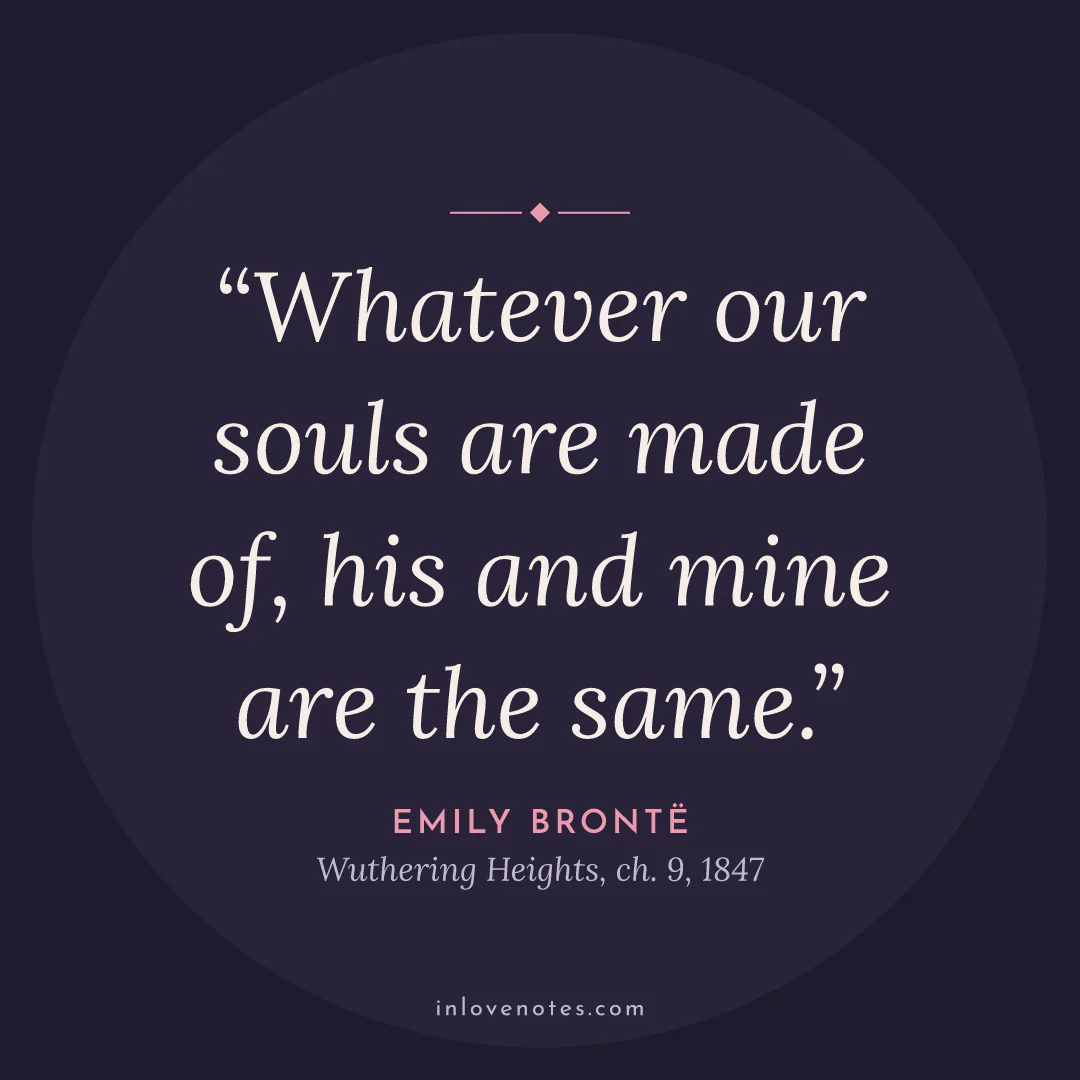
Whatever our souls are made of, his and mine are the same.
Emily Brontë, Wuthering Heights, chapter 9, 1847 (58)
Catherine Earnshaw says this to the housekeeper Nelly about Heathcliff. The very next words, "and Linton's is as different as a moonbeam from lightning", explain why she is going to marry the other man anyway. It's one of the most posted love lines in English, and it only just fits at 58 characters. Change "his" to "yours" and it reads as if it's spoken straight to your partner: "Whatever our souls are made of, yours and mine are the same" (59).
You pierce my soul. I am half agony, half hope.
Jane Austen, Persuasion, 1817 (47)
Captain Wentworth writes this in a letter he slides to Anne Elliot, eight years after she broke off their engagement, while she is in the same room talking about whether women or men love longer. It's a good line for a note after time apart or after a rough patch, because it admits that love can hurt and still hope.
Reader, I married him.
Charlotte Brontë, Jane Eyre, 1847 (22)
The first words of the last chapter, about Jane marrying Rochester. At 22 characters it's the shortest line here. It works best as a wedding-week or anniversary note, and people who know the book will smile at it.
If I loved you less, I might be able to talk about it more.
Jane Austen, Emma, 1815 (59)
Mr. Knightley says this when he finally proposes to Emma in volume 3, chapter 13. It comes from a man who lectures Emma for the whole novel and then can't find his words. It suits a partner who's better at doing than saying, and at 59 characters it leaves room for just one emoji.
Lines from real love letters
Letters are where people wrote the shortest, plainest sentences, because they weren't writing for an audience. Here are three lines from two famous letters, with the date each letter was written.
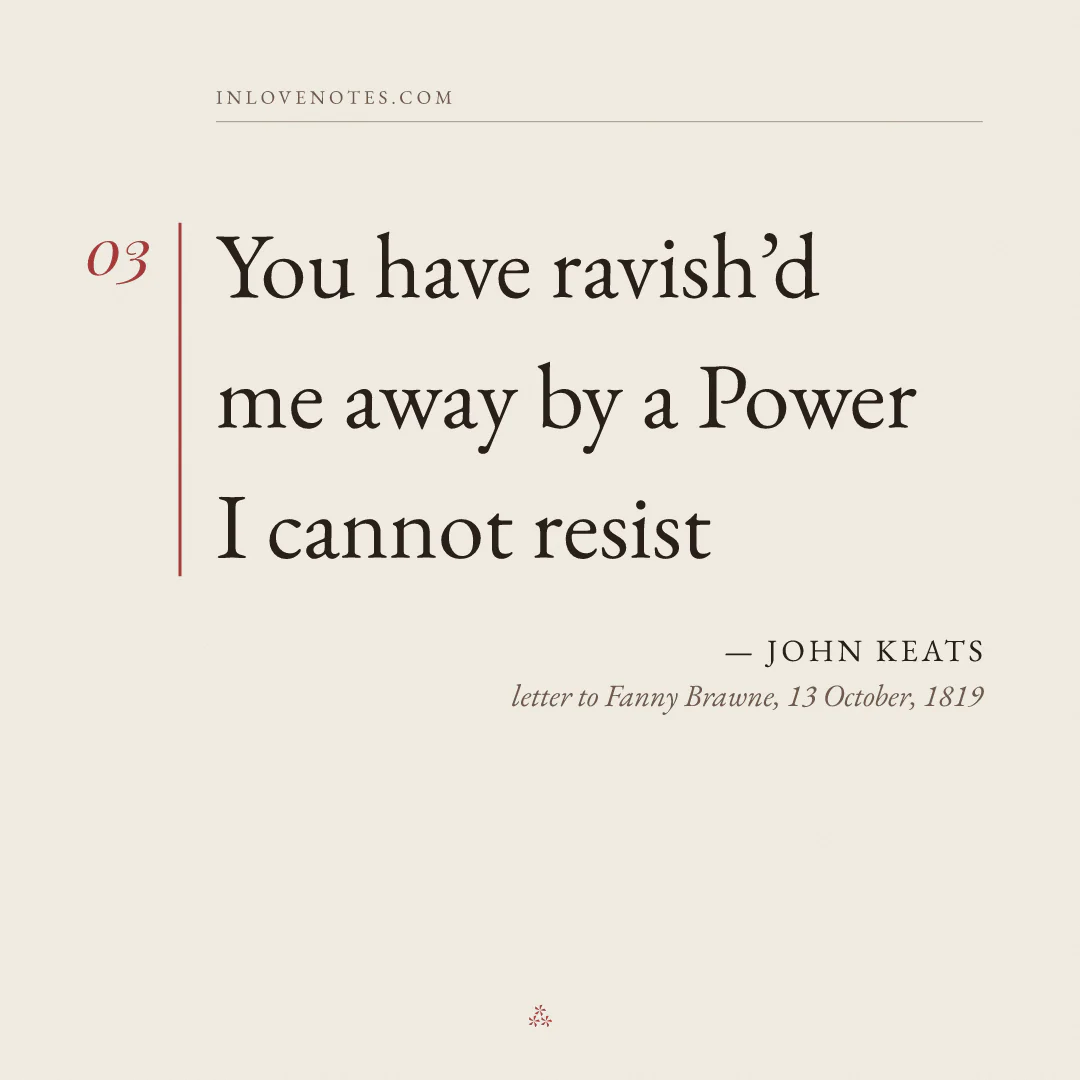
You have ravish'd me away by a Power I cannot resist
John Keats to Fanny Brawne, 13 October 1819 (52)
Keats wrote this from London when he was 23. He was trying to work and failing, because all he could think about was Fanny, whose family rented the other half of the Hampstead house he had just left. The old spelling "ravish'd" is part of the charm. Keep it if you post the line.
I cannot exist without you.
John Keats to Fanny Brawne, 13 October 1819 (27)
This is from the same letter, a few lines on. It's dramatic in a 60-character box, so save it for someone who knows it's Keats, or for a day you're apart. Our deep love messages for him page has more lines like this from real letters, with their context.
Ever thine. Ever mine. Ever each other's.
Ludwig van Beethoven, letter to the "Immortal Beloved", 6–7 July 1812, translated by Lady Wallace, 1866 (41)
Beethoven ends his letter "ewig dein, ewig mein, ewig uns". He wrote it in the spa town of Teplitz to a woman he never named, and it was found among his papers after his death, apparently never sent. You'll often see it translated as "Ever thine, ever mine, ever ours" (32), which is a modern wording and closer to the German. Either fits easily.
Lines from poems and scripture
Poetry and scripture have plenty of lines that are under 60 characters on their own. For three of the five below, we use the first part of a longer sentence, and we say so each time.
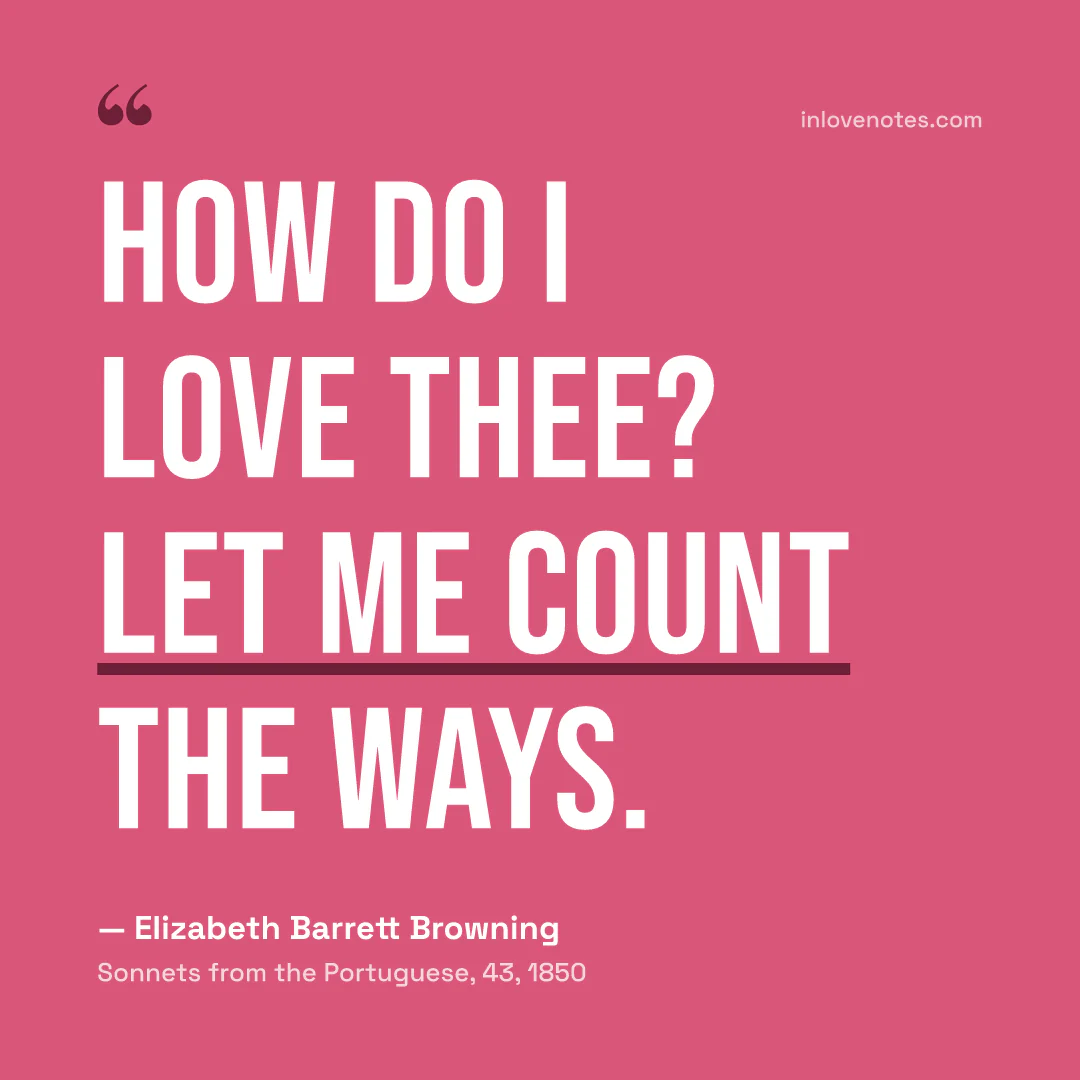
How do I love thee? Let me count the ways.
Elizabeth Barrett Browning, Sonnets from the Portuguese 43, 1850 (42)
Barrett Browning wrote the sequence while Robert Browning was courting her, and showed it to him only after they married. Everyone knows the opening, so it reads as a wink rather than a big declaration. Some people post just the first half, "How do I love thee?", and let their partner answer.
Love alters not with his brief hours and weeks
William Shakespeare, Sonnet 116, 1609 (46)
This is line 11 of the sonnet often read at weddings, which argues that real love doesn't change when circumstances do. "His" here means time's. It's a good anniversary or long-distance note, and the sonnet itself makes a good wedding reading.
Day by day and night by night we were together
Walt Whitman, "Once I Pass'd Through a Populous City", Leaves of Grass (46)
A popular version online, "We were together. I forget the rest.", is not Whitman's wording. His full line is "Day by day and night by night we were together—all else has long been forgotten by me". The first half fits a note and sounds just as good.
I found him whom my soul loveth
Song of Solomon 3:4 (King James Version, 1611) (31)
The bride has searched the city at night for her beloved, and this is the moment she finds him. The verse continues, "I held him, and would not let him go". It suits an engagement announcement. Change "him" to "her" if that fits your story.
I am my beloved's, and my beloved is mine
Song of Solomon 6:3 (King James Version, 1611) (41)
This verse is often engraved inside Jewish and Christian wedding rings, sometimes in the Hebrew ani l'dodi v'dodi li. As a note it's calm and certain rather than gushing, which suits a long marriage.
Famous lines that aren't in the books they're credited to
Search for short love quotes and you'll find these everywhere, often with a book title attached. We checked each one against the original text. Several were in the earlier version of this page, and we've taken them out.
| Line as usually posted | Usually credited to | What we found |
|---|---|---|
| "You have bewitched me, body and soul" | Jane Austen, Pride and Prejudice (1813) | Not in the novel. It's from the 2005 film, written by Deborah Moggach. The novel only says Darcy "had never been so bewitched by any woman". |
| "My heart is and always will be yours" | Jane Austen, Sense and Sensibility (1811) | Not in the novel. Usually traced to Emma Thompson's 1995 screenplay. |
| "I wish I had done everything on earth with you" | F. Scott Fitzgerald, The Great Gatsby (1925) | Not in the novel. We found no reliable source for it. |
| "If I know what love is, it is because of you." | Hermann Hesse, Narcissus and Goldmund (1930) | Real, but it's a translation: Narcissus says "Wenn ich trotzdem weiß, was Liebe ist, so ist es deinetwegen" to the dying Goldmund in chapter 20. He is speaking to his friend, not a lover. |
| "I am entirely yours" | George Washington to Martha (1775) | Not his wording. His letter of 23 June 1775 is signed "Yr entire", and the loving line in it is "I retain an unalterable affection for you". |
| "I love you more than words can wield the matter" | Shakespeare, King Lear | The original says "word", not "words". And Goneril is lying: it's flattery to win land from her father. Not a line to send someone you love. |
| "I love you more than my own skin" | Frida Kahlo, letter to Diego Rivera | We couldn't find it in any primary source. It's widely shared, but we left it out until we can see the letter. |
Writing your own in 60 characters
A note that sounds like you will mean more than any quote. A few habits help:
- Start with something only the two of you know. "Saturday pancakes > everything" says more to your partner than "I love you", and to everyone else it's just a cheerful note.
- Use one sentence, not two. If your line has a full stop in the middle, try cutting the first half.
- Leave room for one emoji. Aim for 50–55 characters so you don't have to cut a word at the end.
- Don't post what needs an answer. "Can we talk tonight?" belongs in a message. A note should feel complete on its own.
- Post a bigger feeling somewhere else. If the thought won't fit in 60 characters, it may be a letter. Our short love messages for handwritten notes can go on paper instead, and love notes for her has ideas sorted by where she'll find them.
Questions people ask about love notes on Messenger
What should I write in a Messenger note for someone I love?
Something short, warm and safe for your whole audience to read, because a note is visible to everyone you share it with, not just your partner. An inside joke, a "thinking of you" line or a short classic like "Reader, I married him." works well. Keep private feelings and apologies for a direct message.
How long can a Messenger note be?
60 characters, including spaces, punctuation and emoji. It stays up for about 24 hours. Every line on this page shows its character count.
Can only my partner see my note?
Not on its own. You can narrow the audience to your Close Friends list, but you can't send a note to just one person. For that, use a direct message.